Electronic Payments Industry changing Forever – All Points Bulletin!
August 23, 2011Electronic Payments Industry Changing Forever – ALL POINTS BULLETIN
Posted on December 17, 2010 at 8:36 PM
Attention business owners and to all those employed in the merchant processing and Merchant Cash Advance industry. The world is changing and not at the ‘global warming will one day kill us all’ pace. It’s happening right now. Remember that little thing called the Wall Street Reform and Consumer Protection Act that passed in July? There was a little itty bitty part in there that we so happened to broadcast and critique in detail on our site, known as the Durbin Ammendment. Take a look the law’s summary, particularly #3. On the evening of December 16th, the Federal Reserve Board delivered an early Christmas present to all the debit card networks and big banks. The gift contained the government’s proposed debit card fee changes, or as some bank executives might tell you, “they mailed us 10 sticks of dynamite.” If you’re serious about this business, read through the 176 page document that every news agency is trying to sum up in 3 paragraphs.

Visa’s stock plunged on the news
Debit cards accounted for 35% of all non-cash transactions in 2009. The proposed changes seek to cap the fee charged for accepting a debit card to a maximum of 12 cents. According to the report issued by the Board, here’s what businesses are paying now:
“Networks reported that debit and prepaid interchange fees totaled $16.2 billion in 2009. The average interchange fee for all debit transactions was 44 cents per transaction, or 1.14 percent of the transaction amount. The average interchange fee for a signature debit transaction was 56 cents, or 1.53 percent of the transaction amount. The average interchange fee for a PIN debit transaction was significantly lower than that of a signature debit transaction, at 23 cents per transaction, or 0.56 percent of the transaction amount. Prepaid card interchange fees were similar to those of signature debit, averaging 50 cents per transaction, or 1.53 percent of the transaction amount.”
Debit interchange fees have always been assessed as a percentage of the sales amount. The larger the transaction size, the higher the fee. Debit cards are most frequently used for smaller purchases but a flat cap on transaction fees regardless of transaction size is a game changer. Now twist this with the fact that interchange fees are almost disappearing altogether and one needn’t think too hard about the unintended consequences.
MasterCard issued a statement immediately. “Experience demonstrates that consumers, not banks or payments networks are the biggest losers as a result of this regulation,” said Noah Hanft, MasterCard’s general counsel. “This type of price control is misguided and anti-competitive, and in the end is harmful to consumers.” Visa hasn’t provided any useful feedback at this time but has openly condemned the report.
The Board acknowledges that some card issuers can’t even cover their own costs with the 12 cent transaction fee in effect. This Board’s direct response to this dilemma is that they simply don’t care. “An issuer with costs above the cap would not receive interchange fees to cover those higher costs. As a result, a high-cost issuer would have an incentive to reduce its costs in order to avoid a penalty.”
Thank you Federal Reserve for the feeble minded, anti-capitalistic solution. “Just lower your costs or we’ll fine you.” The outrage is warranted because the proposal isn’t really a proposal at all. This is the new order granted to the government after the passage of the Wall Street Act back in July. The payment networks and banks may comment on this proposal but effective July 21, 2011, this simply becomes law.
This is the equivalent to forcing all the businesses in America to lower their retail prices under penalty of law as the solution to dealing with consumers whining about the recession.
Additionally, the Board constantly refers to the life cycle of a debit sale to being a 4 party transaction. There is:
* The bank that issued the card to the customer
* The customer
* The business that the customer shops at and uses the debit card
* The acquiring bank that the business uses to accept debit cards
The payment networks are what allow the acquiring banks to communciate with the banks that issued the debit cards. The networks have costs associated with their service, infrastructure, and overhead. The 12 cents per transaction is the combined total that can be charged between both the acquiring bank, payment network, and issuing bank. There’s not a whole lot to go around.
While the Federal Reserve and congress are patting themselves on the back and high fiving eachother for saving the economy (by sticking it to the big banks), the end result will be the loss of millions of jobs, the elimination of debit cards, an increase in other bank fees, the end of all debit rewards programs, the end of electronic payments quality, the end of electronic payments assurance, and the collapse of the free market economy. Give me a high five. Not!
Here’s what will happen and why:
* The Board ignores or does not understand the electronic payments industry business model. The debit card business is not a 4 party transaction. The acquiring bank party encompasses multiple layers and parties in itself. Acquiring bank —> Payment Processor —> Indepedent Sales Office —> Sales Agents. Debit transaction costs are marked up at each level to create a competitive marketplace. The electronic payments industry employs millions of people. With a 12 cent cap and no markup abiliity, those millions of workers will lose their jobs overnight.The majority of this business is commission based, with processors and sales agents directly taking home solely what’s generated on the markup of debit/credit fees of their clients.This is probaby the most blatent and incredibly obvious oversight. There can be no competitive market because costs are fixed and there can be no sales because there is no money for anyone to earn on markups. National unemployment will rise several percent over the course of a few months.
* Rewards debit cards can no longer exist. Card issuing banks currently pay their customers rewards by charging businesses more for accepting a rewards card transaction. Since a bank no longer has that ability, rewards cards can no longer exist.
* Debit cards become a moot point for banks. With no profit incentive to put them in the hands of customers and no ability to compete on price, there is no incentive for debit networks or cards to continue.
* Quality, fraud protection, and assurance will suffer. Banks whose own costs are higher than the imposed cap face fines by the Federal Reserve unless they cut costs. Therefore the government is not only incentivizing poor quality, but in fact making it mandatory.
* Ever hear of too big to fail? This industry is too big to be messing with. These are the actual national and international money networks through which trillions of dollars move through every day. Mandating poor quality, eliminating all competition, and removing profit incentives will de-evolutionize the flow of money altogether.
The Board will review and allow comments through March 31st, at which point this industry will meet its maker. Yes, it’s that’s serious.
-AltFinanceDaily
../../
Consumers Can Help Businesses Saves on their Credit Card Processing
August 23, 2011
Attention business owners and to all those employed in the merchant processing and Merchant Cash Advance industry. The world is changing and not at the ‘global warming will one day kill us all’ pace. It’s happening right now. Remember that little thing called the Wall Street Reform and Consumer Protection Act that passed in July? There was a little itty bitty part in there that we so happened to broadcast and critique in detail on our site, known as the Durbin Ammendment. Take a look the law’s summary, particularly #3. On the evening of December 16th, the Federal Reserve Board delivered an early Christmas present to all the debit card networks and big banks. The gift contained the government’s proposed debit card fee changes, or as some bank executives might tell you, “they mailed us 10 sticks of dynamite.” If you’re serious about this business, read through the 176 page document that every news agency is trying to sum up in 3 paragraphs.
Visa’s stock plunged on the news
Debit cards accounted for 35% of all non-cash transactions in 2009. The proposed changes seek to cap the fee charged for accepting a debit card to a maximum of 12 cents. According to the report issued by the Board, here’s what businesses are paying now:
“Networks reported that debit and prepaid interchange fees totaled $16.2 billion in 2009. The average interchange fee for all debit transactions was 44 cents per transaction, or 1.14 percent of the transaction amount. The average interchange fee for a signature debit transaction was 56 cents, or 1.53 percent of the transaction amount. The average interchange fee for a PIN debit transaction was significantly lower than that of a signature debit transaction, at 23 cents per transaction, or 0.56 percent of the transaction amount. Prepaid card interchange fees were similar to those of signature debit, averaging 50 cents per transaction, or 1.53 percent of the transaction amount.”
Debit interchange fees have always been assessed as a percentage of the sales amount. The larger the transaction size, the higher the fee. Debit cards are most frequently used for smaller purchases but a flat cap on transaction fees regardless of transaction size is a game changer. Now twist this with the fact that interchange fees are almost disappearing altogether and one needn’t think too hard about the unintended consequences.
MasterCard issued a statement immediately. “Experience demonstrates that consumers, not banks or payments networks are the biggest losers as a result of this regulation,” said Noah Hanft, MasterCard’s general counsel. “This type of price control is misguided and anti-competitive, and in the end is harmful to consumers.” Visa hasn’t provided any useful feedback at this time but has openly condemned the report.
The Board acknowledges that some card issuers can’t even cover their own costs with the 12 cent transaction fee in effect. This Board’s direct response to this dilemma is that they simply don’t care. “An issuer with costs above the cap would not receive interchange fees to cover those higher costs. As a result, a high-cost issuer would have an incentive to reduce its costs in order to avoid a penalty.“
Thank you Federal Reserve for the feeble minded, anti-capitalistic solution. “Just lower your costs or we’ll fine you.” The outrage is warranted because the proposal isn’t really a proposal at all. This is the new order granted to the government after the passage of the Wall Street Act back in July. The payment networks and banks may comment on this proposal but effective July 21, 2011, this simply becomes law.
This is the equivalent to forcing all the businesses in America to lower their retail prices under penalty of law as the solution to dealing with consumers whining about the recession.
Additionally, the Board constantly refers to the life cycle of a debit sale to being a 4 party transaction. There is:
- The bank that issued the card to the customer
- The customer
- The business that the customer shops at and uses the debit card
- The acquiring bank that the business uses to accept debit cards
The payment networks are what allow the acquiring banks to communciate with the banks that issued the debit cards. The networks have costs associated with their service, infrastructure, and overhead. The 12 cents per transaction is the combined total that can be charged between both the acquiring bank, payment network, and issuing bank. There’s not a whole lot to go around.
While the Federal Reserve and congress are patting themselves on the back and high fiving eachother for saving the economy (by sticking it to the big banks), the end result will be the loss of millions of jobs, the elimination of debit cards, an increase in other bank fees, the end of all debit rewards programs, the end of electronic payments quality, the end of electronic payments assurance, and the collapse of the free market economy. Give me a high five. Not!
Here’s what will happen and why:
- The Board ignores or does not understand the electronic payments industry business model. The debit card business is not a 4 party transaction. The acquiring bank party encompasses multiple layers and parties in itself. Acquiring bank —> Payment Processor —> Indepedent Sales Office —> Sales Agents. Debit transaction costs are marked up at each level to create a competitive marketplace. The electronic payments industry employs millions of people. With a 12 cent cap and no markup abiliity, those millions of workers will lose their jobs overnight.The majority of this business is commission based, with processors and sales agents directly taking home solely what’s generated on the markup of debit/credit fees of their clients.This is probaby the most blatent and incredibly obvious oversight. There can be no competitive market because costs are fixed and there can be no sales because there is no money for anyone to earn on markups. National unemployment will rise several percent over the course of a few months.
- Rewards debit cards can no longer exist. Card issuing banks currently pay their customers rewards by charging businesses more for accepting a rewards card transaction. Since a bank no longer has that ability, rewards cards can no longer exist.
- Debit cards become a moot point for banks. With no profit incentive to put them in the hands of customers and no ability to compete on price, there is no incentive for debit networks or cards to continue.
- Quality, fraud protection, and assurance will suffer. Banks whose own costs are higher than the imposed cap face fines by the Federal Reserve unless they cut costs. Therefore the government is not only incentivizing poor quality, but in fact making it mandatory.
- Ever hear of too big to fail? This industry is too big to be messing with. These are the actual national and international money networks through which trillions of dollars move through every day. Mandating poor quality, eliminating all competition, and removing profit incentives will de-evolutionize the flow of money altogether.
The Board will review and allow comments through March 31st, at which point this industry will meet its maker. Yes, it’s that’s serious.
-AltFinanceDaily
Let’s Play ‘Solve That UCC Filing!’
August 23, 2011
Underwriters have shared with us that it is more challenging than ever to determine if a merchant has an existing MCA balance already. Integrity Payment Systems, a merchant processor in Chicago, recently stated that they have signed on nearly 100 split funding partners. This is astounding given that we only list 24 officially recognized funding firms in our database. Sounds like we could use an update.
The challenge is not so much that WE don’t know who is funding merchants, but rather MCA firms don’t know. We’ll be the first ones to tell you that a retrieval percentage used to be black and white on a merchant statement. If not, you couldn’t miss that big fat UCC-1 lien by a known MCA firm. Those were the easy days when you saw “Secured Party: Fast Capital” and you could phone them up to verify a balance or find out what the scoop was.
Nowadays, there are lockbox programs, ACH debit programs (both variable and fixed payments), and a whole slew of creative structures to make MCA financing possible. The North American Merchant Advance Association(NAMAA) has an exclusive live network of funding activity. That means any NAMAA member can login to make sure that another member doesn’t already have an outstanding balance with the merchant they are about to fund. This database is an invaluable tool to the industry’s success and yet it has one major flaw, there are ONLY 12 members!
So let’s run through a scenario:
——
Mr. MCA Underwriter is analyzing an application and supporting documents. There is nothing being deducted from the 6 months worth of merchant statements. The bank statements look clean. The credit is good. Everything is pointing towards an approval until they do a UCC search. There are a few terminated UCC’s from over 5 years ago by Bank of America, back when bank lending actually existed. There is nothing since then, except for one by a so called ‘ABC LLC’. There is an address for ABC LLC but there is no contact information for them and a web search reveals nothing about their location or what it is. The UCC language is generic and indicates that it is a lien on the debtors property. Mr. MCA Underwriter has seen plenty like it before but asks the merchant about it anyway. The merchant indicates ABC LLC leased them all their equipment including a new oven and freezer. Everything adds up, the deal is approved, and subsequently funded.
Five days later Mr. MCA Underwiter gets a call from an upset individual with accusations that the merchant’s processing receivables already belong to someone else, an ABC LLC. The individual is a reseller of MCAs normally but has funded 5 clients with his own money(a trend becoming more popular. Read here). He funds those deals under a nondescript company, ABC LLC so that nobody will figure out what it is and solicit his client. Mr. MCA Underwriter explains there was no evidence of repayment of a MCA. It turns out the merchant defaulted 7 months prior and hence the 6 months worth of documentation were clean.
—-
For the past few years, it has been very common for resellers to search UCC databases by secured party, thus revealing ALL of the clients that particular secured party or MCA provider has funded in that state. Those clients are then solicited with the appeal of better rates on a MCA and incentives to get bought out. For some MCA providers, this has had a disastrous effect on retention.
ABC LLC successfully protected themselves on that front because no one was able to identify them as a MCA provider. Thus there was little chance their clients would be revealed. However, the strategy backfired when it became unclear that the merchant’s future credit card receivables had been sold.
ABC LLC’s strategy is becoming extremely common. Many MCA providers are resorting to using code names as the secured party to throw UCC hunters off the trail. We list a lot of those code names HERE. Combine that with the fact that hundreds of people are now funding their own accounts and we have a big mess of no UCCs, confusing UCCs, and incorrectly filed UCCs(some funders are filing them in the state they operate in instead of the state the merchant operates in).
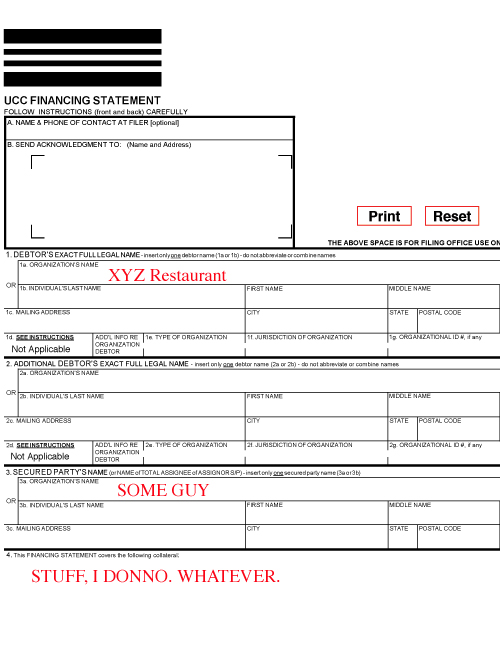
Mr. MCA Underwriter is facing a lack of clues and it would not be surprising if the industry starts to see a resurgence in advance stacking. If anyone would like to anonymously share UCC code names that we do not have included in our records, please e-mail them to merchantprocessingresource@gmail.com
As the industry evolves, so will the issues. In our opinion, MCA providers should be plainly clear on the arrangement they have with their clients. No judge is going to listen to a story about code names, misleading UCC language, or why you don’t file at all. A UCC-1 is intended to be a public notice and is meant to be found. Small businesses will benefit by the expansion of the MCA industry but poor use of UCCs will inhibit the rate of growth.
And that’s our 2 cents…
-The Merchant Cash Advance Resource
../../merchantcashadvanceresource.htm
Who Are You Really Dealing With?
August 23, 2011
A long time ago, I did what every man has to do at some point in their lives (hopefully only once), plan my own wedding. Once the reception hall was booked, I assumed the job was 90% complete. My wife proved that theory wrong and before I knew it, we found ourselves in a wedding vendor tornado. Which photographer was best?…which florist…which DJ…caterer, limo company, hotels, theme, invitations, and honeymoon? But finding the best was only the beginning. Not everyone was available for our special day, nor was everyone in our price range. Even worse, some of our top choices had reputations for being late or not showing up at all.
It was tough to determine who was genuine and dependable. Some of our phone calls would go unreturned for days and others would hide large fees in their contract that they hoped we wouldn’t find. As a consumer, it was an experience I’ll never forget. I was thankful to have most sales presentations face to face and can only imagine how much more difficult it would’ve been to choose over the phone.
And that’s just it… a very large percentage of financial transactions are conducted over the phone and internet. For the Merchant Cash Advance industry, it’s upwards of 90%. Rate shopping can be done at light speed but the warning signs of a bad vendor are harder to spot. Anyone can tell you what you want to hear, but consumers should use the internet to fill in the blanks.
Researching the company helps but it certainly can’t hurt to check up on your salesman too. Believe it or not, bad people can work for good companies. Inexperienced people can too. The Merchant Cash Advance Resource is offering some advice for business owners. Go on Google, Bing, or Yahoo and search any or all of the following:
- The company’s name
- The company’s name (followed by) reviews
- The 1-800 #
- Your salesman’s direct phone #
- Your salesman’s name
- Your saleman’s name (followed by) the company’s name
- Your salesman’s e-mail address
Some additional sites are:
- The Better Business Bureau (www.BBB.org)
- LinkedIn (www.LinkedIn.com) Find the professional profile of your salesman and view their experience
Need help interpreting the data? Here are some signs this vendor may not be for you:
=========================================================

=========================================================
The salesman that tells you how much experience they have in the business comes up with this:
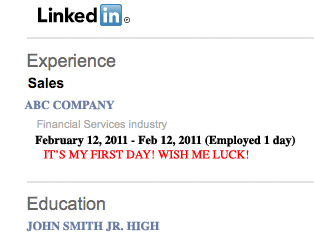
=========================================================
Don’t take any of this the wrong way. The Merchant Cash Advance business has been around for a long time. Most firms perform background checks on their employees and provide them with the proper training. Regardless, any transaction that requires the handling of social security information and bank statements should warrant a little due diligence. This advice applies to banks, insurance companies, stock brokers, and investment funds.
My wedding vendors were fantastic and the time spent chasing the best overall deal (reliability, experience, reputation, price) rather than choosing on price alone was worth it. I hope business owners use the same approach when obtaining working capital.
-The Merchant Cash Advance Resource
By: One of our individual contributors