
Linear CEO on New Merger
March 1, 2021 Fundation and ODX were in talks to merge for over a year, Linear and past Fundation CEO Sam Graziano said. Then covid changed plans, but by mid-summer talks were back on.
There was recognition by the leadership team at Fundation and CEO of OnDeck Noah Breslow that ODX and Fundation were competitors in the same banking-as-a-service space and could merge to serve the entire market, Graziano said.
Launching with the press release last week, Linear is majority-owned by Fundation, but Graziano said it was looked at as a “cashless transaction” and merger between two companies. This upcoming year, Linear plans “To merge the two businesses more structurally,” Graziano said, “continue to merge the two businesses, deepen industry relationships, and continue to expand the scope of clients.”
Fundation’s minor business funding branch will continue under the Fundation brand, Graziano said.
LoanMe, Liberty Tax Merger to Take on Intuit, Enova
February 22, 2021NextPoint Financial will combine LoanMe’s business, consumer, and mortgage lending with Liberty Tax’s tax preparation business, according to merger announced on Monday. Liberty’s “2,700+ locations in the US and Canada” will become consumer and SMB loan shops.
The new firm will also offer Merchant Cash Advances; LoanMe launched MCA funding in January and expects to fund $15 million in MCAs in 2021. Based on the acquisition prospectus, NextPoint will be a tax readiness firm, with the added suite of financial products as a value and growth builder.
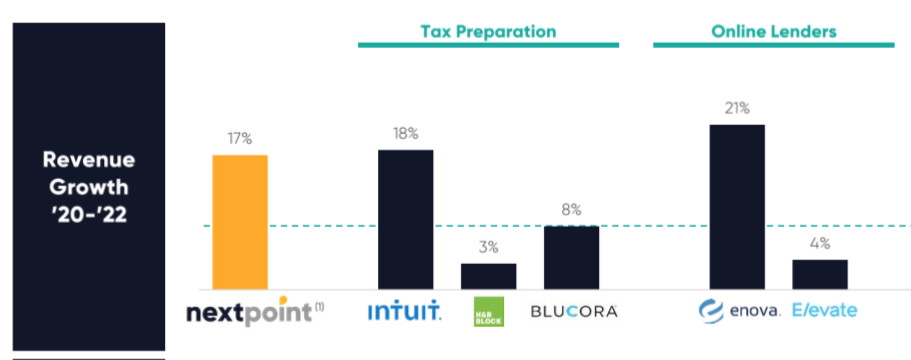
Ramping up consumer, installment, and MCA lending, paired with the third-largest tax-prep business in the U.S, NextPoint expects to compete directly with Intuit, H&R Block, Enova, and Elevate.
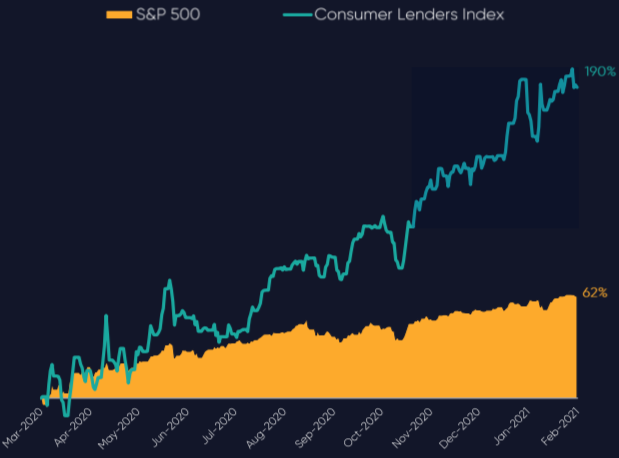
Fintech firms are setting themselves apart from the competition as one-stop shops for everything a business needs, including MCA products. Why branch into financial services now? NextPoint found that this year alt lenders have outperformed the S&P500 three times over.
“We are a one-stop financial services destination empowering hardworking and credit-challenged consumers and small businesses,” the investor presentation reads. “To get to the next point in their financial futures.”
Intuit offers a variety of financial products, like business loans through Quickbooks Capital, alongside their popular, 60%+ market share of tax prep software. H&R began offering small $1,000 lines of credit this year, but not much more.
The team leading the new company, NextPoint Financial, will feature execs like Brent Turner as CEO, Mike Piper CFO, both keeping their previous Liberty Tax positions. Jonathan Williams, former president and founding shareholder of LoanMe, will become president of lending.
Fintech Lenders Did Better Job Meeting Intentions of the CARES Act, Study Finds
February 18, 2021 Fintech lenders doling out PPP not only reached smaller businesses on average but played an essential role in extending PPP loans to Black-and Hispanic-owned businesses, according to a study conducted by professors at the NYU Stern School of Business.
“Fintech lenders originated much smaller loans than other lenders, suggesting they served smaller firms on average,” researchers found. “Overall, we find that, relative to other lenders, [Minority Development Institutions] nonprofits, and fintech lenders make a substantially larger share of their loans to minority borrowers, particularly Black- and Hispanic-owned businesses.”
The team of economists looked over 3.4 million PPP transactions to determine what category of lenders had the highest minority share among their loans. Ryan Metcalf, Head of Public Policy for Funding Circle, member of the Innovative Lending Platform Association (ILPA), shared the full study on LinkedIn, pointing out that six ILPA members had contributed to saving jobs.
“(Funding Circle US, BlueVine, Kabbage, Inc, OnDeck, Fundbox, Lendio) provided more than 476,000 #PPP loans totaling $16.5 billion with an average loan size of ~$30,000, median loan size of $15,000, and helped save more than 2 million jobs,” Metcalf wrote. “And that was just in 2020.”
The study found that fintech lenders did a better job meeting the intention of the CARES act. While most lenders were giving out larger loans to large firms, fintech better reached actual small businesses with smaller loans on average.
“Section 1102 of the CARES Act explicitly specified that the program should prioritize ‘small business concerns owned and controlled by socially and economically disadvantaged individuals,'” they wrote. “However, the SBA did not issue specific guidance for distributing the loans, leaving private financial institutions administering the loans to independently determine which businesses to serve first or at all.”
Instead, as has become clear, many funds went to larger firms and seemed to miss minority communities. The team compared the mean and median loan amounts for different Lenders, finding the smallest in both types were fintech loans.
Researchers put first and last names through a mathematical model to predict race because that data was not available from the majority. Then predictions were compared to the sample borrowers that self-reported race. The algorithm was 78% accurate in guessing black names, 84% in guessing Hispanic, 95% for Asian, and 99% accurate for white names.
BlueVine’s CEO on Latest Round of PPP
February 10, 2021BlueVine CEO Eyal Lifshitz took to twitter last night to update customers on the status of this PPP round. Word from around the industry has suggested that approvals have been slower and that in certain situations, additional documentation is being asked for because of the SBA’s heightened scrutiny.
Below is Lifshitz’s consolidated twitter thread.
As a third-generation entrepreneur, my decision to build BlueVine was personal—I believe in and have dedicated myself to small businesses. To the customers reaching out for Paycheck Protection Program support, know that I’ve read your messages and want to update you directly.
When the latest Paycheck Protection Program was announced, we knew we had to step up again and help small businesses. Though the cause was close to our mission, we had to refocus our business completely. If you feel this program has been slower, it has. But for good reasons.
Waiting is frustrating, especially if these funds will make or break your business. There are explanations for the longer wait times, which can actually mean GOOD news for your business. Let me break this down.
The SBA’s program changes were significant, adding Second Draws and other improvements. Every change requires an additional product build and support team training, ensuring we’re compliant and provide the most efficient and effective application process.
The program’s adjustments include serving the hardest-hit businesses (and not large well-known companies). This extra due-diligence means additional documentation and information for us to review. It also means that smaller businesses may have a greater share of the funds.
The previous PPP round was impacted by some fraudulent actors. To prevent funds from getting in the wrong hands, the SBA added more robust requirements. While this added protection is more work and slows things down, it ensures funding remains for those that need it most.
We know the process of reviewing and approving PPP loans was slow at first, but we wanted to ensure we got it right before automating. Since we started, our throughput has more than tripled. If you’re in review, be patient. We haven’t forgotten about you!
I want to emphasize that BlueVine, and me personally, are committed to serving small businesses. We’ve more than doubled our customer support team to better assist you during what I can only imagine has been a brutal year. We see you and are doing everything we can to help.
2021: The Year of Uncertainty
January 7, 2021 For alternative lenders and funders, 2021 is starting out with a question mark and will lead (hopefully) to a resounding exclamation point of recovery.
Many industry participants waved goodbye to 2020 with relief, and are welcoming a bounce-back in 2021, despite some trepidation about potential bumps along the way and how long a full recovery will take. While things started to improve somewhat toward the latter half of 2020 after grinding to a halt earlier in the year, the pandemic is still raging, with economic growth highly dependent on the immunization trajectory. Then there’s the incoming Democratic administration and the possibility of new rule- making, along with January’s runoff elections in Georgia that could change the balance of power in the Senate, and thus impact the new president’s law- making abilities.
Beyond these macro-issues, the funding industry is also dealing with its own uncertainties. Small business lenders and funders have been hit particularly hard, with underwriting decidedly more difficult in this environment. Some industry players have been forced to find alternative revenue streams in order to ride things out. Not only that, but there are scores of small businesses still reeling from pandemic-induced shutdowns and lighter foot traffic, with some gloomy estimates about their ability to bounce back. Many alternative players are weighing diminished returns against a widely-held bullish outlook for the industry long-term. Many are simply hoping they can hunker down and stick it out long enough and to avoid additional carnage and consolidation that’s widely expected over the short-term.
Ultimately things will get better, but it’s unclear precisely when, says Scott Stewart, chief executive of the Innovative Lending Platform Association. “It’s going to be a bumpy ride for the next year to figure out who is going to be able to survive,” he says.
Here’s a deeper dive into how industry participants see 2021 shaping up in terms of the challenges, competition, M&A, regulation, changing business model, expansion opportunities and more.
SPECIFIC CHALLENGES FOR SMALL BUSINESS FINANCERS
Companies that focus on consumer financing haven’t struggled quite as much amid the pandemic as their small business brethren, and they could continue to see demand grow in 2021. Even amid high unemployment rates, many consumers still need loans for home repairs or as a stop-gap to pay necessary expenses, helping to mitigate the impact on firms that focus on personal loans.
Small business financers, however, got pummeled in 2020 and the situation remains precarious, especially given the prognosis for small companies broadly. Consider that 163,735 Yelp-listed businesses closed from the beginning of the pandemic through Aug. 31—at least 97,966 of them permanently. Further underscoring how dire the situation is for small businesses, 48 percent of owners feared not earning enough revenue in December to keep their businesses afloat, according to a recent poll by Alignable, an online referral network for small businesses. What’s more, 50 percent of retail establishments and 47 percent of B2B firms could close permanently, according to the poll of 9,204 small business owners.
A SHRINKING COMPETITIVE LANDSCAPE
For many lenders and funders, the latter part of 2020 proved more successful for originations, though business is still a far cry from before the pandemic. A number of players who suspended or reduced business operations for a period of time during the first wave of the pandemic have dipped their toes back in and are in the process of trying to adapt to the new normal. For some, though, the challenges may prove too great, industry observers say. Given that many brokers and funders that were on the fringe have been hurt by the pandemic, more shake- out can be expected, says Lou Pizzileo, a certified public accountant who advises and audits alternative finance companies for Grassi in Jericho. N.Y.
And, with fewer competitors, there will be more of a need for those who are left to pick up the slack, says Peter Renton, founder of Lend Academy. Beyond being a lifeline for many alternative financers, PPP loans helped open the eyes of many small businesses who hadn’t previously considered working with anyone but a bank. In the beginning, when it was so difficult for small businesses to get these funds, they looked beyond banks for options and some found their way to online providers. This could be a boon for the industry going forward since alternative providers are now on the radar screen of more small businesses, says Moshe Kazimirsky, vice president of strategic partnerships and business development at Become.
He predicts that larger, stronger players will gradually ease some of their lending and funding criteria early on in 2021, but no one is expecting a quick revival, with some predicting it could be well into 2022 before the industry is on truly stable footing. “I think it’s going to be a very slow recovery,” Kazimirsky says.
M&A
In 2020, the industry saw bellwethers like Kabbage and OnDeck get swallowed up, and with so many businesses pinched, there are likely to be more bargains ahead from M&A standpoint, Pizzileo says. “The damage from Covid is palpable; we just haven’t seen the real impact of it yet,” he says.
No matter what product you are providing, if you’re a smaller player who can’t find your way, you’re going to have a hard time staying in business,” says Stewart of the Innovative Lending Platform Association. “There will be some collateral damage going into next year,” he predicts.
In terms of likely buyers, Renton says he expects other fintechs to step in, and possibly even mid-size community banks snap up some alternative providers. If you can buy something for “a song” it’s compelling, he says. “I expect to see a few more offers that are too good to refuse,” he says.
CHANGING BUSINESS MODELS
Pizzileo, the CPA, predicts there will be ongoing opportunities in the year ahead for well-positioned, strong businesses with available capital. In some cases, however, this may require tinkering with their existing ways of doing business.
Before the crisis, some lenders applied the same or very similar lending model across industries. “That is going the way of the dinosaur. That’s not going to be a successful model going forward,” Renton says. Lenders will focus more on having a differentiated model for the businesses they serve. “I think the crisis created this necessity to treat each industry on its own merits and create a model that has some level of independence, he says.
The year ahead is also likely to be one in which e-commerce lending continues to thrive. According to the third quarter 2020 report from the U.S. Census Bureau, U.S. retail e-commerce stood at $209.5 billion, up 36.7% year over-year. E-commerce accounted for 14.3% of total retail sales in Q3. Because it’s such a high-growth area, and many businesses that didn’t have this vertical before are moving in this direction and more lenders are focusing on it and growing that part of their business, says Kazimirsky of Become.
It will also be interesting to watch how lenders and funders continue to reshape themselves. Sofi, for instance, is continuing to pursue its goal of receiving a national bank charter. Other lenders and funders may also seek to reinvent themselves as they attempt to stay afloat and compete more effectively.
“Monoline lenders that rely on a single product will have more difficulty supporting customers in the wake of Covid,” says Gina Taylor Cotter, senior vice president and general manager of global business financing at American Express, which purchased Kabbage in 2020. “Small businesses need multi-product solutions to not only access working capital, but also real-time insights to help them be more prudent with their cash flow and accept contactless payments safely to encourage more business,” she says.
CHANGES IN RISK MODELING
Another pandemic-driven change is that lenders have had to tweak their risk modeling. Everyone understands the economy is not in the greatest spot, but their challenge in 2021 will be developing a way to assess future losses in the absence of a baseline, says Rutger van Faassen, head of product and market strategy for the benchmarking and omnichannel research group at Informa Financial Intelligence.
Consumer behaviors have changed, for instance. So even though the pandemic will end, it’s too soon to say what the structural impacts on an industry will be and how that affects the desirability of lending to especially hard-hit businesses, such as restaurants, cruise lines and fitness centers. “Clearly the behavior that everyone is showing right now is because of the pandemic. The question is: how will people behave once the pandemic ends,” he says.
“In the meantime, a lot of lenders will have to do more in-the-moment decision-making, until we get to a point when we’re truly in a new normal, when they can start recalibrating models for the longer-term,” he says.
OPPORTUNITIES TO HELP SMALL BUSINESSES
One certainty in the year ahead is the need to help existing small businesses with their recovery, says Cotter of American Express. “Small businesses represent 99 percent of all jobs, two-thirds of new jobs and half of the non-farm GDP in America. Our country’s success depends on small businesses, and financial institutions have a great opportunity to meet their needs to recover and return to positions of growth in 2021,” she says.
How to make this happen is something many alternative financers will grapple with in 2021. Another opportunity may exist in providing funding solutions to new businesses or those that have pivoted as a result of the pandemic. Cotter points to the inaugural American Express Entrepreneurial Spirit Trendex, which found 76% of businesses have already pivoted their business this year and 73% expect to do it again next year. “New-business applications have reached record heights as entrepreneurs pivot and adapt, indicating a surge of new ventures that will require financial solutions to build their business,” Cotter says.
REGULATORY WATCH
Several regulatory issues hang in the balance in 2021, including state-based disclosure laws, expected rules on third-party data aggregation and demographic data collection, and the status of a special purpose charter for fintechs, says Ryan Metcalf, head of U.S. public policy, regulatory affairs and social impact at Funding Circle. With a new administration coming in, the regulatory environment could become more favorable for measures that stalled during Trump’s tenure.
Armen Meyer, vice president of LendingClub and an active member of the Marketplace Lending Association, says he’s hoping to see a bill pass in 2021 that requires more transparency for small business lending. He would also like to see more states follow the lead of California and Virginia and make the 36% interest rate standard of Congress’s Military Lending Act, which covers active- duty service members (including those on active Guard or active Reserve duty) and covered dependents, the law of the land. “We’re calling for this to be expanded to everybody,” he says.
CANADA
Meanwhile, our neighbors to the North have their own challenges and opportunities for the year ahead. The alternative financing industry in Canada originated out of the 2008 recession when banks restricted their credit box and wouldn’t lend to certain groups. While conditions are very different now, “this period of economic uncertainty is going to be an incredible fertile period of time for fintechs to come up with new and interesting and creative credit products just like they did entering the last financial crisis,” says Tal Schwartz, head of policy at the Canadian Lenders Association.
Open banking continues to be on the Canadian docket for 2021 and how the framework shapes up is of utmost interest to fintech lenders in Canada. Schwartz says he’s also hopeful that alternative players in Canada will have a role to play in subsequent government- initiated lending programs. He’s also expecting to see more growth in the e-commerce area, particularly when it comes to extending credit to e-commerce companies and in financing solutions at checkout for online shopping.
Greenbox Capital Comments on Landmark Florida Legal Victory
January 7, 2021 Greenbox Capital was the victor of a major lawsuit argued before Florida’s Third District Court of Appeal that conclusively established the legality of merchant cash advances in the state.
When asked for comment, Greenbox Capital® CEO Jordan Fein said:
“It’s been a long, arduous, and expensive battle over the last few years proving in a court of law that a Merchant Cash Advance is not a loan. Today, we celebrate a win for all Merchant Cash Advance companies in Florida and the entire United States who are dedicated to funding small businesses through ethical practices. Our hard work and commitment to helping small businesses grow was validated and we are thrilled with the final decision of the District Court of Appeal.”
The decision in Florida echoes a similiar opinion reached in New York in 2018.
Halcyon Capital Announces Launch
January 4, 2021A trusted Midwest Business Cash Advance, LOCs and Commercial Loan Broker with a portfolio Targeting $100K to $20MM Opportunities
 Kansas City Metro Area / November 21st, 2020 – The Halcyon Group LLC (“Halcyon Capital”) announced today the launch of its Broker and ISO lending platform. Halcyon’s mission is to provide a white-gloved service and consultation to match underserved small-to-medium sized businesses (SMBs). Halcyon is here to help them unlock capital to grow and create jobs. Its financing solutions work for businesses nationwide, and in most industries.
About Halcyon Capital LLC
Provide fast and easy MCA, Term, LOC and Commercial Loan financing to small-to-medium sized businesses in the United States seeking $100,000 to $20 million to grow and scale their companies.
Halcyon is here to help SMBs navigate the challenges that all business owners face. They have over 30 years of experience at their side. Through a holistic approach they will review all possible funding solutions that match your business needs.
By utilizing Halcyon’s extensive lending partner platform, SMBs can dramatically increase their profitability, and ability to scale their businesses with credit facilities that can grow and become more flexible. Side by side as a compliment to their business.
PPP funding options are available as well to help ease the path associated with the nearly $300 billion in additional funding set to arrive in days. We have partnered with Lendver and Loan Source to give a streamlined tech platform. With this process it will allow business owners to take the burden off of them and remained focused on growing their business and keeping employees stable.
SMBs that need $100,000 to $20 million of asset backed or Commercial RE are often overlooked by traditional and alternative financing because the large, fixed costs of underwriting make economies of larger deal sizes important—creating a wall for smaller opportunities. Halcyon’s lender platform streamlines the application and approval process for these clients. Business owners will be able to utilize Halcyon’s lending platform to obtain financing in a fast, efficient and transparent way.
Alex Wigginton, who has significant experience in Merchant Cash Advances, Term Loans and Lines of Credit lending, will serve as Managing Partner and CEO of Halcyon. Alex Trigg, who has vast amount of experience in Commercial Real Estate, Equipment, SBA Loans and AR/Factoring, will serve as managing partner and COO of Halcyon.
For more information about Halcyon Capital go to www.halcyonlending.com or contact Alex Wigginton or Alex Trigg at underwriting@halcyonlending.com to learn more about its financing solutions.
Related Links
www.halcyonlending.com
www.linkedin.com/in/alex-wigginton-015b5036/
www.linkedin.com/in/alex-trigg/
AltFinanceDaily’s Top Five Stories of 2020
December 28, 2020DeBanked’s Top 10 most read stories of 2020 all involved the Payment Protection Program (PPP). It was by far the hottest topic in small business financial services for the year. As a result, we consolidated our most read stories into FIVE categories and this is what our readers consumed most in 2020!
1. PPP
 The Payroll Protection Program saga boiled down to one major question early on in the pandemic: Who, if anybody, would be able to lend the money out on the government’s behalf? PPP Lender Requirements was the most read story on AltFinanceDaily in 2020, followed by the world being curious to find out who was the biggest PPP lender. On April 22, AltFinanceDaily was the first to spread the story that Ready Capital (Knight Capital‘s parent company) was the largest PPP lender in the US for Round 1.
2. NY’s Disclosure Bill
 The biggest non-PPP story of the year was a bill passed in New York that was signed by the governor at Midnight on Christmas Eve. SB 5470, which some have dubbed “The Small Business Truth in Lending Act,” is slated to completely overhaul the non-bank small business lending market in the state. The bill was passed by the legislature in July.
3. OnDeck
 It’s difficult to overstate how much of a rollercoaster it was for the stalwart fintech lender in 2020. OnDeck started the year with optimism, announcing a NASCAR sponsorship in March just as the company’s stock suddenly plummeted by 30%. By the time summer rolled around, the company was no longer engaged in non-PPP lending activities and was battling in a fight for its life with its creditors. In July, OnDeck was acquired by Enova, which led to shareholder lawsuits over the terms and disclosures tied to the deal. Somehow, by year-end, OnDeck managed to pull itself back together, thanks to its new parent company. It successfully originated $148M worth of loans in Q3.
Wow, just wow.
4. Covid-19
 The impact of Covid was a close 4th on AltFinanceDaily’s top read list. In March, AltFinanceDaily published a writeup of How Small Business Funders [Were] Reacting, an interesting glimpse into the pandemic as it was just unfolding. At that time, attitudes ranged from confidence in being prepared to being convinced it was time to shut everything down. One notable takeaway from the commentary is that nobody surmised that the situation would persist for the entire rest of the year.
Capify CEO David Goldin made an early bold prediction, however. “I would not be surprised if we learn in the next few weeks that the President of the United States has it,” he said in an interview with AltFinanceDaily in mid-March. President Trump was diagnosed with Covid-19 less than six months later on October 6th.
5. Scandal
 Three scandals were a near-tie for views in 2020 so we’re revisiting them all here.
Brendan Ross & Direct Lending Investments – Brendan Ross, the former CEO of a very popular fintech lending hedge fund, was indicted on August 11th. Federal officials including the SEC, say that Ross defrauded investors while managing more than $1 billion in assets. Ross’s “unwinding” began in 2019 when he suddenly resigned from the firm and wrongdoing was alleged.
Jonathan Braun – Jon Braun, made infamous by a Bloomberg Businessweek profile, checked into FCI Otisville earlier this year after having been sentenced the previous May for drug related offenses. Braun resurfaced in the news this summer when the FTC announced civil charges against him for alleged acts related to a company named Richmond Capital Group, LLC. The New York State Attorney General filed its own charges against Braun and affiliates at the same time.
Par Funding – A financial services firm based in Philadelphia generated major headlines this year after the SEC filed a lawsuit against the company that ultimately resulted in it being placed in receivership. A series of stunts and accidents got the SEC’s case off to a rocky start, but the likelihood of Par ever restarting its business has diminished to almost nothing.