Catch up with Alternative Business Lending
May 7, 2013 If you feel like you’re falling behind on the news, you’re not alone. Things are happening FAST. here’s what you need to know:
5/7/13: Google Looks to Profit from Alternative Lending. Say hello to Mother Google.
5/6/13: Forbes interview with a Kabbage co-founder. It did not sound like they plan on remaining exclusive to the e-commerce side of business lending.
5/3/13: Summary of the ETA Expo. ACH is now the leading platform behind Merchant Cash Advance.
5/2/13: Google Acquires a Stake in Lending Club. This of course begged the question that was asked in BusinessWeek the next day on 5/3/13 in Does Google Want to be a Small Business Lender?
5/2/13: IOU Central smashes last year’s numbers. Publicly traded in Canada, this funder is only picking up steam.
5/1/13: Google Ventures and Peter Thiel invest in On Deck Capital. How’s that for big names?
5/1/13: My Silicon Valley VC prediction comes true with the On Deck and Lending Club announcements.
4/24/13: Business Financial Services Upgrades to $82 million credit facility. Not too shabby
4/24/13: IOU Central renews their credit facility.
4/24/13: Rumors begin to swirl that Amerimerchant has also landed a new credit facility. We have no confirmation on this.
How’s that for a 2 week span and those are just some of the headlines. More news is on the way as we are hearing rumors galore.
Be sure to join the industry chatter about these developments on DailyFunder in these 2 hot threads:
Google investing in the industry
OnDeck vs. Kabbage
I made another prediction back in February 2012 (Does Your Mom Sell Merchant Cash Advance?) in which I said consolidation was inevitable. With all these funders raising massive capital, mergers and acquisitions will be next on the agenda.
ETA Expo Recap
May 3, 2013 Recap of the ETA Expo as it pertains to Merchant Cash Advance:
- Just about every funder has an ACH program or is working on implementing one.
- Many funders are licensed lenders or are working to become licensed in the states where it may be necessary. There actually seemed to be a lot of excitement about this. Funders are finding comfort in being subject to state mandated regulations as it probably raises their legitimacy and it will make their businesses easier to value when trying to raise money or sell.
- The ACH repayment market will be larger than the split-funding market this year. There’s no doubt in my mind about this. That means that ACH funding is now the primary protocol behind Merchant Cash Advance.
- Almost everyone is working hard to build up their technology. I got a personal demo of RetailCapital’s ISO/Agent system in addition to Capital Access Network’s new CapTap. Both are great. Capital Stack also has a beautiful platform.
- Stacking is the issue of 2013 as I heard that word uttered probably every 30 seconds for a whole week. I know the NAMAA folks are talking about it but I don’t know what the consensus is. It’s important to keep in mind that many funders aren’t NAMAA members and that affects NAMAA’s ability to dictate policy. Capital Access Network, the largest funder in the industry isn’t even a member.
- Speaking of NAMAA, they refaced their website and it looks A LOT better. I see only 14 members listed but it’s my understanding that there are closer to 20 of them.
- Factor rates are all over the place. Swift Capital has a new 1.099 program, which has got to be the first one to fall under the 10% threshold aside from Amex’s Merchant Financing. Higher risk deals however still operate in the 1.49 and up range. There is no one-size-fits-all product anymore.
- There were several direct lenders walking around that I had never heard of and they are apparently doing significant monthly volume. More and more people are getting into the funding business.
- It’s exhausting trying to keep up with the news surrounding On Deck Capital. They are on a very deliberate path and what we keeping seeing and hearing is them just checking things off on their to-do list. I bullet-pointed my theory on DailyFunder in response to a few posts.
- Discover and Priority Payments threw great parties.
- New Orleans has a lot of charm.
Make sure to check out my updates and photos that I’ve finally posted from the ETA Expo on DailyFunder and feel free to add your own if you were there.
Dozens of photos from the show
Also read: Soul Mates: Merchant Cash Advance and Silicon Valley VCs
Follow us at the ETA Expo
April 30, 2013May 3, 1:00am: I underestimated how easy it would be to make frequent updates. Wednesday was fantastic. I uploaded a couple dozen photos and updates all at once earlier today over on DailyFunder. As soon as the show was over, I found myself on Bourbon Street at the Discover party followed by the Priority Payments party. Both were a great time.
My Recap of the show is up now: ETA Expo Recap
Soul Mates: Merchant Cash Advance and Silicon Valley VCs
Original story about On Deck Capital’s investment from Google Ventures and Peter Thiel
My theory on why On Deck Capital took a paltry $17 million from Google Ventures and Peter Thiel
Photos and updates from the ETA
————————————–
May 1, 1:00am: Great start to the show this evening. Merchant Cash Advance providers and alternative business lenders continue to have a very strong presence in the payments industry. The booths I saw include: RetailCapital, NextWave Funding, Merchant Cash Group, On Deck Capital, Capital Access Network, Strategic Funding Source, American Finance Solutions, Swift Capital, MotherFund, and Principis Capital. GRP Funding and Paramount Merchant Funding are also on the exhibitor list but I didn’t spot their booths yet. That’s pretty substantial and it omits the major presence of Merchant Cash Advance companies that aren’t exhibiting. I bumped into Merchant Cash and Capital and walked the floor a bit with David Rubin of Capital Stack.
I met the guys behind Super G Funding which lends money against residuals. They’re great guys and they have such a unique role in the industry.
I think every funder I spoke with was quick to mention that they do 12 month deals and either offer direct debit repayment or will have it soon. The ACH train has disrupted the split-funding market pretty severely though many funders continue to do big numbers via split.
Nobody seemed to have an appetite for low FICO score deals (500s and below) except for Merchant Cash Group and Capital Stack which target the higher risk market intentionally. And when I say “don’t have an appetite for,” I literally mean when asking a funder if they do below 500 credit, the answer is some version of “HECK NO!!”
Overall tone, and perhaps its because opening night included open bar, but it was very optimistic. Most funders seemed intent on expanding and are eager to service as much business as possible. I definitely get that sense that there is a real focus these days on the bigger fish ISOs ($1 million+ in referral business a month). When newbie brokers enter the space, funders spend an enormous amount of resources developing them and many times they just don’t pan out. Either the brokers don’t have the capacity to do more than a handful of deals, or they just don’t “get it.”
If you’re a mom and pop ISO and you have just 1 or 2 deals a month, it’s more difficult these days to get time and attention from a funder. Capital is flooding into the industry and everybody wants partners that can produce volume. From a resource standpoint, the “1 and done” reps are not an efficient use of time.
Big ISOs have a lot of negotiating power at their disposal these days. In the last 7 years, it was good to be an ISO, then hard to be an ISO and now it’s good again. Many things in MCA have a weird way of going full circle. Hope to see you on Wednesday.
————————————–
Apr 30, 1:00am:  Merchant Processing Resource will be publishing updates as often as we can from the ETA Expo in New Orleans. I am very excited to be down here. Earlier today I had the opportunity to eat beignets at Cafe Du Monde, visit the French Market District, and take a ride on the Natchez Steamboat on the Mississippi River. But starting Tuesday, it’s all business. A schedule of events can be found on the ETA’s website.
You can follow along with everyone else in town on twitter using #ETAExpo2013 or #ETAExpo13
and of course via the DailyFunder Merchant Cash Advance iPhone App.
Some pre-conference tweets:
ETA Expo 2013 on Twitter
pre-conference tweets
Storified by Sean M· Mon, Apr 29 2013 22:21:50
Here’s to learning, networking, and having fun!
– Merchant Processing Resource
../../
Factoring Construction Deals: It’s not impossible
April 18, 2013 Being my first post in the Small Business Corner, allow me to introduce myself. My name is Steve Ontiveros and I’m the founder of The Factoring Place. I’m good at finding the right factoring company for my clients based on their unique situations. Factoring and MCA really aren’t that different. Each company seeking a merchant cash advance is unique, like each factoring client is unique. Not all merchant cash advance companies are alike, and similarly not all factoring companies offer the same program & factoring rate. I became a factoring broker because I wanted to make sure my clients were getting the very best factoring deal for their unique situation.
Many factors lack the c-c-c-courage needed to fund a construction deal. Preliminary & Mechanic’s Liens, Payment & Performance Bonds, Progress Billing, and Retention, OH MY! Follow me along the “Yellow Brick Road” to mitigate the common risks of factoring construction deals.y factoring and merchant cash advance brokers turn down or walk away from construction companies seeking working capital. Factoring construction companies is a niche within a niche. As a broker, understanding the inherent risks of construction factoring can help you find the right factoring firm that will successfully fund your client. Understanding how each factoring company operates is also important to knowing whether or not your client will get funded.
Actually, you don’t have to live in the fantasy world of “Oz” to successfully navigate the unique risks found in a typical construction deal. When you peel back the curtain inside the “Emerald City Factoring Company,” you’ll find that there are no wizards or wizardry going on at all. But for this article, I’ll be your Emerald City Factoring Company Wizard. I’ll help you understand construction factoring giving you the confidence to walk the walk and get your construction client funded.
Construction Factoring 101: Preliminary Lien Notice & Mechanic’s Liens
A Preliminary Lien Notice is a formal document sent by the contractor, sub contractor, material supplier, equipment lessor – and factoring company in some cases– to the owner of the project. This “pre-lien” establishes the right to file a mechanic’s lien later on down the road. If the pre-lien is sent and the claimant’s bill is paid, the pre-lien has no further legal effect. However, if the bill is not paid then the claimant may now file a mechanic’s lien on the owner’s property. An active mechanic’s lien on a property ties that property up, leaving it in a position such that it cannot be sold or transferred to another party until the mechanic’s lien is released. Roughly 40 states in the US require a preliminary lien to be present before a mechanic’s lien can be enforced–check the laws in your state to see where you stand.
The Emerald City Factoring Company often requires its construction clients to provide evidence of a pre-lien being sent to everyone up the food chain, including the owners. In fact, Emerald City Factoring Company has been known to file a pre-lien of its own to further protect its position. True, Emerald City Factoring Company is not a contractor, supplier, or equipment lessor. But, because Emerald City Factoring Company has a blanket UCC1 on all assets of the client, the factor is indeed a supplier of material and equipment on the job. Even if the General Contractor argues a factoring company has no legal standing to file a pre-lien, the owner doesn’t care. The owner will simply tell the General Contractor to ensure all invoices are paid to all subcontractors so that the factoring company’s pre-lien won’t magically turn into a mechanic’s lien. Having the pre-lien in place allows the Emerald City Factoring Company to file a mechanic’s lien if payment is not made, which means the Wizards running the show can sleep well at night.
Construction Factoring 102: Payment & Performance Bonds
Performance bonds are used in the construction industry as a tool for the owner of the property being developed to guarantee that the value of the work will not be lost in the case of an unfortunate event (such as insolvency of the contractor.) A payment bond guarantees that the contractor will pay the labor and material costs they are obligated to. Shoddy work, sub-standard materials, and corner-cutting put Emerald City Factor’s factored invoices at risk, because if the owner throws your client off the job, the bonding company can step in and finish the job – and then back charges your factoring client. It’s unlikely that a bonding company will subordinate to the factoring company, and thus the factor’s lien on the receivables may be primed by the big bad bonding company.
So, how do you prevent the Wicked Witch of the West coming through to spoil the party, kick your contractor off the job, and call in the bonding company to clean up the mess? Unlike Dorothy, clicking your heels and repeating “there’s no place like home” won’t prevent the damage done by that under-performing contractor factoring client of yours.
Invite “Captain Obvious” to work for the Emerald City Factoring Company. He’s the guy that usually shows up after the disaster struck, and is rich with advice on what you should have done. These are usually “DUH” moments but, in retrospect, they were so obvious and simple that you may have over looked them. Here’s what Captain Obvious has taught us over the years:

- Have your contractor client share the bid file with you. Go over each scope with a fine tooth comb. Ask the contractor to tell you what % gross profit was built into each unique scope. Use common sense to work out where the estimate may be wildly optimistic. Is there enough gross profit in the estimate for them to have “oh crap” room? More importantly, is there enough room in the estimate to cover the costs of your factoring services?
- Ask about the job costing engine that the contractor is using. Are they plugging in the job budget before the job starts, and then recording costs against the original budget? Ask the contractor how long it takes for their AP accounting staff to enter job costs against each job. The costs need to get added to the job cost engine almost immediately after they are incurred.
- Ask to be shown a copy of a recent “over/under” billing report. This report will show whether or not the job is hemorrhaging cash as the job is happening. If the job is over-billed, the contractor is in a strong cash position on the job. If it’s under billed, it means the contractor has spent more on the job than they have yet to bill. Running jobs under billed for too long is probably what brought the contractor to you in the first place, so don’t be surprised to see this – just monitor it so that you know just how bad the situation might be.
- If your contractor’s eyes gloss over when you ask them about job budgets and job costing and over / under billing, then you might have a different sort of problem on your hand. Without these tools in place, the contractor will have a tough time knowing whether or not he’s profitable and whether or not he has the longevity to complete the job. Yes, even with factoring company in place, there’s no avoiding disaster when working with a contractor who doesn’t watch his budgets.
- Get a hard hat and a vest with fashionable fluorescent reflective tape. Travel to the job site at least once a week to make sure progress is being made and to be visible to your client. You’re in luck if you have a pick-up truck and even better if you have a pick-up truck with a diesel fuel tank in the bed. This way you can top off the heavy equipment on the job site so that they’re ready for a full day’s use tomorrow!
- While at the job site, cozy up to the project manager / superintendent that is in charge of your client’s performance. He’s usually the person who will approve or deny the progress billing requests. Be up-front with him and tell him that you’re the “money guy” behind your client. Ask the project manager regularly about progress on the project. Are there dicey issues that you can take up with your client to make the job run smoothly?
- Be the guy that a) brings the donuts and coffee into the planning meetings and b) has a cooler full of sodas and snacks for the laborers. Develop relationships with people on the job. Not only are you looking after your investment, but you’re sure to get “insider” information about the performance of your client. Another added benefit to being on the job site consistently? More clients. As you’re talking with the project manager, it’ll be no secret what you do. I can’t tell you how many clients Emerald City Factors has earned as a result of job-site schmoozing.
- Most of all, be useful on the job site, and then get out of there. Bring lunch to the trades people. Ask your questions. Get invoice approvals. Find out when the city / county inspector is coming to inspect your client’s work (and be there for those inspections!) Do no harm.
- Require that your contractor provide you with weekly job cost reports. Measure the actual job costs against the original job budgets. If you start to see a budget getting to the end of its life, investigate. Find out if there are change orders that you don’t know about. Maybe it’s just job cost entry errors (costs being tagged to the wrong element of the job). Don’t accept your client’s word for it when he tells you “I’m on time and under budget.” Expect that he’s not, and verify with proof in the job cost / budget reports.

Construction Factoring 103: Progress Billing & Retention
The c-c-c-cowardly Lion will tell you that the contractual ability to off-set the cost of defects or repairs against previously approved billings is what prevents him from getting into the construction factoring game. In other words, the Lion is afraid that even after the general contractor approves an invoice, somehow he or she can still legally refuse to pay any or all of the approved invoice. This is typically when retention comes into play. Retention is a process by which the general contractor will hold back usually 10% of a progress payment. This 10% is not paid to the contractor until the end of the job, when all the punch list items are completed, and when the owner is satisfied with the material and workmanship. Think of it as a “reserve” account of sorts.
Be sure you understand that a progress billing invoice may have retention – if so, don’t advance against the full value of the invoice. Gauge your advance based on the invoice amount AFTER retention is taken out. Don’t fund unless and until you get the general contractor to physically sign your approval letter. Put language on your approval letter that says something to the effect of: “Invoice approved without offsets or deductions” and then pray that you don’t ever have to defend that language – a costly adventure in the American Justice System!
Construction Factoring 104: Distance Makes the Heart Grow Fonder
Emerald City Factoring Company is located in the Heart of Oz. Let’s say that your construction client’s project is all the way over in Kansas, so there is no chance that you or your wizard staff can visit the job site to protect your investment and market to others on the site. In that case contract with a broker, or a construction manager, to visit the site on your behalf. Get some eyes and ears on the ground at the job site, and be sure to review the budgets and job cost reports on a regular basis. If you want to get really creative, partner up with a bookkeeper who is local to the construction client and job site. Ask that your construction client consider using a chosen bookkeeper who knows how to manage construction job costing and billing. You’ll be singing the praises of Glinda, the Good Bookkeeping Witch of the North before you can say “there’s no place like home, there’s no place like home, there’s no place like home.”
The c-c-c-cowardly Lion gets Courage
It’s always easier to get something done when you have a little bit of experience. Dorothy didn’t get home without taking a few calculated risks. Consider funding a small deal, perhaps a spot factor on a small project will give you some practice but won’t cause you to lose sleep. You can learn the lingo of the contractor (and flatter your client) by asking questions about the business. Or, consider working with non-competing factoring company who does construction and let them teach you the ropes.
Just watch, before long you’ll be chanting in your sleep: “There’s no factoring like construction factoring…”
Steve Ontiveros is the founder and president of The Factoring Place, Inc. a privately held full service factoring brokerage firm specializing in construction factoring deals (including progress billing.) He can be reached at steve@thefactoringplace.com or 510.223.1285
MCA Industry Continues Expansion
April 3, 2013 It’s said that one way to measure success or growth of an industry is to count how much capital is being raised. In that case, Kabbage and On Deck Capital have been on fire lately.
Early this morning, Kabbage announced they had secured a new $75 million line, after having just raised $30 million 6 months ago. The Forbes article announcement states that Kabbage has funded 60,000 deals to date and predicts to fund 100,000 deals in 2013 alone, a figure hard to comprehend considering that’s equivalent to the amount of transactions Capital Access Network has managed to do over the course of 15 years. I understand that Kabbage may do smaller, shorter term deals, but Capital Access Network has dominated MCA for a long time. Could Kabbage really do 100,000 deals this year? I’m unsure about this one.
Are traditional MCA funders missing out by letting Kabbage rule Ebay, Amazon, and Etsy unchecked? Is the Internet really that different than the brick and mortar market? Late last year, Amazon entered the financing market but for the purpose of strengthening their selling partners, so there are several reasons funders are tapping that market.
Paypal has been sitting on the sidelines and is perhaps considering jumping in the ring themselves. They are beta testing now with Ebay sellers.
Merchant Cash Advance is exploding in all directions. Did you hear that Yellowstone Capital funded $700,000 to a restaurant with the help of Strategic Funding Source? That’s a lot of money for a restaurant!
Your Web Presence Matters to Alternative Lenders
March 20, 2013 A bunch of my risqué comments about what’s right and what’s wrong in alternative lending just got some support. Phew. I happened to be reading the news, you know about Merchant Cash Advance… and I found a delightful article on CNBC today titled, Starved for Cash, Main Street Turns to Alternative Lenders
First, I will merely point out some of my corroborated statements between what I said in The Inefficient Merchant Lending Market Theory on March 5th and the story on CNBC.
Me: How is a business REALLY doing? Reviews will tell you a lot so long as there are enough of them, and not just the star meter, but the actual written reviews. | A business’s whole reputation can’t be assessed from paperwork and credit scores, but it can be by hearing from people in the local community. I would go so far as to say that any business that does not have at least a website, business fan page on Facebook, twitter account, or a reasonable substitute should be automatically declined for financing.
————-
On CNBC: The new crop of lenders are also using nontraditional measures to assess applicants. Those measures can include payroll, Better Business Bureau ratings, Yelp ratings and more.But more recently, public databases and even social-media activity have been factored into the decision-making process.
“Every restaurant we do, we look at their Yelp review,” said Joseph Looney, chief operating officer and general counsel for cash-advance company Rapid Advance, which consults with data scientists to refine its methods and discover new insights into a business’ prospects.
Rapid Advance considers the mere presence of an active social-media footprint to be a good sign of an active business.
The technology platform of lender IOU Central pulls in data such as personal business credit information, business cash flow, social media rankings, and other information from various databases. It can even consider such factors as restaurants’ health score.
IOU Central’s system taps sources that include payroll data, insurance information, accounting records, and social-media data.
Me: Relying on weak indicators forces lenders to charge higher rates since they must compensate for the risk of unknowns. It also decreases the length of time that lenders can trust their borrowers to hold their money for.
————-
CNBC: Most alternative lenders offer shorter-term, higher-cost loans.Many rely most heavily on an applicants’ submitted bank statements or other financial data.
Merchant cash-advance companies have been around for years, Breslow said, but they typically made up for sloppier underwriting by charging high rates.
Side Notes
Not so sure about this one. From the CNBC article: “The alternative-lending industry average for a six-month loan was 38 percent when On Deck started in 2007. Now, it’s 15 percent, and Breslow said it may come down further as this underwriting continues to improve.” I don’t believe this figure to be accurate. In 2007, commissions to sales agents were embedded into the cost of a deal. Meaning, if a small business signed for a 1.38 factor rate, the sales office would get up to .10 of it, reducing the funder’s return to 1.28. Additional closing fees could be added on top of it, but were not necessary. With a 15% deal, funders like On Deck Capital expect sales agents to upsell on their own to earn their commission. So 1.15 may be the base rate, but since there are no margins built in for the sales agents to earn a commission, the cost can be upsold to 1.25 or some other figure. It’s true that the cost has come down but it’s not practical to compare 38% to 15% since the latter number is not net of fees. I’m pointing this out to inform merchants about what to expect, but also so people don’t get the wrong idea about how much the price has changed over the years.
Wow: “We have 40 engineers working on this system,” he said. IOU Central’s system taps sources that include payroll data, insurance information, accounting records, and social-media data.” 40 engineers? That’s kind of intense…
Read a story today that pretty much claims FICO is irrelevant in 2013: http://gigaom.com/2013/03/20/forget-fico-how-data-is-changing-the-rules-of-credit-and-underwriting/
Funding for Startups – An Ongoing Struggle
March 6, 2013Startup. Some people like the term and some people hate it. It doesn’t even mean the same thing to everyone. To some, the mega giant Groupon is a startup and they’ve been in business for almost 4 years and earned $638 million in revenue last quarter. To others, a startup is simply an idea for a business that hasn’t gotten off the ground yet. And to the Merchant Cash Advance industry, startups are people who don’t qualify for funding but manage to come storming through the front gates demanding loans while waving around business plans. There’s a real dilemma in this country. Millions of people aspire to go into business for themselves and very few have any idea what to do. I get exhausted just thinking about this because for many years, I’ve been trying to tackle what you’d think would be a simpler problem, funding people that ALREADY have a business.
 It’s finally gotten much easier for existing businesses to obtain capital, so much so that I started to warn the lenders in a recent article about getting too aggressive with their programs. But all that aside, these lenders have been plagued with an ongoing problem for years, a problem that has caused marketing costs to skyrocket, and have made loans for everyone more expensive. That problem is startups. It’s not that startups aren’t appreciated, it’s just that imagine opening a hair salon and seeing there’s a line of a thousand people waiting outside the door to get in. At first, you’d probably think “wow! we’re going to need to hire 50 more stylists to satisfy all this demand,” but then you find out that 900 of the people waiting were men that were completely bald. It’s awesome that they were interested to come out and get a perm, but without hair, there’s nothing for the stylists to do. The business ends up spending a lot of time and money telling folks with no hair that a mohawk will not be possible, causing the price of haircuts to go up for everyone else.
 Some lenders are so inundated with startups that they stop marketing altogether. Others try to board up their pay-per-click ads with specific instructions for startups to STAY AWAY. It doesn’t reflect very well on the brand to do this, but if bald guys were overrunning a hair salon, the poor stylists would have to do something so they weren’t driven out of business. I’m not making fun of startups per se, I’ve been a part of 3 startups, including my own. I’ve been in the position where I was unsure of what to do first, especially since I never knew anyone that funded people whose businesses weren’t already up and running. Yes, I was the guy who knew tons about business lending and I had no idea how to raise capital for a business that hadn’t yet started.
Oh I knew how to set the gears in motion: perform market research, talk to potential customers about what they want, draw up a plan, incorporate, get the necessary permits, draw up an operating agreement, pay for legal advice, and set aside a large enough cash cushion to pay for at least 3 months expenses in case nothing went as planned. I had enough experience to know what I needed to be ready, but I guess I was still shocked the day I went to a bank to finally open a business account. With my account, the bank granted me a substantial unsecured line of credit. I’m fortunate to have an excellent credit score and that definitely played a role, but try to understand that I walked into the bank with no job and no income. I told them I was starting a business, wanted to open a bank account, and had all my business document ducks in a row and within 2 minutes I was approved for a line. This is after I’ve been hearing for years that no banks were lending, businesses with excellent credit couldn’t get money, and startups had no place to go.
Keep in mind though that I didn’t just walk into the bank and tell them all my good ideas and sum it up by asking for money. Heck, I didn’t even ask for money at all, though it was really nice to have it. I went in showing I meant business and walked out with something that everyone said is impossible to get in this country. I’ll admit there’s a few caveats. I live in New York City, have a decent net worth, have great credit, and have a background in business financing. So I’m not going to pretend that what worked for me is what’s going to work for everyone else.
I’ve always wanted to help the people I couldn’t. So I’ve been wracking my brain for some time as to what to do if a hair salon had 900 bald customers waiting on line. Do you help them regrow their hair first?
 I totally believe in the old fashioned way of raising money, which means making sure you have enough of your own money saved up and taking every measure possible to be ready to launch before looking elsewhere for help. I realized though that many people don’t have the capital to get them as far as opening day, some don’t have strong enough credit to be confident that a bank line would ever be possible, and others just have a dream of something they want to do but have no money to even put their idea to the test. I’d say they were out of luck, but new friends of mine were telling me that’s not exactly right.
Crowdfunding – Get familiar
I recently spoke with Rachael Alford, a crowdfunding consultant who told me that you didn’t need to approach startup capital the old fashioned way. A bank? What’s that? The exact conversation between us is available online and I learned that folks with a serious idea can actually raise money just on the IDEA alone. Crowdfunding means raising money from other people so a lot of effort is required to make it work for you. When you go to a bank, the bank is forced to acknowledge that you applied and then decide to either approve or reject your application. With crowdfunding, your campaign to raise money can be outright ignored. It’s not a “hi, please approve me, bye” experience. Rachael said, “the problem is, people think it is as easy as making a page (on Kickstarter, GoFundMe etc.) and then they can just tweet or share the funding request and that is it.”
Driving interest to your crowdfunding campaign to raise money is kind of like a test to sell your product on opening day. If you can’t get anyone interested in your campaign, how in the heck are you going to get them interested to buy your product once it’s done? It should be mentioned that crowdfunding doesn’t necessarily require you pay back the money raised with interest like a loan. Some campaigns can be donation based. Others can be in return for a prototype of the product. Rachael shared this example with me to better explain: “Say Joe has an idea that may or may not cure XYZ disease but he needs to buy a super xyz widget before he can prove his hypothesis. No one will loan him the $10,000 he needs to see if it can work. With crowdfunding, he can’t offer (as a reward) to cure backers who pledge $1,000 or more. He should offer what he has: limited edition t-shirts that read: I’m a hero, I helped Joe Smith try to cure XYZ. Get the point? If it’s a food start up don’t offer to cater a wedding, offer to name a brick, booth etc.”
 So having the idea is a starting point but you have to sell that dream HARD to get people to invest in it. Fortunately, it’s easier than making appointments with scary Silicon Valley venture capitalists and having to sweat out a presentation and then being told at the end that your idea is terrible.
Rachael teaches classes specifically to help people approach crowdfunding in the most efficient manner. If you’d like to know more about crowdfunding, I highly suggest you connect with her.
P2P Lending – Have you really not tried this yet?
On the flip side of raising capital is peer to peer lending. This type of financing has been around for quite some time. Websites like Prosper.com allow people to post loan requests so that individuals can collectively contribute to the amount wanted. Unlike crowdfunding, peer to peer lending is… lending. You can’t offer to name bricks after your peers instead of paying them back. In the case of Prosper.com, they act as the loan servicer but they also determine based on your credit rating the interest rate that your peers will have to charge. Prosper.com works for personal loans and for startup loans, but the key again here is that you can’t post a request and walk away. Instead you to have to rally people to your cause. Prosper.com sums it up with this tip on their website: “Asking your friends and family to invest in your listing and give you a recommendation will increase your chances of having your listing fully funded.”

Selling on Ebay or Amazon makes you official already
A third option for startups is Kabbage. Though they are technically a Merchant Cash Advance financing provider for established businesses, they specifically fund people with ebay and Amazon stores. I find that many people that want a shot at starting their own retail business have already tested out their skills on ebay or Amazon. What they may not know is that Kabbage sees these sellers as businesses already and that they need not feel like a startup at all!
There is no sleep-while-you-get-funded method of raising capital
Alas, raising money for a startup means work. Whether that work means being ready to cut the tape at the grand opening before applying for a loan or furiously banging the social media drum to mobilize people to your cause to invest. To the entrepreneurs that read this, I hope you’re a little bit more informed about where to start. To the lenders, the good news is that startup financing does exist, we just need to guide these people to the right places.
Perhaps there is an opportunity for lenders to set up peer to peer lending or crowdfunding campaigns on behalf of all the serious startups that call in. They could top it off by contributing the first 10% of capital needed to help them generate buzz to raise the rest. Let the market decide if the business plans are viable. If successful, then you can consult them through their grand opening and up through the point that they become eligible for a merchant loan. I would think a fee for this service would be reasonable. Everybody wins.
We need not struggle!
– Merchant Processing Resource
../../
MPR.mobi on iPhone, iPad, and Android
The Inefficient Merchant Lending Market Theory
March 5, 2013There are 4 major factors used to determine approvals in the merchant lending market:
• FICO Score / Credit Report history of owners
• Monthly Gross Revenue
• Time in Business
• Average Daily Bank Balance
Only 1 of these factors considers the applicant’s reputation, and that’s credit reports. Credit reports reveal past payment history with other creditors. They show lawsuits, unpaid taxes, and bankruptcies. Knowing whether an applicant pays on time or not is valuable to lenders but it fails to reveal an even more important metric, the business’s ability to generate future profits. If you’re shaking your head and saying “credit reports aren’t for that purpose,” I would respond by asking which of the 4 factors then is?
The amount of money deposited in someone’s bank account in the past reveals how much they took in, but it doesn’t indicate what will happen in the future. Similarly, a substantial daily ending bank balance may show responsibility to maintain a cash cushion, but it says nothing about how likely customers are to buy from that business in the future.
Could time in business then tell us? Is it safe to assume that a business that has been operational for a year, two years, or five years will be there for many more years to come? The local auto mechanic that’s been around for 5 years may only have lasted because no one else has gotten around to opening up a rival auto shop. Would it be safe to give the most hated mechanic in town a three year loan when their success is simply the result of being the only auto mechanic in the community? There may be somewhat of a correlation between time in business and customer satisfaction but it is by no means strong enough to predict future success.
In effect, the major metrics used to judge small businesses for financing today take no consideration of the number one thing that matters to a business for survival, customers. Without customers, the amount deposited historically means nothing. Without customers, a 700 FICO score cannot produce sales, profits, or money to repay a loan. Without customers, a 50 year old restaurant can’t continue to stay open just because it’s been there for 50 years. And without customers you better hope that $1 million in sales last year made you really rich, since without customers, you’re going to need to start a new business… preferably one WITH customers.
This doesn’t mean that these 4 factors are irrelevant, they’re not. But I believe these factors combined are but a tiny sliver of data to predict how well a business will do in the future and at the same time repay a loan. Relying on weak indicators forces lenders to charge higher rates since they must compensate for the risk of unknowns. It also decreases the length of time that lenders can trust their borrowers to hold their money for.
It is no surprise then that loan terms in the merchant lending industry only range from 3 to 12 months. None of the lenders are able to predict how their borrowers are going to do far into the future, so they bank on the odds that sales and deposits in the next few months will mimic sales and deposits in the last few months. That’s also the reason why there are a lot of test/starter/trial funding rounds that are short to witness how a merchant “does” before funding additional capital on a longer term. Underwriters are flying blind. They have to see how you do because they have no data to suggest what will happen.
 The big firms do have SOME data by now, but they’re broad statistics that say a certain industry in a certain region is likely to perform X with a Y margin of error. Or FICO scores below 600 are likely to have a Z rate of default. Yet this data also ignores a business’s reputation and relationship with its customers. It applies a blanket assumption of performance over the period of 3 to 12 months. These statistics are highly important to a lender because they can use them to predict defaults and delinquencies as a whole and enable them to set rates that will cover all of it and then some.
The owner of an ISO once asked me, “Wouldn’t it be great if we got to the point where we were funding every business in America?” My answer was “No.” If 10, 20, or 30% of those businesses failed to repay or eventually went out of business (and they would if you funded everyone) and the lender STILL made money, then the ones in good standing had to of gotten charged way too much. It would also mean that there had to be a portion of performing loans that were actually distressing the borrower, causing the capital they obtained to work against them, rather than for them. The goal shouldn’t be to fund EVERYONE, but rather to fund the few that could truly benefit.
A great example of doing it wrong is Wonga, a UK based lender that accepted a 41% rate of bad debt in 2011 while still managing to reap £62.4 million in profit. If Wonga had a few hundred bucks, a few thousand bucks, or heck only a million, they’d probably be very careful about who they approved and why they approved them. But venture capital changes the game and not always in a positive way. Putting a few hundred million dollars in the hands of Wonga has caused them to become incredibly inefficient.
Why should they only fund 5,000 people through a highly comprehensive underwriting process when they can fund 30,000 people with a one-size fits all rate, ask no questions, and accept that they will burn a lot of their customers along the way? This is the question they must have asked themselves years ago. (You can read the founder’s interview HERE)
At some point when they were developing their business model they had to admit that they really didn’t care what the outcome would be for their borrowers, so long as the business made money. And so they created an algorithm that would statistically predict the rate of default based on weak indicators like demographics, how they answered a few questions, and credit score and the resulting delinquencies were just necessary casualties to make the system work. In essence, Wonga knows they will devastate a portion of their customers and accepts this. They’re like a restaurant that only sells sugar frosted donut cheese ice cream to obese people and accepts that 41% of their revenues will be lost due to their customers dying. Can a lender truly be helping a community or economy where it intentionally hurts a percentage of borrowers because it’s still profitable at the end of the day? Do their contests, soccer sponsorships, and positive messaging on social media make up for their disruption to the economy?
Wonga’s mission is to grab market share, a strategy to make holy their blanket performance statistics and the rate that has to be charged to make money. Every single individual in the country becomes a candidate for their loans even though the lender will never know anything about the individual borrowers, their long term prospects, or what they can afford. The math says it doesn’t matter because an acceptable amount of the loans will perform and applicants can either accept the high rate or get nothing.
How I portray Wonga is not what I think of the merchant lending market in the US but rather I believe they’re a good example of the trap that merchant lenders COULD fall into if they come into too much money. When I first began to hear lenders fresh off a capital raise saying they wanted to fund the sh*t out of small business and would do anything in their power to fund as many deals as possible, I fear they could end up disrupting communities more than they could help them.
 You know that thing called the Internet?
So I’ve talked a lot about what lenders don’t know but nothing about what they can learn. There is an unbelievable amount of free data available on the web that can collectively be used as a strong indicator of future business performance. You know those all important customers I spoke about earlier? The ones that make a business a business? Well lucky for us, they seem to go online and offer feedback about their experiences. Yelp, Zagat, and Facebook come to mind.
How is a business REALLY doing? Reviews will tell you a lot so long as there are enough of them, and not just the star meter, but the actual written reviews. I assure you that it will help a lender if they see that the last 10 reviews say that the owner is a no good lying crook that stopped paying his employees and punched a customer just the other night. A business’s whole reputation can’t be assessed from paperwork and credit scores, but it can be by hearing from people in the local community. That community is online.
That brings me to another point here. If a small business isn’t online, then no faith should be put in that small business in 2013. I don’t know why there are still so many small businesses out there that don’t use e-mail, don’t have a website, and don’t participate on social networks. Unless their shtick is that they are an Amish style operation striving for authenticity, then not being online should be an indicator that they do not care much about their long-term success. I would go so far as to say that any business that does not have at least a website, business fan page on Facebook, twitter account, or a reasonable substitute should be automatically declined for financing. Yeah, I said it!
In 2013, ignoring the Internet is like opening a store with no sign, boarding up the windows, and surrounding the front door with barbed wire. Sure, the locals might know you’re there and be smart enough to come in the back door, and maybe they’re enough to keep your business stable but no one else will find you and the ones that do, will see that you have no interest in being something more. You don’t have to be on every social network but if you’re not on any, you’re doing something wrong. Ideally, you should be somewhat active with your customers online too. This doesn’t mean sending each person that dined at a restaurant a Thank-You e-mail, but it does mean addressing complaints if there are any, posting announcements so customers can see them, and taking steps to improve your reputation.
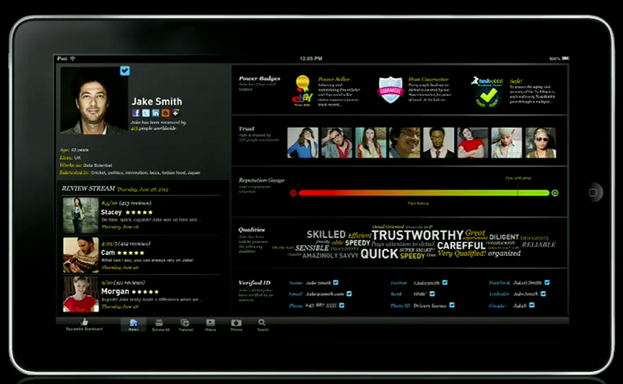
There are many, many trust and reputation signals online. At the most recent TED Conference, Rachel Botsman talked about collaborative consumption, trust, and reputation. She believes that trust is the most vital currency in our economy, not the money in your bank account, but trust. I highly recommend you watch it below. You should definitely take notice of what may eventually become a reality, an individual’s reputation scorecard, a report that aggregates reviews from everyone you’ve ever had an exchange with, and one that has the ability to evaluate the transactions which have the most meaning. My stellar e-bay seller record going back to 1999 might be on there (72 rave reviews baby!) but they won’t be as important if you’re looking to determine how credible I am as a business lending analyst. Still, in the grand scheme of reputation, they could have their place if someone wanted to gauge how trustworthy I am to deliver on something I agreed to.
Release the darn data
You want to know who is holding out on making the merchant lending industry and American economy a better place? The North American Merchant Advance Association (NAMAA) is. NAMAA possesses a database of every merchant that has defaulted or gone delinquent with a funding member in the last 4 years. There’s thousands of names in it. Not a member of NAMAA? You won’t get to know if a merchant has tried some funny stuff with another funder or gone out of business while having an advance.
 But you want to know who this private bank of data hurts most? It hurts every business and wholesaler these merchants work with in the future. A month after a retail store fraudulently skips out on a $100,000 advance, that same retailer could apply for 60 day terms with a supplier and sign a 5 year lease for a new business location. Don’t that supplier and landlord deserve to know that their “awesome” new client has a reputation for committing theft and fraud as recent as 30 days ago? I think it’s our duty to let them know. NAMAA is withholding information that could prevent a lot of unreputable people from doing further harm in local economies. Make this data public and we’ll allow suppliers, landlords, and other lenders to make more informed decisions.
I’ve heard the argument that privacy can be a big selling point to borrowers. They don’t necessarily want outsiders to know that they borrowed money or to suffer the shame if they don’t pay it back. I can understand the benefits of privacy from a competitive standpoint for a borrower but it defies all logic and reason for a lender to keep a default under tight wraps. Public record of a default discourages borrowers from defaulting in the first place and is helpful to everyone that may interact with that borrower in some way in the future. How many merchants would reconsider signing on the dotted line for $50,000 if they knew a default meant the lender would personally message all of their fans on Facebook to tell them about it? Is this wrong? Is this any of the customers business? What if their customers were paying for services 12 weeks in advance? Would their customers have the same confidence that their service would be rendered knowing this new information? It is likely that some customers would view a default as a sign that the business cannot deliver on their promises and reconsider using them. By not letting them know, you are putting them all at risk of paying for services they might not get.
Even though everyone hates me, I project 300% growth!
Show an underwriter a chart of sales projections for the next two years and they’ll have no idea if it’s just wishful thinking. All the demographic research in the world won’t convince the bank that people will trust your product. Show an underwriter that 50, 100, or a thousand people are saying positive things about their experience with you online, and they might believe you’re on to something. Time in business, cash flow, profitability, and positive credit history show what someone did and what they have, but reputation and trust reveal what someone’s success in the future will be like.
It’s not just what they say about you
Your reputation goes beyond just what people are saying about you. At some point, you’ll talk back and what you say can clue lenders into who you are and what you are doing. I’ve caught a few business announcements on Facebook that went something like “To our loyal customers, we are making a last ditch effort to get a merchant cash advance to pay off our landlord by Friday and keep the business open. If it does not happen, then we want to thank you all for your support over the years as we will close for good.” Yeah, it’s interesting to see things like this after you just had a 15 minute conversation with that same person that claimed the funds would be used for a marketing campaign.
With hundreds of millions of dollars burning a hole in their pocket, a lender may be tempted to take the Wonga approach. I guarantee Wonga would say I wasted my time by examining a business owner’s social interactions. They’d say there were statistics and data that show they should fund that business anyway because the FICO score and sales volume are within their parameters, that defaults were acceptable and built into the numbers, and that funding as many businesses as fast as you can above a certain interest rate, is better than funding fewer businesses with more appropriate terms.
This is the premise of my inefficient merchant lending hypothesis for lenders that get real sloppy when they have too much money. Would you rather be a lender that charges more, funds more, and knows less about your borrowers or would you rather charge less, fund more intelligently, and know more about who you’re funding? The first road accepts that you will outright devastate a percentage of your customers, disrupt local economies, and leave a bad taste in the mouth of a handful of people. It might be profitable, but could you really claim to be a helper of small business?
 When you fund EVERYONE, businesses with bad reputations can knock out competitors with good reputations, the cost of debt can harm more than it helps, or lenders can get skinned alive by defaults they never saw coming. We need to be aware that there are consequences to backing a business with a bad reputation because it can allow them to squeeze out the guys that would’ve actually had the most positive impact on a community. The counter argument may be the theory by the philosopher Adam Smith, a gentleman famous for promoting economic principles such that the pursuit of self-interest promotes the good of society. By this standard, if it’s good for the lender, then ultimately it must be good for the economy. However, allowing yourself to devastate a percentage of your customers isn’t good for the lender’s reputation even if it’s profitable. In a sense, pursuing immediate profit doesn’t mean pursuing ones self-interest. It may be months or years before enough unsatisfied borrowers begin to affect your reputation as a whole. Eventually, public opinion will sway. It’s happening to Wonga right now. If a lender’s business practices today could force them out of business in 5 years, then they are not pursuing their self-interest.
Real predictions, not just hoping tomorrow’s financial standing will be the same as it was yesterday
I look forward to the day when a merchant lender announces a 3, 5, or 7 year program. Their underwriting analysis would have to be incredibly well thought out, but that’s not a bad thing. Borrowers shouldn’t be forced to choose between an 8 month loan and a 9 month loan because so few lenders are willing to make real long-term projections. A business might make good use of short term financing to pay for an aggressive marketing campaign, but the likelihood that they could “open a 2nd store” and pay back all of the money with interest in 4 months isn’t very good.
My advice to the merchant lenders that are flexing their hundred million dollar muscles right now? Don’t carpet bomb the entire country with loans and hope that a one-size fits all rate and term will have a positive impact on the economy. It won’t. Writing off a portion of your customers today as collateral damage will hurt your reputation in the long run. Some businesses shouldn’t be getting funded even if they have money in the bank and a history of revenue. Others can’t sustain such short term repayments. These things should matter not just in the context of how much it will impact profits, but how much it will impact communities.
 Incorporating factors like trust and reputation don’t have to slow the application process down. There are technologies to help aggregate, sort, and make sense of these signals online. Automation and speed are good but the day that lenders stop caring about who they’re funding and why they’re funding them is the day that lending becomes inefficient. When it becomes purely a numbers game, we’ll be in bubble territory. Can you think of any other industries where lenders stopped considering whether or not the loans were good for their borrowers and played the numbers? I’m sure you can 😉
Lend efficiently, be a good citizen, and don’t be afraid to place a value on what customers are saying about your applicants.
– Merchant Processing Resource
../../
MPR.mobi on iPhone, iPad, and Android