
2014 Starts off With a Case of Red bull
January 10, 2014 Woah, slow down there fellas. Let us digest one thing at a time. We’re not even 2 weeks into the new year and already we’ve learned that:
CAN Capital raised another $33 Million (but that they didn’t need it?)
Merchant Cash Advance was the the feature story on the front page of the Wall Street Journal. Seriously…
Bloggers are learning about this industry for the first time. They’re having a bit of trouble getting it right.
PayPal, which just recently kicked off its own merchant cash advance program (or as they call it, their Working Capital Program) has already issued 4,000 advances.
Regulators are freaking out over the use of social media information in loan approvals.
DailyFunder will begin mailing out the first alternative business lending magazine a week from today. It’s free so sign up!
Amazon Quietly Funding Small Businesses
December 30, 2013 Ever since Amazon announced their exclusive business loan program last year, they’ve been quietly booking deals. I say quietly because no one really talked about it much ever since. Though the loan program is available only to qualified Amazon.com merchants, it’s very similar to how Kabbage started off with eBay. Amazon’s Business Loan program has all the bells and whistles of merchant cash advance financing and their clients tend to have huge daily sales volumes.
So are they really doing deals? You betcha they are. Secured Party Name: Amazon Capital Services. I wonder if any of their merchants would do a fixed ACH deal.
Enjoy.
Peer-to-Peer Lending Will Meet MCA Financing
December 29, 2013 In 2014 the peer-to-peer lending industry will collide with merchant cash advance and the rest of alternative business lending. Get familiar with these names: Lending Club, Funding Circle, and Prosper. They are brothers and sisters in the business of non-bank financing. They’re also seasoned, tested, and much like the merchant cash advance industry, experiencing phenomenal growth.
The old guard of merchant cash advance companies should take notice. After losing significant ground to Kabbage and OnDeck Capital, a new breed of fighter is about to enter the ring. I hear this phrase too often in response to the threat of competition, “there’s enough opportunity out there for everyone.”
But is there? Aside from the ACH repayment boom, one of the biggest drivers of merchant cash advance industry growth has been stacking. Stacking is the process of issuing an additional advance or loan to a merchant without paying off their existing advances or loans. That puts merchants in the position of having 2, 3, 4, or even 5 daily withdrawals to remain in good standing with all of them.
While the legality and risks of stacking have long been debated, the deeper revelation here is that there may not be as much new opportunity as everyone thinks. There has been an ongoing turf war over land that had already been discovered. It’s caused overall annual funding volume to rise significantly, but there’s not much room for 400%, 500% or 1,000% growth.
Funders like Kabbage came in and conquered the online merchant cash advance space without anyone noticing. Some funders have taken 5 years to double output on a monthly basis. Impressive, yes, but Lending Club on the other hand has more than quadrupled monthly funding volume over just the last 18 months. Not only that, but they’re doing more than OnDeck and CAN Capital (formerly Capital Access Network) combined. That’s massive.
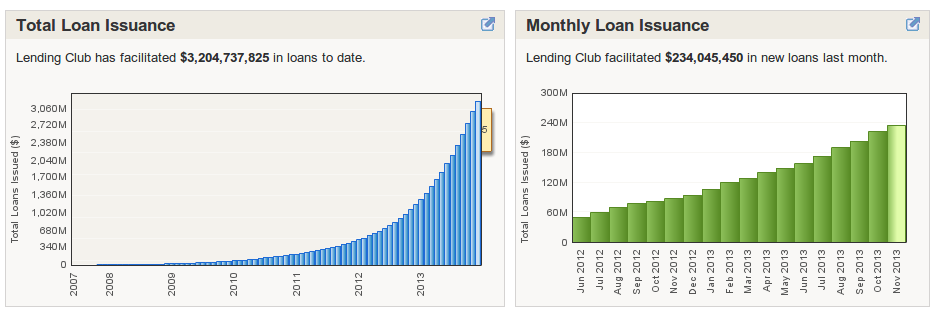
Backed by Google and recently valued at $2.3 Billion, Lending Club is expected to go public in the next 12 months. As they seek to extend their dominance from consumer lending to business lending, funders should seriously ask themselves, is there really enough opportunity out there for everyone?
The Achilles Heel for merchant cash advance companies is money. Regardless of how fast they turn it over, there’s no possible way to experience fast triple digit growth without outside capital. Some funders spend a lot of time and energy trying to raise it. Others are content without it and go chugging along at a moderate pace.
 Peer-to-peer lenders on the other hand have a unique advantage, unlimited access to cash. That’s because they source all the money from individuals. The money is crowdsourced from an infinite pool of investors and they just book the deals and service them. Combine this model with a sweet infusion from an IPO and alternative business lending will have its very own behemoth.
I’m not predicting the doom of merchant cash advance at the hands of Lending Club, but quite the opposite. Lending Club will legitimize non-bank business financing once and for all. Merchants will seek capital and investors will seek lucrative returns. Merchant cash advance companies offer a vastly better ROI than what 3-5 year loans can do with regulated interest rates. The top 10 Prosper investors are only earning 15-19%.
Lending Club will carpet bomb businesses across the nation with marketing and likely end up declining 90% of them. If they do indeed stick to their model of 3-5 year loans, they will undoubtedly leave a trail of interested but unfundable merchants. Alternative lenders and merchant cash advance companies will rush in to fill the void.
At the same time, that capital raising problem could fix itself. As everyone jumps on the peer-to-peer/crowdsourcing bandwagon, investors will be thrilled to learn that merchant cash advance is peer-to-peer based as well. Oh you didn’t know? Many funders already crowdsource capital from “syndicates”. Syndication in merchant cash advance is a simplified form of crowdsourcing. ISOs, investors, and account reps can pool funds collectively into deals just as someone could with Prosper or Lending Club.
I first raised this similarity in December 2010 (three years ago!) and even went so far as to make a mock version of Prosper’s site with MCA terminology plastered on it. Eerie isn’t it?
The difference between a company like Lending Club and say a company like RapidAdvance is whether or not funding is meant to be used as working capital or permanent capital.
The consumer lending model is not applicable when it comes to underwriting businesses. Renaud Laplanche, the CEO of Lending Club acknowledged that when he testified before congress a few weeks ago. But is he really ready to experience it for himself?
We shall see in 2014 when the line blurs once and for all. MCA, say hi to your family, P2P.
—————
Get familiar:
Dear Ami
November 19, 2013I don’t know Ami Kassar personally, but I read the articles in his NY Times blog, a column dedicated to chastising merchant cash advance companies. In it he yearns for the glory days of 10 year loans at 8% interest for local mom and pop shops. Having been a broker for 3 years myself, believe me when I say I wish rates were lower and terms were longer. It’d be an easier sell. But having also been a very senior underwriter and risk manager, I know exactly why the terms are what they are.
The below post was intended to be a comment on Ami’s latest post, Assessing a Kevin O’Leary Investment on Shark Tank, but it shattered the 1,500 character limit so I’m posting it here. As it was intended to be a comment and not its own post, I did not expand or delve into as much as I wanted.
—-
 Ami,
Ami,
We get it. You don’t think expensive capital is right or moral and in a perfect world where small businesses have perfect credit and a 0% likelihood of delinquency or default, there probably wouldn’t be a merchant cash advance industry.
Unfortunately, the reality is that many small businesses are high risk borrowers for one reason or another. This isn’t because a bank says so but because there is substantial data that shows there is a high likelihood of delinquency or default. Almost all of the small businesses that existed in my neighborhood 25 years ago are gone. They were replaced by new businesses, which were replaced by new businesses, which were replaced by new businesses. To say that a store with 2 years in business and 700 credit in my neighborhood is a safe long term investment would be a huge mistake. Residents tired of eating the same food, local bars lost their cool factor, the CD store got replaced by digital downloading, the supermarket got replaced by one that only sold organic food, and Blockbuster Video is gone. The Exxon became Shell which turned into Gulf which got torn down and rebuilt as a bank. New extensions to a mall 3 miles away damaged 40+ retail businesses on Main Street. A failed health inspection killed a restaurant, bad Yelp reviews killed the bowling alley, and the 78 year old master tailor didn’t relate to the new generation of residents. A flood closed a clothing store for 2 months, a fire killed a coffee shop, and a hurricane wiped away a strip mall.
Shall I keep going? Partners had a falling out, a son ran his father’s cafe into the ground, development killed a farm stand, and increasing rent put a barbershop over the edge.
I’m not knocking small business, just acknowledging that it’s one of the toughest things in this country to manage. God bless the people that try and especially the ones that last decades.
You know what else happens with a lot of small businesses? They declare losses for tax purposes and make organizing financial documents secondary to all else. To a lender, there is a layer of risk built upon a mountain of risk.
You cited IOU Central as a shining example of rate fairness, but failed to acknowledge that they are wildly unprofitable and have teetered on the brink of insolvency for a year. IOU Central is a publicly traded company and I mean them no disrespect, but check out their books. Lending isn’t supposed to be charity.
SBA loans and defaults are synonymous with each other. It’s great for businesses, but the poor economics of them fall on the taxpayers.
There is this belief that merchant cash advance companies are predatory, but the rates they charge are what the market has priced as sustainable for both parties. There’s more than a hundred funding companies offering the same product. You want to know why the competition hasn’t dropped rates to 10% APR yet? It’s because they’d all be out of business. Rates have come down a little bit, but there is only so far they can drop. Small business is risky business.
As a broker out on the street shaking the wary hands of shop owners, I understand your frustration with the high cost. Believe me, the merchant cash advance companies wish they could lower the prices too. Some have done so at their own peril and closed up shop. Others are on their way to that point now. Would you rather only a tiny fraction of small businesses get non-bank financing at a rate in line with your comfort level and let the rest burn? Small businesses of all credit types and financial standings for years have cried, “HEY, WHAT ABOUT US?!” and in response, private companies made access to capital possible. Often times the money is expensive, very expensive. You are concerned that small business owners are making a mistake when they enter into these agreements yet you admittedly lock them into these deals yourself. It seems as though some of your clients would rather have the opportunity to do something positive with expensive money than have no opportunity at all.
I can think of few things tougher than running a small business. The way my old neighborhood looks today is proof of that. I barely recognize the place. You know what wasn’t around 25 years ago? Merchant cash advance companies. Who knows what would’ve happened if they all had access to capital despite a less than stellar credit rating. Some of those stores may have grew, evolved with the changing times, or become franchises. Things might’ve been different. We all want lower rates, sincerely we do. Competition will drive it down as far as it can go and there’s plenty of that today. Once we hit the floor, if we’re not there already, you will have to ask yourself this question. Are you living in a perfect world or the real one? Let the small businesses decide if the opportunity they’re given is one they want to take.
News from the Space
November 18, 2013 American Express recently teamed up with Heartland Payment Systems to provide split-processing loans tied to all card transactions rather than just American Express exclusively. The max loan size is $750,000. Prior to this deal American Express and other merchant cash advance companies rarely competed head-to-head. Unless a small business was processing substantial AMEX, they weren’t a candidate for American Express Merchant Financing. I expect them to make similar deals with other card processors.
Lending Club got a valuation boost with a $57 million investment from Yuri Milner’s DST Global and Coatue Management LLC. They’re now worth about $2.3 billion. They are expected to go public in 2014 which will be especially significant given their plans to enter the small business lending space as early as January. Today, alternative small business lenders worth tens of millions or hundreds of millions of dollars are the big shots in the industry. Expect major disruption if Lending Club achieves an IPO valuation in the tens of billions.
Zazma put their own spin on lending by financing the purchases small businesses make. Funds are actually wired directly to the suppliers instead of to the borrower. For now they are only doing up to $5,000 at one time, which is typically the minimum sized deal for the merchant cash advance industry.
ISO&Agent published a great article about merchant cash advance titled, Taming the Wild Frontier.
The end of the year is coming and Capital Access Network, which is now CAN Capital projects they will finish with $800 million in transactions for 2013. 15 years after they started, they are still the biggest in the business.
Here Comes Lending Club
October 17, 2013 As highlighted in BusinessWeek, Lending Club has finally entered the small business lending market. Some of you might say, “bahh… so what!” but you should be paying attention. Lending Club recently got a valuation of $1.55 billion when Google bought a piece of them back in May. To put that in perspective, that’s about 15x the enterprise valuation that RapidAdvance got in its acquisition by Rockbridge Growth Equity. A monster has entered the ring and it doesn’t matter if it’s peer-to-peer lending, because they’re targeting the same market. What Lending Club does isn’t much different than what the typical merchant cash advance industry does these days anyway. Both thrive on syndication, though one relies on a handful of partners and the other relies on tens of thousands of partners. Both are bank loan alternatives and both can get you funded within days.
Back in 2009, the only short term financing opportunities small businesses had was merchant cash advance. There really wasn’t anything else. There were banks or there was merchant cash advance… and banks weren’t lending. Now there’s a whole spectrum of bank loan alternatives and to say that they operate in markets that don’t compete with each other is crazy.
There was a time when folks said Kabbage was not a competitor in the merchant cash advance space. Now they’re synonymous with merchant cash advance financing, have patents that specifically use the merchant cash advance terminology, and they fund brick and mortar businesses. On Deck Capital supposedly wasn’t a competitor back in 2007 because they did loans with fixed daily ACH. On Deck wanted only the high credit merchants that wouldn’t settle for a cash advance and now they compete head to head with everyone else.
The market is all over the place with pricing and structures. Factors range from 1.09s to 1.50s. Deal terms range from 6 weeks to 24 months. For those already annoyed that there has been downward pressure on rates for high quality clients because of what it has done to margins, you may have more to worry about with Lending Club.
I’ve personally referred consumer loan deals for a commission to Lending Club in the past and they went pretty smoothly. They said if they approve a loan, it will basically fund within days. They don’t have any worry about approved loans not raising enough capital to be funded from syndicates/investors/participants. They said almost every approved loan funds. They also charge between 6.5% and 29.99% APR and make loans with terms of 3-5 years. Try competing against that.
Now I don’t know what repayment time frame will be offered on their business loans, but I do know that they’re used to making loans for very low interest over a much longer term than a merchant cash advance company. Something tells me that they won’t stray too far from that and they’re going to disrupt the market (the premium market anyway) on price and time frame more than a few other companies already have.
Granted, I will admit that Lending Club on the consumer side generally only approved applicants with higher than 680 FICO and a low debt-to-income ratio and I don’t think they’ll change that. That means they won’t be a competitor initially for a large chunk of the market. Lending Club will probably butt heads with On Deck Capital, NewLogic Business Loans, and all the premium 12 month programs floating around out there.
Peer-to-peer lending is part of the broader merchant cash advance industry. Deals fund quickly, the capital is unsecured, there’s little paperwork involved, and the deals are syndicated. Hence, Lending Club is now a competitor.
Being owned by Google also can’t hurt. Lending Club is typically ranked at or near the top of the 1st page for the search query, “unsecured business loans.” Coincidence?
Get ready for Lending Club. They won’t be the last billion dollar plus company to throw their hat in the ring.
—
Note 1: An edit was made to correct Rapid’s valuation as an enterprise valuation, which one insider noted can be substantially different than a raw equity valuation. That makes Lending Club likely a lot more valuable in comparison.
Note 2: I initially reported that Lending Club owned Dealstruck.com. This is not correct. Dealstruck.com has previously been reported to be the Lending Club of the small business space in the characteristic way of how they structure deals, but they are not actually part of Lending Club. Thanks to Darrin Ginsberg of Super G Funding for pointing out my mistake.
More on DailyFunder about this topic: http://dailyfunder.com/showthread.php/451-lending-club
Were You at the WSAA Conference?
October 9, 2013We didn’t make it to the Western State Acquirers Association Conference this year, but Merchant Cash Group did and they were nice enough to send over some photos from the show:


Merchant Cash Advance companies are going to a lot more conferences than they used to. At the Money2020 Conference in Vegas right now for example, Kabbage, Strategic Funding Source, On Deck Capital, and Capital Access Network are not only in attendance, they’re sponsors.
Update: Strategic Funding Source let us repost their photos on twitter of Money2020:
Come and find us #money2020 pic.twitter.com/560EDbTM2J
— Strategic Funding (@SFSCapital) October 7, 2013



Is a Merchant Cash Advance conference in the cards for the future? I floated this idea before back in April 2012 and I’ve heard other people mention it too.