
Fund it and Ask Questions Later
March 25, 2014 Ever since OnDeck Capital stopped doing verbal landlord references, the underwriting landscape of alternative lending has changed dramatically. Kabbage will supposedly fund applicants in just 7 minutes. Everybody’s under the gun to streamline their process, fund deals faster, and produce record breaking numbers month after month.
And why shouldn’t they? Investors are practically foaming at the mouth to get in on any and all kinds of alternative lending. Even Lending Club has thrown in the towel by no longer allowing investors to ask applicants questions. Prior to March 19th, applicants on Lending Club’s platform had the option to answer standardized questions about themselves and their purpose for seeking out a loan. This was set up to help investors feel more informed and comfortable. Once the loan was posted, prospective investors could ask the applicant additional questions of their own to help them decide if it was a deal they wanted to participate in. For example, “what are the interest rates on the credit cards you claim you want to consolidate?” That’s a fair question to ask someone seeking a debt consolidation loan.
Lending Club did away with the Q&A in the name of privacy but conceded in their blog that people are funding deals so fast that no one cares what applicants have to say.
We know that in the past some investors enjoyed reading these descriptions and answers, but as the platform has grown, fewer and fewer investors are using this approach to inform their decisions. Fewer than 3% of investors currently ask questions and only 13% of posted loans have answers provided by borrowers. Furthermore, loans are currently funding in as little as a few hours – well before borrower answers and descriptions can be reviewed and posted.
Loans are being fully funded by institutional investors and mom & pop investors before the applicant can even finish filling out the questionnaire.
 The demand to invest outpaces the amount of loans that Lending Club can originate. In a call I had with Lending Club today as a potential investor, I was told that businesses were not even allowed to invest on their platform at this time because they’ll take up all the loans and leave nothing for the average mom & pop investors, the ones which have made their peer-to-peer fame possible.
In the Lend Academy blog forum, mom & pop investors debated the usefulness of the Q&A system. Some argued that responses from applicants allowed them to weed out folks with poor spelling and grammar. Others believed that a poorly worded response was better than someone who didn’t respond at all because it showed that they actually cared about the loan they were applying for.
There were folks that analyzed the applicants language on a scientific level, with one going so far as to cite this study: Peer-to-Peer Lending The Relationship Between Language Features, Trustworthiness, and Persuasion Success.
I am reminded of my underwriting days conducting merchant interviews prior to a final decision. There were applicants that looked good on paper that came across as completely clueless about their business over the phone. Like beyond clueless. And then there were applicants that looked ugly on paper that really impressed me with their command of business subject matter. What shocked me were the former and it’s a testament to how tricky business lending is. Those phone calls impacted my final decision all the time.
But in today’s world where funders are dealing in kilos of cash instead of nickels and dimes, there’s a growing impatience over non-automated things like interacting with the applicant. Fund the deal and ask questions later!
 The vast majority of merchant cash advance companies still conduct applicant phone interviews and there’s a part of me that hopes that never changes. As investors grow restless for new pools of loans or advances to participate in, I fear there will be more underwriting sacrifices to satisfy that demand.
It was only a year ago that I laughed at my friend in commercial banking when he told me a small business loan application begins with lunch and a few rounds of golf. “It’s about relationships,” he said. That couldn’t be less true in peer-to-peer lending where the goal is to know as little as possible about where the money is going. I see that mentality creeping into merchant cash advance as well. Sure, there are folks that point to thousands of data points aggregated through online sources but it only takes a 5 minute phone call to determine that an applicant is completely full of crap.
Maybe Jeremy Brown of RapidAdvance was on to something. When Will the Bubble Burst?
Join the discussion about this on DailyFunder.
Lending Club Threatens The Status Quo
March 20, 2014 In late 2013, consumer peer-to-peer lender Lending Club announced their plans to start offering small business loans. That caused a stir in the merchant cash advance world for a few weeks, but the hype died down. The general consensus was that there would be little to no overlap between the applicants each target.
To this day, I continue to doubt that the overlap will be anything less than substantial. Nik Milanovic of Funding Circle would probably disagree with me. The main argument has been that Lending Club will only target small business owners with good credit, which assumes that businesses with anything less are the only users of merchant cash advances. Not to give anyone’s figures away, but I have seen data to suggest that a large segment of merchant cash advance users have FICO scores in excess of 660. Somewhere along the line we convinced ourselves that merchant cash advances were for businesses with really bad credit. That was never the purpose it was intended for, though it’s true that many applicants have low scores.
Historically, merchant cash advances were for businesses that posed a cash flow risk to banks. Split-processing eliminated that risk by withholding a percentage of card sales automatically through the payment company processing the business’s transactions. Funders today that rely on bank debits for repayment don’t have that safeguard, but they make up for the risk they take by doing something banks don’t do, require payments to be made daily instead of monthly. This allows businesses to manage their cash flow throughout the month and enables the funder to compound their earnings daily. It’s a phenomenon I wrote about in the March/April issue of DailyFunder (Razzle Dazzle Debits & Splits: Daily is the Secret Sauce)
According to the Wall Street Journal, Lending Club will require a minimum of 2 years in business and participation will initially only be open to institutional investors.
Lending Club’s website states that they will recoup funds on a monthly basis via ACH and that interest rates range from 5.9% APR to 29.9% APR + an origination fee. Terms range from 1 to 5 years and there are no early payment penalties.
TechCrunch openly pegs CAN Capital and OnDeck Capital as chief rivals for Lending Club in the space. CAN has enjoyed frontrunner status in the industry since 1998 and while they have been tested in the last 2 years, they haven’t come up against something like this.
In the same Wall Street Journal story, Lending Club’s CEO, Renaud Laplanche lays out who his competitors are with his quote, “The rates provide an alternative to short-term lenders and cash-advance companies that sometimes charge more than the equivalent of 50% annually.”
But will the impact be felt right away? In Laplanche’s interview with Fortune, he claims that it’s very likely they’ll focus on the 750+ FICO segment first, where institutional investors will be comfortable. But make no mistake about it, that will change quick, especially with a probable IPO in the next 8 months.
Is Lending Club really all that big? To draw a comparison, RapidAdvance got a $100 million enterprise valuation when they got bought out by Rockbridge Growth Equity about 6 months ago. Lending Club on the other hand was valued at around $2.3 billion at that time. It took OnDeck Capital 7 years to fund $1 Billion in loans. Lending Club is funding a billion dollars in loans every 3 and a half months. Granted, they’ve all been consumer loans, but let’s not kid ourselves about their capabilities.
Lending Club is funding more consumer loans than the entire merchant cash advance industry is doing combined. Thanks to the peer-to-peer model, they have infinity capital at their disposal. We can pretend that no one with good credit ever applied for a merchant cash advance or we can acknowledge the 3 billion pound gorilla in the room.
Lending Club and other peer-to-peer lenders that follow them will disrupt the alternative business lending status quo.
—
Previous articles on this subject:
Will Peer-to-Peer Lending Burn the Alternative Lending Market?
Lending Club Business Loans are Here
Peer-to-Peer Lending will Meet MCA Financing
Are Loan Underwriting Algorithms Limited?
March 15, 2014As news of OnDeck Capital’s $1 billion milestone spread yesterday,
Crossing the $1B mark in small business loans from OnDeck to #smallbiz around the country! Great way to end the week! pic.twitter.com/U3KUNxjyez
— Noah Breslow (@noahbreslow) March 14, 2014
I couldn’t help but reflect on a major detail revealed about their operation a week prior in American Banker. OnDeck’s underwriting system is not as fully automated as they would have us believe. For the last few years its been said that their success is related to their advanced underwriting algorithm which analyzes thousands of factors. We were reminded of such recently in a Bloomberg interview:
Such capabilities have been received with both awe and skepticism. Do factors like social media activity really make a difference in how loans perform? OnDeck’s CEO, Noah Breslow has openly acknowledged that many of their algorithm’s innovative factors carry little to no weight. Things like credit history, cash flow, and profitability still have a major impact in approval.
American Banker revealed that 30% of all loan decisions at OnDeck are human made. That’s a shockingly high percentage for a company that has 56 employees with backgrounds in math, statistics, computer science, and engineering. Furthermore, as human involvement is reserved for the larger deals, 30% of all loan decisions could easily be 50% of all actual dollars loaned. That would seem to prove that computer automated underwriting is a far greater challenge than anyone could have been led to believe.
With 7 years in business and a tech savvy board of directors that would make most billionaires blush, one has to wonder why so much human involvement is still necessary.
More than a year ago, UK payday lender Wonga almost acquired OnDeck but the deal fell apart in the late stages. Wonga’s CEO is a strong believer that human involvement in underwriting leads to poor decisions not better ones. As was quoted in The Guardian,
Asking for a loan from a financial institution had traditionally involved making a strong first impression – putting on a suit to see the bank manager – then rigorous questioning, checking your documents and references, before the institution made an evaluation of your trustworthiness. In a way, it was exactly the same as an interview, but instead of a job being at stake it was cash.
Damelin found this system old-fashioned and flawed. “The idea of doing peer-to-peer lending is insane,” he says. “We are quite poor at judging other people and ourselves – you get to know that in your life, both with personal relationships and in business. You realise that we’re not as good as we think we are at that stuff, and that goes for almost everybody. I certainly thought I was much better at it.”
That begs the question if that mentality can be applied to (1) lending in the US as opposed to the UK and (2) to businesses as opposed to consumers.
Fast growing merchant cash advance provider Yellowstone Capital hasn’t fully subscribed to the theory that automation is better. In an ISO&Agent interview, Managing Partner Isaac Stern said, “A computer-generated algorithm is no substitute for human analysis when brokering big loans. There are companies making decisions about merchants without ever speaking to them. You cut out a lot of important information.”
Peter Renton, the founder of both Lend Academy and the LendIt Conference shared with me that, “it is very true that [business lending] requires an entirely different skill set when it comes to measuring risk.”
 I think a lot of this explains why peer-to-peer lenders like Lending Club were able to get very big very quickly. Pre-packaged factors like FICO score can still largely predict consumer loan performance. That helped them scale because FICO is widely understood and believed to be reliable. Future business performance on the other hand is a mystery. The stock market is a great example of that unknown. Expectations of future performance change every nano-second.
All one thousand variables examined by a computer could confidently signal a lender to approve a loan to a restaurant. But 30 days later when a brand new competing restaurant opens up across the street, all that analysis goes out the window. Loan performance may be nothing like you possibly expected.
Is it any surprise that OnDeck isn’t fully automated? In my opinion, no. But when 30% of all loan approvals are human based, that should be a strong indication that computers can’t go all the way.
Wonga’s Damelin might have it backwards. Humans might be better judges of people than any algorithm could aspire to be. An algorithm creates scalability though. OnDeck would not have broken the $1 billion mark without one. It could just be about allowing a computer to do as much of the human work as possible without delivering significantly worse loan performance results. If you can at least get close to the performance that your best and brightest human underwriters could produce, that may be considered success.
Is There Cause for Alarm?
March 8, 2014
Brick and mortar chain stores died this week, after a long illness. Born along Main Street, raised in shopping malls across post-World War II America, the traditional store enjoyed decades of good health, wealth and steady growth. But in recent years its fortunes have declined. Survived by Amazon.com and online outfits too numerous to list.
– CNN 3/7/14
Just a day after Jeremy Brown’s new CEO Corner post appeared on DailyFunder with an overt bubble warning, CNN’s Chris Isidore alluded that the era of brick & mortar retail may be drawing to a close. In Isidore’s brief sensational article, he fingers an overabundance of retail space, a weak economy, and the Internet as the culprits behind Main Street‘s decline.
In the broad alternative business lending industry, the sentiment is quite the opposite. Small business demand for working capital is surging and no one is predicting anything less than stellar growth for the foreseeable future. But is the growth real?
Jeremy Brown is the CEO of Bethesda, MD-based RapidAdvance and he explains the growth may not be what it appears to be on the surface. Some cash providers are overpaying commissions, stretching out terms longer than what their risk tolerance supports, and are growing by funding businesses that have already been funded by someone else (a practice known as stacking).
If the industry collectively booked 50,000 deals in 2013 and increased that to 100,000 deals in 2014, you’d have 100% growth, or at least it would appear that way on the surface. What if the additional 50,000 deals funded this year were not new clients but rather additional advances and loans made to existing clients? It’s a lot easier to give all of your clients money twice instead of acquiring new ones.
This all begs the question, is demand for non-bank financing really growing by leaps and bounds? Or does it just appear that way because those that have already utilized it are demanding more of it?
Brown left his readers with this conclusion, “There will be a rebalancing at some point. And it will not be pretty.”
Chime in with your thoughts about this on DailyFunder.
—–
When Will the Bubble Burst? by Jeremy Brown will also appear in the next print issue of DailyFunder. If you haven’t subscribed to the magazine already, you can do so HERE.
The Growing Divide
February 28, 2014 It wasn’t too long ago that everyone in this industry knew everyone else. If not personally, then at least through their credit inquiries or UCC names. You crossed paths and acknowledged each other. It was a small world then. Today, not so much.
As the barriers to entry have remained low, the simplicity of ACH repayment has drawn in people by the thousands to become brokers, syndicates, and funders. Anyone can be any one of those three or all three at the same time. There’s still the originals out there, the guys who go to the trade shows and visit offices regularly to stay in touch. But then there’s another crowd, the newcomers that don’t file UCCs, attend shows, or interact much with everyone else. They’re funding a half million, a million, or even $5 million a month and no one really knows they exist except for their own clients. The merchant cash advance industry which was once a shadowy market in its own right now has its own shadowy sector within it.
At the Factoring 2014 conference in April, the President of Fora Financial is poised to debate the Business Development manager of Credit Cash on the subject of whether or not merchant cash advance transactions are true sales. The truth is that I have seen so many variations of funding contracts out on the street that the merits of that debate may be flawed. No one knows what a merchant cash advance is anymore. It’s a point I argued in You Can’t Ask How Big it Is Without Defining What it is in January’s issue of DailyFunder.
The industry is made up of people that deal in daily payments. How these deals are structured vary widely. Indeed there is a growing divide.
Emotions are running high in 2014 and some grievances are practically coming to blows. Stacking is as polarizing a debate as Obamacare. There are folks that believe there is no precedence for dealing with stacking, but stacking is as old as MCA.
Many years ago it was cut and dry. If one company purchased the future revenues of a small business, it was contractually impossible for a second company to buy that same block of future revenues. “How could someone else buy what has already been sold?” so the argument went…
In 2007-2008, stacking was a merchant problem, whereby small business owners would devise ways to get double or triple funded in a very short amount of time so that each company didn’t know about the other until long after the money had been wired. Much of the arguments in favor of stacking back then came from the merchants themselves who felt that MCA contracts bordered on being unlawfully restrictive because it prevented them from obtaining virtually any outside financing unless the MCA was satisfied in full. Without the capital to satisfy their entire outstanding MCA balance, they were locked into renewing with the same company indefinitely with little leverage to negotiate future terms, so the argument went…
Today, it’s the funding companies that bear the brunt of criticism from their peers for stacking, mainly because they do it willingly and are not being deceived by merchants. It is perceived as a funder problem.
In March of 2008 (a full 6 years ago), the Electronic Transactions Association (ETA) established the following guidelines on the issue in their MCA white paper:
In order to effectively manage risk and prevent a merchant from becoming over-extended, merchants should not knowingly be allowed to “stack” advances (obtaining an additional advance when an outstanding balance on a previous advance exists). In the event additional advances are sought, the original advance should be paid off directly to the previous Merchant Cash Advance Company [MCAC] by the new MCAC (to ensure that the merchant does not retain funds due to the previous MCAC) with a portion of the proceeds given on the current advance.
The ETA calls for many common sense standards such as fair retrieval rates, sound underwriting, and legal collections practices. The advice is timeless and I suggest everyone read it. The industry might be growing apart but many of the fundamentals are the same.
Still, with the new crowd of near-anonymous funders, it is impossible to know what everyone’s intentions are. Given the low barriers to entry, there’s also the question as to whether or not the newcomers are legally prepared to book such deals. The industry is fraught with risks and always has been.
I just hope that as the divide grows, we are all united by a common goal, acting in the best interest of small businesses.
Meet the New UCCs
January 27, 2014 For all the small businesses that have gotten funded over the last few years, it’s been said that merchant cash advance companies and their lending counterparts have only filed UCCs against 50,000 unique merchants (not saying that’s correct). It’s an impossibly small number but those that have been in the industry a long time know that deals get recycled again and again. Some merchants have been using this product for a decade now. They jump from funder to funder or they stay with one for a long stretch until one doesn’t want to do business with the other anymore. I’ve seen merchants with a UCC history so long and so chronologically perfect that it’s like reading the book of Genesis. AdvanceMe begat funder B who funded the merchant for 365 days and begat funder C who begat funder D who put the merchant on a starter and begat a 2nd location with funder E, who begat 3 more funders each offering the merchant a 6 month program, Amen. And now they’re applying again still in 2014. Don’t get me wrong, it’s great that businesses have been able to put outside capital to use again and again, but it couldn’t hurt to have some fresh faces.
The market is saturated, the old school UCC market anyway. Businesses that have used a cash advance historically can potentially get up to 1,000 calls a year by UCC poachers trying to convince them to switch, stack, or do something else. It makes a lot of companies not want to file a UCC, and many don’t or they mask their filing name because of it.
Other companies in the greater alternative lending space would say, “A UCC? Why would we file that?” In the case of purchasing future revenues, it makes sense to put a public claim on assets purchased. Future revenues are an indeed an asset. But to an unsecured creditor, there are no claims to assets. So when I spotted Lending Club in the wild funding a business, I couldn’t help but check to see if they filed a UCC-1. They didn’t and they don’t. Unsecured business credit cards don’t file them either. I don’t think any unsecured creditor can.
With no UCC-1 on record, is merchant cash advance’s newest competitor invisible? Not quite. Each loan serviced on Lending Club’s platform is registered as a security with the SEC. Each deal has a prospectus and investors rather than “syndicates” can choose to participate in the loan based on limited information provided about the borrower. These loans only range up to $35,000.
Since each loan is registered with the SEC, all of that information is public. But there’s one catch, Lending Club’s borrowers are anonymous. As an existing investor on Lending Club’s platform, I can only see the borrower’s credit score range, location, and other basics. It’s like browsing leads on iBank and deciding which ones you want to buy but instead of paying to get their personal information so you can contact them and collect docs to underwrite, you have to fund them right then and there based on what you see. You never ever get to find out who they are or see their docs.
Here’s a screenshot of a real live business loan listing that any of their registered investors can participate in:
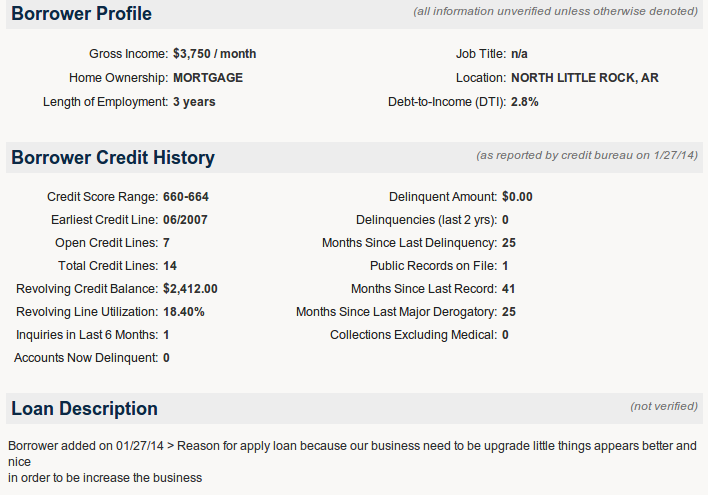
28 people are already participating in this loan. I think the smallest you can contribute is $25. Each loan gets filed with the SEC, which anyone can look up using Edgar.
But what you and I can see on the site seems to be all you can see in the SEC filings as well. Business location, credit, loan terms, and date filed, but nothing that identifies them personally. Unless of course you are smarter than I am and find a way.
Lending Club has made $3.5 billion in consumer loans in just a few short years. I have no doubt that they will be a billion dollar player in the business loan market as well. It sure would be nice to find out more about who they’re funding,especially since their cap is $35,000. There’s a good chance they’ll be underserving their clients’ capital needs.
The guys who figured out reverse UCC searching in MCA early made a fortune. Could reverse SEC filings be the next gold rush?
Lending Club Business Loans are Here
January 19, 2014 As mentioned in a thread on DailyFunder, I have personally seen evidence that Lending Club is already doing business loans. The loan was issued this month in the amount of $35,000 and disbursed to a business, not an individual.
I have been very outspoken about my belief that peer-to-peer lenders will compete directly against merchant cash advance companies and their short term lending counterparts. I am now absolutely positive that will be the case as the first merchant I saw to receive a Lending Club business loan was a former user of merchant cash advances.
One has to ask themselves if Lending Club will be targeting UCCs, particularly those of their new closest competitors in the space, OnDeck Capital and NewLogic. I was not able to determine the terms of the Lending Club loan but it is still my expectation that it will be a 3-5 year deal with automated monthly payments. Compare that against the industry’s dominant short term lenders that do 1 year deals with automated daily payments.
You can argue that there will be very little overlap in the merchants these companies target but I have seen overlap right out of the gate.
I expect we’ll all see a lot more of this.
Industry Fun Leads to Charity Funds
January 15, 20142013’s alternative business financing fantasy football competition came to a close near the end of the regular NFL season. There were some tough matchups and upsets, but two Florida based companies pulled through to win it all. The league raised a total of $9,000 from its participants and as per the rules, must be donated in equal halves to non-profit organizations selected by the two winners.
Financial Advantage Group selected the Spring of Tampa Bay, a noble choice since their mission is to prevent domestic violence, protect victims and promote change in lives, families and communities. DailyFunder, the trustee of the competition reached out to the organization late last month and made the donation in a low-key manner as per their request. They did express their gratitude to Scott Williams of Financial Advantage Group on their facebook page however:
Business Financial Services selected Wounded Warrior Project. They wrote their own post about the organization and why they are proud to support that cause on their website here: http://www.businessfinancialservices.com/blog/fantasy-football-for-charity/
Wounded Warrior Project accepted their donation with some pizazz, holding a giant check for a photo-op at the organization’s Jacksonville, FL office.

—-
I personally would like to thank Heather Francis of Merchant Cash Group for being a great competition co-host this year as well all of the participants that contributed funds to make these donations possible:
- Merchant Cash Group
- Benchmark Merchant Solutions
- Yellowstone Capital
- Raharney Capital
- Strategic Funding Source
- Sure Payment Solutions
- Pearl Capital
- United Capital Source
- NVMS
- Entrust Merchant Solutions
- Financial Advantage Group
- Snap Advances
- Business Financial Services
- Integrity Payment Systems
- DailyFunder
- Capital Stack
I’m already looking forward to next season!