FICO-Free Zone
January 15, 2016 Many lenders and alternative funders over the last several years have stressed a reduced dependence on FICO scores, but SoFi might be the first lender to declare their turf a “FICO-Free Zone.”
In a blog post, SoFi co-founder Daniel Macklin vented that his 15 years of credit history in the UK prior to moving to the US counted for nothing at all. To fix that, he felt pressured to obtain and use credit just to build his score, which he referred to as counterintuitive. For those that have been in this country all along though, his gripe was that things that should matter in a credit score for some reason don’t. “The FICO score calculation doesn’t consider things like your savings, your cash flow, your ability to pay non-credit bills like water and electric or your future earnings,” he wrote.
That’s the opposite of how other marketplace lenders are thinking.
In an online discussion I had six months ago with some members of the Lend Academy forum regarding a borrower’s ability to repay as evidenced by their bank statements, the feedback was resoundingly negative. “I have a feeling if you ask to crawl someone’s bank account, they’ll just go elsewhere,” one user said. “Seems that’d only work on subprime borrowers who have limited bargaining power,” he added.
The logic behind the defense of a continued FICO-oriented approach was steeped in competitive advantage, basically that no sane borrower would ever consider disclosing additional information about their financial situation to one lender when another would just give them a loan on FICO score alone. Ironically that translated to, anyone who wants their creditworthiness to be judged on their ability to pay probably can’t afford to pay, at least that was my takeaway from it.
But over in SoFi land, the student lender “has chosen to not use FICO scores when evaluating the financial wherewithal of applicants.” They alternatively examine your more complete financial situation and well-being, things marketplace lending investors on other platforms (at least for consumer loans) seemed to argue couldn’t and shouldn’t be done.
SoFi is no small fish. To date they have issued around $7 billion in loans.
Credibly and BodeTree Announce Strategic Partnership
October 27, 2015Today, Credibly, an emerging Fintech platform that provides a broad range of tailored capital solutions to satisfy the entire SMB credit spectrum, announced a partnership with BodeTree, a leading cloud platform that provides small businesses with real-time access to all of their financial accounts and cash flow trends in one place.
The partnership provides BodeTree’s customers with streamlined access to Credibly’s full suite of business capital solutions. The collaboration will also allow Credibly to further optimize their service offerings, which provide customized funding and financial management options that best fit a small business’s unique needs.
“At Credibly, we believe all businesses deserve the right to access capital, and our partnership with BodeTree makes good on the mission of providing that access to as many entrepreneurs as possible,” said Glenn Goldman, CEO of Credibly. “The insights garnered from the BodeTree platform, coupled with access to funding through Credibly, will help BodeTree’s customers achieve their growth goals.”
To date, Credibly has provided over $200 million of funding to more than 4,500 businesses in over 300 industries. In Q3 2015 alone, Credibly provided small businesses with access to over $26 million, and in the last year, the company has grown revenue 100%, opened new offices in three states, and doubled the number of its employees to 120.
“The integration of BodeTree’s financial tools and Credibly’s efficient and equitable lending process equips even more small businesses with the resources and capital they need to thrive,” said BodeTree CEO Chris Myers. “The spirit of our partnership, and the shared vision of both companies, is truly about helping small businesses.”
BodeTree was developed to fill the gap in business intelligence and financial resources available to small businesses and startups. The company’s intuitive financial management system aggregates and organizes financial information, giving businesses a clear and actionable picture of business health, cash flow, valuation and options for capital.
For information on BodeTree, visit www.bodetree.com, and learn more about the Credibly Partner Program at partners.credibly.com.
About Credibly
Credibly is a best-in-class Fintech platform that leverages data science and analytics to improve the speed, cost, and choice of capital available to all small businesses. Founded in 2010, with offices in New York, Michigan, Arizona, and Massachusetts, Credibly is dedicated to creating a superior lending experience that meets the needs of all small businesses, regardless of product need or credit profile. To learn more, visit www.credibly.com.
About BodeTree
Founded in 2010, BodeTree is an online financial management platform for small businesses, and an alternative to costly accounting services and complex bookkeeping applications. The BodeTree app securely imports data from bank records to automatically generate financial reports, forecasts, and benchmark analyses so owners can confidently take steps to bring their businesses to the next level. For more information, visit www.bodetree.com.
Contacts
Bliss Integrated Communication
Reed Handley, 212-840-0088
reed@blissintegrated.com
For Lending, It Might as Well be 1997
October 9, 2015 If you did any business with OnDeck between 2008 and 2014, you probably spoke with or at least knew of Sherif Hassan. His last position with the company before he left in May, 2014 was the Vice President of Major Markets. About six months later OnDeck went public and Hassan, one of the company’s earliest employees, was not there to celebrate it.
That’s because Hassan was busy working on something new, Herio Capital, a provider of working capital to small businesses that just recently surpassed more than $10 million in funding since inception.
Herio teamed up with Orchard on Thursday evening, September 8th to present The Future of Credit 2015.
“This is e-commerce in 1997 right now for lending,” said Jason Jones, a partner in Lend Academy who moderated the event’s panel. And Hassan, who is now easily considered an industry veteran, explained what set his new company apart.
It’s apparently not all algorithms when it comes to small business either. “We’re using our data to do all the heavy lifting and we’re using our people to do all the thinking,” Hassan said. And while they can take a deal from start to finish in four hours, they still have a human credit committee process. Other industry leaders have reported using similar approaches. “I like eyes on a deal,” said Orion First Financial CEO David Schaefer back in June at the AltLend conference. But for Herio, APIs and data allow the company to do a lot of filtering before anyone even touches the deal. Yodlee’s bank verification product reportedly plays a big role in being able to do that and Terry McKeown, Yodlee’s Data Practice Manager was coincidentally also on the panel.
Next to Hassan sat Matt Burton, the CEO of Orchard Platform, who was previously the 7th employee of Admeld, a company that was acquired by Google in 2011 for $400 million. His co-founder, Angela Ceresnie, is a former VP of Risk Management at Citibank and Director of Risk Management at American Express.
 Speaking on the availability of decisioning tools, Burton said “there’s never been a better time to enter the space.” That may seem counter-intuitive since the frenzy of M&A activity and capital raising over the last couple years has had some players worried there’s a bubble brewing, but studies show they may just be filling a growing gap. Small business lending is actually shrinking in the traditional banking sector in part because of Dodd-Frank.
“Community banks are being destroyed,” said Burton. “All the products they used to be able to provide have been taken away.” That’s not just his opinion either. Three weeks ago, the heads of the Independent Community Bankers of America and National Association of Federal Credit Unions offered testimony to the House Small Business Committee that demonstrated the carnage that regulations were having on their industry. During that hearing, Subcommittee Chairman Tom Rice said, “the burdens created by Dodd-Frank are causing many small financial institutions to merge with larger entities or shut their doors completely, resulting in far fewer options where there were already not many options to choose from.”
So today’s online lending industry might seem really big but it’s relatively small when compared to the shoes they’re trying to fill. Case in point, nearly 10% of the 104 companies that responded to the Treasury RFI on marketplace lending attended Herio & Orchard’s three hour event in New York City. That was determined by a quick show of hands from the audience when asked by Manatt Phelps and Phillips attorney Brian Korn. The industry didn’t seem so big all the sudden.
Korn, making a lawyer joke, likened the Treasury RFI to the first discovery request in a lawsuit, but argued the Treasury Department is not really in a position to be the regulator in this space. He believed their motivation came down to, are we doing enough for small business and are we doing enough to protect consumers?
A more serious issue was the Madden v. Midland decision which has put National Bank Act preemption in uncertain legal limbo. For those still unsure what preemption means, Korn offered an example of a 16-year old obtaining a driver’s license in one state and driving to another state where the minimum driving age is 17. The driver can legally export their home state’s minimum driving age and drive in a state where the age limit is higher. It’s that model which is uncertain now thanks to Madden v. Midland, but with interest rates not with drivers’ licenses.
So what’s the Future of Credit as the event was so aptly named? One could argue that whatever the future is, Orchard and Herio will likely have a place in it. The panelists mostly agreed that while some online lenders might be at risk in the next credit cycle, the online lending concept is here to stay. That’s because the borrowers themselves have changed. Nobody’s going to want to walk into a bank anymore and fill out paperwork after this, they argued.
If Lend Academy’s Jason Jones was right about this being like e-commerce in 1997, then it’s certainly incredible to think that the future of credit is something we can hardly even imagine yet.
Occupy Main Street?
October 10, 2011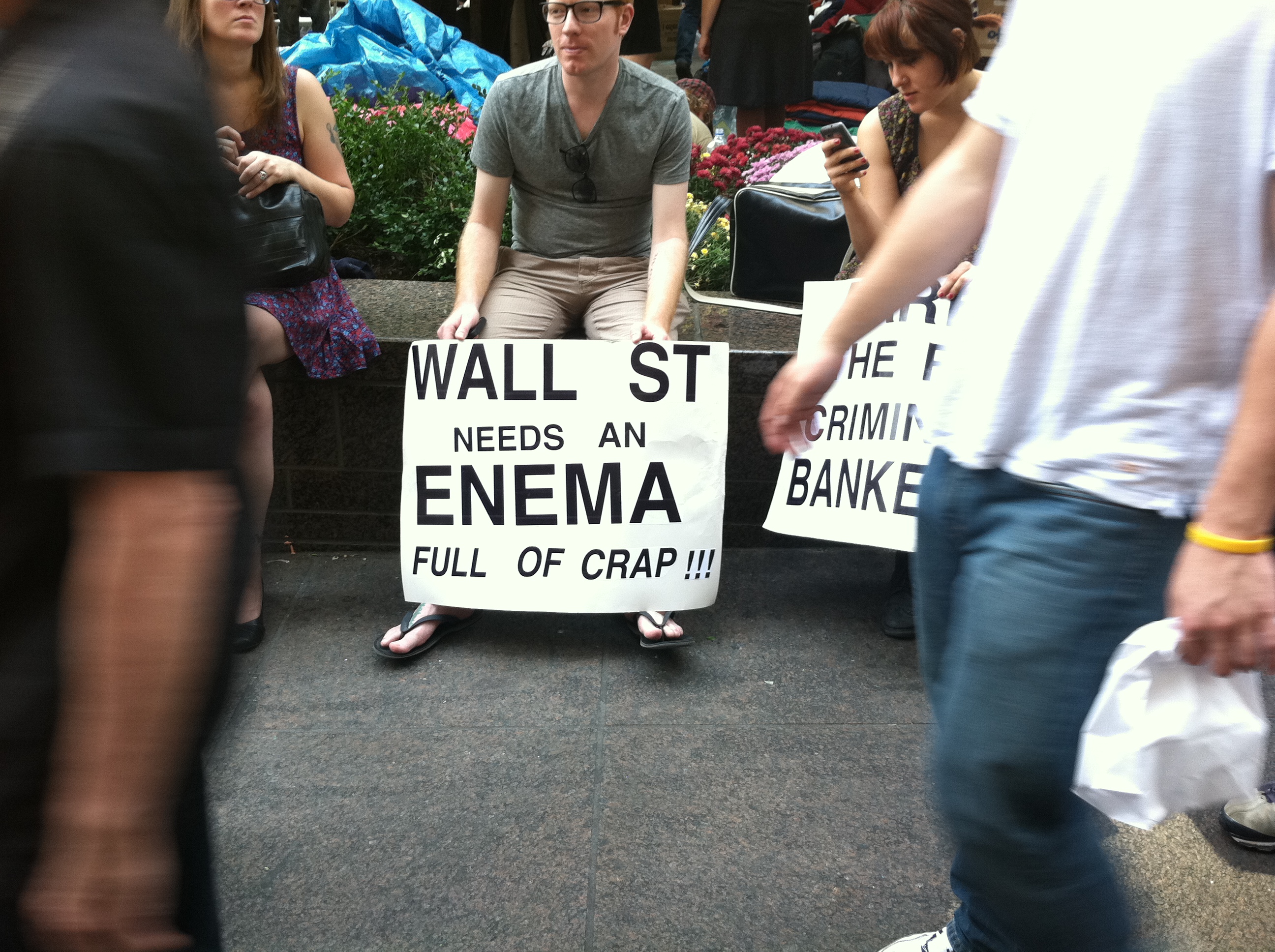 We didn’t protest… but we decided to see who was. Nowhere in the strange crowd did we find outraged business owners. Could the occupiers of Wall St. also be fighting against Main St.?
Wall St. bankers might have a lot of money, but small businesses employ the most jobs in America. Chances are if you are unemployed, unhappy, or overworked, it will ultimately be Main St. that will save you. But for time being, nobody is hiring. Business owners are pointing the fingers at banks, citing the lack of loans has stalled expansion. Excuses, excuses…
Wall St. might have perverted capitalism to enrich themselves, but Main St. has done just the opposite lately. When presented with an opportunity, thousands of businesses are unwilling to take the risk. “We’re just holding on for right now,” is a phrase we hear way too often from Mom and Pop shops.
We posed this question to an unnamed ‘Occupy Wall St.’ protester today:
MPR: “If we gave you $10 today, could you turn it into $20? “
PROTESTER: “Hell, I could turn it into $100. You can make money on a lot of stuff going on down here.”
Capitalism lives… It’s the drive and execution that enables someone with $1 to turn it into $2, $5, or $100 in a marketplace. It’s an intuition that Americans are born with, even those with anarchistic tendencies yelling in protest against it.
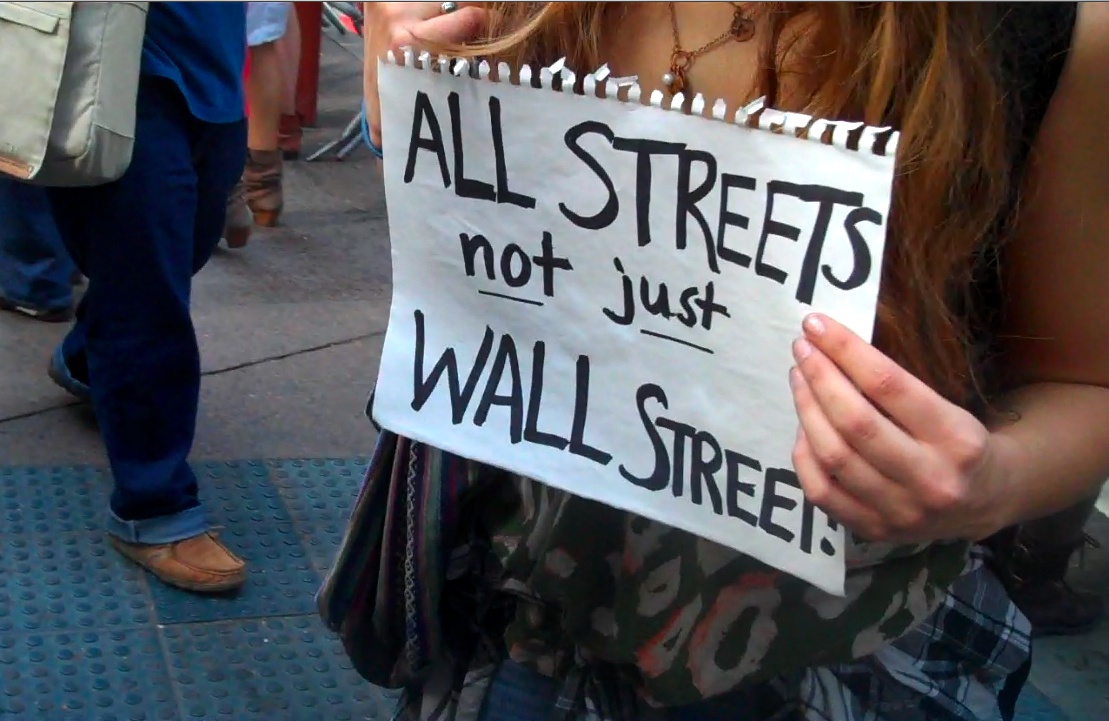
But something has happened to our beloved Main St.
Opportunities to grow are being passed up, and with that the ability to hire more workers. The rich get richer by investing their capital and taking risk. In a competitive marketplace, we must always seek out ways to grow, expand, and improve. “Holding on” is not a strategy, at least not one that will lead to hiring. Stability does not prepare you for downturns, nor will it make you rich in the long term. Stability is actually the beginning of a long road that will one day lead you to being mad at those who got rich.
The math is simple. If you turn $1 into $1.10 everyday, while somebody else turns $1 into $2, expect yourself to be very poor by comparison 20 years from now. Whether you have a small retail store or a national franchise, don’t let your guard down, take chances, think big, and elbow your way to the top 1%. You’ll create a lot of jobs on the way.
Once you’re ready to turn $1 into $2, don’t worry about the lack of bank loans, Merchant Cash Advance providers will offer you $1 in return for $1.30. You net the profits and can redo it as often as you like. Naysayers will tell you it’s expensive and it would be if you didn’t invest the dollar. Rebuilding the economy begins with small business. Show them growth, show them jobs, show them how you were born to turn one dollar into two…
AltFinanceDaily
http://www.merchantprocessingresouce.com
Learn about Merchant Cash Advance Here
Some video clips we took while we were at the Wall St. protest: