
Did Google Penguin Hurt Your MCA Website?
October 22, 2014 Google struck again late on Friday the 17th with a refresh of the Penguin Algorithm. As posted on Search Engine Roundtable, the algorithm is still rolling out and will continue to do so over the next few weeks.
Those familiar with Penguin know that it targets backlinks, specifically: paid links, spam links, bad links, the whole gamut. Hit the trigger and your site can virtually disappear from search.
I monitor several keywords in our niche and I haven’t noticed much of a change between what I see now and what I saw prior to the 17th. Truthfully, some of the companies I see popping up now in the first 2 pages are exactly the type of companies I’d expect to see on a list offline. That’s a good indicator that something is going right.
The exact search results are different for everyone but amongst the top 20 results for the search term merchant cash advance, I get:
- OnDeck
- Kabbage
- AmeriMerchant
- Business Financial Services
- Capital for Merchants
- CAN Capital
- Merchant Cash and Capital
- Retail Capital
Years ago through spam manipulation, the first few results were dominated by random lead generation sites like fastcashfunding4unow.com. I see very few sites like that these days ranking well.
If you were wondering where your organic site traffic went in the last week, there’s a good chance you got Penguined. Good luck getting out of that!
OnDeck Already Filed Form S-1
September 27, 2014 Back on August 14th, the Wall Street Journal reported that OnDeck was preparing to file for an initial public offering. Since then, industry insiders have been bustling with anticipation to see the S-1 filing, the document that would reveal once and for all their true financial standing.
Update 11/18/14: Click to see OnDeck’s Public S-1 Filing
In between then and now, Lending Club, their rival in the business loan market, filed their S-1 on August 27th. The peer-to-peer lending world went nuts and merchant cash advance veterans such as AmeriMerchant’s David Goldin were asked to comment on BloombergTV.
And then… things quieted down. OnDeck went radio silent on August 14th, despite the SEC requiring such only after the S-1 form had actually been filed. Speculation began to build as to whether or not the WSJ report in August was a false alarm or misinformation. And with no word from the industry’s beloved charismatic superstar Noah Breslow, something seemed to be amiss.
And then the Financial Times dropped the bombshell that the registration documents had already been filed… last month… confidentially.
Admittedly, I didn’t even know a company could file confidentially, a process done offline so that it is not recorded electronically. Thanks to the JOBS Act, companies with less than a billion dollars in revenue can submit draft versions of their registration documents to the SEC, allowing the SEC to review, revise, and agree on a final version that will ultimately have to be made public. The takeaway here is that an OnDeck IPO is in the process and the registration documents will eventually be released. The law states that OnDeck must make the documents public at least 21 days prior to pitching investors.
The New Yorker walked readers through confidential registrations back when Twitter was planning their IPO, noting that it was not uncommon to choose this method, “Twitter is much like its peers: most small companies that have gone public since the passage of the JOBS Act have filed their S-1s confidentially,” the New Yorker said.
So why be secretive? The New Yorker continues to explain:
From the perspective of companies, the new rule has a couple of virtues. First, it allows companies that are thinking about going public to test the waters—they can gauge investor reaction, get feedback from the S.E.C. on their filings, and so on—before deciding if they want to go ahead with an I.P.O. If a company goes through that process publicly, and then decides to abandon the offering, its reputation gets damaged, even though it often makes sense for a company not to go public. Do it privately, and no one gets hurt.
-Source: http://www.newyorker.com/business/currency/the-virtues-of-twitters-confidential-i-p-o-filing
OnDeck’s biggest critics are their competitors, naysayers convinced that they are recklessly undercutting pricing to acquire market share. Indeed FT reported that OnDeck posted annual losses of $16.8m and $24.4m in 2012 and 2013, and losses of $14.4m in the first half of 2014.
 With $1.3 billion funded since 2006, an independent report cited in the registration by Oliver Wyman estimates the untapped market to be between $80 billion and $120 billion.
There’s plenty of runway left, but OnDeck has yet to turn a profit. In An Insider’s Perspective, I wrote, “What scares their competitors though, is that this strategy has been intentional. Very few if any players in the industry have had the luxury, guts, or the purse to lose money for seven years as part of a coup to conquer the market.”
If the IPO goes through, we can all place actual monetary bets on the company’s future. What a trip that will be. I expect the stadium of insiders to get loud once the public documents are released. Good luck OnDeck.
Lend360: The Industry Event of the Year
September 5, 2014It’s being called the full circle of lending. Non-bank business lenders, merchant cash advance companies, peer-to-peer lenders, consumer lenders, lead generators, and Wall Street tycoons are descending on New Orleans from October 14th to 17th to attend Lend360. I’ve partnered up with the event through the DailyFunder name.
From the governmental arena, Governor Bobby Jindal (left) and U.S. Senator David Vitter (right) are speaking at the conference.


On the business side, here are some speakers you might recognize that are definitely confirmed.
- Brendan Carroll, Victory Park Capital
- Brendan Ross, Direct Lending Investments
- Scott Termini, Direct Media Power
- Bob Coleman, Coleman Report
- Heather Francis, Merchant Cash Group
- Nick Owens, Magnolia Strategic Partners
- Sean Murray, DailyFunder (myself)
- Ken Rees, Elevate
- Mark Curry, Sol Partners
- Sasha Grutman, MiddleMarch advisors
- Al Wild, Crest Financial
- Mark Doman, eBureau
- Tim Madsen, PartnerWeekly
- Dickson Chu, Ingo
- John Hecht, Jeffries
If you’re involved in MCA or business lending, you NEED to be there.
Here’s the most recent version of the agenda:


October 14-17, 2014 New Orleans, LA
In Partnership with

| REGISTER TODAY |
Six Signs Alternative Lending is Rigged
August 3, 2014There’s a lot of players at the alternative lending table but there are two that have won a string of lucky hands to put them on top. Neither were the first to draw cards, nor do either of them offer something that everybody else does not. These two lenders have something in common of course, special favor with the Internet gods. Is the game rigged?
OnDeck Capital is the most celebrated alternative business lender of our time. Their daily repayment loans and fast approval times are a hit with customers. In fact, as told in their recent securitization prospectus, OnDeck has been eroding its reliance on brokers and third parties to accommodate growth through their direct channel. Direct has been good for OnDeck, very good.
LendingClub on the other hand is the big dog in consumer lending, having funded more than $5 billion since inception. Every month they shatter the previous record for volume of loans funded and they’re expected to go public within the next year. LendingClub continues to pound their distant rival Prosper in monthly loan production. Are they just better at marketing?
Curiously I can’t help but notice they have something in common, they’re both owned by Google. Google Ventures led OnDeck Capital’s series D round and Google Ventures’ Karim Faris sits on OnDeck’s board of directors. Similarly, Google owns a minority stake in LendingClub.
While neither is outright owned or controlled, It’d be surprising if Google didn’t do something to foster the success of their investments. What could a billion dollar Internet giant possibly do to give them a little push?
Stop backlinking and SEO. The game is rigged
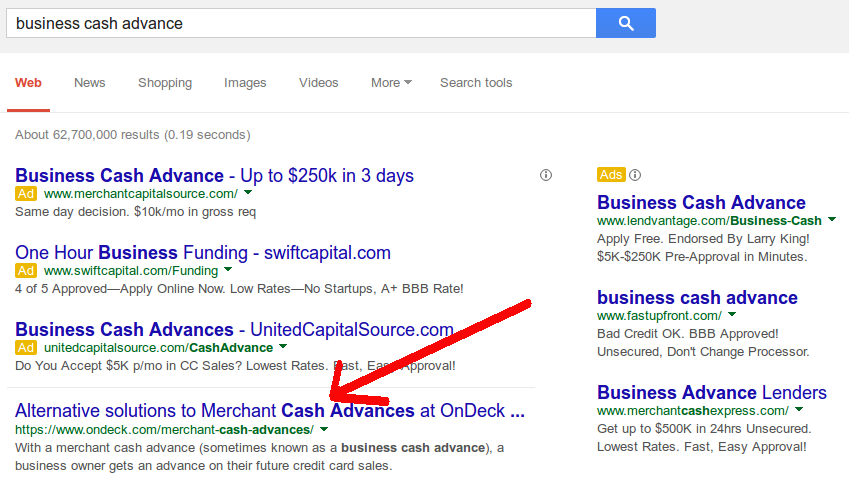
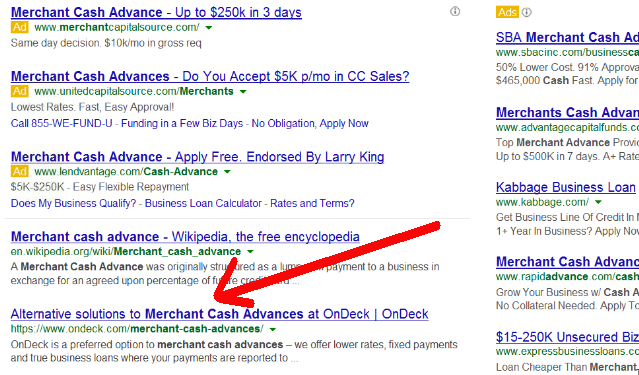
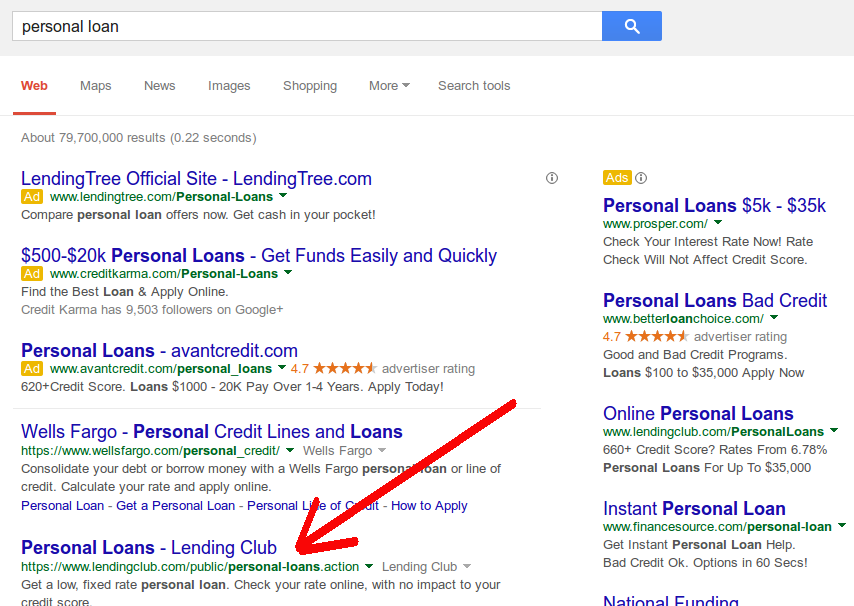

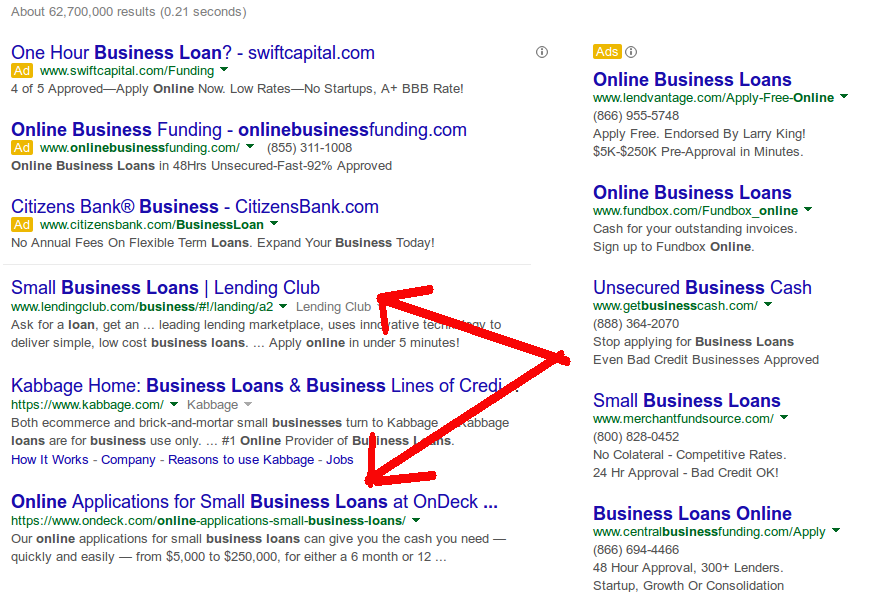

If you reproduce a search for the same keywords, you should know that results vary depending on what kind of device you’re using (mobile vs. desktop), what zip code you’re in, what time of the day it is, whether or not you’re logged into Gmail/Google+/Youtube, and whether you’ve searched for related topics before. I performed my searches with a fresh desktop browser on a Sunday evening in NYC with all cookies, cache, and Google account sessions wiped clean.
 You might not get exactly what I get and I realize that obfuscates the conspiracy I’m trying to establish here. If you do witness peculiar keyword domination though, keep an open mind that there might be more going on than good SEO and strong natural backlinking brought on by mainstream media publicity. Plenty of big businesses that dominate offline fail to rank well in the top ten results online.
Search engines say that if you’re popular, you’ll rank well. But there are plenty of cases where ranking well has made businesses popular.
Maybe, just maybe the game is rigged…
Yield Baby Yield
July 30, 2014 Somebody once called business loans the Cadillac of Credit products and that person is Brendan Ross, the President of Direct Lending Investments (DLI). In a newsletter he put out in September 2013, he began by saying:
Business loans are the Cadillac of credit products, with the highest yields and lowest default rates. Portfolio returns of 13-17% are the norm for successful underwriters – generally private, non-bank institutions.
He goes on to share his firm’s own investment success in these asset classes, claiming to be earning approximately 1% a month. DLI currently manages $48 million, all of which is deployed in alternative lending.
In today’s newsletter Ross admitted the goal is to “maintain unlevered, double-digit, investment returns.” With savings accounts today paying only fractions of a percent, double digits sounds too good to be true. But do you need $48 million to partake in the action?
The truth is you don’t. If you’re an ISO in the merchant cash advance industry you likely have the option to syndicate on your deals and if you’re friends with the right people you can syndicate on deals you don’t even originate.
But even then for folks who don’t have tens of thousands or hundreds of thousands at their disposal to recycle into deals, you can still strive for double digit returns through peer-to-peer lenders like LendingClub or Prosper. Through investments as small as $25 a pop you can participate in 3-5 year consumer loans that pay out monthly.
I myself opened a LendingClub account early this year to understand the experience and grew comfortable enough to begin amassing a real portfolio there. You can craft a portfolio based on your yield goals but the higher paying loans have much higher levels of default.
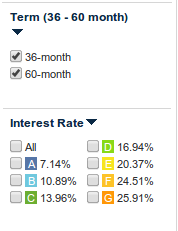 Investing in G-rated loans with an average annual interest rate of 25% doesn’t mean you’ll get that number or that you can even comfortably expect double digit returns. But you can try… And most do.
In fact the higher yielding loans are bought up fast and furiously every time LendingClub uploads a fresh batch to the platform. They’re added at four precise times a day: 9am, 1pm, 5pm, and 9pm EST. Savvy investors call each interval feeding time and the early bird truly gets the worm. By 9:03 a.m., hundreds of newly added loans are already fully funded and off limits to late investors looking to get the good stuff.
That doesn’t mean there is nothing to invest in if you log on an hour later, but the loans with the most desirable characteristics are nowhere to be found.
The average interest rate of my own portfolio is currently 15.72% a year before taking into account defaults. Using LendingClub’s sophisticated tools, I can compare how my portfolio is likely to play out against very similar ones on their platform (Same yield range with a minimum of 500 loans). Over the course of 30 months, it suggests that defaults will probably drop my actual yield below 10%.
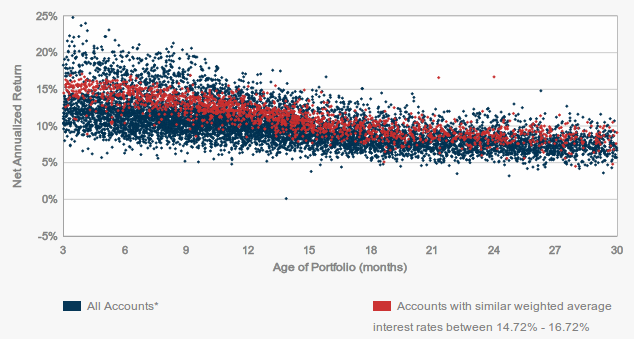
I have a say in how it will actually play out. For instance if loans in Nevada and Florida are likely to default substantially more than loans in other states, then perhaps I can expect different results between a D-rated loan in Florida and one in Vermont. Using both experience as a merchant cash advance underwriter and the controversial article, The Joys of Redlining as a basis, I never make loans to consumers in Florida, Nevada, or California.
Logging into the platform between feeding times, I often notice an abundance of seemingly attractive but very available loans in those specific states.
Whether that and other aspects of my strategy allow me to prevail with consistent double digit returns is to be determined but I can’t help but contrast even a substantially worse outcome against my savings account which legitimately only pays .01% a year. Not 1% and not .1%. It actually pays .01%.
My S&P mutual funds meanwhile are up more than 6.5% this year already but stocks are far more volatile. I’d also like to add that rather than compare the performances of both and decide to choose 1 over the other, consumer lending is a great way to diversify your overall investment capital. An index fund diversifies your stock holdings but there were very few options for everyday people to invest in outside of the stock market until alternative lending came along.
I still keep some cash in the savings account, but much like Brendan Ross announced in his newsletter today, I’m going full speed ahead with buying loans. In 2014, you don’t have to have $48 million in assets to make the returns that institutional investors can. There’s yield to chase out there and anyone can grab it.
What Would Barney Frank Say?
July 16, 2014While crowd funders navigate the JOBS Act and a possible revision to what constitutes an accredited investor, non-bank business lenders are raising eyebrows with sky high interest rates. Annual Percentage Rates (APRs) are reaching into the triple digits and critics are reaching for their megaphones to say something about it.
Unfortunately APRs don’t spell out the true dollar for dollar cost, a flaw pointed out by OnDeck Capital CEO Noah Breslow in regards to daily amortizing loans. In the June Access to Capital Small Business Panel, Breslow explained that a 60% APR loan could actually only cost 15% on a dollar for dollar basis over 6 months simply because of daily amortizing.
Still, the figures make for enticing headlines and it is to be expected that they will come under greater public scrutiny as time goes on.
In an opportunity I got to speak one-on-one with former Congressman Barney Frank in June, he offered some pretty interesting thoughts on the governance of business to business transactions.
 Frank, who was the key author of the Dodd-Frank Wall Street Reform and Consumer Protection Act that was signed into law in 2010, was a longtime champion of consumer financial protections. But he sings a different tune when it’s all about business. Many people may not realize that he opposed the Durbin Amendment of the Dodd-Frank Act, the addition that placed caps and restrictions on debit card interchange fees. Federal restrictions on how much a business can charge another business? Not his thing…
Unsurprisingly then when I asked him if he’d be in favor of a federal cap on business loan interest rates, he sternly replied, “no.” He went on to say that he supported transparency in business loan transactions, such that the borrower should be easily able to identify the terms, but that the premise behind consumer loan protections was that consumers were less sophisticated.
Curiously, there are a few states that impose caps on commercial interest rates, making the regional landscape for high rate business lenders a little bit tricky. In a recent publication by financial law firm Hudson Cook, they spelled out federal laws that already govern business loans.
To date there has been no legislative activity related to merchant cash advance or alternative business lenders. If such discussion did arise though, it’s ironic to say that one of the most liberal congressmen of the last decade, a man who wrecked Wall Street, would stand to make an excellent champion of the alternative business lending cause.
I never thought I’d say this, but too bad the guy retired.
Industry Survey Results
July 6, 2014Curious what the general consensus is on a variety of issues? DailyFunder® polled business lending industry insiders and analyzed the results. Click below to expand the graph, check out the image, or scan the text beneath it:

#1 What’s a Merchant Cash Advance?
61% consider it to be strictly a purchase of future revenue.
32% believe it’s an ambiguous term that could be used to describe a purchase transaction or a loan
How much are you earning?
62% reported making at least $100,000 per year
Almost half of the respondents in that group claimed to be making more than $200,000 per year
Stacking
62% said stacking is OK in the right circumstances
19% said stacking is not OK
16% said stacking is the bane of the industry
Who’s earning more?
57% of respondents that were in favor of stacking make at least $100,000 per year
73% of respondents that were against stacking make more than $100,000 per year.
Trade show anyone?
78% would attend an alternative business lending/merchant cash advance conference.
4% flat out said they wouldn’t.
Do you have skin in the game?
58% of respondents have invested funds in a merchant cash advance directly or through syndication
Top influencer?
A substantial portion of respondents wrote in OnDeck Capital CEO Noah Breslow as the most influential person in alternative business lending or merchant cash advance
Is government friend or foe?
49% fear future regulations could hurt their business
25% do not fear future regulations
What do insiders want to read more about?
- Regulatory issues
- Ethics, best practices
- Lead sources, lead generation, marketing strategies, sales guides
- The future, evolving products, trends
This graph appears in the July/August print issue of DailyFunder® magazine. Not subscribed? Get it free!
Is Awareness of Alternative Lending Still Low?
July 4, 2014 Prosper’s President Ron Suber and LendingClub’s CEO Renaud Laplanche have previously explained that there is still a large opportunity for growth because most people still don’t know non-bank lending options exist.
As cited on LendingMemo, Renaud Laplanche admitted the reason they are even considering an IPO is “to use it as an opportunity to raise awareness for the company.” He continued by saying that they don’t need capital so the purpose of their IPO aspirations “is a lot of free advertising.”
In casual conversations with business owners, friends, and new acquaintances I’ve asked if they’ve ever heard of merchant cash advance, p2p lending, or companies like OnDeck Capital and LendingClub. The answer is almost always ‘no’.
That means there is still a lot of work to do.
In this CNBC interview Funding Circle acknowledges that many business owners aren’t aware of alternatives and explains what makes them different.