
STRATEGIC FUNDING SOURCE NAMES ALAN NUSSBAUM VICE PRESIDENT OF BUSINESS DEVELOPMENT
April 20, 2015NEW YORK (April 20, 2015) – Strategic Funding Source, Inc., a leading provider of small business financing, today announced that Alan Nussbaum has joined the company as Vice President of Business Development.
In his role, Nussbaum will be responsible for developing untapped affinity relationships and other industry opportunities including the opening of new channels in emerging markets, which seek access to capital. He will report to David Sederholt, the Chief Operating Officer of Strategic Funding Source and will be based at the company’s New York City headquarters.
Nussbaum is one of the early entrants to the small business alternative financing industry and spent over 16 years leading sales initiatives with CAN Capital, the largest company in the industry. During his tenure at CAN Capital, he contributed to the growth of the company by developing diverse sales channels and will now bring his years of experience to Strategic Funding Source. As with several executives of Strategic Funding Source, Nussbaum started his career as the owner operator of small businesses, which included restaurants and a food service supply company.
“We’re pleased to welcome Alan to the management team at Strategic Funding Source,” said Sederholt. “I have known him for over 20 years as a respected member of the industry and look forward to him contributing his vast experience and insights to our company.”
“Over the course of my career, I have seen alternative finance products evolve into the mainstream direct solution for small businesses,” said Nussbaum. “I’m excited to join Strategic Funding Source, which has never forgotten the importance of people in their relationships. The company has a proven record as a leader and innovator that combines technology with a human touch. I look forward to helping both Strategic Funding Source and the small businesses we serve continue to grow.”
Nussbaum is a graduate of Pratt Institute in Brooklyn, N.Y.
About Strategic Funding Source, Inc.
Strategic Funding Source finances the future of small businesses utilizing advanced technology and human insight. Established in 2006, the company is headquartered in New York City and maintains regional offices in Virginia, Washington state, and Florida. The company has served thousands of small business clients across the U.S. and Australia, having financed over $800MM since inception. Visit www.sfscapital.com to learn more about Strategic Funding Source, its financing products and partnership opportunities.
Good Recordkeeping Plays Important Role in Funding Success
April 17, 2015CPA Yoel Wagschal recently started working with a syndicator who relied on Excel spreadsheets to track all his deals. The syndicator thought he had everything in tip-top shape, but it turns out that his system was hard for an outsider to understand and the data didn’t reconcile with his bank statements.
Wagschal, who heads an accounting firm in Monroe, New York, comes across this problem frequently these days. It’s been exacerbated by the exponential growth of the alternative funding industry in recent years. There are a sizeable number of alternative funders that started out small and have grown by leaps and bounds, yet they are still using rudimentary systems to keep track of their business dealings. In most cases, funders want to do the right thing, but they don’t always know how or the extent of what’s involved. Unknowingly these funders may be setting themselves up for financial or legal troubles.
 “Sooner rather than later you are going to find yourself swimming in the Atlantic Ocean without any plan on how to get out of there,” Wagschal says.
Although newbie funders may be able to get by with simple tools and minimal staff, more sophisticated efforts are required once they are doing multiple transactions a month. It’s one thing when you are tracking a few daily deals on a spreadsheet. It’s quite another when you’re trying to keep track of all the moving parts for hundreds of deals.
What’s more, there’s a lot of slicing and dicing of data that goes into properly understanding your existing business and growth possibilities. If you don’t use the right tools to help you keep precise records, it’s nearly impossible to understand the fundamentals of your business in order to grow. Excel, while a useful tool, has its limits, and funders who rely exclusively on spreadsheets don’t get the benefits of other more sophisticated options that have become available to them in the past few years. Manually entering data also increases the possibility of human error, which can lead to thousands upon thousands of lost revenue for a funder’s business.
The Pitfalls of Not Keeping Good Data
Keeping good data is especially important to funders who want to take on additional investors or who are considering a sale at some point. Kim Anderson, chief executive of Longitude Partners Inc., a strategic advisory firm in Tampa, Florida, works with a number of funders that are looking to facilitate additional growth by bringing on outside investors. Many of these companies find themselves scrambling because they don’t readily have access to the kind of information potential investors want.
Not keeping good books can also inhibit a funder’s ability to expand into additional markets. Say a funder wants to introduce a new product or migrate a product offering to a different vertical. Companies that don’t analyze their data effectively may have a hard time understanding what part of their existing portfolio would be the most appropriate or profitable segment to introduce the product to, Anderson says.
Potentially impeding growth is bad enough, but funders that don’t keep proper books can also find themselves embroiled in legal or tax troubles. Some MCA providers, for instance, have faced stiff penalties for treating transactions as loans on their books instead of the purchase and sale of future income.
“If they are showing the revenue recognition in the exact same way that loan industry companies are doing, then they are setting themselves up to be judged in the same way that a loan company would,” says Christina Joy Tharp, a staff accountant in Wagschal’s office. If you’re using the same accounting methods as lenders, you could be deemed a predatory lender by multiple enforcement agencies, even if that’s not your intent, she says.
The strength of your business can also be significantly impacted by how you classify performing and nonperforming loans or receivables. “There are thousands of pages of rules on how banks have to classify performing and non-performing loans. None of that exists for this industry, which is completely unregulated,” says Alex Gemici, managing director and head of M&A at World Business Lenders, an alternative lending company in Manhattan.
As a result, funders don’t have a universal way of keeping their books. Many funders believe that as long as they are collecting sporadic payments, a loan or receivable should be classified as performing. Gemici strongly disagrees, saying this approach sets up a funder for potential failure given that the default rate for loans/receivables is about one in five. “It’s one thing to show on your books that loans or receivables are performing, it’s another when you run out of cash,” Gemici says.
Choosing an Outside Provider
Recognizing that Excel spreadsheets can only carry a funder so far and that out-of-the-box software probably won’t be a complete solution for alternative funders, a small number of companies have stepped up to provide customized solutions for the industry. MCA funders—where the perceived need is greatest—are a particular focus for these providers.
 Benchmark Merchant Solutions, a processor in Amherst, New York, is one such company honing in on the MCA funder space. In 2014 the company launched MCA Track, software that’s designed to help MCA funders with their recordkeeping needs. It also helps them keep track of their income for tax purposes.
Among other things, MCA Track allows funders to view their performance at a glance. It shows them, for example, how merchants are performing, how the funds are allocated according to syndicator, the status of a deal, open cash advances, closed cash advances and defaulted cash advances. Funders can also get profitability data and other types of big picture information about their business as well. The software costs about $2,000 a month depending on the user’s size.
Benny Silberstein, chief operating officer of Benchmark, says the software was created because the processing company found that funders were often asking Benchmark to get data for them, especially when there were discrepancies. It can be real headache for funders to wade through inconsistencies with merchants, syndicators and ISOs, Silberstein says. “I can’t begin to tell you how many times funders asked us for a list of all the payments they’d received.”
PSC of Port Washington, New York, is another company trying to help MCA funders keep better records and manage their business more effectively. For a monthly membership fee, the company offers a front-end to back-end relationship management solution that allows funders to track all their contacts, documents, deals and commissions. Daily reports provide detailed data and summary information about an MCA’s funding business. The data includes the actual advance amount, the right to receive amount, the factor rate, processing fees, daily debits and credits, commissions paid to outside brokers or their own people, other management fees, ACH fees, wiring fees, payments, missing payments, collections information and participation with other syndicates.
The product has been on the market for about two years and the monthly fee varies according to a funder’s size, says Tom Nix, director of sales for PSC. He declined to be more specific about cost.
“The companies that are small and just starting out—if they are just doing a few transactions a month—they could probably get by using a spreadsheet. But that’s only feasible if you have a few transactions that you’re doing per month. Once you’re growing, when you get up to 10, 20, 30, 100 deals, the management of data becomes truly uncontrollable,” says Nix, who has seen a number of funders struggling to stay afloat or exit the business entirely because of their inability to keep good records.
“If you don’t have the right information and understand it, you’re going to give money to someone and you won’t [necessarily] get it back,” Nix says.
It’s possible for funders to set up their own infrastructure, but it can be costly and some feel it detracts from their ability to generate new business. That’s why Anthony Mannino, president of Nulook Capital in Massapequa, New York, chose to work with PSC. He researched the idea of doing all the back office and data collection on his own, but he decided not to reinvent the wheel since it would have meant hiring additional staff and would divert the company’s attention away from its primary focus—bringing in new business.
“A service provider like PSC gives us the ability to grow our company controlled and in a much quicker manner than we ever could than if we had to build our back end on our own,” Mannino says. “It takes most of the responsibility off of my company so we are able to focus on just growing the business and growing the sales.”
CloudMyBiz Inc. in Los Angeles is another company trying to service the alternative funder market, providing customized CRM systems for both lenders and MCA providers.
The CloudMyBiz system relies on a platform called Salesforce and is customized to the funding industry. It helps funders with the various facets of origination, underwriting and loan servicing. It helps them generate and track leads, automate funding workflow, understand and manage their deal pipeline and daily funding activities, collect and schedule recurring ACH payments and track syndication partners.
You could buy the Salesforce software and use it out of the box, but it provides only the basic functionality that funders need to run their business properly, says Henry Abenaim, principal consultant at CloudMyBiz. That’s where CloudMyBiz comes in by customizing the software for a funder’s specific business requirements. The fee varies widely, depending on the funder’s specifications, he says, declining to be more specific.
About two and a half years ago, Creative Vision Studio LLC in Long Beach, Calif., which had focused on the merchant credit card processing industry for more than a decade, also started offering a CRM system to MCA providers. The software is called Bankcard Pros CRM and customers can use it for merchant credit card processing, MCA or both. The software automates the data entry, underwriting, approval, funding and payback process from start to finish, says Robert Hendrix, the company’s chief executive. Funders also have access to 17 different management reports so they can track the performance and profitability of their entire portfolio per month.
The company charges an upfront fee of $4,000 to $5,000 to use the software, which is customized to a particular client’s business. There’s a $399 monthly fee after that. While it may seem costly to some funders, Hendrix says the software pays for itself within a month because of the efficiencies created. Importantly, the software eliminates the possibility of costly human mistakes that can occur in manually updating daily payments on a spreadsheet. “One little mistake can cost funders $2,000 to $3,000, even up to $10,000. They can be very costly mistakes,” he says.
It is, of course, possible for funders to keep good books and records using homegrown systems and personnel, and funders need to carefully weigh their options, taking into account that doing it right will probably require a meaningful investment in infrastructure and personnel. Whether they do it alone or hire an outside vendor, the important thing for funders is to collect the data and be able to evaluate it and display it in a way that makes sense to them, their customers, tax preparers, potential investors and others who need access.
Funders also need to remember that being successful in the business over the long term requires them to do more than simply capture accurate data. Beyond that, funders need to be able to manipulate the information in a way that helps them understand the nuts and bolts of their specific business, says Anderson of Longitude Partners.
“They may be able to produce enough financial information to complete an accurate tax return, but when it comes to understanding their operating metrics, they may not have collected or evaluated all of the right information to answer questions about what really drives the growth or sustainable profitability of the business,” he says.
Is NAMAA Reborn? Meet the Small Business Finance Association
April 14, 2015Almost seven years ago exactly, the North American Merchant Advance Association announced their presence. As of today, they are now officially the Small Business Finance Association (SBFA). Back then, a release dated April 15, 2008 stated:
The North American Merchant Advance Association, Inc. (NAMAA) has recently been created to represent merchant cash advance providers and to promote competition and efficiency throughout the merchant advance industry. NAMAA’s members will have the opportunity to share industry education and professional development, ethical standards and best practices guidelines, the development of industry relevant products and services, and the engagement in regulatory and legislative advocacy.
Of the ten original members, a handful are no longer operating. NAMAA’s membership in 2008 arguably encompassed the entirety of the merchant cash advance industry sans AdvanceMe (now named CAN Capital). Today, the SBFA website currently lists seventeen members. The organization has clearly grown but it pales in comparison to the size of the industry in 2015.
Internal data indicates that there are well over one hundred direct providers of merchant cash advance. Several hundred more are ISOs/brokers that co-invest in merchant cash advance transactions (Strategic Funding Source has had more than 200). And there are more than one thousand ISO/brokers that resell the product nationwide.
On this basis alone, less than two percent of industry providers and resellers are members of the trade organization. Granted, the seventeen member companies likely make up at least 15% of the industry’s funding volume. Member company Merchant Cash and Capital for example, announced just last month that they had funded $1 billion since inception.
Some have viewed the organization’s membership as overly exclusive and resistant to change. A seasoned veteran of an ISO that wished to remain anonymous said prior to the organization’s announced changes that, “NAMAA served a purpose for a long time but as the industry has changed, they have not.”
Ironically, Goldin’s statement in today’s release couldn’t be any more well timed. “With the alternative financing industry growing exponentially into a multi-billion dollar industry, we felt it was time for the trade association to evolve with it and open itself up to all types of small business alternative financing providers hence the name change to Small Business Finance Association,” he said.
The shift clearly acknowledges the true dynamic of the industry’s growth, that it’s not all merchant cash advance anymore.
 SBFA Vice President Jeremy Brown is quoted in the release as saying, “NAMAA started primarily as an association of merchant cash advance providers and has evolved into an association for all types of small business alternative financing – particularly those providers of business loans.”
But with lenders added to the mix of potential constitutents, is the SBFA a little light? The SBFA will now represent less than 1% of the companies selling or reselling merchant cash advances and business loans. In growing membership however, patience may perhaps be a virtue.
Jared Weitz, CEO of United Capital Source, said, “NAMAA is a beneficial association in the industry and should be choosy with who they let in.” As a broker, his company has historically not been eligible for membership.
Similarly, Chad Otar, Managing Partner of Excel Capital Management, whose company has also not been historically eligible for membership, said, “The aim of NAMAA is to help out our audience to understand and remember the information we stand for as funders and ISOs.”
Otar’s point belies a troubling trend, that many players in this industry disagree about what it is they stand for.
In a AltFinanceDaily Magazine article, titled, Stacking: Is it Tortious Interference?, Robert Cook, Cathy Brennan, and Kate Fisher of Hudson Cook, LLP delved into the industry’s most polarizing debate, the practice of entering into a cash advance transaction or loan knowing that the merchant has one or more open cash advances or loans with a competitor. They wrote:
On one side are companies that only originate first-position deals. These companies generally include a clause in their contracts prohibiting the merchant from obtaining another merchant cash advance or loan until the company receives all of the future receivables it has purchased or is fully repaid. First-position companies view stacking as a threat to recovery of money advanced or loaned to merchants. On the other side are companies that routinely offer second or third-position deals. These companies argue that merchants with adequate cash flow to support additional advances should be free to obtain them.
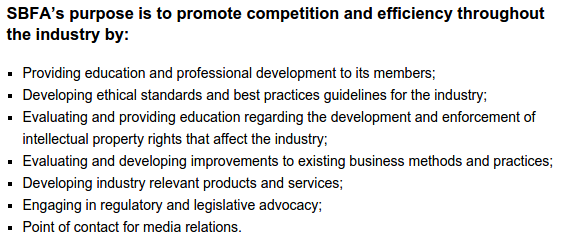 Though I did not ask the SBFA directly if the practice of stacking is an immediate disqualifier for membership, the organization has long been known to advocate against it. In Year of the Broker, Goldin commented that stacking litigation is underway.
Lawyers at Hudson Cook, LLP echoed the same. “In the last several months, at least two first position companies have sued their stacking competitors, claiming that stacking constitutes tortious interference with contractual relations,” they wrote.
The lawsuits come on the heels of the International Factoring Association (IFA) ban on merchant cash advance companies, citing tortious interference as the main driver.
After meeting with board members from both associations, the decision was made to deny membership to merchant cash advance businesses. This decision was based on numerous complaints and increased scrutiny that could negatively impact the factoring industry. By distancing ourselves from the merchant cash advance industry, we hope to diminish the chance of potential legislation.
-Commercial Factor July/August 2014
With several merchant cash advance companies left high and dry by the IFA, a potential leadership void has been created.
“As every industry evolves and shapes itself, some sort of governance and guidance is always needed,” said Otar. “This guidance is something that NAMAA holds itself responsible for,” he argued.
“The question is, can they reestablish themselves as a powerful voice that demands respect?” asked an industry veteran on the condition of anonymity.
Goldin assured me that the updated version of the organization’s best practices guide will be a public document.
Industry brokers like Otar are eager to comply with an established code of conduct and play any role they can in its creation. “Most of the business driven industry-wide is brought in through various ISO channels, which are the ones responsible in presenting the product offered by the funders to the end client,” he said.
That enthusiasm may be resonating with the SBFA. Goldin communicated that they are working towards different types of memberships, hinting at the possibility that brokers might one day be extended an invitation to join.
“We are exploring different levels of membership / pricing,” Goldin wrote in an email.
For the right price, they will likely find a lot of eager applicants.
From Lowes to Loans: Meet William Ramos
April 12, 2015Non-bank financing changed William Ramos’ life. Not as a borrower, but as a mover and shaker in the competitive world of financial deal-making. As an ambitious 20-year old, Ramos was working at both Lowes and ShopRite to try and put himself through Staten Island Community College. These were stepping stones, he told himself. He was dedicated to bettering himself, or more aptly to be the best at whatever he did.
Already on a path to success, he found himself growing impatient. The life of two jobs and school was a slow grind. Ramos wanted to do something big. He wasn’t sure what it would be, but he was confident that his attitude combined with his strong work ethic would eventually lead him to great success.
And so one day, he made a promise to himself to go out and find that big thing rather than wait for it to find him. It’s a bit of an American Cliché to say that his lucky break coincided with a sudden bout of adversity, but that’s exactly how it played out. Raised in the tough neighborhood of Brownsville in eastern Brooklyn, he didn’t have the connections to step right into the business world. Instead, Ramos had to start his search on the ground floor with millions of others on Craigslist.
His luck began with an interview for a job in telemarketing, a role that meant being connected to an autodialer nine hours a day as an opener. Undeterred by the challenge, Ramos had a feeling that this is where it would all begin. “I’ll do it,” he said.
There was only one problem, they didn’t want to hire him. The firm, which sold mostly financing products to small business owners, was very selective, even with cold callers. His interviewer at the time, who later became his boss, confirmed to me that he didn’t think Ramos was the right fit after they first met. But Ramos was determined to change his mind.
 After calling the firm repeatedly over the next week to convince them that he was up to the task, they finally acquiesced. It didn’t mean he was in. It just meant it was time to put up or shut up. “They gave me a three-day trial period,” Ramos said.
His former boss confirmed this relentless persistence.
39 working hours, 3,000 calls, and 3 days later, Ramos brought in two deals, one for $100,000 and another for $35,000. They both went through.
It was more than good enough to survive the trial and he was offered a job to work full time.
With a starting compensation of only $250 a week + commission, he still had a long way to go. “I would be the first one in and last one out,” Ramos shared with me. “I kept my head down and I wouldn’t leave my seat unless I needed to use the bathroom or eat. All I would do is make my calls.”
His former boss explained to me that Ramos had a knack for bringing in the firm’s larger deals even from the very beginning. He was too junior early on to be making a lot of money, but they were very focused on developing his skills. The firm saw his potential and was committed to nurturing him.
Within the first three months he managed to save $700 and he used it to buy a Mercedes-Benz C240 from a co-worker. After a life of taking the bus to work, Ramos had reached his first milestone of success.
While it was obvious that he still harbors pride in that first car, it sadly became all that stood in the way of homelessness. He had sacrificed everything for this job including college. Unfortunately there would be just one more thing to lose.
Adversity struck when a series of unfortunate events suddenly left him without a place to live. Ramos’ car was now both his ride and his home, though with the long hours he was putting in at the office, he might as well of lived at his desk. His boss took a special interest in his life and soon discovered just how much his young protégé was struggling.
“He was literally sleeping in his car,” his former boss told me. “I offered to let him sleep on my couch or at the very least let him stay in the office,” he added. Ramos took him up on the latter and began sleeping at the office. At the same time his commission percentage was bumped up, which sweetened the potential and only encouraged him to keep going.
 Always looking for an edge, he sometimes pretended to be a customer himself. “I would call up lenders as a merchant to hear what pitches their sales teams were using,” he said. “I would then take that pitch, tweak it and make it my own.”
Soon he was regularly closing more than $500,000 a month in deal flow and his financial situation and lifestyle began to improve significantly. A little more than a year later, Ramos had risen up to become a sales manager and was overseeing a team of five members.
Now some people in his shoes might’ve decided not to press their luck. He had taken a major gamble and it had paid off, so why do anything to jeopardize it?
But Ramos didn’t leave everything behind to settle for pretty good and a middle class lifestyle. After two years, he gave his boss and mentor some bad news.
“I’m going off on my own,” he explained. They parted on amicable terms and to this day still do business with each other. Ramos’ last commission check there was for $15,000, an amount he had never imagined back in his Lowes days.
In 2013 he founded Supreme Capital Group, a firm that primarily brokers merchant cash advances but will fund A paper deals on its own. With only two years in business, they are already on pace to generate more than $1.5 million in revenue over the next 12 months. He excitedly recalled a recent deal that generated $66,000 in commission. And that was just one deal!
He attributes part of his success to strong organizational skills. “I don’t think brokers realize how important keeping track of all their data is,” he said. He went on to explain that he can email the list of all his old leads and turn that into six to ten closed deals easily. He doesn’t have to work as much as he used to, but he still does.
With 10 callers working for him now, he’s not content with just being the boss. “I am still currently pounding the phones, doing email marketing, and sending out mailers,” he said. “We use the mailers to follow up with merchants, and we get a great response from it,” he added.
 After working incredibly hard for several years, Ramos has at least found the time to play hard too. In the summer of 2014, he had made enough money to buy a white Maserati GranTurismo MC Sport Line, of which he shared several photos with me. He’s since upgraded to a 2013 Ferrari California in a color he described as Pepsi blue. And while that might be the kind of car some people would dream of sleeping in, Ramos has said those days are long over.
He just bought a house in Mesa, Arizona where his fiancée grew up and he plans to relocate his office there. “It’s already in the process of being built,” he said.
Ramos is now just 25 years old. He said he regrets not finishing school and he plans to go back. But he wouldn’t change everything that happened to him. He stressed more than once that asking questions is something he considers to be very important to success, especially in the business he’s in. “For all the newcomers in the industry, my advice would be to work hard and ask a lot of questions,” he said.
He was certain he had found the right opportunity almost from the beginning. “I knew that if I made those commissions the first week that I could make more,” he said.
It wasn’t easy.
William Ramos is the President of Staten Island, New York-based Supreme Capital Group.
Yes, Rising Rates Will Impact Alternative Lenders
April 6, 2015 On April 1st, Ari Levy of CNBC posed the question, “what do rising rates mean for online lenders?”
Right now, everyone’s lending so much that it’s hard to keep up with. There’s a waiting list for institutional investors to deploy capital into these platforms and even retail investors have been drawn away from stocks to earn 5% – 12% a year on risky three to five year notes.
To be frank, borrowers aren’t necessarily choosing alternative lenders over banks because of the rates. The ease of getting a loan online is part of the attraction. But even if the lending platforms raise their rates and the borrowers stick around, will the investors?
Peter Renton, founder of Lend Academy told Levy, “Nothing below 2 percent [federal funds rate] is much of a concern.”
According to the WSJ, Fed officials have estimated the federal funds rate to be 3.125% in 2017. That’s above Renton’s 2% threshold. This rise will inevitably translate into higher national savings account rates, which currently yield below 1% on average. There are definitely price points that will flush out retail investors from investing in platform notes.
Remember that around 2006, banks like HSBC were paying 5.5% APY. If such a scenario were to happen again, even if five years from now, how likely is it that a retail investor would place capital in an exotic, risky, and relatively illiquid 3-5 year note? I think the average retail investor would be willing to sacrifice a few percentage points and go for the absolute safety of an FDIC-insured account. I know I would.
It’s already possible to earn over 2% in a 5-year FDIC-insured CD. It’s not enticing yet but it’s getting warmer.
Given the choice between a 5% 5-year FDIC-insured CD and an 8-10% 5-year note backed by the full faith and credit of some dude on the Internet that needed a loan to pay for his medical expenses, I’m probably going with the CD. But with a savings account right now earning less than 1% and CDs barely earning more than that, right now my moneys riding on some dude.
– Myself
The allure of a Lending Club, Prosper, or note of any other marketplace lender is especially attractive right now because a savings account is where money goes to die. There’s stocks of course but there will always be stocks. They’re actually a good way to complement a portfolio in marketplace loan notes for diversity. A safe investment at present basically earns nothing so the average joe has an incentive to play around with alternative lending.
Just two months ago, Jorge Newberry, the Founder & Chief Executive Officer of American Homeowner Preservation LLC, declared peer-to-peer lending dead in his Huffington Post blog. His basis was that it’s all institutional investors doing the lending to peers now, instead of their actual peers. Give the remaining peers on the platforms a safer more liquid investment with an acceptable yield and the notion of peer-to-peer lending could be deader than dead.
First, disco bit the dust. Then, punk rock keeled over. Now, peer-to-peer lending has been annihilated. Who murdered P2P? Wall Street. BlackRock. Wealthy bankers. The guys I was shoulder-to-shoulder with last week in Las Vegas. At ABS Vegas 2015, billed as the largest capital markets conference in the world, the P2P/Online Lending 101 session attracted a Standing Room Only crowd.
However, this crowd was not made up of peers. These were killers.
-Jorge Newberry
As for short term business lenders and merchant cash advance companies, the turn time of an investment might only be six to twelve months. You’re not locked in for five years and the yields are typically better than consumer lending notes. There’s plenty of incentives for a retail investor who is syndicating to stick around even if rates rise.
And that brings me to the institutions lending to alternative lenders. I don’t know how much institutional investors expect to earn on consumer notes, but I have heard in the merchant cash advance industry that borrowing costs for the funders themselves can range from 8% to 18% APR. They might borrow money from a hedge fund for example.
That partially explains why costs to merchants are high, but it’s uncertain as to whether or not the institutions will just be able to raise their rates and pass along the increase or if there will be new yield opportunities elsewhere with less risk more fitting to their fancy.
My belief is that rising rates will indeed impact alternative lenders and retail investors will probably find safer places for their money pretty early on. As to what the institutional investors will tolerate and who can weather passed on cost increases without being hurt is yet to be seen.
Year of the Broker
April 4, 2015 Many of the newcomers are fleeing hard times in the mortgage or payday loan businesses. Others are abandoning jobs selling insurance, car warranties or search-engine optimization.
“You have wandering souls trying to find their place in this industry, whether it be as a company or on their own,” said Amanda Kingsley, CEO of Sendto, a Florida-based company that assists new brokers.
Though exact counts appear difficult to obtain, Kingsley professed amazement at the volume of new entrants. “I’m swamped,” she said. “It’s crazy.”
Some of the new brokers discovered alternative financing in December, when OnDeck Capital’s initial public stock offering raised $200 million and valued the company at $1.3 billion. The Lending Club IPO that raised $1 billion the same month also raised public awareness of alternative loans.
Mesmerized with those whopping figures, salespeople from other businesses began committing themselves to a new career in alternative finance. In a business with virtually no barriers to entry, it’s easy to get started. To call themselves brokers, they just need a phone, someplace to sit and a list of leads they can buy online.
Virtually all of the entrants are pursuing dreams of lucrative paydays. Many even expect to make a fast buck with minimum effort.
If only it were that simple. Too often, the untutored new players are making mistakes simply because they don’t know any better, industry veterans maintained.
“A lot of people think you can just walk in and be successful,” said the sales manager of an established New York-based brokerage who asked for anonymity. “They don’t know what it takes to run a company. They don’t know what it takes to get a deal done.”
Worst of all – either unknowingly or with evil intent – new brokers are stacking deals. In other words, inexperienced salespeople pile second or third loans or advances on top of original positions. It’s an approach that clearly violates the industry’s standards, observers agreed.
In fact, virtually all contracts for a first loan or advance prohibit the merchant from taking on another similar obligation, noted Paul Rianda, an Irvine, Calif.-based attorney who specializes in payments and financing.
“I can’t remember one agreement I’ve seen that didn’t have that provision in it,” Rianda said.
Violating that stipulation could provide grounds for a lawsuit, and litigation is underway, according to David Goldin, president and CEO of New York-based AmeriMerchant and president of the North American Merchant Advance Association (NAMAA).
Bigger funders would sue smaller funders because the latter appear more likely to take on riskier, more problematic multiple-position deals, said Jared Weitz, CEO at United Capital Source LLC, a New York-based broker.
Plaintiffs have a case to make because stacking harms the broker and funder of the first position by increasing the risk that the merchant won’t meet the resulting financial obligations, Weitz said. “The guys going out 18 and 24 months to make this a more bankable product are being hurt by the people coming in and stacking those three-month high-rate loans,” he noted.
Deducting fees for more than one advance also impedes cash flow, adding another risk factor, Weitz said.
To further complicate matters, the company offering the second or even third deal sometimes moves the merchant’s transaction services to another processor, Rianda said. That forces the firms that made the first advance to approach the new processor to stake a claim to card receipts, he noted.
So the companies with the original deal suffer from the effects of stacking, but the practice’s shortcomings will haunt the stackers, too, observers maintained.
“It’s not a model that’s going to allow them to succeed,” a broker who asked to remain anonymous said of stackers’ long-term prospects.
Many hardly give a thought to staying power, according to Weitz. “A lot of people entering this space think it’s about fast money and not longevity,” he said.
Longevity requires that brokers build relationships with merchants, a process stacking undermines because too much credit can drive merchants out of business or merely prop up merchants already doomed to fail, sources said.
Yet stacking has become so widespread that it constitutes a business plan for some brokerage shops, said a broker who asked that his name and company not appear in the article.
It can begin when brokers buy lists of Uniform Commercial Code filings to find out what merchants have already taken out term loans or advances, said Zach Ramirez, vice president of sales and operations at Orange, Calif.- based Core Financial Inc.
The brokers then contact those merchants, many of whom are already over-extended financially, to offer additional credit or advances, Ramirez said.
Inexperienced brokers often resort to stacking because they don’t know how to generate leads that can bring alternative lending vehicles to merchants who weren’t aware of them.
Referrals from accountants or other business owners who deal with merchants can provide some of those greenfield prospects, Ramirez noted.
 And leads aren’t the only area of cluelessness among newcomers, a broker who requested anonymity maintained.
“They don’t know why a bank declines a deal or approves a deal,” he said. “They don’t know what’s the basis for a good deal.”
To teach new brokers those basics of alternative business financing, the industry should establish standard policies and technology, according to Kingsley.
A credential, perhaps something similar to the Certified Payments Professional designation created by the Electronic Transactions Association, sources said. To earn the credential, candidates would pass an exam to show they’ve mastered the basics of the business, they proposed.
NAMAA is considering such a credential, said Goldin, the trade group’s president. It’s the kind of self-regulation that could forestall federal oversight, industry sources agreed.
But that might not matter, according to Tom McGovern, a vice president at Cypress Associates LLC, a New York-based advisory firm that raises capital for alternative lenders and merchant cash advance companies.
After all, McGovern noted, Barney Frank, former Democratic U.S. representative from Massachusetts and co-author of the Dodd-Frank Wall Street Reform and Consumer Protection Act, has gone on record as saying that piece of legislation focuses on consumers and does not govern business-to-business dealings like loans or advances to merchants.
That lack of regulation over B2B deals seems likely to continue, “especially in the world we’re in now with a Republican Congress,” said a broker who asked to remain nameless.
However, some members of the industry would welcome federal regulation as a way of barring incompetent or unscrupulous brokers. An agency patterned after the Financial Industry Regulatory Authority, know as FINRA, could do the job, suggested a broker who requested anonymity.
Whether a government regulator or an industry- supported association should police the market, problems could remain stubbornly in place, some said.
Many doubt an association could build the consensus required for united action on some issues – stacking in particular.
For one thing, cleaning up the business could reduce profits for brokerages that profit from stacking, noted a broker who asked that his name not appear in the article.
“Everybody wants to make money,” he said. “Everybody’s out for themselves.”
Another barrier to agreement arises because some brokerages fear cooperation could expose their trade secrets, said Sendto’s Kingsley.
Moreover, unscrupulous brokers want to keep their employees uninformed of the industry’s potential for big profits, Kingsley said. That way they suppress compensation for an underclass of prequalifiers who work the early stages of deals, she noted.
Prequalifiers earn from $150 to $500 a week, depending upon the location, and don’t qualify for benefits like health insurance, Kingsley said. Once they realize what a tiny portion of the profits they’re receiving, brokers terminate the prequalifiers and many go on to become brokers themselves, she observed.
Closers who take over from prequalifiers to wrap up the sale can earn up to 50% or occasionally even 60% of a brokerage house’s commission – if the closer originates the deal and sees it through to completion unassisted, Kingsley said.
Eventually, closers realize they could keep all of the commission if they strike out on their own and become brokers, she noted.
In a way, the progression from prequalifier to broker or closer represents a market correction. And many seasoned industry participants believe market forces will also work out other problems the influx of new brokers is causing.
A large number of the new brokers simply won’t last long because they don’t understand the industry, they’re stacking deals and they’re signing up merchants that won’t stay in business.
Meanwhile, funders are beginning to perform background checks on brokers to make sure they’re dealing with reputable people, sources said.
Some funders protect themselves by simply declining to do business with new brokers, according to observers.
And many new brokers are learning the industry with the help of experienced brokerages that act as mentors and conduits and call themselves super brokers, super ISOs, broker consultants or syndicators.
“So what I’m saying is, ‘Guys, let’s not compete. Let’s grow parallel together,’ ” Weitz said of United Capital Source’s relationships with new brokers. The company began working with new brokers in October 2014.
In such relationships new brokers get advice from the more seasoned brokers. The older brokers can also provide the newcomers with services that include accounting, marketing and reporting, he said.
New brokers can also benefit from the customer relationship management platform that United Capital Source developed, Weitz said.
The new brokers also capitalize on the older brokers’ relationships with funders. Established brokers have earned better rates and terms because of reputation and volume, Weitz noted. Companies like his also know which lenders work more quickly and thus capture more deals, he added.
Older brokers can also steer new brokers away from newer funders that offer shorter terms and demand higher rates, Weitz said. Of the 30 to 40 companies that call themselves funders, only eight or 10 deserve the name, he contended.
The less-respectable funders place only a small amount of money in a few deals, he said.
Newer brokers become aware of their need for help from more experienced brokers when they see how many sales they’re failing to close, Weitz said.
 The new brokers also come to realize that the puzzle of running a brokerage office has a lot more pieces than they may have thought, said Kingsley.
The percentage of the commission that the older broker charges can vary, according to Weitz.
“If someone needs a lot of hand holding and a lot more resources, they would get a different structure,” he said.
While Weitz said his company plans to acquire only about 10% of its volume through new brokers, Sendto specializes in helping newcomers. Sendto’s Kingsley described the company as “a turnkey solution that provides training and placement of deals. It’s for new brokers or sales offices that do not have what they need to be part of this industry.”
There’s room for entrants because not all merchants know about alternative business financing, said McGovern.
The market can even seem like it doesn’t have enough brokers in the estimation of experienced players skillful enough to find the many merchants who haven’t been introduced to the industry, said Ramirez of Core Financial.
And the big banks don’t really want the business because the deals aren’t big enough to interest them, McGovern said.
But the potential profits look promising to outsiders disillusioned with sales jobs in other industries.
Some experienced brokers even prefer to hire salespeople from outside the alternative financing industry, noted Kingsley. That way, they avoid employees who have picked up bad habits at other brokerage houses, she said.
Long-time members of the industry sometimes enjoy belittling new entrants who can seem clueless about the business they’re trying to master, noted Ramirez of Core Financial. But he recalled the time not so long ago that he himself had a lot to learn.
And regardless of how unsophisticated they may seem, new players have a role, McGovern said.
“They are performing a service,” he maintained. “They’re like the missionaries of the industry going out to untapped areas of the market – of which there are many – and drumming up business.”
To Kingsley, brokers in general – old and new – are beginning to earn the respect they deserve.
“A lot of people are afraid of the word ‘broker,’ ” she said. “I feel that 2015 is the year of the broker, and people should embrace what a broker can actually do. It’s a great thing.”
A Return to the Fundamentals? (At Transact 15)
April 3, 2015 The Transact ’15 conference opened to a record crowd and there was no shortage of merchant cash advance players in attendance. Those facts were to be expected. And if you walked in and poked your head around, you might not have noticed anything to be different. Payment processors touted the latest mobile technology and at every turn security systems were being offered to prevent catastrophic breaches of cardholder data.
Everything looked normal… except the merchant cash advance companies.
Back to the fundamentals
Early on Wednesday, April 1st, CAN Capital kicked off a product announcement by raffling off free Apple watches. CAN’s new product is called TrakLoan, a revolutionary new loan program that allows merchants to repay via a split percentage of their credit card sales instead of fixed ACH.
April Fools?
The described advantage of TrackLoan is that there is no fixed term and that merchants only pay back at the pace that they generate card sales. Wait, Where have I heard of this before?
After slapping myself across the face a few times to make sure I hadn’t teleported to the year 2005, the rip in the space time continuum grew more apparent at the after parties.
Card processors Integrity Payment Systems, North American Bancard and Priority Payment systems are still among the hottest names in town for splits. The veteran MCA ISOs and funders are still boarding hoards of merchant accounts with them every month and are therefore building multi-million dollar residual portfolios in the process. It makes one wonder why so many people have turned their back on split-deals for the ACH methodology.
Years ago, merchant cash advance was a sideshow value-add that could be used to acquire what really mattered and what was reliably profitable, merchant accounts. Not everyone has forgotten that however.
 Over at Strategic Funding Source, Vice President Hellen McQuain is heading up a new merchant services division. In The Business Strategist, an SFS periodical, McQuain speaks the native tongue of the payments industry: EMV, PCI, NFC, etc.. Few, if any, of today’s new entrants in merchant cash advance could identify what those acronyms stand for, let alone explain the current climate of adoption.
So, is it time to get back to the basics?
Over the last six months, I have heard more gripes from funders about how to align a broker’s interest with theirs, other than by offering the opportunity to syndicate of course. The question comes down to, how can you get a broker to care about the outcome of a deal?
The answer should be obvious. Pay half the commission upfront and the other half as part of an ongoing performance residual. That gives the broker a stake in the outcome without having to syndicate. This is not a novel idea. This was how the entire industry operated from 2005 to 2011.
Might brokers resist such a compensation plan today in an upfront-only world? Maybe. But the greatest resistance I sense from funders, especially new ones, is that automated residual payments are too complicated for their current accounting systems.
That of course begs another question. How can this possibly be? Despite the rapid growth in technology, there is an entire segment of the industry that is ill-equipped to handle transactions that were commonplace and scalable five years ago.
While today’s systems are impressive, there are times when it seems like yesterday’s advanced technology was lost in a great flood, along with all the scientific texts documenting how to build the powerful machines.
To add to this, some of today’s edgy ideas are not new. A monthly payment loan for example is not an innovative idea. Weekly payments might acquire the merchant that wouldn’t do daily payments. And monthly payments might get the merchant that wouldn’t do weekly payments. These stretched out programs might make you popular with merchant cash advance brokers that are used to selling daily payment products, but they’re in no way new. It’s a return to the basics.
In 2015 we may apparently be going full circle.

Strategic Funding Source Names Stephen Lerch Chief Financial Officer
March 10, 2015NEW YORK (March 10, 2015) – Strategic Funding Source, Inc., a New York City-based provider of financing options to small and midsize businesses (SMB), today announced that Stephen E. Lerch has joined the company as Executive Vice President and Chief Financial Officer.
In this role, Lerch will be responsible for all aspects of the company’s financial operations, including enhancing fiscal capabilities, identifying new investment opportunities and executing growth plans. He will report to Strategic Funding Source Chairman and CEO Andrew Reiser.
With more than 17 years in various C-suite roles with technology-based companies in both the public and private sectors, Lerch brings an extensive range of expertise in finance, revenue generation and operations management to Strategic Funding Source. Most notably, he is a veteran of the small business finance and marketing industry, having worked for more than seven years as CFO and COO of Rewards Network where he helped pioneer the early successful growth of the alternative lending marketplace. Prior to that, Lerch was a Partner at Coopers & Lybrand, now PwC. He is a graduate of the University of Notre Dame.
“We are thrilled to welcome Steve to the Strategic Funding Source team,” said Reiser. “With his immense financial, operational and industry specific experience, Steve will play a key role in advancing the way we do business and drive the company’s growth.”
“I am extremely pleased to be joining Andy and the talented management group at Strategic Funding Source,” Lerch commented. “With the best reputation in the industry, the premier underwriting and syndication platform and an excellent equity partner in Pine Brook Partners, Strategic Funding Source is extremely well-positioned to take advantage of the tremendous growth opportunity already underway in small business financing.”
About Strategic Funding Source, Inc.
Strategic Funding Source finances the future of small businesses utilizing advanced technology and human insight. Established in 2006, the company is headquartered in New York City and maintains regional offices in Virginia, Washington state, and Florida. The company has served thousands of small business clients across the U.S. and Australia, having financed over $800MM since inception. Visit www.sfscapital.com to learn more about Strategic Funding Source, its financing products and partnership opportunities.