LendItFintech In Photos and Sound Bites
April 10, 2018
when speaking about the increase in mortality rate for people who have faced major financial distress
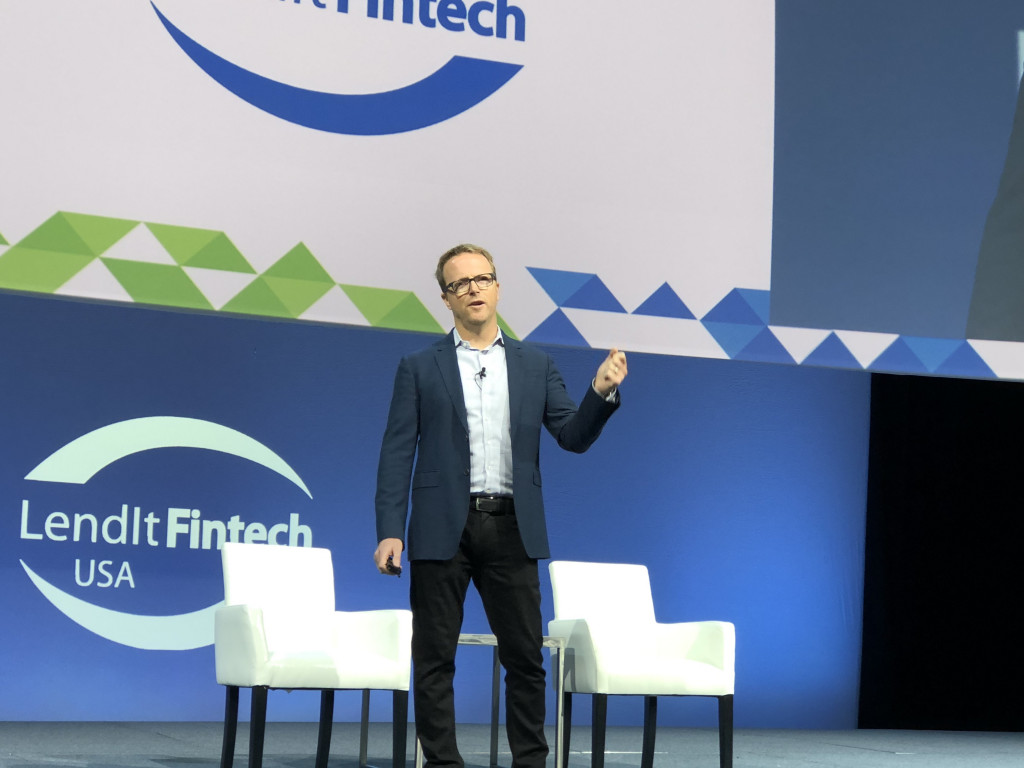
when interviewed on stage by Bloomberg’s Selina Wang

when interviewed by Jo Ann Barefoot

When asked by Bloomberg Technology reporter Emily Chang if Goldman Sachs would be considered a competitor

when interviewed by Lendio’s Brock Blake

When asked who will win the race for marketshare
When asked if it’s harder to underwrite loans above $50,000
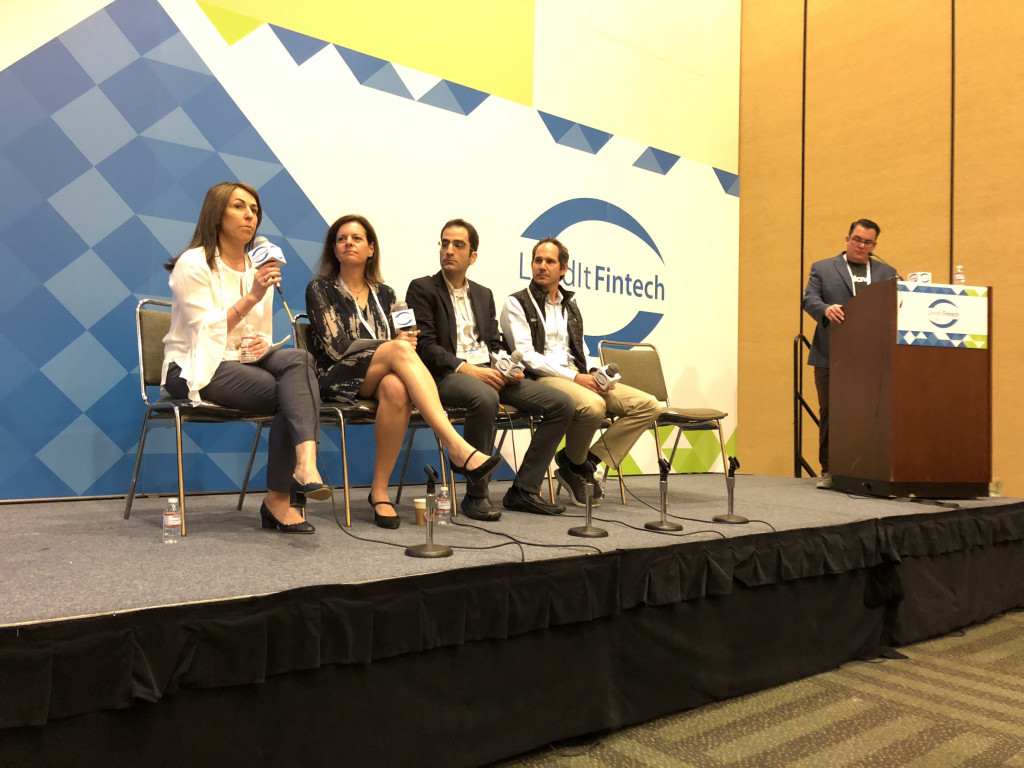
talks business at the company booth

Below: Ocrolus account executive John Lowenthal stands in front of the company booth




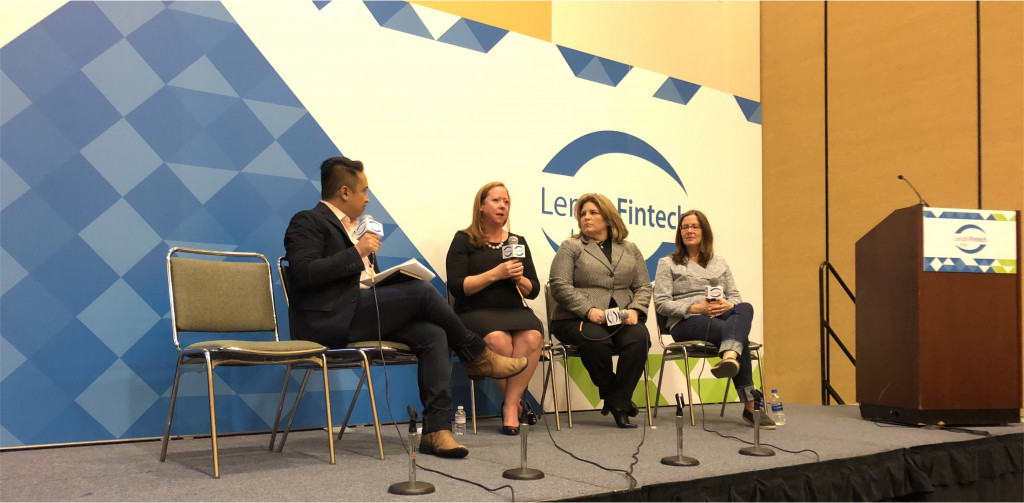

How One CEO Unified Two Companies with Different Cultures on Different Coasts
March 21, 2018 Company mergers, like marriages, have their pros and cons. Some are more successful than others and many say it’s unwise to rush into one. This is certainly the approach Adam Stettner adopted when he, as CEO of San Diego, CA-based Reliant Funding, oversaw the merger of his company with Merchants Capital Access, based in Melville, NY on Long Island.
At the time of the merger in April 2015, Merchants Capital Access was an MCA funder. According to Stettner, they were what he considered a “back end” as they didn’t do marketing or sales. They did underwriting and funding, but they did not originate any new business.
Reliant Funding, which Stettner led, did almost the inverse. While it did some cursory underwriting, it mostly marketed and sold funding to small businesses. It would also package small business merchants and place them for appropriate funding. But they did not fund directly. So, it seems, these two companies made for a perfect marriage. They completed each other. But not so fast.
Even though Stettner had considerable experience working as a direct lender in the student loan business prior to taking the helm at Reliant Funding in 2008, he didn’t feel ready to dive into funding a different type of client. (Stettner said he originated and held on his balance sheet $15 billion in student loans at National Lending Associates, a San Diego company he co-founded.)
“I felt like it was easy for somebody to come into the [merchant advance] space and start writing checks and funding businesses,” Stettner said. “It’s hard to figure out how to get that money back. So instead of jumping in with both feet, I thought it would be wise to really understand our target demographic, our end user, the small business owner.”
So while the technical merger of Reliant Funding and Merchants Capital Access happened in April 2015, the newly enlarged entity operated as two distinct brands until September 2017.
During this period, Stettner said, “we were studying everybody’s credit models and the best way to approach American small business owners, the best way to fund them, the best way to service them, and ultimately, the best way to renew them.”
This roughly two year period between the time of the actual merger and the official fusion of the two companies, now simply called Reliant Funding, was not just for Stettner to learn about funding small businesses. A lot more needed to happen to sync together a southern California company and a New York City-area company, each with different corporate cultures, attitudes and ways of getting work done.
“Getting 150 people with different views on work, culture, approach and strategy wasn’t easy,” Stettner said. “But it was definitely worthwhile and it was a lot of fun. There were times, of course, when it was frustrating as well.”
The stereotype of southern California being more laid back doesn’t hold up, according to Stettner, who grew up in New York and has worked in southern California for 14 years.
“While the environment may be laid back in appearance, the effort that’s put forth and the intensity that exists in the southern California office is no less than what you see out from our New York office,” Stettner said. “Both work incredibly hard and have great attitudes.”
However, he did say that the original culture in the New York office (formerly the Merchants Capital Access office) was much more centered around management decisions and Stettner made a point of bringing a culture of empowerment to that office.
What does that look like exactly?
“We talk [with employees] not only about the top line numbers, but also the bottom line numbers with the idea of empowering everyone,” Stettner said. “It’s important to me that everybody knows the why behind what we do. If people understand why we do something, it’s easier for them to get behind it, and they’re better equipped to offer an opinion that can help get us there faster.”
Now as Reliant Funding, Stettner said that the company is fully integrated under the one brand with unified systems and technology. The company is a funder with a sales team focused on direct origination. It also continues to grow what Stettner calls the wholesale channel or broker channel.
2017 Small Business Financing Leaderboard
March 14, 2018Thanks to several companies filing their annual earnings statements and Funding Circle disclosing their USA origination figures for 2017, we’ve been able to put together a leaderboard in the small business financing space. This list is not comprehensive and omits key players like PayPal Working Capital and Amazon Lending.
| Company Name | 2017 Originations | 2016 | 2015 | 2014 |
| OnDeck | $2,114,663,000 | $2,400,000,000 | $1,900,000,000 | $1,200,000,000 |
| Kabbage | $1,500,000,000 | $1,220,000,000 | $900,000,000 | $350,000,000 |
| Square Capital | $1,177,000,000 | $798,000,000 | $400,000,000 | $100,000,000 |
| Yellowstone Capital | $553,000,000 | $460,000,000 | $422,000,000 | $290,000,000 |
| Funding Circle (USA only) | $500,000,000 | |||
| BlueVine | $500,000,000* | $200,000,000* | ||
| National Funding | $427,000,000 | $350,000,000 | $293,000,000 | |
| Strategic Funding | $393,000,000 | $375,000,000 | $375,000,000 | $280,000,000 |
| BFS Capital | $300,000,000 | $300,000,000 | ||
| RapidAdvance | $260,000,000 | $280,000,000 | $195,000,000 | |
| Credibly | $180,000,000 | $150,000,000 | $95,000,000 | $55,000,000 |
| Shopify | $140,000,000 | |||
| Forward Financing | $125,000,000 | |||
| IOU Financial | $91,300,000 | $107,600,000 | $146,400,000 | $100,000,000 |
*Asterisks signify that the figure is the editor’s estimate
What’s Lending Got to do With Cryptocurrency?
January 10, 2018 Facebook and Snapchat might be the last things that employees are being distracted by these days. Instead it’s Coinbase and Blockfolio, two cryptocurrency apps, that are quickly stealing the attention of young finance professionals. And the interest in Bitcoin, Ethereum and alt coins is causing some in the industry to wonder if the phenomenon can somehow be connected to online lending and merchant cash advance.
A meetup hosted by partners of Central Diligence Group (CDG) on Tuesday night in NYC, for example, was geared towards cryptocurrency enthusiasts. CDG is a merchant cash advance and business lending consulting firm. Those that attended, talked candidly about Ripple, Bitcoin, Ethereum, and the hot topic of Initial Coin Offerings (ICOs). And it did seem all connected. Companies successfully raised more than $3 billion through ICOs in 2017, for example, some of them online lending companies.
 ETHLend and SALT, blockchain-based p2p lenders, each raised $16.2 million and $48.5 million respectively through ICOs. What’s more, their crypto market caps currently stand at $325 million and $754 million respectively. The latter is nearly twice as valuable as online lender OnDeck. The founder of Ripple, meanwhile, briefly became one of the richest men in the entire world.
Whether these valuations are overdone is besides the point. A smart phone is all that’s required to get in on the action and trade thousands of cryptocurrencies online, many of which move up and down by astronomical percentages over the course of a day. Becoming a millionaire overnight by hitting on the right one is a dream sought after by many. And young people, especially millennials, are become unconsciously comfortable transacting in non-government-backed currencies through technology that completely shuts out banks.
And that may be the shift in all of this to pay attention to. It isn’t that a local restaurant is going to collateralize their Bitcoin to get a loan and outcompete an MCA company, but that a portion of the monetary system eventually starts to sidestep banks.
Trying to collect on that judgment? Good luck tracing the money in cryptos.
Need to freeze funds? You can’t freeze someone’s Bitcoins if they’ve got them stored on their own hardware.
Evaluating a business’s bank statements? The transactions can only be verified on a blockchain.
You might not believe me, but it’s incredibly likely that you’ve encountered a client that has defaulted on an MCA or loan whose stash of money has been obscured in cryptos all the while their bank statements appear to show insolvency.
It’s also likely that you’ve encountered a client that has used the proceeds of their MCA or loan to buy a crypto. Maybe not the whole amount, but with some of it. One study, for example, revealed that 18% of people have purchased Bitcoin using credit. Bloomberg reported that the phrase “buy bitcoin with credit card,” just recently spiked to an all-time high.
People are even taking out mortgages to buy Bitcoin, according to CNBC.
If you think cryptocurrency is an industry completely independent of your business, consider that the market cap of cryptocurrencies is currently valued at more than $700 billion. That’s nearly twice the market cap of Goldman Sachs and JPMorgan, COMBINED. The #3 cryptocurrency by market cap, Ripple, is being pitched almost entirely to traditional financial institutions.
Bet all you want on the prediction that this bubble will burst. Maybe it will. But the underlying technology, transacting without banks in non-government backed currencies that may be difficult to trace and recover, is a genie that’s not returning to its bottle anytime soon.
In the meantime, now might be a good time to poll your employees or colleagues about their knowledge or use of cryptocurrency. You may be surprised by what you find, especially among the younger crowd.
——–
Disclaimer: I currently hold a material amount of Ether, the currency of the Ethereum blockchain.
How I Failed to Become a Bitcoin Millionaire
December 18, 2017 This past Fall, an industry colleague congratulated me on my newfound wealth. “What newfound wealth?” I reply. “What are you talking about?”
“Aren’t you a bitcoin millionaire now?” he says, smiling brightly, with a look in my direction that suggests he can see through my deceptively coy demeanor. “You were talking about it for years. You were right about it!”
“Oh, yeah… Bitcoin,” I say back while looking at the ground, embarrassed by what I am about to tell him. “I spent nearly all my Bitcoins well before the price jump,” I reveal.
He didn’t believe me, but it didn’t matter. I had no regrets up until that moment when I decided to look back and see how much my Bitcoins would’ve been worth had I just held on to them. Doing the math ultimately turned out to be a bad idea.
$500,000.
That’s the rise in value I missed out on by spending the Bitcoins I had been acquiring in 2014-2016. It’s not a million dollars, but it’s enough to sit back and think, what if. [Editor’s note. The market value of those Bitcoins since the time this issue went to print reached about a million dollars after all. DAMN.]
Bummer
But why spend or sell them if I was a supposed true believer? I never cared much for speculating. I liked and still like Bitcoin because it’s a payment methodology that exists outside the purview and control of banks and government. It is the ultimate way to de-bank. And hey, that’s what all the fuss of this publication is about.

I started reporting on Bitcoin here in AltFinanceDaily as early as 2014, mainly to an audience that didn’t know what they were and didn’t care to know. I couldn’t blame you all. Talk of digital currency, mining, and block sizes doesn’t exactly go hand-in-hand with things like online lending, merchant cash advance, and brokering deals.
A handful of diehard Bitcoin fans at the time told me they were happy to see Bitcoin legitimized through our coverage. Others told me it was complete garbage, a ponzi scheme even, that didn’t deserve any attention whatsoever.
In those days, I took a tour through the whole ecosystem by mining Bitcoin, buying it, selling it, paying people with it, and accepting payment with it. I read books about it, attended seminars on it, and watched documentaries about it. I even experimented with turning my computer into a node in the Bitcoin network to keep the ecosystem itself running smooth. I repeatedly heard critics argue that it was all a scam and I walked away every time remaining unconvinced.
Bitcoin allows users to carry their money across borders without hassle and to retain possession of their funds even if a bank or government agency wants to seize it. Perhaps these benefits appeal to criminals, but surely they also do to law-abiding citizens.
I didn’t like the volatility of it so much back when I was acquiring them. It wasn’t a very good store of value and it still isn’t. The fact that a Bitcoin I acquired for $300 is now worth $10,000 [market value at the time it went to print] is amusing but also terribly unnerving. What good is Bitcoin to legitimately use as money if the value can swing massively in an hour? And what to do if I bought 1 Bitcoin now at $10,000 and it retreated back to $300?

In a way, I may have been more excited to have held all those Bitcoins for another year without them experiencing any increase in value, rather than to have accidentally profited handsomely thanks to speculators who do not care about the underlying utility of Bitcoin.
Maybe I’m an idealist. Or maybe I’m just rationalizing why I shouldn’t cry myself to sleep over having missed out on 500k in profit. I personally believe Bitcoin will be at its most valuable when its price is stable. If we can get to that point and the world economy becomes more accepting of it as a form of payment, well then I’d be very interested in holding on to Bitcoin indeed.
I wondered, of course, if the me of three years ago would’ve agreed with my philosophy now. A blog post I wrote in November 2014 answers that question.
Below are some of the points I made then:
“Bitcoin is more than a currency. It’s not the Euro, the Yen, or the Peso. It’s a detachment from governments and banking. It’s self-control. Without the private key, your bitcoins can’t be seized.”
“I’m not necessarily speculating though. I spent almost half my bitcoins shopping on Overstock on Black Friday.”
“A 5% swing might be acceptable for an investment but it’s quite ugly for a currency.”
“Your money is not really yours. You have rights to it, but only to an extent. It can be garnished, frozen or confiscated. That’s the price of liquidity and relative stability. If you can afford to color outside the lines, where you can remove [bankers] and their control, why not experiment? There’s something pure about [Bitcoin], liberating. And when you add in the fact that it’s governed by math, it’s more than that, it’s beautiful.”
“There are indeed those holding [Bitcoin] and not spending. Rampant speculation is both a cause of volatility and an argument for its long term unsustainability. Speculators are hoping the digital currency will appreciate and make them filthy rich. If that day never comes, a big sell off will cause its value to drop.”
And so it was in 2014, I was interested in the utility of Bitcoin while concerned about the volatility of it. The value has since shot up to the moon, largely due to speculation. Along the way my views caused me to miss out on becoming a Bitcoin millionaire.
And I couldn’t care less. Wake me up when the price stabilizes.
Editor’s Note: Between the time this story was sent off to print and now (when it’s being published online), the market value of those Bitcoins had increased from $500,000 to nearly $1 million. Incredibly, I legitimately would’ve been a Bitcoin millionaire.
Editor’s Note 2: It’s been a long time since I have played around with being a Bitcoin node. More recently, I have become a node on Ethereum, a blockchain for decentralized applications that also serves as the backbone platform for things like Initial Coin Offerings.
Closing Loans and MCAs — From the Bedroom to the Office
December 8, 2017 The merchant cash advance industry has gone mainstream so quickly that it has become more difficult to identify potential customers.
Market saturation and industry consolidation have caused the cost of sales leads to increase sharply. Yet a New York business loan broker is finding success by applying lead generation and online marketing strategies to merchant cash advance, or MCA, while expanding the number of services he offers prospects. Funding is just the foot in the door.
Philip Smith, founder and CEO of PJP Marketing Inc., told AltFinanceDaily the MCA industry’s acceptance has made it more difficult for sales lead generators to produce profits. But expanding the number of services that independent sales organizations (ISOs) offer can offset the contraction. Smith’s life as a stay-at-home-dad, was recently featured in Innovate Long Island, a regional newspaper.
An ISO can’t just be a broker anymore. It needs to change, identify new revenue streams to excel. In doing so, a lead generator transforms itself into a business consultant that prospective customers turn to for additional services they often didn’t even know existed, Smith said.
For example, business loans and MCA is Smith’s largest business generator. But his most popular add-on services with such sales leads are credit repair and credit monitoring.
“The market is relatively easy,” Smith said. “The hard part is monetizing. The ISOs are going out of business because they refuse to monetize the other, non-cash advance leads.”
Smith, armed with a degree in business/e-business from the University of Phoenix, is also an advocate for entrepreneurs who want to work from home. It’s a viable model for lead generators because low overhead costs provide entrepreneurs an opportunity to capitalize on aggressive business strategies.
As such, Smith markets his pajama-centric business model with IWorkInMyJams.com. But he acknowledges that working from home presents its own challenges. Entrepreneurs need to be extra focused and tough to distract. No watching Dr. Phil during work hours.
Since they don’t work with more experienced managers, work-from-home entrepreneurs also need to seek their own sources of business advice and strategies. They deal with the reality that some lenders may deem them too small to do business. “Not everyone will work with you,” he said.
Working from home also requires a entrepreneur to set office hour limits and parameters to prevent burnout, Smith said.
“Do you know when to turn it off?” he asked. “That’s my problem. I’m up until 1 o’clock in the morning because I can.”
Smith now brokers sales leads in several verticals such as credit repair, tax relief, mortgage and solar energy. He claims revenue of $1.6 million last year and plans to reach $2 million this year.
When he was just 23, Smith launched his first company, We Link You Internet Services, a business that evolved into a web hosting concern.
He later worked for New York-based Canrock Ventures to launch a search-engine optimization platform called SEOPledge that was acquired in 2013. The following year, he founded what is now called PJP Marketing to broker leads amid the rapidly rising MCA space using the digital marketing skills he’d learned from the previous positions.
In October, AltFinanceDaily reported that several factors have contributed to several changes in the MCA industry, including consolidation, making it more difficult for alternative-funding business lead generators.
ISOs and brokers have gotten pickier about the types of leads they’ll accept as MCA evolves from a niche business to one that’s more commonplace. Also, a stricter application of the Telephone Consumer Protection Act (TCPA) has chilled soliciting and hamstrung the ability to connect with business owners who are prospective clients.
Last year’s LendingClub Corp. scandal ousted several senior managers, including the company’s then-CEO. Last summer, Bizfi laid off workers and sold the servicing rights to its $250 million loan portfolio to rival Credibly.
The result has been a consolidation of the alternative funding business.
“There are still roughly 75,000 business owners every week who meet the criteria for an [MCA],” California-based Lenders Marketing partner Justin Benton told AltFinanceDaily. “Now instead of there being 5,000 options in the space, there are 2,000, so those 2,000 are gobbling it all up.”
 David Ross, a 12-year veteran of the MCA industry and owner of Pro Leads NYC, said MCAs higher profile has been a game changer for lead generators.
“MCA is beyond saturation,” he said. “All of the merchants know about it and understand it. Now, [funders] want exclusive leads.”
Working from home is a possible option for ISOs that are wizards at online marketing. But it’s less attractive for the conventional lead generator who relies on backing from a marketing team, Ross said.
“Realistically, if you’re a broker and want to make money you have to be on someone’s floor,” he said. “You need marketing.”
Last year, a Bryant Park Capital report estimated the MCA market to be worth about $12.8 billion. It’s projected to top $15 billion this year. Smith expects the continued strong demand for MCAs regardless of all the industry consolidation and costlier lead generation.
“I think they will always be fine because they can live through the storm,” he said. “It’s now a mainstream service so more people know about it.”
Smith told Donna Drake during an appearance on the Live It Up television program that going it alone as entrepreneur takes a “do-not-quit attitude” that has served him well so far.
“Any business is pretty much a numbers game,” he said. “I live and breathe it every single day.”
The Top Small Business Funders By Revenue
October 23, 2017The below chart ranks several companies in the non-bank small business financing space by revenue over the last 5 years. The data is primarily drawn from reports submitted to the Inc. 5000 list, public earnings statements, or published media reports. It is not comprehensive. Companies for which no data is publicly available are excluded.
| Company | 2016 | 2015 | 2014 | 2013 | 2012 |
| Square1 | $1,708,721,000 | $1,267,118,000 | $850,192,000 | $552,433,000 | $203,449,000 |
| OnDeck2 | $291,300,000 | $254,700,000 | $158,100,000 | $65,200,000 | $25,600,000 |
| Kabbage3 | $171,784,000 | $97,461,712 | $40,193,000 | ||
| Swift Capital4 | $88,600,000 | $51,400,000 | $27,540,900 | $11,703,500 | |
| National Funding | $75,693,096 | $59,075,878 | $39,048,959 | $26,707,000 | $18,643,813 |
| Reliant Funding5 | $51,946,472 | $11,294,044 | $9,723,924 | $5,968,009 | $2,096,324 |
| Fora Financial6 | $41,590,720 | $33,974,000 | $26,932,581 | $18,418,300 | |
| Forward Financing | $28,305,078 | ||||
| Gibraltar Business Capital | $15,984,688 | ||||
| Tax Guard | $9,886,365 | $8,197,755 | $5,142,739 | $4,354,787 | |
| United Capital Source | $8,465,260 | $3,917,193 | |||
| Blue Bridge Financial | $6,569,714 | $5,470,564 | |||
| Lighter Capital | $6,364,417 | $4,364,907 | |||
| Fast Capital 360 | $6,264,924 | ||||
| US Business Funding | $5,794,936 | ||||
| Cashbloom | $5,404,123 | $4,804,112 | $3,941,819 | $3,823,893 | $2,555,140 |
| Fund&Grow | $4,082,130 | ||||
| Nav | $2,663,344 | ||||
| Priority Funding Solutions | $2,599,931 | ||||
| StreetShares | $647,119 | $239,593 | |||
| CAN Capital7 | $213,402,616 | $269,852,762 | $215,503,978 | $151,606,959 | |
| Bizfi8 | $79,886,000 | $51,475,000 | $38,715,312 | ||
| Quick Bridge Funding | $48,856,909 | $44,603,626 | |||
| Funding Circle Holdings9 | $39,411,279 | $20,100,000 | $8,100,000 | ||
| Capify10 | $37,860,596 | $41,119,291 | |||
| Credibly11 | $26,265,198 | $14,603,213 | $7,013,359 | ||
| Envision Capital Group | $21,034,113 | $19,432,205 | $12,071,976 | $11,173,853 | |
| Capital Advance Solutions | $4,856,377 | ||||
| Channel Partners Capital | $2,207,927 | $4,013,608 | $3,673,990 | $2,208,488 | |
| Bankers Healthcare Group | $93,825,129 | $61,332,289 | |||
| Strada Capital | $8,765,600 | ||||
| Direct Capital | $432,780,164 | $329,350,716 | |||
| Snap Advances | $21,946,000 | ||||
| American Finance Solutions12 | $5,871,832 | $6,359,078 | |||
| The Business Backer13 | $19,593,171 | $11,205,755 | $9,615,062 |
1Square (SQ) went public in 2015
2OnDeck (ONDK) went public in 2014
3Kabbage received a $1.25B+ private market valuation in August 2017
4Swift Capital was acquired by PayPal (PYPL) in August 2017
5Reliant Funding was acquired by a PE firm in 2014
6Fora Financial was acquired by a PE firm in 2015
7CAN Capital ceased funding operations in December 2016 but resumed in July 2017
8Bizfi wound down in 2017. Credibly secured the servicing rights of their portfolio
9Funding Circle’s primary market is the UK
10Capify’s US operations were wound down in early 2017 and their operations were integrated with Strategic Funding Source. Capify’s international companies are still operating
11Credibly received a significant equity investment from a PE firm in 2015
12American Finance Solutions was acquired by Rapid Capital Funding in 2014, who was then immediately acquired by North American Bancard
13The Business Backer was acquired by Enova (ENVA) in 2015
Catching Up With Online Lending – A Timeline
October 21, 20177/17
- Online lender Upgrade, launched by former Lending Club CEO Renaud Laplanche, revealed it had already hired about 100 people
- Credit risk startup James closed $2.7M funding found led by Gaël de Boissard
7/18 – Former Bizfi COO Tomo Matsuo joined iPayment as an SVP to oversee its new merchant cash advance division
7/21 – SoFi Chief Revenue Officer Michael Tannenbaum departed the company
7/27
- Lending surpassed $500M in lifetime originations
- RealtyShares acquired marketplace platform Acquire Real Estate
7/28
- Former MB Financial Bank SVP Stan Scott became VP at Gibraltar Business Capital
- Prosper Marketplace shut down its Prosper Daily (formerly BillGuard) app
7/31 – First Associates Loan Servicing announced the opening of their new 1000-seat capacity operations center in Baja California, Mexico
8/1
- Ron Suber joined Credible.com as executive vice-chairman and a member of the board of directors
- PeerStreet integrated with Personal Capital
8/2
- Lending Loop raised $2M, launched automated investment platform
- PeerIQ secured $12M in Series A round
- OnDeck partnered with Payment Source in Canada
- Bread raised $126M in equity and debt
8/3 – Kabbage secured $250M in Series F round from SoftBank Group, was valued at more than $1.25B
8/9
- Former Capital One VP Heather Tuason became Chief Product Officer at StreetShares
- PayPal acquired Swift Capital
8/10 – Coinbase raised $100M at $1.6B valuation
8/11 – Former SoFi employee raised Brandon Charles filed a lawsuit against the company alleging among other things that he witnessed sexual harassment in the workplace
8/14
- Prosper closed $500M securitization, announced $775M in Q2 loan originations, $41.4M net loss
- Bitcoin surged past $4,000
8/15 – iPayment announced the formation of its new merchant cash advance division, iPayment Capital
8/16 – Fifth Third Bank made another equity investment in ApplePie Capital, agreed to purchase loans through the company’s marketplace
8/19 – Former CFO of Credibly became president of Western Funding
8/22 – Former SoFi employees filed a lawsuit against the company over wage issues
8/23 – Ellevest raised $32.5M
8/24 – AutoFi raised $10M in Series A
8/25 – Rep. Maxine Waters called for a congressional hearing on SoFi’s bank charter application and ILC charters in general
8/29 – Snap Finance secured $100M credit facility
8/30
- IOU Financial announced Q2 originations of $26.2M (US) and a net loss of $2.08M (CAD)
- ShopKeep launched ShopKeep Capital, a merchant cash advance service
8/31 – Bizfi wound down operations, sold servicing rights to its $250M portfolio to Credibly
9/2 – Bitcoin surpassed $5,000
9/5 – Former Chief Sales Officer of OnDEck, Paul Rosen, joined CoverWallet as COO
9/6 – Square revealed that they would apply for an ILC charter, following in the footsteps of SoFi
9/7
- Former Director of External Sales at OnDeck, Jared Kogan, joined Pearl Capital as Chief Revenue Officer
- First Internet Bank announces strategic partnership with Lendeavor, Inc.
9/11
- SoFi CEO Mike Cagney announced he had resigned as board chairman and would be resigning as CEO later in the year
- Lenda raised $5.25M Series A
9/12
- Groundfloor announced $100M loan purchase agreement with Direct Access Capital
- Orchard unveiled its Deals platform
- JPMorgan CEO Jamie Dimon called Bitcoin a fraud for stupid people
9/13 – dv01 closed $5.5M Series A
9/14 – SmartBiz surpassed $500M in lifetime SBA loan originations
9/15
- Amid more negative press, SoFi CEO Mike Cagney announced he was resigning as CEO immediately
- Enova announced $25M share repurchase program
9/20 – World Business Lenders acquired strategic assets of Bizfi including the company’s brand and marketplace
9/22 – Prosper Marketplace raised $50M in a Series G round at a 70% lower valuation of $550M
See previous timelines:
5/17/17 – 7/11/17
4/6/17 – 5/16/17
2/17/17 – 4/5/17
12/16/16 – 2/16/17
9/27/16 – 12/16/16