
What Big Publicly Traded Companies Say About Merchant Cash Advances
March 13, 2024AltFinanceDaily examined the public messaging from some of the largest publicly traded merchant cash advance facilitators in the US and this is what it found:
SHOPIFY
A merchant cash advance is a purchase of your future sales, also known as receivables. If your application for funding is accepted, then Shopify provides you a lump sum of money for a fixed fee. Under the Shopify capital agreement, this lump sum is known as the amount advanced, and the total to remit is the amount advanced plus the fixed fee. In return, you pay Shopify Capital a percentage of your daily sales until Shopify receives the total to remit. The percentage of your daily sales that you must remit to Shopify is known as the remittance rate. The amount advanced and the remittance rate depend on your risk profile.
For example, Shopify Capital might advance you 5,000 USD for 5,650 USD paid from your store’s future sales, with a remittance rate of 10%. The 5,000 USD amount that you receive is transferred to your business bank account specified in your admin, and Shopify Capital receives 10% of your store’s gross daily sales until the full 5,650 USD total to remit has been remitted. You have the option, at any time, to remit any outstanding balance in a single lump sum.
There is no deadline for remitting the total to Shopify Capital. The daily remittance amount in USD is determined by your store’s daily sales, because the remittance rate is a percentage of your store’s daily sales. The remittance amount is automatically debited from your business bank account.
DOORDASH
DoorDash Capital is a cash advance, not a loan. With a cash advance, the offer is based on your sales and account history, and includes a simple, transparent one-time fee that you’ll know before you decide to accept the offer. A loan operates using interest, which can compound over time, and often includes other fees in addition to the stated interest rate.

LIGHTSPEED
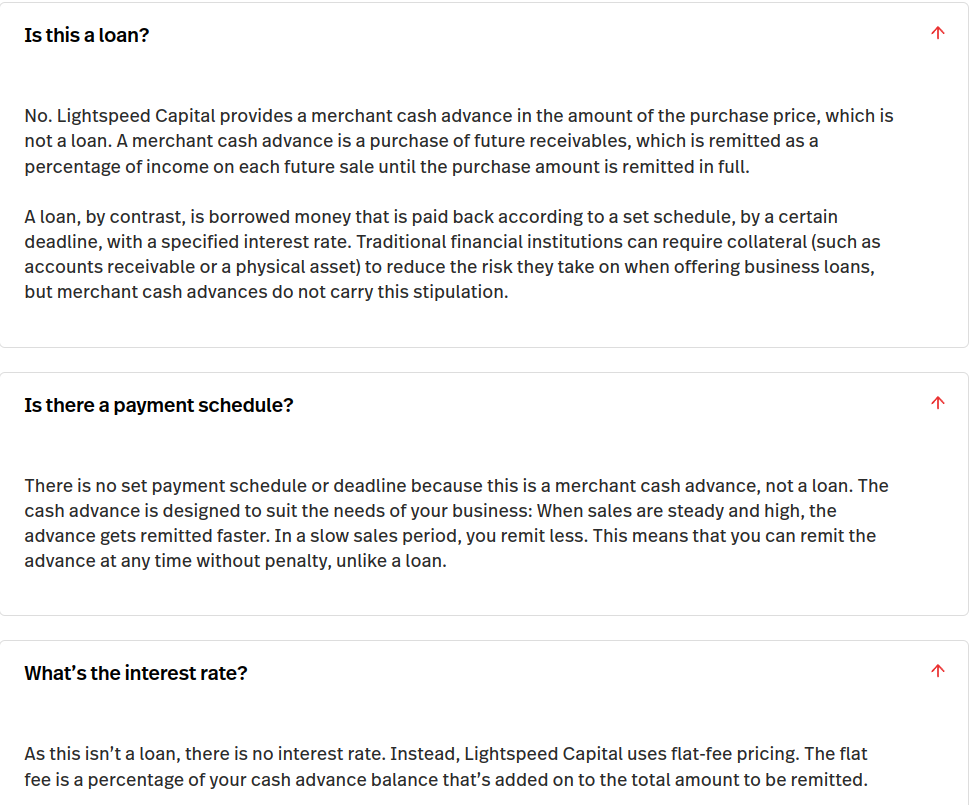
AMAZON
A [merchant cash advance is a] non-revolving sum of funding with flexible payment, no personal collateral required and no late fees. With flexible payment, no personal collateral required and no late fees, a merchant cash advance provides sellers funding to help run and grow their business. Unlike interest-bearing loans, the advance ties payment to a portion of a seller’s future sales for a fixed capital fee, there are no additional fees or interest charged.
NERDWALLET
Fixed withdrawals from a bank account
Merchant cash advance companies can also withdraw funds directly from your business bank account. In this case, fixed repayments are made daily or weekly from your account regardless of how much you earn in sales, and the fixed repayment amount is determined based on an estimate of your monthly revenue.
PAYPAL
A merchant cash advance is not a loan, but rather a type of financing that business owners pay back with a percentage of their future sales.
Capify Announces New Appointment to Lead Broker Division
March 7, 2024Leading online SME lender, Capify, has appointed Mike Morris to lead its broker business in the UK.
Mike joins Capify after five years with Funding Circle, most recently as Head of Business Development, where he was responsible for leading the lender’s broker network.
With nearly 20 years experience in the finance industry, including time at Close Brothers retail finance, Mike will focus on the growth and expansion of Capify’s introducer relationships and its marketplace offering.
“I’m hugely excited to join Capify to build out its broker programme and exponentially grow this channel for one of the first online SME lenders in the UK market,” said Mike.
“Capify occupies a vital place in the funding landscape – offering much-needed fast, flexible and responsible solutions for businesses. We’re focused on ensuring that introducers understand our offering and how we can help their clients. Our growth will then be realised by launching new products that go up and down the credit spectrum, providing the best possible service to enable the brokers, and ultimately the clients they represent, to get the funds they need to thrive in the current climate. Our goal is to have an offering for all types of businesses so we can be a one-stop shop for brokers and their clients. I look forward to Capify announcing these new offerings in the near future.”
Capify was launched in the UK in 2008, against the backdrop of the global financial crisis, when many small and medium-sized businesses were struggling to access funding from banks. Last year it was named the UK Credit Awards SME Lender of the Year (up to £1m). The company was founded initially in the United States in 2002 making it one of the world’s first online alternative financing companies for SMEs globally.
John Rozenbroek, COO/CFO at Capify, said: “We’re absolutely delighted to welcome Mike to the Capify team. Brokers play an integral role in helping businesses understand the complex funding landscape and the types of finance that are best suited to their needs. His appointment underlines our commitment to introducers and marks an exciting new stage in Capify’s continued growth.”
ABOUT CAPIFY
Capify is an online lender that provides flexible financing solutions to SMEs seeking working capital to sustain or grow their business. Alongside its sister company, Capify Australia, the fintech businesses have been serving their respective markets for over 15 years. In that time, it has provided finance to thousands of businesses, ensuring the UK’s vibrant and vital SME community can meet the challenges of today and the opportunities of tomorrow.
For more details about Capify, visit: http://www.capify.co.uk
Capify Contact:
Ash Yazdani, Marketing Director
ayazdani@capify.co.uk
Media enquiries
Sam Gallagher, Director
sam.gallagher@1473media.com
CFG Merchant Solutions Upsizes Corporate Note to $30.0 Million
March 6, 2024NEW YORK, NY. March 6, 2024 – CFG Merchant Solutions, LLC (“CFGMS” or the “Company”), a technology-enabled specialty finance and alternative funding provider, announced the upsize to $30.0 million of its investment-grade corporate note. The transaction was assigned a BBB rating by a nationally recognized statistical ratings organization.
Since its founding in 2015, CFGMS has a proven track record of asset performance and profitability, and has funded more than $1.3 billion to over 31,000 small and medium-sized businesses (SMBs) across diverse industries throughout the U.S. The Company plans to use the proceeds from the issuance to support continued growth of the business.
Our business has experienced considerable growth as banks and other funders have pulled back on credit over the past year,” said Andrew Coon, Chief Executive Officer of CFGMS. “This additional capital will help us continue our momentum in serving SMBs across the U.S.”
Bill Gallagher, President of CFGMS, added, “At CFGMS, we believe our unique platform is differentiated from other funders across the space. We are pleased that institutional investors share this view and continue to support us. This flexible capital will be very valuable as we seek to gain further market share.”
Brean Capital, LLC served as the Company’s exclusive financial advisor and sole placement agent in connection with the transaction.
About CFG Merchant Solutions
CFG Merchant Solutions (“CFGMS”) is an independent, technology-enabled alternative funding platform focused on providing capital access to small and mid-sized businesses that have historically been underserved by traditional financial institutions and may have experienced challenges obtaining timely financing. The Company utilizes its historical transactional data, proprietary underwriting, predictive analytics, and electronic payment technologies and platforms to assess risk, and provide access to flexible and timely capital.
For additional information about the Company, visit: https://cfgmerchantsolutions.com/.
Contact:
Name: Richard Polgar
Title: Chief Financial Officer
rpolgar@cfgms.com
Shopify Capital Renewal Rate Greater than 70%
February 13, 2024Shopify Capital’s funding business is continuing to gain momentum, according to the company’s latest quarterly earnings. Shopify stopped specifying precisely how much it is originating (perhaps because AltFinanceDaily kept turning those numbers into posts every quarter for years) but still lists the receivables from its loans and merchant cash advances as a line item on its balance sheet. There the balance increased from $580M to $816 year-over-year.
“We know the capital product has been effective because we’re seeing a repeat renewal rate of over 70%, a testament to our ability to help merchants access the funding they need for growth, particularly ahead of key sale times, including the crucial Q4 holiday shopping season,” said Shopify President Harley Finkelstein during the call.
SellersFi Announces Financing Solution With Amazon Lending To Provide E-Commerce Sellers Credit Lines Up to $10M
January 30, 2024Weston, FL, January, 30, 2024 – SellersFi, a global e-commerce financing and financial services company, today announced a financing solution with Amazon that will provide eligible Amazon sellers with access to credit lines of up to $10 million through Amazon Lending.
Through this relationship, eligible Amazon sellers can now seamlessly access broader lines of credit to support their Amazon stores.
“SellersFi was launched seven years ago to address e-commerce sellers’ paramount challenge: to secure the right capital to grow their businesses,” stated Ricardo Pero, co-founder and CEO of SellersFi. “This relationship with Amazon highlights our dedication to transforming e-commerce financing to empower small and medium-sized businesses with the accessible financial tools they need to focus their energy and aspirations on amplifying their businesses and attaining exceptional growth.”
Sellers face a range of hurdles in building successful online businesses including competition, order fulfillment, visitor conversion, marketing and more. Even when effectively addressing those factors, however, 32% of e-commerce startups fail due to running out of money, according to research by Marketing Signals. These lines of credit from SellersFi and Amazon Lending are meant to support sellers experiencing such challenges.
“Working with the Amazon Lending team has been an exceptional experience for SellersFi,” said Leonardo Felisberto, Head of Global Business Development and Partnerships at SellersFi. “Their dedication to empowering sellers aligns perfectly with our mission, and together, we’ve unlocked more possibilities for e-commerce entrepreneurs. We’re hopeful this can be another step toward supporting the growth aspirations of online sellers in the US and beyond.”
“Amazon is committed to providing our sellers with flexible and convenient access to capital, regardless of their size,” said Tai Koottatep, director and general manager, Amazon WW B2B Payments & Lending. “Through this lending option with SellersFi, we’re able to strengthen that commitment and offer sellers even more opportunities to grow their business.”
This announcement bolsters SellersFi’s expansion as a financial services platform. The company currently offers working capital, prepaid debit cards and digital wallets with insurance, business credit and debit, and checking accounts in the pipeline.
For more information about investment opportunities with SellersFi, please visit www.sellersfi.com. To learn more about SellersFi lines of credit via Amazon Lending, please visit sell.amazon.com/programs/amazon-lending.
About SellersFi: SellersFi, formerly SellersFunding, is a global financial technology company that utilizes AI-driven credit scoring models and extensive integration with leading e-commerce platforms to offer working capital and cash management solutions to empower e-commerce merchants looking to grow. As e-commerce evolves, SellersFi will drive the fintech innovations that allow sellers and brands to worry less about funding and finance and to focus more on growth and achieving their business goals. From inventory and marketing to product launches, international expansion, and more, thousands of e-commerce sellers trust SellersFi to achieve limitless success.
Surprising Stats of 2023
December 27, 2023Remember when interest rates soared, banks collapsed, and experts began to prepare for the worst? Well, appearances can be deceiving.
Business loan origination volume at Square, Enova, Shopify, and Funding Circle are all on track to surpass 2022’s numbers. When it came to bad debt, PayPal was the only large tech lender to announce that it had become a problem this year. PayPal’s origination numbers are consequently also down year-over-year.
The S&P 500 was at 3,839.50 one year ago and closed at 4,774.75 yesterday, a gain of more than 24%.
Unemployment was 3.5% last December and had only modestly increased to 3.7% this November.
Inflation was 7.1% last November and only 3.1% this November.
Bitcoin is up by 150% year-over-year!
Anecdotal reports at smaller non-public small business funders, however, have hinted at bad debt increases all year and underwriting has generally become more conservative. Despite this, brokers are still brokering deals and funders are still funding. The predicted mass AI-induced layoffs have also not yet materialized. In the grand scheme of things, the argument could be made that 2023 was actually a pretty good year.
But 2024 could be dicey.
- The FCC closed the lead generator loophole.
- The first wave of small business finance companies will have to begin complying with new CFPB regulations.
- It will be a presidential election year like none ever experienced before.
- Americans are overleveraged. Forty percent of student loan borrowers failed to make a payment after the covid-era pause ended.
- General economic, societal, and political unease.
So what will happen? I guess we’ll find out. It could be terrible or awesome or anything in between.
AltFinanceDaily’s Top Five Stories of 2023
December 13, 2023 deBanked’s most read stories of 2023 are in. Here’s what the industry read about most this year!
EIDL & ERC Updates
Readers tuned in to learn about EIDL loans going bad and the roller coaster surrounding the ERC program.
See:
As IRS Announces Pause of ERC Payouts, Businesses May Resume Pursuit of Upfront Alternatives
Whoa, That’s a Lot of Bad EIDL Loans
Reliant Funding
There was a lot of talk about Reliant Funding this year, which first made waves in February and then later in September.
See:
Reliant Funding Shifts Gears
The LCF Group Acquires Key Strategic Assets from Reliant Funding and Sets Course for a Record-Breaking Year
GFE
The company is called Global Funding Experts. After they raised a debt facility of $100 million, everyone wanted to know more!
See: Experts: How GFE Went Big
Bluevine Cutting off ISOs
The news just broke, but seeing a big name change their business strategy like this has got many people talking.
See: Bluevine Partner Email Circulates
Florida Commercial Financing Disclosure Rule
Guess what’s about to go into effect? A unique disclosure rule like nowhere else. Brokers, I hope you’ve read this one!
See: Pending Florida Law Draws From DailyFunder’s Rulebook
Top stories of 2022
Top stories of 2021
Top stories of 2020
Top stories of 2019
Top stories of 2018
Top stories of 2016
Legal Risks: Penalties for Non-Compliance in Revenue-Based Financing
December 11, 2023Jeffrey S. Paige is the General Counsel of CFG Merchant Solutions. Visit: https://cfgmerchantsolutions.com
Staying compliant with disclosure legislation and regulations is paramount for revenue-based financing funders and brokers alike. In states such as California, Virginia, Utah, New York, Georgia, Connecticut, and Florida, there are specific requirements to which commercial financing funders must adhere. Funders and brokers who fail to comply with these requirements could face significant legal and/or financial penalties. Funders and brokers are encouraged to consult their legal counsel to ensure full compliance with all laws and regulations of every state in which they transact business.
California Code of Regulations Title 10, Chapter 3 – California Financing Disclosure Law (Effective December 9, 2022):
Starting on December 9, 2022, commercial financing funders in California are required to provide clients with certain disclosures, including the controversial APR calculation. This became mandatory following the issuance of final regulations by the California Department of Financial Protection and Innovation (DFPI) on June 15th to implement the California Code of Regulations Title 10, Chapter 3. Violations of these disclosure requirements in California can lead to significant penalties, reaching up to $10,000 for willful violations, along with the possibility of imprisonment for licensees who commit violations. To maintain compliance and avoid penalties, consult with your counsel to ensure your disclosures are timely and set forth all required information, including but not limited to:
- Total amount of funds provided
- Total dollar cost of the financing
- Term or estimated term
- Payment details
- Prepayment policies
- Total cost of financing expressed as an annualized rate
Virginia HB1027 – Virginia Financing Disclosure Law (Effective July 1, 2022):
Virginia enacted HB1027, introducing disclosure and registration requirements for sales-based financing funders. Funders conducting business in Virginia are obligated to conform to these regulations, which include but are not limited to:
- Registration: Funders and brokers in revenue-based financing must register with the State Corporation Commission and subsequently renew annually.
- Disclosures: Disclosures for specific financing offers are mandatory, covering total financing amount, finance charges, total repayment amount, estimated payments, payment amounts, and applicable fees.
- Virginia’s Distinction: Unlike California and New York, Virginia does not mandate the disclosure of an annual percentage rate (APR), focusing on the disclosure of the total cost of capital.
Non-compliance with Virginia HB1027, the Virginia Financing Disclosure Law, exposes businesses to substantial penalties. The law empowers the Virginia Attorney General to seek injunctions for violations, in addition to restitution payments, damages, and attorney’s fees for violations.
Utah SB183 – Utah Financing Disclosure Law (Effective January 1, 2023):
Engaging in a commercial financing transaction as a provider in Utah or with a Utah resident has become unlawful unless one is registered with the Utah Department of Financial Institutions (DFI). This registration, akin to California’s process, must be renewed annually through the Nationwide Multistate Licensing System (NMLS). Utah’s unique framework explicitly states that non-compliance does not affect the enforceability of transactions, nor do violations give rise to a private cause of action against the funder. However, civil penalties are not to be underestimated. Violators can face penalties of $500 per violation, not exceeding $20,000 for all violations. For repeat offenders, especially those who receive written notice of prior violations, penalties can escalate to $1,000 per violation, capped at $50,000. To ensure compliance with Utah SB 183 and avoid legal trouble, ensure proper and timely registration and annual renewal. Also, consult with counsel to prepare the required disclosures, which feature (but are not limited to) the total amount of funds provided, the total cost of financing, and any other pertinent material terms and associated costs as required by the regulations.
New York Commercial Financing Disclosure Law (August 1, 2023):
The New York Commercial Financing Disclosure Law (CFDL) mandates standardized disclosures for unregulated financial institutions engaged in commercial financing transactions. Funders failing to comply may face civil penalties, with fines reaching up to $2,000 per violation or $10,000 for intentional violations. In addition, for knowing violations, the Superintendent of the Department of Financial Services can impose restitution payments and/or injunctive relief. Disclosures include, but are not limited to:
- The total amount of funds provided
- The total cost of financing (expressed as an annualized rate)
- A description of the financing product
- Other material terms and fees
- The name and contact information of the funder
- A statement that the borrower has the right to cancel the deal within three business days of receiving the disclosures
- Timing: The disclosure must be given to the borrower when a specific commercial financing offer is made.
- Any portion of the amount financed used to pay unpaid finance charges or fees (referred to in the legislation as “double dipping.”)
Funders should proactively integrate these disclosures to align with New York’s regulatory standards and foster a culture of accuracy and responsibility in commercial financing practices.
Georgia Commercial Financing Disclosure Law (Effective January 1, 2024):
Effective January 1, 2023, Georgia’s Commercial Financing Disclosure Law mandates clear and detailed disclosures for commercial financing funders. The law amends Georgia’s Fair Business Practices Act, applying specifically to providers of commercial loans and accounts receivable purchase transactions under $500,000. Transactions are defined as purchases of accounts receivable or payment intangibles, strategically avoiding loan classification, and notably, no licensing or registration requirements are imposed on funders. Funders failing to comply with these disclosure requirements face potential civil penalties, ranging from $500 to $20,000, with additional penalties for continued non-compliance after notice. Importantly, these penalties do not compromise the enforceability of the transactions, and it is noteworthy that the law does not grant a private right of action.
Disclosure Requirements:
- Providers must disclose key terms: total funding amount, net funds disbursed, total payable, financing cost, payment schedule, and prepayment penalties.
- Unlike California and New York, Georgia’s law does not mandate APR calculation.
- The definition of “Providers” is consistent with Utah’s Commercial Financing Registration and Disclosure Act.
- Covers those engaging in more than five commercial financing transactions in Georgia annually, including online platforms partnering with depository institutions.
Florida Commercial Financing Disclosure Law (Effective July 1, 2023):
Effective from July 1, 2023, commercial financing funders in Florida are mandated to comply with the requirements of the Florida Commercial Financing Disclosure Law.
Florida Law Disclosure Requirements:
Non-compliance with these regulations can result in fines ranging from $500 per incident to an aggregate of $20,000, with possible aggregate penalties up to $50,000 for continued violations after receipt of notice. As with other states, transparency in financial dealings is paramount, and funders should stay updated on regulatory changes to ensure continuous compliance.
Connecticut Financing Disclosure Law (Effective July 1, 2024):
Connecticut sets a clear deadline for funders and brokers to register with the state banking commissioner by October 1, 2024. Additionally, the Connecticut Financing Disclosure law requires funders to disclose:
These regulations apply to entities providing commercial financing, and failure to comply can result in severe civil penalties of up to $100,000. The commissioner additionally holds the authority to enjoin those violating the statute. Understanding and fully complying with these requirements is crucial for funders and brokers that transact business in this state.
The Imperative of Adhering to Evolving Commercial Financing Disclosure Laws
The regulatory frameworks in California, Virginia, Utah, Georgia, New York, Florida, and Connecticut, coupled with impending regulations in other states, underscore a growing regulatory focus on transparency, customer protection, disclosure and equitable financial practices. With revenue-based financing facing heightened scrutiny, the strict compliance with these laws cannot be emphasized enough. Ensuring adherence is not just a best practice but a crucial necessity to avoid potential legal penalties and foster a financial ecosystem built on trust, integrity, and responsible funding practices.