
What’s Going on in California?
August 23, 2011
The people have spoken! Many of our readers have sent e-mails wondering why we don’t have any coverage on the recent events in California. So here goes:
If you’re out of the loop, a nearly 3 year old lawsuit against one of the major Merchant Cash Advance (MCA) providers is coming to a close. Their name is not important, but it is a firm we revere still to this day. The story takes place in California, where a group of merchants in 2008 contested their Merchant Cash Advance was actually a loan, not a sale. In the other 49 states, MCA has been virtually undisputed for years but California law has shades of Gray.
 There is one cardinal rule for making a loan in California and that’s to be licensed to do so. The case struck at the heart of what MCA is all about, a sale of future card payment receivables for a discounted price today. So why would a buyer of future cash flows need a lending license? The answer is not a short one and it was a heated debate that spanned 3 years.
It comes as no surprise that the end result was a stalemate. Both sides exhausted their time and energy until they called it quits with a settlement. Over $4 Million dollars will be paid to the legal team representing the plaintiffs. That’s big bucks for a group that was unable to prove over the course of 3 years the need for a lending license to conduct a sale.
While the affected merchants, attorneys, and the MCA provider are eager to move on, a particular California law firm seems to have grabbed the baton. As of early March 2011, at least 3 other MCA providers are now facing the same situation. We’ve seen the court filings and it’s essentially the same challenge and question of licensed lending.
However, when considering the absolute unlikelihood that these independent lawsuits would have come together at the same time without extreme goading by their class representation attorneys, we are highly suspicious of the motives behind them. The timing implies that merchants funded by MCA provider A, MCA provider B, and MCA provider C all approached the same law firm at the same time with the same problem. This may have been possible if each provider structured a deal in the exact same manner. Rather, each provider used different contract language and there is no commonality between them outside of the tendency to all describe their product as a “Merchant Cash Advance”.
We are therefore inclined to believe this law firm is taking the “throw shit at the wall and hope something sticks” approach. Keen to the $4 Million windfall to be reaped in the case described above, it is reasonable to believe these attorneys went searching for customers of all MCA providers and invited them to be plaintiffs in their frivolous suits. There’s no precedence that they’ll win, but there is for a settlement, and a settlement could mean millions of dollars in representation fees.
Some of The Merchant Cash Advance Resource’s top connections can attest that this particular law firm spent a substantial amount of time surfing the net for all MCA providers in California. Using their web traffic analytics and tracing the activity to their domain name, it certainly appears they’re going shopping for “victims.” If we are right, expect more lawsuits from them in the next few months.
To add insult to injury, these events coincide with tough economic times. MCAs are widely celebrated as the easiest, most flexible financial option available to small businesses today. Over half a billion dollars was funded in 2010 alone. With the Federal Government struggling to do the same, it is troubling that a few slick lawyers are seeking to take the lifeline away.
Treasury offers funds to spur business lending
The SBA is in shambles, the unemployment rate is extraordinary, and banks are unwilling to lend. That’s not a great combination for America’s small business owner. Fortunately MCA providers have filled the gap. If steps are taken to discourage them from operating in California, millions of dollars will disappear from the state’s economy. That means less jobs, less sales, and less growth. And if that day should come, don’t point the finger at the Governor, The Federal Reserve, Obama, or the banks. You’ll be able to thank a few lawyers that robbed Californians for their own personal gain. The truth hurts.
– The Merchant Cash Advance Resource
What Recovery? Small Businesses are Still Suffering
August 23, 2011
Experts claim the economy is getting better, but average Americans have yet to claim the same. According to the March Discover Small Business Watch Survey, 54% of small business owners said the U.S. economy is getting worse. The sentiment seems to fly in the face of the stock market’s surge forward, as well as a declining unemployment rate. As of the latest March jobs report, unemployment ticked an inch downward to 8.8%. Sadly, the official unemployment rate does not count individuals that have been unemployed for an extended period of time or have given up looking for work altogether, traits that characterize many of the ACTUAL unemployed in this country. (Find out who the labor force consists of)
The unemployment rating system loses accuracy in prolonged recessions and therefore 8.8% is not valid, nor worth comparing to previous months. In an Interview with Reuters, Bill Cheney, the Chief Economist at John Hancock Financial Services stated, “It is always possible that as the job market improves, people will start looking again and the unemployment rate could go up.” That being said, the one true measure of the economy is the voice of the people.
As a member of the U.S. Chamber of Commerce, the Merchant Cash Advance Resource is constantly tuned in to the issues of small business owners. And guess what? We’re not hearing much positive feedback there either. The lending and capital markets continue to be a pressing factor, but federal, state, and local government regulations are stymieing innovation and expansion as well. From the Chamber, “With increasing uncertainty and government barriers threatening America’s economic recovery–Congressional leaders are reaching out to business owners to hear what is hindering their growth and what can be done to remove barriers.” (Watch the videos and interviews here)
In the face of discouraging news, access to capital is slowly making a comeback but not from the banks. Alternative financial firms providing a product known as a Merchant Cash Advance will buy your future credit card sale receivables in exchange for a big chunk of cash today. Different from a loan and becoming widely accepted, businesses all over the country are taking advantage of the most innovative form of financing available. In a true level playing field, ‘mom and pop’ shops are just as eligible as the major franchises to receive up to $250,000.
Next month, the experts could claim an unemployment rate of 0%. So long as the statistics fail to reflect reality, it becomes more frustrating for Americans who continue to live through a recession that never actually ended. High unemployment, scarce capital, and job killing regulations still plague commerce. We’re not experts ourselves, but if 54% of business owners testify that things are getting worse, they probably are. With the Dow at a 52 week high, now is a great time to sell…
– The Merchant Cash Advance Resource
Interchange Regulation and Reduction: Proof it will fail
August 23, 2011Originally Published on April 16, 2011.

As proponents and opponents debate debit card fee reform, few seem to be aware that interchange regulation has been
implemented before and the results were disastrous. In 2000, The Reserve Bank of Australia (RBA) published a 90 page report (A STUDY OF INTERCHANGE FEES AND ACCESS) that outlined their assessment on card payment interchange rates and the impact. It’s central thesis was this: “The study is concerned with the economic efficiency of these [payment] networks. Most importantly, are they delivering the best possible service at the lowest cost to end-users?”
Eerily similar to the U.S. Federal Reserve’s 2010 analysis, the RBA reached the following conclusion: “While a pricing system based on interchange fees still seems to be the most practical arrangement for the credit card network, the levels of interchange fees are high relative to costs and fees of this magnitude are not essential to the continued viability of this network.”
Bolstered by the findings, consumer activitsts groups pushed for regulation and by 2002, the RBA announced that 4 party payment networks such as those operated by Visa and MasterCard would need to make serious changes. Lobbyists groups fought to rally against regulation but came up short. In 2004, strict measures to limit costs became law and with that a series of unintended consequences.
The U.S. should examine the outcome in Australia, a country whose values and economic system is much like our own. 3 years before the Durbin Amendment came to pass, MasterCard did just that. In early 2007, it researched the impact and side effects of regulation in a report titled “Interchange Regulation: Lessons From the RBA Intervention in Australia.” We reviewed the rules that most closely resemble those of the Federal Reserve and have republished MasterCard’s findings below:
Regulatory Measure #1: Reduction of Interchange Costs
Intended Consequence #1: Merchant fees would be reduced, which would then be passed onto consumers, resulting in lower prices for all.
Actual Outcome: 70% of merchants did not realize that any changes had been implemented and thus did not make an effort to pass on savings to consumers. Annual reports actually showed that retailers pocketed the difference instead. This issue has been largely debated in the U.S., with many retailers openly stating that they would not pass on any savings. Proposed New Debit Card Rules May Not Help Consumers Much
Intended Consequence #2: Debit card usage expands while credit usage declines.
Actual Outcome: Debit card usage declined instead. This appears to be the same path the U.S. is on already as implementation of the law approaches. JP Morgan Chase, Bank of America and Citigroup Might Limit Debit Card Purchases
Regulatory Measure #2: Elimination of The “No Surcharge” Rule
Intended Consequence: Merchants would judiciously surcharge for accepting credit cards; and in so doing, make credit usage less attractive than debit usage; which would in turn encourage higher debit card usage.
Actual Outcome: Where surcharging actually occurred, it appeared to be mainly by brand, applied in a way that is not disclosed to consumers, and done mainly outside of retail markets. As of July 2010, the U.S. implemented a similar law under the Durbin Amendment that is already in effect. See an article we wrote on the subject back in December titled “Take Your Rewards Card and Get Out My Store!.”
The outcomes seem to answer questions that we in the U.S. are spending too much time debating. Regulation in Australia was a failure. “Contrary to the RBA’s intention of making the payments system more efficient and increasing competitive intensity, the exact opposite has happened in Australia. In addition, the payments system has actually become more expensive for the average cardholder. While there is no evidence of retail price reduction by the merchants (so confidently predicted by the RBA), there is widespread acknowlegement that issuers have actually increased fees to cardholders to compensate for lower interchange fees since the RBA regulation.”
Consumer rewards programs are already disappearing as reported by CBS News. “Banks to strip debit card rewards; What next?” This is the exact sequence of events that happened abroad. MasterCard addressed this in their report, but did not offer any hard statistics. “For the most issuers, the rewards programs have been downsized, and in some instances very substantially.”
Many believe the shortsighted push for reform has less to do with savings for retailers and consumers and more with to do with a desire for Americans to punish the banks for their role in the financial crisis. The banking industry employees millions of people so the harm intended for rich CEOs is more likely to affect the jobs of the middle class.

There is still hope. A few Senators have proposed the Debit Interchange Fee Study Act of 2011, which seeks to delay regulation for two years. This will allow the Federal Reserve to properly assess the goals they hope to achieve, come up with a better plan of action, and study the likely consequences.
While two years seems fair, we can’t help but point out the chain of events in Australia should be all the evidence we need. Ignorant disdain for the electronic payments industry is a major distraction from the real issues facing our country today. The unemployment rate, the national deficit, and the educational system all lose our full attention every time we quip about debit card fees.
Customers spend more when they pay with plastic. Consumers don’t need to carry bundles of cash in their pocket. Banks employ millions of workers. Everybody already wins. AltFinanceDaily’s advice? Let’s move on to fix a different system that’s actually broken. We’ll all be better off.
– AltFinanceDaily
Your Credit Card Processor is on the Hook for illegal Sales
August 23, 2011
A long, long time ago when I first got into the electronic payments business, I encountered a tricky situation. One of my clients owned a small retail store in a mall selling African art, sculptures, posters, and merchandise. Looking over the previous few statements, it was obvious their customers paid face to face, their transactions ranged from as low as $2 to as high as $150, and that they conducted about $10,000 in sales per month. I was happy to have saved them a few bucks and made my way on to the next client.
Three weeks later I was called into the boss’s office. He stared at me intently and asked in a very serious tone “What do you know about this art store?” I replied with what I knew but was confused as to what the fuss was about. That very same art store had run three transactions for $7,000 in one day, all with foreign credit cards that were hand-keyed into the machine. Red flags went off and the processing account was frozen. The sales were far in excess of $150, he processed double what he would normally do in a month all in one day, the transactions were not conducted face to face, and the cardholders were not in the U.S. It didn’t look good.
I, with my boss, called the art store to determine what had happened. The owner explained that his brother owned an adventure touring business in Kenya. Since he didn’t have the ability to accept credit cards, he would occassionally take the card information from customers, call his brother in the U.S. and have him run the transactions for him at the art store. Once the deposit cleared, the proceeds would be wired back to his brother in Kenya and the customers would be told that their adventure tour was approved.
That’s not exactly art, sculptures, posters or merchandise now is it? We didn’t catch it because they hadn’t done this in any of the previous three months statements they supplied to approve the account. To our surprise, the banks reached the card holders who confirmed the transactions were legitimate and they had actually intended to pay $7,000 each for tours in Kenya. The only problem was that this retail store merchant account wasn’t approved for such use, nor could sales be processed by one business on behalf of another.
The result was termination of the account and a crash course for me in the school of electronic payment schemes.
All that was nothing compared to the shocking message online poker players received when trying to access fulltiltpoker.com and others on April 15th. A screenshot is below:

Online gambling is illegal and U.S. based banks are not allowed to process payments for gambling. So how did online poker sites accept card payments for over a billion dollars? They lied to the credit card processors about what they did or induced them to commit fraud in order to reap big profits.
As reported by Forbes, the scheme was very complex. the poker companies created multiple fake online shopping sites that supposedly sold flowers, pet supplies, and other items. So when a gambler used their Visa card to load their poker account with $100, the poker company would create a false invoice that showed $100 worth of flowers had been sold and shipped to the customer. The scheme was so efficient that it remained undetected for years.
As stated on Forbes “Federal prosecutors claim that the men behind PokerStars, Full Tilt and Absolute Poker, relied on highly compensated payment processors who lied to U.S. banks about the nature of financial transactions they were processing.” Shame on them.
I bet my old boss is shaking his head right now after hearing this on the news. No doubt all the new sales representatives are in his office, being stared at intently and spoken to in a serious tone. “What do you know about these poker sites you’re hearing about?” Confused by all the fuss, I’m sure they’re learning just like I did, that payment processing is a very, very serious business. Keep it clean and play by the rules.
– AltFinanceDaily
The Fork in the Merchant Cash Advance Road
August 23, 2011Originally Posted on April 25, 2011 at 10:48 PM
The Merchant Cash Advance (MCA) industry is growing, albeit slower than some may have you believe. But it’s moving in two opposing directions, a condition that’s making it tougher to describe the financial product itself in general terms. MCAs are becoming more expensive and a lot cheaper at the same time. HUH? You read that right.
Originally aimed at business owners with poor credit, the risk of default or delinquency was overcome by withholding a percentage of sales revenue directly. As the credit crisis and Great Recession took hold, it attracted businesses of all credit backgrounds and today it’s widely accepted as a lending alternative, rather than a solution to poor credit.
As MCAs pushed forward to compete for customers normally accustomed to bank credit lines, the cost was stiffly resisted. These businesses had a tough time envisioning their financing terms to be anything outside of some percentage over the Prime Rate. Since a MCA is supposed to be structured as a sale, there is no APR equivalent, no timeframe, no amortization, nor any real familiarities of a loan. As the past couple years have passed, the product is more publicly understood, but for it to actually catch on, the costs had to come down. Many funding providers now refer to such high credit, low cost accounts as premium, platinum, preferred, gold, etc.
While the margins earned on high credit accounts shrank, funding providers were dealing with another challenge simultaneously, defaults. Whether the business owner intentionally interfered with their credit card processing or the store went out of business altogether, bad debt in the MCA world was mounting…FAST!
No matter which company ran the figures or how secret these portfolio statistics were, every funding provider came to the same realization. The lower the credit score of the business owner, the greater the chance of a problem. Why this came as any surprise, is a surprise in that of itself. The Fair Isaac Corporation (FICO) will have you know that any individual with a score below 499 has an 87 percent chance of being delinquent on a credit payment within the next 2 years. Delinquent, is defined as a payment of 90 days or more past due.

But wait… if a MCA is not a loan, nor does it depend on the business owner to make payments, then how can there be a risk of delinquency? Intentional manipulation of the revenue flow back to the funding provider can be relatively easy to do. A business owner could use spare POS equipment to accept card payments for which the funding provider is not aware of and therefore prevent the collection of funds. That’s a method known as splitting, and serious consequences can result when discovered. (Read more on what happens in the case of default or deliquency on a MCA in a previous article)
But outside the scope of malice, there’s the traditional reason, the inability to make payments. If the suppliers and wholesales aren’t being paid, then the business isn’t going to have inventory on hand to sell. If the rent isn’t being paid, then there’s not going to be any location to generate these sales. Essentially, the funding provider has a mutual interest in the business being able to satisfy ALL of their obligations, not just the MCA itself.
If there is an 87% chance that suppliers, landlords, or other essential creditors will not be paid on time in the next 2 years, then there’s an excellent probability that the business will be unable to operate at the same level. With no collateral as protection, the MCA industry has adapted to the challenge by raising the cost. Business owners with poor credit can expect funds to be expensive and the terms to be more restrictive. Lower funding amounts, higher withholding percentages, and the sacrifice of any negotiation is the price the MCA industry has set to make funding to the maximum risk group possible. These programs, which are now often referred to as starter advances, don’t work for everyone so the pros and cons should be weighed prior to executing a contract.
Both the premium advances and starter advances have experienced extraordinary growth to the point where they have become niches of their own. There are now starter advance companies and premium advance companies. Funding providers like Strategic Funding Source have taken the product a step further and reportedly did a MCA for an exhibit at the Tropicana Hotel in Las Vegas for $4 Million. Contrast that with deals that are struck for as little as $750. And we can’t fail to mention that some have taken it back to the basics, a loan. ForwardLine in Woodland Hills, CA lends money to businesses which are then repaid in accordance with a predetermined, fixed pace through the card sales. They have reintroduced concepts like APR back to the finance world.
If we continue at the current pace, MCAs will become less expensive, more costly, a lot bigger, and markedly smaller. We’ve come to the fork in the road for what the Merchant Cash Advance industry seeks to brand itself as. Loan alternative? First choice? Backup plan? Is it for smaller businesses or larger ones? Should it go the way of lending or continue to remain a structured purchase of future card sales? Is industry cohesion really necessary or will increased decentralization lead to greater acceptance of this financial product a whole? Will there come a time when America’s big banks swallow the industry up, buy out the existing portfolios, and add this product to their financing arsenals?
These are tough questions. Merchant Cash Advance is evolving, growing, and no longer moving in one direction. While we contemplate our next step, one thing is for certain, there’s no turning back.
– AltFinanceDaily
www.merchantprocessingresource.com
The Merchant Cash Advance “Don’ts”
August 22, 2011In sales training, young men and women are taught to negotiate with positive language to close a deal. For example: “We can’t meet the deadline” is replaced with “We can achieve the objective, but we may need to extend the deadline.” Or “We don’t offer that service” is transformed into “We offer many services that can add value to your business but that particular one is a challenge.”We apply a bit of that psychology when developing resources for business owners. People are a lot more open to input when you cast out the negativity. So it’s a bit ironic then that we created a printable reference form, titled The Merchant Cash Advance “Don’ts”. Though it may be perceived as a little condescending, this little banker/business pep talk can protect you from making a major mistake that could cost your business money. So keep it handy even if you don’t plan on applying in the near future.
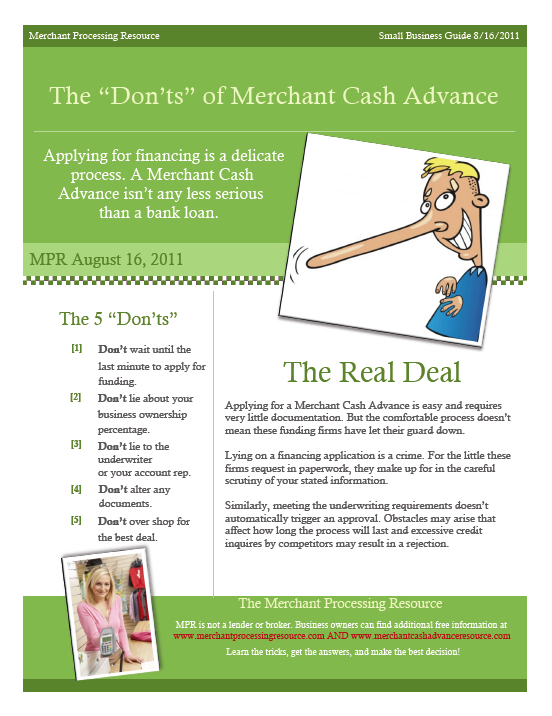
1. Don’t wait until the last minute to apply for funding.If a firm is advertising funding in 3-5 days, don’t put yourself in a position where you MUST have the funds in 5 days or less. The underwriting process may take longer than you anticipate. The advertised timeframes generally describe a perfect situation. For example: If all documents are received by day 1, all references checked out by day 2, you could potentially receive funds by day 3 assuming the technical setup is already completed. There are situations where business owners have spent 10 days waiting to obtain a copy of their lease from their landlord, which piggybacks onto the 3-5 days. Additionally, supplemental paperwork may be asked for, a trade reference might be unreachable, or your method of card acceptance might require more time to integrate. Anything can happen so don’t wait until the last minute!
2. Don’t lie about your business ownership percentage.This might be seem like silly advice but underwriters report that it’s a growing trend. People with low credit scores tend to assume that they will be declined for their score alone. Therefore they may feel inclined to state that a partner, friend, or family member with excellent credit is the owner of their business and not them. This is bad for several reasons:
- Credit score isn’t the sole determining factor for a Merchant Cash Advance. So why lie?
- Misrepresentation of ownership will be discovered and the application declined.
- Misrepresentation to obtain financing constitutes fraud and is a crime.
3. Don’t lie to the underwriter or your account rep.The liar loans of the mortgage boom ultimately led to the financial crisis and lending shortage. That means the days of declaring whatever you want to obtain the deal you want, are gone. If you state that you generate $100,000 in sales per month, be prepared to show documentation that backs up that claim. Your sales agent or account rep is probably compensated if you close on financing. That doesn’t mean they will help you get there at all cost. They are bound by a certain code of ethics and all applicable laws. If they become aware of any misrepresentation or intended misrepresentation, don’t expect them to be an accomplice to your dishonorable act. If you put them at risk, they will inform the underwriter and terminate your application.
4. Don’t alter any documents.Changing the expiration date on a lease, editing out the embarrassing withdrawals from the bank statements, or any other more or less blatant alteration will result in a rejection. Merchant Cash Advance underwriters are extremely adept in detecting alterations and fraud. Altering documents in an attempt to secure financing is a crime. You are well advised not to try this, no matter how harmless you may perceive the alteration to be.
5. Don’t over shop for a deal.You are entitled to obtain quotes from multiple sources, but don’t press your luck. Too many credit inquiries can spook an underwriter. For one, it tends to drive down the margins that will be earned because competition, thus making the deal less profitable for them and less attractive to put on the books. On the other hand, they may suspect that the other firms declined you and therefore they are being picked as a last resort. When underwriters start to feel this way, your approval may be retracted and it can be a tough battle to convince them to change it back.
We promise next time to provide a guide full of “Do’s”! But for now, we’re making it a point that Merchant Cash Advance is a serious business. The process may be fast and easy, but don’t get too comfortable and make claims you can’t back up. That will lead nowhere good…
– The Merchant Cash Advance Resource
http://www.merchantcashadvanceresource.com