
The Bubble That Wasn’t
August 17, 2012“The smaller the loan, the more likely a lender will deny it. The denial rate for applications for small loans (less than $100,000) was more than twice as high as it was for bigger loans.”
– CNNMoney 8/16/12
In early 2009, a very wise friend of mine gave me a bit of advice. As an ex-stock broker who made his fortune in the 80s, he’d seen his fair share of bubbles. And so he bestowed upon me his wisdom that the Merchant Cash Advance (MCA) industry’s days were numbered. “It’s got 6-8 months left of life in it and then it’ll go away. Everyone’s in freakout mode right now but things will go right back to the way they were and banks will push you right out of a job,” he lectured me. My expression didn’t change, for he wasn’t the first one to sing me this cautionary tale. He continued on, “You’re a nice guy so I suggest in the next few months, you go out and get into another line of work. You can always look at this experience as a wild ride but MCA is a fringe industry borne out of the financial crisis.” I thanked him for looking out for me and went home that night to mull over what he and a few others had been saying.
 No one wants to believe their thriving business is part of a bubble that will inevitably burst. But at the same time, no one wants to later on be perceived as that naive fool that couldn’t see an obvious end coming either. And while the career itself seemed honorable and sustainable (helping small businesses get financing), there were a lot of pivotal moments along the way that made me think for a second that at any day I could be told to pack up my stuff and go home because there was suddenly no more demand for MCA.
I am reminded of the time when a Craigslist Ad was answered by over 500 recently laid off mortgage brokers and underwriters. Some had literally been hired to underwrite mortgages, only to be told days later that their division was closing down. Similarly, there were hot shots from the payday loan industry who stopped by to learn what our business was all about. These people looked like they had been punched in the gut and told stories of major success followed by unforeseen ruin as states legislated them out of business overnight. And still others had the mentality that MCA was a get rich quick scheme and went on to run their own funding companies or brokerage offices into the ground within a matter of months. They cursed the MCA gods and the bubble they believed they were a victim of, ignoring the reality that they had poorly managed themselves into oblivion.
As the 6 to 8 month timeline for destruction expired and the light shone on those still standing, I realized I had made the right choice by sticking it out. MCA was not a progeny of the financial meltdown. Heck, the product itself had already been around since the late 1990s and had gained significant popularity around 2005 when other players began entering the market. It also had none of the trademark signs of a bubble. If financing businesses was a bubble, there would be no such thing as banks today. Business financing has been around for literally thousands of years. MCA firms just catered to the ones that banks ignored and by 2008 that included nearly every small business in the country. One could argue that the growth rate of MCA would eventually slow down, supporting the claim with the same wisdom I had heard nearly a year before, that everything would return to “normal.”
Today’s world is anything but the world of yesterday. The unemployment rate in July was 8.3% and according to a survey reported by CNN, “[Today], the option most often sought by businesses — opening a new credit line — face[s] the lowest approval rate at 13%” Banks never did return to their old ways, nor does it seem likely that they will any time soon. Those that doubted MCA’s longevity in 2009, including those who left the industry altogether back then in fear, did not foresee the many roads of evolution that would allow it to thrive.
Years ago, an MCA was easily defined as a purchase of future sales that would ideally be completed in 6 to 9 months. Virtually every provider offered identical terms and costs, which stymied competition and eventually created stereotypes that would come to haunt the image of MCA for quite some time. For a while, America had a hard time envisioning MCA as anything but a 1.38 factor rate that was available to those that fit a certain credit criteria and processed a minimum amount of credit card sales monthly. So imagine the shock some small business owners felt when approved by RapidAdvance, a veteran MCA firm, for a ::gasp:: small business loan. A loan?! could it be? Yes, MCA has been semantically broadened to include many forms of short term lending. And then there’s Florida based Merchant Cash Group that became famous with their Fast Funding program, a financing option for businesses that fell outside the box for traditional MCAs. Some companies don’t even require businesses to accept credit cards as a form of payment. “Credit card sales? Who cares how much they’re doing in credit card sales?!” Would you ever imagine an MCA rep making such a statement in 2009?
MCA is still widely considered to be tied to credit card processing and it doesn’t ever need to officially evolve away from that. Withholding a percentage of sales directly from a payment processor is what initially allowed the many business owners that were horrible at making monthly payments suddenly eligible to receive capital. But for all the changes that have been applied to the financing product itself, something has changed with the companies offering it as well.
Competitors used to be ultra secretive about their practices. An MCA firm could be underwriting an application that another MCA firm funded the day before. Sure, the merchant wasn’t supposed to hop around and do this with more than one company at a time, but the other firm wouldn’t even confirm if they funded them if you asked. One of the great failures of the past was the lack of cooperation amongst the players in the industry. An ‘every man for himself’ mentality hurt more than it helped in a business that was struggling to create its identity in the mainstream world of finance. The North American Merchant Advance Association (NAMAA) sought to correct that through data sharing and the promotion of common standards. Some of the major members have years of experience under their belt including Merchant Cash and Capital, Strategic Funding Source, RapidAdvance, and Merchant Cash Group. These firms have been around the block and back. “MCA bubble? What bubble?,” they’ll say with 100% confidence in their tone.
 So why a boring history lesson on MCA today? It’s only fitting on the day that CNN declared the bursting of the social media bubble, that I re-visit a decision I made 3 years ago. “I’m just looking out for you kid,” a mentor once told me. Bad advice for sure. This year, I am noticing many people that left MCA years ago are coming back. After so much time has passed, they are STILL getting in early on something that’s going to be huge, rather than coming back to ‘manage the decay’ (did I just take a swipe at Obama?!). VCs are having a field day trying to get in on it. Accel Partners recently forged an equity deal with Capital Access Network with the ultimate goal of what I’m guessing is to one day go public.
The only things bubbly in MCA these days are the excited account reps, underwriters, and support staff that are working to get America’s small businesses humming again. Some have taken to wearing their FUNDED pants 7 days a week. I know I have practically worn mine out.
I’m always struck now by the college grads that ask me if this business is sustainable. Their anxious parents are worried sick that their babies are going to be caught up in some bubble and be out of a job 6 to 8 months from now. To this I offer a few words of wisdom. “Providing small businesses with capital isn’t going away anytime soon. Sure, the product might evolve and the economy will change, but the fundamental demand for short term financing is here to stay. You seem like nice parents so I’d hate to see your kid get involved in some other industry at the end of its life cycle. He or She is getting in early on something big, something long lasting, something that has become a permanent staple of the American financial system.” Good advice for sure.
By: Sean Murray
Founder of Merchant Processing Resource (../../)
Began career in the MCA industry in August, 2006
P.S.
The FUNDED pants do exist and were created by Next Level Funding in early 2010.
It Might Be You
August 8, 2012You are innocently eating your bologna sandwich in the lunchroom when some of your fellow elementary school friends start to giggle. You giggle a little too just because you usually all laugh at things together, even though you’re not exactly sure what the joke was. “Damn,” you think to yourself. “I got all caught up in my bologna sandwich and I missed something.” Soon others begin to laugh. You laugh nervously with them, but take a couple quick glances around the room to try and locate the source of the humor. You spot nothing, but realize the chuckles are spreading like wildfire. Some people are looking at you as if they are suspicious that you might be the only one that doesn’t GET it. So instead you double down on your laughter as if to prove you’re enjoying the joke more than they are. “I’m enjoying whatever it is we’re all laughing at more than you are!,” you say under your breath. This only makes the crowd more raucous and by now everyone is starting to point in your direction.
“Ohhhhh crapppp…”
And then you find out it is you. There you are, sitting in the cafeteria, munching on a bologna sandwich with a grade school level obscenity drawn on the back of your shirt. You don’t know who drew it or when it happened, but you quickly learn it was done in red marker, particularly the kind from the 1980s that smelled like cherry, caused dizziness, and made your nose bleed after 15 seconds. There’s always somebody getting picked on, you just never thought it would be you.

Smells Sooooo Gooddddd
“Ohhhhh crapppp…”
 It might be you. Every year or so, the MCA industry welcomes in a couple new big players. There’s always one that funds more, pays more, bends more, and brags more as they quickly cut into the marketshare that established funders have had for years. Suddenly they’re the hottest thing in town, that is until about 6 months later when they start telling their “loyal” broker shops to stop sending in new deals for a while. As the newbie’s joyride comes to an end, the established funders roll their eyes and continue on the way they always have, responsibly.
We’re not here to point anyone out or to suggest that brokers purposely send bad paper to an inexperienced funder. It’s just easy to spot the amateurs. Sadly, most people laugh at them behind the scenes until the funder calls it quits, completely unaware that they’ve been wearing a “kick me” sign on their back for months.
This could be an uncomfortable topic for some, but this rapid rise and fall scenario plays out across many industries. If your business is less than two years old, ask yourself this: Is your success a result of awesomeness or do you smell a tinge of red cherry marker?
—————
Does anyone know what the truth is anymore? These contradictory articles were both published yesterday by reputable news media outlets:
Banks Keep Lending Standards Tight For Small Firms
Fed Says Banks Ease Standards On Business, Consumer Loans
Is affirmative action coming to a funder near you?
Dodd-Frank’s small business lending time bomb
Growth in the usage of MCAs (selling future sales for cash upfront) is taking a huge chunk of market share away from traditional lenders.
Some crusty old reporters remain clueless as to why fewer and fewer businesses are turning to their banks for loans. Professor Scott Shane in BusinessWeek fumbled through his recent 700 word article in which he makes several unconvincing arguments for credit cards as being the new holy grail for business owners. Ultimately, he concedes that the decrease in small loans to businesses might simply be a benign statistical anomaly. This guy is a professor??!! Borrow, Borrow, Loan, Loan, Loan. Some people still can’t imagine a world where leveraging can happen without a borrower and a lender.
—————
Have you ever tried to peg down what exactly is happening in the credit markets? The National Federation of Independent Business has already done a lot of the work for you. A few clues:
- Small-business owners are increasingly employing personal rather than business cards for business purposes
- Fifty-seven (57) percent of small employers attempted to obtain credit from a financial institution in the last 12 months, a nine percentage point increase from 2010 with the demand for lines and cards each rising more than one-third. The demand for line renewals and loans were flat. More attempts resulted in more rejections rather than more small-business owners obtaining credit
- Poorer credit risks were more likely to try to borrow in 2011 than better credit risks, other factors equal. A number of financial factors, such as credit score, differentiate the two groups. Men and owners of larger small businesses were also more likely than their counter-parts to try to borrow
Download the full 76 page NFIB January 2012 report
—————
Some MCA underwriters hate when merchants state they aim to use the funding proceeds for “cash flow” as if its unspecific nature was code for betting on the horses. In the traditional lending world, businesses have been offering that up as a purpose for decades. From the NFIB Report:
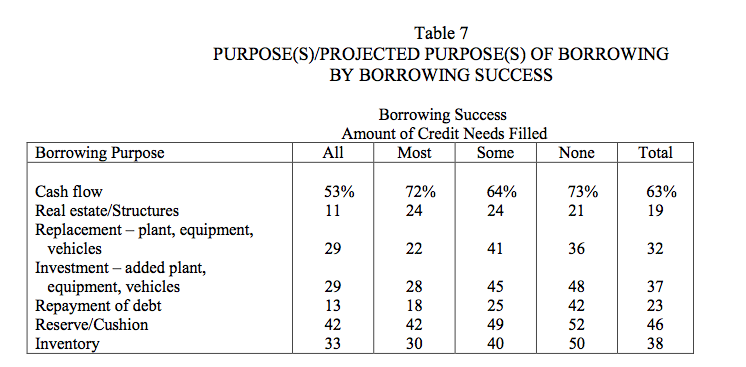
– Merchant Processing Resource
../../
The American Obsession With Startups
June 20, 2012Hi, I was just driving down 3rd Street and I saw an old building that had a For Sale sign on it. So I was just thinking it would be a great place to open a restaurant. It would have a really big outdoor eating area and I’ve always dreamed of owning my own restaurant. Lord knows I love food. I can’t talk long but I Googled loans on the Internet and you guys came up so I wanted to know if I could get a $4 million loan or line of credit to buy the building, fix it up, and make it into a Mexican restaurant, or maybe even Italian! Is that something you could do? I would need the money by friday…
This is the real transcript of a call to a Merchant Cash Advance brokerage. Don’t let anyone tell you that the U.S. is not a capitalistic society. Opportunity and entrepreneurship is so ingrained into the very fabric of our being that even self-proclaimed communists and socialists cast away their utopian worker ideals for the chance and self-satisfaction of turning something small into something big. We’re also an impulsive society, a trait partially due to our obsession with immediate self-gratification, but more to do with the fact that opportunities come and go in the blink of an eye. It is for these reasons that an individual who was taught to do market research, create a business plan, and mull things over is instead flying down the road with one hand on the wheel while the other hand is furiously applying for a $4 million loan to finance an opportunity he thought up 7 seconds ago.
How many other people driving down this road thought the same thing? How many of them have access to that kind of capital? Some might and so for the ones that don’t, the fear that someone is going to beat them to it turns them into unrealistic cash demanding lunatics. It’s true. The full service Merchant Cash Advance shops should probably offer John (the name we’re going to assign to the guy driving down the road) a proposal to help him create a business plan, form an LLC, and obtain the necessary licenses. These services would come with a price, a price that many people like John misinterpret as obstacles to be handled once he’s received the $4 Million. As John continues driving down the road, the dream of starting a restaurant is repeatedly crushed as he makes phone call after phone call to business lenders he found on the Internet. “There’s just no help for startups,” he concludes, and decides to hold off until the economy gets better before giving it another shot.
For 37 minutes that day, John was one of the many millions of startup businesses searching for capital. For the Merchant Cash Advance brokerage, he may have been one of the few hundred phone calls an account rep was bogged down with, while trying to help businesses that have been open for at least 1 year. The account reps have probably heard it all. “I want to start a home-based gas station“, “I need twenty million dollars for a good idea that I can’t tell you what it is because I don’t want anyone to steal the idea“, “I just got an LLC and I need $100,000 to come up with some business ideas“, “I’m gonna start an online shoe store and I need money to buy my first computer so I can get on the Internet.” We’re not poking fun at entrepreneurs since there are plenty of those who are really serious. But for the millions that call first and think second, they’re creating a disease unique to the U.S. It’s called startup fatigue. Business lenders are losing so much money by just talking to non-business owners, that they’ve taken to putting up big signs to ward them off.

The Internet is a great example because the cost of one click to the lender’s website can reach as high as $20. So how then does one tactfully express that their financing programs are for existing businesses only? It’s an art form that many have difficulty mastering. Advertisements, which are usually created to rope people in are instead being crafted to keep people out. “Hey Startups, GET OUT AND STAY OUT!” is the marketing campaign some lenders might be considering rolling out next quarter.

We expect that at this point in our post, startup specialists have already stopped reading and have instead taken to writing us long e-mails explaining how ignorant we are.
“DEAR MPR,
You are dumb. There are tons of startup lenders out there just begging for business.”
We’ll welcome any e-mails like this. Maybe these companies will stop hiding in the shadows and we can finally start helping people.
Raharney Capital, the organization that owns Merchant Processing Resource has a division that connects existing small businesses with financing companies. Coincidentally, they encounter a lot of pre-operational startups and continuously face the dilemma of how to service them.
Their first attempt to refer them out was with Go Big Network, a gargantuan networking service specifically for startups to obtain capital. Their homepage touts:
We help entrepreneurs find funding.
Over 300,000 Startups Have Used Go BIG to Connection with Millions of Dollars in Funding. Join today to connect with our network of over 20,000 investors.
They’ve been around for years and their advertisements can be seen all over the web. Inquiries about referring startups to them for a fee went nowhere as Go Big Network made abundantly clear that they did not want affiliates. Further attempts to refer them the business (even free of charge) went unanswered. It seems that even the startup masters don’t want to deal with more startups.
So we took to LinkedIn discussion groups and replied to the many individuals claiming to be angel investors or startup lenders. All of them backtracked on their original statements, with most eventually revealing that they were really looking for businesses that have been operating two years with positive cash flow. Are they liars? Not really. A young business is technically still a startup. What we did find though is that some Merchant Cash Advance providers are funding businesses that have been open for as little as three months. Not bad! (Check out: Capital Stack, Yellowstone Capital, United Capital Source, and Merchant Cash and Capital)
We thought we struck gold when we joined Startup Specialists, expecting to find lenders swarming the discussions with startup lending spam. Instead, we found no mention of financing at all. Interestingly though, this group was abuzz with activity. Thought you were cool because your post got 1 thumbs up? Thought that nothing was happening on LinkedIn? Some posts in this group are receiving hundreds or THOUSANDS of engaging, thoughtful responses! Sadly, no one seems to know where the money is, but that doesn’t seem to matter to them.
While writing this, our own inbox has grown considerably bigger and our voicemail box more full. Many are reaching out to us with questions about startup financing. The fatigue is slowly starting to set in.
One is a voicemail from Google, asking us to reactivate our Adwords campaign, something this site experimented with in the past with $100 in free ad credits. In their message, the account rep mentions that they have reviewed our site and can help startup lenders like ourselves create successful ads(what gave them this impression?). In startup-obsessed America, a stable, sustainable, and somewhat aged business is a mythical beast. Even Google has somehow mistaken our small business information site to be startup information. Too many people assume that small business means the act of trying to start a business. “Do You Have An Existing Business?” a bank advertisement might ask. Tons of people who don’t will still answer ‘yes‘ simply because the idea exists in their mind. It’s a beautiful thing in America to think that way, but getting off the ground and generating revenue shouldn’t be like winning the lottery, a game that you’ll never win but is fun to dream about.
We have interviewed writers for our site, some for volunteer positions, others to be paid. While instructing them to use small business as the subject matter, almost all of them revert to writing about starting a business. Marketing companies have also made the same mistake by pitching us their proposal to make cool videos for the site and then go on to create a demo video that talks about starting a business. One company actually asked us to provide a script and still they CHANGED IT to talk about how Merchant Processing Resource is a premier helper of startups. WHAT?!!!
By now, we’re running a high fever and the doctors suspect we have startup fatigue. Eleven more people have left voicemails, to request $300, $10,000, or $100,000,000 because they have this really sweet idea to make a restaurant named Chesster’s, (Chester’s with a double ‘s’) because each dining table will have a chessboard on it with chess pieces. Boo ya!! They haven’t worked out all the details yet but they thought the name was brilliant and oh yea… they need the money by tomorrow.
We’ll refer them to SCORE, a nonprofit association dedicated to helping small businesses get off the ground, grow and achieve their goals through education and mentorship. They may not get financing, but they will get HELP. And that’s really what Americans need. There isn’t a lending problem, there’s a helping problem.
Entrepreneurs like Mark Zuckerberg made it tougher for all of us. His progression went from random idea to scooping up cash from a classmate, to billionaire CEO of a publicly traded empire. He didn’t sit down with a SCORE mentor, do market research, and consult with a lawyer about how best to structure an organization. These are things he would have considered as obstacles to achieving his dream before someone else beat him to it. “I need the money by friday because this is going to be big,” Zuckerberg might have told a Merchant Cash Advance account rep who had heard the same story 97 times that morning alone.
Zuckerberg’s whirlwind success story portrays him as a role model genius, a boy who acted and capitalized on the split second window of opportunity while all the pieces fell into place after the fact. The rest of America so badly wants to replicate that. Too many people envision themselves in an interview with a New York Times reporter two years from now to talk about how they were driving down 3rd Street and the idea of starting a home-based gas station just popped into their heads, prompting them to Google business loans, and the rest of their billion dollar story is history. Similarly, when that doesn’t happen, just as many people chalk up their failure to a bad economy, Obama’s unwillingness to help, or the big bad banks indifference to the little guy.
It’s okay to go slow and get your ducks in a row. Hell, doing it this way is probably more honorable than what Zuckerberg did. You don’t need the funds by tomorrow, friday, or even next week. What you need is proof that you can provide a product or service for a profit and then to carefully plan and structure an organization that will last. Raising money should be a contingency for expanding sales, not for registering your LLC or to solidify an idea.
There’s a reason that the topic of small business is inundated with information on how to start one. So many fail to get off the ground. There are conflicting and sensational statistics that claim that 9 out of every 10 startups fail. In startup-obsessed America, it’s probably more than that. We would argue that John’s wild foray into entrepreneurship started when he spotted available space for a restaurant and failed when his first instinct was to search for lenders. In the meantime, a few financial firms got caught in the cross fire and spent money to answer his phone calls. Both sides were left frustrated since neither got what they wanted.
In today’s world there is a growing anti-startup movement. Americans want jobs to feed their families and lenders prefer to invest only in existing businesses. The problem is that without startups, fewer businesses will become established (bad for lenders) and fewer jobs will be created (bad for Americans). Our only hope then to turn the tide is to embrace the startups, not shun them. The message shouldn’t be: Get lost you potential job creating jerks! Every lender (and Merchant Cash Advance provider) should have a model to assist startups in some way. It’s okay to charge for this service and profit from it by the way. Any potential business owner who enters the startup arena expecting not to pay anything out of pocket is dreaming.
If America associates small business with starting a business, can a lender really parade themselves as a small business champion if their public message is to send startups packing? We don’t think they can. Similarly, individuals need to do their part and calm their impulses. Drawing up a plan, forming an LLC, and obtaining the necessary licenses aren’t annoying obstacles to take care of after the fact. You can’t really expect to raise capital on a wild whim while you’re flying down the street talking about a random building you saw on the side of the road. Imagine how crazy that sounds to a lender?
Patience and hard work, we say. That goes for the entrepreneurs and lenders alike. Let’s help each other, not hate each other. It won’t be easy, but then again success isn’t supposed to be like winning the lottery, a game that you’ll never win but is fun to dream about.
The Small Business Lending Climate is Bad, But it’s Not a Disaster
January 27, 2012 We’re proponents of the Merchant Cash Advance (MCA) financial product, but we also believe in objectivity. Over the last several years, MCA providers have collectively rallied the masses by branding themselves as a source of business financing in an economy where financing is scarce.
Many people consider the collapse of Lehman Brothers on September 15, 2008 to be the official start of the latest recession. Some will argue that we’re still in that recession. We would probably agree with that. Either way, there hasn’t been much improvement in the financial markets.
Yesterday, on Sean Hannity’s radio show, guest speaker Donald Trump, said “banks aren’t lending.” That’s verbatim and it says a lot, considering that yesterday was January 26th, 2012, a full three years after Lehman’s demise.
A friend of ours that does commercial banking in Philadelphia reiterated the same thing to us a few months ago and even went so far to reveal that restaurants and retail establishments are on their lending blacklist. These revelations paint a grim picture and it’s fortunate that the MCA industry has risen to the challenge to support small business owners.
But there is light at the end of the lending world’s black hole. This morning we had a meeting with a big bank in New York City and of course we asked the question, “Are you lending to small businesses?” They responded, “yes”, and we expected them to follow it with a “but.” Except they didn’t. In fact, they said that small business lending was their biggest market right now.
Intrigued, we demanded to know more. Approximately 50% of applications are being approved and the criteria is as follows:
- Minimum two years in business
- Minimum personal FICO score of 680
- Minimum $250,000 in annual sales
- Must have consistent pattern of sales
- No history of overdrafts or NSFs
- Must prove history of keeping substantial cash reserves in the business account
- Must be current with all vendors and business property landlord
- Collateral may be required
- Maximum approval amount is 20% of annual gross sales
This checklist is challenging. That’s why leveraging your future credit and debit card sales to obtain a large chunk of capital upfront is not only the preferred method of financing for businesses with bad credit, but also for those that are making a serious investment in themselves.
Nonetheless, if a bank IS lending, we’ll be the first ones to admit it. MCAs offer a lot of powerful benefits, but if all banks start lending again one day in the future, quoting Donald Trump might not have the same impact it once did. Fortunately, there are twenty other reasons why MCA is a solid solution, and what banks are doing or aren’t doing is completely irrelevant.
– AltFinanceDaily
../../
Note:
If you are a small business located in the New York City area that is interested in a loan as described above, we would be happy to personally refer you to that bank.
The Stigma of Merchant Cash Advance?
September 6, 2011Bankcard Funding, a Long Island based Merchant Cash Advance (MCA) provider, recently blogged about the “stigma” of Merchant Cash Advance. While we don’t deny that there is one, we don’t agree with their basis for it.
To quote them:
“Many people do not believe that a merchant cash advance is a legitimate type of financing. This is because many merchant cash advance companies take advantage of naïve clients who are uneducated in the process, take them for a ride, and then focus on the next“sucker.” NOTE: As of 9/13, we noticed that they have updated their article and the above quote no longer appears.
This is a weak argument, especially since it inflames the target market’s concerns. If you market your company by claiming everyone in the industry is a scam artist except yourself, you’re not going to reassure your prospects. But Bankcard Funding is not alone in their assessment so maybe they’re on to something. We’ve heard similar rhetoric in private groups on LinkedIn where seasoned professionals vented their frustrations. Some of the anonymous comments include:
 This guy is screwing it up for me!
It seems too many industry professionals are casting the blame on malevolent third parties. If the competition was as evil as you think, then your work should be cut out for you. Business owners are intelligent people. That’s why they’ve managed to successfully work for themselves. If given the choice between a malicious salesman and an honest one or a good deal and a bad deal, they’re inclined to go with the honest guy with the good deal.
The point being… If you feel that you are losing prospects because the competition is muddying up the industry’s reputation, you simply need to sell better. If the few evildoers (and there’s a bunch in every industry) are defining the industry itself, then it’s time to rethink your marketing strategy. The companies with the highest rates and the nonsensical fees shouldn’t be beating you. If anything, they should be making it easier for you to grow.
So the good guys have a marketing problem and it’s about time we addressed that…again. Reread The Colossal Marketing Failure of the Merchant Cash Advance Industry in which we highlight some of the problems in advertising.
Some people have asked us about the purpose of the erotic photos we used in it. Why did you notice them? Did they stand out? Did you think about what the point of it was? If it got you wondering at all, then we did our job. Junk mail and cold calls don’t get your prospects to think about anything.
If we are to redefine the image of the industry, then the vehicle in which the message is delivered needs to change. Big financial firms like Bank of America have so many businesses applying for loans, that they can barely keep up with the demand. That’s the way it should be for MCA providers, especially given the state of the economy.
The only people claiming there’s a stigma are the ones selling the product. Guess what? That’s not a winning strategy…
Debit Interchange Fee Study Act: A Few Good Senators Try to Stop the Madness
August 23, 2011Originally published on March 17, 2011.
What started as a citizen revolt against Wall Street to both punish them for the previous recession and prevent another one, has now morphed and devolved into a personal battle that threatens to eliminate the use of money altogether.
JPMorgan Chase, one of the largest card issuers in the world recently stated the legislation may force them to limit the amount a consumer can spend in a single debit card transaction to as low as $50. Need a full tank of gas? You better bring cash!
The Durbin Amendment of the Wall Street Reform and Consumer Protection Act will instate a flat 12 cent cap on Debit Card “interchange fees” effective as of July, 2011. The media communicated this cap as a “flat swipe fee”, a term used in such incorrect context that it has even confused executives of major card processors. How can public opinion be formed or swayed when the media and quite possibly the Senators and Congressman that passed the law fail to understand what “interchange fees” actually are and who they are paid to?
The original 176 page study and law can be downloaded here. It outlines on page 7 what they believe to be a 5 party system. It actually refers to it as a 4 party system and then corrects itself in the footnotes.
- Party #1 – The Cardholder/Customer
- Party #2 – The Card Issuing Bank (The bank that gave the customer the card. aka Wells Fargo, Bank of America, etc.)
- Party #3 – The Business/Merchant That is Accepting the Card as Payment
- Party #4 – The Acquiring Bank (The bank that allows the merchant to accept a credit card and services their account)
- Party #5 – The Payment Network (Visa or MasterCard or whichever brand’s logo is indicated on the card or used to transfer information from the merchant’s Acquiring Bank over to the customer’s Card Issuing Bank.)
Party #4 consists of multiple layers including companies that do all or just one of: marketing and underwriting the risk of the debit card accounts, processing the payments, receiving and providing settlement for the transactions, and maintaining the reports while offering support to the merchant.
Add that to the fact that the Federal Reserve at times seems to misuse “interchange fees.” Interchange fees are associated only with Party #2, the Card Issuing bank. The bulk of the report does indeed seem to limit the scope of the 12 cent cap to Card Issuing Banks. That implies and makes evident that the overall swipe fee that merchants pay will not have any such cap at all, but party #2 will be greatly affected. Since the Acquiring Banks are not clearly defined as subject to inclusion in the cap (it’s mentioned vaguely in a few paragraphs and footnotes), then the media frenzied reporting of a “12 cent swipe fee” would not be true at all. The Acquiring Banks and all the layers within them could fill the gap and keep the overall swipe fee that a merchant pays, the same. D’oh!
But Card Issuing banks are up in arms because the cap is impossible to sustain and it is even acknowledged in the report. The report quotes, “An issuer with costs above the cap would not receive interchange fees to cover those higher costs. As a result, a high-cost issuer would have an incentive to reduce its costs in order to avoid a penalty.” With millions of people in the industry, does the Federal Reserve really think that banks have at no point considered how to reduce costs already?
Too Rich?
As hard working Americans, we so badly want “Wall Street” and the “Big Banks” to simply be a handful of arrogant individuals in overpriced suits, drinking fine wines, while chatting about their new private jets and weekend trips to Paris. But instead the financial services industry employs millions of individuals, many who make less than $35,000/ year.

How many administrative assistants, customer support reps, technical support reps, risk analysts, underwriters, fraud prevention managers, internal IT & systems support reps, compliance officers, bookkeepers, internal auditors, salesmen, marketers, lawyers, and handlers of human resources do you think are employed in the electronic payments industry?

If these jobs were lost or affected, consider the consequences to the businesses that support them. How many supply companies sell them paper, business cards, printer ink, pens, and staplers? How many accountants do their books? How many IT companies sell them computer hardware and technology? These millions of workers do not starve to death, but rather eat breakfast and lunches at restaurants and cafes near their offices. How many restaurants and cafes depend on their business? How many cleaning services have contracts to maintain their offices? How many dealerships sell these workers cars?
How many of these people are doing the job just to support their families? We are not using the face of the hard working middle class to support our argument, but they will certainly become unwitting victims. While the contributors to our site are involved in the electronic payments industry, we are not executives, higher ups, or even rich. The site’s core message is to guide business owners to get the best deal in an industry that is already highly competitive and tough to understand.
Let us state this: Some banks have excessive profits and some executives in the payment industry are just a little too rich for comfort. But cutting what many experts are saying is $14 Billion dollars worth of revenue as of the result of this legislation isn’t going to affect the big guys, it’s going to clamp down on the little ones.
Didn’t the Article Title Mention Something about Senators?
Some may consider our message to be astroturfing but we’re just explaining the other side of the story. Before we regulate ourselves into a world without debit cards and the loss of a few milliion jobs, we applaud a few good Senators for introducing the Debit Interchange Fee Study Act of 2011. It aims to delay the Durbin Amendment for 2 years until a better system can be created. We like to think of it as taking a deep breath, composing ourselves, and then really trying to tackle the issue.
The sponsors of the Act are:
- Jon Tester D-Montana
- Bob Corker R-Tennessee
- John Kyl R-Arizona
- Ben Nelson D-Nebraska
- Tom Carper D-Delaware
- Chris Coons D-Delaware (What would Christine O’Donnell have done?)
- Pat Roberts R-Kansas
- Mike Lee R-Utah
- Pat Toomey R-Pennsylvania
Everyone wants lower costs but let’s do it right.
– AltFinanceDaily
Banks Don’t Care About SBA Loans or Your Tax Dollars
August 23, 2011
Need proof the Small Business Administration (SBA) does more harm than good? The SBA has been protecting banks for decades against up to 90% of losses on eligible business loans. Funded by taxpayer money, it was designed to stimulate lending in the private sector. But banks have perverted the system and are using it as a literal blank check to commit fraud and reap profis.
With the Government footing the bill on defaults, banks have made it their business to make as many loans as possible to generate fees, regardless of whether or not the borrowers could repay. We have proof and it comes right from the source in a report prepared by the Office of the Inspector General.
MATERIAL DEFICIENCIES IDENTIFIED IN
EARLY DEFAULTED AND EARLY PROBLEM
RECOVERY ACT LOANS
Report Number: ROM 10-19
Date Issued: September 24, 2010
Prepared by the
Office of Inspector General
U. S. Small Business Administration
The Office of the Inspector General performed an audit on loans that had problems or defaulted especially early. On the sample they selected, it was determined that 82% of the loans should not have been made at all. From the report: “The audit identified material deficiencies in 32, or 82 percent, of the 39 early defaulted or early-problem Recovery Act loans reviewed, which resulted in the disbursement of approximately $5 million to borrowers who could not repay or were ineligible for the loans.“
82%?! And no, these loans were not flagged for technicalities, but rather for wildly incredible mistakes or intentional malice. This includes:
- Failure to request a business credit report on the borrower
- Using a borrower’s old credit report since a current credit report would make the applicant ineligible
- Using financial statements by the applicant that were more than 2 years old
- Not verifying business income
- Not verifying the age of the business
- Ignoring the borrower’s financial reports and creating their own figures that would make the applicant eligible
- Making loans to borrowers that did not even own businesses
- Failure to report fees both earned and paid for referrals to the SBA as required
An example: “One lender used 2007 personal income of $443,110 for a loan approved on April 13, 2009, even though the borrower noted annual income of only $750 on its April 1, 2009 loan application.”

As of June 30, 2010, there were a total of 484 early-defaulted or early-problem Recovery Act loans approved for $69,205,600. If the audit is any indication, it’s because 82% of the time, the banks just didn’t care. And why should they? The Government has only stepped up the effort to spur lending using this massively failed approach.
See more on that in our article, More Funding for Small Business Loan Programs – A Dysfunctional System
It may be interesting to note that while the traditional banking system is mired in corruption, an alternative financial product known as a Merchant Cash Advance (MCA) has been helping small businesses for years. With no taxpayer default guaranties, flexible terms, and an openness to borrowers of all credit types, it’s on track to become the most sustainable form of financing for businesses in the U.S.
SBA Loan vs. Merchant Cash Advance
Perhaps we’re a tad biased since we follow the MCA industry religiously, but one thing is for certain, don’t trust your banker for a second. They’re trying to pull a fast one almost 82% of the time.
– The Merchant Cash Advance Resource