
Are You Calculating Defaults Wrong?
January 22, 2025David Roitblat is the founder and CEO of Better Accounting Solutions, an accounting firm based in New York City, and a leading authority in specialized accounting for merchant cash advance companies.To connect with David or schedule a call about working with Better Accounting Solutions, email david@betteraccountingsolutions.com.
As we dive into tax season, it’s crucial for those involved in the merchant cash advance (MCA) industry to have a solid grasp of how to account for defaults. The way defaults are measured can significantly influence financial reporting and tax obligations, so understanding the different perspectives is essential.
There are several ways to evaluate defaults in the MCA industry, each offering different benefits depending on the context.
One common approach is the Right-to-Receive (RTR) perspective, which looks at the difference between the total payback amount agreed upon in a deal and what has actually been repaid.
For example, if a business secures $100,000 with a payback obligation of $150,000, and it repays $135,000, then there’s a remaining $15,000 that constitutes a default—a 10% shortfall from what was expected. This method is excellent for highlighting the gap between expected and actual returns, making it a valuable tool for financial modeling and long-term forecasting.
However, while the RTR method is strong for assessing contractual obligations, it can sometimes feel a bit too rigid. It often overlooks the real-world dynamics of cash flow and the impact of fees, which can give a skewed picture of a deal’s financial health.
Another method is the cash perspective. The approach simplifies things by focusing on whether the initial funding amount has been recovered. Using the same example, if the client repays $135,000, there’s no default recorded since the principal has been recovered. But if only $75,000 is paid back, that’s a 25% default based on the original funding. This approach is particularly handy for tax reporting because it zeroes in on principal recovery without complicating the picture with profit margins.
While straightforward, the cash perspective has its drawbacks. It tends to gloss over important details like origination fees and the overall financial implications of the repayment agreement, which can lead to an incomplete understanding of the deal.
Next, we have the wire perspective, which considers the actual amount transferred to the client after any deductions, such as origination fees. For instance, if a client gets $100,000 but pays a 10% origination fee, they effectively receive $90,000. If they then repay $75,000, the default is calculated based on the wired amount, leading to a 16.66% default rate. This perspective is particularly useful in syndication agreements, where understanding profitability post-fees is crucial.
Yet, like the cash perspective, the wire approach may miss the broader financial picture, focusing too narrowly on fees without accounting for total contractual expectations.
Each of these methods has strengths and weaknesses, but a comprehensive understanding of defaults requires a more detailed approach.
The percentage of payback perspective is the solution, calculating defaults based on the total percentage of the expected payback received.
In a scenario where the RTR is $150,000 and $135,000 is repaid, the default is 10% of the total payback amount. This method accounts for historical trends and repayment behaviors, offering valuable insights for portfolio management and financial forecasting. It allows us to estimate defaults based on historic defaults and post a percentage of the payback as the payments come as defaults. By incorporating both RTR obligations and cash flow realities, it balances the limitations of other methods.
For tax purposes, the cash perspective is practical, recognizing defaults as the shortfall between the funded amount and repayments. However, it oversimplifies the complexities of MCA financing by neglecting origination fees and RTR contracts. Similarly, the RTR perspective, while excellent for identifying contractual gaps, can be too rigid for broader financial analyses, as it does not consider upfront deductions or actual cash flow timing.
The percentage of payback perspective addresses these shortcomings, making it the most effective method for evaluating defaults across all scenarios.
A significant advantage of the percentage of payback perspective is its flexibility for financial projections.
Businesses can use past repayment data to estimate default rates across different portfolios, helping them align with long-term profitability goals. This is especially important in the merchant cash advance industry, where repayment patterns can vary widely. It also works well for situations involving origination fees or syndication agreements, ensuring those fees are factored into default calculations. By doing so, it avoids the distortions seen in cash- or RTR-focused analyses and provides clearer reporting for syndication partners on how their investments are performing. Although this approach requires more effort, its ability to offer accurate and nuanced insights makes it essential for MCA companies in today’s complex financial landscape.
This tax season, understand your accounting options, and leverage them to help you kick off an amazing 2025.
Maxim Commercial Capital Reports 25% Growth in 2024
January 21, 2025LOS ANGELES, CALIF. (Jan. 21, 2025) – Maxim Commercial Capital (“Maxim”) announced impressive growth during 2024, continuing a multi-year trend. The hard asset secured lender reported a 25% increase in funded deals during the year as compared to 2023. Maxim is a national provider of loans and leases from $10,000 to $3 million collateralized by class 6 and 8 trucks, trailers, heavy equipment, and real estate.
“Our team stepped up to fill an increasing capital void for small businesses in 2024,” noted Michael Kianmahd, Maxim’s CEO. “Our consistent delivery and flexible terms have earned Maxim a strong reputation over the past 16 years among our customers and referral partners.”
Founded during the 2008 financial crisis, the privately-owned lender supports the needs of small and mid-sized businesses, including startups and those with challenged credit, during all types of economic landscapes. Keys to Maxim’s success include its dedication to customer success, providing value to its referral network of equipment vendors and finance brokers, and providing excellent customer service through all cycles and markets.
Class 8 truck financings during the year comprised loans and leases for experienced and startup owner operators in 41 states across the U.S. New borrowers included: an experienced owner operator with challenged credit who purchased a 2019 Kenworth T680 with 539K miles for $38,135 with 22% down and the help of a co-applicant; a startup owner operator with a limited credit history and 642 FICO who purchased a 2019 Kenworth T680 with 472K miles for $39,248 with 25% down; and, a startup owner operator with bad credit who purchased a 2020 Peterbilt 579 with 424K miles for $55,047 with 27% down.
Notable heavy equipment financings during the year included 100% purchase financing for a small car hauling business to buy a 2020 Freightliner M2 4-Car Carrier for $105,000. Maxim secured a second lien on the borrowers’ home as additional collateral in lieu of a down payment, helping the company preserve cash. A startup entrepreneur purchased a 2015 Freightliner 114SD, his first dump truck, for 36% down on the $109,000 invoice; and a subcontractor with 35 years of experience replaced an older compact track loader by leasing a 2023 New Holland C337 priced at $83,760 from Maxim.
Maxim also provided essential working capital for small businesses through structured real estate-secured, cash-out financings. New borrowers funded in 2024 include the owner of a virtual platform offering on-demand exercise and meditation classes who borrowed $200,000 in growth capital secured by a second lien position on her home; and, experienced restaurateurs in New York City who borrowed $410,000, secured by a 1st lien against a family residence, to pay off MCA debt held by five lenders, make property improvements, and expand the business’s catering services.
Maxim continues to expand and improve its infrastructure to support its growth. The company currently is seeking to hire an accounting manager and senior accountant. Please visit https://www.maximcc.com/our-company/careers/ for job descriptions and to apply.
About Maxim Commercial Capital
Maxim Commercial Capital helps small and mid-sized business owners nationwide by providing loans and leases (“financing”) from $10,000 to $3 million secured by trucks, trailers, heavy equipment, and real estate. It funds equipment purchase financings and leases, working capital, and debt consolidations. Maxim’s more creative financing structures leverage equity in real estate and owned heavy equipment to facilitate growth and preserve customers’ cash. As a leading provider of transportation equipment financing, Maxim supports startup and experienced owner-operators and non-CDL small fleet owners by funding loans and leases for class 8 and class 6 trucks, trailers, and reefers. Learn more at www.maximcc.com or by calling 877-776-2946.
###
Cloudsquare Broker MCA CRM now Integrated with Bitty Advance for API Submissions
January 13, 2025Los Angeles, CA – January 13, 2025 – Cloudsquare, the leading end-to-end lending platform powered by Salesforce, is excited to introduce the latest Cloudsquare Broker Lender API Integration, now with Bitty Advance—a trusted provider of fast business funding solutions. This integration transforms how MCA brokers deliver faster submissions, improve accuracy, and elevate customer satisfaction.
 Cloudsquare Broker is the top CRM for MCA brokers, built to simplify and optimize lending workflows. With the addition of Bitty Advance, brokers can leverage advanced tools to automate applications, streamline operations, and close deals more efficiently.
Key Features of the Cloudsquare Broker + Bitty Advance Integration
- API Submission: Automate application submissions through Bitty Advance’s API, eliminating manual entry and reducing errors.
- Bulk File Upload: Manage high volumes of submissions effortlessly with bulk document uploads, saving time and improving team efficiency.
- Offer Generation: Generate tailored funding offers for merchants instantly, leveraging Bitty Advance’s advanced capabilities.
- Instant Approval Offers: Provide qualified merchants with same-day approvals to boost customer satisfaction and increase closure rates.
Effortless Scaling for MCA Brokers
With the Cloudsquare Broker Lender API Integration, brokers can scale their operations effortlessly while staying ahead in the competitive MCA industry. Whether handling a single application or managing multiple deals, the Cloudsquare Broker platform ensures smooth workflows and dependable performance. For more information about the Bitty Advance Integration, please visit Cloudsquare
About Cloudsquare
Cloudsquare is the leading end-to-end lending platform, uniquely powered by Salesforce to deliver unparalleled flexibility and innovation for lenders and brokers. With a commitment to optimizing lending processes through cutting-edge technology, Cloudsquare provides robust, scalable solutions that empower clients to achieve greater efficiency and growth. Celebrated by industry leaders, Cloudsquare has earned a place on the Inc. 5000 list as one of America’s fastest-growing companies and is consistently rated a top service provider on platforms like Salesforce AppExchange, G2, Clutch, and Manifest.
For media inquiries, please contact:
Cloudsquare Marketing Email: marketing@cloudsquare.io
Top Stories of 2024 vs 2014
December 30, 2024A lot happened in 2024, but rather than just rehash it all out, let’s revisit the world of 10 years ago. In 2014, both OnDeck and LendingClub went public, Bitcoin landed in the mainstream, Square started funding, securitizations in the industry commenced, and the world was still not totally sold on the concept of MCA. Oh how things changed!

BriteCap Financial Ramps Up Team, Ready For Growth
December 20, 2024 The stream of announcements coming out of BriteCap Financial garnered notice. It started with news of a $150M credit facility back in August, followed by announcements of a new CEO, CFO, CCO, VPs, and more. The new CEO, Richard Henderson, whose CV includes previous roles at CAN Capital, Marlin Capital Solutions, and Direct Capital, told AltFinanceDaily that the company wanted to have the right team in place to carefully grow the business. BriteCap, which is part of the North Mill family of companies, offers attractive term loans to small businesses.
As part of the plan, the company is looking to add not just new brokers but the right brokers, especially given the upstream programs they offer to merchants. “We’re being very selective on who we onboard,” said Henderson. “We’re trying to make sure that we’ll use that to get to scale, but also to build powerful relationships with those brokers where it’s a true partnership.”
BriteCap has developed an online checkout system to streamline the funding process. It can be configured to work with however the broker is used to working. They’ve focused a lot on the mobile experience so that a merchant need not even be in front of a computer to go through it.
One notable advantage to BriteCap is precisely that affiliation with the North Mill family because it opens up the possibility of not just working capital as a solution but also equipment finance. According to Henderson, the potential crossover between the products works well especially when the deals have been originated in the right context. That context includes the best practices and professionalism that equipment finance brokers typically operate within.
Among the C-suite executives to recently join BriteCap are Pushkar Choudhuri as Chief Financial Officer and David Lafferty as Chief Credit Officer. The timing of everything aligns with the firm’s economic sentiments. Henderson said that he believes optimism is higher now and growing.
“…generally speaking, we’ve seen demand picking up and we have a pretty bullish view on the economy moving forward,” he said. “I think we’re entering into a very good time in our space.”
Taycor Financial to Become the Vendor Division of North Mill Equipment Finance
November 14, 2024NOVEMBER 8, 2024, NORWALK, CT – North Mill Equipment Finance, LLC (“NMEF”), a leading commercial equipment lessor located in Norwalk, Connecticut, announced today the acquisition of 100% of the stock of TF Group, Inc., (“Taycor Financial”), a preeminent, technology-driven finance provider in El Segundo, California. Taycor Financial will continue to operate as an independent division of NMEF, with a focus on developing direct and vendor origination programs.
NMEF’s partnership with, and substantial capital investment in, Taycor Financial over the past four years has been instrumental in expanding our commercial footprint,” said David C. Lee, Chairman and CEO of North Mill. “As we take this next step to bring our companies even closer, we want to underscore that our dedication to our existing partners remains unwavering. This integration will further empower each division to build on its core strengths – with NMEF committed to nurturing and expanding our referral partner relationships, while Taycor focuses on developing vendor and direct programs.”
Michael Hong, President of Taycor Financial, stated, “This partnership with NMEF represents an exciting opportunity to expand our capabilities and enhance our service speed across underwriting, documentation, and funding. While we look forward to leveraging our combined technology and resources, our dedication to exceptional customer care remains at the heart of everything we do. We will continue to operate under the Taycor Financial name with the same steadfast commitment to our clients and partners, fostering strong relationships, and delivering personalized, responsive support.”
About North Mill Equipment Finance (NMEF)
NMEF is a national, premier lender who works with third-party referral (TPR) sources to finance small to mid-ticket equipment commercial leases and loans ranging from $15,000 to $3,000,000 and up to $5,000,000 for investment grade opportunities. NMEF accepts A – C credit qualities and finances transactions for many asset categories including but not limited to medical, construction, franchise, technology, vocational, manufacturing, renovation, janitorial and material handling equipment. NMEF is majority owned by an affiliate of InterVest Capital Partners. The company’s headquarters are in Norwalk, CT, with regional offices in Irvine, CA, Voorhees NJ, and Murray, UT. For more information, visit www.nmef.com. One of NMEF’s controlled affiliates, BriteCap Financial LLC, is a leading non-bank lender providing small businesses with fast, convenient financing alternatives such as working capital loans since 2003 from its main office in Las Vegas, NV. For more information, visit www.britecap.com.
###”
Rewarding Loyalty in Revenue Based Finance
November 13, 2024 Everyone’s heard the pitch that if a deal goes well there could be better terms on the next one, but how much better are we talking about precisely? Well, after conducting an internal study, Pennsylvania-based Funding Metrics decided to actually codify incentives for success into a fully fledged loyalty rewards program that enables merchants to get a precise factor rate reduction, origination fee discount, and additional estimated remittances on subsequent advances.
“Early 2023 we took a deep dive into our customer experience and how it directly correlated to merchant retention,” said Melissa Flagg, Vice President of Operations for Funding Metrics. “We listened to the pain points our ISOs shared, with customer retention always driving the conversation. Most ISOs we spoke with seemed to face similar retention challenges and were coming up short with solutions.”
The challenge is that merchants tend to shop around on subsequent deals even if they are happy with what they got the first time. The loyalty program was the eventual outcome of what they learned and it’s open to merchants funded by Lendini and Quick Fix Capital. As Flagg tells it, there are three ways for merchants to accrue points. First, points simply for opting in, which they must do in order to take advantage of it. Second, additional points for each 1% they remit toward the purchased amount, and third, points for each renewal. There are six total milestones that range from Bronze Level to Diamond+ Level. While the tiers, conditions, and corresponding discounts are published right on their website, merchants can easily track their points through the Funding Metrics mobile app.
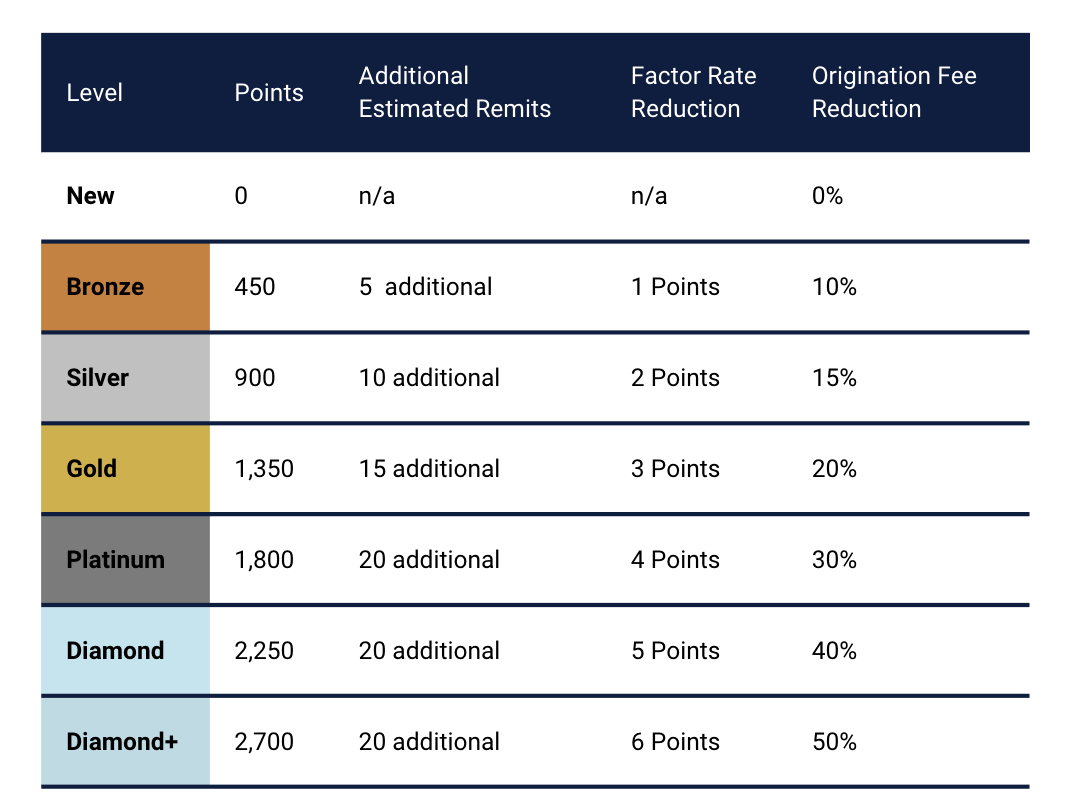
“There’s no need for a redemption email or request,” said Flagg. “Points don’t deduct, they continually accrue as long as merchants continue to remit, and discounts automatically associated with the loyalty level apply on their next offer.”
She added that it’s quickly been recognized as a great way to incentivize a merchant not to shop around. It’s also been used to secure a renewal or win back an old customer that had left. This logically helps the ISOs involved.
Most readers are already familiar with the Lendini brand through their constant mix of on- and offline marketing. Members of their team usually show up in large numbers at major industry events, for example. Flagg said that 2024 has been a big year for the company. “In Q2, we successfully launched Instant Offers, and we’re proud to report that we’re now averaging a turnaround time of under 5 minutes for offers up to $75,000,” she said. Their new mobile app, while still in beta, allows merchants to track offers, remittances, and engage with the Resolutions Team.
“Over the past two years, we’ve prioritized elevating the customer experience by creating accessible tools that empower merchants to navigate the financing process with ease and transparency,” Flagg said. “This is only the beginning. Funding Metrics is dedicated to continuously enhancing these experiences that put merchants in greater control of their business financing and making every step from offer to origination as seamless as possible.”
eBay: ‘We’ve Already Done $40M in MCAs’
November 3, 2024 eBay is coming in hot to the small business financing game. The company reported that it had connected merchants with $100M in funding YTD, over $40M of it being “business cash advances” through Liberis alone.
Liberis is a UK-based company that expanded into North America 4 years ago. It secured $112M in debt funding last year. The partnership between Liberis and eBay only started this past July. eBay’s other big funding partner is Funding Circle.
eBay’s role as a facilitator for funding follows what every other major e-commerce platform is doing. For example, Amazon, Shopify, Walmart, Lightspeed, and DoorDash all offer funding to sellers on their platforms. Technically, eBay was the first considering it had originally partnered up with Kabbage back in 2010. That relationship did not last, however.