
On Deck Capital IPO, An Insider’s Perspective
August 16, 2014It was August 23, 2011, the day the Virginia Earthquake could be felt all the way up in New York City. The four of us were enjoying outdoor seating at a restaurant on the Upper East Side. The ground shook, my drink spilled and Ace looked at each one of us and said, “Okay so I’m putting you down for five deals this month.” OnDeck Capital’s relationship managers were aggressive. If you were a small Independent Sales Organization (ISO), they didn’t expect to get all of your dealflow so they roped you in little by little. It was hard to say no. If five deals was too much, Ace would say three and if three was too much, then he’d put you down for three anyway. Zero was not in the cards. OnDeck owned a specific niche and if you didn’t send your premium credit clients to them, then any ISOs you were competing against would. That was a death knell in those days. Just a few years earlier I would’ve shrugged them off, but public sentiment was changing. Merchants were embracing the fixed daily payment methodology and the merchant cash advance industry would never be the same.
OnDeck Capital is now going public. Will you buy stock?
 I’m in a unique position to discuss OnDeck. I started my career in this industry before they even existed. I’ve competed against them as an underwriter at a rival firm, worked with them as a referral partner when I was in sales, and covered them in my capacity as Chief Editor of an industry trade publication.
I left my post as Merchant Cash & Capital’s Director of Underwriting in late 2008. I was 25, about a year or two older than the average employee in the industry. Several of MCC’s rivals got demolished in the financial crisis but OnDeck wasn’t one of them. They also weren’t much of a competitor either. Struggling to define themselves as the anti-merchant cash advance, their product ran counter to the spirit of the industry’s rise. The single biggest allure of a merchant cash advance wasn’t that it was easy to obtain but that there was no fixed repayment term. The funds came with a pre-determined net cost but no specific date on when the delivery of future sales would be due.
Outsiders like the news media aren’t exactly sure what separates merchant cash advance from OnDeck except for maybe the cost of funds. Cash advance just sounds expensive, doesn’t it?
Outsiders identify the company by three characteristics.
1. They’re a non-bank business lender
2. They’re more expensive than a bank
3. They’re a tech company
These bullet points gloss over the fact that OnDeck’s loans require payments to be made every day. Can you imagine a credit card company forcing you to send a payment every day of the month? Or your landlord asking for rent on the 1st of the month, the 2nd, the 3rd, 4th, 5th, and so on every day until your lease is up?
This is not to say that this system is necessarily bad for borrowers, but that it is quite possibly the most unique and important part of what makes OnDeck different. It’s their secret sauce. It is why OnDeck gets lumped in with merchant cash advance companies in many conversations. OnDeck and the legion of copycats they have spawned are part of a broader industry that includes merchant cash advance companies. I call them daily funders. Daily funders provide financing on the condition that payments are made daily. I don’t call them daily lenders because traditional merchant cash advance products are not made by lenders, but by a unique group of investors that purchase future revenue streams.
Transition
Under company founder Mitch Jacobs, OnDeck had established themselves as the de facto loan option.
The merchant’s not biting on merchant cash advance? Send it to OnDeck. The merchant doesn’t accept credit cards? Send it to OnDeck.
They were every merchant cash advance ISO’s frenemy. They’d solicit you for your deals and then throw you under the bus to journalists as evil purveyors of expensive financing. They needed us to source dealflow and we needed them to maximize closing ratios but neither was quite satisfied with the arrangement.
When the company’s first employee took over as CEO in June 2012, the rhetoric changed. While still happy to be portrayed as the anti-merchant cash advance, OnDeck transformed their image from a niche Wall Street lender to a Silicon Valley-esque tech company. Noah Breslow was a curious choice. He has a BS from MIT and an MBA from Harvard Business School. He’s tall, charismatic, and he introduced vocabulary words such as algorithm to an industry that relied entirely on manual human underwriting.
At a recent lending conference, the younger crowd characterized Breslow as the Steve Jobs of business loans. He commands a cult-like following inside and outside the company, and in 2013 was embraced by New York City’s Mayor Bloomberg.
Breslow fast tracked OnDeck. With only $43 million raised in the first 5 years, the company went on to raise more than $300 million in the first 24 months under Breslow’s leadership.
This was their plan all along
In November 2012, OnDeck entertained a buyout offer from UK-based payday lender Wonga in which they reportedly received a $250 million valuation. The deal fell apart in the late stages but at the time I believed the negotiations were all a ploy for OnDeck to get a true market valuation. With a solid offer on the table, they knew both where they stood and where they needed to go. Last week the WSJ reported that preliminary IPO discussions valued them at $1.5 billion, six times higher than where they were two years ago.
With stock options being offered to new employees at least as far back as 2012, the plan to go public should come as no surprise. Later this year, those employees may actually get to do something very few startup workers ever get to do, convert those options into real shares.
So will OnDeck ride off into the sunset of billion dollar bliss? Not so fast say several industry insiders, some of whom are itching to short the stock on the first day they can.
 Smoke and mirrors?
As OnDeck took advantage of the swing in public consensus (that fixed terms were better and lower costs increased the attactiveness ), insiders began to ask an important question. Why weren’t merchant cash advance companies collectively countering with lower prices to remain competitive? Greed was fingered by journalists especially in the wake of the financial crisis. But greed is a weak prerogative if you consider that merchant cash advance companies were filing for bankruptcy left and right in 2009.
And oddly or perhaps even ominously, an entire segment of merchant cash advance companies began to raise their prices just as OnDeck was lowering theirs. When I wrote The Fork in the Merchant Cash Advance Road in April 2011, I said:
While the margins earned on high credit accounts shrank, funding providers were dealing with another challenge simultaneously, defaults. Whether the business owner intentionally interfered with their credit card processing or the store went out of business altogether, bad debt in the MCA world was mounting…FAST!
Risk was and still is the number one reason that merchant cash advances cost so much. While it’s true that OnDeck serviced higher credit businesses, insiders speculated that the spreads were too thin. For years, OnDeck’s merchant cash advance competitors have doubted the soundness of their model.
 It’s a debate that continues even to this day and yet OnDeck has secured hundreds of millions in investments from companies like Google Ventures, Goldman Sachs, Peter Thiel, and Fortress Investment Group. Their notes got an investment grade rating from DBRS. And as far as volume is concerned, they have likely eclipsed the industry’s all time reigning giant CAN Capital. If they had reached none of these milestones, OnDeck would have little credibility to convince critics of their sanity.
With a mountain of circumstantial evidence through big name backing in OnDeck’s favor, it seems to be indicative that the skeptics are wrong. But maybe they’re not. Could their model be both seriously flawed and superior at the same time?
It’s all about eyeballs
Going back to the 1990s, Internet companies have been judged, valued, and made famous by the price of eyeballs and the number of site visits. It’s a measure that’s never disappeared and according to USA Today is making a comeback. And while OnDeck Capital has always been based in New York City, true to their Silicon Valley form, their model has been to conquer market share first  and take on profitability second. In their case, it’s not eyeballs or site visits, it’s loan origination volume.
Five months ago Breslow was quoted in the WSJ as saying OnDeck is “imminently profitable“. With seven years in business, it’s proof that their critics have been right all along, that their model doesn’t make money.
What scares their competitors though, is that this strategy has been intentional. Very few if any players in the industry have had the luxury, guts, or the purse to lose money for seven years as part of a coup to conquer the market. Disbelievers in this long term wildly risky strategy are salivating at the opportunity to inspect the company’s financial statements in the IPO.
In When Will the Bubble Burst?, RapidAdvance CEO Jeremy Brown, whose company became part of the Quicken Loans family last winter, fired shots at OnDeck, “To accomplish high growth rates, which may be driven by a desire or need for an IPO or to raise investment or to sell to private equity, assets are being overpaid for through higher than economically justified commissions (I’ve heard 12-15 points upfront from the more aggressive companies) and stretch the repayment term of the MCA or loan even further (On Deck24, I am talking about you).”
Insiders testify that OnDeck’s strategy has not so much been about lower costs but about growth at all costs. Among the evidence is the sudden removal of an industry-wide practice of verifying the business owner is current on their rent. Repayment terms are getting stretched out, commissions have shot up, and for a while they ran a program that allowed applicants to get funding with the submission of just a single bank statement.
Merchant cash advance companies look at their own default figures and scoff at the notion that OnDeck’s aggressive practices could produce low single digit defaults as they’ve publicly claimed.
Imminent
 Through it all, there remains the fact that OnDeck has never claimed their methodologies to be profitable, at least not yet. Red ink at IPO time might reward their detractors with a certain delicious satisfaction, but what will they say if and when they become profitable?
I’m reminded of The 20 Smartest Things Amazon Founder Jeff Bezos ever said. Below is a few of them.
- “There are two kinds of companies: Those that work to try to charge more and those that work to charge less. We will be the second.”
- “Your margin is my opportunity.”
- “We’ve done price elasticity studies, and the answer is always that we should raise prices. We don’t do that, because we believe — and we have to take this as an article of faith — that by keeping our prices very, very low, we earn trust with customers over time, and that that actually does maximize free cash flow over the long term.”
- “If you never want to be criticized, for goodness’ sake don’t do anything new.”
- “Invention requires a long-term willingness to be misunderstood. You do something that you genuinely believe in, that you have conviction about, but for a long period of time, well-meaning people may criticize that effort. When you receive criticism from well-meaning people, it pays to ask, ‘Are they right?’ And if they are, you need to adapt what they’re doing. If they’re not right, if you really have conviction that they’re not right, you need to have that long-term willingness to be misunderstood. It’s a key part of invention.”
I wonder if the executive team at OnDeck would share these philosophies.
They’ve always claimed themselves to be a tech company, much to the bewilderment of their competitors. Will technology come through for them?
The data available on businesses has changed. Bank statements and a credit report might’ve been all there was to go on when the company first started, but in Automated Intelligence Breslow said, “the fact is most businesses operating today, in 2014, are already technology focused to one degree or another. They have computers, they have online banking, they use credit card processors, their customers are reviewing them online, there are public records, etc. All this electronic data helps paint a deeper and more accurate picture of the health of a business.”
With such easy access to important data, it might be possible that through the use of 2,000 data points, OnDeck doesn’t need to do all the manual investigations that their competitors still place high values on. The available data might be able to predict loan repayment success just as well as a human analyst.
And if that’s true, then they can reduce the cost of overhead as they scale. As their predictive algorithms get fed more data, they might be able to eliminate humans altogether. At the May 2014 LendIt conference, Breslow admitted that 30% of their loans were still manually underwritten but said that “if customers want full automation, we are prepared to deliver it.”
By that charge, a sustainable model should not be that far out of reach. Through advanced data analysis and decreasing fixed costs, profitability may indeed be imminent.
Winner
If the story of the merchant cash advance industry has been a race to the top, then OnDeck might be declared the winner in a successful IPO. It would be an ironic achievement for the company that positioned itself as the anti-merchant cash advance. In their wake today are hundreds of daily funders offering fixed payment products.
 OnDeck’s critics are in a paradoxical position because a successful IPO is good for them too. They want to believe OnDeck’s model never worked, can’t work, and have it be proven a failure. But if it goes the other way, the legitimacy of the daily funder universe will be solidified in the mainstream. What’s good for the goose is good for the gander.
As AmeriMerchant CEO David Goldin said to Inc, “the OnDeck IPO shows that Wall Street is now taking this industry seriously.”
So does that mean he’d buy stock? Somewhere out there at a restaurant in New York City, an OnDeck relationship manager is probably putting Goldin down for five shares.
Cue the earthquake, the industry will never be the same.
Curious how it will change it exactly? Read my magazine published prediction, The Retail Investor.
Should Licensing and Accreditation Come to MCA?
August 13, 2014 It’s not said often, but it has been suggested by some players in the merchant cash advance industry to introduce sales licensing requirements. Anybody can sell and broker MCAs or alternative business loans, even your mom.
That’s been a boon for growth but a bust for maintaining any kind of uniformity or standards. That’s a bad position to be in when influential political leaders are beginning to talk about oversight and regulation, even if it’s way too early to sound the alarm.
Earlier today, former SBA head Karen Mills published, Can Lending Technology Revive America’s Small Businesses? in which she states, “there is already concern that, if left unchecked, small business lending could become the next subprime lending crisis.”
One way to dispel future regulation is through self-licensing, much like the payments industry worked to pull off three years ago. For the first time ever, merchant account sales reps could take an official exam and become a CPP, a Certified Payment Professional. This originated when I was still directly selling merchant cash advances and along with it, merchant accounts.
Merchant accounts were the focus of my compensation strategy and I seriously considered taking the first ever CPP exam in 2011 even though it cost $350. I considered it solely on the basis of whether or not it would convince more people to change their merchant accounts. I finally decided to wait and see if it was helping others before jumping in myself. The question in my mind was, would merchants care? If not, then why busy myself with being accredited?
 Now that three years have gone by, the Green Sheet is attempting to answer this question: Is the CPP Dead on Arrival? Members of their forum reported that accreditation had no teeth because the Electronic Transactions Association (ETA) which created it, lacks industry oversight authority. Others said it was a flawed idea from the beginning. And just as I expected to find, there is belief that merchants do not recognize it as meaningful, don’t know about it, or they don’t care.
The story concludes by saying there is hope since three years is too early to judge CPP adoption. Regardless of what will become of CPPs, today any person with access to a phone or the Internet can sell merchant accounts. If you don’t understand how interchange works or what it is, it doesn’t matter.
Ironically, in the very same Green Sheet issue there is a story that argues the secret to selling merchant accounts successfully is really just about having the right tone. Accreditation? What’s that? Interchange? Huh? Instead, ask the owner a few things about their business, “match your response as closely as possible to that of the merchant. Use similar words. Try to pause as the prospect paused.”
The advice touches upon an interesting aspect of sales, that your clients don’t necessarily care about how smart or knowledgeable you are about the subject matter. They’re buying YOU even if your product sucks. Compare that to say accounting where prepared financial statements need to be constructed in such a way to comply with IRS codes or law where a lawyer needs to be admitted to the Bar to practice. In those cases the clients can’t even receive the service unless the seller meets certain professional standards.
And that’s where accreditations become murky. As a business owner, you’re allowed to wildly overpay for printer ink and buy it from someone who doesn’t know anything about printers or ink. I’ve done it myself. I don’t care if they have a certificate in printing expertise or if they’re members of the National Ink Masters of America. Part of being a business owner means being automatically qualified to make transactional decisions.
The same can be applied to merchant accounts. Need to accept cards? Find a rep you like that can articulate what’s important to you. You can make a deal based on no intellectual substance or one completely dependent on it. If it’s not legally required to be a CPP, then the target audience needs a lot of convincing as to why it should be important to them.

Tom Waters and Ben Abel of Bank Associates Merchant Services are the writers behind the CPP DOA piece in Green Sheet and they admit that success in mainstreaming accreditation can and has taken up to 25 years in other industries. That of course brings me full circle to MCA and business lending. The enormity of self-licensing could take years or perhaps even decades to nail down. And even if they were instituted, would the merchants care? That’s the question I ask myself.
With virtually no outcry from merchants over best practices currently, I think the dream some have of becoming a CMCAP (Certified Merchant Cash Advance Professional) will have to be put on hold. Of course you could always be proactive and become a Certified Lender Business Banker, though I predict it would do nothing to help you in this business.
The reality is that we should expect to live with the status quo at least for now. My advice is to be honest, fair, and a good example for everyone else. Do that and we’ll never have to worry.
—-
What Would Barney Frank Say?
July 16, 2014While crowd funders navigate the JOBS Act and a possible revision to what constitutes an accredited investor, non-bank business lenders are raising eyebrows with sky high interest rates. Annual Percentage Rates (APRs) are reaching into the triple digits and critics are reaching for their megaphones to say something about it.
Unfortunately APRs don’t spell out the true dollar for dollar cost, a flaw pointed out by OnDeck Capital CEO Noah Breslow in regards to daily amortizing loans. In the June Access to Capital Small Business Panel, Breslow explained that a 60% APR loan could actually only cost 15% on a dollar for dollar basis over 6 months simply because of daily amortizing.
Still, the figures make for enticing headlines and it is to be expected that they will come under greater public scrutiny as time goes on.
In an opportunity I got to speak one-on-one with former Congressman Barney Frank in June, he offered some pretty interesting thoughts on the governance of business to business transactions.
 Frank, who was the key author of the Dodd-Frank Wall Street Reform and Consumer Protection Act that was signed into law in 2010, was a longtime champion of consumer financial protections. But he sings a different tune when it’s all about business. Many people may not realize that he opposed the Durbin Amendment of the Dodd-Frank Act, the addition that placed caps and restrictions on debit card interchange fees. Federal restrictions on how much a business can charge another business? Not his thing…
Unsurprisingly then when I asked him if he’d be in favor of a federal cap on business loan interest rates, he sternly replied, “no.” He went on to say that he supported transparency in business loan transactions, such that the borrower should be easily able to identify the terms, but that the premise behind consumer loan protections was that consumers were less sophisticated.
Curiously, there are a few states that impose caps on commercial interest rates, making the regional landscape for high rate business lenders a little bit tricky. In a recent publication by financial law firm Hudson Cook, they spelled out federal laws that already govern business loans.
To date there has been no legislative activity related to merchant cash advance or alternative business lenders. If such discussion did arise though, it’s ironic to say that one of the most liberal congressmen of the last decade, a man who wrecked Wall Street, would stand to make an excellent champion of the alternative business lending cause.
I never thought I’d say this, but too bad the guy retired.
Making Cents of Short Term Business Lending
June 22, 2014Where do you see yourself in 5 years? Perhaps you’ve seriously planned what you’ll be doing in mid-2019 or maybe you at least have an idea of how things will play out. It’s only a half a decade after all so how hard could it be to foresee the future?
Surely all of us saw the DOW surging 5 years ago and got rich right?

Did New Yorkers factor Hurricane Sandy into their 5 year plan back in 2009?

It’s only 5 years, what could possibly happen to a small business in that time?


As I recently logged onto LendingClub to invest in consumers loans, I began to wonder just how safe the 60 month terms were. Not that I have a lot of options since LendingClub only offers 3 or 5 year terms, but the latter is unquestionably risky. The borrower might look good now, but where in the heck will they be in 5 years? I can’t even begin to guess.
Mortgages, student loans, and car leases aside, I can think of very few reasons to use a 5 year loan from a personal perspective, mainly because that’s an extremely long commitment. For a small business, such a term far exceeds the rationale behind “working capital”, the reason oft-cited by businesses seeking less than $200,000.
The Small Business Administration’s website speaks of this:
Businesses that are seasonal or cyclical often require more working capital to stay afloat during the off season. Although your company may make more than enough to pay all its obligations yearly, you must ensure you have enough working capital at any one time to meet your short term obligations. For example, a company may do significantly more business over the holidays, resulting in large payoffs at the end of the year. However, the company must have enough working capital to buy inventory and cover payroll during the off season as well, when revenues are lower.
Working capital may come in handy for something like inventory for which the business probably expects to sell it all off in less than a year. Can you imagine still making monthly payments in 2019 for inventory you bought with a loan in 2014?
I bet this guy can’t:
And if the financial picture looks great and they have a long term need, why not go out 5 years?


Verizon replaced Washington Mutual. But a Verizon store, that will last forever…
Only 41.1% of retail businesses live to experience their 5th birthday.
And even then when business types are aggregated, making it past year 5 doesn’t ensure lifelong success. Don’t confuse established with safe:
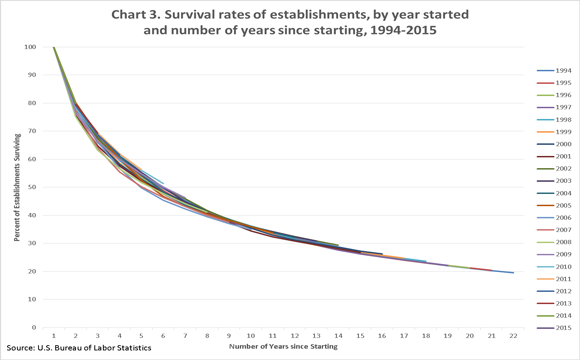
In fact, even borrowers are opting for shorter term loans with higher interest rates than long term loans with lower interest rates. Part of that is due to the lower net dollar cost paid for the loan said OnDeck Capital CEO Noah Breslow in an interview with Peter Renton:


5 years ago I used to spend way too much time on Instagram. Oh wait, no I didn’t… there was no such thing as Instagram.

What do you think is the best bet for this CD store? A 3-6 month working capital loan or a 5 year term loan?
Giving a borrower a lengthy repayment term ensures they will be able to pay you back right?

Above is the result of my $25 contribution towards a 5-year LendingClub loan issued on May 16th. They missed the very first payment. I’m really looking forward to the next 59 months…
In 2019, everything will be business as usual, won’t it Madam President…

As short term business lending critics herald the emergence of 3-5 year term business loans, I think it’s important to remember that they are catering to a market that likely has different goals. Long terms are often not appropriate for borrowers with working capital needs. The CEO of RapidAdvance, Jeremy Brown discussed this in an article he wrote for DailyFunder more than a year ago.
Our industry is based on providing working capital to merchants. By its very definition, working capital is less than 12 months. Longer term deals are permanent capital, even when they are repaid over 15-24 months.
As a borrower, the very idea of committing yourself to monthly payments 5 years from now should be considered very seriously. The average length of a marriage prior to a divorce is 8 years. For past or future divorcees, a 5 year loan is more than half as long as a marriage!
Alternative lenders should be asking themselves if they really have the data and underwriting skills necessary to make accurate predictions that far out in the future. Working capital underwriting models are not applicable as long term assessments.
If you’re going to make 5 year business loans, make sure to take advantage of Google maps. Take a look back at the business location and the ones surrounding it over the last few years. You may not feel so safe about your investment…
Securitization Begins in Alternative Business Lending
May 1, 2014 It’s official, alternative business loans can now be pooled up and sold off to investors. On Wednesday, OnDeck Capital announced a $175 million transaction made possible by issuing fixed rate notes backed by their loans.
Their Class A notes were rated BBB by DBRS while the Class B notes received a BB.
According to DBRS, BBB grade are of “Adequate credit quality. The capacity for the payment of financial obligations is considered acceptable. May be vulnerable to future events.”
BB grade are “Speculative, non-investment grade quality. The capacity for the payment of financial obligations is uncertain. Vulnerable to future events.”
While it’s popular to refer to alternative business lending as highly speculative and fraught with risk, it’s notable that a highly respected ratings agency would not officially bestow OnDeck’s loans with a label to match that. A single B would’ve signified a highly speculative investment and CCC, CC, and C would signal danger. But OnDeck’s Class A notes are up to snuff as investment-grade level material.
OnDeck has been dogged by critics over the last few years, most of whom are their competitors. The argument goes that their practice of undercutting the rest of the industry on rates is doomed to fail. Those theories are bolstered by the very public knowledge that they have yet to turn a profit. Back in March, CEO Noah Breslow was quoted in the Wall Street Journal as saying they were “imminently profitable“, an optimistic yet openly ambiguous indicator of where they stand. Since they are not a publicly traded company, they are not required to disclose their financial statements.
While DBRS serves to validate OnDeck’s policies and approach, word that they had achieved “investment-grade” status did little to pacify their critics. Yet, for a company that places a remarkably heavier focus on credit modeling and technology infrastructure than the majority of their peers, there is always the possibility that OnDeck is actually as smart as they want everyone to believe. Four months ago it was reported that “fifty-six of their 225 employees have backgrounds in math, statistics, computer science, or engineering.” Contrast that with some of the small and mid-sized players that are largely focused on ISO recruitment and sales.
While I haven’t seen a prospectus in its entirely, I’ve learned there are quite a few ground rules in place for these notes. For one, these loan pools have to be diversified. That means no secretly packaging up all the loans in a risky zip code in Nevada and selling them off as a BBB rated note. There are concentration limits in place to reduce risk. Below are the maximum thresholds allowed in a pool based on their location:
Obligor Located in California 20.0%
Obligor Located in Florida 15.0%
Obligor Located in New York 15.0%
Obligor Located in Texas 15.0%
Obligor Located in Any Other State 10.0%
 If a concentration limit is exceeded, the issuer is required to maintain additional credit enhancement. I’m not surprised at all that California, Florida, New York, and Texas are singled out. In addition to being among the most populous in the country, they are the heaviest users of alternative business loans and merchant cash advances. There’s also the theory that Floridians are statistically the least likely to repay a loan, as openly discussed in The Joy of Redlining, a controversial assessment borne out of the peer-to-peer lending crowd.
There are other concentration limits to adhere to such as the OnDeck Score range (not FICO score range), size of the outstanding principal, industry type, and repayment time frame.
Notably, recognition and acceptance of the proprietary OnDeck Score in concentration limits is a major achievement for them. Breslow previously referred to the OnDeck Score as “the Main Street equivalent of FICO” in American Banker.
Additionally, OnDeck’s reliance on ISOs/brokers for originations is shrinking. In 2013, their direct marketing channel accounted for 43% of their deal flow, compared to only 12% back in 2010. This is a step in the right direction for them financially as broker commissions are on the rise. Increasing the direct marketing percentage will serve as a hedge against increasing third party origination costs.
So what’s next?
For now, OnDeck Capital can enjoy the liquidity gained through securitization and focus on more important things like growth and profitability. Profits are a must in the current IPO environment. Payment company Square had their IPO hopes dashed when word of their losses were leaked to the Wall Street Journal. That came as a shock to the general public. Meanwhile everybody already has an idea of where OnDeck stands, sort of. They’re either brilliant or doomed to fail. I’d say an independent assessment that they’re capable of issuing investment grade notes, increases their odds of brilliance.
Whatever your feelings, they have set a powerful precedent for secuitization. As these notes were reportedly oversubscribed, investors will be looking to their competitors for a taste. OnDeck just whet the appetite. Additional securitization in this industry could be right around the corner. One might say it’s… imminent.
Regulatory Paranoia and the Industry Civil War
April 11, 2014Stacking is on everyone’s minds in the merchant cash advance (MCA) industry but that war is little more than smoke compared to the fire burning in our own backyard. One of the major topics of debate at Transact 14 has been Operation Choke Point, a federal campaign against banks and payment processors to kill off the payday lending industry and protect consumer bank accounts. Caught in the mix are law abiding financial institutions, some of which if affected, could potentially disrupt the merchant cash advance and alternative lending industries. Both have become heavily dependent on ACH processing. Could their strength become their Achilles heel?
Indeed, there was a rumor circulating around the conference that a popular ACH processor in the MCA industry is no longer accepting new funding companies. I know the name but was not able to confirm it as fact. There is a two-fold threat on the horizon:
1. The probability that ACH processors in this industry are also processing payments for payday lenders or other high risk businesses.
2. The likelihood that a bank or ACH processor would take preemptive action and terminate relationships with merchant cash advance companies and alternative business lenders, not because it’s illegal but as a way to make their books squeaky clean.
The sentiment at the conference however was that MCA providers and alternative business lenders had little need to worry. While Operation Choke Point specifies online lenders, they are narrowly defined as businesses making loans to consumers. MCA and their counterparts do not fall under that scope, even if they themselves lend exclusively online.

Is regulation coming?
There seems to be both a call for and paranoia about regulation, especially in the context of stacking merchant cash advances and daily repayment business loans. On the popular online forum DailyFunder, several opponents of stacking are under the impression that regulators will be busting down doors any day now to put an end to businesses utilizing multiple sources of expensive capital simultaneously. Many insiders who have had their merchants stacked on view the issue as both a legal and a moral one. Opponents get worked up about it for many reasons. They believe any one or multiple of the following:
- The merchant can’t sell something which has already been contractually sold to another party.
- That the merchant ends up borrowing and selling their future revenues at their own peril, endangering their cash flow and their business.
- That the stackers endanger the first lender or funder’s ability to collect.
- That the merchant taking on stacks won’t be eligible for additional funds with the first company, hurting the retention rate.
Stacking is not illegal, but it may be tortious interference. That allegation is the one that gets thrown around the most, but it’s important to recognize that actual damages are an integral part of any such case. If I stack on your merchant and the deal performs as expected for you, then what damages would you have suffered? But if I stack on your deal and it defaults 3 weeks later, you might be able to allege that I was the cause of it.
Insiders on DailyFunder’s forum that wonder how they might be able to get stacking to stop, only need to follow the example of what a few select funders are already doing, going on the offensive. The first thing one west coast MCA company does when they have a merchant default is find out if there was a stack that came on top of them. If they find out who it was, they send the offending funder a bill for the outstanding balance. That may sound cheesy, but given their industry prowess and litigious nature, they said that some stackers quietly mail them a check, rather than risk things escalating to the next level. The threats only hold weight of course if you’re actually prepared to bring the case to court.
I’ve spoken with dozens of proponents for stacking, many of sound character, high intelligence, and business acumen. They buck the stereotype of stackers as sleazy wall street guys with pinky rings. Few of these proponents believe that future revenue is a precise asset. It’s been said that, “future revenues are unknowable and possibly infinite. A business should be able to sell infinite amounts of these future revenues if there are investors out there that will buy them.” The general consensus on this side of the aisle is that a 2nd position stack, or “seconds” are here to stay. There’s a sense of calm and conviction, as if seconds were a boring subject of little contention. Many are okay with thirds “if the math works” but discomfort sets in on fourths, fifths and beyond. If they believe it’ll be a good investment, they’ll do the deal. They scoff at the notion that they’d willingly chance putting a merchant out of business since that would jeopardize their own investment.
To date, I’ve seen no data to support that stacking causes merchants to go out of business. I would not be surprised if there was a correlation between defaults and stacks, but that would not imply causation. A business that is on its way towards bankruptcy regardless may be able to obtain a few stacks in the process as a last ditch effort to stave it off. When the business finally fails, it may appear to look like the stacks caused it, even if they didn’t.
For those that don’t want to play cat and mouse with threats and lawsuits, there’s a growing call for regulation, both self-regulation and federal. That call feeds off the paranoia that regulators are knocking at the industry’s door already anyway.
NAMAA
In regards to self-regulation, insiders have been looking to the North American Merchant Advance Association (NAMAA) to create rules and become an enforcer. It’s no secret that their members are opponents of stacking, but as a powerful body of industry leaders, they’re up against a threat of their own, antitrust laws. Creating rules and enforcing them could be construed as anti-competitive. In truth, a lot of the MCA industry’s growth over the last 2 years can be attributed to stacking. A private association of the largest players actively working to establish rules to squash the fast growing segment of new entrants could indeed be perceived as anti-competitive.
But that doesn’t mean NAMAA is powerless to promote their views. Following in the footsteps of the Electronic Transactions Association, they could create a set of best practices, host workshops, and offer courses and sessions to train newcomers on these best practices. Such benefits and opportunities are a standard in the payments industry, but nothing like it is available in MCA or alternative business lending.
But is it too late for self regulation?
With all the government enforcement occurring in the rest of the financial sphere, fears of imminent federal involvement in MCA and alternative business lending are not unfounded… or are they?
In the wake of the financial crisis, the Consumer Financial Protection Bureau (CFPB) was formed to protect consumers in financial markets. The CFPB was instrumental in Operation Choke Point and they would be the most likely federal agency to field complaints about stacking. Unlike the Office of the Comptroller of the Currency which has jurisdiction over banks, the CFPB’s oversight extends to non-bank financial institutions. They’re the wild card agency that has financial companies across the nation on their heels.
I had the opportunity to speak with a former lead attorney of the CFPB off the record today about the definition of consumer. Could a small business be construed as a consumer? The short answer was no. The long answer was that there is no specific definition of consumer at the CFPB but it was meant to represent individuals. Although businesses at the end of the day are run by individuals, I got a pretty confident response that the CFPB would not have jurisdiction over a business lending money to a business, even if it was a very small 1 or 2 man operation. If they were acting in a commercial capacity, then they’re no longer consumers.
The other side of her argument was that it would take up too much resources to take on a case where the victim class was basically outside of their scope. The CFPB already has enough on their plate.
Is the government busy?
I also spoke with a few lobbyists and payments industry attorneys off the record and the unilateral response was that MCA and alternative business lending were not on any agenda, nor does the government have the resources to juggle something that is basically…insignificant in their eyes.
In the grand scheme of financial issues, a few billion year in small business-to-business financing transactions isn’t worth anyone’s breath. “A business acting in a business capacity was unhappy with a business contract they entered into? Take it up in civil court,” I imagine a regulator might say.
Regulators aren’t completely in the dark about MCA. Just a month or two ago, several industry captains and myself included were contacted by the Federal Reserve as part of a research mission to basically find out what this industry even was. The feds appear to have stumbled upon the MCA industry as part of their research into peer-to-peer lending. Who would’ve thought a 16 year old industry could be so stealthy?
If the big PR machines like Kabbage, Lending Club, and OnDeck Capital didn’t exist, I’m inclined to believe no one in the government would’ve heard of MCA for at least another 10 years. In 2014, they’re just now discovering it.
My gut tells me we’re a long way from any kind of regulatory enforcement. In a session I attended at Transact 14 today, a former member of the Department of Justice and a current member of the Office of the Comptroller of the Currency both offered examples of cases that took 3-8 years before there was an enforcement action. In each scenario, they alerted the parties there was a problem and they were given time to correct it. They had to show progress along the way and eventually when no such progress was made after years of warnings, they acted.
In the conversation of regulation, alternative business lending and MCA are relatively tiny. Lending Club does more in loan volume each year than the entire MCA industry combined. So long as there’s no fraud involved, small business-to-business financing transactions are not likely to make it on the agenda for federal regulators for a long time. That doesn’t mean it won’t be there some day in the future.
I think it was Brian Mooney, the CEO of Bank America Merchant Services that said in the Transact 14 roundtable discussion that if something feels wrong in your gut, don’t do it. Debra Rossi, the head of Wells Fargo Merchant Services added that you can’t tell a regulator, “I didn’t know.” Keep those suggestions in the front of your mind.
No police
For the foreseeable future it’s on us as an industry to find a resolution to stacking. There’s no such thing as the cash advance police. On one side is tort law. On the other is creating best practices and actively educating newcomers. That’s where the blood boiling debates need to turn to. After all, there’s already a large crowd that yawns over seconds, a group that wholeheartedly believes a stack is just as legitimate as a first position deal.
Instead of waiting for a referee to call foul on somebody, I think 2014 is the year to realize that you might be stuck in the room with the person you hate. Could you bring yourself to tolerate them for years to come?
Blind spot
We should consider that the greatest threat to the industry may not come from within, but from outside. More than 50% of MCA/alternative business lending transactions are repaid via ACH. Government action on ACH providers or the banks that sponsor them could end up hitting this industry as collateral damage.
One metric that banks and regulators consider is the return rate of ACHs, namely the percentage of ACHs rejected for insufficient funds or rejected because the transactions weren’t authorized. Daily fixed debits run the risk of rejects and boost the return rate. Could the frequency of your rejects eventually scare the processor into terminating the relationship? With the pressure they’re getting from the Department of Justice, there’s always the possibility.
Data security is another sleeping giant to consider. Do you keep merchant data safe? Are you protected from hackers?
Know your merchant. The push towards automated underwriting seems dead set on eliminating humans from the analysis. But what if the algorithm misses something and loans get approved to facilitate a money laundering scheme? Or what if it approves a known terrorist?
Paranoia
If you’re paranoid you’re doing something wrong, then maybe you are doing something wrong even if there’s no current law against it. Follow your gut, create value, and work together. Who knows, maybe one day there will be an ETA-like organization for MCA and alternative business lending. Now is a good time to be proactive.
Errol Damelin’s Legacy
April 1, 2014 Wonga’s been a point of interest ever since they tried to buy OnDeck Capital and set up shop in the United States. Far from your average run-of-the-mill UK-based payday lender, they rode the technology wave to international fame. Founder Errol Damelin doesn’t believe in human risk analysis as I’ve cited several times before. He lives by the law of data and algorithms are his muse.
But It hasn’t been all rainbows and unicorns to get to the top. The archbishop of Canterbury told Damelin that he wanted him competed out of existence. Wonga became a religious issue and then a parental one when parents protested that children were being solicited with payday loan offers. And there was the little problem of the algorithm not delivering flattering results. More than a year ago I wrote of my shock when I learned that their bad debt had risen to 41% of their revenues, an astoundingly poor figure for a system that was being heralded as superior to human risk analysis.
Wonga’s been accused of preying on women and ruining lives. They’ve had their sponsorships protested on religious grounds and Damelin himself has even faced criticism for his own religion from the dark bowels of the Internet.
 It’s been said that it was never really about lending for Damelin, who often times categorized Wonga as a technology company (something we’ve heard before in the U.S.).
Despite all the outside criticism, it’s been reported that Wonga’s customers are nearly twice as satisfied with them as they are with their banks and even more so than customers of Apple and Google. Wonga seems to make everyone upset but the borrowers, but it hasn’t been any consolation.
The UK’s Financial Conduct Authority’s intent to regulate them has been the last straw for Damelin. Weary of never ending battle, he is resigning from his post. Though it’s said he will continue to play a role, it’s clear that the mojo is gone. Wonga will be regulated, restrained, and will perhaps endure or be dismantled.
Damelin’s legacy is a 15 minute loan approval that is based off of 8,000 data points. He never proved that algorithms could assess risks better than humans, but he has inspired alternative lenders around the world to pursue ultra lean lending models built for massive scalability.
Great technology exists. Damelin dared us all to use it…
Merchant Cash Advance Syndication: Crowdfunding?
March 28, 2014 You might not have known this, but one of the most lucrative opportunities in merchant cash advance is the ability to participate in deals. It’s a phenomenon Paul A. Rianda, Esq addressed in DailyFunder’s March/April issue with his piece, So You Want to Participate?
Syndication is industry jargon of course. You probably know the concept by its sexier pop culture name, crowdfunding. For all the shadowy rumors and misinformation that circulates out there about merchant cash advance companies, they’re similar to the trendy financial tech companies that have become darlings of the mainstream media.
Did you know that many merchant cash advances are crowdfunded? To date, no online marketplace has been able to gain traction in the public domain aside from perhaps FundersCloud, so crowdfunding in this industry happens almost entirely behind the scenes. There is so much crowdfunding taking place that it’s becoming something of a novelty for one party to bear 100% of the risk in a merchant cash advance transaction. Big broker shops chip in their own funds as do underwriters, account reps, specialty finance firms, hedge funds, lenders, and even friends and family members of the aforementioned.
Merchant cash advance companies find themselves playing the role of servicer quite often, which is coincidentally the model that Lending Club is built on. A $25,000 advance to an auto repair shop could be collectively funded by 10 parties, but serviced by only 1. Each participant is referred to as a syndicate. This is not quite the same system as peer-to-peer lending because syndicates are not random strangers. Syndication is typically only open to businesses, and most often ones that are familiar with the transaction such as the company brokering the deal itself.
In the immediate aftermath of the ’08-’09 financial crisis, some merchant cash advance companies became very mistrusting of brokers and deal pipelines were going nowhere. Underwriters had a list of solid rebuttals for deals they weren’t comfortable with. “If you want us to approve this deal so bad, why don’t you fund it yourself!,” underwriters would say. Such language was intended to put a broker’s objections over a declined deal to bed. But with all the money being spent to originate these deals, it wasn’t long until brokers stumbled upon a solution to put anxious merchant cash advance companies at ease. “Fund it myself? I’d love to, but I just can’t put up ALL of the cash.”
And so some brokers started off by reinvesting their commissions into the deals they made happen. That earned them a nice return, which in turn got reinvested into additional deals. Fast forward a few years later and deals are being parceled out by the truckload to brokers, underwriters, investors, lenders, and friends. There’s a lot of money to be made in commissions but anybody who’s anybody in this business has a syndication portfolio. The appetite for it is heavy. Wealthy individuals and investors spend their days cold calling merchant cash advance companies, brokers, and even me, trying to get their money into these deals. They know the ROI is high and they want in.
 That’s the interesting twist about crowdfunding in the merchant cash advance industry. You can’t get in on it unless you know somebody. There are no online exchanges for anonymous investors to sign up and pay in. It requires back door meetings, contracts, and typically advice from sound legal counsel. A certain level of business acumen and financial prowess are needed to be considered. These transactions are fraught with risk.
In Lending Club’s peer-to-peer model, investors can participate in a “note” with an investment as small as $25. This is a world apart from merchant cash advance where it is commonplace to contribute a minimum of $500 per deal but can range up to well over $100,000.
Lending Club defines diversification as the possession of more than 100 notes. At $25 a pop, an investor would only need to spend $2,500. With merchant cash advance, 100 deals could be $50,000 or $10,000,000. By that measure, syndication is crowdfunding at the grownup’s table, a table that doesn’t care about sexy labels to appease silicon valley, only yield.
Strange merchant cash advance jargon keeps the industry shrouded in mystery. Did you know that split-funding and split-processing are terms often used interchangeably? Or that they have a different meaning than splitting? Or that the split refers to something else entirely?
Do you know what a holdback is or a withhold? How about a stack, a 2nd, a grasshopper, an ISO, an ACH deal, a junk, a reup, a batch, a residual, a purchase price, a factor rate, or a UCC lead?
Paul Rianda did a great job detailing the risks of syndication, but there is one thing he left unsaid, and that’s if you’re going to participate in merchant cash advances, you better be able to keep up with the conversation.
At face value, syndication is nothing more than crowdfunding. But if your reup blows up because some random UCC hunting ISO stacked an ACH on top of your split while junking him hard and upping the factor with a shorter turn, you just might curse the hopper that ignored your holdback and did a 2nd. And on that note, perhaps it’s better that the industry refrain from adopting mainstream terminology. We wouldn’t want everybody to think this business is easy. Because it’s not.
One factor to consider is the actual product being crowdfunded. In equity crowfunding, participants pool funds together to buy shares of a business. In crowdlending, participants pool funds together to make a loan. But in merchant cash advance syndication, participants pool capital to purchase future revenues of a business. An assessment is made to predict the pace of future income and a discounted price is paid to the business owner upfront. That purchase price is commonly known as the advance amount.
Syndication has more in common with equity crowdfunding than crowdlending. If you buy future revenues and the business fails, then your purchase becomes worthless. There is typically no recourse against the business owner personally unless they purposely interfere with the revenue stream and breach the agreement. Sound a bit complicated? It is, but crowdfunding in this space is prevalent nonetheless. To get in on it, you need to know someone, and to do it intelligently, you better know what the risks are.
If you want to sit at the grownup’s table and syndicate, consult with an attorney first. There’s a reason this industry hasn’t adopted sexy labels. It isn’t like anything else.