
What Will it Take to Grow OnDeck’s Stock Price?
September 20, 2017OnDeck closed at the exact same price on September 14th as it did on July 20th, $4.58. In between, OnDeck reported one of their best quarters ever (they released their 2nd quarter earnings on August 7th) and experienced a temporary boost to $5. Even then, the stock was 75% down from the IPO price and more than 80% down from their all-time high, yet that too couldn’t be sustained.
In Q2, OnDeck only had a GAAP net loss of $1.5 million and announced that they had expanded their collaboration with JPMorgan Chase for up to four years to provide the underlying technology supporting Chase’s online lending solution to its small business customers.
In the rest of the lending world, optimism is in style. Square is up 121% year-to-date, according to the AltFinanceDaily Online Lender Tracker and even Lending Club is up 14%.
More traditional finance companies like American Express and Intuit are meanwhile hovering near their 52-week highs, according to the Specialty Business Lending Tracker.
Some of OnDeck’s former employees at least appear to be doing well. Just recently, the former Chief Sales Officer was named COO of CoverWallet, the former Director of External Sales was named Chief Revenue Officer of Pearl Capital and the former Director of Portfolio Management and Credit Operations was named SVP at Breakout Capital.
Former Chief Sales Officer of OnDeck Joins CoverWallet as COO
September 5, 2017Paul Rosen, the former Chief Sales Officer of OnDeck, is now the Chief Operating Officer of CoverWallet, according to LinkedIn. Rosen worked at OnDeck from May 2011 to June 2017. CoverWallet is part of the growing insurtech (insurance technology) industry, helping business owners manage “all [their] policies online, all in one place.” The company was named Best Insurtech Solution at 2017 Benzinga global FinTech Awards.
Has OnDeck Turned The Corner?
August 7, 2017
OnDeck’s loan origination volume declined by approximately 20% in the second quarter to $464.4 million but more importantly the company only recorded a GAAP net loss of $1.5 million. That’s down from the $11.1 million loss recorded in Q1 and in line with the company’s plan to achieve profitability in the second half of the year. OnDeck predicts that sequential originations growth will resume in Q3.
OnDeck also announced that it has expanded its collaboration with JPMorgan Chase for up to four years to provide the underlying technology supporting Chase’s online lending solution to its small business customers, according to the release. “Chase plans to continue to refine the offering, including expanding access and enhancing features throughout next year.” The image at right is from their Q2 earnings presentation demonstrating the front-end collaboration.
The company has also implemented stricter underwriting standards which includes lower loan amounts, shorter loan terms and stronger credit metrics.
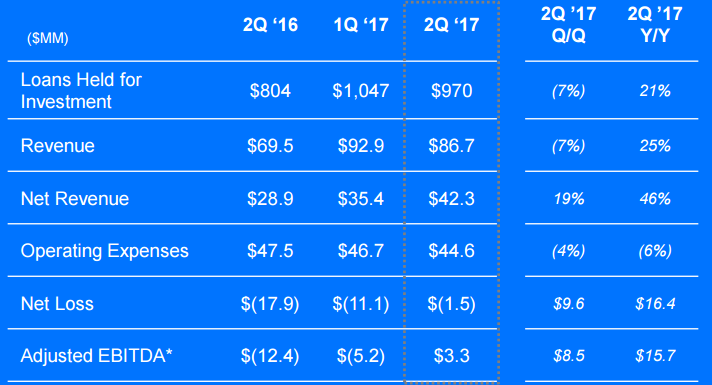
Sales and marketing expenses actually increased from $14.8 million in Q1 to $15.3 million in Q2 but that was inclusive of $1.4 million in severance charges. The high cost of marketing is consistent with anecdotal reports obtained by AltFinanceDaily regarding market saturation. Just recently, a small business owner told us in an interview that she has received so many mailed advertisements for working capital that she has a pile of them that’s now four inches thick.
OnDeck recorded a significantly higher charge-off percentage in Q2 at 18.5% up from 14.9%, which the company partially attributed to a contracting portfolio. However, the raw dollar amount grew substantially as well. The 15+ day delinquency ration dropped from 7.8% in Q1 to 7.2% in Q2

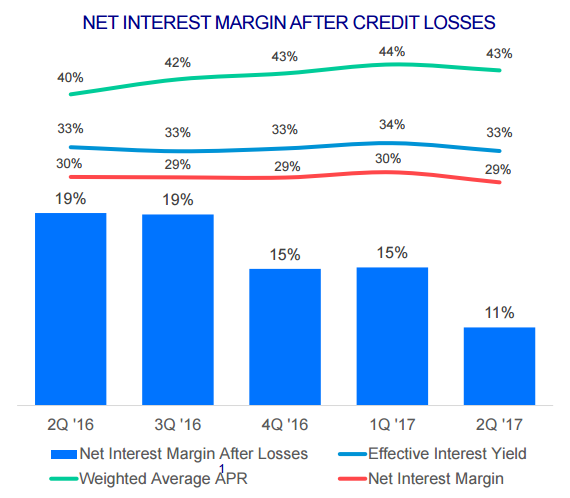
During the Q&A session of the earnings call, CEO Noah Breslow said he believed the company was positioned well to gain some market share due to the shakeout occurring in the industry.
Daniel Gorfine Moves On From OnDeck to CFTC
July 10, 2017Daniel Gorfine has moved on from OnDeck, according to a public announcement made by his new employer, the US Commodity Future Trading Commission (CFTC). Gorfine served as OnDeck’s VP of External Affairs and Associate General Counsel for a little over 2 and a half years.
His new job, an appointment made by Acting CFTC Chairman J. Christopher Giancarlo, will be Director of LabCFTC and Chief Innovation Officer.
According to the announcement, “Gorfine will be responsible for coordinating closely with international regulatory bodies, other US regulators, and Capitol Hill to discuss best practices around implementing digital and agile regulatory frameworks and approaches for the CFTC.”
His background in fintech is expected to help the CFTC accomplish its goal of promoting fintech innovation and fair competition.
Why OnDeck is Underperforming its Peers
May 29, 2017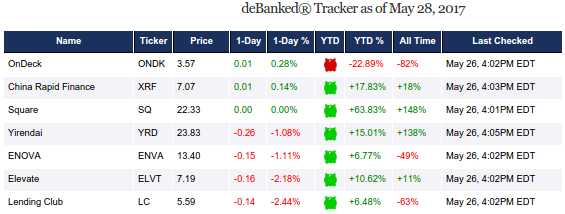 Small business lending company OnDeck was down nearly 23% on the year when the market closed on Friday. One of their closest rivals, Square, a company that makes business loans in addition to offering payment processing services, was up almost 64% this year so far. The disparity can be partially attributed to the market’s changing perception of OnDeck, originally viewed as a disruptive technology company, to what they’re seen as now, a niche commercial lender. Their tech multiple is gone, putting their market capitalization near book value.
Square is faring differently since they have virtually no borrower acquisition costs (whereas OnDeck has high acquisition costs) and a strong revenue stream outside of loans. Square’s strategy is to turn its existing payment processing customers into borrowers.
Meanwhile, Lending Club, an online lender that makes both consumer loans and business loans, is up 6.48% on the year. Despite being down 63% from their IPO price, Lending Club is different in that they generate fee income off of originated loans rather than book loans on balance sheet like OnDeck.
What ties them all together is that OnDeck, Square and Lending Club all rely on chartered banks to make the loans they advertise, a model that is coming under scrutiny by states such as New York. OnDeck and Square both depend on Celtic Bank, a Utah-chartered industrial bank.
Among its peers, OnDeck arguably has the riskiest makeup. They’re concentrated in only one type of lending, they have high acquisition costs, and they retain direct exposure to the loans they generate. Combine that with a lack of profits, lack of growth, and future regulatory challenges ahead, and it’s easy to understand why they’re so significantly underperforming the pack.
OnDeck Shares Drop Again
May 10, 2017The market continued to express their unhappiness with OnDeck on Tuesday by driving the stock down another 6% to $4.06. The stock had already fallen by 7% the previous day after OnDeck posted their quarterly report. Tuesday’s rout may have been caused by a profile published in the Wall Street Journal Monday evening that asserted that OnDeck was really a niche financial company rather than a revolutionary technology platform.
“At 1.2 times book value, it is now valued like a financial company and roughly in line with the average bank. This still looks a bit rich because it has no profits,” wrote WSJ’s Aaron Back.
The AltFinanceDaily Tracker currently pegs OnDeck’s all-time performance as the worst of their peer group, down 80% since they went public in 2014.
OnDeck On the Path to Profitability?
May 8, 2017 In their earnings announcement this morning, OnDeck predicted that GAAP profitability would be achieved in the second half of 2017. For now, the GAAP net loss in Q1 was only $11.1 million, down from $36.5 million in Q4. The company originated $573 million worth of loans for the quarter.
OnDeck has been under pressure from at least one major shareholder to make changes. “We’re talking about a stock that is down 75 percent to 80 percent from its IPO price. You’re not going to find a lot of happy campers in that situation. Shareholders are going to ask tough questions,” Mario Cibelli, Marathon Partners managing member, told AltFinanceDaily last month.
OnDeck has been underperforming just about all of its peers year-to-date according to the AltFinanceDaily Tracker. The company’s stock price has been flat on the year, whereas Square, which does payments in addition to business loans, is up 45%.
The Marketplace, once a defining part of the tech-based lender’s strategy, is being almost completely phased out. “Loans sold or designated as held for sale through OnDeck Marketplace represented 9.0% of term loan originations in the first quarter of 2017 compared to 25.9% of term loan originations in the comparable prior year period,” their report said. OnDeck plans to reduce the amount of loans sold through their marketplace to less than 5% for the remainder of 2017.
“The Provision Rate in the first quarter of 2017 was 8.7% compared to 5.8% in the prior year period.”
“The 15+ Day Delinquency Ratio increased to 7.8% in the first quarter of 2017 from 5.7% in the prior year period and from 6.6% in the fourth quarter of 2016 due primarily to the continued seasoning of the portfolio.”
“The Cost of Funds Rate during the first quarter of 2017 increased to 5.9% from 5.5% in the prior year period primarily due to the increase in short-term rates.”
“The Net Charge-off rate increased to 14.9% in the first quarter of 2017 from 11.2% in the prior year period and increased sequentially from 14.2%.”
“Combined with the company’s prior workforce reduction, total headcount at the end of the second quarter of 2017 is expected to be approximately 27% lower than December 31, 2016 levels, due to both involuntary terminations and actual and scheduled attrition.”
Marathon Partners Targets OnDeck Capital
April 17, 2017Marathon Partners, which owns 1.25 million shares of OnDeck Capital, has drawn a line in sand on the shore of the online lender. The private investor is urging OnDeck, whose share price has shed approximately three-quarters of its value since its IPO, to lower its risk profile amid lofty overhead expenses, which Marathon believes are preventing the online lender from achieving real profitability. Marathon has given OnDeck until the company’s annual shareholder meeting in May to respond. Otherwise the investor has vowed to withhold its support for a trio of board members who are up for a vote.
“We’re talking about a stock that is down 75 percent to 80 percent from its IPO price. You’re not going to find a lot of happy campers in that situation. Shareholders are going to ask tough questions,” Mario Cibelli, Marathon Partners managing member, told AltFinanceDaily.
OnDeck Capital, meanwhile, believes it is on the right path for creating greater shareholder value.
“OnDeck welcomes open communications with all stockholders and values constructive input. Members of our board and management team have met with Marathon on several occasions. We are committed to driving value for all OnDeck stockholders and will continue to take actions to achieve this important objective,” said OnDeck’s Jim Larkin.
Indeed Marathon and OnDeck executives have had their share of discussions in the past year, over which time Marathon has acquired its stake and during which time the company’s valuation has become more interesting.
While other institutional investors have been buying shares, evidenced by EJF Capital’s 13-D filing in recent weeks, Marathon — though it has the capital to increase its stake in OnDeck — would not consider doing so with the company’s current risk profile. Marathon Capital’s lack of support for the vote, however, is less a reflection on any one individual and more a protest against the actions or lack thereof of the board as a whole.
“The only way for shareholders to reflect any disappointment or criticism on the proxy is by withholding votes for directors. Instead of picking out one or two of them, we said we’re not going to vote for any of them. This is a clear protest vote for poor performance,” said Cibelli.
Chief among Marathon’s criticisms is an executive compensation structure, including that of CEO Noah Breslow, which omits detail for investors. “There is not a tremendous amount of detail on executive compensation in the proxy, so it’s hard for investors to know what the incentives are that drive the senior management team. The board needs to be very thoughtful around creating the right set of incentives to increase shareholder value,” said Cibelli.
 For instance, OnDeck Capital in its quest for profitability points to adjusted EBITDA, which Cibelli said is a “terrible” metric to use to incentivize a management team of a lending business. “It excludes stock-based compensation and depreciation. It also ignores the risk level on the balance sheet. For OnDeck profitability ought to mean GAAP net income,” said Cibelli. “You don’t hear Chase, Wells Fargo or any specialty finance company talking about adjusted EBITDA. GAAP net income is the proper metric and that is what we want OnDeck Capital to achieve.”
The murkiness surrounding Breslow’s compensation incentives has been exacerbated by what Cibelli described as an “excessive” overhead structure at the company that amounts to approximately $200 million each year.
“Given the high level of overhead, they have a tremendous amount of pressure on them to maintain and grow the loan portfolio,” said Cibelli, pointing to the company’s lack of profitability. If the company were profitable, Cibelli said OnDeck would start from a very different place when making its loan decisions.
“They would focus more on the quality of loans and interest rates. If OnDeck was profitable today, they might choose to step back from certain types and durations of loans since they would be under far less pressure to grow. Instead they could let the market and their competitive positioning dictate the level of growth,” he said, adding that OnDeck Capital is very challenged to be both prudently leveraged and profitable with its current level of overhead at $200 million.
As for next steps, Marathon Partners, which also wants the online lender to consider a sale of the company, is watching and waiting to see what OnDeck Capital will do.
“The ball is in their court,” said Cibelli. “We will see what they have to say and what they tell shareholders in a couple of weeks on the first quarter call.”