
Square Renews Effort to Become a Bank
December 19, 2018 Square has plans to refile paperwork with state and federal regulators to open a wholly owned bank in Utah, according to a report in The Wall Street Journal today. In 2017, the company applied with the Federal Deposit Insurance Corp (FDIC) for a licence to become an Industrial Loan Company (ILC) bank, but it withdrew the application at the beginning of July 2018.
An ILC bank can take deposits and can be owned by a non-bank. It is also exempt from certain regulations that traditional banks must follow, making the ILC bank structure highly controversial. Critics say that ILC banks are very risky because they can engage in commercial activity outside of banking, which could lose money and jeopardize the bank.
“ILC banks were meant to serve a certain type of industrial worker [in the early 1900s] that had trouble finding a commercial bank they could bank with,” said Chris Cole, Senior Regulatory Counsel at Independent Community Bankers of America (ICBA), a trade group.
“Now we don’t have that problem anymore…this [ILC bank] charter is completely outdated [and is] a loophole that should be closed so that the owners of these bank-like institutions are restricted in the same way that commercial banks are restricted,” he said.
Proponents of ILC banks, like the fintechs that seek ILC status, say that becoming a bank can better serve their customers. Under the 2010 Dodd-Frank Act, which came in response to the Great Recession, there was a moratorium on establishing ILC banks because they were deemed to be a risk to the U.S. banking system. That moratorium was lifted in 2013 and over the last several years, a handful of fintechs have applied to get an ILC bank charter license.
SoFi applied for a license and later withdrew its application in 2017 amid a scandal related to its former CEO. But its current CEO, Anthony Noto, mentioned the possibility of pursuing ILC status again at the Money 20/20 conference in October.
NelNet, which services student loans, applied for an ILC license in June of this year and later withdrew its application in October.
Square Capital Loaned $405 Million in Q3
November 8, 2018Square Capital originated more than 62,000 business loans for a total of $405M in Q3, up from $390M in the previous quarter, according to the company’s latest earnings report.
By contrast, OnDeck, a Square Capital competitor, reported loan originations of $648M for the quarter. Both companies find themselves facing new competition from a growing field of tech players like Shopify (who last quarter originated $76.4M in merchant cash advances).
Thanks to an early investment in Eventbrite, the online events company that went public in September, Square turned its regularly scheduled quarterly losses into a profit in Q3. On the company’s earnings call, Square CFO Sarah Friar said that the company would have had a $17 million loss if it weren’t for a windfall related to the IPO of Eventbrite.
The big news that Square CEO Jack Dorsey had to share on the earnings call was the introduction of Square Terminal, a portable, all-in-one payment device that prints receipts.
“People don’t want to use their personal device to accept payments,” Dorsey said of many small business owners.
Dorsey said that this device is essentially meant to replace “those black rectangular boxes,” referring to the ubiquitous credit card processing machines which he described as “dinosaurs.”
Another theme of the earnings call was Friar’s departure from Square. Friar announced in October that she will be taking the job of CEO at Nextdoor, a social network. Dorsey thanked Friar for her contribution to Square and in a tweet expressed sadness that she was leaving. He said that a search to replace Friar is currently underway.
Dorsey also expressed pleasure with the continued success of Square’s Cash app, a peer to peer payments app that he said allows the “underserved and unbanked” to transfer money.
“I’m excited [about] what we can build on top of it,” Dorsey said.
Square Expands into Consumer Lending, Keeps Banking Hopes Alive
October 16, 2018Square is no stranger to payments and is looking more and more like a bank every day. Square Capital already facilitates loans to small businesses, and now they’re expanding into consumer loans. Meanwhile, it’s been several months since Jack Dorsey’s fintech startup withdrew its application to become an Industrial Loan Company (ILC), but Square’s banking pursuits appear far from over.
“With regard to charters, Square Capital is uniquely positioned to build a bridge between the financial system and the underserved, and we continue to work closely with the FDIC and Utah DFI on our ILC applications,” a Square spokesperson told AltFinanceDaily.
In the interim, Square is making a push into consumer lending, giving small businesses the opportunity to capture big-ticket sales that might otherwise slip away. After testing the feature for about a year, Square Installments has now been rolled out across 22 states with plans for a nationwide expansion.
“Historically, offering financing options for customers has only been available to larger businesses. For many Square sellers, providing a payment option like this to customers has either not been possible, or has been too complicated or time/labor intensive to set up. We are focused on expanding access to financial services for both businesses and individuals, and Square Installments sits at the intersection of both,” the spokesperson said.
Square Installments will further diversify the company’s revenue stream and build on the momentum that they have been experiencing with business loans. The new product offers customers more flexibility for purchases between $250 and $10,000, giving them the option to pay over three, six or 12-month installments at an APR of up to 24%.
“We noticed there were a lot of very high-ticket purchases on Square and sellers were saying that they might lose a sale because a national chain might offer financing,” according to the spokesperson. Over the past year, Square facilitated tens of millions of transactions for purchases of more than $250.
And it isn’t just merchant demand. Small business customers similarly are hunting greater flexibility and more financing options for budgeting purposes, according to a survey of American consumers done by Square over the summer.
Square Installments works at both the point-of-sale for brick-and-mortar businesses as well as with Square Invoices for e-commerce companies. Other fintechs that offer similar consumer lending solutions include Affirm, GreenSky and Klarna, as Reuters pointed out.
For sellers, Square Installments can be integrated into their existing Square offerings. The seller is not engaged in the credit decision process and is paid for the sale up front.
By giving customers the ability to pay in installments, small businesses can increase their sales, bolstering growth in the process. Square gives the example of Fly1 Motorsports, whose sales increased between 20%-30% while order values increased by more than 50% as a result of Square Installments.
Square has a history with the sellers on its platform, which delivers greater transparency to the credit decision process. The loans, however, will be added to Square’s balance sheet, a risk that was reflected in declines in Square’s stock price on the heels of the announcement. Square (SQ) shares are down 22% so far in October. The declines also coincided with the departure of Square’s CFO, Sarah Friar.
“From a risk perspective, we look at two types of risk — fraud and credit. At Square, we start with an advantage since we know the sellers we are bringing on to the Square Installments program given they are already processing with Square. We have visibility into what they sell, their average ticket size, and any chargebacks,” the Square spokesperson explained.
On the consumer credit risk side, Square uses machine learning and other tools to provide what it describes as a “holistic view of our borrowers.”
Square Capital is Funding $130 Million a MONTH
August 1, 2018Today Square released its Q2 2018 earnings, revealing that in the second quarter Square Capital facilitated over 60,000 business loans totaling $390 million. This is an increase of 22% year over year, and a 13% increase compared to last quarter’s loan volume of $339 million.
Square’s growth was also driven by its Instant Deposit, Caviar and Cash Card products. Additionally, second quarter growth came from Square’s acquisitions, including Weebly, which provides tools to help individuals and small businesses create websites or online stores.
In today’s earnings call with Square CEO Jack Dorsey and CFO Sarah Friar, an analyst asked about plans for development of Square Capital. In response, Friar said that they plan for Square Capital to grow as the Square customer base grows. But she said Square is also taking more proactive steps to acquire Square Capital customers, including partnerships. Just last week, Square partnered with eBay to make loans to eBay merchants.
“We’re looking to partner [with companies] where their customers look like Square sellers,” Friar said.
Founded by Jack Dorsey and Jim McKelvey in 2009, Square is headquartered in San Francisco, with offices also in Canada, Japan, Australia, Ireland, and the UK. Dorsey is also the CEO of Twitter.
Square Funded $339M to SMBs in Q1
May 2, 2018
Square’s small business funding arm, Square Capital, made over 50,000 business loans for a total of $339 million in Q1, according to the company’s latest earnings report. That figure is a 35% increase year-over-year and puts them on pace to break last year’s $1.177B total. OnDeck, by comparison, who is arguably their top rival, made $2.11B in business loans last year.
“[..] they just don’t have another way to get access to that sort of capital. And when they get it, they invest in their business,” Square CFO Sarah Friar, said of their merchants during the earnings call. “They’re buying inventory, they’re hiring new employees, they may be taking any lease hold and opening that second location. And when they do that, their business grows and hence our business grows. So, we still think we have a unique product that no one else can really follow us into.”
Square also earned $34 million in revenue from bitcoin, thanks to the Cash App they launched in January that allows users to buy and sell bitcoin. Bitcoin was mentioned an eye-opening 37 times in their quarterly shareholder letter, while their loan program is only referenced 7 times.
Overall, the company brought in $669 million in revenue and recorded a $24 million loss. They also entered into an agreement to buy Weebly, a company that helps people build professional websites and online stores.
“Weebly will expand Square’s customer base globally and add a new recurring revenue stream. Weebly has millions of customers and more than 625,000 paid subscribers,” the company wrote.
Square Wants to Become a Bank
September 6, 2017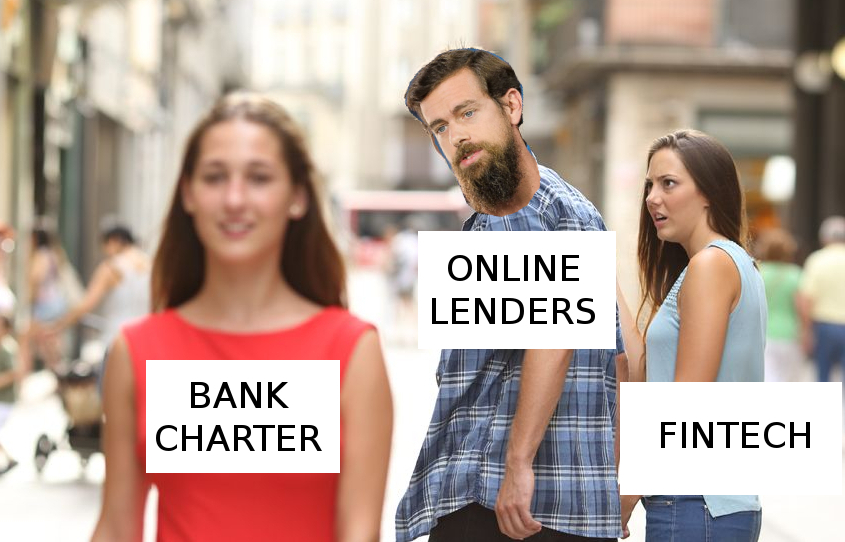 Square is expected to apply for an Industrial Loan Company (ILC) bank charter this week, according to American Banker and other sources. Like SoFi, who is busy trying to do the same thing, their attempt will also face competitive resistance.
In June, Richard Hunt, president and CEO of the Consumer Bankers Association (CBA), told AltFinanceDaily that in the case of SoFi, “The whole world is evolving, fintech is evolving. This was inevitable one way or another.” It is therefore not entirely surprising that Square is following SoFi. Others may wait to see how the regulatory debate plays out before putting in applications of their own, however.
“No one envisioned when they wrote the ILC charter that we would have fintech companies that finance mortgages and student loans from private equity capital and not deposits. It’s a new world. Like with all rules and regulations, federal regulators should periodically review longstanding policy,” Hunt said.
Several people from the banking industry argue that the ILC charter route is a loophole and that if fintech companies exploit it and screw up, they could put the entire banking system at risk.
Christopher Cole, executive vice president and senior regulatory counsel at the Independent Community Bankers of America (ICBA), previously said, “We have been fighting the ILC charter for over a decade. When Walmart tried to apply for an ILC charter in 2006 we objected at that point. And that resistance was part of the reason why they never got a charter.”
On August 25th, Congresswoman Maxine Waters requested that a hearing be held on ILC charters to weigh all the concerns before acting on new ILC applications.
Until then, just because Square wants to become a bank, doesn’t mean they will succeed in doing so.
As Summer Winds Down, Square, Bitcoin, Yirendai Big Winners of the Year So Far
August 30, 2017Yirendai, an online lender in China listed on the NYSE, is up 92% this year, according to the AltFinanceDaily Tracker. China is reported to be the largest marketplace lending market in the world. Yirendai went public in December 2015 at the peak of the online lending bubble and the stock price has tripled since then.
Square, a payment processor and tech-based small business lender is up 90% year-to-date. The company lent $317 million in Q2, or about 30% less than what OnDeck lent over the same time period. Unlike OnDeck whose stock is down 76% from the IPO price, Square is up 186% since inception. While Square is lending less, the company has virtually no borrower acquisition costs and is a payments company first.
While the value of a Bitcoin fluctuates all the time, it was up 78% for the year as of Wednesday afternoon. One Bitcoin was equal to $4,554.07. Yesterday, Bitcoin reached a record high of $4,703 after North Korea fired rockets over Japan. While the increase in value can be partially attributed to speculators, there is a growing chorus of Bitcoin owners who are using it as a hedge against governmental currency manipulation or collapse.
Square Capital Funded $318M in Q2
August 3, 2017Square’s small business lending arm, Square Capital, issued 49,000 business loans for a total of $318 million in Q2, according to their earnings report. That’s a quarter-over-quarter increase of 26.7% and slightly more than half the loan volume that their rival OnDeck originated in Q1. That statistic is significant because Square is a payment processor first and a lender second while OnDeck is only a lender.
Square had a net loss of $16 million in the second quarter on $552 million in revenue. The stock price has nearly doubled year-to-date, according to the AltFinanceDaily Tracker.
32% of Square Capital users say they are using the funds to purchase equipment or open a new store. 31% say they are using it to purchase inventory while 23% say it’s to fund day-to-day general & administrative expenses and marketing expenses.
In December 2016, AltFinanceDaily received a $35,000 loan from Square, the experience of which was detailed in the Jan/Feb Magazine issue.