Fake Business Loan Application Fees Leads to Two Convictions
October 5, 2015 Two men were convicted last week of perpetrating an advance fee fraud scheme. David C. Jackson and Alexander D. Hurt defrauded more than 40 individuals out of $4.5 million, mainly by directing small businesses hoping to get a loan to pay phony application fees, collateral fees, or commitment fees. “These defendants and their co-conspirators took advantage of individuals and business owners who had limited options in acquiring business loans in the difficult financial environment that existed after the recession of 2008,” states a report issued by the Department of Justice.
Deirdre M. Daly, United States Attorney for the District of Connecticut, said that people need to be careful about loan offers online. “Those seeking business loans need to be wary of any provider of funding that requires significant fees in advance—especially those who use the Internet to prey upon trusting people who are unable to verify the representations made,” Daly said.
“Jackson was previously convicted of federal bank fraud and money laundering offenses in October 2006 and was sentenced to 41 months in prison, followed by five years of supervised release,” the DOJ report says. “He was released from federal prison in September 2009 and operated this advance fee fraud scheme while on supervised release.”
The two used a slew of personal aliases and business names to cover their trail. The business names included:
- Jalin Realty Capital Advisors, LLC
- American Capital Holdings, LLC
- Brightway Financial Group, LLC
An archived version of American Capital Holding’s website said the following on the home page:
“In today’s economic climate, finding reliable funding sources can be frustrating. Fortunately, we are partnered with an investment fund that provides commercial real estate development and acquisition projects. Due to our professionalism & honesty we have achieved massive trust worldwide.”
One lesson here would be to cautious of anyone who says they have “achieved massive trust” but another is to conduct background checks on the online lender you’re considering.
And of course never pay a fee upfront for the promise of a loan in return.
Federal Reserve Governor Lael Brainard Speaks About Alternative Lenders
October 4, 2015Federal Reserve Governor Lael Brainard gave the September 30th closing keynote address at the Community Banking in the 21st Century 2015 Conference and here are some of the highlights of what she had to say about online lenders and merchant cash advances:
The data that are available suggest that the various types of online alternative lenders have captured a small but rapidly growing share of lending since the financial crisis. In aggregate, the outstanding portfolio balances of these lenders have doubled every year since the mid-2000s. It is estimated that online alternative lenders originated $12 billion in 2014, with unsecured consumer loans representing $7 billion and small business loans accounting for approximately $5 billion.13 While this amount represents only a small fraction of U.S. unsecured consumer and small business lending overall, the rate of growth is notable.
Although rates vary by platform and borrower characteristics, when taking into account origination fees and repayment periods, the average annual cost of borrowing, or APR, associated with loans and credit products offered by online alternative small business lenders tend to be higher than those associated with traditional bank products. Reports suggest that some borrowers are willing to pay a higher price in exchange for an easy application process, a quick decision, and rapid availability of funds.
While some see online alternative lenders as a disruptive threat to traditional lenders, banks increasingly are finding ways to partner with online alternative lenders, including through loan purchases and referral agreements. Loan purchases by community banks of loans originated by online alternative lenders have been focused on unsecured consumer debt. As the percentage of unsecured consumer debt outstanding held by community banks has been declining in recent years, several banks have partnered with online alternative lenders to grow and diversify their portfolios of unsecured consumer debt.
In contrast to the consumer loan activity, the small business partnerships that have developed so far are largely fee-based referral partnerships. In these partnerships, banks refer to online alternative lenders some of their small business customers who are usually seeking loan amounts that the referring banks may see as too costly to underwrite and service, particularly in the size range below $100,000.
Across the Federal Reserve System, we are actively following developments in the alternative online lending space and have engaged with several alternative online lenders over the past few years to learn more about the industry, the technology, and the business models as well as engaging with bankers to understand how these developments are affecting their markets.Most recently, several alternative lenders have participated in events where we have joined with community development finance experts to discuss ways to adopt platform lending technology to better serve low- and moderate-income borrowers and small business owners.
We want to better understand the opportunities presented by technological advances that may bring new data to bear and help lenders make available credit to a more diverse set of small business borrowers. In some cases, partnerships between community banks and online platforms may help expand access to credit for consumers and small businesses, and help banks retain and grow their customer base.
As regulators, we also want to help the various stakeholders anticipate and carefully manage the associated risks. Of course, third-party and vendor risks are factors that banks should always take into account when introducing new products and services. Taking the time to identify and mitigate risks is a prudent step that banks can take to avoid unintended consequences when entering into partnership agreements with alternative online lenders. In addition, banks should consider whether the partnerships provide new opportunities to diversify their portfolios if they are purchasing loans, and whether the partnerships provide opportunities to offer new products that are a good strategic fit for their bank and their customers.
It is also important for banks to carefully consider regulatory compliance. When purchasing consumer loans originated by online alternative lenders, banks should examine whether fair lending or unfair or deceptive acts or practices issues result from the origination and underwriting methods used by online alternative lenders. To the extent that the underlying algorithms used for credit decisionmaking use nontraditional data sources, it will be important to ensure that this does not lead to disparate treatment or have a disparate impact on a prohibited basis.
Aside from these risks, banks should consider a variety of others, including the implications of credit risk stemming from the purchase of loans and reputational risk if referrals to online alternative lending platforms end badly.
The risks I have described so far have primarily been from the perspective of banks considering partnerships with online alternative lenders. Another important set of concerns are focused on the small business borrowers who may be considering online alternative loans. Some have raised concerns about the high APRs associated with some online alternative lending products. Others have raised concerns about the risk that some small business borrowers may have difficulty fully understanding the terms of the various loan products or the risk of becoming trapped in layered debt that poses risks to the survival of their businesses. Some industry participants have recently proposed that online lenders follow a voluntary set of guidelines designed to standardize best practices and mitigate these risks. It is too soon to determine whether such efforts of industry participants to self-police will be sufficient. Even with these efforts, some have suggested a need for regulators to take a more active role in defining and enforcing standards that apply more broadly in this sector.
BFS Capital Joins the Ranks of Consolidated Powerhouses in Alternative Lending
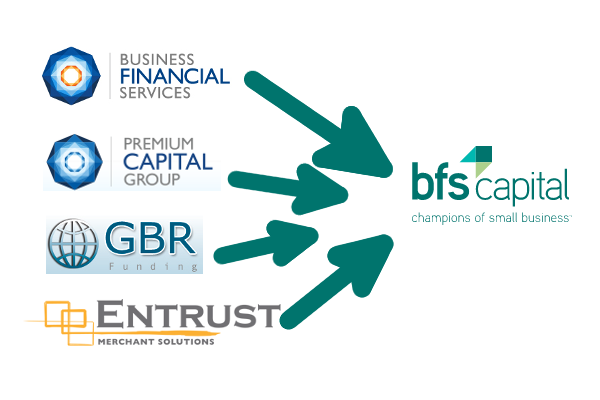
September 21, 2015 Coral Springs, FL-based Business Financial Services has joined the ranks of consolidated powerhouses with the announcement of their rebrand to BFS Capital. As part of the move, the company has unified its North American business affiliates.
Entrust Merchant Solutions, GBR Funding and Premium Capital Group will now also use the BFS Capital name. Entrust, who was acquired by BFS Capital on August 26th, has become the firm’s direct sales division. Ilya Fridman, Entrust’s former CEO, is now a Senior Vice President of BFS Capital and will oversee sales.
Boost Capital, their UK arm, is not changing its name.
BFS Capital is the latest small business funding provider to consolidate their affiliates and change their name.
Already this year, Merchant and Cash and Capital became Bizfi, AmeriMerchant became Capify, and RetailCapital became Credibly. Industry insiders have noticed one thing in common about all these changes, that they’re memorable.
“I think people are thinking about going public and want names that are easily identifiable more than wanting to sound techy,” said John Celifarco, Sales Manager at NY-based Sure Payment Solutions. “Maybe a little of both.”
When AltFinanceDaily previously asked Rory Marks, a Managing Partner of NY-based Central Diligence Group, about the name recognition-value of certain funders in the industry including Business Financial Services, he said “when choosing to use words that are ubiquitous in the industry, it could be difficult to distinguish yourself. Ultimately this could potentially impact the customer’s ability to fully understand the nature of your business.”
Business financial services could be confused as a genre or a category, a few insiders commented, instead of a company name.
The BFS Capital brand should remedy any confusion, although Justin Benton, Executive Loan Producer of Lenders Marketing shared, “a simple name that conveys what you do has value, not only in the eyes of your potential clients, but in the eyes of search engines like Google. At the end of the day, if you do your job well and the client is pleased with the loan product and service you provide, your name will be positively associated as a trusted resource.”
Business Financial Services has long been referred to as BFS by industry insiders so unlike other funders that completely transformed during their rebrand, BFS Capital may retain more of their previous name’s goodwill.
“Bringing all your companies under one umbrella can bring each company’s unique strengths together in one collective effort, rowing towards one common destination,” said Benton.
BFS Capital has been a hot news item this summer. In July, they surpassed $1 billion in lifetime funding.
Fundera Raises $11.5 Million
September 17, 2015 NEW YORK–(BUSINESS WIRE)–Fundera, the online credit marketplace for small businesses, today announced an $11.5 million Series B funding round led by Susquehanna Growth Equity with participation from previous investors including QED Investors, Khosla Ventures and First Round Capital, bringing the company’s total funding to date to $15 million.
Since the most recent financial crisis, small business owners have been underserved by traditional banks with small business loans down from their pre-recession high. As a result, they have been forced to turn to online lenders to find the capital they need to grow. The majority of small business loans originated by online lenders are sourced through predatory offline loan brokers who engage in deceptive practices and take exorbitant fees to market certain lenders over others, driving up the cost of loans to borrowers. This unethical behavior takes advantage of small business owners, often putting them into loans that they do not fully understand or cannot reasonably repay.
America’s small business owners deserve better. Fundera was created to disrupt the loan broker ecosystem and make the process of getting a small business loan as transparent, fair and accountable as possible. Fundera utilizes software to create a seamless common application which enables borrowers to apply to multiple pre-screened lenders in a matter of minutes, clearly presenting funding options while encouraging competition among lenders. Fundera’s customer success team acts as an impartial advocate on behalf of borrowers and the company produces content to educate and allow borrowers to make informed financing decisions. Additionally, this past August, Fundera helped lead the creation of a Small Business Borrowers’ Bill of Rights that brought together a coalition of major industry players with the goal of eliminating predatory lending, and which is quickly becoming the gold standard for fairness in online lending.
Fundera will use this latest round of funding to accelerate its mission of making small business lending more transparent and helping small business owners grow through the responsible use of credit. The company plans to expand its team of dedicated loan specialists and engineers, develop and refine its borrower experience, and continue to build new products that help empower borrowers to choose the best loan for their business.
“Everyday throughout America small businesses which represent the lifeblood of our economy are being taken advantage of by online lenders and brokers,” said Fundera founder and CEO, Jared Hecht. “By creating a transparent marketplace that lays out a small business owners’ loan options and empowers them with tools to choose the best option for their business, Fundera is revolutionizing how small business owners access credit while creating a software solution that is disrupting the loan broker industry.”
Susquehanna Growth Equity shares the company’s passion for empowering consumers and affecting structural changes in the financial space. Scott Feldman, Managing Director at Susquehanna Growth Equity and newly appointed member of Fundera’s Board of Directors, echoes this sentiment: “At Susquehanna, we look for holistic teams that demonstrate true passion for their mission. As early investors in Credit Karma, we understand the Fundera model and have experience in helping companies transform areas of credit and financial services that empower consumers to win.”
Small business credit is one of the few industries where the Internet has had minimal impact when it comes to empowering borrowers and providing them the buying power they need to come out on top, and Fundera is bringing that change to small businesses nation-wide.
Fundera launched in February 2014 and has established itself as the most-trusted online marketplace for small business owners. To date, Fundera has helped secure over $60 million in credit to more than 1,200 small business owners across the country in industries including retail, restaurants, and creative contractors. The company is based in New York City.
About Fundera
Fundera is the most-trusted online marketplace that connects small business owners with the best funding providers for their businesses by working with prescreened lenders to assemble the highest quality funding sources. Fundera was co-founded in 2013 by GroupMe co-founder Jared Hecht and successful software entrepreneur Rohan Deshpande to bring transparency, accountability, and fairness to the online lending industry at large. The company has raised $15 million from Susquehanna Growth Equity, QED Investors, Khosla Ventures, First Round Capital, Lerer Ventures, SV Angel, and angel investors Aaron Levie, Scott Belsky, Strauss Zelnick, Rob Wiesenthal, David Rosenblatt and David Tisch, and is based in New York City. To learn more or get started on a loan application, please visit www.fundera.com.
About Susquehanna Growth Equity
Susquehanna Growth Equity, LLC (SGE) invests in growth stage technology companies in the software, information services, internet and financial technology sectors. The firm is backed by a unique and patient capital base that allows management teams the freedom and flexibility to maximize growth. Notable prior investments in marketplace companies include CreditKarma (financial management platform with 40 million members), BStock Solutions (overstock inventory liquidation marketplace) and Globaltranz (marketplace for transportation services). To learn more, please visit us at www.sgep.com.
Contacts
Brew Media Relations
Ashley Hopkins, 646-517-7544
fundera@brewpr.com
Is The Small Business Administration An Ally to Alternative Lenders?
September 16, 2015 Add the Small Business Administration (SBA) to the list of organizations likely to understand the rise of tech-based business lending. Miriam Segal, a research economist for the SBA, recently published a report titled, Peer-to-Peer Lending: A Financing Alternative for Small Businesses. In it, she opens with a line that is all too familiar in the merchant cash advance and non-bank lending industry. “Imagine that you own a small bakery and you need $15,000 to buy a new oven,” she writes. She later adds, “Data suggest that peer-to-peer lending may be a viable financing alternative for small businesses, particularly given the post-recession credit market.”
After having read the recent Federal Reserve study that essentially concluded that small business owners are just too confused to make sound financial decisions, the SBA report is a welcome sign that there is little to fear from “alternative lending.”
While the SBA is sometimes cast as a villain to the private sector, what with their ability to assuage banks into making small business loans at very low interest rates with the assurance of default guarantees, a practice viewed by some economic ideologues as anti-free market, there hasn’t actually been much competition with alternative lenders. The average SBA loan is about $371,000, much higher than the average merchant cash advance transaction of about $30,000. And although they are a government agency, the SBA is scrutinized far more than today’s alternative lenders are. Politicians have sought to shut the agency down for decades but it has managed to survive. If any small business lending group knows what it’s like to be a political football, it’s the SBA. They’ve even been accused of similar antics, like being a participant to predatory lending.
Chris Hurn, Fountainhead Commercial Capital’s CEO, offered his opinion on such in the Huffington Post when he wrote, “I realize that calling some behaviors ‘predatory’ will raise some hackles, but what else would you call a virtually systemic practice of convincing small business owners to accept an inferior loan program on commercial real estate transactions, which almost certainly puts these borrowers in future harm’s way, only so a bank can maximize its income?”
Where have we heard this viewpoint before?
In the SBA report, Segal acknowledges a wide array of working capital options including merchant cash advance products. “P2P lending may fill a gap in small business lending for entrepreneurs seeking small amounts of capital when existing options are not suitable or available (e.g., bank loans, credit cards, and merchant cash advances),” she states.
She also gets to the heart of the issue that those touting the superiority of long term loans seem to be missing and that is that, “the majority of small business borrowers appear to be interested in relatively short-term loans in relatively small amounts.” Using data made available by Lending Club, 56% of small business owners applied for loans of $15,000 or less. Although the SBA will guarantee really small loans, it’s uncommon for banks to spend time and effort underwriting these, not to mention that many small businesses lack collateral and other minimum requirements for eligibility.
The reality is that alternative lending is for the most part the world outside of the SBA’s scope. “For some small businesses, an expensive loan may be better than no loan,” Segal concludes.
Given the variations in application process, interest rate, loan amount, and term length across loan products, it is apparent that each option presents a unique set of pros and cons. Peer-to-peer loans offer the benefits of expedited application processing, smaller loan amounts, and shorter terms, but borrowers pay for these conveniences in the form of higher interest rates.
– Miriam Segal
Research Economist, SBA
From the perspective of small business advocacy, the report gets it right. “Peer-to-peer lending to small businesses is rising while the origination of small business bank loans is decreasing. Micro businesses are interested in borrowing small amounts of money, although their credit applications are the most likely to be rejected. Therefore, the financial regulatory environment in which P2P lending exists is particularly important to small businesses.”
And it concludes, “Peer-to-peer lending has the potential to change the landscape of small business financing for the better. In order for this to happen, financial regulations must reflect the need for investor protection and simultaneously allow small businesses to access the capital that many individuals are willing to provide—no small task.”
As the wider industry is being researched by regulators, it is an especially important time to discover who shares the same understanding of the facts. Although not an immediately obvious choice of ally, the SBA is undoubtedly qualified to communicate the needs of small business. That makes them an especially good candidate to help explain the story about the what, why, and how of the changing landscape.
SBA Offers Balanced Review of Alternative Small Business Lending
September 15, 2015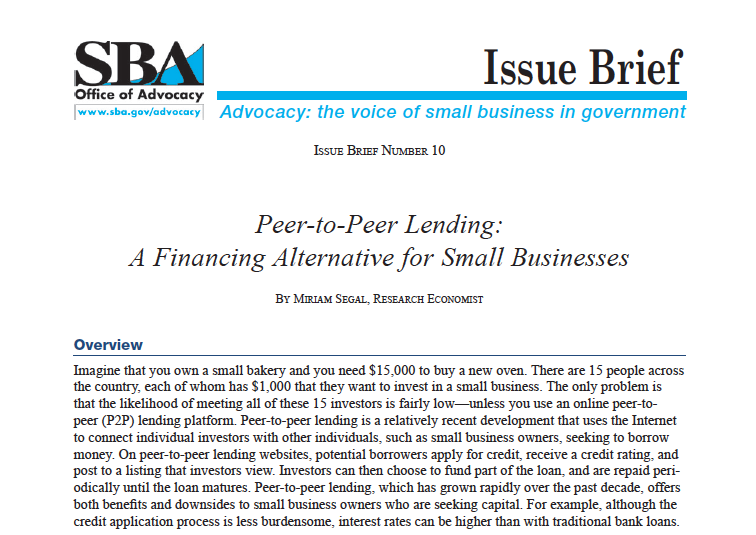 In response to the Treasury’s RFI, I expect many industry commentators to encourage potential government regulators to engage in a careful review of the small business finance market before deciding on a course of action. As an example of the type of review necessary, these commentators could highlight the recent issue brief published by the SBA Office of Advocacy entitled “Peer-to-Peer Lending: A Financing Alternative for Small Businesses“.
While the scope of the paper is limited to P2P loans used for business purposes, it explains how alternative small business lenders are expanding access to capital:
Compared to traditional loan products, marketplace loans feature decreased search costs; this is a result of the proprietary credit scoring algorithms that the lending platforms use. This decrease in costs makes it economical for lenders to provide smaller and/or shorter-term loans to firms on which less information is available. Such firms may include those that are younger, less established, have a shorter credit history, lack collateral, or may be in acute financial distress (e.g., imagine that you own a bakery and your only oven stops working).
The paper recognizes that alternative lenders are able to offer financing to small businesses that previously had no way of obtaining working capital, a fact that is often misunderstood or disregarded by industry critics. The paper also explains some of the reasons why alternative small business loans charge higher rates when compared with other types of loans:
[E]ven controlling for observable borrower characteristics, loans for small businesses were more than 250 times more likely to perform poorly than loans for other purposes, which may give some insights into why such loans are charged a higher rate. Put simply, investors require a higher payoff in order to fund these riskier loans, and for some small businesses, an expensive loan may be better than no loan.
Overall, the paper is a evenhanded assessment of a complex topic. It highlights how alternative lenders have increased credit availability for small business owners while explaining the economics behind the rates charged. And as the policy discussion regarding marketplace lenders begins, explaining these facts will become increasingly important.
Multiple State Regulators Challenging Lender’s Use of Choice of Law Clause in Usury Enforcement Actions
September 11, 2015 A growing number of state regulators are challenging the use of choice of law provisions as a method of usury law compliance. On August 27, 2015, the Attorney General of North Carolina was granted an injunction against Western Sky Financial and CashCall¹. The injunction prohibits them from offering any loans to North Carolina consumers or collecting on any outstanding accounts in that state.
Prior to the issuance of the North Carolina injunction, the Massachusetts Division of Banks sent a cease and desist letter to Western and CashCall stating that each had violated Massachusetts’ law by engaging in the small loan business without a license and that each had violated the state’s criminal usury statute (the letters were initially sent in 2013 but the Division’s findings were recently challenged by Western and CashCall in Massachusetts Superior Court. The court issued its ruling on the challenge on August 31, 2015²). The cease and desist orders specifically directed Western and CashCall to cease collecting on loans made to Massachusetts borrowers, refrain from transferring the loans, refund all interest charges and fees received from borrowers during the last four years, and submit a list of borrowers to whom reimbursement is owed.
And just yesterday the Attorney General of the District of Columbia filed a lawsuit against Western, CashCall and their owner, J. Paul Reddam. The complaint alleges that the defendants charged their customers interest rates in excess of the District’s usury cap. The District is seeking a permanent injunction, restitution, statutory penalties and attorney fees.
In response to both the North Carolina and Massachusetts actions, Western and CashCall asserted that they were not subject to the regulators’ jurisdiction because the choice of law clause in their loan contracts provided the laws of the Cheyenne River Sioux Tribe governed the transactions. The defendants argued that the rates charged were permissible under tribal law (a similar argument is expected to be made by the defendants in response to the DC complaint).
Their argument was rejected in both cases. The reviewing courts found that a contractual choice of law provision did not govern a state regulator and that North Carolina and Massachusetts could pursue the defendants for their alleged violations of local usury laws. These decisions, along with the complaint filed by DC’s Attorney General, cast further doubt on a lender’s ability to rely on a choice of law clause when faced with regulatory enforcement actions.
¹State ex rel. Cooper v. Western Sky Fin., LLC, 2015 NCBC 84 (N.C. Super. Ct. 2015)
²Cashcall, Inc. v. Mass. Div. of Banks, 2015 Mass. Super. LEXIS 87 (Mass. Super. Ct. Aug. 31, 2015)
Competing Factions Hurt Alternative Lending’s Message
September 10, 2015 It’s over. Legislators and regulators in Washington DC know alternative lenders exist, and there’s no going back. There will be regulations that impact the industry in some way. That seems to be a definite at this point. What aspects will be regulated and to what extent however is yet to be determined.
And here’s the important thing you need to know about that impending conversation with folks in DC; They’re not up to speed on many of the issues being debated between industry insiders, and honestly probably won’t be for a long time, if ever.
They’re literally on square one. So if you were secretly hoping that regulators were on the verge of outlawing stacking, excessive broker fees, or high interest rates, you’re going to be very disappointed. I would argue that more than likely they’d have no idea what you were talking about if you broached these issues with them and it would come across like this:

And that’s because they’re trying to fully understand more basic things such as, why would a small business borrow money online as opposed to a bank? And what does marketplace lending really mean and how does it work?
Folks in DC are genuinely curious about the basics. They want to understand because they don’t want to be caught not understanding and ignorantly lead the nation into another financial crisis. That’s why the Treasury recently issued a Request For Information. You should notice how there’s nothing about stacking in it, but rather more fundamental issues like whether or not marketplace lending is helping borrowers that were historically underserved.
You have to applaud the Treasury’s approach because informed regulations, if that’s what this all leads to, would be much better than uninformed regulations.
The process could easily be jeopardized however if everyone’s so caught up in choosing teams, sides, and points of view that they believe are the “right” ones with the hope of scoring nothing other than perceived political points.
If this is what folks in DC see while they are in the information gathering stage, well then it’s probably not going to be a good outcome for anyone:







Companies that buy future receivables with daily payments and lenders originating 3-year loans with monthly payments actually have a lot in common on the fundamental level. They’re both bank alternatives. And for a number of reasons, small businesses are choosing them over more traditional sources. That’s where the conversation needs to begin.
The opportunity to communicate with rule-makers shouldn’t be squandered on complaints about what other people are doing, but rather on the what, why, and how for small business.
The worst thing that could happen is that divisive language within the industry leads to a regulatory result that negatively impacts all the parties involved, including the small businesses that benefit from this improved system of accessing capital.
Surely there is a way forward for everyone…