CFPB Track Record on Anti-Discrimination Analyses Show Malfeasance
December 11, 2015Congressman David Scott (D), the same congressman that said, “God Bless the online lenders” back in October had some choice words for the Consumer Financial Protection Bureau recently after learning they manipulated data to falsely support evidence of racial bias in lending. According to the Wall Street Journal, Scott called their data “shamefully flawed.”
As explained by the WSJ:
The bureau has been guessing the race and ethnicity of car-loan borrowers based on their last names and addresses—and then suing banks whenever it looks like the people the government guesses are white seem to be getting a better deal than the people it guesses are minorities. This largely fact-free prosecutorial method is the reason a bipartisan House supermajority recently voted to roll back the bureau’s auto-loan rules.
 The House of Representatives responded on November 18th by voting 332-96 in favor of stripping some powers away from the CFPB. In a bill, that hopes to be known as the Reforming CFPB Indirect Auto Financing Guidance Act if it is also passed in the Senate and signed by the President, attacks the CFPB’s guidance of the Equal Credit Opportunity Act as it applies to auto lending.
“Bulletin 2013-02 of the Bureau of Consumer Financial Protection (published March 21, 2013) shall have no force or effect,” the bill states outright.
Bulletin 2013-02 addressed the auto lending industry by saying, “the ECOA makes it illegal for a ‘creditor’ to discriminate in any aspect of a credit transaction because of race, color, religion, national origin, sex, marital status, age, receipt of income from any public assistance program, or the exercise, in good faith, of a right under the Consumer Credit Protection Act.”
The CFPB reviewed loan data as expected to see if there were racial disparities but disturbingly did not actually know the race of the borrowers in many cases. So they guessed, according to the WSJ, by reviewing the last names and addresses of the borrowers. When being shown the results of their guesses against a sample of data for which they actually had racial background data, the CFPB only successfully guessed correctly 54% of the time. Despite being aware of this, the CFPB sued Honda, Fifth Third Bank, and others for discriminatory lending practices. Honda was pressured into settling for $24 million and Fifth Third for $18 million even though the CFPB’s data and methodology were false.
The House bill also requires that the CFPB publicly disclose the methodologies and analyses used to assess discrimination in auto financing, lest they continue to manufacture their own data, draw conclusions based on that, and then extort corporations for tens of millions of dollars through lawsuits, investigations and public shaming.
88 Democrats in the House joined their Republican colleagues in passing this bill.
This kind of blatant malfeasance is especially alarming considering the CFPB is already licking their chops to collect data on small business lending so that they can test it for racial and gender disparities as well.
As small business underwriting is markedly different from the commoditized world of consumer lending, it would be near impossible for a pious, law-abiding, and even omnipotent CFPB to make meaningful determinations. Considering that the CFPB we have acts in a manner as described above, small business lenders have a lot to worry about over the implementation of Dodd Frank’s Section 1071.
Prosper Loan Linked to Terror – A Preliminary Assessment
December 9, 2015By now you have probably heard that one of the San Bernardino terrorists received a $28,500 deposit from WebBank.com two weeks prior to committing the attack. After Fox News broke that story, I may have been the first to publicly connect it to an alternative lender which was later revealed to be marketplace lender Prosper about 12 hours later.
As a Prosper investor myself, here are some things you should know:
The $28,500 deposit (if that was the exact true amount) would have been net of the origination fees. In all likelihood this was a loan for around $30,000 and the borrower only netted $28,500.
Those that have speculated that it would be impossible for someone making $53,000 a year (as Syed Farook did) to qualify for an unsecured loan of this amount are wrong. There are loans on the platform right now that fit these parameters. Online Lenders like Prosper and Lending Club are pretty aggressive with their lending.
The notion that Prosper somehow could’ve detected what the borrower planned to do two weeks later just isn’t possible. In lending, this is known as the asshole factor, meaning that even if the applicant meets all the criteria, they could just decide to be an asshole, and there’s no way to predict that.
There are strict laws in place to prevent all kinds of discrimination, meaning that even if Prosper had formed some kind of suspicion about the borrower, it may have been illegal to act on that suspicion. Such is the hypocritical paradigm of fair lending where factors that are measurable predictors of negative performance (or worse) cannot be legally used. Federal laws have purposely tried to create an environment where lenders make decisions on an objective basis they consider to be fair. In business lending for example, there is a law within Dodd-Frank that has not been implemented yet, but seeks to prevent loan officers from knowing the gender or even the name of the prospective borrower to protect them from subconscious discrimination.
Investigators have publicly announced that the terrorists were not on any watch lists and therefore there are no systems or checks that Prosper could’ve plugged into to have gotten the information.
Prosper and other alternative lenders already have Anti-Money Laundering Policies. I know this because I complained about Lending Club’s over a year ago.
The Wall Street Journal stated, “Only some nonbank financial institutions, such as mortgage lenders, are subject to Treasury rules requiring lenders to report suspicious activity to the government under the Financial Crimes Enforcement Network.” Maybe that’s true, but there is nothing suspicious about someone applying for a loan online who is not on any watch lists. I can’t think of anything that could’ve been suspicious unless they submitted fake pay stubs or forged documents.
“There’s no due diligence that’s done into how these loans are actually going to be used,” said Brian Korn, a partner at the law firm Manatt, Phelps & Phillips, LLP in the WSJ. This is true and at the same time related to anti-discrimination laws. Judging a loan applicant by their detailed monetary plans could potentially induce gender or ethnicity bias, even if subconscious.
There will be plenty of questions in the coming days from Americans, the media, and government officials about what alternative lenders are doing to make sure they’re not funding terrorists. Part of what they may learn is that for all the data that alternative lenders have at their disposal to make intelligent decisions on an automated basis, some of them cannot be legally used. They’ll also find out that there’s only so much that predictive analytics can actually predict.
It’s very unlikely that Prosper could’ve handled anything differently…
Fundry’s Isaac Stern Hosts Successful Fundraiser for Hatzalah of Union County
December 6, 2015 ‘Tis the season of giving for Fundry’s Isaac Stern and the dozens of folks that attended the December 5th winter fundraiser at his home in Hillside, New Jersey. The event, which served up 550 pounds of barbecue and included a Scotch taste testing bar hosted by representatives of Glenfiddich, raised over $60,000 for Hatzalah of Union County, a local non-profit all-volunteer emergency medical service organization.
Founded in 2004, Hatzalah EMS provides basic life support in medical emergency situations. They cover Union County NJ including the towns of Elizabeth, Hillside, Union, Roselle and Linden. Today, Hatzalah is staffed with 3 ambulances, 24 EMTs and 18 dispatchers all under the medical direction of a physician and two paramedics.
Hatzalah Chief Yudi Abraham told AltFinanceDaily that Yellowstone Capital (a Fundry subsidiary) has been a long-time supporter of their organization. A few years ago, when the squad was undergoing a transition of directors, Chief Abraham reached out to Isaac Stern for financial help. At the time, Hatzalah was in serious need of replacing an older ambulance as well as covering monthly operating expenses. “Isaac didn’t waste any time and sprang right into action,” says Chief Abraham. “He immediately convened his employees and his associates and came through for us in a huge way.” Yellowstone Capital raised the funds in under two days for Hatzalah to buy a fairly used ambulance. Ever since then, Stern and Chief Abraham have been working closely together to ensure that other expenses were covered. Over the years, Yellowstone Capital has helped donate the funds to purchase two additional ambulances that currently make up Hatzalah’s fleet. The Yellowstone Capital name appears on the side of each of them.

The most recent event kicked off with a $10,000 personal donation from Stern, prompting others to give too while enjoying the festivities.
“With the help of Yellowstone Capital we are able to maintain our level of service and continue providing the best possible emergency care for our patients,” said Chief Chaim Cillo. “We at Hatzalah will forever be most appreciative for such an incredible company that cares and gives back to the community in such a large way.”
Stern and Yellowstone were also presented an award for their continued generosity.
 Chief Yudi Abraham (left) and Fundry CEO Isaac Stern (right)
In attendance at the event were Fundry employees, friends, family members, and others from the non-bank finance industry.

 From left to right: Andrew Hernandez of Central Diligence Group, Sean Murray of AltFinanceDaily, and Andy McDonald of Yellowstone Capital/Fundry
 Michael Samuels (left) and Steve Weinrib (right) both of Yellowstone Capital/Fundry
Hatzalah means “rescue” or “relief” in Hebrew and for many guests the event fell on the eve of the Hanukkah holiday. The volunteer EMS crew of course helps all people in need of care.
“Our pay,” said Chief Abraham, “is helping our patients and saving lives.”
Bad Merchants: Lies, Fraud, and Hard Times
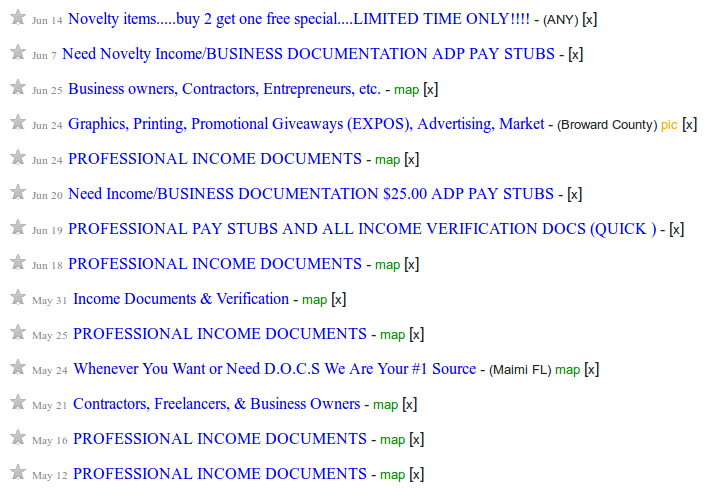
December 4, 2015 Critics seldom tire of bashing alternative finance companies, but bad behavior by merchants on the other side of the funding equation goes largely unreported. Behind a veil of silence, devious funding applicants lie about their circumstances or falsify bank records to “qualify” for advances or loans they can’t or won’t repay. Meanwhile, imposters who don’t even own stores or restaurants apply for working capital and then disappear with the money.
“People advertise on craigslist to help you commit fraud,” declared Scott Williams, managing member at Florida-based Financial Advantage Group LLC, who helped start DataMerch LLC to track wayward funding applicants. “Fraud’s a booming business, and every year the numbers seem to increase.”
Deception’s naturally on the rise as the industry continues to grow, according to funders, industry attorneys and collections experts. But it’s also increasing because technology has made it easy for unscrupulous funding applicants to make themselves appear worthy of funding by doctoring or forging bank statements, observers agreed.
Some fraud-minded merchants buy “novelty” bank statements online for as little as $5 and fill them out electronically, said David Goldin, president and CEO of Capify, a New York-based funder formerly called AmeriMerchant, and president of the SBFA, which in the past was called the North American Merchant Advance Association.
To make matters worse, dishonest brokers sometimes coach merchants on how to create the forgeries or modify legitimate records, Goldin maintained. Funders have gone so far as to hire private investigators to scrutinize brokers, he said.
But savvy funders can avoid bogus bank statements, according to Nicholas Giuliano, a partner at Giuliano, McDonnell & Perrone, a New York law firm that handles collections. Funders can protect themselves by remaining skeptical of bank records supplied by applicants. “If the merchant cash advance company is not getting them directly from the source, they can be fooled,” Giuliano said of obtaining the documents from banks.
Another attorney at the firm, Christopher Murray, noted that many funders insist upon getting the merchant’s user name and password to log on to bank accounts to check for risk. That way, they can see for themselves what’s happening with the merchant.

Besides banking records, funders should beware of other types of false information the can prove difficult to ferret out and even more difficult to prove, Murray said. For example, a merchant who’s nine or ten months behind in the rent could convince a landlord to lie about the situation, he noted. The landlord might be willing to go along with the scam in the hope of recouping some of the back rent from a merchant newly flush with cash.
Merchants can also reduce their payments on cash advances by providing customers with incentives to pay with cash instead of cards or by routing transactions through point of sale terminals that aren’t integrated onto the platform that splits the revenue, said Jamie Polon, a partner at the Great Neck, N.Y.-based law firm of Mavrides, Moyal, Packman & Sadkin, LLP and manager of its Creditors’ Rights Group. A site inspection can sometimes detect the extra terminals used to reduce the funder’s share of revenue, he suggested.
In a ruse they call “the evil twin” around the law offices of Giuliano, McDonnell & Perrone, merchants simply deny applying for the funding or receiving it, Giuliano said. “Suddenly, the transaction goes bad, and they deny they had anything to do with it,” he said. “It was someone who stole the merchant’s identity somehow and then falsified records.”
In other cases, merchants direct their banks not to continue paying an obligation to a funder, or they change to a different bank that’s not aware of the loan or advance, according to Murray. They can also switch to a transaction processor that’s not aware of the revenue split with the funder. Such behavior earns the sobriquet “predatory merchant,” and they’re a real problem for the industry, he said.
Occasionally, merchants decide to stop paying off their loans or advances on the advice of a credit consulting company that markets itself as capable of consolidating debt and lowering payments, Giuliano said. “That’s a growing issue,” agreed Murray. “A lot of these guys are coming from the consumer side of the industry.”
The debt consolidator may even bully creditors to settle for substantially less than the merchant has agreed to pay, Murray continued. Remember that in most cases the merchants hiring those companies to negotiate tend to be in less financial trouble than merchants that file for bankruptcy protection, he advised.
“More often than not, they simply don’t want to pay,” he said of some of the merchants coached by “the credit consultants.” They pay themselves a hundred thousand a year, and everyone else be damned. You continue to see them drive Humvees.”

Merchants sometimes take out a cash advance and immediately use the money to hire a bankruptcy attorney, who tries to lower the amount paid back, Murray continued. However, such cases are becoming rare because bankruptcy judges have almost no tolerance for the practice and because underwriting continues to improve, he noted.
Still, it’s not unheard of for a merchant to sell a business and then apply for working capital, Murray said. In such cases, funders who perform an online search find the applicant’s name still associated with the enterprise he or she formerly owned. Moreover, no one may have filed papers indicating the sale of the business. “That’s a bit more common than one would like,” he said.
In other cases the applicant didn’t even own a business in the first place. “They’re not just fudging numbers – they’re fudging contact information,” said Polon. “It’s a pure bait and switch. There wasn’t even a company. It’s a scheme and it’s stealing money.”
Whatever transgressions the merchants or pseudo-merchants commit, they seldom come up on criminal charges. “It is extremely, extremely rare that you will find a law enforcement agency that cares that a merchant cash advance company or alternative lender has been defrauded,” Murray said. It happens only if a merchant cheats a number of funders and clients, he asserted. “Recently, a guy made it his business to collect fraudulent auto loans,” he continued. “That’s a guy who is doing some time.”
However, funders can take miscreants to court in civil actions. “We’re generally successful in obtaining judgments,” said Giuliano. “Then my question is ‘how do you enforce it?’ You have to find the assets.” About 80 percent of merchants fail to appear in court, Murray added. Funders may have to deal with two sets of attorneys – one to litigate the case and another to enforce the judgment. Even merchants who aren’t appearing in court to meet the charges usually find the wherewithal to hire counsel, he said.
Funders sometimes recover the full amount through litigation but sometimes accept a partial settlement. “Compromise is not uncommon,” noted Giuliano. Settling for less makes more sense when the merchant is struggling financially but hasn’t been malicious, said Murray.
To avoid court, attorneys try to persuade merchants to pay up, said Polon. “My job is to get people on the phone and try to facilitate a resolution,” he said of his work in “pre-litigation efforts,” which also included demand letters advising debtors an attorney was handling the case.
 But it’s even better not to become involved with fraudsters in the first place. That’s why more than 400 funding companies are using commercially available software that detects and reduces incidence of falsified bank records, said a representative of Microbilt, a 37-year-old Kennesaw, Ga.-based consumer reporting agency that has supplied a fraud-detection product for nearly four years.
“Our system logs into their bank account and draws down the various data points, and we run them through 175 algorithms,” he said. “It’s really a tool to automate the process of transferring information from the bank to the lender,” he explained.
The tools note gross income, customer expenditures, loans outstanding, checks returned for non-sufficient funds and other factors. Funders use the portions of the data that apply to their risk models, noted Sean M. Albert, MicroBilt’s senior vice president and chief marketing officer.
Funders pay 25 cents to $1.25 each time they use MicroBilt’s service, with the rate based on how often they use it, Albert said. “They only pay for hits,” he said, noting that they don’t charge if information’s not available. Funders can integrate with the MicroBilt server or use the service online. The company checks to make sure that potential customers actually work in the alternative funding business.
MicroBilt is testing a product that gathers information from a merchant’s credit card processing statement to analyze ability to repay excessive chargebacks reflected in the statements could spell trouble, and seasonality in receipts should show up, he noted.
Additional help in avoiding problem merchants comes from the Small Business Finance Association, which maintains a list of more than 10,000 badly behaving funding applicants, said the SBFA’s David Goldin. The nearly 20 companies that belong to the trade group supply the names.
SBFA members, who pay $3,000 monthly to belong, have access to the list. According to Goldin, the dues make sense because preventing a single case of fraud can offset them for some time, he maintained. Besides, associations in other industries charge as much as $10,000 a month, he added.
Another database of possibly dubious merchants, maintained by DataMerch LLC, became available to funders in July, according to Scott Williams, who started the enterprise with Cody Burgess. It became integrated with the AltFinanceDaily news feed by early October, causing the number of participating funders to double to a total of about 40, he said. The service is free now, but will carry a fee in the future.
It’s not a blacklist of merchants that should never receive funding again, Williams emphasized. Businesses can return to solvency when circumstances can change, he noted. That’s why it’s wise to regard the database as an underwriting tool. In addition, merchants can in some cases add their side of the story to the listings.
Funding companies directly affected by wayward merchants can contribute names to the list, Williams said. About 2,500 merchants made the list within a few months of its inception, he noted. “We’re super happy with our numbers,” he said of the database’s growth.
Many merchants find themselves in the database because of hard times. Of those who land on the list because of fraud, perhaps 75 percent actually own businesses and about 25 percent are con artists applying for funding for shell companies, Williams said.
So far, only direct funders – not brokers or ISOs – can get access to the database, he continued, noting that DataMerch could rethink the restriction in the future. “We don’t want hearsay from a broker who might not know the full scope of the story,” he said.
DataMerch might grant brokers and ISOs the right to read the list to avoid wasting time pitching deals to substandard merchants, but the company does not intend to enable members of those groups to add merchants to the database, Williams said.
Williams sees a need for the new database because smaller companies can’t afford belonging to the SBFA. The association also tracks deals about to become final, which could prevent double-funding but makes some users uncomfortable because they don’t want to disclose their good merchants, Williams said.
 Although dishonesty’s sometimes a factor, merchants often go into default just because of lean times, Jamie Polon, the attorney, cautioned. A restaurant could close, for example, because of construction or an equipment breakdown. “Were they not serving dinner anymore, or was there something much deeper going on?” he said. Fraud may play a role in 10 percent to 20 percent of the collections cases his law firm sees, he noted. More than 95 percent blame their troubles on a downturn in business, and the rest claim they didn’t understand the contract, he said.
To understand the downturn, it’s important to amass as much information about the merchant as possible, said Mark LeFevre, president and CEO of Kearns, Brinen & Monaghan, a Dover, Del.-based collections agency that works with funders. That information sheds light on a merchant’s ability to repay and could help determine what terms the merchant can meet, he said.
Timeliness matters because the sooner a creditor takes action to collect, the greater the chance of recouping all or most of the obligation, LeFevre maintained. When distress signals arise – such as closing an ACH account or a spate of unreturned phone calls – it’s time to place the merchant with a collections expert, he advised.
LeFevre’s company also traces a troubled merchant’s dwindling assets to help the funder receive a fair share. Funders can sometimes recover all or most of what they pay a collection agency by imposing fees on the merchant, he noted.
Pinning the collection fees to merchants in default makes sense because that’s where the guilt often resides, observers said. It’s part of balancing the bad behavior equation, they agreed.
Google Serves Low Blow to Merchant Cash Advance Seekers
December 2, 2015 Almost eighteen months ago, I explored whether or not Google was rigging the search results to benefit two lending companies they had equity investments in, Lending Club and OnDeck. At the time, both companies ranked at the top for highly coveted keywords even if they weren’t directly related to the user’s search query.
Now that those two companies are public, a company called Credit Karma seems to have inherited the top spots. And wouldn’t you know it, Google has also invested in them.
Google: loans
Google: personal loan
But that’s not the worst of it. Thanks (or no thanks rather!) to a relatively new search result feature called “People Also Ask,” one keyword recently started serving up results with a different kind of hidden agenda.
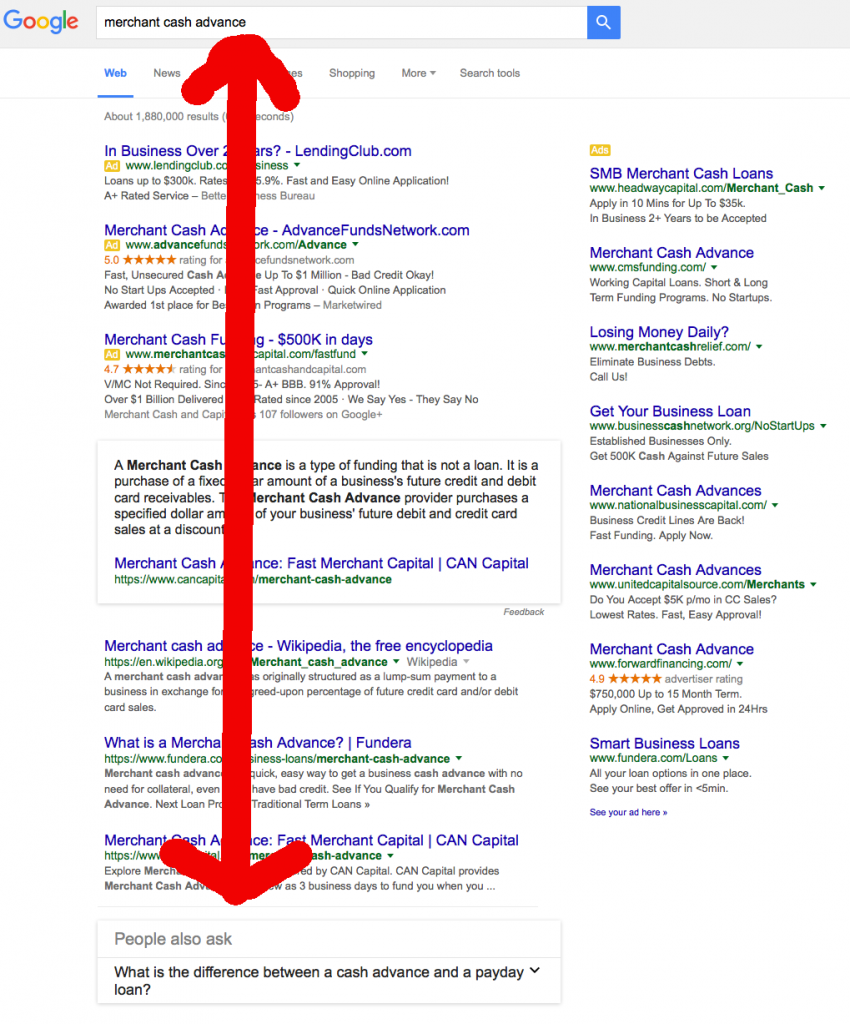
While my captured results may not be identical for everyone, I have conducted tests with other people on other devices and from other areas and it was present each time. With this box, Google is subtly planting the negative seed that payday loans and merchant cash advances are basically so identical that other people just like you are wondering what the difference between the two are. But here’s the rub, the two have nothing to do with each other and it’s unlikely so many people are asking that.
Pay no mind to the fact that the box makes reference to a “cash advance” not a “merchant cash advance.” The painstaking mishap could be innocently chalked up to an algorithmic error if only googling just cash advance revealed the same box in the results. But it doesn’t. Only merchant cash advance brings this up.
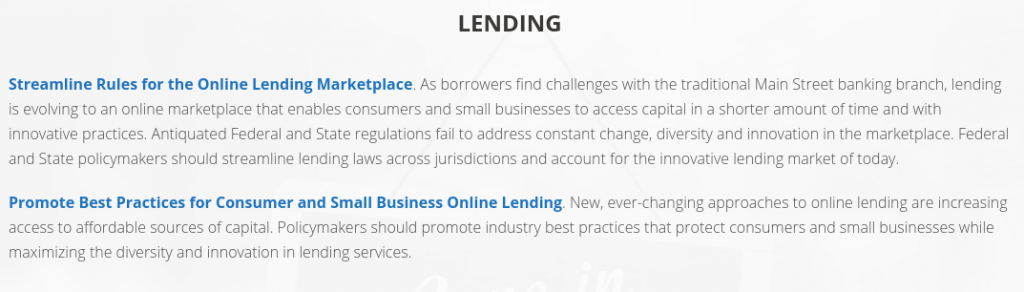
Comparing merchant cash advances to payday loans is straight out of the anti-merchant cash advance propaganda playbook. At least one Google-owned business lending company is actively lobbying against short term business lending and merchant cash advances in Washington so the placement and comparison of the People Also Ask box in their results is highly suspicious.
It’s no secret that Google is also directly lobbying in the online lending space too. One month ago, right before Google magically started to suggest to searchers that merchant cash advances and payday loans were related, Google formed a lobbying organization called Financial Innovation Now with Amazon and Apple. On their main agenda is online lending.
Given the suspicious search rankings for companies they have an equity stake in, I would not doubt for a second that something like this was manually inserted. I admit that my evidence and my case are weak, but given the circumstances, it’s quite possible there’s something deliberate happening here.
What do you think? Do you see this when you google merchant cash advance?
Merchant Cash Advance | A Look Back and Plan Forward
November 29, 2015 Merchant Cash Advance is still a relatively unknown term and product to the masses, but amongst most of its target customer base, it definitely has a stigma that is rightly deserved in some ways, but I believe that it is also misunderstood in many other ways. Having been in the industry for nearly 10 years, I can say that I have seen my fair share of positive and negative events as they relate to the industry, but I believe that it has all been for its betterment and growth. Furthermore, by having been on the underwriting side for a majority of that time, I can say with great certainty that I have seen this product help several small business owners over the years, and it will continue to do so as the stigma fades away and acceptance increases.
For those of us working in this industry now, let’s face it – most small business owners that have taken a merchant cash advance or have been solicited for the product would much rather go to their bank for the money. The problem, as many merchants have come to realize in recent years, is that lending in general essentially dried up after the recession. The faucet is now running again, but small businesses were all but forgotten. Only the most well qualified borrowers are able to obtain the desired amount of capital needed at a reasonable cost through traditional bank loans. In addition to meeting all of the necessary criteria for a bank loan or line of credit, a borrower must also be prepared to wait months for the process to be finalized.
The days of a small business owner being able to go down to his or her community bank or local branch for a quick cash injection are long gone, but that’s where we come in. We are catering to a customer base that has been left out to dry. We are dealing in a marketplace that is grossly underserved by the larger financial institutions. We are charging a premium for taking on risk that most cannot stomach. We are keeping America running. That might sound ambitious, but is realistic when you put things in perspective.
SBA and IDC data show that small businesses employ at least half of the US workforce and produce anywhere from 60% – 80% of the new jobs annually while also accounting for nearly half of total US private payroll. As if that weren’t enough, small businesses also produce six trillion dollars or over 50% of all non-farm GDP in the US. When looking at additional SBA data which also states that more than 80% of all small businesses need to use some sort of financing to grow their business, it’s perplexing as to why banks have turned their backs on the people that have put America on their very own backs.
However, I do not want to go into great detail or make any assumptions on why “big banks” are not lending to small businesses. Rather, I would like to take some time to focus on how we can continue to support the growth of small businesses across America. The MCA product in particular has evolved quite a bit over the past 10 years, but a lot of that development has taken place in the past 3-5 years, and the industry has grown leaps and bounds as a result. When I started working as an underwriter several years ago, there were less than 10 lenders and 50 brokers operating within the space. Nowadays, there are hundreds on both sides of the fence, and there are multiple new entrants every day – senior guys starting their own operations, one man rogues from the insurance and mortgage businesses, consumer payday lenders, et cetera. – all looking for our piece of the pie, but who out there is really looking to improve upon and grow the product for the better?
 I suppose therein lies the problem. Unfortunately, the tremendous growth we have recently witnessed also comes with a flood of unqualified and unknowledgeable management and staff that are simply following the direction of their unqualified and unknowledgeable employers. As an industry, if we expect to continue making headway in the small business lending environment, we must first better ourselves by taking the time to learn and understand the product in order to better educate our customers. If you know me, you have heard me say on a few occasions that it is easy to put the money on the streets, but the problem for most people is getting it back.
As with anything in life, you cannot jump into something and expect to master it. Over time, you get a grip of what you are doing, and you begin to build on that understanding. Therefore, no one should enter the market expecting to make huge returns without learning the ins and outs of the business. I, along with several of my peers, have seen plenty of well-intentioned but aggressive entrants “lose their shirts,” so to speak, because they did not do the proper diligence on the industry or the actual diligence required to operate within the space. Lending money with only a UCC-1 in place only on future receivables or sometimes no collateral at all is risky business as it is, but not taking the necessary steps to mitigate that risk is only asking for a rough road ahead – not only for the lender itself, but also for their potential clients, brokers, other lenders, and the industry as a whole.
Our underwriters and sales people, in addition to management, should have a solid understanding of the product they are working on. They should be able to educate customers as well as their peers. Transparency throughout the process is key for maintaining a long and mutually benefiting relationship with the client. By having this firm grip and understanding of the product, we reduce the risk of an unsatisfied customer. As with the mortgage and insurance industries, sales and underwriting must work together to determine the best possible result for both the client and the company. This is definitely a challenge for most groups due to the amount of balancing required to meet the needs of the company, but by establishing best practices and procedures in both the sales and underwriting processes, we can begin to think and work within separate verticals and group goals but streamline the process to achieve the agenda of alternative small business lending which should be to help provide small business owners with the fast and efficient capital they need.
Whether you have been in the industry for years, you have just joined this year, or you are considering taking the dive now, it’s only fitting that at this time of year we give thanks to those small business owners and celebrate their entrepreneurial spirits because they are the reason we, ourselves, are currently employed. But more importantly, they are setting us up for quite an adventure which will change the landscape of small business lending for good. I, personally, cannot wait for the next 3-5 years of continued growth because I can only see a bright future if we are able to collectively educate ourselves and pass that knowledge along to our clients. As long as the proper steps to learn have been taken, the competition from new entrants mentioned previously is also welcomed because this further drives new ideas and developments within the space – new financial products to offer clients, lower costs, and most importantly easier and efficient access to quick capital for the busy small business owners constantly on the go in an effort to grow their business while putting the rest of us on their backs.
Merchant Cash Advance is The Real Square IPO Story
November 22, 2015 Square’s debut on the New York Stock Exchange is being talked about as one of the more consequential IPOs of 2015. As a mobile payments company famous for both losing money and its founding by Jack Dorsey, Twitter’s CEO, the $2.9 billion valuation pales in comparison to its rival First Data that went public just a month before. First Data, which was founded in 1971, is worth five times more than Square with a market cap of $14.7 billion to Square’s $2.9 billion. But it’s Square that everyone’s talking about and not necessarily in a positive way. Cast as the poster child for runaway private market valuations in Fintech, Square’s Series E round just a year before had supposedly increased its worth to $6 billion.
Robert Greifeld, the CEO of Nasdaq, had warned people just weeks earlier about the validity of private market valuations. “A unicorn valuation in private markets could be from just two people,” he said. “Whereas public markets could be 200,000 people.”
And while Square’s IPO was relatively well-received, closing at 45% above its offered price, there’s an entire story beyond payments hidden in the company’s financial statements under the label of “software and data products.” That’s code for merchant cash advance, the working capital product they offer to customers that currently makes up 4% of the company’s revenue.
“Since Square Capital is not a loan, there is no interest rate,” states the company’s FAQ. That echoes what dozens of other merchant cash advance companies have been saying for a decade. “You sell a specific amount of your future receivables to Square, and in return you get a lump sum for the sale,” marketing materials explain.
Lenders that don’t approve of this receivable purchase model are lobbying politically against it, some of whom are well-known. Lending Club for example, is a signatory to the Responsible Business Lending Coalition’s Small Business Borrowers Bill of Rights (SBBOR), committing themselves to things like transparency and the disclosure of APRs even for non-loan products.
 But disclosing an APR on a receivable purchase merchant cash advance transaction is not only impossible since there is no time variable, but would violate the spirit of the contract even if estimates were used to fill in the blanks. Nonetheless, Fundera CEO Jared Hecht, whose marketplace platform has also signed the SBBOR told Forbes in September that “small business owners have been sold by pushy salespeople, hiding terms, disguising rates and manipulating customers into taking products that aren’t good for them.”
Ironically, Fundera’s own merchant cash advance partners have not made any such pledge to disclose APRs. No one’s commitment is verified anyway. “Neither Small Business Majority nor any other coalition member independently verifies that any of these signatory companies or entities in fact abide by the SBBOR,” the group’s website states. This isn’t to say that their intent is misguided, there’s just very little substance to it below the surface.
For example, while the coalition has made some subtle and not so subtle digs about merchant cash advances over fairness and transparency, it’s the lending model used by some of the SBBOR’s signatories that is being challenged by the courts right now. Because of Madden v. Midland, Lending Club’s practice of using a chartered bank to originate loans could potentially be in jeopardy. The ruling was just appealed to the U.S. Supreme Court. At the heart of the issue is the ability to usurp state usury caps through the National Bank Act. For a company that has pledged to offer non-abusive products, it’s ironic that their model relies on preemption of state interest rate caps all the while reassuring their shareholders that there’s no risk because of their Choice of Law fallback provision. In truth, Lending Club uses a state chartered bank and not a nationally chartered bank and thus would be somewhat shielded in an unfavorable Supreme Court ruling.
Those concerned in years past that receivable purchase merchant cash advances were full of regulatory uncertainty had shifted towards the model that Lending Club uses since it was perceived to have more nationally recognized legitimacy. However, with that model seriously challenged, old school merchant cash advances are once again looking pretty good. That’s probably why publicly traded Enova International Inc. (NYSE:ENVA) bought The Business Backer this past summer. And it’s why Square skated through their IPO without much resistance to their merchant cash advance activities.
The story of Square was either that it was overvalued, that CEO Jack Dorsey couldn’t handle running two companies, that they were losing money, or that their deal with Starbucks was a mistake. Meanwhile Square has processed $300 million worth of merchant cash advances, a product that doesn’t disclose an APR since it’s not a loan. “Nearly 90% of sellers who have been offered a second Square Capital advance cho[se] to accept a repeat advance,” their S-1 stated.
“If our Square Capital program shifts from an MCA model to a loan model, state and federal rules concerning lending could become applicable,” it adds. And right now partly due to Madden v. Midland, the loan model looks pretty shaky. Square proved many things when they went public on November 19th and one was that merchant cash advances are just the opposite of what critics have argued in the past.
Battery Ventures’ general partner Roger Lee told Business Insider, “the [Square Capital] product itself will have unique advantages in the market, and it’s a big market.”
Lending Club Narrowly Avoids Major Transparency Flop
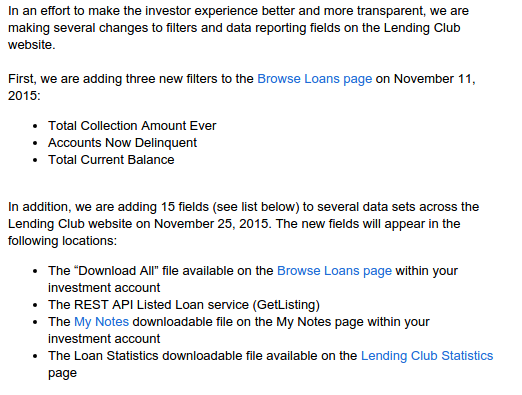
November 18, 2015After many months of Lending Club warning that they would be REMOVING borrower credit data from note listings, they have completely reversed course and ADDED fifteen new credit attributes. On Peter Renton’s LendAcademy forum, one member speculated that this move was made to compete with Prosper for the attention of institutional investors. If true, that would be entirely misguided.
Almost exactly one year ago, Lending Club announced that they were cutting the amount of data points available to investors from 100 to 56. Renton, a marketplace lending evangelist and founder of the LendIt conference, gave it a negative spin in his blog:
It is pretty obvious by now that I don’t like these changes. For quite some time now Lending Club has been reducing the amount of transparency for investors. Now, some changes I completely understood such as removing the Q&A with borrowers and even the removal of loan descriptions. But removing data that investors have been using to make investment decisions is a step too far in my opinion.
I think Lending Club need to ask themselves if they are a true marketplace connecting borrowers and investors in a transparent fashion or whether they are more of a loan origination platform that makes products available to investors. They are certainly moving more towards the latter, I think, and that is a shame for everyone.
The move was seen by many as a way to stop investors from trying to reverse engineer their models and beat their grading system for above average yields. While understanding that perspective, it is mind boggling that they had planned to remove more data points and make the loans on the platform even less transparent. And here’s why…
 Lending Club is a key signatory to the Small Business Borrower’s Bill of Rights, a group of political activists that claim innovative small business lending can only achieve its potential “if it is built on transparency, fairness, and putting the rights of borrowers at the center of the lending process.” With transparency being a focal point of their agenda there, one might find their attempts to reduce disclosure and eradicate transparency a bit hypocritical.
Investors on Renton’s forum who had for months anticipated Lending Club to remove more data points, also viewed it negatively. “I’d have to think hard on whether to continue investing in LC notes without those credit fields — it would be very much like gambling rather than investing,” wrote Fred back on July 8th.
A similarly named user, Fred93, communicated that these data points were all investors had to go off. “We can’t shake a borrower’s hand, feel the firmness of his grip, the sweatiness of his palm. We can’t look a borrower in the eye. We live or die by a handful of numbers, which we hope mean something, on the average,” he wrote.
Clearly some investors weren’t thrilled with the proposed changes. All the while, Lending Club’s co-signatories had been promoting the transparency pledge through speeches, TV appearances, public relation events, and press releases. To be fair, The Small Business Borrowers Bill of Rights is aimed at transparency between business borrowers and sources offering business financing. Lending Club’s planned removal of data was targeted at investors in their consumer notes. It sounds different enough until you consider that 72% of Lending Club’s loans originated in 2014 were funded by investors vastly less sophisticated than the commercial businesses they have pledged to protect. That’s because that money came from consumers, many of whom are unaccredited and went through no screening process. Instead, these investors are presented with a prospectus as if they were buying a stock or bond and stuck with the risk whether they understand it all or not.
These consumers who are legally presumed to be unsophisticated are the very same people that Lending Club planned to reduce disclosures to, all the while heavily promoting to them that they roll over their retirement savings onto their platform. That logic is the very definition of insanity. Obfuscating the reasoning behind certain scoring grades to these investing consumers would be nothing short of unconscionable and would reasonably invalidate any pledge they’ve made towards transparency in other areas.
Lending Club has for now avoided a major flop by reversing course after having added 15 new pieces of data for investors.
While some investors speculated the move had to do with pressure from Lending Club’s institutional investor base. The more likely reason is increasing scrutiny from federal regulators. Less than two weeks ago for example, the FDIC warned banks about marketplace lending and advised them to perform their own underwriting on the loans they buy and not to rely on originator scoring models. A summary of their letter specifically said:
Some institutions are relying on lead or originating institutions and nonbank third parties to perform risk management functions when purchasing: loans and loan participations, including out-of territory loans; loans to industries or loan types unfamiliar to the bank; leveraged loans; unsecured loans; or loans underwritten using proprietary models.
Institutions should underwrite and administer loan and loan participation purchases as if the loans were originated by the purchasing institution. This includes understanding the loan type, the obligor’s market and industry, and the credit models relied on to make credit decisions.
Before purchasing a loan or participation or entering into a third-party arrangement to purchase or participate in loans, financial institutions should:
– ensure that loan policies address such purchases,
– understand the terms and limitations of agreements,
– perform appropriate due diligence, and
– obtain necessary board or committee approvals.
These guidelines conflict with Lending Club’s long sought after goal of getting investors to trust their A-G scoring grades. The banking regulator is advising banks to basically disregard them. “The institution should perform a sufficient level of analysis to determine whether the loans or participations purchased are consistent with the board’s risk appetite and comply with loan policy guidelines prior to committing funds, and on an ongoing basis,” the more complete memo reads. “This assessment and determination should not be contracted out to a third party.”
A law firm with specialized knowledge of the industry, criticized the FDIC’s move when they wrote on their website, “Ironically, given the Treasury Department’s recent request for information, which supported marketplace lending and focused in part on how the federal government could be supportive of the innovations in marketplace lending, we now have a federal banking agency that is creating roadblocks to having banks participate in this dynamic and rapidly growing space.”
 Asking banks not to rely on marketplace scoring models alone hardly seems like a roadblock, especially when the models are tucked away in algorithmic obscurity, have hardly been around for very long, and would decide the fate of depositor money. And if this directive indeed contributed to Lending Club’s transparency reversal, then it couldn’t have been any more well-timed.
Whether or not the added data points will make any difference to the performance of investment portfolios is irrelevant. If unaccredited investors and/or depositor money are the source of marketplace loan funding, then Lending Club has a responsibility to disclose as much as possible, no matter how little value they believe certain pieces of information are worth. The 15 additional points are a welcome announcement. The question going forward should be, what else can they disclose?
As a company that pledged so strongly to protect corporations from transparency issues in the developing commercial finance market, they should be trying twice as hard to protect the unsophisticated consumers that invest in the loans they approve and make available for investing. Some of these consumers are prodded into putting their retirement funds on the platform and we all know some people will irresponsibly place their entire retirement portfolio in it. The “Number of credit union trades” a borrower has might not unlock the secret to better investing performance but if it’s something Lending Club knows, the investing public deserves to know it too, if only in the name of transparency which they have so committed themselves to uphold…