
Breaking News: Judge Grants Temporary Injunction to Halt Entire Marketplace Lending Industry
April 1, 2016April Fools 2016
 A late night session on Capitol Hill has led to a catastrophic outcome for the marketplace lending industry.
At approximately 11:30 PM Thursday night, lobbyists working on behalf of Bank of America, Wells Fargo and TD Bank scheduled an emergency meeting with six members of Congress to discuss, among other issues, the impact of marketplace lending on their bottom lines. “Q1 earnings won’t officially be released for a while,” said Oregon Congressman Edward Duchovny, who was present, “but loan volumes were down across all three banks by a substantial percentage.”
The drops were so alarming, that each bank had initially concluded that their financial reports had been hacked. “They thought there was a security breach,” said a congressional staff member with knowledge of the meeting who was not authorized to speak on the record. “One bank’s consumer lending unit experienced a drop in originations by 50% year over year.”
Shortly after midnight, a team of bleary-eyed auditors and staff members from the Treasury Department concluded that the numbers were correct and that something nefarious was to blame. “We knew that something like this might happen,” said US Treasury forecast analyst Andrea Mitchells. “When we conducted the RFI last year, we met with some of the banks and flat out told them that marketplace lending was irreversibly changing how people borrow money.”
The revenue loss to banks from marketplace lenders in just the first quarter of this year may total as high as $947 Billion, Mitchells said, which warranted the attention of Federal Reserve Chairman Janet Yellen. Though it was the dead of night, Yellen arrived within the hour, along with a team of economists and attorneys.
“The atmosphere changed really quick,” said the anonymous congressional staff member. “One minute we were eating pizza and Chinese food while parsing these boring financial reports and the next minute Chairman Yellen is warning us all about the systemic threat this poses to the very notion of bank lending altogether.”
Yellen, two attorneys, and three of the six Congressmen present, including Edward Duchovny, arranged for an emergency hearing with a federal judge on the grounds that banks stood to suffer irreparable harm unless drastic temporary action was undertaken.
Within minutes, an attorney argued with a straight face that Bank of America might not even survive to see the market’s close on Friday, in part because almost all of its business had been “hijacked” by marketplace lenders. Judge Thomas McAdams III was clearly rattled by what he heard. “I have no idea what the hell marketplace lending even is,” McAdams pontificated from the bench. “It sounds like you’re just describing every single type of lending that exists and then just adding the word marketplace to it,” he shouted, while waving his gavel around.
Ads run by SoFi, a marketplace lender known mainly for student loans, had apparently inflicted devastating damage with their “Don’t Bank” campaign.
“People saw those advertisements and then actually decided not to bank,” said Jane Martin, SVP of TD Bank. “We thought we had a great case for a temporary restraining order.”
McAdams, who held everyone present in contempt of court, nonetheless granted a temporary injunction on all of marketplace lending.
“I think the judge did the right thing,” said Mitchells of the US Treasury.
Duchovny’s feelings however, were mixed. “I thought we were trying to stop people from lending money at supermarkets,” he said. “I asked Yellen if this would affect my loan with Lending Club and she just gave me the dirtiest look.”
Investors across the world from the US to China are bracing themselves for what is expected to be a tumultuous Friday for stocks.
APRIL FOOLS 🙂
Will Marketplace Lending Revert Back to Peer-to-Peer Lending?
March 28, 2016 Institutional investors wanted higher yields on Prosper’s latest bond offering, an entire five percentage points higher, according to the WSJ. This wasn’t necessarily brought on by performance either. Instead the once voracious appetite for all things online lending is being tempered by uncertainty.
Bain Capital Ventures partner Matt Harris told the WSJ that online lenders will need to replace the easy hedge fund money by “longer-term capital.” Normally, that would include traditional bank lines and credit facilities, but moving that direction could irreversibly sever the ties with their peer-to-peer roots and image.
Peer-to-peer (p2p) lenders embraced Wall Street’s easy money to scale, rationalizing to the peers on which they were founded that this was all necessary to change the status quo. The road to the sharing economy utopia required hobnobbing with the very institutions they were set on disrupting, they said. The P2p term wasn’t compatible with this narrative so it was replaced with “marketplace lending,” which helped it retain its Silicon Valley feel and gave it the range to argue that hedge funds and peers were virtually the same thing since they were both buyers in a new-age marketplace.
But early this year, something started to happen. Loan originators like SoFi (which was never peer-to-peer) could not sell loans fast enough. One solution they came up with was to launch their own hedge fund to buy their own loans. SoFi CEO Mike Cagney said, “In normal environments, we wouldn’t have brought a deal into the market, but we have to lend. This is the problem with our space.”
But blaming financial institutions for pulling back credit is a scenario that has played out thousands of times in history. One only need watch The Big Short to connect why it’s dangerous for a lender to depend on the institutional credit markets. That’s where the peer-to-peer model was supposed to come in, a new way for a new day without Wall Street to prevent these problems.
But it’s not too late to go back. Lending Club for example, has capped their wholesale channel (the institutional portion) at 50%. They’ve kept more than 100,000 retail investors and intend to grow that even larger. “We’ve always been more exposed to retail, and I think we want to keep it that way,” said Lending Club CEO Renaud Laplanche to the Financial Times. “We’ll probably see that as a competitive advantage, as a source of stability and predictability, particularly in an economic downturn,” he added.
Prosper meanwhile has depended almost entirely on the institutional channel, an astounding 92% of their loans were sold to that category of investors. It’s a far cry from the slogan that appeared on their website back in 2007. “People-to-people lending. It’s an old idea that’s new again,” it said. Today it says, “We connect people looking to borrow money with investors.” Those investors are predominantly Wall Street.
But what to do when Wall Street will one day no longer be interested? It’s not too late to go back in time.
“Borrow money from people just like you,” said Prosper’s website nine years ago. People just like you might not suddenly decide they want five percentage points more. Peer-to-Peer implied a human aspect to the marketplace, that empathy played a role in a world where Wall Street had always been stone cold.
Will the industry revert back to the people? Or will ideas such as starting your own hedge fund to buy your own loans rule the day?
SoFi Starts Hedge Fund – And It’s Weird
March 8, 2016 With investor interest waning, SoFi’s solution to sell more loans is to launch their own hedge fund to buy them. Are they hypocrites?
Why stop at a dating app when you could also launch a hedge fund?
According to the WSJ, SoFi needs to be able to sell more loans so that they can continue to grow, but investors just aren’t buying them fast enough. A new hedge fund launched last month solely for the purpose of solving this problem has already raised $15 million. It has “a real chance to solve the balance-sheet problems facing the industry,” said SoFi CEO Mike Cagney to the WSJ. Called the SoFi Credit Opportunities Fund, Cagney believes it could grow to manage $1 billion and be used to buy loans from other lenders, not just SoFi.
News of the hedge fund arrives on the heels of a leaked rumor that the company was exploring the formation of a REIT to keep up with its burgeoning mortgage business, which it also does alongside student lending. Just a few months ago, SoFi was reportedly originating more than $50 million a month in mortgages.
Cagney’s choice of words in the WSJ interview seem to depart with his previously held beliefs on the capital markets. “In normal environments, we wouldn’t have brought a deal into the market, but we have to lend. This is the problem with our space,” he said. Emphasis mine.
In Cagney’s August 2015 Op-ed for American Banker, he said “The beauty of marketplaces is real-time information feedback. If there are too many buyers, the loan rates are too high. If there aren’t enough, they are too low.”
In practice, SoFi’s reaction to there not being enough buyers has been to start their own hedge fund to continue originating loans at a fever pitch. Absent a buyer, they’ll simply become their own buyer.
“If there is no buyer, MPLs simply stop lending — they won’t start originating underwater loans,” Cagney wrote back then.
Broadmoor Consulting’s Managing Principal Todd Baker warned of this exact scenario, ironically in an Op-ed battle with Mike Cagney. “An MPL has to keep issuing loans to survive. It can’t slow down lending and slash operating costs to stay afloat while collecting cash from existing loans, like a traditional finance company, because it doesn’t own any loans,” he wrote.
And although SoFi’s survival is not currently at stake, SoFi is indeed not slowing down.
 Cagney and Baker actually faced off in person last November at the Marketplace Lending and Investing Conference in NYC. There, Cagney told the crowd that “the beauty of marketplace lending is we’re balance sheet light.” But just a few months later, he’s claiming the industry has “balance-sheet problems,” as in there’s not enough money floating around to buy the loans they want to generate regardless of demand.
Slowing down growth is apparently not a path that SoFi is looking to take. More loans originated means more fee income, and that’s ultimately the conflict of interest that Baker had pointed out.
Brendan Ross, who heads up a similar hedge fund that buys only business loans, expressed concern over the existence of an institutional buyer in the market that is connected to the seller. “You wouldn’t want to have SoFi advisers cherry-picking the best loans,” Ross said to the WSJ.
One thing is certain. SoFi’s “We’re Not a Bank” slogan says what they’re not, but these days it’s becoming harder to tell what exactly they ARE.
The Yield Bubble of Marketplace Lending
March 2, 2016 There was a twinkle in his eye, the sort of glimmer one gets when they’ve just learned of a hidden treasure. “It’s called marketplace lending,” I said to him, “and it allows you to invest in loans online. It can be a nice way to diversify your overall portfolio.”
The more I described it, the more it whet his appetite. “Yes, I like it. That sounds awesome,” he said, followed by a huge toothy smile. I was the one seemingly drawing a map to the secret trove of Wall Street riches. Marketplace lending, whatever my old college friend was envisioning it to be, was going to make him a millionaire. He was sure of it. All this techie stuff was involved, big name financial institutions were backing it and Silicon Valley all-stars were driving it. It was all very exciting to him.
“I’m making about 7% on one platform and like 9% on another one, but those are the,” I was saying until he interrupted me.
“–WHAT?! THAT’S IT?”
His dreams crushed by the potential for only single digit returns, he could only laugh at himself for dreaming so big and then at me for thinking numbers like that were worth discussing at all.
I was almost sorry I brought it up.
Somewhere out there, American Greed‘s Stacy Keach is probably shaking his head. On the TV show that he famously narrates, guest law enforcement officials regularly warn people that double digit investment returns are a sure sign of a Ponzi scheme or fraud. Worse, they advise that smart scam artists advertise lower rates like 7-9% so as not to arouse suspicion. The moral of every story? Even those enticed by single digit percentage returns as high as those are partially guilty for being scammed because they too were driven by blinding greed.
And yet there are opportunities to all kinds of people these days that have never have been available before in the past. I know individual investors who regularly make over 20% a year in commercial financing and seriously believe that anything less is an outrage. There are those touting success by earning only 9% through consumer lending and writing blogs to share exactly how they did it. And then there are people who look to double or triple their money and succeed at it.
How to reconcile these new classes of investors in a near-zero interest rate environment when my local bank is paying 5 basis points annually on a savings account and up to 60 basis points annually on a high-yield investment? At times I feel like I am stepping into an alternate reality. Just recently, my bank pitched me on a structured investment that would still gross less than 1% a year. It was presented as something exclusive, exotic and high risk. That’s supposedly why the yield was so high. It was the kind of risk that required a minimum $250,000 investment, you know to see if I was serious about sitting at the big boy table of yield. And we were seriously talking about 60 basis points…
The buildup on their presentation fell so flat that I laughed at myself and then at them for thinking that it was worth discussing at all. Deja vu.
The first time I ever invested in a merchant cash advance, it was at a 1.49 factor rate. It had the potential to cycle through to completion in just two to three months. Do a few of those a year as a passive investor and you could earn triple digit percentage returns. Not a scam, not a Ponzi, totally legit. It was a seemingly real hidden treasure.
The deal went bad in the 2nd week and I took an almost complete loss on my investment. With great reward comes great risk, but I knew that already. I participated in more deals and lo and behold was able to generate double digit percentage returns even after defaults and commissions.
Double digit returns are a real thing. Peter Renton’s investment in the Direct Lending Fund is earning 13.29% according to his latest update. The Direct Lending Fund “owns a diversified pool of high-yielding, 3-36 month business notes. The notes are purchased from a number of lenders including IOUCentral.com and QuarterSpot,” according to their website. “These lenders make loans to qualified, established businesses that fit our strict filtering criteria.”
While very impressive, the fund’s returns are not too good to be true. CNBC labeled it a new flavor of fixed income when interviewing the fund’s founder. In that interview, it was said that returns are ranging from 6% to 14% and that access could soon be open to unaccredited investors as well. Lending Club, a publicly traded loan marketplace, advertises that 99.9% of its investors that buy 100+ notes on their platform have earned positive returns, a fantastically alluring statistic.
My bankers assured me no such investments could legitimately exist. Yet these yields are typical for marketplace lending investors today, and would be considered outrageously low to commercial financing’s high risk crowd. To that end, I know investors that have doubled and tripled their money over a few short years. If they could narrate their own version of American Greed it would be to say that 7% definitely is a sign of criminal intent, because it’s criminally low. “Never settle for less than double digit returns,” I imagine they would advise.
Marketplace lending has created investing anomalies. What shouldn’t be, is. It’s a bad time to be out of the loop. And it’s a bad time to put $250,000 in a non-FDIC insured investment that earns less than 1% a year. There’s always the stock market, you know, if you’re in to that kind of thing. Nobody I know ever talks about the stock market. It’s goes up, it goes down. It can be very emotional.
The new way to avoid the roller coaster is marketplace lending. These returns for the little guy are not supposed to exist and yet they do. 6%, 7%, 9%, 20%, 100%. Take your pick.
Yield is out there.
OnDeck Regains Their Swagger in Q4 Earnings Call – Lends $1.9 Billion in 2015
February 23, 2016 OnDeck’s chief executive Noah Breslow and chief financial officer Howard Katzenberg brimmed with confidence in their Q4 earnings call, assuring investors that it’s full steam ahead. After two previous quarters of profitability and getting no love from the market for it, they’re back to doing what they know best, growing.
OnDeck loaned a record $557 million in Q4, an increase of 51% year-over-year. Despite market fears of an impending economic downturn, the company is just not seeing signs of the alleged doom in the performance of their loans. “We are not seeing weakness in our portfolio at this time,” Breslow said.
Later in the call they reemphasized that their early warning systems are not setting off any alarms. In fact, they said, origination growth is their main goal in 2016. “We currently believe we can grow annual originations by 45% to 50% in 2016,” Katzenberg said.
OnDeck reminded investors that their unique model is specifically built for economic downturns. Among their strengths are their short duration, pricing spreads and daily payments, they said. Those attributes (which are sometimes criticized by consumer groups today) will serve as the backbone of sustainability if the economy goes south.
Also coming back into the fold are outside brokers, which they refer to as “Funding Advisors.” OnDeck spent a lot of time recertifying those relationships in 2015 and the bulk of the effort associated with that is over, they said. The percentage of loans generated from brokers rose from 18.6% in Q3 to 20.1% in Q4.
They also rebuffed speculation that they were giving up their business model in favor of becoming a bank technology service. While they admitted finding value in the partnerships they’ve formed, particularly with JPMorgan Chase, their core business is and will continue to be lending to small businesses. According to Katzenberg, 2016 will have two key objectives however, “One, launching and refining our pilot program with Chase, and two, continuing to build out our infrastructure to add and support additional partners that understand the small business capital assets problem and are willing to invest in a great customer experience.” They expect to see bank service revenues really begin to scale in 2017 and 2018.
Breslow said in regards to the Chase deal, “Chase will be able to offer almost real-time approvals in the same or next day funding a dramatic improvement over a traditional loan process that might take weeks. Chase will hold the loans, which will be priced like bank products on their balance sheet and OnDeck will earn servicing and platform fees based on volume.”
Their 15+ Day Delinquency ratio was down.
Their partnerships with Minor League Baseball and Barbara Corcoran have been very successful.
They lent $1.9 billion in 2015 across the U.S., Canada, and Australia.
Chicago Resumes Call for Protection of Small Business Owners Against Predatory Lenders
February 12, 2016 Chicago City Treasurer Kurt Summers has picked up where Rahm Emanuel left off a year ago. During a January 25th Illinois Senate Financial Institutions Committee hearing named, Small Businesses, lack of access to capital, and predatory lending practices, Summers called for new legislation to protect small business owners from misleading and dishonest predatory lenders.
OnDeck we mean you
Spencer M. Cowan, Senior Vice President for Research, Woodstock Institute, also testified during the hearing and referenced OnDeck specifically. “The terms do not, without calculations that few people can make, let the borrower know that the loan will take a full year to repay with an effective interest rate of just under 70 percent,” he said. Cowan’s position was that banks need to lend more so that small businesses don’t need such alternatives. “If businesses do not have access to loans from banks, then they are probably going to resort to the same types of strategies as consumers who can’t get small loans from banks,” he said.
Cowan cited a report he prepared 18 months ago that examined the relationship between banks and the racial makeup of the small business owners they lend to. The sources he cited about alternative lending were blog posts written by industry critic Ami Kassar.
Treasurer Summers meanwhile recommended the following measures be included in draft legislation to protect small business owners:
- Require loan terms to be clear and unequivocal. Loan terms should be clearly stated using straightforward language and the interest rate should be clearly disclosed as an annualized interest rate or an annual percentage rate (APR).
- Loans should be free from traps. Borrowers should not be hit with new fees on existing principal if they refinance or modify a loan. Borrowers should not be charged interest or periodic costs for the remaining period of the loan if they pay it off early.
- Lenders should be required to display information about the results of their previous loans. This information could be anonymous and in the aggregate, but would give borrowers important data points as they determine whether or not to use a particular lender. If borrowers are able to see that a lender has a pattern of providing loans that are not paid back or have caused businesses to fail, they will be more likely to choose a more reputable lender.
- Conflicts of interest should be disclosed to borrowers. Borrowers should know what types of incentives are driving the lender and whether the broker will receive higher fees for using certain lenders or types of loans.
- Because many of these loans are made online, lenders must take substantial steps to protect the data privacy of loan applicants. Borrower data should not be allowed to be sent to third parties without the written consent of the borrower and lenders should be required to take steps to ensure that the data is encrypted and protected from breaches.
Unsurprisingly, the Illinois Bankers Association (IBA), who was not even invited to the hearing, felt compelled to issue a public statement. In a letter addressed to Chairperson Jacqueline Collins, the IBA was rather protective of their own interests. “We share the Committee’s concern with the proliferation of these under-regulated lenders, sometimes known as ‘fintech’ companies,” they stated. “This relatively new ‘shadow banking’ industry — unlike traditional financial institutions — is in many respects unregulated. Consequently, some bad actors are engaging in predatory lending practices with repayment terms that too often are forcing small business customers into cycles of debt.”
However they tapered down the rhetoric and made a technology-forward plea. “We do think it is important for lawmakers to preserve the benefits of lending innovations, and to ensure that mainstream financial institutions are not prevented from adopting technologies that result in better customer service,” they said. “For example, mobile lending interfaces and faster loan approvals, with appropriate safeguards, provide many potential benefits and match changing customer needs and expectations. We should seek to preserve these innovative solutions that benefit entrepreneurs and small businesses, while at the same time curbing abusive lending practices.”
A public digital transcript of the hearing is not currently available.
CFPB (and others) Not Amused By Quicken’s Push-Button Mortgage Ad
February 9, 2016Is Quicken in the right place at the wrong time?
Imagine a world where you could get a mortgage at the push of a button. And then imagine like literally pushing that button while you’re sitting in a dark auditorium watching a magic show. As the magician saws a woman in half, you agree to a $400,000 loan payable over 30 years. That pivotal moment, according to Quicken’s vision for American prosperity, will lead to a “tidal wave of ownership” that will flood the country with new home owners.
Consider the implications of that commercial on its own merits (or watch it below of course) and then imagine watching it after you’ve just seen The Big Short in theaters. Given that the movie is a true story about the build-up of the housing and credit bubble in the 2000s that led to a near catastrophic global collapse, a mortgage “tidal wave” might not be the best way to describe your new mobile app.
After Quicken’s push-button mortgage commercial aired during the Super Bowl, the Consumer Financial Protection Bureau responded on twitter:
When it comes to #mortgages, take your time, ask questions and #knowbeforeyouowe. https://t.co/UUaGyWDbzk
— consumerfinance.gov (@CFPB) February 8, 2016
While the mortgage process shown on TV looked overly ambitious, a Quicken customer service rep who I chatted with while posing as a borrower, said that it really can be all done online, even if the mortgage was for like $600,000. When I inquired about what documents I’d need to provide through that process, I was told all I needed to do was state the address of the home.
A no-doc process?
According to the Wall Street Journal, “borrowers can authorize Quicken to access their bank and other financial information directly, eliminating the need for sending pay stubs, bank statements and tax returns back and forth.” So there’s still documents, they’re just electronic and retrieved via APIs.
Having scanned the process, there is clearly more than just one button to push (I counted 9 steps), but it may actually be possible to get a mortgage while watching a magic show. Apparently a lot of people on twitter don’t think that’s a good thing:
Thanks Rocket Mortgage for thinking the '08 housing crisis needed a sequel
— Wyatt Rasmussen (@Wyatt_Rasmussen) February 8, 2016
Let's start another financial collapse. #RocketMortgage https://t.co/7CkBTGJRPD
— Turney Duff (@turneyduff) February 8, 2016
My kid was playing with my phone and bought 7 houses. I can return those right? #RocketMortgage #SB50
— Tim Murphy (@TimMurphy104) February 8, 2016
Rocket Mortgage: explaining the 2008 financial crisis in one commercial
— Rahul Vedantam (@RahulVedantam) February 8, 2016
This commercial is making an excellent case for a massive real estate bubble. It worked awesome in 2007. #RocketMortgage
— Ben Shapiro (@benshapiro) February 8, 2016
Meanwhile, Rana Foroohar, Assistant Managing Editor and Columnist for Time and Global Economic Analyst for CNN, argued that the backlash is unfounded. “No, the Rocket Mortgage Ad Is Not the Sign of Another Financial Apocalypse,” was the headline of her Time story published on Monday. Her evidence? Nobody can afford a mortgage anyway so there’s nothing to worry about, she basically says.
Private equity firm Blackstone has become the largest buyer of single family homes in the country over the last few years. […] Most ordinary Americans need mortgages to buy real estate; at current housing prices and incomes, it would take a typical family more than twenty years to save even a 10% down payment for a home plus closing costs. But they can’t get the loans, because in our post-crisis world, banks are still keeping credit tighter than usual. Besides, many individuals simply don’t have the secure employment, nest egg, and increasingly high credit scores needed to obtain a mortgage these days.
– Rana Foroohar
http://time.com/4212259/rocket-mortgage-super-bowl-ad/
See? There can’t be a bubble brewing because nobody can possibly qualify.
So when Quicken makes wildly provocative sales pitches like this:
Push Button. Get Mortgage. https://t.co/UzOXYFF25C#RocketMortgage 🚀🚀🚀
— Quicken Loans (@QuickenLoans) February 8, 2016
What they’re really apparently trying to say is that the process for those that qualify is supposedly more transparent and therefore better for borrowers:
.@CFPB We agree. No better way than #RocketMortgage for full transparency into mortgage options & info needed to make the right decision.
— Quicken Loans (@QuickenLoans) February 8, 2016
Of course, it probably doesn’t help when their legal help page is titled “legal mumbo jumbo.”

Quicken CEO Bill Emerson tried to clarify the message of the commercial to the WSJ. “What we’re saying is that a strong housing market filled with responsible homeowners is important to the economy,” he said.
Don’t worry about the mumbo jumbo folks, just push button, get mortgage.
—
What do you think? Is Quicken walking down a slippery slope?
The Ghost of Second Source Funding Has Lost a Desperate Court Battle
February 4, 2016The notorious company returned from the dead for one last final stand
 For many veterans of the merchant cash advance business, the Second Source Funding name is something they’d rather forget. They were perhaps the largest funding ISO in the industry between 2006 and 2008. And as plenty of ex-employees will tell you, the story ends badly.
Meir Hurwitz, a co-founder of NY based Pearl Capital, immortalized the Second Source years through a Bloomberg exposé about how his own company rose and sold for $40 million. In his tale, he claimed that Second Source founder Sam Chanin still owed him $2 million for the work he performed there. For Hurwitz, the falling out set the stage for the company he would go on to start. For other employees, it was the beginning of a grudge that would stick around for almost a decade.
Chanin has gone so far as to admit on his blog that he became known as “the guy who ripped them off and didn’t pay their residuals.” According to him, it wasn’t his fault. Court records do show Second Source Funding filing a complaint against Cynergy Data back in 2009 for $60 million in damages. Cynergy was the processor behind their lucrative merchant services operation and ultimately where the residuals they paid out to sales agents originated from. The case was dismissed in October of that year because Cynergy declared bankruptcy.
Effectively shuttered by the circumstances, the only reminder of what had once been, was another lawsuit filed by Second Source in September 2012 against a company (and more than 30 co-defendants) that acquired Cynergy Data’s assets. In October of 2009, Cynergy’s assets were reportedly sold to The Comvest Group for $81 million. In the complaint, Second Source sought at least $50 million from them in damages.
It has been approximately seven years since Second Source’s days ended, sources estimate. Users on industry forums were already speaking of the company in the past tense as far back as early 2009. The Second Source website no longer even exists. While ex-employees have long urged old peers to move on from those days, others have been forced to confront their demons.
 THE GHOST OF MERCHANT CASH ADVANCE PAST
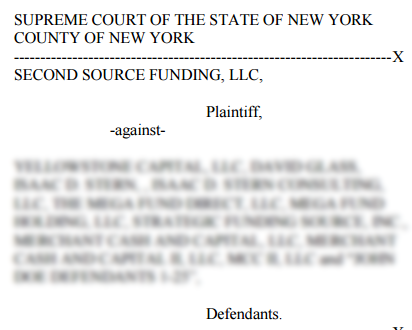
In September of 2014, the very same Second Source Funding emerged through a complaint filed in the Supreme Court of New York against Yellowstone Capital, LLC, 8 named co-defendants and 25 John Doe defendants. Seeking damages in the astounding amount of $360 million, Second Source alleged that Yellowstone’s co-founders stole their “revolutionary business model” of which they describe as using “Independent Sales Offices to leverage economies of scale in marketing and selling a bundle of financial services, including credit card processing and cash advances.” As a result of that and other claims, they were allegedly the reason for “Plaintiff SSF going out of business.”
The ensuing battle was probably one of the most contentious litigations the industry has ever experienced, at least from what can be seen on the docket. In one publicly filed exhibit introduced by Yellowstone, was the draft of a complaint that the plaintiffs had allegedly sent them that named more than 40 defendants. It reads like a yearbook of the merchant cash advance industry in 2009.
Other exhibits are packed with plenty of Second Source era nostalgia, including copies of the entrance exams given to new hires. One test question embodies the culture of the time, when it asked applicants:
What movie is this quote from, “Put the coffee down, coffee is for closers?”
While motions and cross motions at times appear to venture into the arena of insanity, especially considering Second Source went out of business a long time ago, AltFinanceDaily has learned that Yellowstone was vindicated this week in a decision that dismissed all the claims with prejudice. That means they can’t have a do-over. The suit lasted 17 months.
AltFinanceDaily has been quietly following the docket for over a year. We did not ask either party to comment on the decision for the reason being that Second Source may be considering an appeal, or at least they alluded to that in the court transcripts.
 In the meantime, the ghost of Second Source reminded a few people in the merchant cash advance industry that the antics of 2006-2008 were more than just tall tales told by grey beard Wall Street guys. Back then the coffee was still for closers only. And back then, the game was so different that some people would still be feeling the effects of it a decade later.
THEN AND NOW
Yellowstone Capital was one of the first merchant cash advance companies to experiment with the ACH payment method. Today, they originate nearly a half billion dollars a year in funded deals.
If you want to see just how much has changed since the Second Source days, check out this answer to the Second Source exam in 2008.
Q: If a merchant is getting an advance from MCA and can’t switch processors, what can the agent offer this merchant?
A: Lock box
It’s amazing to think that ACH was inconceivable at the time. Touched by ghosts indeed…