Maxim Commercial Capital Exceeds Expectations in Q1 2025
April 22, 2025 LOS ANGELES, CALIF. (April 22, 2025) – Maxim Commercial Capital (“Maxim”) announced exceptionally strong results for the first quarter of 2025, reporting a 150% increase in funding volume over the prior year’s period. Maxim is a national provider of loans and leases from $10,000 to $3 million collateralized by class 6 and 8 trucks, trailers, heavy equipment for the construction and agriculture industries, and real estate.
“As the unprecedented pace of change under the new administration’s economic policies present challenges for our industry, we remain steadfast in our mission to be the preeminent non-prime finance company supporting entrepreneurs, vendors, and finance brokers,” noted Michael Kianmahd, Maxim’s CEO. “Despite market conditions, we approved 80% of financing applications submitted in Q1 2025, funded borrowers in 37 states, and continued to invest in our infrastructure, systems, and team regardless of market conditions.”
Maxim’s dedicated, solutions-oriented approach is particularly impactful when equipment pricing is turbulent. For example, when Class 8 used truck prices increase, Maxim’s team works with buyers to clarify price points and financing structures they can afford and refers them to vendors if needed. In a recent interaction, Maxim approved financing for a current customer with 2 years’ experience and challenged credit to purchase a $55,000 2020 Peterbilt 579. When the applicant communicated he needed a lower down payment, Maxim proactively revised the approval for a less expensive, higher mileage 2019 Peterbilt 579 and closed the deal.
Contractors nationwide with challenged credit are growing their businesses with heavy equipment financed by Maxim during Q1 2025. Notable examples include an Alabama-based tree service company specializing in disaster relief work that purchased a new, $65,000 2025 Kymron CX10 Crawler Crane for 42% down to fulfill its government contracts and expanding residential business; a South Carolina-based contractor who purchased a $52,000 2014 Caterpillar 308E2 CR Hydraulic Excavator for 34% down to expand his tree-planting business; and, a start up roadside and recovery contractor with a sub-500 FICO who added a second truck by leasing a $6,660 2018 Ram 4500 Wrecker Tow Truck.
Maxim continues to expand and improve its infrastructure to support its growth. The company currently is seeking to hire an accounting manager and senior accountant. Please visit https://www.maximcc.com/our-company/careers/ for job descriptions and to apply.
About Maxim Commercial Capital
Maxim Commercial Capital helps small and mid-sized business owners nationwide by providing loans and leases (“financing”) from $10,000 to $3 million secured by trucks, trailers, heavy equipment, and real estate. It funds equipment purchase financings and leases, working capital, and debt consolidations. Maxim’s more creative financing structures leverage equity in real estate and owned heavy equipment to facilitate growth and preserve customers’ cash. As a leading provider of transportation equipment financing, Maxim supports startup and experienced owner-operators and non-CDL small fleet owners by funding loans and leases for class 8 and class 6 trucks, trailers, and reefers. Learn more at www.maximcc.com or by calling 877-776-2946.
###
Contact:
Michael Kianmahd, CEO
Maxim Commercial Capital
michael@maximcc.com
(213) 984-2727
NMEF Acquires Pawnee, Marking a Significant Milestone of Growth and Industry Leadership
April 1, 2025 April 1, 2025, NORWALK, CT – North Mill Equipment Finance LLC (“NMEF”), a leading independent commercial equipment lender and lessor headquartered in Norwalk, Connecticut, is pleased to announce that it has closed on its acquisition of Pawnee Leasing Corporation and certain other assets (“Pawnee”) from an affiliate of Chesswood Group Limited (“Chesswood”) pursuant to final approval from the U.S. Bankruptcy Court for the District of Delaware as a result of a court-supervised Sale and Investment Solicitation Process initiated in Canada in December 2024. NMEF acquired substantially all of Pawnee’s assets, while certain excluded assets and liabilities were transferred to a newly formed entity, which will remain subject to Canadian and U.S. restructuring proceedings.
With the addition of the Pawnee portfolio of leases and loans, NMEF’s total gross receivables under management now exceed $2 billion, marking a significant milestone in the company’s growth trajectory. The Pawnee and Tandem brand names will be retired, and no new originations will occur under Pawnee’s former referral partner programs. The servicing of Pawnee’s managed investment partnerships has been transferred to NMEF. More than half of Pawnee’s former employees are joining NMEF and will be located mostly in Ft. Collins, Colorado. These highly skilled professionals—primarily in Collections, Legal Recoveries, Data Analytics, Customer Service, and Accounting—demonstrated exceptional resilience and dedication throughout a challenging transition.
“We are thrilled to finally complete the acquisition of Pawnee after years of discussions with Chesswood,” said David C. Lee, Chairman and CEO of NMEF. “Pawnee has been in business for over 40 years and was the gold standard for referral partner-based small-ticket equipment financing—so much so that we modeled many aspects of NMEF’s business strategy around Pawnee following our recapitalization in 2018. Through no fault of Pawnee’s first-rate management team, the company endured financial distress when Chesswood filed for creditor protection in Canada and Delaware in late 2024, ultimately resulting in the court- sanctioned sale to NMEF.”
“The acquisition of Pawnee is immediately accretive to NMEF,” said Mark Bonanno, President and Chief Revenue Officer of NMEF. “We successfully refinanced approximately 50% of Pawnee’s assets at significantly improved cost of funds and leverage levels, driving an attractive return on equity for our stakeholders.”
“We went from court approval to closing in just over three weeks which was only made possible by the incredible collaboration between our companies,” said Tom Lyle, Executive Vice President and Chief Operating Officer. “I couldn’t be more impressed by how our two teams, aligned around a common goal, came together and delivered. I have the highest respect for the former Pawnee team and am excited to welcome them into the NMEF family – stronger together.”
Truist Securities, Inc. acted as exclusive U.S. financial advisor to NMEF, while Oaklins Canada served as NMEF’s Canadian financial advisor. Legal counsel for NMEF was provided by Moore & Van Allen (U.S.) and Blake, Cassels & Graydon LLP (Canada). FTI Consulting Canada Inc. served as the court-appointed Monitor of Chesswood, including Pawnee. Legal counsel for the Monitor was provided by Osler Hoskin and Harcourt LLP (Canada), Alston & Bird LLP (U.S.), and Young Conaway Stargatt & Taylor LLP (Delaware).
About NMEF
NMEF originates and services small to mid-ticket equipment leases and loans, ranging from $15,000 and to $5,000,000, for many diversified industry segments including the construction, transportation, vocational, medical, manufacturing, technology, franchise, renovation, janitorial and material handling industries. NMEF is majority-owned by an affiliate of InterVest Capital Partners. The company’s headquarters are in Norwalk, CT, with regional offices in Irvine, CA, Ft. Collins, CO, Voorhees NJ, Murray, UT, and Montego Bay, Jamaica. For more information, visit www.nmef.com. Taycor Financial operates as an independent division of NMEF, with a focus on developing direct and vendor origination programs. For more information, visit www.taycor.com. One of NMEF’s controlled affiliates, BriteCap Financial LLC, is a leading non-bank lender providing small businesses with fast, convenient financing alternatives such as working capital loans from its main office in Las Vegas, NV. For more information, visit www.britecap.com.
Brokers: Making the Leap from Working Capital into Equipment Financing
March 13, 2025 “We can finance anything that doesn’t shoot, fly or float,” says Josh Feinberg, CEO of Everlasting Capital. “So no planes, no boats, no guns.” But any other type of equipment and he’s ready to chat. As a seasoned veteran of the equipment finance industry, that conversational starting point of knowing what to ask and how to answer takes a lot of practice to develop.
“Roleplaying is like stretching before going for a run,” said Feinberg. “It makes it possible for you to be fast on your feet and really be able to have the answers.”
Everlasting Capital is a broker shop based in Rochester, NH that believes strongly in practicing calls with colleagues to develop their skills. It’s a role play. Many shops do it. But becoming seasoned at it for one product doesn’t mean that a broker automatically becomes an expert at any type of call.
“A lot of [working capital] brokers think that they’re the ones that are trying to figure out if the business owner qualifies, but to be honest with you, in the equipment space, it’s vice-versa,” Feinberg said. “The customer is actually trying to qualify you to see if you are apt to be able to finance their equipment.”
Equipment financing flips the stakes and the direction, and with that a fresh need for practice toward managing it successfully. And that’s where some brokers used to other products get stuck, because their confidence drops in being able to navigate something they don’t fully know. To that point, it can feel intimidating to discuss machinery they’re not familiar with or trucks they’ve never driven.
Feinberg believes that anyone can learn this, however, simply by talking to business owners about these things. One doesn’t need to actually spend 20 years in construction to finance equipment in that industry, for example, though it certainly wouldn’t hurt. Feinberg’s own start in the business is very simple to replicate.
“I just started talking to business owners, figuring out what they want. A lot of times [in the very beginning] I didn’t even know what the equipment did. I would have to Google it while I was on the phone with them.”
 That, of course, has changed with experience. Now he and his firm have become so well acquainted with certain industries that they’ve integrated themselves within them. The dump truck market, for example, has become one of their core areas of expertise.
Despite this attainable path to success, some brokers throw up their hands and assume the process will be too hard or the financial incentive too low to even try equipment financing—even though that is generally not the case. In an era where working capital has become so competitive, it should be considered as an additional offering to maximize value at the bare minimum.
“[When] you have the one person calling like, ‘hey we have monthly payments that are single digit rates, and we can do monthly payments one to five years.’ It’s really easy to spark up a conversation and be able to ask the questions that you need to do, and then get answers back,” he said.
Advocating for other brokers to adopt his approach might seem like it would increase competition, but Feinberg explained that the market is wide open with opportunities. Moreover, he feels strongly about matching business owners with the right solution. To that end, he is also the co-founder of Equipment Broker School, a system designed for anyone needing a jump start or a refresher on the art of equipment financing. His company previously starred in an online reality show where new salespeople were trained in person in the office, and Feinberg himself recently appeared as a judge at AltFinanceDaily CONNECT’s Broker Battle in Miami Beach this past February. The event was a roleplaying competition that evaluated brokers on their ability to diagnose needs and propose solutions. It was like just another day in the office for him.
“It made me really excited to be able to be a part of the Broker Battle, just as a lot of people know, and you know especially just for myself, being able to train people on how to be able to promote, how to be able to work, and how to be able to just partake in equipment financing,” Feinberg said. “It has been a super big passion of mine, especially just within the AltFinanceDaily community as a whole.”
Maxim Commercial Capital Reports 25% Growth in 2024
January 21, 2025LOS ANGELES, CALIF. (Jan. 21, 2025) – Maxim Commercial Capital (“Maxim”) announced impressive growth during 2024, continuing a multi-year trend. The hard asset secured lender reported a 25% increase in funded deals during the year as compared to 2023. Maxim is a national provider of loans and leases from $10,000 to $3 million collateralized by class 6 and 8 trucks, trailers, heavy equipment, and real estate.
“Our team stepped up to fill an increasing capital void for small businesses in 2024,” noted Michael Kianmahd, Maxim’s CEO. “Our consistent delivery and flexible terms have earned Maxim a strong reputation over the past 16 years among our customers and referral partners.”
Founded during the 2008 financial crisis, the privately-owned lender supports the needs of small and mid-sized businesses, including startups and those with challenged credit, during all types of economic landscapes. Keys to Maxim’s success include its dedication to customer success, providing value to its referral network of equipment vendors and finance brokers, and providing excellent customer service through all cycles and markets.
Class 8 truck financings during the year comprised loans and leases for experienced and startup owner operators in 41 states across the U.S. New borrowers included: an experienced owner operator with challenged credit who purchased a 2019 Kenworth T680 with 539K miles for $38,135 with 22% down and the help of a co-applicant; a startup owner operator with a limited credit history and 642 FICO who purchased a 2019 Kenworth T680 with 472K miles for $39,248 with 25% down; and, a startup owner operator with bad credit who purchased a 2020 Peterbilt 579 with 424K miles for $55,047 with 27% down.
Notable heavy equipment financings during the year included 100% purchase financing for a small car hauling business to buy a 2020 Freightliner M2 4-Car Carrier for $105,000. Maxim secured a second lien on the borrowers’ home as additional collateral in lieu of a down payment, helping the company preserve cash. A startup entrepreneur purchased a 2015 Freightliner 114SD, his first dump truck, for 36% down on the $109,000 invoice; and a subcontractor with 35 years of experience replaced an older compact track loader by leasing a 2023 New Holland C337 priced at $83,760 from Maxim.
Maxim also provided essential working capital for small businesses through structured real estate-secured, cash-out financings. New borrowers funded in 2024 include the owner of a virtual platform offering on-demand exercise and meditation classes who borrowed $200,000 in growth capital secured by a second lien position on her home; and, experienced restaurateurs in New York City who borrowed $410,000, secured by a 1st lien against a family residence, to pay off MCA debt held by five lenders, make property improvements, and expand the business’s catering services.
Maxim continues to expand and improve its infrastructure to support its growth. The company currently is seeking to hire an accounting manager and senior accountant. Please visit https://www.maximcc.com/our-company/careers/ for job descriptions and to apply.
About Maxim Commercial Capital
Maxim Commercial Capital helps small and mid-sized business owners nationwide by providing loans and leases (“financing”) from $10,000 to $3 million secured by trucks, trailers, heavy equipment, and real estate. It funds equipment purchase financings and leases, working capital, and debt consolidations. Maxim’s more creative financing structures leverage equity in real estate and owned heavy equipment to facilitate growth and preserve customers’ cash. As a leading provider of transportation equipment financing, Maxim supports startup and experienced owner-operators and non-CDL small fleet owners by funding loans and leases for class 8 and class 6 trucks, trailers, and reefers. Learn more at www.maximcc.com or by calling 877-776-2946.
###
Ready Capital Grows as Leading Non-Bank Small Business Lender
November 10, 2024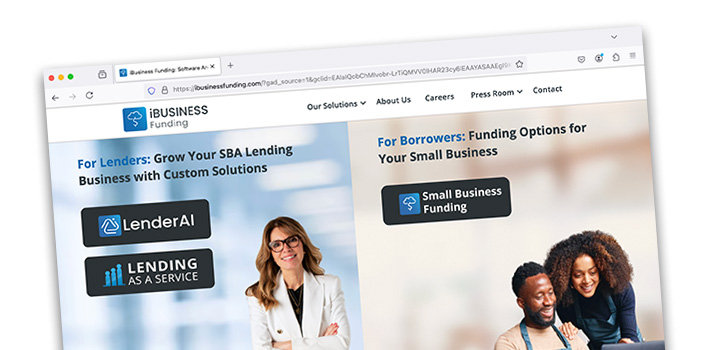 “Ready Capital has become a leading national non-bank lender to small businesses providing a full suite of loan options from $10,000 unsecured working capital loans to $25 million plus real estate-backed USDA loans,” said Ready Capital CEO Thomas Capasse during the company’s Q3 earnings call.
Ready, in some ways, has flown under the radar in recognition. On the one hand the company is the top non-bank SBA lender in the country and fourth overall SBA lender in the country. On the other hand, the company has previously acquired Knight Capital, iBusiness Funding, Madison One Capital, select non-SBA assets of Fountainhead, and Funding Circle USA. The result is that the overall organization is a powerhouse with a current public market cap of $1.25B.
iBusiness Funding, once the technology arm of Knight Capital, has played an integral role for the company. For example, when Ready acquired Funding Circle USA, it did it through the iBusiness Funding brand.
“[In 2019, iBusiness Funding was] a leader in unsecured small business lending,” Capasse said on the call. “And then they adopted their tech to the PPP which was very accretive. And since then there’s been the initiative within the SBA to emphasize small loans below $350,000, which many times are minority women-owned businesses, and so that’s been a significant initiative by the SBA& and so what we’ve done is iBusiness has developed a tech stack, which is now being marketed as a third-party underwriting model for banks. Banks just do not focus on that at all. Even if they do SBA loans, it’s mostly for larger loans again above the $350,000 to the $5 million. So the idea with iBusiness is to grow the revenue stream from this software-based business.”
On Funding Circle, Capasse said that the newly acquired subsidiary would be “accretive to earnings once fully ramped.” The numbers offered so far was that $6.6 million growth in Q3 origination income came from small business working capital loans through the Funding Circle platform.
Applicant Didn’t Complete their Business Loan Application? They Might’ve Gotten Stuck
September 26, 2024 “Early discovery showed us in the market that over 85% of [small business] loan application packets were straight up abandoned,” said Jay Long, COO and co-founder of Parlay.
In an era where fintechs have sought to increase the speed and accuracy of the underwriting process, Parlay, an AI-native SaaS company, noticed that one major lingering challenge for small business lenders starts well before today’s tech stacks even come into play. For example, an applicant might not be sure what they’re supposed to be submitting to the lender in the first place and thus the process may never even make it to the fintech underwriting stage. This bottleneck comes at a cost for both a lender who fails to move a loan application forward and for a borrower who gets stuck and isn’t able to get what they wanted.
“A lot of small businesses when you request a bunch of stuff in an email or you just say ‘give me these things,’ they may not have the financial background, that financial education to know how to answer those questions,” said Alexandra McLeod, CEO and co-founder of Parlay. “And so what we’ve done is we’ve built a series of really intuitive, user-friendly, plain-English workflows that are easy and rapid to get through but also systematic.”
Parlay’s Loan Intelligence System (LIS) was drawn from interviews with hundreds of small businesses and also by observing how they did with existing workflows.
“We’re asking them yes-no questions, and based on how they answer, then the questions arrange themselves in a specific way,” said McLeod. “But also, we have tool tips in the platform, so if somebody doesn’t know what a term is or if they need help building something—like a debt schedule is something they have to provide, and people don’t know how to generate those, then we have these builders in the workflows to help them with that.”
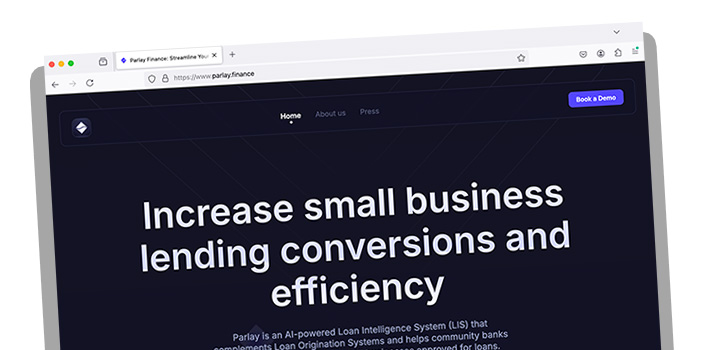
At present, Parlay is focused on SBA 7(a) loans with their most common customer being a community bank or credit union. The company’s focus on the intake process has also enabled their technology to do even more, and that is to nurture applicants that are not eligible for approval to eventually become eligible through personalized actionable recommendations.
According to Parlay, their LIS easily integrates with existing Loan Origination Systems and it improves profitability without increasing overall business risk.
For McLeod, who has a prior background with financial inclusion initiatives and startups, she’s seen firsthand that there are financial institutions eager to provide capital to the underserved but that the economics to do it with legacy systems at scale have just made it too cost prohibitive. “The other side of the problem is the small business needs more hand holding,” said McLeod, “and the lender can’t provide it. And so this is a perfect application of technology where you can offer a scalable alternative where you can handhold the small business, you can provide a lot more insight to the lender as to the needs of those small businesses and you can generate that outcome of more booked loans because more people can actually get through the process.”
Notably, Parlay is a recent graduate of the Center for Accelerating Financial Equity (CAFE) Fintech Accelerator Program, which supports fintechs advancing health & wellness of underserved populations. CAFE is headquartered in the Fintech Innovation Hub building on University of Delaware’s STAR Campus, a building AltFinanceDaily covered in 2022.
Five Leading Innovative Banks Join American Fintech Council (AFC), Expanding Collaborative Efforts With Fintech Industry Leaders and Regulators To Develop Future of Finance
August 28, 2024
Washington, D.C. (August 28, 2024) – The American Fintech Council (AFC), the premier industry association representing responsible fintech companies and innovative banks, has announced the addition of five new members representing regional and community banks committed to fintech innovation. In joining AFC, the five banks bring deep history and experience serving community needs, as well as leading fintech platforms and services that are driving unprecedented value for customers both local and national.
“We are immensely proud to welcome our five new innovative bank members, but this announcement is about far more than AFC,” said Phil Goldfeder, Chief Executive Officer of AFC. “Financial technology has been a disruptive force helping to expand access to financial services for millions, particularly underserved communities. Yet, regulators have far too often applied inconsistent and unclear standards to responsible fintech providers – failing to consider the needs of consumers and the realities of who benefits from the inclusive, transparent, customer-centric services our members provide. Adding five more responsible innovative banks to our membership, sends a clear signal that fintech is the future of finance, and the scope of responsible innovation happening across the industry is far too significant to be ignored.”
AFC has consistently advocated for a unified and pragmatic regulatory approach towards innovation. Building on its mission to develop sound public policy, AFC has engaged significantly with federal prudential regulators and made its members’ views understood across the government.
More about AFC’s five new members:
- Lincoln Savings Bank, founded 1902, is owned and managed by Iowans and offers full-service community banking and financial services, as well as fintech and Banking-as-a Service (Baas) offerings through its LSBX division founded in 2014.
- New Horizon Bank was founded in 2009 by local business owners in Powhatan, VA looking for a community-focused bank; New Horizon combines traditional banking with technology and innovation that anticipate community needs.
- Republic Bank has served Chicagoans since 1964; in addition to traditional bank offerings, family-owned Republic Bank is the payments and fintech partner for Fortune 500 companies, national retailers, and nationwide auto insurers.
- Stearns Bank was founded in Minnesota in 1912 and has since grown to serve customers in Arizona and Florida; in 2021, Stearns entered the embedded finance and BaaS spaces with a continued focus on expanding access to responsible credit and capital.
- TransPecos Banks offers a full range of banking products as well as fintech services concentrated in the TransPecos region of West Texas and San Antonio; founded in 1928, TransPecos Banks embraces technology and innovation to better serve local communities and businesses.
A standards-based organization, AFC is the premier trade association representing the largest financial technology (Fintech) companies and innovative BaaS banks. AFC’s mission is to promote a transparent, inclusive, and customer-centric financial system by supporting responsible innovation in financial services and encouraging sound public policy. AFC members foster competition in consumer finance and pioneer products to better serve underserved consumer segments and geographies.
Whoa, QuickBooks Capital Shoots Up in Business Loan Originations
August 22, 2024Intuit’s fiscal year ending July 31, 2024 revealed a stunning detail, $2.4B in financing through QuickBooks Capital over 12 months. This was up 28% from the prior year. That number likely puts Intuit’s business loan volume ahead of Shopify’s but that’s still less than Enova and Square. Customers of QuickBooks Capital can apply for financing by clicking a button right in their QuickBooks software.
QuickBooks Online accounting revenue grew 17% in Q4 and 19% in fiscal 2024, the company reported. Intuit has the advantage of many related QuickBooks services slowly merging into one such as payments, payroll, capital, and Mailchimp. Intuit also owns Credit Karma.