
Amazon Now Among The Top Online Small Business Lenders in The United States
May 8, 2019
Amazon has joined PayPal, OnDeck, Kabbage, and Square as being among the largest online small business lenders. On Tuesday, Amazon revealed that it had made more than $1 billion in small business loans to US-based merchants in 2018. Amazon says the capital is used to build inventory and support their Amazon stores.
By selling on Amazon, “SMBs do not need to invest in a physical store or the costs of customer discovery, acquisition, and driving customer traffic to their branded websites,” the company says. Small and medium-sized businesses selling in Amazon’s stores now account for 58 percent of Amazon’s sales. More than 200,000 SMBs exceeded $100,000 in sales on Amazon in 2018 and more than 25,000 surpassed $1 million.
You can view the full report they published here.
| Company Name | 2018 Originations | 2017 | 2016 | 2015 | 2014 | |
| PayPal | $4,000,000,000* | $750,000,000* | ||||
| OnDeck | $2,484,000,000 | $2,114,663,000 | $2,400,000,000 | $1,900,000,000 | $1,200,000,000 | |
| Kabbage | $2,000,000,000 | $1,500,000,000 | $1,220,000,000 | $900,000,000 | $350,000,000 | |
| Square Capital | $1,600,000,000 | $1,177,000,000 | $798,000,000 | $400,000,000 | $100,000,000 | |
| Amazon | $1,000,000,000 | |||||
| Funding Circle (USA only) | $792,000,000 | $514,000,000 | $281,000,000 | |||
| BlueVine | $500,000,000* | $200,000,000* | ||||
| National Funding | $494,000,000 | $427,000,000 | $350,000,000 | $293,000,000 | ||
| Kapitus | $393,000,000 | $375,000,000 | $375,000,000 | $280,000,000 | ||
| BFS Capital | $300,000,000 | $300,000,000 | $300,000,000 | |||
| RapidFinance | $260,000,000 | $280,000,000 | $195,000,000 | |||
| Credibly | $290,000,000 | $180,000,000 | $150,000,000 | $95,000,000 | $55,000,000 | |
| Shopify | $277,100,000 | $140,000,000 | ||||
| Forward Financing | $210,000,000 | $125,000,000 | ||||
| IOU Financial | $125,000,000 | $91,300,000 | $107,600,000 | $146,400,000 | $100,000,000 | |
| Yalber | $65,000,000 |
Has PayPal Eclipsed OnDeck in Small Business Loans?
April 26, 2019
It’s been said that Kabbage is on pace to surpass OnDeck in small business loan originations, but PayPal has already done it.
When PayPal announced a working capital program in the Fall of 2013, few were predicting that the initiative would propel them to the top of the small business lending charts. Just two years later, however, the payment processing giant had already loaned more than $1 billion to small businesses.
Today, that number is over $10 billion, according to a comment made by PayPal CEO Dan Schulman on the company’s Q1 earnings call.
That figure would suggest that they had loaned approximately $9 billion from Fall 2015 to the end of Q1 2019. OnDeck, by comparison, loaned $7.5 billion since Fall 2015 through Q4 2018. Several other data sources, including previous statements from PayPal that they had surpassed more than a billion dollars in quarterly small business funding in 2018 (already more than OnDeck), indicate that PayPal has become #1 on the AltFinanceDaily small business funding leaderboard.
PayPal’s growth was helped in part by its acquisition of Swift Capital in 2017.
Two of the top four are payment processors:
| Company Name | 2018 Originations | 2017 | 2016 | 2015 | 2014 | |
| PayPal | $4,000,000,000* | $750,000,000* | ||||
| OnDeck | $2,484,000,000 | $2,114,663,000 | $2,400,000,000 | $1,900,000,000 | $1,200,000,000 | |
| Kabbage | $2,000,000,000 | $1,500,000,000 | $1,220,000,000 | $900,000,000 | $350,000,000 | |
| Square Capital | $1,600,000,000 | $1,177,000,000 | $798,000,000 | $400,000,000 | $100,000,000 | |
| Funding Circle (USA only) | $500,000,000 | |||||
| BlueVine | $500,000,000* | $200,000,000* | ||||
| National Funding | $427,000,000 | $350,000,000 | $293,000,000 | |||
| Kapitus | $393,000,000 | $375,000,000 | $375,000,000 | $280,000,000 | ||
| BFS Capital | $300,000,000 | $300,000,000 | ||||
| RapidFinance | $260,000,000 | $280,000,000 | $195,000,000 | |||
| Credibly | $180,000,000 | $150,000,000 | $95,000,000 | $55,000,000 | ||
| Shopify | $277,100,000 | $140,000,000 | ||||
| Forward Financing | $125,000,000 | |||||
| IOU Financial | $91,300,000 | $107,600,000 | $146,400,000 | $100,000,000 | ||
| Yalber | $65,000,000 |
*Asterisks signify that the figure is the editor’s estimate
Shopify is Quickly Climbing the Ranks of the Largest Small Business Funders
February 12, 2019Shopify originated $277 million in merchant cash advances in 2018, according to their quarterly earnings reports. That figure already places them among the largest small business funding providers nationwide.
Below is a look of how they stack up thus far:
| Company Name | 2018 Originations | 2017 | 2016 | 2015 | 2014 | |
| OnDeck | $2,484,000,000 | $2,114,663,000 | $2,400,000,000 | $1,900,000,000 | $1,200,000,000 | |
| Kabbage | $2,000,000,000 | $1,500,000,000 | $1,220,000,000 | $900,000,000 | $350,000,000 | |
| Square Capital | $1,600,000,000 | $1,177,000,000 | $798,000,000 | $400,000,000 | $100,000,000 | |
| Funding Circle (USA only) | $500,000,000 | |||||
| BlueVine | $500,000,000* | $200,000,000* | ||||
| National Funding | $427,000,000 | $350,000,000 | $293,000,000 | |||
| Kapitus | $393,000,000 | $375,000,000 | $375,000,000 | $280,000,000 | ||
| BFS Capital | $300,000,000 | $300,000,000 | ||||
| RapidFinance | $260,000,000 | $280,000,000 | $195,000,000 | |||
| Credibly | $180,000,000 | $150,000,000 | $95,000,000 | $55,000,000 | ||
| Shopify | $277,100,000 | $140,000,000 | ||||
| Forward Financing | $125,000,000 | |||||
| IOU Financial | $91,300,000 | $107,600,000 | $146,400,000 | $100,000,000 | ||
| Yalber | $65,000,000 |
*Asterisks signify that the figure is the editor’s estimate
Grooming The Best Sales Reps
August 22, 2018The best sales reps have a lot in common – they’re smart, honest, likable, well-organized, thick-skinned and hungry for success. They navigate the difficult early days of their careers in the alternative small-business funding community by persevering despite long hours, countless outbound telephone calls and meager commissions.

“Persistency is really, really the key – putting in the time,” says Evan Marmott, CEO of Montreal-based CanaCap and CEO of New York-based CapCall LLC. “It’s not always easy, but you’ve got to stay late, make the phone calls, send the emails and do the follow-ups. It’s a numbers game.”
Being relentless counts not only when pursuing merchants but also when matching merchants with funders, Marmott emphasizes. “If they can’t get an approval one place, they’re going to shop it out until they get approval someplace else so they can monetize everything that comes in,” he says.
“It’s all mindset and work ethic,” in sales, according to Joe Camberato, president at Bohemia, N.Y.-based National Business Capital. His company works to create a culture that supports the right mindset by working with a firm called “Delivering Happiness.” Together, they forge to a set of core values based on integrity, innovation, teamwork, empathy, and respect for fellow employees, clients and clients’ businesses.
National Business Capital employees learn to live those ideals by working and playing together on the company volleyball team, through work with local and national charities, and at company mixers and staff picnics, Camberato maintains. “We adapt and change, and we’re committed to helping small businesses grow,” he says of the company culture, “and we have fun while doing all that.”
Likeability helps build relationships with customers, says Justin Thompson, vice president of sales for San Diego-based National Funding. “People will do business with people they like and trust,” says Thompson. “It’s really about establishing a relationship first and then establishing quality discovery.” From there, presentation and execution become paramount, he says.

Methodology can make the difference between success and failure in sales, observes Justin Bakes, co-founder and CEO of Boston-based Forward Financing LLC. “Have a defined process and stick to it,” he advises. A well-organized approach inspires trust among clients, establishes and maintains a great reputation; and fosters understanding of the customers’ needs, wants and business operations that help the rep choose the right financing option and appropriate funder. Using technology to wrangle multiple leads and high volume counts for a lot, too, he says.
It’s all part of the consultative approach to sales, says Jared Weitz, CEO of Great Neck, N.Y.-based United Capital Source. Long ago, sales reps may have succeeded by mimicking carnival barkers, sideshow pitchman and arm-twisting medicine-show peddlers. Thankfully, those days have ended – if they ever really existed. Most of today’s successful salespeople earn clients’ respect by becoming knowledgeable, trusted business consultants, says Weitz.
THE CONSULTATIVE SALE
“Someone calls, and there are two ways of handling a deal, right?” Weitz asks rhetorically. Using one method, a salesperson can say, “We’ll fund you this much at this rate today – are we good?” he says. The other way calls for understanding the client’s business – how long has it been open, does it make more cash deposits or credit card deposits, would it be best-served by an advance, a loan, an equipment lease or a line of credit, how much can it afford in monthly payments?

Establishing how the merchant intends to use the funding plays a crucial role in the consultative sale, Marmott agrees. Objections can arise when a merchant learns that receiving $100,000 this week will require paying back $150,000 in four or five months, he notes. So it’s essential to demonstrate that using the money productively will more than pay for the deal. A trucking company can realize more income if it deploys two more trucks, or a restaurant can increase revenue by placing another bar outside for the summer, he says by way of example.
“A lot of salespeople ask a business owner what they need the money for,” observes Thompson. “The merchant says, ‘Inventory,’ and the rep stops right there. I train my reps at National Funding to go two or three clicks deeper.” Examples abound. When does the merchant need the inventory? From whom do they order it? How long does it take to ship? How long does it take to turn it over? What are the shipping terms?
The consultative approach can require salespeople to pose a lot of open-ended questions that can’t be answered yes or no, according to Thompson. Ideally, the conversation should adhere to the 80-20 rule, with the client talking 80 percent of the time and the sales rep speaking 20 percent, he asserts, adding that “a lot of times it’s reversed in this industry.”
Sometimes, however, salespeople should set aside the time-consuming consultative approach and instead find funding for a merchant as soon as possible. That’s true when the business owner can make an opportune purchase of inventory or when it’s time to acquire a competitor quickly. More often, however, it pays to take the time to understand the merchant’s needs and search out the best type of funding for that particular case, top sales people maintain.

Much of the alternative small-business finance industry has caught on to the importance of the consultative approach to sales as the array of available alternative financial products has grown beyond the industry’s initial offerings of merchant cash advances, according to Weitz. The days of scripted pitches and preplanned rebuttals to objections have ended, he says. Today, management trains reps for success.
THE RIGHT TRAINING
Are top salespeople born that way? “Some people hit the ground running, but sales can be taught – that’s for sure,” Weitz says. “The tougher thing to teach is integrity.” Much of the training process focuses on learning the products to enable a rep to make a consultative sale and shoulder financial responsibility, he maintains.
Believing that some people are born to sell provides a crutch to avoid learning what really works, according to Bakes. Training can teach a smart, motivated person how to succeed, he maintains. They don’t have to be born that way.
However, some people do seem born to exert influence, which can translate into sales prowess, says Thompson. Still, those born with a strong work-ethic can overcome other deficiencies, he notes. The work ethic drives them to “come in every day,” he notes. “They’re organized and disciplined. They follow the National Funding philosophy, and they make a ton of money.”

National Funding trains salespeople to view their craft as being defined by two broad elements – art and science, Thompson continues. The science proves easier to master and includes asking the right questions to learn about the customer and the deal. The hard part, the art of the sale, consists of getting to know the business owner, building a relationship and demonstrating expertise. In one example, that’s based on learning how many trucks are in the fleet, whether they’re long-haul or short haul and whether they use dumpsters versus box trailers, he says.
Beyond those important basics, training should be ongoing because selling techniques change slightly as new products and systems emerge, according to Weitz. “One of the things I like about being a broker is the ability to pivot and add another arrow to your quiver,” he says.
Salespeople at United Capital Source talk sales among themselves almost nonstop, which amounts to daily sales training, Weitz observes. That can take the form of describing a challenge and explaining how to overcome it, he notes. A particularly good idea merits an email to the group to share the new piece of wisdom. It’s a matter of constantly refining the approach.
Training can help sales reps understand the businesses their clients run, according to Marmott. Knowing the margins in a restaurant, for example, can help the salesperson explain that the increase in revenue from an expansion will quickly pay the cost of capital, he notes.
Training should teach new employees how business works because common elements arise in enterprises ranging from dog grooming to asphalt paving, Thompson notes. There’s inventory, marketing, employee expense, payroll taxes, insurance and 401k’s in almost any business. “We teach all that to the reps,” he says. Then after conversations with thousands of merchants, reps have a solid foundation in the workings of businesses.
 National Business Capital’s formal two-week classroom training usually lasts three hours a day, focusing on systems, guidelines, product, general business principles and the company’s processes, says Camberato. Teachers include the sales management team, company culture leaders and the managers of IT and Tech, Marketing, Processing, and Human Resources.
New hires spend much of their time working with mentors for the first six months and a team leader who works with them indefinitely, Camberto continues. The company sometimes hires in groups and sometimes hires individually, he notes.
National Funding provides three eight-hour days of regimented classroom training on the fundamentals to each of the four groups of 12 to 17 hired each year, says Thompson. The classes cover processes, sales strategy, marketing and the lender matrix. Next comes three months of working with a sales manager dedicated to working with the class. After a total of nine to 12 months, management knows which reps will succeed.
Some shops operate on the opener-closer model, with less experienced salespeople qualifying the merchant by asking questions like how long they’re been in business and how much revenue they bring in monthly, Marmott says. If the merchant qualifies, the newer salesperson who’s working as an opener then hands off the call to an experienced closer to complete the deal. Good openers become closers, but opening isn’t easy because it requires lots of calls, he notes.
National Funding doesn’t use the opener-closer approach because the company believes reps should Participate “from cradle to grave,” Thompson says. “They hunt the business down, build the relationship and handle the transaction from A to Z.” East Coast shops often focus on cold calling and use the opener-closer model, while West Coast shops tend to invest more in marketing and reject the opener-closer method, he noted.
But where do these top salespeople come from?
THE RIGHT BACKGROUND
Prospective sales reps who have just finished college should have a grounding in communications or business, Weitz believes. Experience in sales and a familiarity with dealing with merchants helps prepare reps, he notes. Job history doesn’t have to be in the finance industry. Someone who’s sold business services in a Verizon store or worked for a payroll company, for instance, has been dealing with small-business owners and may succeed more quickly than those without that background.
Sales experience in other industries counts, Bakes agrees, especially in businesses that require dealing with a large number of leads. “Organization and process is just as important as being born with the traits of a salesperson,” he opines.
Life experience that breeds a positive attitude can prove vital, says Marmott. That’s especially important in the beginning when a new rep might take home a paltry $300 in the first month. Later, when the rep has a $50,000 month, he or she will see that their optimism wasn’t misplaced, he declares.
GUYS WHO ARE HUNGRY”
“The biggest thing I look for is guys who are hungry,” Marmott maintains. I don’t need somebody with a doctorate or a master’s degree or even a degree,” he says. “I need somebody who is going to put the work in.” Of a roomful of 25 new reps, two or three will succeed and stay on the job, he calculates. “You get to eat what you kill. If you’re not killing anything, you don’t get to eat.”
“We look for potential candidates who come from backgrounds of rejection,” says Thompson. Their previous sales experience has taught them not to take the answer “no” personally. “It’s part of the business and you continue to move on.”
Although most regard the financial services industry as a white-collar pursuit, “it has blue collar written all over it,” Thompson says, referring to the work ethic required for success. But it’s not just the volume of work. Sixty good phone calls generate more business than 300 mediocre calls, he emphasizes.
GETTING UP TO SPEED
Succeeding at sales requires taking the time to form relationships, understand guidelines, become familiar with lenders and acquire a working knowledge of how clients’ businesses operate, Camberato says. How long does it take? “It’s a solid year,” he contends while conceding that most who succeed operate at a fairly high level before then.
Others disagree about what constitutes being up to speed and how much time’s necessary to achieve it. “I’ve seen it take 30 days, and I’ve seen it up to 120 days,” says Weitz. “The hope is that it’s within 60.”
A salesperson should start feeling better after 30 days and should start feeling good after 60 days, Marmott says. Management can usually identify the strong and the week reps within two to three weeks, he says. “You get the lazy ones that drop out, the guys who aren’t making any money, the ones who aren’t putting the effort in,” he says. “The first two weeks are the toughest because you’re learning the product and how to sell it.”
“It depends on the person,” Bakes says of the time needed to begin selling successfully. “It takes time. It is not something that will just happen overnight.” About six months should suffice to become confident as a closer, he estimates.
Even when sales reps hit their stride, some outsell others, Marmott notes, citing the 80-20 rule that 80 percent of the business comes from 20 percent of the salesforce. Outbound sales to merchants who may feel beleaguered by offers of funding requires more effort than when a merchant makes an inbound call to seek funding, he adds.
And even the best salespeople need great marketing and tech support from the their companies, sources agree.
INVESTING IN SALES
A shop just starting out might have a marketing budget as low as $2,500 a month, which won’t do much more than pay for direct mail pieces that might prompt a few potential clients to pick up the phone, Weitz says. With a little more money to spend, a shop can begin buying leads, he notes. “Don’t break the bank before you understand what formula works for you,” he advises.
“The key to sales is marketing,” says Marmott. “You can be the best sales guy but if you don’t have anything qualified to call or follow up with, it’s a waste of time.” Social media doesn’t work as well for business-to-business contact as it does for business-to-consumer marketing, he says. Pay per click and key words have become more expensive and isn’t as cost-effective as it once was, especially for smaller shops, he contends. Mailers can work but require heavy volume and repetition, he says, adding that could mean at least 25,000 pieces and at least three mailings.
Besides allocating marketing dollars, companies can invest in sales by paying new sales staffers a salary instead of forcing them to rely on commissions to eke out subsistence during the tough early days. National Business Capital pays a salary at first and later switches reps to commissions and draw, Camberato says. “An energetic person interested in sales can plug into our platform, get trained and do very well,” he continues. “We believe in you, as long as you believe in us.”
National Funding provides recruits with a salary and commissions so that they have enough income to get by and still reap rewards when they help close a deal, Thompson says.
Investment in technology can help salespeople set priorities, eliminate some of the drudge work in the sale process, measure the sales staff member’s success or lack of success, and provide a consistent experience for customers, notes Bakes. “Because of the way our technology is set up we can hold people accountable,” he adds.
Every salesperson and every shop should organize the workflow by using a lead-management system or customer relationship management tool (CRM) – such as Zoho or Salesforce –instead of operating with just a spreadsheet, Weitz says.
Brokers can invest in sales through syndication, which means putting up some of the funds involved in a deal. Forward Financing favors syndication in some cases because it aligns the salesperson and the funder, thus demonstrating the sales rep’s belief in the validity of the deal and ensuring a willingness to continue servicing that customer, Bakes says.
Some shops offer monthly bonuses for outstanding sales results, but Weitz believes awarding incentives weekly makes more sense. With a monthly cycle, some reps tend to slack off for the first week or so because they believe they can make up for lost time later. With weekly rewards, there’s not much room for downtime, he notes.
Whatever form investment takes, it can help build a sterling reputation and a free-flowing “pipeline.”
THE RIGHT REPUTATION
“Reputation is huge,” especially for repeat business and referrals, Marmott says. Once a merchant has received funding, a blizzard of sales call can follow. Treating customers right by maintaining ethical standards and helping them during hard times can guard against defection to a competitor touing low prices, he says.
Reputation requires differentiation, which usually occurs online, by email or over the phone, notes Bakes. Factors that enhance reputation include referrals by satisfied customers and real-world testimonials from actual customers and good ratings on social media sites, he says.
While it’s still uncertain what role social media plays in the industry’s reputation-building efforts, it appears that text messages elicit quick responses if the client has agreed to communicate with the company via that format, Bakes says. He notes that unwanted text messages won’t work. Email messages provide more information than text messages but seem less likely to prompt response, he says.
THE RIGHT GOAL
So, where does the effort to succeed at sales lead? It’s the foundation for building “the pipeline” – the name given to the flow of renewals, referrals and leads that makes every day not just busy, but busy in a productive and profitable way. As a rep’s pipeline takes shape, the cost of acquiring new business also goes down, Marmott says. “It just grows from there,” he says of the successful salesperson’s endeavors at building a pipeline of business. It’s what successful salespeople seek.
The 2018 Top Small Business Funders By Revenue
August 16, 2018The below chart ranks several companies in the non-bank small business financing space by revenue over the last 5 years. The data is primarily drawn from reports submitted to the Inc. 5000 list, public earnings statements, or published media reports. It is not comprehensive. Companies for which no data is publicly available are excluded. Want to add your figures? Email Sean@debanked.com
| Company | 2017 | 2016 | 2015 | 2014 | 2013 |
| Square | $2,214,253,000 | $1,708,721,000 | $1,267,118,000 | $850,192,000 | $552,433,000 |
| OnDeck | $350,950,000 | $291,300,000 | $254,700,000 | $158,100,000 | $65,200,000 |
| Kabbage | $200,000,000+* | $171,784,000 | $97,461,712 | $40,193,000 | |
| Bankers Healthcare Group | $160,300,000 | $93,825,129 | $61,332,289 | ||
| Global Lending Services | $125,700,000 | ||||
| National Funding | $94,500,000 | $75,693,096 | $59,075,878 | $39,048,959 | $26,707,000 |
| Reliant Funding | $55,400,000 | $51,946,000 | $11,294,044 | $9,723,924 | $5,968,009 |
| Fora Financial | $50,800,000 | $41,590,720 | $33,974,000 | $26,932,581 | $18,418,300 |
| Forward Financing | $42,100,000 | $28,305,078 | |||
| SmartBiz Loans | $23,600,000 | ||||
| Expansion Capital Group | $23,400,000 | ||||
| 1st Global Capital | $22,600,000 | ||||
| IOU Financial | $17,415,096 | $17,400,527 | $11,971,148 | $6,160,017 | $4,047,105 |
| Quicksilver Capital | $16,500,000 | ||||
| Channel Partners Capital | $14,500,000 | $2,207,927 | $4,013,608 | $3,673,990 | |
| Wellen Capital | $13,200,000 | $15,984,688 | |||
| Lighter Capital | $11,900,000 | $6,364,417 | $4,364,907 | ||
| Lendr | $11,800,000 | ||||
| United Capital Source | $9,735,350 | $8,465,260 | $3,917,193 | ||
| US Business Funding | $9,100,000 | $5,794,936 | |||
| Fundera | $8,800,000 | ||||
| Nav | $5,900,000 | $2,663,344 | |||
| Fund&Grow | $5,700,000 | $4,082,130 | |||
| Shore Funding Solutions | $4,300,000 | ||||
| StreetShares | $3,701,210 | $647,119 | $239,593 | ||
| FitSmallBusiness.com | $3,000,000 | ||||
| Eagle Business Credit | $2,600,000 | ||||
| Swift Capital | $88,600,000 | $51,400,000 | $27,540,900 | $11,703,500 | |
| Blue Bridge Financial | $6,569,714 | $5,470,564 | |||
| Fast Capital 360 | $6,264,924 | ||||
| Cashbloom | $5,404,123 | $4,804,112 | $3,941,819 | $3,823,893 | |
| Priority Funding Solutions | $2,599,931 |
Second Annual Alternative Finance Bar Association Conference Draws Lawyers from Afar
June 11, 2018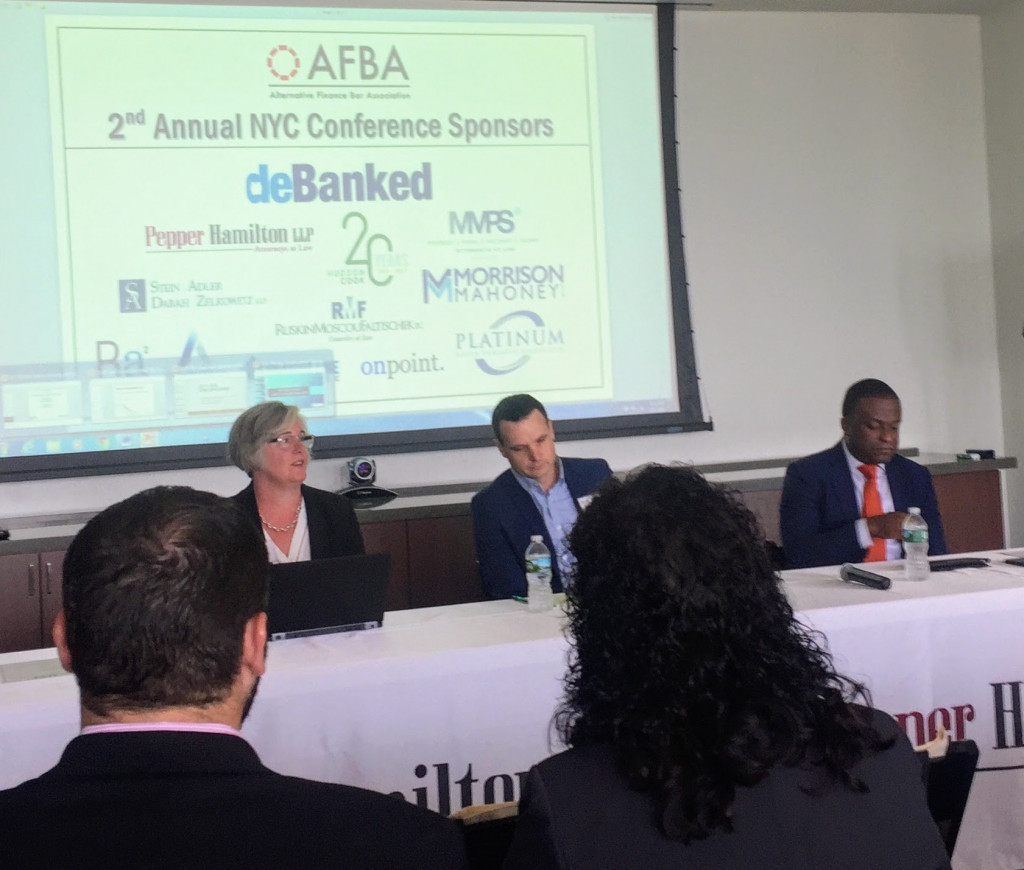 Attorneys who represent alternative finance companies congregated in New York on Friday for the second annual conference of the Alternative Finance Bar Association (AFBA.)
They came for a day of learning about the latest legal developments pertaining to alternative finance, and MCA in particular. Seminars at the conference had names like: “Credit Facilities 101: What an Alternative Finance Company Can Expect,” “Syndication Relationships: Partner? Participant? Investor?” and “Bankruptcy Developments: The Rise of the Adversary Proceeding.”
“I think it’s like heaven for a new attorney in the MCA world,” said Judith Ramos, who is Corporate Counsel at McKenzie Capital in the Miami area.
Another attorney somewhat new to the MCA space and eager to learn more was Alexis Shapiro, General Counsel at Forward Financing in Boston.
“This was one stop shopping to learn about the latest legal developments in the MCA industry,” Shapiro said.
In one seminar, called “Updates on Recent Case Law,” attorney panelists Steven Berkovitch of ABF Servicing and Adam Stein and Christopher Murray of Stein Adler Dabah and Zelkowitz, discussed the positive impact of the Pearl Beta Funding v Champion Auto Sales decision in New York. They spoke about how judges have dismissed lawsuits against their MCA clients by referencing this decision, which establishes that MCA deals are not loans.
Murray reviewed the current climate with regard to MCA cases in New York, California, Texas and Utah. And one panelist emphasized the importance of simply being knowledgeable about the industry by relating a story of an MCA defense lawyer who, when asked by a judge about the interest rate on a particular MCA deal, fumbled and gave a percentage. (MCA deals do not have interest rates given that payments are subject to change over time).
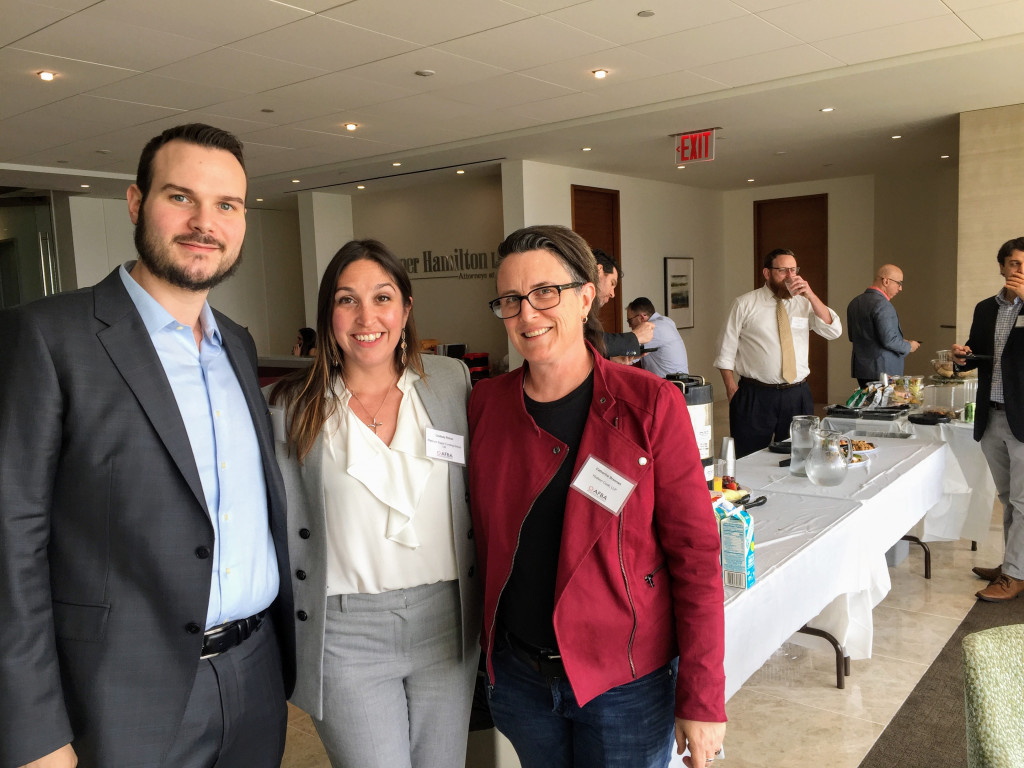 Later, Gregory Nowak, a partner at Pepper Hamilton, entertained the crowd with a few jokes before diving into the details and the risks of syndication. The conference was held at New York offices of Pepper Hamilton, with expansive views of the Hudson River.
“We are energized by the response of so many attorneys from different backgrounds in this emerging and evolving industry,” said one of founders of the AFBA, Lindsey Rohan, General Counsel at Platinum Rapid Funding Group in Long Island.
AFBA’s other founders are Kate Fisher, partner at Hudson Cook outside of Baltimore, Patrick Siegfried, Assistant General Counsel at Rapid Advance in Bethesda, MD, and Murray, attorney at Stein Adler outside of New York City.
 Robert Cook, one of Hudson Cook’s founding partners, was at the conference. He told AltFinanceDaily that he remembered back in 2006 when an investment bank client asked his firm to do due diligence on a merchant cash advance company.
“We didn’t know what that was,” Cook said. “The client looked around for a law firm that had experience with MCAs. They couldn’t find any. So they came back to us and said, ‘You’re going to have to learn.’”
More than a decade later, MCA is no longer so obscure and the AFBA has at least three more planned events in 2018. The next event will be a cocktail reception on October 24th.
For more information, contact: Tiffany@LRohanlaw.com

AltFinanceDaily was also a sponsor of the second annual AFBA conference.
Broker Fair 2018 On Pace for Major Success
April 4, 2018 Broker Fair 2018 is on pace to be a major success!
Companies still wishing to become a sponsor of Broker Fair 2018 have until Friday, April 6th to do so. After that, no additional sponsors will be accepted.
The coming May 14th conference in Brooklyn, NY has already sold out of funder/lender and general admission level tickets. Only ISOs, brokers and those employed by them can continue to register!
The inaugural event has lined up dozens of awesome speakers and sponsors from around the MCA and small business lending industry. In addition to the 31 confirmed speakers and 50 sponsors, TV sales celebrity Ryan Serhant will be the keynote speaker of the event and will offer the audience sales tips. Serhant’s new TV show, Sell It Like Serhant premieres on April 11th.
Salespeople will also be in for a treat with the Be A Better Closer panel featuring Jared Weitz (United Capital Source), Joe Camberato (National Business Capital), Ed Tucker (Yellowstone Capital), Evan Marmott (CanaCap), and Justin Bakes (Forward Financing) as Moderator and the Marketing Your Business panel with Jennie Villano (Kalamata Advisors), Adam Stettner (Reliant Funding), and Tom Gricka (Babylon Solutions).
Industry captains will also teach you how they underwrite deals and tips for ISOs to succeed. Attorneys will walk you through the ins and outs of telemarketing law and legal advertising. There’s more of course, like networking with the funders, tips to raise capital, debates on industry issues, and checking out industry CRMs.
Afterwards, all attendees are invited to network upstairs at Westlight sponsored by RapidAdvance, while enjoying free food and drinks. Westlight offers full views of the Manhattan skyline from Brooklyn’s William Vale.
To date, there’s never been anything like it. I hope to see you at Broker Fair.
Originations Since Inception
December 8, 2017After several company announcements recently, we’ve compiled a milestone chart to plot where they rank. Originations may indicate business loans or MCAs funded on balance sheet, brokered, or placed through a marketplace. These rankings are a work in progress. This chart may not include companies for which public data is not available. If you’d like your figures to be listed here, e-mail sean@debanked.com.
| Company | Origination Volume Since Inception | Year Founded |
| OnDeck | $8 Billion | 2007 |
| Kabbage | $4 Billion | 2009 |
| Yellowstone Capital | $2 Billion | 2009 |
| BFS Capital | $1.7 Billion | 2002 |
| Funding Circle | $1 Billion (US only) | 2010 |
| IOU Financial | $500 Million | |
| Lending Club | $500 Million (SMB loans only) | 2006 |
| SmartBiz Loans | > $500 Million (SBA loans) | 2009 |
| Lendio | > $500 Milllion | |
| Forward Financing | $275 Million | 2012 |
| Blue Bridge Financial | $200 Million | 2009 |