
Talk to People, Ask Questions, and Deals Are Everywhere
March 17, 2025 “Well, when everybody says it’s tough, that’s when I start smiling, because I’m going to sit there and collect them all,” said Adam Oster, Director of Canyongate Financial. Oster was talking about financing deals for trucks in a tough market, though he’s known to be able to handle any kind of equipment in any kind of market. Part of the joy he gets from the challenge of the job is rooted in just how many great people he gets to speak with. Connecting, helping, and building relationships are his passions. And it never stops for him.
“I like to jump in and do everything. I have to have direction so I got to be talking to somebody,” Oster said.
True to form, when he’s taking a break from talking about semis, box trucks, and medical equipment, he’s marketing 3″ filled bones, beef cheek rolls, and gourmet treats for dogs.
“My fiancée has a dog food company, so Thursday, Friday, Saturday, Sunday, we’re out slinging dog food, we’re promoting her business,” said Oster. That business is called Abby’s Barkery, and he’s proudly featured on the company’s main Shopify page. Sometimes the two worlds overlap—in that he could be processing payments for treats while placing an equipment deal at the same time.
“…by 7:30 you get home and you’re like, ‘I think just every day is Monday.’ That’s how I’m going to look at it. Every day is just Monday in my life,” he said jokingly.
Oster began his career in mortgages, followed by a stint as the owner of a supplements store. He launched Canyongate right in the early days of the COVID pandemic after a colleague said he’d be really good in the field.
“When we came on we were strictly working capital, and working capital has its peaks and valleys, so I needed to fill the gap when working capital was down,” Oster said. “I’m like, ‘Hey, let’s transition here.’ So we started onboarding.”
 Onboarding with equipment financing providers is precisely what he did. It helped that some of those providers were located right in his own neighborhood, which shortened the learning curve and helped lead to some great relationships. These days, Canyongate’s business is now 70% equipment financing and 30% working capital. Like others AltFinanceDaily has spoken to, not everyone who makes deals in equipment financing starts off by knowing everything about equipment.
“I knew enough in transportation, semis, trailers, that we lean there. But then I found very quickly that you got medical equipment—everything is a piece of equipment, essentially. So if I get a lot of invoices and I don’t know what they are, I have to Google it. I’ve got to look because the broker doesn’t tell you what it is. So I’m looking it up. I’m like, ‘Okay, this is a CNC machine… or this is a piece of yellow iron.'”
By now he knows so many things so well that he helps other brokers learn the ropes. As part of that he does coaching and training for large groups of people looking to break in. For example, they recently conducted an orientation for 500 people, where they started off by teaching them to focus on a niche. That could be semis or trailers or something else to get in the game. The deals themselves can come from anywhere, including simply knowing someone at the local gas station who might know someone who, in turn, knows another person—turning into a referral. It’s all about building relationships and asking the right questions.
“At the end of the day, it’s just conversation, ‘what are you trying to buy?’ And they’ll tell you. If I don’t know what that equipment is, I’ll say ‘what do you use that equipment for?’ They’ll tell you.”
For brokers already offering products like MCAs, they’re already on the call to steer the conversation in that direction if they so choose, but it’s important to do it thoroughly since the process to get a deal done is a bit more stringent.
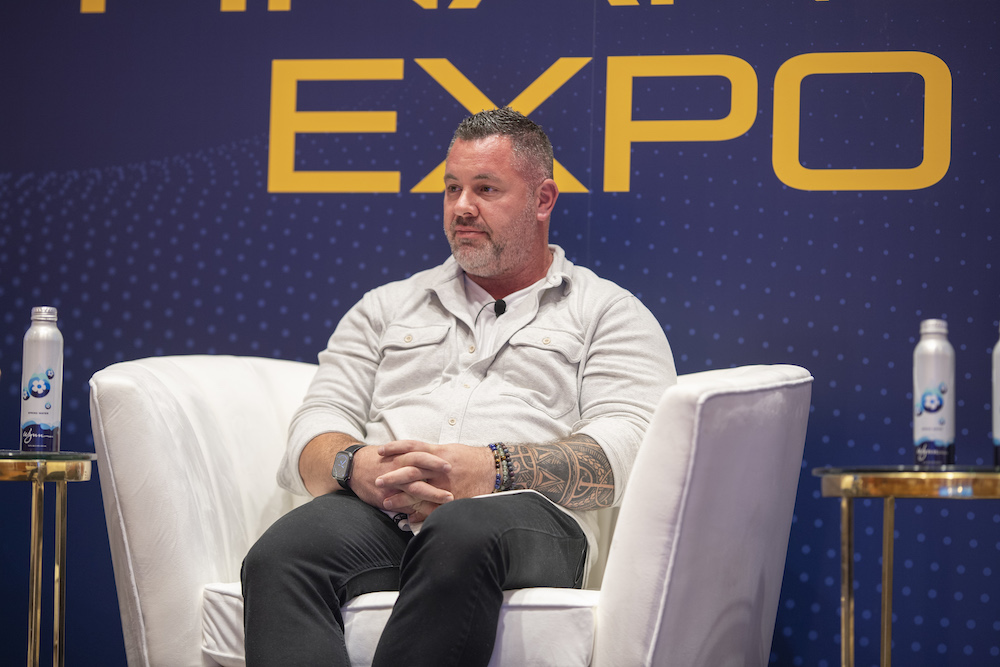
“Ask if they need a truck, ask them what they need to finance,” Oster said. “When you’re submitting an equipment finance deal, it’s not an app and banks with no write up. You’ve got to tell me about the customer. Tell me about their experience. How are they going to use this equipment? There’s a lot of detail that goes into the deal before you even submit for underwriting.”
To that end, he said it’s important to set expectations for brokers looking to do equipment finance deals because it isn’t exactly the same even though it’s similar. On one hand if a broker can already sell a daily or weekly payment working capital deal then surely they’d be able to sell a monthly payment equipment financing deal. It’s a no-brainer when it comes to being able to offer the terms.
“Don’t fear it, ask the right questions,” he insists about taking the leap. And be prepared to ask them anytime anywhere. For example, he’s funded five MCA deals just through relationships he’s made through the Barkery.
“That’s a true story,” he said. “And I have pulled probably six or seven equipment deals out of the last year and a half from working at [my fiancée’s] business. So again, it goes back to it’s just conversation. Look at people’s needs. People tell me, ‘Well, I want to update my little shop and do all these things, I just don’t have the money.’ Well, what do you need? ‘Well, I need shelving, I need this…’ ”
Then he offers to help. Suddenly it’s the perpetual Monday all over again where he’s placing the customer while simultaneously processing payment for a good pup to chew on a lamb foot or a mammoth bone.
“And that’s how deals come about. Opportunity is everywhere. I love it. I get excited, man. I get all hyped up about this.”
Top Online Small Business Lenders of 2024
March 7, 2025Below is a list of the top online small business lenders in 2024 for those that disclose their data:
| Company | 2024 Origination Volume |
| Square Loans | $5.7B |
| Enova | $3.98B |
| Bankers Healthcare Group | $3.7B |
| Shopify Capital | $3B |
| PayPal | $3B |
| QuickBooks Capital | $1.8B |
| North Mill Equipment Finance | $654M |
eBay: ‘We’ve Already Done $40M in MCAs’
November 3, 2024 eBay is coming in hot to the small business financing game. The company reported that it had connected merchants with $100M in funding YTD, over $40M of it being “business cash advances” through Liberis alone.
Liberis is a UK-based company that expanded into North America 4 years ago. It secured $112M in debt funding last year. The partnership between Liberis and eBay only started this past July. eBay’s other big funding partner is Funding Circle.
eBay’s role as a facilitator for funding follows what every other major e-commerce platform is doing. For example, Amazon, Shopify, Walmart, Lightspeed, and DoorDash all offer funding to sellers on their platforms. Technically, eBay was the first considering it had originally partnered up with Kabbage back in 2010. That relationship did not last, however.
Whoa, QuickBooks Capital Shoots Up in Business Loan Originations
August 22, 2024Intuit’s fiscal year ending July 31, 2024 revealed a stunning detail, $2.4B in financing through QuickBooks Capital over 12 months. This was up 28% from the prior year. That number likely puts Intuit’s business loan volume ahead of Shopify’s but that’s still less than Enova and Square. Customers of QuickBooks Capital can apply for financing by clicking a button right in their QuickBooks software.
QuickBooks Online accounting revenue grew 17% in Q4 and 19% in fiscal 2024, the company reported. Intuit has the advantage of many related QuickBooks services slowly merging into one such as payments, payroll, capital, and Mailchimp. Intuit also owns Credit Karma.
SellersFi Surpasses $1B in Loans Since Inception, Experiences Success Through E-Commerce Funding
June 14, 2024The timing of it all was fortuitous for SellersFi. When the company announced in January that it had secured a partnership with Amazon to provide eligible Amazon sellers with access to credit lines, it was clear that its fresh equity raise and credit facility of up to $300 million were going to be put to use. SellersFi wasn’t the only partner, however, and Amazon still did most of the lending to its own sellers directly, a business it had been in for more than a decade, but it was still a big relationship to have. But then it got better. In March, Amazon announced that it would end its direct lending program and rely entirely on its partners instead. For SellersFi that meant it would have the opportunity to service even more sellers on the platform than before. Since then, SellersFi has quietly surpassed $1 billion in loans since inception.

“What we are seeing now is less competition,” said Ricardo Pero, CEO of SellersFi, in a call with AltFinanceDaily. He partially attributed that to the current interest rate environment which has impacted those with small margins. SellersFi, however, has experienced a lot of success. The company knows the e-commerce space particularly well, the only space it operates in, since its the only US lending platform also approved as a payment service provider member for Amazon. They started their relationship with Amazon as a service provider 3 years ago. While Pero said they have seen “nothing that points to a recession,” their experience suggests that even if one were to happen in the future, consumers would react by seeking out bargains on e-commerce platforms, reinforcing their position as the niche to be in. As readers may recall, a flight to e-commerce is also what happened during the pandemic.
E-commerce, however, is a broad umbrella, and Amazon is not alone in the universe. Millions of businesses rely on various platforms for e-commerce from basic templates with API connections to Shopify and more. Even big box brick and mortar retailers are waking up and rapidly inching their way into e-commerce. Walmart is just one example, which not only accommodates individual sellers on its platform but also offers merchant cash advances to them.
“The competitive landscape is changing for our clients,” Pero said. Pero added that they know what’s going on because they talk to these clients all the time and that even in the e-commerce business there are person-to-person relationships. “Customers mention their account managers by name,” Pero said. “We have a reputation as a partner to these merchants.”
One trend they’ve noticed over the last year or so is their strategy towards borrowing. While merchants have always typically used funds for things like advertising or inventory, the previous low rate environment enabled behavior where merchants could borrow first and then figure out how to spend the funds second whereas now that rates are higher there is a lot more of a deliberative approach to precisely how much they should get and what it will be used for in advance. It’s something they see all the time now and agree with. “You need to plan,” Pero said.
What Big Publicly Traded Companies Say About Merchant Cash Advances
March 13, 2024AltFinanceDaily examined the public messaging from some of the largest publicly traded merchant cash advance facilitators in the US and this is what it found:
SHOPIFY
A merchant cash advance is a purchase of your future sales, also known as receivables. If your application for funding is accepted, then Shopify provides you a lump sum of money for a fixed fee. Under the Shopify capital agreement, this lump sum is known as the amount advanced, and the total to remit is the amount advanced plus the fixed fee. In return, you pay Shopify Capital a percentage of your daily sales until Shopify receives the total to remit. The percentage of your daily sales that you must remit to Shopify is known as the remittance rate. The amount advanced and the remittance rate depend on your risk profile.
For example, Shopify Capital might advance you 5,000 USD for 5,650 USD paid from your store’s future sales, with a remittance rate of 10%. The 5,000 USD amount that you receive is transferred to your business bank account specified in your admin, and Shopify Capital receives 10% of your store’s gross daily sales until the full 5,650 USD total to remit has been remitted. You have the option, at any time, to remit any outstanding balance in a single lump sum.
There is no deadline for remitting the total to Shopify Capital. The daily remittance amount in USD is determined by your store’s daily sales, because the remittance rate is a percentage of your store’s daily sales. The remittance amount is automatically debited from your business bank account.
DOORDASH
DoorDash Capital is a cash advance, not a loan. With a cash advance, the offer is based on your sales and account history, and includes a simple, transparent one-time fee that you’ll know before you decide to accept the offer. A loan operates using interest, which can compound over time, and often includes other fees in addition to the stated interest rate.

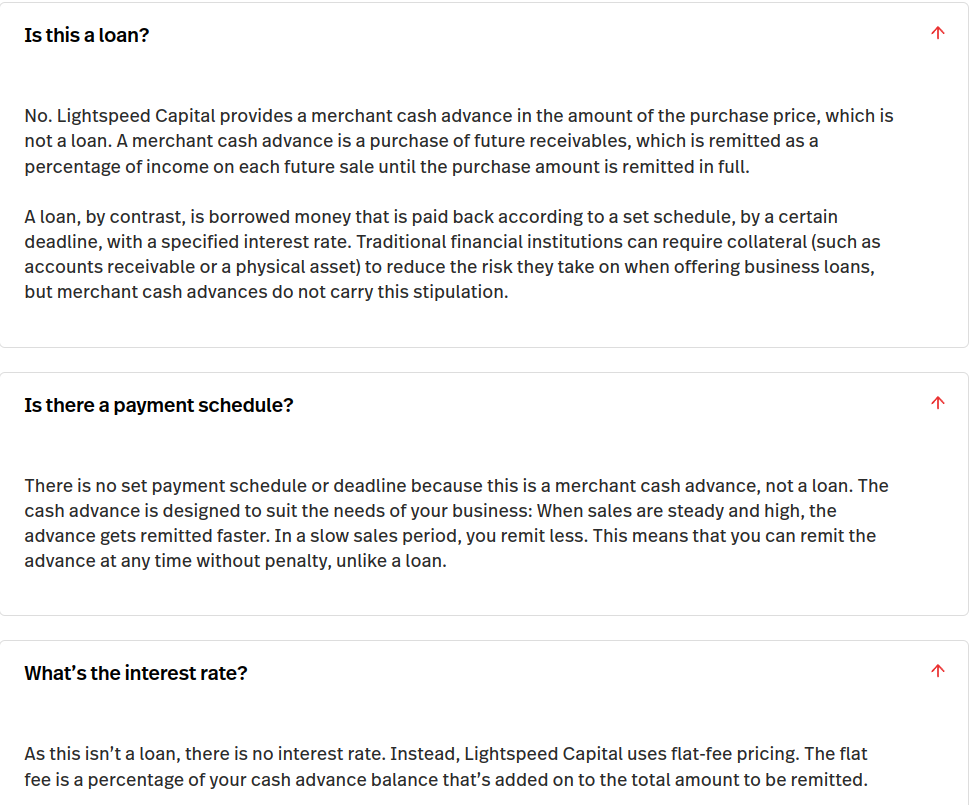
LIGHTSPEED
AMAZON
A [merchant cash advance is a] non-revolving sum of funding with flexible payment, no personal collateral required and no late fees. With flexible payment, no personal collateral required and no late fees, a merchant cash advance provides sellers funding to help run and grow their business. Unlike interest-bearing loans, the advance ties payment to a portion of a seller’s future sales for a fixed capital fee, there are no additional fees or interest charged.
NERDWALLET
Fixed withdrawals from a bank account
Merchant cash advance companies can also withdraw funds directly from your business bank account. In this case, fixed repayments are made daily or weekly from your account regardless of how much you earn in sales, and the fixed repayment amount is determined based on an estimate of your monthly revenue.
PAYPAL
A merchant cash advance is not a loan, but rather a type of financing that business owners pay back with a percentage of their future sales.
The Biggest Small Business Funders
February 21, 2024Although all of the specific data isn’t entirely available, we’ve compiled a short list of who the largest small business funders were in 2023:
1. Square
2. Enova
3. PayPal
4. Shopify
5. Amazon
6. Intuit
7. Parafin

The Top Small Business Funders Now Vs. Then
January 11, 2024Top Small Business Funders By Year
| 2008 | 2014 | 2023 |
| AdvanceMe (CAN Capital) | OnDeck | Square |
| First Funds | CAN Capital | Enova (OnDeck / Headway) |
| Merchant Cash and Capital (BizFi) | Kabbage | Shopify |
| BFS | Kapitus | PayPal |
| AmeriMerchant | Rapid Finance | Amazon |
| GBR Funding | National Funding | Intuit |
Many people look at 2023 vs 2008 and arrive at the conclusion that the fintechs rose to the top, but if one were to narrow down the definition of those players a little further, they’d notice that PayPal and Square are payment companies, Shopify and Amazon are e-commerce companies, and Intuit owns the Quickbooks accounting software. These are actually older companies that took an old idea (split-funding) and made it new again with some key changes. Although in the present moment it may feel like some of them cannot be beat (which is how the industry felt about the top funders in 2008), much can change over the course of this decade.
Keep your eye on:
- AI
- Blockchain (as payment rails, record-keeping)
- Regulation