
A Broker Diversifies With Suite of Value-Adds
August 8, 2024 Like many broker shops these days, Connecticut-based Sharpe Capital is offering more than just a revenue-based financing product. Owned by CEO Brendan Lynch who has been funding deals and boarding credit card processing accounts for more than 15 years, the company is now looking much deeper into business owners’ needs through a whole new set of diagnostic questions like whether or not they have a written will, access to a lawyer, possession of a firearm, or ownership in real estate.
The latter on that list, real estate, is becoming more familiar in the small business finance community. Sharpe Capital, for example, added mortgages to its product set about 18 months ago.
“When we talk to anybody on the phone and they start asking questions, ‘oh, what kind of programs do you have? What are the rates?’ now we’ll always say, ‘well, the cheapest way and the most affordable way to get money is, even though rates are higher on mortgages and that stuff right now than they were in the past few years, it’s still the cheapest way.'” Lynch said. “And then what we’ll try to do is explain that it’s going to take a while. ‘How much do you need to get through the next two months while we work this up for you,’ right? Try to get the long term funding going for them and the short term solution all in one.”
More recently, however, the company has added a bundle of services that include things like identity theft protection, legal consultations, will writing, and more. In one example, Lynch said that a merchant disclosed that an IRS audit had slowed down their ability to continue the application process with them and he realized they actually had a solution for that.
“One of the things [this partnered service] covers here is audit services,” Lynch said. “They’ll give you up to 25 hours and walk you through an audit from the IRS. So it was easy. I was like, ‘hey, yeah, let me help you out right now. We signed him up right away.'”
Lynch says that for now, since it’s all still new for them, these value-adds are typically being proposed after the customer onboards for funding but that he’s open to switching it around.
“We’re definitely trying to figure out a way to approach it as the frontend as well,” he said. “The way these leads are being bought and sold so fast and rapidly, you’re fighting with 50-60 different brokers on every deal, you know? … So, we’re really just trying to find something that separates us.”
Lynch argued that in a market where a lot of brokers are essentially offering the same thing, just being personally remembered later on when it comes time for funding again can make all the difference and that being the guy who helped them draft a will for sixty bucks will probably stay fresh in their mind.
“It definitely stands out,” Lynch said. “It definitely opens up conversations where you’re going to get a little more personal with them and build a closer relationship because you’re going to start asking, ‘Are you married?’ Yeah, I know maybe that’s part of people’s sales pitch, but a lot of times we’re just so focused on getting you an offer fast and getting you funded fast, you kind of don’t have time to get into all that, so that afterwards getting to really build the relationship seems to really be working.”
B2B Finance at AltFinanceDaily
July 5, 2024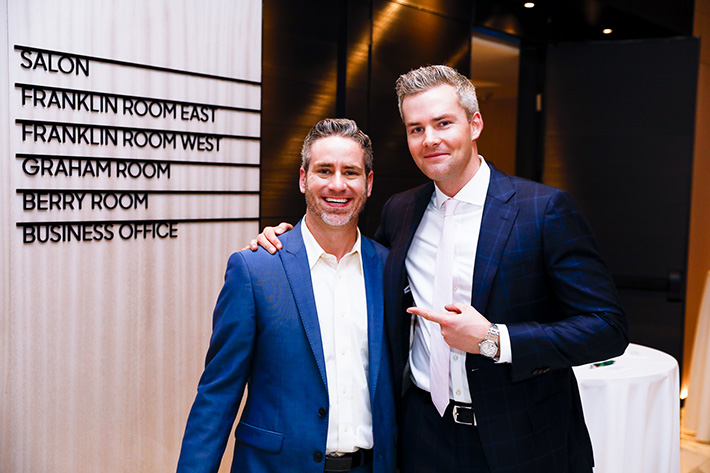 When Broker Fair first debuted in 2018, the keynote speaker was none other than Ryan Serhant, then a fast rising New York City real estate broker and star of Bravo’s Million Dollar Listing. Today he’s got his own Netflix Series called Owning Manhattan.
“After selling real estate for 12 years, I decided to start my own company,” Serhant says in the trailer for the first episode, “and if you can’t sell, you can’t be here.”
That New York hustle attitude was the connecting link for why Broker Fair chose him despite the broker audience being largely engaged in small business financial services at the time. But since then the small business finance broker community has become increasingly diversified in its product offerings and real estate is frequently one of the assets on the menu.
“People will be surprised how many clients have real estate, not just a [primary home], but they own just a small multifamily down the road that they never touched or tapped into,” said Julio Sencion, Principal at Alta Financial, in a recent interview with AltFinanceDaily.
Companies like World Business Lenders figured that out a long time ago while still more discovered the business during the covid recovery, leading AltFinanceDaily to produce a video miniseries about real estate investing in the summer of 2021. The guests ranged from real estate influencer Ralph DiBugnara to NestSeekers International’s Chief Economist Erin Sykes to a couple of old fashioned guys named Danny and Bruce who started investing in real estate across New Jersey long ago.
AltFinanceDaily also interviewed house-flipper turned real estate tech CEO Andrew Luong of Doorvest, did a deep dive as to why real estate was becoming the side hustle of choice in the industry, and even bought real land using the blockchain for the purpose of a story.
Equipment financing has also taken off, leading AltFinanceDaily to produce the first ever sales reality series named Equipping The Dream in 2022.
That’s been complemented by regular coverage and even sitdown interviews from Andrew Carman, Steve Geller, and George A. Parker.
AltFinanceDaily’s Sean Murray has previously presented at the International Factoring Association’s (IFA) Fintech educational event, been a guest on the Coleman Report run by renowned SBA expert Bob Coleman, and moderated panels separately for the New York Institute of Credit and the Alternative Finance Bar Association.
Murray was also the host and producer of the industry’s first ever Broker Battle which took placed in Miami Beach this past January.
AltFinanceDaily is also affiliated with the largest online small business finance community in the US, DailyFunder, and has produced nearly two dozen events since 2017.
“Back in 2018, there was a question that Serhant posed on stage to the Broker Fair audience to make sure he understood where they were coming from,” Murray said. “‘You guys are all B2B right?’ he said, and I think his characterization was spot on, because B2B is pretty much what we’ve been all along.”
AltFinanceDaily is collaborating with the Small Business Finance Association on the B2B Finance Expo that’s taking place in Las Vegas on September 23-24. For info, visit: https://www.b2bfinexpo.com
Trading MCA for Mortgages
June 5, 2024 “I like multiple ways of getting business,” said Julio Sencion, Principal at Alta Financial. “If I did one thing and one thing only and that slows down, it affects my bottom line, so I like to keep my doors open for more opportunity and I think the ISOs should as well.”
Sencion’s not funding MCAs today, he’s doing mortgages, a business he had been in for years prior to the Great Recession. In the early 2000s, he said that everyone wanted to be a mortgage broker, himself included when he got into it. Like many in that business at the time, the fallout of it all pushed him to seek out a new revenue stream and a product that was still in demand. By 2011 he and a partner were running a large MCA brokerage shop in New York with nearly 70 sales reps on the floor. Sencion liked the business but not necessarily the conversion rates on the leads he was buying. By his count only 2-3% of the leads would become a funded deal, a metric deemed too low in the industry era of yesteryear. Old habits die hard, however, because he couldn’t help but continue to think like a mortgage guy.
“We realized that we had a couple of different questions on our application, one of them was ‘Do you own real estate? Commercial, residential?’ 40 to 50% of our clients owned real estate, so because of that we spun off a division for commercial lending.”
By 2016 Sencion exited MCA and went back into traditional finance. He’s now a principal at Alta Financial, which not only does mortgages but has also found a unique niche to source borrowers from, MCA brokers.
“So let’s say for example you’re an ISO and the client says ‘yes, I own real estate’ I’ll be interested in looking at that product,” Sencion said. “Then you will click a link that we will give you, that link will open up the questionnaire and you will fill out that questionnaire and then my agent will receive that lead from that questionnaire with all the data in it.”
Referrals of this nature in the biz are not new, but perhaps the circumstances are. One of Sencion’s account managers, Jamie Schiff, is also a former MCA rep himself, and he’s found this business to be better.
“I think over the past a year and a half, from my perspective, I think the MCA space is just a bit saturated,” said Schiff. “There’s a million and one funders out there.”
The challenge with this different product, according to Schiff, is getting an MCA broker to wrap their mind around a deal that could take a month to close when they might be used to 2-3 days. But on the upside Alta Financial does all the work and they really just want a broker to qualify a lead and submit the details. If a loan closes the broker gets paid. Quite a number of MCA broker shops are already doing this with them, the company said. Once these files are in hand, they underwrite various factors including credit score of the borrower. While just about any kind of property could qualify except for gas stations, they said that multifamily properties are the most common they get.
“People will be surprised how many clients have real estate, not just a [primary home], but they own just a small multifamily down the road that they never touched or tapped into,” said Sencion. “So I think it’s important nowadays to have the ISOs ask the question because if they didn’t do the cash advance they could always flip this into a mortgage.”
While all of Alta’s loans are secured by real estate, they can look beyond the value of the asset by evaluating an applicant on the rental income they generate or look at the average revenue from their business bank statements and base a loan amount off of that. Naturally, the rates and terms are much more attractive than what’s available in the unsecured market. There’s also the added benefit of these products being able to work alongside an MCA or to buy out existing ones. It’s a commission a broker might not have gotten otherwise.
“I’m actually excited, it’s something different but it’s kind of the same,” said Schiff. “And it’s such a smaller space that I don’t have to worry about every other month 10 other new funders popping up…”
As for Sencion, he said that the barriers to entry are higher than the MCA business, between the education, state licensing, how to process the files, etc.
“It takes years to get to the level of where we’re at, to be able to underwrite, fund deals, sell to a secondary market,” said Sencion. “And I think that’s where the edge comes in, you can’t get a cash advance guy, no matter how big they are, to get into my space unless they team up with a mortgage company. No one’s out there trying to become a mortgage company anymore like it was back then.”
Maxim Commercial Capital Promotes Fernando Rodriguez to Director – Vendor Sales
May 6, 2024LOS ANGELES, CALIF. (May 5, 2024) – Maxim Commercial Capital (“Maxim”) announced Fernando Rodriguez has been promoted to Director – Vendor Sales. In this role, Rodriguez manages vendor relationships, business origination, and sales for Maxim’s Truck and Equipment Financing divisions. He is responsible for the divisions’ national sales strategy, leads the company’s sales team, manages high volume national vendor accounts, and assesses and onboards new vendors.
“Fernando has made great contributions to Maxim since joining the firm in 2021,” noted Michael Kianmahd, Maxim’s CEO. “He has been instrumental in developing and leading our direct and returning customer sales efforts, handling high touch strategic accounts, and managing truck vendor relationships in California. We are extremely pleased to have Fernando on our executive team.”
Rodriguez brings 25 years of experience in the financial services industry to his new role. Previously, he served as a senior credit manager, sales team manager, mortgage loan officer, and mortgage broker for companies including Secured Funding, Citibank, and Newport Lending Corporation, funding over $40 million in mortgage loans monthly. Prior to joining Maxim, Fernando managed his family’s environmental business in Puerto Rico.
About Maxim Commercial Capital
Maxim Commercial Capital helps small and mid-sized business owners nationwide by providing loans and leases (“financing”) from $10,000 to $3 million secured by trucks, trailers, heavy equipment, and real estate. It funds equipment purchase financings and leases, working capital, and debt consolidations. Maxim’s more creative financing structures leverage equity in real estate and owned heavy equipment to facilitate growth and preserve customers’ cash. As a leading provider of transportation equipment financing, Maxim supports startup and experienced owner-operators and non-CDL small fleet owners by funding loans and leases for class 8 and class 6 trucks, trailers, and reefers. Learn more at www.maximcc.com or by calling 877-776-2946.
###
Contact:
Michael Kianmahd, CEO
Maxim Commercial Capital
michael@maximcc.com
(213) 984-2727
—
NACLB Named in Receivership Pursuit
February 13, 2024 A series of legal disputes between creditors and Prime Capital Ventures, LLC has taken an interesting turn. Originally, creditors forced Prime Capital Ventures, LLC, a commercial real estate financing firm, into involuntary bankruptcy late last year but withdrew it after a review determined that the assets they sought were allegedly no longer in the possession of the defendant. Despite this, related lingering issues kept the entity in receivership and on Jan 24 the Court appointed a permanent receiver. The Receiver, on behalf of Prime, then filed a lawsuit against its owner Kris D. Roglieri and his related entities including Prime Commercial Lending, LLC, Commercial Capital Training Group, The Finance Marketing Group, FUPME, LLC, and the National Alliance of Commercial Loan Brokers LLC and other individuals for the recovery of assets related to Prime.
The Receiver opens the lawsuit by saying that “This case involves what appears to be a multi-state fraud scheme with victims holding claims for well over $50 million for return of deposits, which were paid and then not returned.”
On February 2, FBI agents executed search warrants at the homes of Roglieri and Kimberly Humphrey, according to a letter filed by a lawyer for Prime which was reviewed by AltFinanceDaily. They are in the process of getting separate criminal defense counsel, according to that letter.
The lawsuit by the Receiver against Roglieri et al can be viewed here.
BusinessFunding.com Sells for $44,000
February 12, 2024 The world of domain name investors called out a big sale that took place on GoDaddy over the weekend. The domain is businessfunding.com and it reportedly sold for $44,000, according to Namebio which tracks sales when data is available. The whois information does not reveal who the buyer is at this time.
Other potentially high value domain names in the small business finance industry include businessloans.com and smallbusinessloans.com, each of which are standalone businesses.
Meanwhile:
loans.com was sold for $3 million 24 years ago and today redirects to the homepage of Bank of America.
businesslenders.com belongs to Business Lenders, LLC, which has since ceased its lending operations.
businesslending.com redirects to a bio page for a big real estate broker.
merchantloan.com redirects to Circadian Funding’s website.
revenuebasedfinancing.com redirects to Lighter Capital’s website.
lenders.com is a page that hasn’t been set up yet.
lending.com doesn’t resolve.
How important is a domain name to a business? Important enough that a business can hardly afford to lose one. And did you hear about the first domain name to ever be used as loan collateral over the blockchain? It just happened recently!
The Story Behind the Broker Battle Champion
January 26, 2024 “I think I’m the best because I understand my clients very, very well,” said Anthony Truglia, an Account Manager at CapFront. “I listen to them, I ask the right questions, and I really try to dive very deeply into what it is the problem that they’re facing, and I try to find a solution to it to the best of my abilities.”
Truglia uttered these lines in a calm baritone voice on the red carpet at AltFinanceDaily CONNECT MIAMI just hours before the inaugural Broker Battle in which he had been accepted as a contestant. The contest was designed to showcase the top brokers taking real but hypothetical questions and applying their knowledge live on stage.
At the time, Truglia had no idea how it was going to be conducted, not to mention that the other highly qualified contestants had also projected equally similar confidence in the likelihoods that they were going to win. It was anyone’s game at that point and the suspense was palpable. There had never been anything like it.
“I’m definitely going to be watching that,” said Manny Yosipov of Advanced Recovery Group during a show floor interview before it took place. “I’ve never seen a broker battle, never heard of a broker battle.”
“Broker Battle is huge because it shows the level that you can reach of talking to these clients, dealing with objections, and just selling in general,” said Joshua Hillian, Creative Director at Advance Funds Network. “I think a lot of people have the wrong idea of sales–but at the end of the day it’s question-based, customer focused, and that’s what it’s about.”
Hillian’s colleague Irving Betesh was slated to go first in the Battle later that evening. Betesh, like others, said that they had been preparing for this day well in advance. There was an overwhelming desire from all of them to showcase not only their technical knowledge but also their friendly diagnostic qualities. This was an educational opportunity for everyone.
 When it finally kicked off, Truglia and Betesh squared off against fellow contestants Corey Digi, Stanley Mitchell, Danielle Rivelli, and Mike Brooks.
By the time Truglia went on stage, which was last in the order, the four judges and thousands in the audience had already heard five impressive performances. But Truglia delivered, earning a near perfect score that sent him to the final championship round against experienced veteran Danielle Rivelli. And when that close matchup was completed, he found himself wearing a gold belt and holding a big check that duly crowned him as the Top Broker.
For those that didn’t know him, Anthony Truglia was simply the man that had put on the most impressive performance, an Account Manager at CapFront who won the hearts and minds of his peers. AltFinanceDaily wanted to know more as he was little known to the editorial team until the day of his victory. It turns out he’s got an interesting story.
Anthony Truglia
Truglia was born and raised in Stamford, Connecticut and got his education at Lawrence University in Appleton, Wisconsin. He interned for a paper company that he said was reminiscent of Dunder Mifflin in the hit sitcom The Office, where he got a taste of doing sales. There, he discovered his own inner drive but paper was not the business he wanted to be in. “I was very young and I’ve always been very ambitious, always trying to accomplish something,” he said. After that he aimed big and actually launched his own coffee business, which ultimately didn’t pan out. Truglia followed that up with real estate, which he enjoyed, until he met someone that changed everything for him, a mentor that was making a name for themselves in the world of small business financing.
 “See, I know most people when they get into this industry they’re just thrown into the gauntlet, they maybe have a team lead that gives them some supervision and some pointers, maybe you go through like a training for a month with a group of people, but I actually got one on one training with Justin Friedman,” Truglia said. Friedman, as one might already be familiar, is currently the Head of Sales Training & Development for Enova International, the parent company of one of the largest small business lenders in the country. At the corporate level, one could confidently say that he is among the best of the best.
That was in 2018 for Truglia, where that one-on-one training included roleplay rehearsals, ones that eventually resembled the format of the Broker Battle he’d partake in nearly six years later. Truglia’s career has led him to CapFront. He speaks incredibly highly of the company and its CEO Zack Fiddle. If one suspected that Truglia’s time in the business had led him to slow down or retreat to back-office work, they’d be wrong. Truglia says that he’s on the front lines making about 150 customer calls per day on average.
“…my job is to contact [inquiring clients] as soon as possible to get a feel for whether they’re interested, if they’ve already been funded or not, but also just trying to figure out what it is they’re trying to accomplish really, try to gauge their urgency, gauge what their comfortability is, and see if we can find something that they will be comfortable with,” he says. “But also it’s a fine line because people’s aspirations are oftentimes not anywhere close to what they qualify for. And unfortunately, not a lot of people are aware of what lenders look for so that’s where we come into play.”
To get ready every morning to do this job he’s up at 6am and off to the gym before he even has his first cup of coffee. Then it’s game time, a lifestyle he’s accustomed to that doesn’t require anything else to pump him up.
“I’ve just gotten to that point where I’m very confident I know what I’m talking about. I’ve heard every question asked and I just practice it so daily that [outside motivation] is not really needed anymore,” he says.
Truglia is also confident that the type of role he fulfills is here to stay, that even lurking AI technologies are not something to fear.
“I definitely think that AI is not going to take away sales jobs because I’m one of those people that thinks that people enjoy talking to human beings. They don’t like talking to robots,” he says. “I think there’s something about—even if [an AI] sounded good, and you know it’s not really a human deep down, there’s no connection. So there’s no loyalty generated. I think people naturally like to talk to people, they like the personal connections relationship.”
 But in real life, one might not be the only person that a potential client is considering and how they make a final decision to move forward could entirely depend on the best vibe that they feel.
“I always tell clients, ‘check out our company, myself on Trustpilot’ and stuff like that, do they always do that? Sometimes, not always. But from a psychological standpoint, I think a lot of times it comes down to how professional you are, how polished, your tone—just the chemistry that you can develop in that first call is what usually decides if this is somebody that you enjoy speaking to.”
This entire thought process ultimately played out on stage where his approach, one which included warmly thanking the judges for their imaginary call and the reaching in for a fist bump to close a deal, wooed the judges in his favor.
“[My team was] all very ecstatic for me,” he says. “And I thank them very much deeply for it. They were certainly rooting for me.”
Nice Asset, Sure Would Love to Lend Against It
December 6, 2023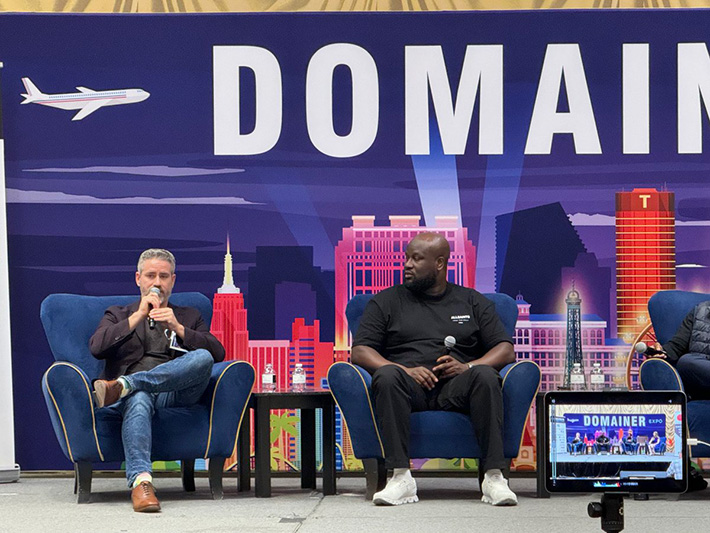 “Sean,” said the moderator, “where do you see domain names in five years?”
At the inaugural Domainer Expo in Las Vegas this week, I was sort of a self-proclaimed emissary from the lending world, there to tell everyone that domain names had a lot more potential utility than what most people probably realize.
“When businesses are looking for capital, there’s sort of a diagnostic checklist,” I said (in substance). “You ask the business how much revenue they have, you ask them if they have equipment, you ask them if they have real estate, etc. and lenders are trying to figure out which of those assets is something they can use as the basis for financing, but nobody asks about their domain name.”
Maybe they should. If a million links on the internet point to a business’s domain name and search engines rank it, then that domain name is integral to the sales generated on the site. And if a business got a loan against a domain name that they’re using to generate tens of thousands or hundreds of thousands in sales per month, they probably wouldn’t want to lose it because it’s worth a lot.
Usually in the business loan world the story ends here. Ok, domain names? sounds complicated, too techie, waste of time, dollar amounts are too small, nobody wants to deal with that, etc.
 But you’d actually be surprised. The technology is just about there that if a business doing $1 million/year in website-originated sales said that they’d be willing to put up their domain name as collateral for a $100,000 loan today, you could send them a link that automatically transfers their domain name to escrow in seconds without them experiencing any disruption to their site. Then if they default on the loan, the domain name transfers to you, where if you understand anything about e-commerce, you should immediately be able to monetize their domain and capture those sales for yourself.
That means no trying to foreclose on a property, no trying to chase down equipment, no suing them, getting a judgment and then hiring an expert to find if they have assets anywhere. Just click-click yours, a revenue generating asset that you can use as leverage to cure the default or monetize immediately and start making your money back with. If you don’t know anything about websites, then maybe this concept wouldn’t be enticing for you as a lender.
I could go into the technical mechanics of how this domain loan process would work, but for now just imagine talking to a business owner generating a lot of revenue that really doesn’t have many assets to make use of. They need $100k and they can’t get it any other way. You tell them they can use their domain name as collateral with no disruption to their website. It will happen instantly. There’s no tax returns needed, no credit check. It’s based on sales, something we might all already be familiar with. Will some business owners say “yes” to such a proposal or would they tell you they’d rather have nothing instead?