Funding Down to a Science
December 21, 2012Account rep: Congratulations, you’ve been approved for $27,000!
Merchant: How did you come up with these figures?
Account rep: It was science. Science did this.
Funny? Maybe not, especially since an underwriting super algorithm may be on its way to the United States. In the days after we posted Made for Each other?, friends, acquaintances, and strangers have been telling us to keep an eye on Wonga’s potential acquisition of On Deck Capital. “It’s not just a european company’s gateway to the US. They’re going to change everything,” a few have said. Aside from their background of being a payday lender, having prestigious VC backing, and the resources to throw a quarter billion dollars at a main street lender in a takeover bid a lot of people didn’t see coming, apparently there is much more to be seen.
Just like MCA in years past, Wonga has worked hard to repel a negative image. Not easy stuff, especially considering they embrace their hefty costs wholeheartedly. Sure, it’s easy to calculate an APR equivalent of a very short term loan and spin whatever number you come up with as the symbol of something evil. If I let a stranger borrow $100 today with the stipulation that they pay me the whole thing back tomorrow plus 1 dollar extra to make it worth my while, would I be evil? That’s an APR of 365%. If I did the same thing with 100 strangers, what are the real odds that all 100 would actually pay me back? Somewhere along the line because of a borrower’s circumstances, bad decisions, or even malicious intent, I’m going to lose the entire $100 I lent out. Others might need more time to pay me back. If one person out of those hundred doesn’t pay back, I break even. If two people don’t pay back, I lose money. If one person doesn’t pay back and another can’t come up with the whole thing, I lose money. You can lend money at 365% APR and lose BIG.
So how do banks manage to charge 4, 7, and 10% APR? Is it just because they’re smarter? No. They don’t make money off loans at these rates either. In the US, interest rates are distorted by government guarantees. Politicians have decided that certain interest rates sound “fair,” then push big banks to lend money at these low unsustainable rates. But of course it doesn’t work and so government agencies sweeten the deal by reimbursing banks for up to 90% of the losses on the borrowers that default. Banks make money on the loan closing fees and other services they sell to the businesses. The loan is the doorbuster offer the bank puts in the storefront window. Once you come inside, they try to sell you on other things so that you don’t walk away with just the loan, otherwise they’re losing money.
So when you hear “banks aren’t lending,” don’t be so surprised. Lending money means giving it away to someone that might not pay it back. That’s a really tough business to be in, no matter how qualified the borrowers are or how good the underwriters are supposed to be.
But somewhere in between the opinions of the Merchant Processing Resource staff and government bureaucrats over what is fair, is a special recipe that determines once and for all what works best. It’s science. Wonga’s lending success is rooted in science and propelled by an advanced algorithm that can systematically calculate risk better than any bank in the world, or so they say.
 One of Wonga’s major investors, Mark Wellport, is a knighted renowned immunologist and rheumatologist that has defended Wonga’s methods against regulation. He believes their data-based process and strong motivation to make their borrowers satisfied places them in an entirely different category than payday lenders.
Wonga takes a human-free approach, something no MCA provider in North America does regardless of how automated their process may seem. In the UK, their business loan application process takes only 12 minutes and the funds are wired 30 minutes later. That’s it. Their max loan is £10,000 but just think about how that compares to MCA in the US. How much time and overhead is being spent on printing documents, underwriters, conference room meetings to discuss deals, setting up the merchant interview, trying to reach the landlord, trying to get page 7 of a bank statement from 6 months ago and the signature page of the lease, etc. etc. Funders might have had the wrong approach all along.
Wonga’s founder, Errol Damelin believes in data. According to some quotes in The Guardian, Damelin believes interacting with the borrower actually impairs a lender’s judgement.
From the Guardian:
Asking for a loan from a financial institution had traditionally involved making a strong first impression – putting on a suit to see the bank manager – then rigorous questioning, checking your documents and references, before the institution made an evaluation of your trustworthiness. In a way, it was exactly the same as an interview, but instead of a job being at stake it was cash.Damelin found this system old-fashioned and flawed. “The idea of doing peer-to-peer lending is insane,” he says. “We are quite poor at judging other people and ourselves – you get to know that in your life, both with personal relationships and in business. You realise that we’re not as good as we think we are at that stuff, and that goes for almost everybody. I certainly thought I was much better at it.
The 42-year-old entrepreneur grew up in apartheid South Africa, and he believes the experience of living in that country in the 80s has had a significant impact on his outlook. He was active in student politics at the University of Cape Town and marched in civil disobedience protests. So, when it came to deciding who should be lent money, Damelin says he wanted to strip away some of the prejudice – decisions would be taken without a face-to-face meeting; you wouldn’t even speak to an adviser on the phone, because people subconsciously judge accents too. The final call on whether to hand out cash would be based on “the belief that data could be more predictive than emotion”.
According to Wired, Damelin and his team created a system to approve or decline applicants all on its own. They tested it on a site called SameDayCash by using Google Adwords and within ten minutes of their ad going live, their system had already approved its first customer. In its early forms, it wasn’t very profitable from a lending standpoint but it did allow them to collect a massive amount of data.
From Wired
its strategy over this period wasn’t just to disburse money — it was to accumulate facts. For every loan, good or bad, SameDayCash gathered data about the borrowers — and about their behaviour. Who were they? What was their online profile? Did they repay the money on time? The site was feeding an algorithm that would form the basis of Wonga, launched a year after the beta experiment that was SameDayCash.
MCA has utilized Adwords for lead generation for years with mixed success, but few have used it for the purpose of accumulating facts. This isn’t to say that the firms collecting information for the purpose of leads aren’t sitting on treasure troves of data, it’s just that none of it to date has led to 100% computerized underwriting. The MCA industry is quite possibly about to undergo a major shift in how they promote their product on Adwords as a result of Google’s ominous warning a couple weeks ago. New disclosure requirements may change the way consumers respond and apply, ultimately impacting the data collected.
So will european science work in the good ‘ol US of A? If Wonga acquires On Deck Capital, you can bet they’ll try to replicate their success. There is a gigantic market of really small businesses that aren’t getting funded, and even the ones that are, they’re waiting 3-7 days to deal with the paperwork, handle the phone calls, fax documents, complete a landlord verification, and in some cases, deal with a credit card processing equipment change. If On Deck Capital becomes a household name as Wonga is in the UK, a lot of smaller funders are going to get squeezed.
Wonga claims to have a net-promoter score above 90%, a customer satisfaction metric that beats most banks and even Apple Computer. It’s a company that seems to be winning on every front.
Critics will say that the American lending market is big enough for everyone, that the loans Wonga has done traditionally are really small and therefore not in the same league as MCA, or that their own company has something similar or better. We believe however, that if this deal goes through that it’s a bad idea to get comfortable. There are Wonga-like companies in the US already, data fortresses that will soon revolutionize how loans are issued and determine what makes a successful business. New York based Biz2Credit is one such example.
We’ve been right about a lot of things in the last couple years and wrong about some. But we believe it is inevitable that any lender ignoring the automation revolution on the horizon is not going to last very long. Go ahead, brush it aside and convince yourself that this whole Automation thing is just hype as BusinessWeek did in 1995 about the Internet. “Automation? Bah!”
As Damelin told Wired in June, 2011, “For me the epiphany was right there. People were online, looking for a solution to a problem.” Ask any funder using Adwords or pouring work into SEO and they’ll tell you the same thing. People are looking online for money. What happens after they fill out the form on the website is what makes the USA MCA/alternative lending industry different from Wonga.
 But will a perfected european algorithm work in the US? Americans approach debt and money differently than the rest of the world and small businesses operate in a much more open manner. You never know, the european lab coat wearing scientists could come here and get their butts handed to them. Plenty of smart companies have jumped headfirst into MCA and left after disastrous results. Some veterans that have been in this business a long time will you tell that an impressive resumé, big investors, and a fancy algorithm will help you make it through the first six months. After that, you better know what the hell you’re doing, if you can continue to do it at all.
If in three years the average small business owner thinks Wonga is the last name of a guy that owns a chocolate factory, we promise to write a jingle that admits we were wrong about them. But On Deck Capital has been around the block and knows the business. They would allow Wonga to skip the learning curve and together could quite possibly nail lending down to a science.
Oompa Loompa do-ba-dee-doo, I’ve got another algorithm for you.
– Merchant Processing Resource
../../
There is great feedback to this article in a LinkedIn Group HERE
Movember Rocked!
December 1, 2012 Movember: Mo’ Merchants, Mo’ Deals
The pre-holiday season is usually big in the Merchant Cash Advance (MCA) industry but this year seemed different. We’ve been saying that we’ve entered a new era for a long time, but it’s finally starting to seem real. It feels like 2007 again in a way, when everybody was getting rich and nobody even knew what the heck they were selling. It took years for account reps to finally stop referring to advances as loans and by then it was too late because the ACH loan industry was born.
E-mails like this don’t happen very much anymore:

You know… the ones where the deal would be blatantly shotgunned to multiple companies at once. The major broker shops would “accidentally” CC everyone instead of BCC to let the funders know who was in charge.
That’s not to say that deals don’t get shopped, Some do, but the circumstances have changed. To minimize the risk of being flooded with bad paper, funders ask resellers to put their money where their mouth is. The syndication game has become THE game in town and it’s led to Super ISO networks like the Factor Exchange. A user on the DailyFunder that seems to be intimately familiar with Factor Exchange is quoted as explaining the model like this:
The “mom and pop” ISOs and “Onesy-Twosey” brokers are backed by one giant ISO network and The Factor Exchange assumes half of the risk by syndicating 50% on nearly ever deal…
The massive volume of FEX submissions to lenders gives the ISOs power to negotiate for better rates and terms, One point of submission reaches 15+ lenders, the merchants credit is only pulled once, and the commission is passed straight through to the ISOs because FEX makes their money from participation.
Companies like this empower the smaller brokerages…

Who Did Mo’ Deals in Movember?
Yellowstone Capital broke their single day funding record… TWICE. This actually happened on back to back days. Executive management reported that they funded approximately $3 million in 48 hours.
Who Got Mo’ Money?
Wall Street wizard and business professor, Steven Mandis acquired a stake in Bethesda-based RapidAdvance. The news is all the more interesting with the fact that RapidAdvance is easily one of the top 5 largest players in MCA. Single individuals don’t exactly just walk through door and buy a stake in companies like this. Mandis is taking on a Strategic Advisor position and it’s our guess Rapid is about to enter another major phase of growth.
Who Got Mo’ Likes?
Merchant Cash and Capital’s (MCC) facebook fan page has gotten thousands of Likes since the third week of Movember when they announced their charity campaign. For every new Like until December 7th, MCC is donating $1 to the American Red Cross to help people that were affected by Hurricane Sandy.
Who Got Mo’ Wins?
RapidAdvance was the first team to clinch the playoffs in the MCA industry fantasy football league for charity. Something tells us that Mandis is behind their incredible winning streak.

Who got Mo’ Leads?
You did if you bought leads from either one of our lead advertising partners, Meridian Leads or SmallBusinessLoanRates.com.
Lendio has also been making a splash on the MCA lead scene with Dave Young being a big contributor on DailyFunder. To discuss pricing, he can be reached at dave.young[at]lendio.com
Who lied Mo’?
According to CNN’s statistics, 247 million people in the U.S. went shopping on Black Friday. That’s equal to the entire American population over the age of 14. Something doesn’t smell right with these numbers. It’s our guess that CNN is using Mitt Romney’s polling experts. 😉
But someone else lied just a little bit Mo’. On Movember 26, 2012, PRWeb published a release that claimed ICOA Inc., a small tech company in Rhode Island was acquired by Google for $400 Million. The release turned out to be a hoax as part of a stock pump and dump scheme. Many critics have been left wondering why PRWeb didn’t do anything to verify its authenticity. Considering PRWeb is such a widely used PR service in the MCA space, we can testify that they’ll pretty much publish anything so long as you pay the fee. Some smaller companies use it as part of their SEO campaigns, which explains why there are so many strange looking releases out there that seem to repeat the same keyword in every sentence.
ABC Funding Co Just announced a program that will help small businesses in need of cash by providing these small businesses in need of cash with a special type of financing that will hep them if they are a small business in need of cash. Not exactly New York Times material…
Will Movember be followed by Make-a-lot-of-Doughcember? We’ll find out!
– Mo’chant Processing Resource
../../
The Funders of Summer
August 2, 2012What’s new? Who funded? What happened? Merchant Processing Resource will try to give you a glimpse into the Merchant Cash Advance (MCA) universe:
We all know salespeople love to fund, but underwriters?!! This banner hangs on the wall of the underwriting department at mid-sized MCA firm, Rapid Capital Funding:

Holy Moses Batman! $10 Million in a month?! Yellowstone Capital is reporting a new personal monthly funding record of $10,245,000.

There has been an influx of really creative instructional/promotional videos about MCA lately. Cartoons are really “in” right now:
PayPal white labeled a Merchant Cash Advance program in the U.K.
Will the mega banks be next?
It feels like 2006 all over again says First Annapolis Consulting in a recent article:
This seems to be the same bullish sentiment that surrounded the industry in 2006, when there was a constant influx of new MCA providers into the industry and what appeared to be unlimited financial sources. What might be different now is the experience accumulated in the industry during the recession. In the last few years, and as a result of the mounting losses that the industry suffered during the economic crisis, MCA players have implemented more conservative risk management practices and procedures.
Underwriters industrywide are also reporting that stacking, splitting, double funding, and fake statements are on the rise. It certainly brings back some nostalgia for veterans and not the good kind. A screenshot of a current ad on craigslist that is directed at bad apple merchants:

A new chapter opened for Merchant Cash Advance (This is soooo last month but a great read if you missed it).
http://greensheet.com/emagazine.php?issue_number=120602&story_id=3088
Is the loan shortage a banking problem or a merchant problem? Ami Kassar makes the case in his New York Times column.
“Where are the leads? I need the leads. Can you tell me where the leads are?” We literally get asked daily where to get leads from. We recommend:
http://SmallBusinessLoanRates.com
http://meridianleads.com
By the way… for every company that says cold calling doesn’t work, there’s a company getting rich doing just that. Same goes for SEO, mailers, e-mail blasts, PPC, and so. Marketing is an art form. Just because it doesn’t work for you, doesn’t mean it doesn’t work period. Keep doing what you’re doing. Too many ISOs/agents/marketing directors abandon campaigns after 30-60 days. Practice makes perfect!
Have you abandoned social media? We ask this question: What looks worse to a prospect?
Not having a business twitter account or having one but failing to tweet at all in the last 8 months?
Not having a business blog or having one but failing to add any new blog posts in over a year?
We didn’t spend much time researching hard data but we would surmise that freshness is a psychological component to a prospect’s shopping experience. If a business blogged regularly on their site up until May, 2011 and then stopped, might a merchant think the entire business itself is abandoned or gone? Is a facebook fan page with 1 post from 8 months ago a positive or negative selling point? WE SAY: If you build it, maintain it. Nothing brings down your presence on the Internet like abandonment. We understand that smaller companies might not have the manpower, time, or creative energy to write informative articles or engage people through social networking, especially when it’s hard to measure the results and value it creates. Consider the value you might actually be losing by projecting to the world that you have given up. It’s like operating a store with a sign out front that says “THIS BUILDING HAS BEEN CONDEMNED” even though you are actually open for business. If WE stopped posting articles for a year, would you still come back several times a month?

Here are two examples of MCA firms that keep it FRESH!:
http://unitedcapitalsource.com/blog/
http://takechargecapital.com/category/blog/
Don’t you just love MCA? We do! Visit our site again soon.
– Merchant Processing Resource
../../
The Other 93%
July 13, 2012The SEO war rages on for Merchant Cash Advance providers, ISOs, micro lenders, and other financing firms, but just how much real estate is everyone really fighting over? According to data recently provided in The Green Sheet by First Annapolis Consulting, only 7% of all merchant account leads are generated via the Internet. So if your business plan’s success hinges on getting to page 1 of Google search, you might be shutting yourself out from nearly the entire marketplace. Don’t get us wrong, there’s a lot of money to be made and business to be acquired via the Internet, but even the big firms get roughed up from time to time by competition, new algorithms, and SEO companies that promise the world but deliver few results.

So if not the Internet, then what else is there besides cold calling? That’s a question that tons of small ISOs ask themselves when they realize that competing online isn’t easy. It just so happens that the “what else” comprises of 85% of all generated leads in the payments industry. More than 50% are derived from bank referrals and associations alone.
Has anyone ever wondered why companies like AdvanceMe (Capital Access Network) are still number one in the Merchant Cash Advance arena? They’ve managed to defy Darwin’s theory of evolution. In every industry, there is a pioneer that leads the way, gets too comfortable, stops innovating, and is systematically made irrelevant by fresh thinking competition. There was MySpace until there was Facebook. There was Yahoo until there was Google. There was AOL until…there was just everything else.
So one would expect that in 2012, the mere mention of AdvanceMe would be part of a requiem for the founding fathers of the Merchant Cash Advance industry. That isn’t the case and is quite the opposite considering they are on pace to fund at least $700 million this year. So they must be #1 on Google, right? Nope. For all of the main keywords that people are fighting over, they rarely if ever, even show up on the first page of the results.
 Chances are a lot of their clients never even bothered to search online for financing, or if they did, it was just to get a second opinion. Once they saw that full page advertisement in the merchant account statement their processor mails them every month, they probably just called the phone number listed on there, went through the steps, and got funded. AdvanceMe and other players have some pretty badass referral connections.
All the sales pitches in the world about lower rates and free POS systems aren’t going to compete with a merchant who has just been given a referral by a company they already have a relationship with. Hell, even you have probably enlisted an insurance company, wedding vendor, or mortgage broker because someone you trusted said they were great.
This isn’t another lecture about how referrals are crazy good and that cold calling is wicked bad, especially since we don’t even necessarily feel that way. The point is really to highlight just how much more potential there is out there for small funders and ISOs. You can actually be successful with a sucky website and no SEO if you can just solidify some key relationships.
If you want to be around 14 years later, you can’t ignore the other 93% of the market. The volume of Internet leads will probably increase in the future as more computer savvy people become small business owners. But it’s way too easy to set up a website, hire an SEO guy, and throw money at Pay-Per-Click. Anyone can do it and everyone is doing it. That means most companies are losing the battle and tons of you are saying “what else is there?” Fortunately, the lead generation pie chart offers unlimited hope. You just need to think bigger and try harder.
If the other categories seem too ambitious, well then you’ll never make it in this biz kid…
Why LinkedIn is King
June 9, 2012This may be risky…but we’re doubling down on LinkedIn. The Los Angeles Times will disagree with us, since they recently embraced the radical view that LinkedIn is a big joke. Sure, LinkedIn recently got hacked and that’s a major security issue they’ll need to deal with, but for the haters that brag they haven’t logged into their accounts in years, they probably missed the point of this social media site. LinkedIn isn’t Facebook. They aren’t even competitors. If you want to share your funny photos and write witty updates about how you hate work, please by all means spare the rest of the business world from it. We’ve got some tips for those haters:
- If you view your job as a 9-5 that’s a burden to living your life, LinkedIn is not for you.
- If you’re employed in an entry level position and don’t care about climbing the corporate ladder, LinkedIn is not for you.
- If your goal is to make sure that you never get any kind of individual recognition in your field, LinkedIn is not for you.
- If you want to avoid talking about your line of work with other like-minded people in a way that can help you grow, LinkedIn is not for you.
- If you’re a business owner that has no desire to speak to other business owners, LinkedIn is not for you.
- If you LOL at the thought of networking, in person or online, LinkedIn is not for you.
- If you want to spam the Internet and submit updates that no one will ever read, go sign up for Google Plus.
LinkedIn isn’t a resumé site or a social network. It’s a cooperative movement to make the private sector vastly more efficient. We’ve heard grumblings from Merchant Cash Advance industry insiders that some of the most popular vBulletin-style forums are pretty much losing their value. The discussion is sporadic, many people hide behind a screen name, and there isn’t any way to validate the information being shared. At best, it’s an anonymous way to spread propaganda. Traditional web forums rely on users to visit the site and once there, go on a scavenger hunt to find new posts and discussions. If there are no new posts, then the time spent going to the forum is nothing more than a waste.
LinkedIn has groups, which are monitored and policed by the group owner much like a forum would be. The stakes are upped because everyone participating can view each other’s business credentials through their profiles. In a traditional web forum, you get situations like this all the time:

The individual offering to sell leads looks highly suspect. If only there were a way to find out who they really were, where they were located, how long they’ve been in the lead business for, what company they work for, who else they know in the industry, who has publicly recommended them, etc. Even if they had included a real company e-mail address and website in their post, there would still be much more information left to be desired. We believe it’s a lot harder to accomplish anything with anyone you don’t know via the inherent anonymity of traditional web forums. Sure, anyone can fake their credentials on LinkedIn but if you see they’re connected with a former colleague of yours, you can call that old colleague right up and get the scoop. The transparency leads to transactions that get closed faster and both parties can feel more confident in their decisions to do business with a stranger.
Is LinkedIn perfect? No, it’s not. But the results are incredible if you know how to use the site correctly. We’ll put it this way, in the month of May, LinkedIn brought 21% more visitors to our site than what came organically from the Bing search engine. If you LOL at that because Bing is notoriously smaller than Google, just think about how much money you or other people you know are spending on SEO experts to get traffic from search engines. So LOL it up because LinkedIn is free.
Those statistics also don’t count the relationships we’ve built purely through the site itself. You see, it’s not always about making a sale and the numbers of connections you have isn’t what we mean by relationships. You’re a lot better off reading the updates of a C-level executive on the ins and outs of Crowd Funding in a LinkedIn group than you would be from reading a sensationalist, empty opinion about it by the LA Times. Comment intelligently to that exec’s posts and you could find them wanting to connect with you to discuss further and possibly do some kind of business together.
Here are some of the industry groups we recommend you check out:
We cordially invite the haters described in the bullet point list above NOT to join. Not that we should really worry they will. If you actually visit the twitter accounts that the LA Times cites as proof of LinkedIn’s unpopularity, you’ll find that these people spend their time online talking about Kim Kardashian, Lindsay Lohan, and other useless crap. They read like play-by-play diaries of a junior high school girl. Hate away losers, they made twitter just for people like you.
Job Losses Possible Threat to MCA Industry / Google Penguin Kills Survivors / No Debit Card Savings
May 6, 2012How sure is this recovery?
A few months ago, all signs pointed to a roaring recovery. As the data comes in each month, it’s looking less and less like a definitive thing. Sure the unemployment rate is going down, but mainly because hundreds of thousands of people are giving up on searching for jobs. The Wall Street Journal recently analyzed a less popular statistic, the civilian labor participation rate. At present, the percentage of Americans working is at its lowest point since 1981.
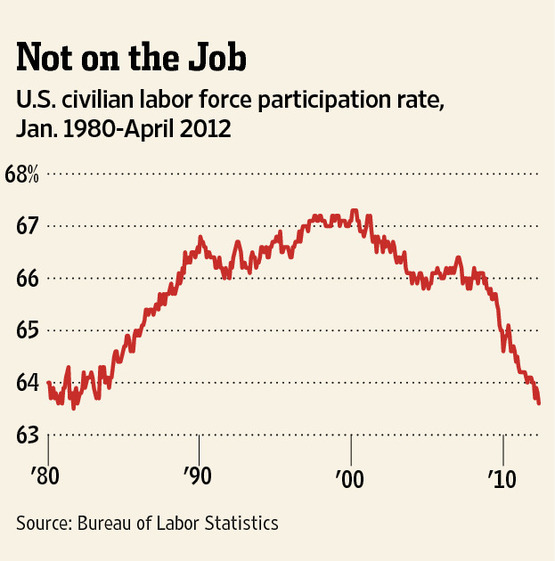
At the same time, the nation’s largest banks are cutting back on loans to businesses yet again. It makes one wonder if the explosive growth being experienced in the Merchant Cash Advance industry will start to fizzle out in the 2nd half of this year.
Google Penguin wipes out the survivors
 If you used blog networks like BuildMyRank to game Google into ranking your site higher, you probably noticed your website got whacked in late March. After years of spending precious money on marketing, 2012 brought upon the realization that leads generated from organic searches are not only possible, but free. This is of course before you factor in the thousands and tens of thousands that MCA funders and ISOs are spending a month on SEO. But since many SEO tactics are doomed to fail and because Google’s algorithm can change at any time, investing in organic rankings is incredibly risky.
For example, one mid-sized MCA provider secretly shared that they had spent two years and nearly a hundred thousand dollars to get the rankings for the keywords they wanted on Google. Leads were just finally starting to come in on a daily basis when out of nowhere, they got thrown back to page 25. Blog networks were a big part of their strategy and when Google cracked down on them, the MCA provider’s presence on the Internet went down with the ship.
Some MCA companies survived the blog network armageddon only to become extinct on April 24th when Google made a key algorithm change to help defeat web spam. This major update has become notoriously known as Penguin. If you were a victim, you may need an SEO crisis management plan.
In any case, the changes at Google immediately affected unemployment in India, the country that most U.S. companies turn to for SEO services. As their clients sites disappeared from search results, so too did their contracts. At least that is the gag story surrounding a photoshopped image that has been going viral around the Internet.

Read our previous coverage on Merchant Cash Advance and SEO:
The SEO War for Merchant Cash Advance
The SEO War Continues
Debit card savings not being passed along
Remember when all those small business owners got their swipe rates reduced? Oh wait, that didn’t happen. The Durbin Amendment limited the interchange rates, which are the fees that acquiring banks pay to card issuing banks. The rates and fees charged to the small business are still left to the discretion of Merchant Service providers. Sure they can lower the cost if they so choose, but there’s no law that dictates they have to. It seems the Durbin Amendment victory was all one big misunderstanding for America’s retailers. We’ve been following this law since December, 2010. ISO&Agent Magazine just published an article titled, Unintended Results Plague Durbin Amendment. Are they seriously just figuring this out now?
Published by: Merchant Processing Resource
../../
Cool Stuff | ISO Extinction | Ignorant Media
April 27, 2012What’s new in the Merchant Cash Advance arena?
Cool Stuff
FundersCloud is making waves in the industry with their Peer2Peer/Crowdfunding platform. We’ve finally gotten a chance to speak to their team, do a walkthrough, and aim to release an independent review of their cloud next week. However, for the moment we would like to take this time to gloat that another one of our predictions is being proven right.
On December 1, 2010, we explained that the Direct Funder model was quickly becoming a thing of the past. (The Direct Funder Model is Sooo 2009). How many of your friends and colleagues have at some point considered leaving their current job to go and start a funding company? Tired and worn down agents are all prone at some point to say “screw this! I want to be the funder so the agents can send the deals to ME instead!” Now it makes increasingly less sense to start a funding company. Why would you do that when you can just syndicate on your own deals or on the deals of other funders? You can earn the same return they enjoy but without having to pay the nasty overhead. In some aspects, being the funder has disadvantages, unless they’re making a hefty amount on management fees.
 ISOs Facing Extinction
According to an article in ISO&Agent Magazine, it’s not practical to compete on just price anymore:
The internal threat lies in continuing to base the ISO business model solely on selling card services at the lowest price and failing to offer the latest payment technology, Helgeson cautioned the packed session room.
“They should be talking innovation,” Helgeson said of ISOs. “If they’re only talking rates, they’re already out of business”
Basically, if two merchant account representatives walk into the corner deli and one offers to lower the processing rates by 15 basis points and the other offers a state of the art POS cloud that can accept payments through the merchant’s smartphone, home computer, and in-store touch screen device, what’s going to happen? So many merchants have been tricked into higher rates under the guise that their rates would be lower that they’re beginning to tune out the low rate pitch already anyway. They want the technology now.
Could the same issue begin to plague the Merchant Cash Advance industry? In the last two years, new funders have popped up with the strategy to acquire marketshare by undercutting the competition. That works until the next guy undercuts the first guy, and the next guy undercuts the second guy. Pretty soon, we’ll have funders purposely operating in the red just to have a share of the market. Some are bleeding red ink already but not because they want to be. 🙁
They key is to give merchants added value with the financing program. This doesn’t mean trying to sell them insurance and warranties and trying to pass this off as some kind of value. Those are junk costs and extra fees for the funder, not value for the merchant. Anything you can contribute that would drive more customers to their business or make their business operate more efficiently is value.
Ways Merchant Cash Advance Companies Can Provide Additional Value to Their Clients:
- Provide them with POS software
- Provide them with SEO services to increase their exposure to customers in search engines
- Create a custom tailored marketing campaign for them to reach more customers
- Create and execute an e-mail marketing campaign for them that would be sent to either previous customers, potential customers, new customers, etc.
- Rent a few billboards and allow merchants to opt-in to have their business advertised on these billboards
- Copy Groupon
- Etc., etc., etc.
If you can’t come up with anymore ideas here on your own, you’ll probably be out of business by 2015. If the items you add to this list include ways to make yourself more money and not the merchant, you’ll probably be out of business by 2015.
Ignorant Media
In our own opinion, the petition set up to automatically e-mail the Huffington Post in response to their article about businesses having no choice but to pawn jewelry was a success. The Huffington Post may feel differently because they didn’t respond to us at all.
It figures that websites that receive millions of views daily really don’t bother to care about actual facts or information. They’re entertainment sites and for-hire PR mechanisms. Every time we see a friend’s company mentioned in the news, we shoot them an e-mail or call them up to offer them congratulations on getting noticed. They always respond with some version of, “Don’t congratulate me. I had to pay $30,000 to some PR company to try and buy placement.” Oh well… At least there’s the Merchant Processing Resource to fulfill all your Merchant Cash Advance information needs. 🙂
– AltFinanceDaily
../../
Merchant Cash Advance Industry is Waiting for its Big Moment
August 25, 2011Originally Posted 7/28/2011
According to an article in ISO&AGENT Magazine, the Merchant Cash Advance (MCA) industry has had significant success but “the companies that fund them acknowledge the cash-advance market is still waiting for its big moment.” This echoes our earlier opinion that a lack of collective marketing is keeping this financial tool from reaching its true potential.
How is it that in an ultra tight credit market that small businesses have not heard of MCA? With lax credit score standards, fast turnaround, minimal documentation, and a flexible method of repayment, it’s absurd that the industry has not reached so many that are looking to borrow. ISO & AGENT points to a negative image crisis and fingers the costs involved as a possible culprit.
The costs are a non-crisis. MCAs would be less expensive if they required collateral, perfect credit scores, fixed terms, ten years in business, and a 3 month underwriting process. If a small business meets those requirements and does not have a time sensitive opportunity they are looking to capitalize on, they should be going to their local bank. But most small business owners either do not meet that criteria or need the funds for a project they have going on today. Hence the product has to be more expensive for it to make sense for the firms providing the funds.
ISO&AGENT claims the industry has been compared to payday loans, an untrue characterization. In fact, that comparison has so rarely been made, that we can pinpoint the exact place they got that from. Inc.com published a very unflattering article on April 1, 2008 titled ‘Thanks, But No Thanks‘, in which they explain MCAs as “the business equivalent of a payday loan.” That was three and half a years ago! The article was not only biased and unfair, but was also written at a time when everything related to Wall Street, banks, or lending was being demonized as the nation sat on the verge of the Great Recession and economic collapse.
Still one can’t help but notice that buried deep within their criticism, is the answer to why MCAs are a tad bit more expensive:
The fact that collateral isn’t necessary is another important part of the MCA providers’ pitch. Entrepreneurs sometimes risk losing their homes if they can’t repay a bank loan, but they have no legal obligation to repay merchant cash advances if their companies fail, as long as they strictly follow the terms of the contract. They can’t encourage customers to pay in cash, for example, and they cannot switch credit card processors (typically, the MCA provider gets paid directly by the processor, rather than by the merchant). “If Diane’s Bistro goes out of business because Lauren’s Bar & Grill opens up across the street, we have absolutely no recourse to Diane, none whatsoever — as long as she follows the clearly defined covenants in our contracts,” says Glenn Goldman, AdvanceMe’s CEO.
And if you had any more reason to suspect MCAs are not as bad they tried to make it out to be, Inc.com published that article on April Fools Day. Case closed.
But there is indeed an image crisis and it’s that many businesses haven’t been exposed to the concept of MCA and thus cannot consider the pros and cons at all.
For instance: Most people can make the case for or against consumer payday loans. They’ve already got loads of information from the media, newspapers, banks, and lawmakers on which to base their argument. It’s become a well known household accepted form of financing. Whether or not payday loans can help the consumer is a separate debate.
That’s the difference. MCA is rarely spoken about by newspapers, banks, or lawmakers. Its presence in the media is limited and as a result we’re referring to stories published over three years ago. We have many friends employed as small business loan officers across the country and the only reason they’re aware of how MCAs work is because we told them. It’s embarrassing. And for an industry that funded over $500 Million last year alone, it really makes no sense.  We blamed antiquated marketing techniques: cold calling, junk mail, useless internet marketing, and spamming. The industry has gotten lazy and has a propensity to market their financing to small businesses that have already secured a MCA. This comes with bold promises of lower rates and other gimmicks. This inner competitiveness leads to both smaller margins and lower conversion rates. It does nothing to grow the industry as a whole.
That’s complemented by carpet bombing the public with an approach their customers learned to ignore a long time ago. Cold calls and junk mail. Really? Yes, really. There will always be a sliver of effectiveness from these methods and the firms that employ them will defend their success to the death. These methods may score some deals and perhaps even work well enough to grow a MCA firm, but it will not lead to the industry’s ‘big moment.’ Same goes for internet spam, poorly constructed articles that serve no purpose other than to boost some company’s SEO, and useless blogs kept by both respectable firms and no-name websites set up to harvest leads. Sure that’s the way of things on the internet these days but there isn’t anything beyond that. There are no mainstream media articles about MCA, forums for business owners where it is actively discussed, nor any public endorsements by anyone of high political or business stature.
Sounds like we have an image crisis on our hands. The Merchant Cash Advance Resource (the site you’re on right now) has been in existence for 1 year. In that time, we’ve made significant additions to the information that can be accessed here. We constantly receive emails from business owners and MCA brokers alike with the hope that we can provide them with an unbiased answer. And guess what? We do just that. By having no commercial affiliation, we give the best advice we can. The e-mail volume has gotten so heavy that our volunteer editors have trouble answering them all. But we try anyway.
And along the way we’ve managed to get some formal offers to convert this resource into a commercial site to generate sales leads. A six figure buyout offer here and there coupled with some lengthy, legalese filled non-disclosure agreements. We say ‘no’ every time. The Merchant Cash Advance Resource is designed to provide information, opinions, critiques, data, guides, and an independent ‘thumbs up’ to an industry that’s destined to do great things for small business.
Why do we spend the time, money, and effort to provide this service? We’re looking at the big picture of MCA. Big picture… Big moment…
And we’re on our way.
AltFinanceDaily
../../