
Do You Need a Mentor?
June 11, 2019 “You don’t need a f-ing mentor,” is the opening line of a short online video delivered to camera by Gary Vaynerchuk, the celebrated high energy marketing and sales guru. In the video, he concludes by saying: “Enough with the mentor horseshit. Go f-ing execute. There’s unlimited free mentors on f-ing YouTube. Go f-ing work.”
A discussion with industry insiders suggests that Vaynerchuk’s sentiment is somewhat controversial.
“Without mentorships, I wouldn’t be able to be where I am now,” said Josh Feinberg, co-founder of New Hampshire-based Everlasting Capital, a brokerage that has twice made it onto the Inc. 500/5000 list of the fastest growing U.S. companies, ranked #323 in 2017.
“Mentorship doesn’t just mean asking people for advice,” Feinberg said. “It means being able to build relationships with people who are on a greater level.”
For instance, Feinberg said that he and co-founder of BFS Capital, Cathy Bass, would speak about how she and others grew BFS, how they go to market and what is most important to them.
“And I was able to implement some of that into my own company,” Feinberg said.
Joe Cohen, who runs Business Finance Advance, a brokerage in Brooklyn, said he has mentored dozens of people, mostly his employees, throughout his career.
“You have to instill a solid work ethic,” Cohen said. “And you have to lead by example. Not by dictating, ‘You do this.’”
As for Vaynerchuk’s assertion that there are “unlimited free mentors on YouTube,” David Korchak, Managing Member of Primary Capital, a funder in Brooklyn, makes a clear distinction between a social media celebrity and a mentor.
 “I don’t understand how anyone can say they have a mentor in someone with two million followers on Instagram,” Korchak said. “What did this person do for you? Maybe he helped you get to the gym in the morning…but that’s inspiration, that’s not mentorship. That’s the difference between someone posting a video on Instagram and someone sitting down with you at a desk and showing you ‘This is where you made a mistake. This is how you can make sure you don’t do that again, and this is how you can make it better for the future.’ That’s not inspiration, that’s guidance. And a mentor is a guide for you.”
But Chad Otar, a veteran MCA broker in New York, said that he agrees with what Vaynerchuk was trying to communicate in his video
“You can have a mentor,” Otar said. “But at the end of the day, you have to put your blood, sweat and grit into it. A mentor can only do so much.”
When asked if Otar has a mentor, he said it’s his brother, who introduced him to the MCA industry. This leads to the question of who can or ought to be one’s mentor?
“A mentor can be anyone in the industry who’s been there before,” Cohen said. “Someone who can tell you what’s going to happen if you do this and what’s going to happen if you do that.”
Cohen said that when he started out in sales years ago, his mentors were older colleagues of his on the sales floor.
“I saw in them commitment to the job and how they worked diligently to make every deal happen,” Cohen said. “They never gave up.”
Some ISO owners even pay to train their managers to be excellent mentors to their salespeople, like Edward Deangelis, founder of the fast-growing Pennsylvania-based brokerage, Amerifi.
Deangelis said that he has used Sandler Training for the last seven years, both for himself and his team. His managers go to Sandler Training’s management boot camps once or twice a month for 3 to 4 hours.
“They learn skill sets on how to be an excellent sales manager,” Deangelis said. “How to cultivate your team rather than just be a boss. And to really ask [their] salespeople what they’re struggling with.”
Deangelis also has a CEO coach that comes to the office once a month for him. He said that the coaching has helped him in many ways, including in his personal life.
Feinberg said that you really have to choose your mentors carefully because a lot of people can talk themselves up into being something they’re not. And he said that one person in the business who said he would guide Feinberg in the right direction ended up stealing his deals by the end of the relationship.
“Look at media exposure,” Feinberg suggested. “If they seem big but you can’t find them in the news or you haven’t seen proof, it’s probably not someone to take advice from.”
Merchant Relationship Status: It’s Complicated
May 14, 2019
Brokers will often say that building strong relationships with their merchants is critical to their success. John Celifarco, Managing Partner at Horizon Financial Group, a five person ISO in Brooklyn, said that the advantage they have over larger competitors is the relationships they’ve developed with their merchants. Celifarco’s office is even in a streetfront store, where a number of their merchants are actually neighboring stores. Celifarco sees this as a strength.
But Michael Bernier, Vice President of 1 West Finance, a 14-person brokerage based in New York, said that things have changed as competition has increased in the space.
Customers gravitate towards companies that can provide them with not only the best pricing, but also the best user experience, which is why we believe so many new players in the space have achieved scale so quickly.
While customer relationships are important, funders in the space that are improving their speed, efficiency, and pricing are going to win the deals.
“In general, if [end users] find a better price on Amazon, 9 times out of 10 they’re going to buy that product on Amazon, regardless of the sales person on the phone” Bernier said.
Bernier suggests that rate or speed may win the customer but another more legally-binding circumstance may guide the relationship accordingly.
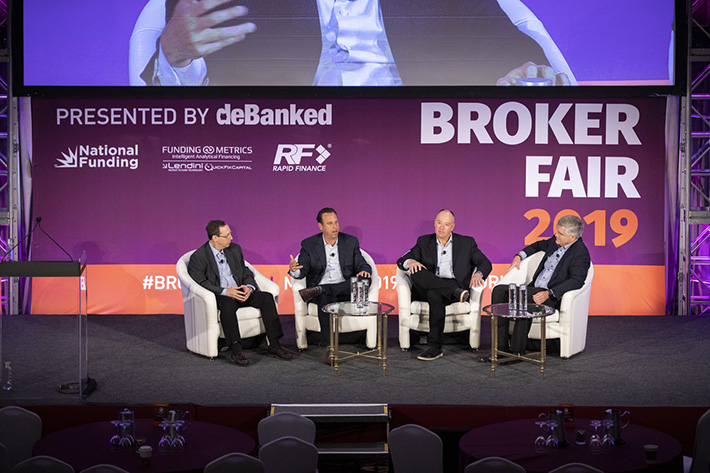
Kapitus CEO Andy Reiser served as moderator.
“Contractually, we own the customer,” said National Funding CEO Dave Gilbert on a panel at Broker Fair. “But we work in conjunction with the broker.”
Fellow panelist and Chairman of Rapid Finance, Jeremy Brown, said that he used to say what Gilbert said, but now says: “We own the loan. [And] we have the right to first renew the customer.”
Brokers seeking a very cozy relationship with their clients should therefore consider what rights and responsibilities are afforded to them under their referral contracts so that there’s no confusion with actions taken by either party with the customer down the road.
“I get close to people very quickly, it’s just who I am,” Kemp, a broker, told AltFinanceDaily in an interview last year. “And in my opinion it works to my advantage because I have merchants that renew with me multiple times a year. And I know that no matter how many calls they get [from other brokers], they’re going to turn to me. I know that they trust me.”
Likewise, Chad Otar, CEO of Excel Capital in New York, has said that building trust with merchants is very important and is what leads to renewal business. Otar introduced one of his merchants, a marketing company, to his other clients. A few of them ended up working with the marketing company, which was a win for everyone and led to even stronger word of mouth from Otar’s merchants.
“I don’t think anyone owns the customer,” said CEO of BFS Capital Mark Ruddock on the panel alongside Gilbert and Brown. “Customers are a privilege, not a right.”
Broker Fair 2019 Makes Major Splash in the Heart of Manhattan
May 10, 2019
If a tiny ray of light were created from every conversation about small business financing, then the Roosevelt Hotel in midtown Manhattan would have been tantamount to the sun on May 6th. It was the site of AltFinanceDaily’s 2nd annual Broker Fair and the grand old lobby was abuzz with brokers, funders and vendors from across the industry. And it wasn’t only the lobby. The hallways and ball rooms and bathrooms were filled with people in jackets or dresses with colorful conference badges hanging from their necks. You could not open your eyes without seeing a Broker Fair attendee.
The day kicked off with an address to the crowd by AltFinanceDaily’s founder and president Sean Murray.
 He spoke to a packed audience in one of the hotel ballrooms that was actually the site of a famous scene in the 1987 movie, “Wall Street,” starring Charlie Sheen and Michael Douglas. It was in this scene where one of the most well-known lines, “Greed is good,” was delivered in a speech by the character Gordon Gekko, a ruthless businessman played by Michael Douglas.
In Murray’s speech, he acknowledged the classic financial thriller, but gave it a twist.
“Funding small business is good,” Murray said. “It’s not greed that’s good. Aligned interests are good.”
This very room was a marriage of old and new. The 1924 room with soaring ceilings and crystal chandeliers was packed with mostly young faces in a still relatively new industry. The stage was simple, the chairs sleek, and colored strobe lights circled the ceiling in what created a fresh energy.
The first panel of the day, called “The Great Debate,” was dominated by discussion of technology among the CEOs of some of the largest companies in the small business funding industry: National Funding, Rapid Finance, BFS Capital, and Kapitus.

“Technology is an inevitability and a powerful way for brokers to stay relevant,” BFS CEO Mark Ruddock told AltFinanceDaily. “The question is, ‘Does that preclude the small [brokers] who don’t have the money to invest in technology?’”
He sees great opportunity for software platforms that can connect an individual broker to lenders, similar to how Shopify connects small mom and pop retailers to a wider consumer audience.
One of the other CEOs on the panel said he was bullish on digitally savvy brokers and all of them seemed to agree that brokers should offer more products.
“Having a broader set of products benefits brokers because they become the go-to person for merchants rather than simply serve a transactional function,” Chairman of RapidAdvance Jeremy Brown told AltFinanceDaily.
For brokers looking to expand their product offerings, there was a well-attended session called “Commissions with Factoring and Leasing” that was led by factoring and leasing professionals, Phil Dushey and Edward Kaye, respectively.
Meanwhile, the co-founders of the successful brokerage Everlasting Capital, led a session called “How to Scale Your Broker Shop” which included advice on everything from hiring to customer acquisition and social media marketing. One of the founders, Josh Feinberg, had his marketing person follow him around with a video camera throughout the day.
There were also sessions on regulations affecting the industry, plus a session called “Operating with Integrity: Why Ethics Matter.”
“The speakers are very relevant,” said Dexter Bataille, a broker at Pivotal Funding in Florida who attended Broker Fair. “And the panels are really good too.”
“AltFinanceDaily always finds ways to make the shows more professional,” said Senior Sales Leader at Reliant Funding Nicolas Marr, who flew in from California to attend the conference. “The details really count.”

In another hotel ballroom, Broker Fair attendees meandered around high tables where event sponsors had representatives talking about their products and handing out free t-shirts and pens. As the day wound down and Broker Fair’s “networking happy hour” approached its end at 6 p.m., the figurative sun (created by small business finance conversations) began to set at the Roosevelt Hotel. But a crowd of about 100 lingered at the hotel bar, buzzing away, eager to make just a few more connections.
The small business financing sun will rise again on July 25 at deBank’s next event, AltFinanceDaily CONNECT in Toronto. Tickets are already available.
Amazon Now Among The Top Online Small Business Lenders in The United States
May 8, 2019
Amazon has joined PayPal, OnDeck, Kabbage, and Square as being among the largest online small business lenders. On Tuesday, Amazon revealed that it had made more than $1 billion in small business loans to US-based merchants in 2018. Amazon says the capital is used to build inventory and support their Amazon stores.
By selling on Amazon, “SMBs do not need to invest in a physical store or the costs of customer discovery, acquisition, and driving customer traffic to their branded websites,” the company says. Small and medium-sized businesses selling in Amazon’s stores now account for 58 percent of Amazon’s sales. More than 200,000 SMBs exceeded $100,000 in sales on Amazon in 2018 and more than 25,000 surpassed $1 million.
You can view the full report they published here.
| Company Name | 2018 Originations | 2017 | 2016 | 2015 | 2014 | |
| PayPal | $4,000,000,000* | $750,000,000* | ||||
| OnDeck | $2,484,000,000 | $2,114,663,000 | $2,400,000,000 | $1,900,000,000 | $1,200,000,000 | |
| Kabbage | $2,000,000,000 | $1,500,000,000 | $1,220,000,000 | $900,000,000 | $350,000,000 | |
| Square Capital | $1,600,000,000 | $1,177,000,000 | $798,000,000 | $400,000,000 | $100,000,000 | |
| Amazon | $1,000,000,000 | |||||
| Funding Circle (USA only) | $792,000,000 | $514,000,000 | $281,000,000 | |||
| BlueVine | $500,000,000* | $200,000,000* | ||||
| National Funding | $494,000,000 | $427,000,000 | $350,000,000 | $293,000,000 | ||
| Kapitus | $393,000,000 | $375,000,000 | $375,000,000 | $280,000,000 | ||
| BFS Capital | $300,000,000 | $300,000,000 | $300,000,000 | |||
| RapidFinance | $260,000,000 | $280,000,000 | $195,000,000 | |||
| Credibly | $290,000,000 | $180,000,000 | $150,000,000 | $95,000,000 | $55,000,000 | |
| Shopify | $277,100,000 | $140,000,000 | ||||
| Forward Financing | $210,000,000 | $125,000,000 | ||||
| IOU Financial | $125,000,000 | $91,300,000 | $107,600,000 | $146,400,000 | $100,000,000 | |
| Yalber | $65,000,000 |
Has PayPal Eclipsed OnDeck in Small Business Loans?
April 26, 2019
It’s been said that Kabbage is on pace to surpass OnDeck in small business loan originations, but PayPal has already done it.
When PayPal announced a working capital program in the Fall of 2013, few were predicting that the initiative would propel them to the top of the small business lending charts. Just two years later, however, the payment processing giant had already loaned more than $1 billion to small businesses.
Today, that number is over $10 billion, according to a comment made by PayPal CEO Dan Schulman on the company’s Q1 earnings call.
That figure would suggest that they had loaned approximately $9 billion from Fall 2015 to the end of Q1 2019. OnDeck, by comparison, loaned $7.5 billion since Fall 2015 through Q4 2018. Several other data sources, including previous statements from PayPal that they had surpassed more than a billion dollars in quarterly small business funding in 2018 (already more than OnDeck), indicate that PayPal has become #1 on the AltFinanceDaily small business funding leaderboard.
PayPal’s growth was helped in part by its acquisition of Swift Capital in 2017.
Two of the top four are payment processors:
| Company Name | 2018 Originations | 2017 | 2016 | 2015 | 2014 | |
| PayPal | $4,000,000,000* | $750,000,000* | ||||
| OnDeck | $2,484,000,000 | $2,114,663,000 | $2,400,000,000 | $1,900,000,000 | $1,200,000,000 | |
| Kabbage | $2,000,000,000 | $1,500,000,000 | $1,220,000,000 | $900,000,000 | $350,000,000 | |
| Square Capital | $1,600,000,000 | $1,177,000,000 | $798,000,000 | $400,000,000 | $100,000,000 | |
| Funding Circle (USA only) | $500,000,000 | |||||
| BlueVine | $500,000,000* | $200,000,000* | ||||
| National Funding | $427,000,000 | $350,000,000 | $293,000,000 | |||
| Kapitus | $393,000,000 | $375,000,000 | $375,000,000 | $280,000,000 | ||
| BFS Capital | $300,000,000 | $300,000,000 | ||||
| RapidFinance | $260,000,000 | $280,000,000 | $195,000,000 | |||
| Credibly | $180,000,000 | $150,000,000 | $95,000,000 | $55,000,000 | ||
| Shopify | $277,100,000 | $140,000,000 | ||||
| Forward Financing | $125,000,000 | |||||
| IOU Financial | $91,300,000 | $107,600,000 | $146,400,000 | $100,000,000 | ||
| Yalber | $65,000,000 |
*Asterisks signify that the figure is the editor’s estimate
Tips For Trade Show Success
February 14, 2019
Conference season will soon kick off, but many attendees are at a loss at how to score big at these events. Without a doubt, trade shows and conferences offer participants a prime opportunity to boost brand exposure, make professional connections and increase sales.
But there’s also a lot of behind-the-scenes work required to turn these events into successful business endeavors. While the playbook won’t be the same for every company, here are some tried-and-true tips to help attendees get the most out of conferences.
Start by determining which conferences to attend. With dozens to choose from, it’s not realistic from a budget, time or value perspective to hit every conference, says Jim Larkin, who manages events for OnDeck. Companies should select conferences based on which ones make the most sense for their goals and objectives. Not all conferences will offer the same benefits to every company or industry professional, frequent conference attendees say.
Ideally, management teams should meet early in the year to weigh the pros and cons of each conference, against the backdrop of the company’s budget. Some factors to consider include where and when the conference is being held, which of your competitors, prospects and customers are likely to attend and how many employees it makes sense to send, if any. “Budgets drive everything and you want to be smart with spending money,” says Janene Machado, Director of Events for AltFinanceDaily, whose flagship conference, Broker Fair, is scheduled for May 6 in New York. “You need to be strategic about why you are attending a particular conference,” she says.
It’s essential to plan ahead for each conference to make the most out of the event. This includes carefully combing through the agenda, scheduling meetings ahead of time and getting acquainted with the physical layout of the event space. If more than one company representative is attending, it’s also important to coordinate their activities in advance to avoid duplicating efforts and to maximize productivity.
“You have to make your own luck at these conferences,” Larkin says.
Most events have an online or mobile agenda and networking portal that are open to participants at least a few weeks beforehand. Bookmark the sessions you would like to attend, build your wish-list of people you would like to meet and start requesting meetings as soon as possible, says Peter Renton, co- founder and co-chairman of LendIt Fintech, which has an upcoming conference scheduled for April 8 and 9 in San Francisco. “Last year we helped to enable nearly 2,100 meetings at our USA event, and most of those meetings were organized through our networking portal,” Renton says.
Don’t delay when it comes to setting up advance appointments because schedules can fill up quickly, says Monique Ruff-Bell, event director for Money20/20 USA, which will take place in Las Vegas from Oct. 27 through Oct. 30. “Identifying the right contacts beforehand, reaching out and establishing what you’d like to achieve in a short meeting will make your time much more productive,” she says.
It’s fine for attendees to leave some time in their schedule for impromptu meetings as well; just be sure to fill those slots, says Ken Peng, head of business development and marketing at Elevate Funding. “No one should ever be asking, ‘what are we doing next?’ You should know,” he says.
It’s also a good idea to plan ahead for a dedicated meeting space so you’ll have a convenient, comfortable and quiet space to conduct meetings, seasoned conference attendees say. This can be especially important at big conferences where thousands congregate. For those who don’t want, or can’t afford, to pay for a meeting room, it’s a good idea to find a quiet restaurant or coffee shop outside the busy convention center area where you can have quiet, uninterrupted, productive conversations in a relaxed environment, says Larkin of OnDeck. Don’t choose the heavily frequented coffee shop next to the hotel where meetings are sure to be disrupted by heavy foot traffic, he says. “Get away from the noise, the hustle, the chaos. Quiet is king.”
Conferences can be expensive, so it’s important to make the right decisions with the available budget. For instance, companies don’t have to miss out on promotional opportunities just because the highest level of sponsorship is out of reach for their budget. Instead, look for creative ways to make an impact without breaking the bank, says Stephanie Schlesinger, director of marketing for LEND360.
Schlesinger suggests that would-be sponsors have an open conversation with conference organizers about what they can afford to spend and what they hope to reap in return for their marketing dollars. She offers the examples of companies that have sponsored popcorn breaks, pens and pads of paper, badges, lanyards and other marketing materials. “There could be opportunities to do something very unique. By brainstorming together we can think of outside-the-box opportunities to really make an impact for your brand,” she says.
Another cost consideration is where to stay. Though it can be tempting to save a few bucks by bunking off-site, that’s not always the most prudent decision, frequent conference attendees say.
“Time is really valuable at these shows and events. If you’re staying off-site you have to battle everybody for the cab line, and the increased expense of commuting can offset any cost savings,” says Sheri Chin, chief marketing officer at BFS Capital. Also, staying on-site “gives you more flexibility when unscheduled things come up,” she says.
If staying on premises isn’t an option, conference attendees should make extra efforts to spend considerable time in the bar or lobby of the conference site, says Jeffrey Bumbales, marketing director at Credibly. People will come in and go and it’s an easy way to start conversations, he says.

Conferences typically consume a lot of energy, so Eden Amirav, chief executive and co-founder of Lending Express, recommends participants try to catch people well before they are running on empty. As the conference goes on, it becomes harder to engage people because they also get drained, he says. Typically conference doors open a few hours before the first sessions begin, and this can be an especially effective time to network, Amirav says.
Arriving early also allows participants to find their way around. Ruff-Bell of Money20/20 USA recommends participants walk through the entire event space upon arrival to get their bearings. “Many of these large conferences can be overwhelming, and knowing where to go will help with your time management,” she says.
Bumbales of Credibly also recommends conference attendees pack their schedule tightly—even though it might mean activities extend late into the evening. Instead of calling it quits at 6 p.m. he recommends conference attendees plow through and host evening meetings over dinner or drinks. Even though a participant may be tired, it’s best not to miss these important networking opportunities, he says.
The proper conference mindset includes knowing there’s a good chance sleep won’t be plentiful. To accommodate, Bumbales tries to ensure he’s well-rested before a conference. He also makes sure to pack protein bars and non-perishable snacks for replacement meals as needed throughout the conference in case he needs to eat on the go. The goal is to hit the ground running and be able to focus entirely on conference-related business, he says.
Although numerous social opportunities abound at conferences, not everyone takes advantage. Certainly not everyone is as comfortable approaching strangers. But it’s important for conference- goers to try to break out of their shell whenever possible, industry professionals say. When he first started going to conferences, Gary Lockwood, vice president of business development at 6th Avenue Capital, says he found it difficult to strike up conversations with strangers because it took him out of his “comfort zone.” But he forced himself to make the extra effort, and it has served him well. He says that some of the best connections he’s made have come from these chance meetings at breakfast, lunch or during random breaks.
 Although attendees don’t always stay on-site for meals, Peng of Elevate Funding recommends people stick around during these times, if possible. He finds these meals a good opportunity to chat with others in a comfortable setting as opposed to the more strained conversations that can happen when someone approaches him at an exhibitor booth. These informal conversations offer a better chance to build a rapport with someone and learn—in a non- pressured environment—about what the other person does, he says.
Bumbales of Credibly says elevator time offers another opportunity for chance meetings that can turn into business opportunities. Most times, he prefers to take the stairs, but not at conferences. Elevators can be great for short, yet productive conversations. He likes to position himself next to the elevator buttons, which gives him an opening to break the ice. He says he’s had a few business opportunities arise as a result of elevator conversations.
 It’s also important not to monopolize anyone’s time says Machado of AltFinanceDaily. Everyone is there to meet as many people as possible, so she recommends keeping conversations quick, meaningful and relevant.
When he’s talking to someone for the first time, Lockwood of 6th Avenue Capital tries to listen more than he speaks. “I want to listen a little more than I talk in the beginning so I can tailor the conversation to what they need.”
While not every exchange will be fruitful, it’s important to recognize that any conversation could lead to future business; even a commercial real estate broker who has no present connection to merchant cash advance can be a potential partner or resource at some point, Lockwood says.
It’s also a good idea to keep your business cards handy at all times. Bumbales says he’s been in several situations when people don’t have them available, which makes exchanging information more awkward. “It’s a lot less awkward to exchange business cards then it is to ask for someone’s cell phone number,” Bumbales says.
Because each day is so jammed- packed with information, it’s a good idea to take notes so you don’t lose track of important details, says Ruff-Bell of Money20/20 USA. Each person will have his own system, but effective note-taking becomes important for recapping the event back in the office and for sending post-event follow-ups to new contacts. “At the end of each day, go through your notes and clean them up, ensuring you’ll understand the key points and important details weeks later,” she says.
Some conference participants fall short when it comes to following up with new connections they’ve made, but this can be a grave mistake. Follow-up emails are most effective when they are personal, says Peng of Elevate Funding. He recommends attendees jot down a few notes on the business card of each person they meet to jog their memory later on about their conversation. Then, weave details of the conversation into the follow-up email, so the correspondence won’t seem cold, generic or canned, he says.
Remember, conference-goers will be meeting hundreds of other people at the conference, Ruff- Bell says. “Ensure your follow-up is prompt, effective, and most importantly, memorable,” she says
Even though the setting is social, conference attendees need to be mindful about maintaining proper decorum at all times. This is a seemingly obvious rule of thumb that people sometimes forget, conference participants say.
“You’re there for work first, play second,” Peng says.
Professionalism also dictates that attendees and exhibitors should be where they are supposed to be at appropriate times. Peng recalls a conference he attended last year where one of the exhibitors left its booth unmanned for most of the conference. There’s no way to know where an interaction at these booths can lead in terms of new business or face-time with existing clients.
“It’s not doing the company any favors” by passing up the opportunity, he says.
Shopify is Quickly Climbing the Ranks of the Largest Small Business Funders
February 12, 2019Shopify originated $277 million in merchant cash advances in 2018, according to their quarterly earnings reports. That figure already places them among the largest small business funding providers nationwide.
Below is a look of how they stack up thus far:
| Company Name | 2018 Originations | 2017 | 2016 | 2015 | 2014 | |
| OnDeck | $2,484,000,000 | $2,114,663,000 | $2,400,000,000 | $1,900,000,000 | $1,200,000,000 | |
| Kabbage | $2,000,000,000 | $1,500,000,000 | $1,220,000,000 | $900,000,000 | $350,000,000 | |
| Square Capital | $1,600,000,000 | $1,177,000,000 | $798,000,000 | $400,000,000 | $100,000,000 | |
| Funding Circle (USA only) | $500,000,000 | |||||
| BlueVine | $500,000,000* | $200,000,000* | ||||
| National Funding | $427,000,000 | $350,000,000 | $293,000,000 | |||
| Kapitus | $393,000,000 | $375,000,000 | $375,000,000 | $280,000,000 | ||
| BFS Capital | $300,000,000 | $300,000,000 | ||||
| RapidFinance | $260,000,000 | $280,000,000 | $195,000,000 | |||
| Credibly | $180,000,000 | $150,000,000 | $95,000,000 | $55,000,000 | ||
| Shopify | $277,100,000 | $140,000,000 | ||||
| Forward Financing | $125,000,000 | |||||
| IOU Financial | $91,300,000 | $107,600,000 | $146,400,000 | $100,000,000 | ||
| Yalber | $65,000,000 |
*Asterisks signify that the figure is the editor’s estimate
How One Broker Moved from One-Man Home Office to 23 Person Shop
January 7, 2019Zach Ramirez started the brokerage company ZR Consulting from his home in Orange County, CA in June 2018. He was generating leads and making phone calls, often in a hushed voice because he was also looking after his six month old daughter.
“That was difficult, having a baby and with my life savings in the business,” Ramirez said.
But he had three brokers working remotely for him and things were working pretty smoothly. That number was growing by the time AltFinanceDaily profiled him in August.
His fledgling business was manageable until he got to six brokers. At this point, the 29 year-old Ramirez said his home office was starting to feel like a call center.
“All day, I was answering calls to help them,” Ramirez said. “‘Zach, I have a question about this merchant, Zach, can you help me close this deal?’ It gave me a ton of anxiety.”
Ramirez realized that it would be much easier to manage employees from a brick and mortar space. So he found the company an office.
 “Technically, we could have stayed at home,” Ramirez said.
And he acknowledges that some brokers can make a nice living working from home.
“But I want to have the biggest ISO,” Ramirez said.
With this as his goal, he said it makes the most sense to have everyone under one roof. If he’s having a large meeting, he wants to know that everyone is paying attention and not driving or playing a video game as they could on a conference call.
“It was difficult to manage salespeople and to track everything, like how many leads we generated in one day? How many leads does it take for me to fund one deal? How much money does the average deal bring me?”
Having his brokers work remotely made keeping track of these numbers even harder. Ramirez still has a couple of people who work for him remotely, but he said that 95% of his employees, or 23 people, now work at their office in Anaheim, CA. Ramirez said that the office was much too big for them with just six people at the beginning.
“We could hear echoes bouncing off the walls,” he recalled.
But now with 23 people, mostly brokers and some support staff, Ramirez is actually planning to expand into an office next door.
“[As we grew in the office,] we just re-invested every penny we earned back into the company,” Ramirez said. “We upgraded our computers and furniture and we put people on W-2s. We gave our employees a 401k right away. I think it’s important to really treat your people right.”
Ramirez acknowledged that he can’t make changes to the business as quickly as he used to. With more than 20 people, he said that costs go up dramatically and therefore decisions have to be much more calculated.
“It takes time to move the ship,” Ramirez said, “and if you’re not careful, everyday can be consumed by the small stuff.”
That’s why he stresses the importance of delegating roles to others.
“It’s the only way to free up your time so you can focus on the bigger picture,” he said.
Now, he said that he very rarely speaks to funders anymore. He has two processors on staff whose job is to organize the paperwork from the brokers and send it to the funders. They organize the company pipeline, he said.

Ramirez said that it can be quite difficult to find the right mix of funders.
“Some funders who you think will be great turn out not to be and other funders who you’ve never heard of turn out to be real diamonds in the rough,” Ramirez said.
And like many brokers feel, Ramirez agrees that when it comes to funders, less is more.
“Having a very precise and small list of funders is incredibly important…because it simplifies your process [and] having a simple process is one of the keys to scaling your business,” Ramirez said.
Ramirez said that a common mistake brokers make is to test out a bunch of brokers all at once. He said that brokers need to try working with new funders intelligently, which means one at a time.
“When you bring on a new lender, you carefully watch every submission to them,” Ramirez said. “You want to make sure they’re not backdooring you. So usually you want to put your phone number and your email address in the contact info so you can catch them if they’re trying to be sneaky. [If they are,] they’ll call asking for the client and you know you only sent that deal to one lender.”
He’ll sometimes then pretend he’s interested and record the call. On about three occasions, he said that he has sent recordings like this to the backdooring lender and he’ll write “this is why I don’t send deals to you.”
Ramirez’s small group of trusted funders are OnDeck, National Funding, BFS, and Orange Advance.
As Ramirez expands, he says he only hires brokers by referral. He said that 90% of his business is short term business loans and MCAs, and 10% is SBA loans and real estate transactions.
Ramirez said that so far, ZR Consulting has originated $15 million in deals since inception and has earned $1.5 million in revenue.