Reliant Funding Announces Steve Kietz as New CEO
August 10, 2021Industry veteran and former Chief Marketing Officer is appointed Chief Executive Officer of the leading alternative finance company
San Diego, CA (August 10, 2021) – Reliant Funding, a leading small business finance company, today announced that it has named Steve Kietz to the role of Chief Executive Officer. Kietz previously served as the firm’s Chief Marketing Officer. The industry veteran will guide Reliant Funding on its mission to continue providing world-class, customized finance solutions for American Small Businesses.
As CMO, Kietz was instrumental in expanding Reliant Funding’s marketing, risk and technology initiatives. He is a seasoned financial services professional with a more than 30-year track record of leading successful teams and is widely recognized as an industry leader in cultivating strategic partnerships. Prior to joining Reliant, Kietz served as President of Inte Q, was Founder and CEO of Mobile Money Ventures (which was acquired by Intuit), and held leading roles at Citi and JP Morgan, including President of Citibank Direct. Outside the profession, Kietz has volunteered as Vice President of the Familial Dysautonomia Foundation for over 30 years.
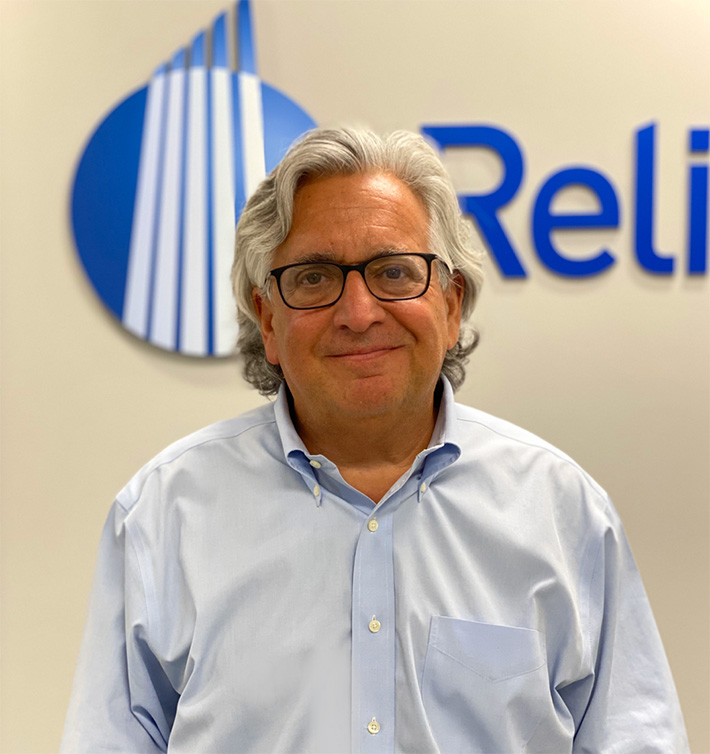 Commenting on his appointment, Kietz said, “I’m excited and grateful for the opportunity to lead Reliant Funding into a new era, where we are positioned as industry leaders in delivering value to our customers. The company has a long history of providing outstanding financial solutions to small businesses and I am deeply humbled to continue this legacy. I am excited to lead a team of great people and I look forward to continuing to execute our mission.”
Reliant Funding has grown rapidly as it seeks to help small businesses across the country in achieving their financial goals, having provided nearly $2 billion in funding to over 30,000 companies since 2008. The nationally recognized company works to provide tailored financial solutions, regardless of business size. Reliant Funding is owned by Angelo Gordon, a leading global alternative investment firm that provides research-driven investment solutions, driven by their 30+ years of expertise.
Art Peponis, Head of Private Equity at Angelo Gordon, said, “Steve has been instrumental in building Reliant Funding to the leading alternative finance company it is today and has been pivotal in its ability to continue to provide support to small businesses impacted by the devastating COVID-19 pandemic. His decades of expertise, innovative perspective and dedication to our people and small businesses made him the perfect fit as the new CEO of Reliant Funding. We’re confident that he will continue to provide American small businesses with the access to funding they need and the service that assists them in accomplishing their goals. The future is bright for Reliant Funding.”
For more information on Reliant Funding, please click here.
Reliant Funding, headquartered in San Diego, provides customized, short-term funding to small and mid-sized businesses nationwide. For more information, please visit www.reliantfunding.com.
Angelo Gordon, headquartered in New York City, is a global alternative investment company, focused on credit and real estate. For more information, please visit www.angelogordon.com.
Merchant Cash Advance Approval Rate Was 84% in 2020, Federal Reserve Finds
February 3, 2021Eighty-four percent of applicants that applied for a merchant cash advance in 2020 were approved, according to the latest study published by the Federal Reserve. However, that figure includes the pre-March 2020 covid era.
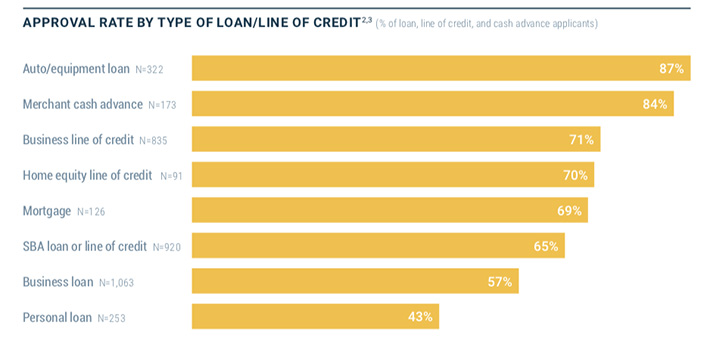
When MCAs and online loans were blended, for example, the approval rate shrank from 81% pre-March 1st to 70% after March 1st.
Eight percent of all small businesses sought a merchant cash advance in 2020, down slightly from 9% in 2019. Leasing dropped from 9% to 7% and factoring dropped from 4% to 3%. Pursuit of credit cards even dropped, down from 29% to 21%.
There were some downsides for the online lending industry reported.
Only 9% of PPP applicants used an online lender.
Online lenders had the lowest satisfaction rate (43%) for small business credit needs. Credit unions scored the highest (87%).
Net satisfaction with online lenders dropped to its lowest level since 2016.
Small businesses satisfaction with big banks actually grew from 2019 to 2020.
Small businesses were less likely to apply for a business loan or MCA from an online lender in 2020 and more likely to apply for them at a bank in 2020 than they were in 2019.
Eighty-two percent of businesses applied for a PPP loan. Forty-seven percent applied for an EIDL loan.
Banks, perhaps counterintuitively, were the big winners in 2020. That trend could increase as banks and online lenders become the same thing.
Become Releases a New Shopify App – Beprofit, to Expand Its Offerings to the E-Commerce Market
November 25, 2020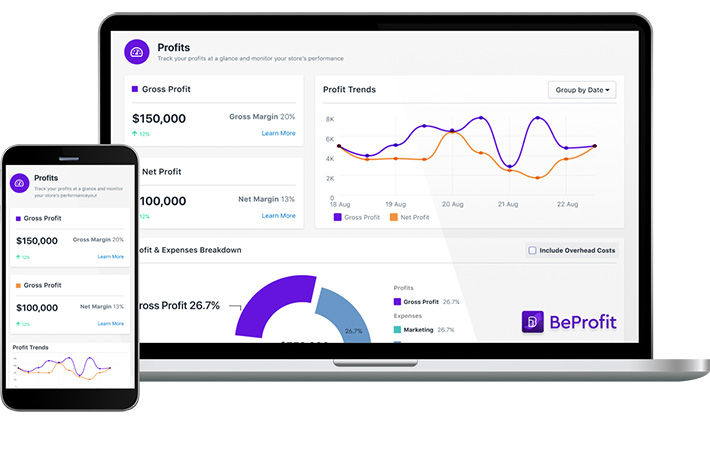 Tel Aviv, Israel – November 25, 2020 – Become, the leading online platform for small and medium businesses to find and optimize their funding solutions, announced today it has released a new Shopify app offering ‘BeProfit’.
With the expansion of the ecommerce landscape in light of the coronavirus, Become noticed the need for a single intuitive dashboard that ecommerce sellers can use to track and manage their profit and expenses. With BeProfit, Shopify sellers across the globe can now trace their profits in real time and discover what areas of their business they can optimize to increase their bottom line.
“Creating BeProfit has been a big part of our ‘pivot strategy’ during COVID-19. Building a Shopify app is a totally new and exciting realm for Become,” said Eden Amirav, CEO and Co-founder of Become. “Although offbeat, BeProfit falls in line with our underlying mission – to create a better world of funding for businesses and essentially help business owners become more. Being more profitable is not only something all businesses aspire to achieve but it is also something that will make a business become more fundable down the line.”
With many e-commerce sellers struggling to calculate, map and understand their profits, BeProfit calculates and organizes everything for them in a process that takes a matter of minutes. The app enables sellers to know exactly how much they’re making and spending, and more importantly on what. The dashboard integrates with a number of external sources, such as shipping service providers, external marketing platforms, and payment processors. This results in both visual and dynamic financial reports that update in real-time.
Noam Sinansky, CEO and Co-founder of Spire Jewelry – one of BeProfit’s first users said it’s “the first app that really manages to put in order all the financial information of my store! The app helped me get rid of complicated excel files, it just displays the information in a convenient, simple, and accurate way.”
To learn more about BeProfit, visit apps.shopify.com/beprofit-profit-tracker
About Become
Become, is the leading online platform for SMBs to find and optimize their funding solutions. The company uses its proprietary technology to nurture each business throughout the funding cycle. Become is rapidly growing with near 200,000 loyal business owners registered through its platform. The company has built an ecosystem of more than 50 leading lenders and partners and has facilitated over $285 million in tailored business loans to date.
Become’s latest service is a Shopify App “BeProfit”, organizes complex data into an intuitive and interactive dashboard. Shopify sellers can easily track their profit and expenses to see which areas of their business needs improving in order to become more profitable.
Become is backed by Benson Oak Ventures, Magenta Venture, Viola Credit, RIO Ventures Holdings, Entrée Capital and iAngels. The company has offices in San Francisco and Tel Aviv. For more information, visit: become.co.
Media Contact
Amit Shalgi
shalgi@become.co
+972547331141
Ocrolus Named #1 Fastest Growing Fintech By Inc.
September 1, 2020 Ocrolus, a document analytics company, was recently named Inc.’s #1 fastest growing fintech company in the US and #1 fastest growing software company in NYC. The rating is based on percentage revenue growth between 2016 and 2019. Ocrolus placed as the #30 fastest-growing private company in America overall.
Ocrolus was founded in 2014 and has grown by 8,000% to become an industry-leading document scanning platform. Automating document applications for partners like BlueVine, Cross River, and Square, Ocrolus recently facilitated 761,455 small business applications for PPP loans.
So what sets Ocrolus apart? CEO and Co-Founder Sam Bobley credits the growth factor on just how fast and accurate the Ocrous API is.
“Lenders who were not using Ocrolus were not able to get to underwriting decisions as fast as lenders that were using Ocrolus- we saw a domino effect,” Bobley said. “Once we got a few big consumers on the platform, we were able to quickly onboard more and more funders and help them increase speed in their underwriting process.”
Bobley also said that while competitor document applications struggle with the accuracy at which they can read documents, landing somewhere in the 70-85% accuracy area, Ocrolus boasts more than 99% accuracy.
Success snowballed, and Ocrolus was helping grow businesses. The API directly addresses many financial institutions’ problems with scale- typically, more applications require more manpower to sift through paperwork.
“Typically, when a customer starts using our platform, within one year of using our platform, they double their volume, and within two years they quadruple,” Bobley said. “One of the reasons for that is they no longer have to staff up and deal with the operational complexities of handling the fluctuating volume of loans.”
With Ocrolus plugged in, customers were free from a major operating cost, and could go all out taking on new clients- which would mean more paperwork to process with Ocrolus.
Today, the company employs more than 900 team members across four offices but was founded in New York City. And like Seinfeld, Bobley loves the city, especially as a thriving hub for fintech activity.
“There’s no better place to do it than in the heart of the financial center of the US here in New York City,” Bobley said. “We’re right near where a lot of our lender customers are operating.”
On the news of recent acquisitions and reports that companies like PayPal and Intuit are ramping up their involvement in small business lending, Bobley said he sees larger entities in fintech as an opportunity for pricing transparency and better access to capital.
“I think the headline here is that financial services firms are recognizing that there’s a significant amount of businesses that used to be underserved,” Bobley said. “The bigger players are raising their eyebrows and want to get more involved, which in my opinion will be ultimately good for small business.”
And when it came time for Ocrolus to do its part for small business, Bobley said that more than 430,000 PPP applications of the 761,455 that were made using their partner network got approved, saving an estimated 1.5 million jobs.
“It’s always great when you know you can connect your work to a greater purpose for the community, so it’s really just a cool rewarding experience,” Bobley said. “It’s been fantastic, but we think we’re still in the early innings in terms of what we can do as a company- not just in small business lending but also in consumer mortgage and auto.”
QuickBooks Capital Has Already Funded $683M in Cumulative Business Loans
August 26, 2020 QuickBooks Capital has funded $683 million in cumulative small business loans since Intuit launched the program in late 2017. This excludes the $1.2 billion in PPP loans the company facilitated, according to the latest quarterly earnings report.
Showing optimism, Intuit recorded revenue of $1.8B in Q4 and $7.7B for the fiscal year, up 13 percent.
Among Intuit’s leading products is TurboTax, which experienced its strongest customer growth in four years. Growth was also strong with QuickBooks online payments, QuickBooks Online payroll and TSheets.
Intuit announced that it was acquiring Credit Karma for $7.1B in cash back in February.
IN DEFAULT OR ABOVE WATER: How PPP Saved or Didn’t Save America
July 31, 2020 Kristy Kowal, a silver medalist in the 200-meter breast stroke at the 2000 Olympic games in Australia, had recently relocated to Southern California and embarked on a new career when the pandemic shutdown hit in March.
After nearly two decades as a third-grade teacher in Pennsylvania, Kowal was able to take early retirement in 2019 and pursue her dream job. At last, she was self-employed and living in Long Beach where she could now devote herself to putting on swim clinics, training top athletes, and accepting speaking engagements. “I’ve been building up to this for twenty years,” she says.
But fate had a different idea. The coronavirus not only grounded her from travel but closed down most swimming pools. At first, she tried to collect unemployment compensation. But after two months of calling the unemployment office every day, her claim was denied. “‘Have a great day,’ the lady said, and then she hung up,” Kowal reports. “She wasn’t rude; she just hung up.”
Then, in June, the former Olympian heard from friends about Kabbage and the Paycheck Protection Program. Using an app on her smart phone, Kowal says, she was able to upload documents and complete the initial application in fewer than 20 minutes. A subsequent application with a bank followed and within a week she had her money.
“I was down to ten cents in my checking account,” says Kowal, who declined to disclose the amount of PPP money for which she qualified, “and I’d begun dipping into my savings. This gives me the confidence that I need to go back to my fulltime work.”
 Kowal is one of 4.9 million small business owners and sole proprietors who, according to the U.S. Small Business Administration, has received potentially forgivable loans under the Paycheck Protection Program. The PPP, a safety-net program designed to pay the wages of employees for small businesses affected by the coronavirus pandemic, is a key component of the $1.76 trillion Coronavirus Aid, Relief, and Economic Security Act (CARES Act). Since the U.S. Congress enacted the law on March 27, the PPP has been renewed and amended twice. It’s now in its third round of funding and Congress is weighing what to do next.
Kowal’s experience, meanwhile, is also a wake-up call for the country on the prominent role that both fintechs like Kabbage as well as community and independent banks, credit unions, non-banks and other alternatives to the country’s biggest banks play in supporting small business. Before many in this cohort were deputized by the SBA as full-fledged PPA lenders, a significant chunk of U.S. microbusinesses – especially sole proprietorships — were largely disdained by the brand-name banks.
“After the first round,” notes Karen Mills, former administrator of the U.S. Small Business Administration and a senior fellow at the Harvard Business School, “more institutions were approved that focused on smaller borrowers. These included fintechs and I have to say I’ve been very impressed.”
Among the cadre of fintechs making PPP loans – including Funding Circle, Intuit Quickbooks, OnDeck, PayPal, and Sabre — Kabbage stands out. The Atlanta-based fintech ranked third among all U.S. financial institutions in the number of PPP credits issued, its 209,000 loans trailing only Bank of America’s 335,000 credits and J.P. Morgan Chase’s 260,000, according to the SBA and company data. Kabbage also reports processing more than $5.8 billion in PPP loans to small businesses ranging from restaurants, gyms, and retail stores to zoos, shrimp boats, beekeepers, and toy factories.
To reach businesses in rural communities and small towns, Kabbage collaborated with MountainSeed, an Atlanta-based data-services provider, to process claims for 135 independent banks and credit unions around the U.S. The proof of the pudding: Eighty-nine percent of Kabbage’s PPP loans, says Paul Bernardini, director of communications at Atlanta-based Kabbage, were under $50,000, and half were for less than $13,500.
The figures illustrate not only that Kabbage’s PPP customers were mainly composed of the country’s smaller, “most vulnerable” businesses, Bernardini asserts, but the numbers serve as a reminder that “fintechs play a very important, vital role in small business lending,” he says.
The helpfulness of such financial institutions contrasts sharply with what many small businesses have reported as imperious indifference by the megabanks. Gerri Detweiler, education director at Nav, Inc., a Utah-based online company that aggregates data and acts as a financial matchmaker for small businesses, steered AltFinanceDaily toward critical comments about the big banks made on Nav’s Facebook page. Bank of America, especially, comes in for withering criticism.
“Bank of America wouldn’t even take my application,” one man wrote in a comment edited for brevity. “I have three accounts there. They are always sending me stuff about what an important client I am. But when the going got tough, they wouldn’t even take my application. I’m moving all my business from Bank of America.”
Lamented another Bank of America customer: “I was denied (PPP funding) from Bank of America (where) I have an individual retirement account, personal checking and savings account, two credit cards, a line of credit for $20.000, and a home mortgage. Add in business checking and a business credit card. Yesterday I pulled out my IRA. In the next few days I’m going to change to a credit union.”
Many PPP borrowers who initially got the cold shoulder from multi-billion-dollar conglomerate banks have found refuge with local — often small-town — bankers and financial institutions. Natasha Crosby, a realtor in Richmond, Va., reports that her bank, Capital One, “didn’t have the applications available when the Paycheck Protection Program started” on April 6. And when she finally was able to apply, she notes, “the money ran out.”
Crosby, who is president of Richmond’s LGBTQ Chamber of Commerce, is media savvy and was able to publicize her predicament through television appearances on CNN and CBS, as well as in interviews with such publications as Mother Jones and Huffington Post. A “friendly acquaintance,” she says, referred her to Atlantic Union Bank, a Richmond-based regional bank, where she eventually received a PPP loan “in the high five figures” for her sole proprietorship.
“It took almost two months,” Crosby says. “I was totally frozen out of the program at first.”
Talibah Bayles heads her own firm, TMB Tax and Financial Services, in Birmingham, Ala. where she serves on that city’s Small Business Council and the state’s Black Chamber of Commerce. She told AltFinanceDaily that she’s seen clients who have similarly been decamping to smaller, less impersonal financial institutions. “I have one client who just left Bank of America and another who’s absolutely done with Wells Fargo,” she says. “They’re going to places like America First Credit Union (based in Ogden, Utah) and Hope Credit Union (headquartered in Jackson, Miss.). I myself,” she adds, “shifted my business from Iberia Bank.”
 Main Street bankers acknowledge that they are benefiting from the phenomenon. “In speaking to our industry colleagues,” says Tony DiVita, chief operating officer at Bank of Southern California, an $830 million-asset community bank based in San Diego, “we’ve seen that many of the big banks have slowed down or stopped lending small-dollar amounts that were too low for them to expend resources to process.”
At the same time, DiVita says, his bank had made 2,634 PPP loans through July 17, roughly 80% of which went to non-clients. Of that number, some 30% have either switched accounts or are in the process of doing so. And, he notes, the bank will get a second crack at conversion when the PPP loan-forgiveness process commences in earnest. “Our guiding spirit is to help these businesses for the continuation of their livelihoods,” he says.
Noah Wilcox, chief executive and chairman of two Minnesota banks, reports that both of his financial institutions have been working with non-customers neglected by bigger banks where many had been longtime customers. At Grand Rapids State Bank, he says, 26% of the 198 PPP applicants who were successfully funded were non-customers. Minnesota Lakes Bank in Delano, handled PPP credits for 274 applicants, of whom 66% were non-customers.
“People who had been customers forever at big banks told us that they had been applying for weeks and were flabbergasted that we were turning those applications around in an hour,” says Wilcox, who is also the current chairman of the Independent Community Bankers of America, a Washington, D.C.-based trade group representing community banks.
Noting that one of his Gopher State banks had successfully secured funding for an elderly PPP borrower “who said he had been at another bank for 69 years and could not get a telephone call returned,” Wilcox added: “We’ve had quite a number of those individuals moving their relationships to us.”
For Chris Hurn, executive director at Fountainhead Commercial Capital, a non-bank SBA lender in Lake Mary, Fla., the psychic rewards have helped compensate for the sometimes 16-hour days he and his staff endured processing and funding PPP applications. “It’s been relentless,” he says of the regimen required to funnel loans to more than 1,300 PPP applicants, “but we’ve gotten glowing e-mails and cards telling us that we’ve saved people’s livelihoods.”
Yet even as the Paycheck Protection Program – which only provides funding for two-and-a-half months – is proving to be immensely helpful, albeit temporarily, there is much trepidation among small businesses over what happens when the government’s spigots run dry. The hastily contrived design of the program, which has relied heavily on the country’s largest financial institutions, has contributed mightily to the program’s flaws.
“The underbanked and those who don’t have banking relationships were frozen out in the first round,” says Sarah Crozier, director of communications at Main Street Alliance, a Washington D.C.-based advocacy organization comprising some 100,000 small businesses. “The new updates were incredibly necessary and long overdue,” she adds, “but the changes didn’t solve the problem of equity in access to the program and whom money is flowing to in the community.”
Professor David Audretsch, an economist at Indiana University’s O’Neill School of Public and Environmental Affairs and an expert on small business, says of PPP: “It’s a short-term fix to keep businesses afloat, but it missed in a lot of ways. It was not well-thought-out and a lot of money went to the wrong people.”
The U.S. unemployment rate stood at 11.1% in June, according to the most recent figures released by the Bureau of Labor Statistics, about three times the rate of February, just before the pandemic hit. The BLS also reported that 47.2% of the U.S. population – nearly half –was jobless in June. Against this backdrop, SBA data on PPP lending released in early July showed that a stunning array of cosseted elite enterprises and organizations, many with close connections to rich and powerful Washington power brokers, have been feasting on the PPP program.
In a stunning number of cases, the program’s recipients have been tony Washington, D.C. law firms, influential lobbyists and think tanks, and even members of Congress. Many businesses with ties to President Trump and Trump donors have also figured prominently on the SBA list of those receiving largesse from the SBA.
 Businesses owned by private equity firms, for which the definition of “small business” strains credulity, were also showered with PPP dollars. Bloomberg News reported that upscale health-care businesses in which leveraged-buyout firms held a controlling interest, were impressively adept at accessing PPP money. Among this group were Abry Partners, Silver Oak Service Partners, Gauge Capital, and Heron Capital. (Small businesses are generally defined as enterprises with fewer than 500 employees. The SBA reports that there are 30.7 million small businesses in the U.S. and that they account for roughly 47% of U.S. employment.)
Boston-based Abry Partners, which currently manages more than $5 billion in capital across its active funds, merits special mention. Among other properties, Abry holds the largest stake in Oliver Street Dermatology Management, recipient of between $5 million and $10 million in potentially forgivable PPP loans. Based in Dallas, Oliver Street ranks among the largest dermatology management practices in the U.S. and, according to a company statement, boasts the most extensive such network in Texas, Kansas and Missouri.
Meanwhile, the design of the program and the formula for the looming forgiveness process is proving impractical. As it currently stands, loan forgiveness depends on businesses spending 60% of PPP money on employees’ wages and health insurance with the remaining 40% earmarked for rent, mortgage or utilities.
 Many businesses such as restaurants and bars, storefront retailers and boutiques – particularly those that have shut down — are preferring to let their employees collect unemployment compensation. “Business owners had a hard time wrapping their heads around the requirement of keeping employees on the payroll while they’re closed,” notes Detweiler, the education director at Nav. “They have other bills that have to be paid.”
The forgiveness formula remains vexing for businesses where real estate costs are exorbitant, particularly in high-rent cities such as New York, Boston, Washington, D.C., San Francisco, and Chicago. Tyler Balliet, the founder and owner of Rose Mansion, a midtown Manhattan wine-bar promising an extravagant, theme-park experience for wine enthusiasts, says that it took him a month and a half to receive almost $500,000 from Chase Bank. Unfortunately, though, the money isn’t doing him much good.
“I have 100 employees on staff, most of whom are actors,” he says. “We shut down on March 13. I laid off 95 employees and kept just a few people to keep the lights on.”
At the same time, his annual rent tops $1 million and the forgivable amount in the PPP loans won’t even cover a month’s rent. “I haven’t paid rent since March and I’m in default,” Balliet says. “Now I’m just waiting to see what the landlord wants to do.”
Like many business owners, Balliet financed much of his venture with credit card debt, which creates an additional liability concern, notes Crozier of the Main Street Alliance. “It’s very common for borrowers to have signed personal guarantees in their loans using their credit cards,” she says. “As we get closer to the funding cliff and as rent moratoriums end,” she adds, “creditors are coming after borrowers and putting their personal homes at risk.”
Mark Frier is the owner of three restaurants in Vermont ski towns, including The Reservoir — his flagship — in Waterbury. In toto, his eateries chalked up $6.5 million in combined sales in 2019. But 2020 is far different: the restaurants have not been open since mid-March and he’s missed out on the lucrative, end-of-season ski rush.
Consequently, Frier has been reluctant to draw down much of the $750,000 in PPP money he’d secured through local financial institutions. “We could end up with $600,000 in debt even with the new rules,” Frier says, adding: “We live off very thin margins. We need grants not loans.”
As the country recorded 3.7 million confirmed cases of coronavirus and more than 141,000 deaths as of mid-July, PPP money earmarked by businesses for health-related spending was not deemed forgivable. Yet in order to comply with regulations promulgated by the Occupational Safety and Health Administration and mandates and ordinances imposed by state and local governments, many establishments will be unable to avoid such expenditures.
“What we really needed was a grant program for companies to pivot to a business environment in a pandemic,” says Crozier. She cites the necessity businesspeople face of “retrofitting their businesses, buying masks, gloves and sanitizers and cleaning supplies, restaurants’ taking out tables and knocking down walls, installing Plexiglass shields, and improving air filtration systems.”
 Meanwhile, as Covid-19 was taking its toll in sickness and death, the economic outlook for small business has been looking dire as well. The recent U.S. Census’s “Pulse Survey” of some 885,000 businesses updated on July 2 found that roughly 83% reported that Covid-19 pandemic had a “negative effect on their business. Fully 38% of all small business respondents, moreover, reported a “large negative effect.”
Amid the unabated spikes in the number of coronavirus cases and the country’s grave economic distress, PPP recipients are faced with the unsettling approach of the PPP forgiveness process. As Congress, the SBA, and the U.S. Treasury Department continue to remake and revise the rules and regulations governing the program, businesses are operating in a climate of uncertainty as well. Currently, the law states that the amount of the PPP loan that fails to be forgiven will convert to a five-year, one-percent loan — a relaxation in terms from the original two-year loan which is not necessarily cheering recipients.
“One of the biggest problems with PPP is that the rule book has been unclear,” frets Vermont restaurateur Frier, glumly adding: “This is not even a good loan program.”
Ashley Harrington, senior counsel at the Center for Responsible Lending, a research and policy group based in Durham, N.C., argued in House committee testimony on June 17, that there ought to be automatic forgiveness for PPP loans under $100,000. Such a policy, she declared, “would likely exempt firms with, on average, 13 or fewer employees and save 71 million hours of small business staff time.”
She also said, “The smallest PPP loans are being provided to microbusinesses and sole proprietors that have the least capacity and resources to engage in a complex (forgiveness) process with their financial institution and the SBA.”
William Phelan, president of Skokie (Ill.)-based PayNet, a credit-data services company for small businesses which recently merged with Equifax, sounded a similar note. Observing that there are some 23 million “non-employer” small businesses in the U.S. with fewer than three employees for whom the forgiveness process will likely be burdensome, he says: “Estimates are that it will cost businesses a few thousand dollars just to get a $100,000 loan forgiven. It’s going to involve mounds of paper work.”
The country’s major challenge now will be to re-boot the economy, Phelan adds, which will require massive financing for small businesses. “The fact is that access to capital for small businesses is still behind the times,” Phelan says. “At the end of the day, it took a massive government program to insure that there’s enough capital available for half of the U.S. economy” during the pandemic.
For his part, Professor Audretsch fervently hopes that the country has learned some profound lessons about the need to prepare for not just a rainy day, but a rainy season. The pandemic, he says, has exposed how decades of political attacks on government spending for disaster-preparedness and safety-net programs have left the U.S. exposed to unforeseen emergencies.
“We’re seeing the consequence of not investing in our infrastructure,” he says. “That’s a vague word but we need a policy apparatus in place so that the calvary can come riding in. This pandemic reminds me a lot of when Hurricane Katrina hit New Orleans,’ he adds. “The city paid a heavy price because we didn’t have the infrastructure to deal with it.”
Online Lenders Are Waiting On The Bench For The PPP To Be Refreshed
April 16, 2020 This week proved mixed for many fintech and non-bank lenders who received approval from the SBA to issue Paycheck Protection Program funds, only for the $349 billion allotted to the program to run dry almost immediately afterwards.
On Wednesday evening Senator Marco Rubio tweeted that the funds would run short, leaving at least 700,000 small businesses who applied in purgatory without PPP financing. But more money may be made available, as Treasury Secretary Steven Mnuchin said in a statement on Wednesday that “We urge Congress to appropriate additional funds for the Paycheck Protection Program – a critical and overwhelmingly bipartisan program – at which point we will once again be able to process loan applications, issue loan numbers, and protect millions more paychecks.”
BlueVine, OnDeck, Funding Circle, PayPal, Intuit, and Square were among the group of non-bank lenders who were recently approved. While unfortunately late to the party, these businesses will be well-positioned to quickly roll out funding once further PPP money is allocated.
“Millions of small businesses need relief more than ever right now, and providing that relief quickly and diligently is our top priority,” BlueVine CEO Eyal Lifshitz told AltFinanceDaily. “While most PPP lenders have limited their efforts to existing customers, our aim is to support and protect all small businesses. Using our data and engineering resources, we want to ensure both existing customers and other small businesses seeking relief, are aware of and have access to PPP loans. We will remain a trusted advisor to small businesses and work to get fast capital solutions to those in need.”
Lifshitz’s comment echoes concerns that have plagued the SBA since the announcement of these funds: that its systems, and the processes of the banks it works with to issue this money, are outdated and insufficient to face a financial crisis of this magnitude and speed. Now weeks into the program, businesses are reporting a lack of communication from both their bank and the SBA; and, most importantly for many, no PPP funds in their accounts.
Online Lenders Ask Congress For Capital For Help and To Help
March 20, 2020 Members of Financial Innovation Now (FIN) have called on senior members of Congress to play a role in supporting small businesses with capital support and by loan distribution. Among their suggestions are:
- To direct Treasury to provide conditional capital to alternative lenders
- Permit these non-bank lenders to disburse loans, including via partnership with financial institutions
- Allocate a portion of funds for distribution via these lenders
FIN’s members include Amazon, Apple, Google, Intuit, PayPal, Square, and Stripe.
The organization also said:
An emergency Treasury facility will get funding to small businesses in a timely manner. FIN welcomes Congressional efforts to dramatically streamline Small Business Administration loans and include alternative lenders in this process as well.