
i2B Capital Provides $4 Million Revolving Line of Credit to CFG Merchant Solutions
November 8, 2016NEW YORK–(BUSINESS WIRE)–i2B Capital (www.i2bcap.com), a provider of direct financing to niche-market financial entrepreneurs, is pleased to announce the closing of a $4 million asset-based revolving line of credit with an accordion to $6 million with CFG Merchant Solutions (CFGMS). CFGMS is a privately owned and operated specialty finance company focused on providing working capital to small and mid-sized businesses (Merchants) in the U.S. that are historically underserved by traditional financial institutions.
Said Mr. Larry L. Curran II, CEO of i2B Capital, “CFGMS gave us the perfect opportunity to apply asset-based lending principals to non-traditional receivable assets in an early stage specialty finance company. CFGMS is a new division of an established finance business with traditional bank financing; however, these receivable assets were excluded from the existing borrowing base. The CFGMS management team is seasoned, backed by private equity, and enabled with technology—exactly what we look for in our target customer. Additionally, they have grown their financed receivables more than 500% since beginning the process.”
Barbara Anderson, Chief Operating Officer at i2B Capital commented, “Our goal over the initial 18-month funding commitment is to prepare CFGMS for more traditional institutional financing in the future. To accomplish that we will provide the growth capital along with our commercial lending expertise to help them prepare for the disciplined reporting requirements and credit processes at the next level.”
William Gallagher, President of CFGMS said, “Obtaining an asset-based loan against our non-traditional asset class within our first year of operation is instrumental in allowing us to execute on our growth strategy, and achieve some very aggressive portfolio and revenue targets. We had to work through several considerations with i2B due to the age and size of the portfolio, but through mutual collaboration we were able to put in place a facility that will enable us to take our business to the next level.”
CFGMS is a subsidiary of CapFlow Funding Group, a commercial finance company that offers an array of products such as factoring, purchase order finance, and asset-based loans. Both companies are headquartered in Rutherford, New Jersey. CFGMS with additional offices in New York City is a direct funder providing working capital to small businesses. They are entrepreneurs who understand first-hand the challenges of acquiring flexible and timely financing. CFGMS combines proprietary analytics and technology, with common sense underwriting to provide fast and efficient access to capital. Programs include Small Business Advance, Merchant Cash Advance, and Invoice Factoring. For more information about CFGMS contact William Gallagher at wgallagher@cfgms.com or visit www.cfgmerchantsolutions.com.
i2B Capital is headquartered in Fort Collins, Colorado with offices in Herndon, Virginia. The company provides senior debt and direct asset investments for growth capital to qualifying entrepreneurs and equity-backed emerging specialty finance companies throughout the United States. For more information about i2B Capital contact Barbara Anderson at 703-871-3993 or banderson@i2bcap.com, or visit www.i2bcap.com.
Contacts
i2B Capital
Barbara Anderson, 703-871-3993
banderson@i2bcap.com
Square Baits New Merchants with Payments
March 30, 2016
Jack Dorsey wants Square to be a one stop shop and is baiting merchants with its new payment integration tool.
Square launched new API tools on Wednesday (March 30) for online and retail stores who “with few lines of codes can seamlessly integrate Square into the checkout process.” The company is going after payment giants like PayPal, Braintree and Stripe alluring merchants with an easier-to-use payment tool and is priced similarly at 2.9 percent and 30 cents per transaction.
For its erstwhile customers, picking Square over rivals makes sense given the integration between online and offline sales and for the businesses that do not use Square, the company wants to handcuff them.
At the time of founding, Square’s primary business model was a merchant-first approach. It went after 27 million micro merchants who hitherto were invisible to incumbent players in the space. It took in these small heterogenous group of merchants and equipped and trained them with a dongle to accept card payments for a flat fee.
And now its plan to consolidate a fragmented customer base seems to be working thus far. It recently swapped out its merchant cash advances for bank loans again, similar to PayPal’s loan products.
But why launch a payment tool now? Almost 46 percent of shopping cart abandonment happens at the payment stage frustrating buyers with a lengthy checkout form. And this new API allows online stores to integrate a simple checkout form for card details unlike Stripe which requires an e-wallet sign up. It also launched an API for inventory, payroll management and for registers which can integrate Square’s payment tool with custom point of sale software.
Square is hoping that merchants come for payments and stay for more. “Sellers, even if they don’t have an offline presence today, will have ambitions for where their business wants to go and will choose a provider that, regardless of how their business grows, will be there with them,” Square’s head of engineering Alyssa Henry told Forbes.
What’s next for Square’s gung ho growth?
The Reason Behind Lendio’s 1175% Growth
February 25, 2016 Lendio, the small business loans marketplace closed 2015 with $128 million in financing for 5100 businesses. That number swiftly becomes impressive compared to the 400 businesses funded with $12.4 million the previous year.
Lendio CEO Brock Blake attributes this 1175 percent growth to the partnerships the company forged, the most noteworthy one with Staples where Lendio finances the small businesses that Staples often interacts with. “We had a great year with our partnership,” he said. “Staples has been a fantastic partner — they have the merchants and we have the finance.”
The Salt Lake City-based company prides itself on its partnership strategy. In 2014, the company struck a deal with UPS to offer their marketplace for free to The UPS Store business customers.
Blake is also excited about expanding the marketing channels and growing the firm’s online marketing strategy.
Lendio’s average loan size is $25,000 and their clients have typically been in business for 26 months in industries like construction, retail, restaurants and real estate.
California Finance Lenders Push Legislative Agenda in Response to Growth of Alternative Small Business Finance Industry
December 8, 2015On October 10, 2015, California Governor Jerry Brown signed into law SB 197, a bill that allows licensed California finance lenders to pay commissions to unlicensed persons that refer prospective commercial loan borrowers to licensees that offer certain types of lower cost loans. The bill was co-sponsored by Opportunity Fund and the California Association for Micro Enterprise Opportunity. The stated purpose of the bill was to “remove a competitive disadvantage that applies to C[alifornia Finance Lender Law (“CFLL”)] licensees making commercial loans.” As the bill’s legislative background explains,
Existing CFLL regulations prohibit CFLL licensees from paying any compensation to any person or company that is unlicensed, in exchange for the referral of business. This places CFLL licensees who make commercial loans at a competitive disadvantage relative to their direct competitors, who are not required to hold CFLL licenses and are thus not subject to this restriction. Two types of direct competitors that are not required to hold CFLL licenses include merchant advance companies (not required to be licensed under the CFLL, because they are advancing, rather than lending money) and companies that partner with banks (not required to be licensed under the CFLL, because the loans are made under the banks’ charters).
Prior to the passage of SB 197, a CFLL licensee was prohibited from paying a commission to an unlicensed person that referred a potential commercial loan borrower to the licensee. The California Code of Regulation states that “no finance company shall pay any compensation to an unlicensed person or company for soliciting or accepting applications for loans…” 10 CCR § 1451.
The new legislation overrides the regulatory restriction and permits licensees to pay compensation to unlicensed persons if certain conditions are met. A CFLL licensee may pay a commission to an unlicensed person if:
- The loan made to the borrower does not charge an annual interest rate in excess of 36%.
- The lender conducts an underwriting and obtains sufficient documentation to ensure that the borrower has the ability to repay the loan.
- The lender maintains records of all compensation paid to unlicensed persons for at least 4 years.
- The lender submits annual reports to the California Commissioner of Business Oversight.
While the bill permits an unlicensed person to refer potential borrowers to commercial lenders in exchange for compensation, it limits the activities in which the unlicensed person can engage. Under the new legislation, unlicensed persons that refer borrowers for compensation may not:
- Participate in any loan negotiation.
- Counsel a borrower about a loan.
- Prepare any loan documents, including credit applications.
- Contact the lender on the borrower’s behalf, other than to refer the borrower.
- Gather documentation of the borrower or obtain the borrower’s signature.
- Participate in the development of any sales or marketing materials.
To be clear, the purpose of SB 197 was not to prohibit licensees from paying compensation to unlicensed persons in exchange for borrower referrals (licensees have been prohibited from paying commissions to unlicensed persons since the CFLL was enacted). Instead, the bill allows certain lenders that charge annual rates under 36% to do something that they were previously prohibited from doing, i.e. pay commissions to unlicensed persons for commercial loan referrals.
Bad Merchants: Lies, Fraud, and Hard Times
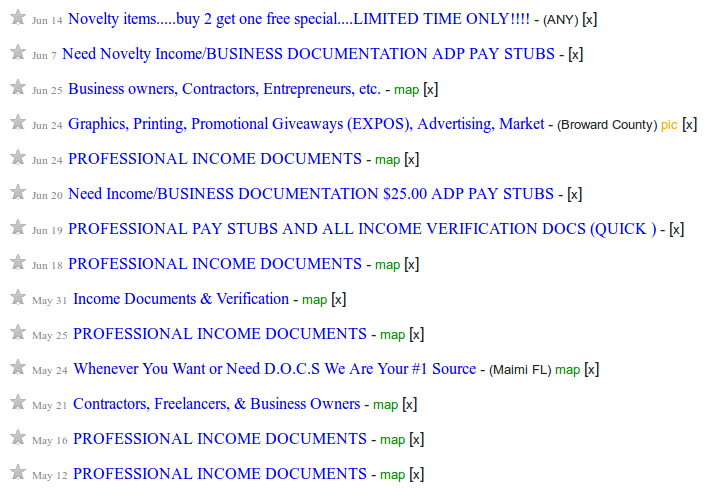
December 4, 2015 Critics seldom tire of bashing alternative finance companies, but bad behavior by merchants on the other side of the funding equation goes largely unreported. Behind a veil of silence, devious funding applicants lie about their circumstances or falsify bank records to “qualify” for advances or loans they can’t or won’t repay. Meanwhile, imposters who don’t even own stores or restaurants apply for working capital and then disappear with the money.
“People advertise on craigslist to help you commit fraud,” declared Scott Williams, managing member at Florida-based Financial Advantage Group LLC, who helped start DataMerch LLC to track wayward funding applicants. “Fraud’s a booming business, and every year the numbers seem to increase.”
Deception’s naturally on the rise as the industry continues to grow, according to funders, industry attorneys and collections experts. But it’s also increasing because technology has made it easy for unscrupulous funding applicants to make themselves appear worthy of funding by doctoring or forging bank statements, observers agreed.
Some fraud-minded merchants buy “novelty” bank statements online for as little as $5 and fill them out electronically, said David Goldin, president and CEO of Capify, a New York-based funder formerly called AmeriMerchant, and president of the SBFA, which in the past was called the North American Merchant Advance Association.
To make matters worse, dishonest brokers sometimes coach merchants on how to create the forgeries or modify legitimate records, Goldin maintained. Funders have gone so far as to hire private investigators to scrutinize brokers, he said.
But savvy funders can avoid bogus bank statements, according to Nicholas Giuliano, a partner at Giuliano, McDonnell & Perrone, a New York law firm that handles collections. Funders can protect themselves by remaining skeptical of bank records supplied by applicants. “If the merchant cash advance company is not getting them directly from the source, they can be fooled,” Giuliano said of obtaining the documents from banks.
Another attorney at the firm, Christopher Murray, noted that many funders insist upon getting the merchant’s user name and password to log on to bank accounts to check for risk. That way, they can see for themselves what’s happening with the merchant.

Besides banking records, funders should beware of other types of false information the can prove difficult to ferret out and even more difficult to prove, Murray said. For example, a merchant who’s nine or ten months behind in the rent could convince a landlord to lie about the situation, he noted. The landlord might be willing to go along with the scam in the hope of recouping some of the back rent from a merchant newly flush with cash.
Merchants can also reduce their payments on cash advances by providing customers with incentives to pay with cash instead of cards or by routing transactions through point of sale terminals that aren’t integrated onto the platform that splits the revenue, said Jamie Polon, a partner at the Great Neck, N.Y.-based law firm of Mavrides, Moyal, Packman & Sadkin, LLP and manager of its Creditors’ Rights Group. A site inspection can sometimes detect the extra terminals used to reduce the funder’s share of revenue, he suggested.
In a ruse they call “the evil twin” around the law offices of Giuliano, McDonnell & Perrone, merchants simply deny applying for the funding or receiving it, Giuliano said. “Suddenly, the transaction goes bad, and they deny they had anything to do with it,” he said. “It was someone who stole the merchant’s identity somehow and then falsified records.”
In other cases, merchants direct their banks not to continue paying an obligation to a funder, or they change to a different bank that’s not aware of the loan or advance, according to Murray. They can also switch to a transaction processor that’s not aware of the revenue split with the funder. Such behavior earns the sobriquet “predatory merchant,” and they’re a real problem for the industry, he said.
Occasionally, merchants decide to stop paying off their loans or advances on the advice of a credit consulting company that markets itself as capable of consolidating debt and lowering payments, Giuliano said. “That’s a growing issue,” agreed Murray. “A lot of these guys are coming from the consumer side of the industry.”
The debt consolidator may even bully creditors to settle for substantially less than the merchant has agreed to pay, Murray continued. Remember that in most cases the merchants hiring those companies to negotiate tend to be in less financial trouble than merchants that file for bankruptcy protection, he advised.
“More often than not, they simply don’t want to pay,” he said of some of the merchants coached by “the credit consultants.” They pay themselves a hundred thousand a year, and everyone else be damned. You continue to see them drive Humvees.”

Merchants sometimes take out a cash advance and immediately use the money to hire a bankruptcy attorney, who tries to lower the amount paid back, Murray continued. However, such cases are becoming rare because bankruptcy judges have almost no tolerance for the practice and because underwriting continues to improve, he noted.
Still, it’s not unheard of for a merchant to sell a business and then apply for working capital, Murray said. In such cases, funders who perform an online search find the applicant’s name still associated with the enterprise he or she formerly owned. Moreover, no one may have filed papers indicating the sale of the business. “That’s a bit more common than one would like,” he said.
In other cases the applicant didn’t even own a business in the first place. “They’re not just fudging numbers – they’re fudging contact information,” said Polon. “It’s a pure bait and switch. There wasn’t even a company. It’s a scheme and it’s stealing money.”
Whatever transgressions the merchants or pseudo-merchants commit, they seldom come up on criminal charges. “It is extremely, extremely rare that you will find a law enforcement agency that cares that a merchant cash advance company or alternative lender has been defrauded,” Murray said. It happens only if a merchant cheats a number of funders and clients, he asserted. “Recently, a guy made it his business to collect fraudulent auto loans,” he continued. “That’s a guy who is doing some time.”
However, funders can take miscreants to court in civil actions. “We’re generally successful in obtaining judgments,” said Giuliano. “Then my question is ‘how do you enforce it?’ You have to find the assets.” About 80 percent of merchants fail to appear in court, Murray added. Funders may have to deal with two sets of attorneys – one to litigate the case and another to enforce the judgment. Even merchants who aren’t appearing in court to meet the charges usually find the wherewithal to hire counsel, he said.
Funders sometimes recover the full amount through litigation but sometimes accept a partial settlement. “Compromise is not uncommon,” noted Giuliano. Settling for less makes more sense when the merchant is struggling financially but hasn’t been malicious, said Murray.
To avoid court, attorneys try to persuade merchants to pay up, said Polon. “My job is to get people on the phone and try to facilitate a resolution,” he said of his work in “pre-litigation efforts,” which also included demand letters advising debtors an attorney was handling the case.
 But it’s even better not to become involved with fraudsters in the first place. That’s why more than 400 funding companies are using commercially available software that detects and reduces incidence of falsified bank records, said a representative of Microbilt, a 37-year-old Kennesaw, Ga.-based consumer reporting agency that has supplied a fraud-detection product for nearly four years.
“Our system logs into their bank account and draws down the various data points, and we run them through 175 algorithms,” he said. “It’s really a tool to automate the process of transferring information from the bank to the lender,” he explained.
The tools note gross income, customer expenditures, loans outstanding, checks returned for non-sufficient funds and other factors. Funders use the portions of the data that apply to their risk models, noted Sean M. Albert, MicroBilt’s senior vice president and chief marketing officer.
Funders pay 25 cents to $1.25 each time they use MicroBilt’s service, with the rate based on how often they use it, Albert said. “They only pay for hits,” he said, noting that they don’t charge if information’s not available. Funders can integrate with the MicroBilt server or use the service online. The company checks to make sure that potential customers actually work in the alternative funding business.
MicroBilt is testing a product that gathers information from a merchant’s credit card processing statement to analyze ability to repay excessive chargebacks reflected in the statements could spell trouble, and seasonality in receipts should show up, he noted.
Additional help in avoiding problem merchants comes from the Small Business Finance Association, which maintains a list of more than 10,000 badly behaving funding applicants, said the SBFA’s David Goldin. The nearly 20 companies that belong to the trade group supply the names.
SBFA members, who pay $3,000 monthly to belong, have access to the list. According to Goldin, the dues make sense because preventing a single case of fraud can offset them for some time, he maintained. Besides, associations in other industries charge as much as $10,000 a month, he added.
Another database of possibly dubious merchants, maintained by DataMerch LLC, became available to funders in July, according to Scott Williams, who started the enterprise with Cody Burgess. It became integrated with the AltFinanceDaily news feed by early October, causing the number of participating funders to double to a total of about 40, he said. The service is free now, but will carry a fee in the future.
It’s not a blacklist of merchants that should never receive funding again, Williams emphasized. Businesses can return to solvency when circumstances can change, he noted. That’s why it’s wise to regard the database as an underwriting tool. In addition, merchants can in some cases add their side of the story to the listings.
Funding companies directly affected by wayward merchants can contribute names to the list, Williams said. About 2,500 merchants made the list within a few months of its inception, he noted. “We’re super happy with our numbers,” he said of the database’s growth.
Many merchants find themselves in the database because of hard times. Of those who land on the list because of fraud, perhaps 75 percent actually own businesses and about 25 percent are con artists applying for funding for shell companies, Williams said.
So far, only direct funders – not brokers or ISOs – can get access to the database, he continued, noting that DataMerch could rethink the restriction in the future. “We don’t want hearsay from a broker who might not know the full scope of the story,” he said.
DataMerch might grant brokers and ISOs the right to read the list to avoid wasting time pitching deals to substandard merchants, but the company does not intend to enable members of those groups to add merchants to the database, Williams said.
Williams sees a need for the new database because smaller companies can’t afford belonging to the SBFA. The association also tracks deals about to become final, which could prevent double-funding but makes some users uncomfortable because they don’t want to disclose their good merchants, Williams said.
 Although dishonesty’s sometimes a factor, merchants often go into default just because of lean times, Jamie Polon, the attorney, cautioned. A restaurant could close, for example, because of construction or an equipment breakdown. “Were they not serving dinner anymore, or was there something much deeper going on?” he said. Fraud may play a role in 10 percent to 20 percent of the collections cases his law firm sees, he noted. More than 95 percent blame their troubles on a downturn in business, and the rest claim they didn’t understand the contract, he said.
To understand the downturn, it’s important to amass as much information about the merchant as possible, said Mark LeFevre, president and CEO of Kearns, Brinen & Monaghan, a Dover, Del.-based collections agency that works with funders. That information sheds light on a merchant’s ability to repay and could help determine what terms the merchant can meet, he said.
Timeliness matters because the sooner a creditor takes action to collect, the greater the chance of recouping all or most of the obligation, LeFevre maintained. When distress signals arise – such as closing an ACH account or a spate of unreturned phone calls – it’s time to place the merchant with a collections expert, he advised.
LeFevre’s company also traces a troubled merchant’s dwindling assets to help the funder receive a fair share. Funders can sometimes recover all or most of what they pay a collection agency by imposing fees on the merchant, he noted.
Pinning the collection fees to merchants in default makes sense because that’s where the guilt often resides, observers said. It’s part of balancing the bad behavior equation, they agreed.
Merchant Cash Advance | A Look Back and Plan Forward
November 29, 2015 Merchant Cash Advance is still a relatively unknown term and product to the masses, but amongst most of its target customer base, it definitely has a stigma that is rightly deserved in some ways, but I believe that it is also misunderstood in many other ways. Having been in the industry for nearly 10 years, I can say that I have seen my fair share of positive and negative events as they relate to the industry, but I believe that it has all been for its betterment and growth. Furthermore, by having been on the underwriting side for a majority of that time, I can say with great certainty that I have seen this product help several small business owners over the years, and it will continue to do so as the stigma fades away and acceptance increases.
For those of us working in this industry now, let’s face it – most small business owners that have taken a merchant cash advance or have been solicited for the product would much rather go to their bank for the money. The problem, as many merchants have come to realize in recent years, is that lending in general essentially dried up after the recession. The faucet is now running again, but small businesses were all but forgotten. Only the most well qualified borrowers are able to obtain the desired amount of capital needed at a reasonable cost through traditional bank loans. In addition to meeting all of the necessary criteria for a bank loan or line of credit, a borrower must also be prepared to wait months for the process to be finalized.
The days of a small business owner being able to go down to his or her community bank or local branch for a quick cash injection are long gone, but that’s where we come in. We are catering to a customer base that has been left out to dry. We are dealing in a marketplace that is grossly underserved by the larger financial institutions. We are charging a premium for taking on risk that most cannot stomach. We are keeping America running. That might sound ambitious, but is realistic when you put things in perspective.
SBA and IDC data show that small businesses employ at least half of the US workforce and produce anywhere from 60% – 80% of the new jobs annually while also accounting for nearly half of total US private payroll. As if that weren’t enough, small businesses also produce six trillion dollars or over 50% of all non-farm GDP in the US. When looking at additional SBA data which also states that more than 80% of all small businesses need to use some sort of financing to grow their business, it’s perplexing as to why banks have turned their backs on the people that have put America on their very own backs.
However, I do not want to go into great detail or make any assumptions on why “big banks” are not lending to small businesses. Rather, I would like to take some time to focus on how we can continue to support the growth of small businesses across America. The MCA product in particular has evolved quite a bit over the past 10 years, but a lot of that development has taken place in the past 3-5 years, and the industry has grown leaps and bounds as a result. When I started working as an underwriter several years ago, there were less than 10 lenders and 50 brokers operating within the space. Nowadays, there are hundreds on both sides of the fence, and there are multiple new entrants every day – senior guys starting their own operations, one man rogues from the insurance and mortgage businesses, consumer payday lenders, et cetera. – all looking for our piece of the pie, but who out there is really looking to improve upon and grow the product for the better?
 I suppose therein lies the problem. Unfortunately, the tremendous growth we have recently witnessed also comes with a flood of unqualified and unknowledgeable management and staff that are simply following the direction of their unqualified and unknowledgeable employers. As an industry, if we expect to continue making headway in the small business lending environment, we must first better ourselves by taking the time to learn and understand the product in order to better educate our customers. If you know me, you have heard me say on a few occasions that it is easy to put the money on the streets, but the problem for most people is getting it back.
As with anything in life, you cannot jump into something and expect to master it. Over time, you get a grip of what you are doing, and you begin to build on that understanding. Therefore, no one should enter the market expecting to make huge returns without learning the ins and outs of the business. I, along with several of my peers, have seen plenty of well-intentioned but aggressive entrants “lose their shirts,” so to speak, because they did not do the proper diligence on the industry or the actual diligence required to operate within the space. Lending money with only a UCC-1 in place only on future receivables or sometimes no collateral at all is risky business as it is, but not taking the necessary steps to mitigate that risk is only asking for a rough road ahead – not only for the lender itself, but also for their potential clients, brokers, other lenders, and the industry as a whole.
Our underwriters and sales people, in addition to management, should have a solid understanding of the product they are working on. They should be able to educate customers as well as their peers. Transparency throughout the process is key for maintaining a long and mutually benefiting relationship with the client. By having this firm grip and understanding of the product, we reduce the risk of an unsatisfied customer. As with the mortgage and insurance industries, sales and underwriting must work together to determine the best possible result for both the client and the company. This is definitely a challenge for most groups due to the amount of balancing required to meet the needs of the company, but by establishing best practices and procedures in both the sales and underwriting processes, we can begin to think and work within separate verticals and group goals but streamline the process to achieve the agenda of alternative small business lending which should be to help provide small business owners with the fast and efficient capital they need.
Whether you have been in the industry for years, you have just joined this year, or you are considering taking the dive now, it’s only fitting that at this time of year we give thanks to those small business owners and celebrate their entrepreneurial spirits because they are the reason we, ourselves, are currently employed. But more importantly, they are setting us up for quite an adventure which will change the landscape of small business lending for good. I, personally, cannot wait for the next 3-5 years of continued growth because I can only see a bright future if we are able to collectively educate ourselves and pass that knowledge along to our clients. As long as the proper steps to learn have been taken, the competition from new entrants mentioned previously is also welcomed because this further drives new ideas and developments within the space – new financial products to offer clients, lower costs, and most importantly easier and efficient access to quick capital for the busy small business owners constantly on the go in an effort to grow their business while putting the rest of us on their backs.
Alternative Fintech Pioneer Merchant Cash and Capital Transforms into Bizfi
September 15, 2015NEW YORK–(BUSINESS WIRE)–Merchant Cash and Capital, one of the pioneers in the alternative finance space, announced today that MCC has transformed into Bizfi, an online lending and aggregation platform. Due to the success of Bizfi.com, launched earlier this year, Merchant Cash and Capital is completing its operational and brand metamorphosis in a way that better reflects the Company’s commitment to financial technology. The name change is a consideration of the Company’s rapid growth – in the second quarter of 2015 alone, the Company provided $115 million to more than 3,000 small business owners – as well as its online expansion.
Bizfi’s aggregation platform provides small businesses access to products from more than 35 funding partners including OnDeck, Funding Circle, CAN Capital, IMCA, Bluevine, Kabbage, and SBA lender SmartBiz. Bizfi, which is also a direct lender on the platform, can finance a small business owner in as little as 24 hours. It is the only funding platform that allows a business owner to go directly to contract online.
“Since the launch of Bizfi.com, we have received an overwhelming response from both business owners and funding partners,” said Stephen Sheinbaum, Founder of Bizfi. Bizfi and its family of companies over the past two years has doubled originations to fund more than 25,000 small businesses totaling $1.3 billion. Sheinbaum continued, “Bizfi stands at the nexus of alternative finance and financial technology. With Merchant Cash and Capital becoming Bizfi, we will provide fast and unparalleled funding options to businesses across all types of sectors in the United States and internationally.”
With 80 percent of small business owners today turning online to search for financing, and 66 percent making loan applications after traditional banking hours, Bizfi is positioned to be the leader in the future of small business financing. Bizfi offers a range of funding options including short-term funding, medium term-loans, SBA loans, equipment financing, invoice financing, medical financing, lines of credit, and franchise financing.
Mr. Sheinbaum concluded, “The marketplace for business funding has changed dramatically throughout the ten years that we have been in the industry. We are continuing to grow, adapt and combine our deep expertise with cutting-edge technology to meet the needs of small business owners around the country.”
About Bizfi
Bizfi.com is the premier alternative finance company combining both aggregation and funding on one platform with proprietary technology and unmatched customer service. Bizfi’s connected marketplace instantly provides multiple funding options to businesses with a wide variety of funding partners and real-time approvals. Bizfi.com’s funding options include short-term financing, franchise funding, equipment financing and invoice financing, medium-term loans and long-term loans guaranteed by the U.S. Small Business Administration. A process that once took hours, now takes minutes.
Formerly Merchant Cash and Capital, Bizfi and its proprietary marketplace and funding technologies have provided more than $1.3 billion in financing to over 25,000 small businesses across the United States since 2005. Businesses across all industries and sectors have received funding through Bizfi, including restaurants, retailers, health service providers, franchises, automotive service shops and many others.
Business Financial Services Acquires Entrust Merchant Solutions
August 26, 2015 A representative for Coral Springs, FL-based Business Financial Services (BFS) has confirmed that the company has acquired Entrust Merchant Solutions. Entrust is a well established and widely known NY-based ISO/broker shop that was founded in 2007. As part of the deal, Entrust CEO Ilya Fridman will remain with the company and for the time being, the Entrust name will not change. They are now a part of the BFS family of companies however.
The news comes on the heels of a major milestone. Just a month ago, BFS announced that they had funded more than $1 Billion since inception, earning them a spot as one of the industry’s largest players.
The Entrust acquisition is representative of an M&A trend taking place in the industry. Below is a list of some of the more recent ones:
- Enova International acquired The Business Backer (for $27 million)
- Merchants Capital Access acquired Reliant Funding
- Capital Z Partners acquired Pearl Capital
- World Business Lenders acquired the business loan operations of Plan B Growth (and has made 11 acquisitions total over the past 12 months)
Prior to the deal, Entrust was an ISO for BFS. Over the last few days though, some insiders speculated that the relationship had suddenly grown even tighter. It turns out they were right.