
Status of Par Funding
November 2, 2020 According to the latest status report filed by the Receiver in the Par Funding SEC case:
“The Receiver and his consultants at Development Specialists, Inc. (“DSI”) have re-hired several employees of Par Funding/Full Spectrum Processing, and remain engaged in the process of communicating with Par Funding’s more than 1,300 merchants to reconcile accounts, discuss the status of collections, and to collect account receivables. Through October 29, 2020, the Receivership Entities have combined cash on hand in excess of $42 million, excluding approximately $1.8 million in funds due to Par Funding that are pending release from various ACH processing companies.”
The Receiver has also asked the judge to expand the Receivership to include additional companies including two “related MCA” entities known as Capital Source 2000, Inc. and Fast Advance Funding, LLC.
At this stage of the litigation, a reboot of the company is becoming less and less likely.
A press release/article published on October 13th appears to plead on behalf of the Par defendants, by saying that the “whole process has unfolded mysteriously” and that “the actions of the receiver make it seem like a verdict had already been issued, before due process could take its course.”
Revisiting Miami in 2020
October 23, 2020AltFinanceDaily reporter Johny Fernandez flew down to Miami in September to find out how the South Florida non-bank small business finance industry has been getting along since covid. The following are some excerpts of interviews:
Jordan Fein, CEO of Greenbox Capital
“I’d be lying to you if I told you that, well it was fine for us. It wasn’t fine for anybody. We got hit pretty hard. I’d say that anywhere between 20 – 24% of our Canadian and about 25 – 28% of our US market got wiped out. And we shut down funding from mid-March to the end of April and we started funding again in early May. We’ve just increasingly been bringing back people from furlough and getting our legs back under us and now I think we’re really cooking right now.”
Craig Hecker, CEO of Bitty Advance
“So I think [the covid crisis] taught us a lot. And I think that when you face challenges like this pandemic, it really pushes you to reinvent yourself or reinvent certain parts of your business that you never thought were possible. And one of those things that we’ve learned is that we have a lot of folks that prefer to work at home, they’re actually more efficient working from home, they’re not in any hurry to come back into the office setting. Of course, we have certain employees that their jobs require them to kind of be with other employees, etc. but I think it’s really forced us to adapt, and to just embrace the new normal.”
Larry Bassuk, President of Idea Financial
“I think that we’ve been consistent in our risk management approach from the beginning. When we first surveyed the alternative lending space to see where we thought the best opportunity was for Idea Financial, we decided to focus on the higher credit quality segment of the market. our credit standards reflect that, our risk management principles reflect that, and quite frankly, our product reflects that. So during the covid crisis, when it was very acute in March, April, May, we got to see in real time, how our risk mitigation principles were functioning. It was a real test of all the theory that crisis, we got to see things shake out, and we got to see things being proven. A lot of assumptions that we were very strict on, really helped us manage the crisis. Going forward, we see that we’re going to be doubling down on those risk management principles, doubling down on how we underwrite and keeping a very close watch on how the businesses perform pre-covid, during covid, and then hopefully post-covid.”
You can watch the full 12 minute, 35 second TV episode AltFinanceDaily produced here.

Steve Denis Talks About SBFA Study: APR is a Bad Metric For SMB Loan Transparency
October 19, 2020 In response to regulatory bills in California and New York that will enforce APR disclosures on small business capital providers, the Small Business Finance Association (SBFA) funded a study by Kingsley-Kleimann to find out if APR is a good metric to use for business loans.
Steve Denis, the Executive director of the SBFA, said his group supported the study because the states should test concepts with actual small business owners before passing regulation. In the NY disclosure bill awaiting signature, Denis said there was no concept testing. Some of the companies that support the bill might not have even read what it stipulates.
“You have a group of companies that are pushing these types of disclosures, for no reason other than their own self-interest,” Denis said. “We’re fine with disclosure, we are all for transparency, but it needs to be done in a way that we believe is meaningful to small business owners.”
In qualitative testing of 24 small business owners and executives who have experience taking commercial loans, the study concluded participants did not understand what APR was. The study found that the total cost of financing model was a better way to understand and compare options for their use.
“As one participant, when asked to define APR, answered: ‘I feel like you are asking a kid, why is the sky blue?’ (Participant 3, NY).” The study concluded, “In other words, [APR] is ever-present yet also inscrutable.”
Kingsley-Kleimann is a research-based organization that studies communication and disclosure for government agencies like the FTC and private or public business. Participants were selected from Califonia and NY.
Denis said that the findings show what SMB lending companies have already known- Anual Percentage Rate is not a useful metric for short term loans. Many do not know that APR represents the annualized cost of funds for the loan term, with the fees and additional costs included.
“People don’t know what APR is; it confuses them,” Denis said. “They know it’s a metric they should use, but they don’t know why. The APR is such a marketing tool now, it’s not a valuable tool.”
The study showed most respondents thought APR was the same as an interest rate. It’s not.
 Denis said using an annualized rate for shorter-term loans or SMB loans that have no ending date worsens the problems. In those cases, firms estimate an APR, and it is inaccurate.
“When you have a merchant cash advance, there’s no term,” Denis said. “So you have to estimate a term, and I mean that is just a recipe for fraud.”
Denis said that the firms supporting California SB1235 and the New York S 5470/A 10118-A disclosure bill and taking credit for writing the laws are the same companies that will suffer under the strict tolerance of an APR rule.
“The companies pushing this, the trade associations pushing it, they like to take credit for writing the bill in California and writing the bill in New York: I don’t even think they’ve read it,” Denis said. “It’s going to subject their own members to potentially millions if not hundreds of millions of dollars in potential liability [fines.]”
The SBFA is not against disclosure by any means, Denis said, but supported other avenues. The trade group believes knowing the total cost of a loan and the cost and timeline of payments will help protect and inform borrowers better than APR. Firms that support the disclosure bill are banking off the positive press, hoping to be seen as pro-consumer protections but forcing APR will make it harder to compare the actual value of loans, Denis said.
Denis is still optimistic that regulators will work with businesses affected by the incoming legislation. He said the NY legislature and governor’s office, as well as the California Department of Business Oversight, understand the problems of using APR.
“They’re receptive to these arguments, and they know what they’re doing,” Denis said. “The last thing they want to do is pass a bill that’s going to further confuse businesses, especially during a pandemic when businesses are relying on this capital to stay afloat.”
University of Delaware, Other Universities Going Long on Fintech
September 15, 2020The University of Delaware recently received a $9 million tax incentive to construct a new Fintech Center on its premier Science, Technology, and Advanced Research (STAR) campus, with help from a community-building company Cinnaire. Slated for completion in 2021, the building marks yet another fintech-focused resource for higher education.
Financial technology programs have long been offered at prominent business schools such as Harvard, Stanford, and Columbia, international schools such as Oxford, and research institutions like MIT since the late 2000s.
Now that fintech has become a long term value creator in the financial world, other institutions such as the University of Michigan, Fordham, and Delaware are excited to implement fintech opportunities on campus for undergraduate and graduate students alike.
 Discover Bank and Cinnaire jointly funded the building, a $39 million project. According to Delaware plans, it will create a space on the Delaware STAR campus to host a new Financial Services Incubator to encourage research and collaboration between students and industry leaders.
“The FinTech building will bring together computer science, engineering and business experts in cybersecurity, human-machine learning, data analysis, and other emerging financial technologies,” said Levi Thompson, Dean of the College of Engineering. “These collaborations will allow us to provide our students with a very unique experience that prepares them to excel in the workforce. Furthermore, our Fintech discoveries will benefit people throughout Delaware and the world.”
Cinnaire is a national nonprofit that focuses on improving communities’ financial health by creating capital solutions to revitalization projects: lending funds, managing, and building housing structures.
Funding communities is what Cinnaire does best: in this case, utilizing a New Markets Tax Credit to fund an addition to the Delaware campus.
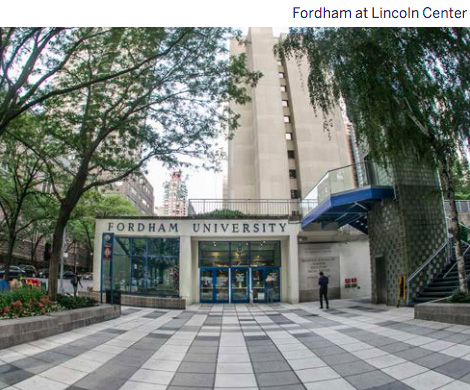 The nearby University of Fordham at Lincoln Center has also been trending toward preparing students for a fintech world. Undergrad and graduate students pursuing an MBA through the Gabelli School have the option of a fintech concentration.
The course work not only incorporates data science and machine learning skills into the worlds of credit lending and risk management but facilitates relationships between students and a wealth of industry partners.
Sudip Gupta, professor, and Director of the MS Quantitative Finance program, spoke about the courses’ popularity there. The program is ranked in the top 20 of its kind in the world by Risk Magazine.
He has seen a revolution in fintech in the past few years that has recently received a big push by pandemic forces, introducing the wholesale adoption of fintech techniques into traditional financial institutions.
“The fintech revolution in the industry- big data, machine learning techniques, storage capacity, and cloud computing has been going on for the last couple of years,” Gupta said. “The pandemic provided the big push to move toward that direction.”
Gupta has been following the development of alternative credit closely, recently publishing an award-winning paper studying machine learning to create alternative consumer credit scores using mobile phone and social media data.
“The idea of my research- let’s look at people who do not have a credit history or enough traditional credit you could get from a FICO score,” Gupta said. “Using this data, it turns out they are better predictors, and better to judge than FICO, and can reach out to more people.”
Gupta is excited for the adoption of big data techniques into alternative and traditional consumer loans because it offers a win-win for consumers and institutions alike, he said. Echoing the findings of many successful alternative finance companies, Gupta said his research showed that collected data could offer better insight for lending than “stale FICO scores.”
 Up north at the Univerisity of Michigan, Professor Robert Dittmar at the Ross School of Business heads the Fintech Initiative. He is working on adding even more fintech classes. Recently, through a partnership with PEAK, a Chicago fintech lending company, Michigan launched a fintech initiative that incorporates undergrad and grad classes, faculty research, and a fintech entrepreneurial club that connects students to industry leaders.
Michigan Ross is adding fintech classes for a variety of reasons.
“The simplest reason: students are interested in learning more about this kind of space,” Dittmar said. “And we’re seeing more demand from the industry side for students that know more.”
For years Dittmar said tech companies and startups in silicon valley were pioneering innovations in the industry. Through talking with alumni and contacts in the industry, Michigan found that fintech has gotten to the place where there is an excellent supply of data engineers. Still, there is a demand for professionals with the financial business expertise to implement these technologies.
“What we are trying to do at Ross is fill in that gap,” Dittmar said. “what we’d like is for [students] to know enough about the technology that they can provide the insights of finance and business to the people that are doing that technical work.”
At Ross, they are organizing what will one day be like a fellowship program. The program will feature a combined learning experience: students will learn data analytic finance, apply their computing skills in credit decision making classes, and then connect with the industry in experiential learning classes.
“In the last couple of years, I have been taking students to London to work at fintech startups in the UK,” Dittmar said. “And we are hoping to expand that program so that most or all graduate students have the opportunity to participate in something like that.”
Last year Ross hosted a “Fintech Challenge” competition to design a banking service to reach customers in a “banking desert” in rural Michigan. The program is hoping to host another challenge this year, despite complications of COVID-19.
Lendini Relaxes Previously Announced Covid-Guidelines
September 9, 2020Bensalem, PA –September 9, 2020– Lendini is excited to announce its return to small business funding. Through superior efficiency and analysis, the company has improved the process of alternative funding from some of the brightest minds in finance, technology and analytics. With updated (temporary COVID-19) guidelines, they remain dedicated and committed to their merchants and ISOs in these unprecedented times.
Lendini works directly with you to prepare the best package for your client, whether that be a Business Cash Advance (BCA) or Merchant Cash Advance (MCA). Simply put, Lendini advances money based on the average monthly gross sales of a business or average monthly credit card sales. Money can be advanced quickly because securing assets and collateral is not required.
Get clients funded in 4 easy steps; application submission, information review, approval or denial, final review and your client is funded. Minimal documentation is required. The company must have 18 months in business with $7,500 per month in gross sales and an average daily balance of $750. We require a minimum of 5 deposits, monthly into the business bank account.
Funding Stipulations:
- Bank login
- Funding call with merchant
Required Documents:
- Application
- All 2020 business bank statements + MTD
- Signed and dated agreement
- Proof of business existence
- Meets state registration requirements
- Proof of ownership
- Merchant interview
- Driver’s license
- Voided check (starter checks will not be accepted)
With $540 million dollars funded to 15,000 small businesses, Lendini offers incomparable solutions customized specifically for your client. The company prides itself in being able to offer up to $300,000 in as little as 1 business day (in most cases). Funding can be used for any business purpose you may have.
Lendini is not a bank and does not provide loans, they offer cash advances. With Lendini, business owners receive the capital they need without lengthy delays or excessive paperwork. In general, Lendini offers pre-approvals in under three hours and next day funding of approved advances. The staff provides unparalleled customer service and treats each business owner with the respect they deserve.
Lendini is Back
September 2, 2020 Bensalem, PA –September 3, 2020– Lendini is excited to announce its return to small business funding. Through superior efficiency and analysis, the company has improved the process of alternative funding from some of the brightest minds in finance, technology and analytics. With updated (temporary COVID-19) guidelines, they remain dedicated and committed to their merchants and ISOs in these unprecedented times.
Lendini works directly with you to prepare the best package for your client, whether that be a Business Cash Advance (BCA) or Merchant Cash Advance (MCA). Simply put, Lendini advances money based on the average monthly gross sales of a business or average monthly credit card sales. Money can be advanced quickly because securing assets and collateral is not required.
Get clients funded in 4 easy steps; application submission, information review, approval or denial, final review and your client is funded. Minimal documentation is required. The company must have 18 months in business with $7,500 per month in gross sales and an average daily balance of $750. We require a minimum of 5 deposits, monthly into the business bank account.
Funding Stipulations:
- Bank login
- Funding call with merchant
Required Documents:
- Application
- All 2020 business bank statements + MTD
- Signed and dated agreement
- Proof of business existence
- Meets state registration requirements
- Proof of ownership
- Merchant interview
- Driver’s license
- Voided check (starter checks will not be accepted)
Industries accepted:
- Restaurants (with takeout)
- Pharmacies
- Healthcare
- Manufacturing
- Transportation (freight)
- Healthcare (primary care)
- Automotive repair
- Grocery stores
With $540 million dollars funded to 15,000 small businesses, Lendini offers incomparable solutions customized specifically for your client. The company prides itself in being able to offer up to $300,000 in as little as 1 business day (in most cases). Funding can be used for any business purpose you may have.
Lendini is not a bank and does not provide loans, they offer cash advances. With Lendini, business owners receive the capital they need without lengthy delays or excessive paperwork. In general, Lendini offers pre-approvals in under three hours and next day funding of approved advances. The staff provides unparalleled customer service and treats each business owner with the respect they deserve.
The SEC Already Suffered a Major Defeat in the Par Funding Battle – But Who is the Real Loser?
August 8, 2020 While the news media, regulatory agencies, and law enforcement are high-fiving each other over the course of events in the Par Funding saga (a lawsuit, a receivership, an asset freeze, and an arrest), there lies a major problem: The SEC already suffered a major defeat.
On July 28th, rumors of a vague legal “victory” for Par Funding circulated on the DailyFunder forum. The context of this win was unknowable because the case at issue was still under seal and nobody was supposed to be aware of it.
Cue Bloomberg News…
In December 2018, Bloomberg Businessweek published a scandalous story about a Philadelphia-based company named Par Funding. And then not a whole lot happened… that is until Bloomberg Law and Courthousenews.com published a lengthy SEC lawsuit less than two years later that alleged Par along with several entities and individuals had engaged in the unlawful sale of unregistered securities.
 At the courthouse in South Florida, those documents were sealed. The public was not supposed to know about them and AltFinanceDaily could not authenticate the contents of the purported lawsuit through those means. According to The Philadelphia Inquirer, the mixup happened when a court clerk briefly unsealed it “by mistake” thus alerting a suspiciously narrow set of news media to the contents. AltFinanceDaily was the first to publicly point this out.
In court papers, some of the defendants said that they learned of the lawsuit that had been filed under seal on July 24th from “news reports.” Bloomberg Law published a summary of the lawsuit on its website in the afternoon of July 27th.
“It is fortuitous that the Complaint was initially published before it was sealed,” an attorney representing several of the defendants wrote in its court papers. “Otherwise, [The SEC] would have likely accomplished its stealth imposition of so-called temporary’ relief, that would have led to the unnecessary destruction of a legitimate business.”
 The day after this, on July 28th, a team of FBI agents raided Par Funding’s Philadelphia offices as well as the home of at least one individual. Rumors about the office raid landed on the DailyFunder forum just hours later, along with links to the inadvertently public SEC lawsuit now circulating on the web.
The New York Post caught wind of the story and published a photo of an arrest that had taken place fifteen years ago, creating confusion about what, if anything, was happening. Nobody, was in fact, arrested.
The SEC lawsuit was finally unsealed on July 31st, along with the revelation that Par Funding and other entities had been placed in a limited receivership pursuant to a Court order issued just days earlier. The receivership order was a massive blow to the SEC. It failed to obtain the most important element of its objective, that is to have the court-ordered right to “to manage, control, operate and maintain the Receivership Estates.” The SEC specifically requested this in its motion papers but was denied this demand and others by the judge who leaned in favor of granting the Receiver document and asset preservation powers rather than complete control of the companies.
The language of the Court order was interpreted differently by the Receiver, who immediately fired all of the company’s employees, locked them out of the office, and then suspended all of the company’s operations which even prevented the inbound flow of cash to the company (of which in the matter of days amounted to nearly $7 million). The SEC did successfully secure an asset freeze order.
In court papers, Par Funding’s attorneys wrote that: “The Receiver’s and SEC’s actions are ruining a business with excellent fundamentals and a strong financial base and essentially putting it into an ineffective liquidation causing huge financial losses. In taking this course of action against a fully operational business, the key fact that has been lost by the SEC, is that their actions are going to unilaterally lead to massive investor defaults.”
 The Receiver, in turn, tried to fire Par Funding’s attorneys from representing Par. Par’s attorneys say that the Receiver has communicated to them that it is his view “that he controls all the companies.”
“The SEC is simply trying to drive counsel out of this case, as an adjunct to all the other draconian relief that they insist must be employed to ‘protect the investors,'” Par’s attorneys told the Court. “Due Process is of no regard to the SEC.”
As lawyers on all sides in this mess assert what is best for “investors,” seemingly lost is the collateral damage that is likely to be thrust on Par’s customers. The Philadelphia Inquirer has repeated the SEC’s contention that Par made loans with up to 400% interest. Bloomberg News has called Par a “lending company” whose alleged top executive is a “cash-advance tycoon.”
A review of some of Par’s contracts, however, indicate that they often entered into “recourse factoring” arrangements. “This is a factoring agreement with Recourse,” is a statement that is displayed prominently on the first page of the sample of contracts obtained by AltFinanceDaily.
Parallels between the business practices of Par Funding and a former competitor, 1 Global Capital, have been raised at several junctures in the SEC litigation thus far. But some sources told AltFinanceDaily that in recent times, Par has been offering a unique product, one that is likely to create disastrous ripple effects for hundreds or perhaps thousands of small businesses as a result of the Receiver’s actions (even if well-intentioned).
The “Reverse”
Par offered what’s known as a “Reverse Consolidation,” industry insiders told AltFinanceDaily. In these instances Par would provide small businesses with weekly injections of capital that were just enough to cover the weekly payments that these small businesses owed to other creditors.
One might understand a consolidation as a circumstance in which a creditor pays off all the outstanding debts of a borrower so that the borrower can focus on a relationship with a single lender. In a “reverse” consolidation, the consolidating lender makes the daily, weekly, or monthly payments to the borrower’s other creditors as they become due rather than all at once. Once the other creditors have been satisfied, the borrower’s only remaining debt (theoretically) is to the consolidating lender.
 Par does not appear to have offered loans but sources told AltFinanceDaily that Par would provide regular weekly capital injections to businesses that could not afford its financial obligations otherwise. Par, in essence, would keep those businesses afloat by making their payments.
That all begs the question, what is going to happen to the numerous businesses when Par breaches its end of the contract by failing to provide the weekly injections?
As the Receiver makes controversial attempts to assert the control it wished it had gotten (but didn’t), the press dazzled the public on Friday with the announcement that an executive at Par Funding had been arrested on something entirely unrelated, an illegal gun possession charge. The FBI discovered the weapons while executing a search warrant on July 28th but waited until August 7th to make the arrest.
It remains to be seen what the 1,200 investors will recover in this case or what will become of the Receiver in the battle for control, but sources tell AltFinanceDaily that the authorities are all fighting over the wrong thing.
They should all be asking “what’s going to happen to the small businesses when their weekly capital injection doesn’t come in the middle of a pandemic?”
Shopify Originates $153M in MCAs and Loans in Q2
July 29, 2020 Shopify had a monster 2nd quarter. The e-commerce giant generated $36M in profit on $714.3M in revenue. As part of that the company originated $153 million worth of loans and merchant cash advances, only slightly down from the $162.4M in Q1. Still that figure was up by 65% year-over-year (and was more than 2x the volume originated by OnDeck).
The company has offered capital to its US merchants since 2016 and recently begun doing the same with its UK and Canadian merchants starting this past March and April respectively, the company revealed.
Shopify CFO Amy Shapero said that company had maintained loss ratios “in line with historical periods,” despite COVID. “Access to capital is even tougher in times like these, which makes it even more important to continue lowering this barrier by making it quick and easy so merchants can focus on growing their business,” Shapero stated.