
DFS Releases Recommendations for Online Lending
July 12, 2018
The New York State Department of Financial Services (DFS) released a report on Wednesday on the subject of online lending in the state. The report was mandated by a bill signed by New York Governor Andrew Cuomo on June 1 of last year. According to the original bill, this report was to be researched and composed by a task force of multiple parties. But in the eleventh hour, the section regarding the task force was struck. The report is to be presented to the governor, the temporary president of the senate, the speaker of the assembly, the chair of the senate standing committee on banks, and the chair of the assembly standing committee on banks.
Wednesday’s 31-page report is based on survey responses from 35 online lenders operating in the state, lending both to businesses and to individuals. One of the revelations in the report is that, from the data obtained, “New York individuals appear to account for a higher total dollar amount of loans than New York businesses.”
The report presents three primary assertions:
Equal Application of Consumer Protection Laws.
The report establishes that New York has strong consumer protection laws and regulations that apply to financial institutions. “These protections should apply equally to all consumer lending and small business lending activities,” the report reads. The report explains that there are strong protections against payday lenders and indicates that there should be strong protections across the board, even though the financial products and the consumers may vary widely.
Usury Limits Must Apply to All Lending in New York.
The report asserts that access to credit at usurious rates has long been prohibited in New York and that online lenders should not be able to bypass this by having arrangements with banks in other states, like Utah, where the usury laws are different. In New York, the civil usury rate is 16% and the criminal usury rate is 25%. But because online lenders have arrangements with out-of-state banks, they can charge interest at rates well above 25%.
Currently, if an online lender sues a merchant for not paying, the merchant cannot use usury as a defense. In the report, DFS recommends that a business should have the right to present usury as a defense.
All Online Lenders Should be Licensed and Supervised.
The report states that New York State chartered banks, credit unions and licensed non-depositories are subject to regular examinations by the DFS and, if applicable, federal regulatory agencies.
“Many online lenders remain unlicensed in New York with no direct supervisory oversight from a safety and soundness or consumer compliance perspective,” the report reads. “Direct supervision and oversight is the only way to ensure that New York’s consumers and small business owners receive the same protections irrespective of the channel of delivery [of financing.]”
Some of these issues relate to the well-known 2015 Madden v. Midland Funding court decision, in which a credit card consumer (Madden) won a case against a debt-collection agency (Midland Funding) because the court decided that Midland, as a non-bank, was not allowed to charge interest above what was allowed in the state.
House Passes Bill That Would Help More Consumers Build Credit
June 26, 2018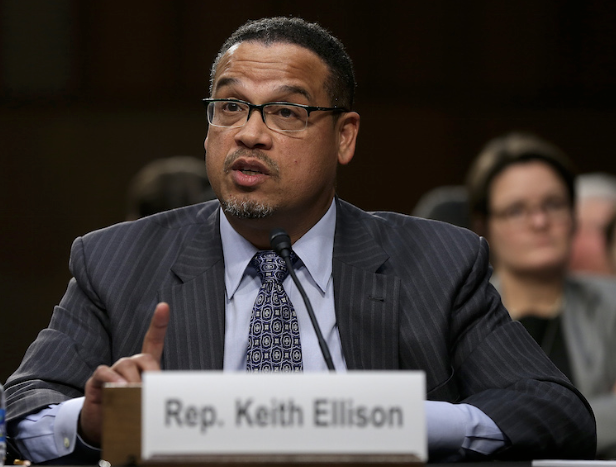 Yesterday, the house passed the Credit Access and Inclusion Act of 2017, a bill that would allow reporting of telecom and utility payments to credit reporting agencies. The idea behind the bill, written by Rep. Keith Ellison of Minnesota, is to give people more opportunities to report positive on-time payments that could improve their credit.
“By allowing more of Americans’ positive financial information to be reported to credit rating agencies, this bill will help millions more Americans access credit and everything that comes with it,” Ellison wrote in a statement. “Once this bill is signed into law, millions of Americans who previously couldn’t will now be able to access lower-cost loans, cheaper car payments, or a mortgage on their first home.”
If passed in the Senate, the law would allow a person to present to a consumer reporting agency information about payments “with respect to a dwelling, including such a lease in which the Department of Housing and Urban Development provides subsidized payments for occupancy,” according to the bill.
This bill is an amendment to the Fair Credit Reporting Act, which was originally passed in 1970.
Tech Changes Lending And Payments The World Over
June 25, 2018 On a business trip to China last summer, Matt Burton had plenty of money in his wallet but it was practically useless.
Case in point: He had a lengthy standoff with a Shanghai taxi driver who insisted on a mobile-phone payment. “I spent 20 minutes arguing with the cabbie,” says Burton, one of the founding partners at Orchard Platform, a leading provider of technology and software to the alternative lending industry. “You’d think that — out of all of the professions — a taxi driver would accept cash.”
The New Yorker finally convinced the cab driver to take the payment in renminbi, China’s paper currency. The incident, meanwhile, is illustrative of how deeply and widely mobile payments have penetrated the huge Chinese market. “No one in China carries wallets anymore,” Burton reports. “Everyone pays with their smart-phones. Even the elderly women selling vegetables on the side of the road accept mobile payments,” he adds. “Cash has become a hassle.”
Welcome to China’s financial technology revolution. Almost overnight, China’s population graduated from calculating with the 16th-century abacus to showcasing what is arguably the world’s most sophisticated system of mobile payments. Thanks to financial technology, China is fast becoming a cashless economy. China is just one place outside the U.S. where financial technology is catching on in a big way. As Americans remain, for the most part, wedded to suburban drive-in banks, walk-up automated teller machines, and plastic credit and debit cards, the rest of the world is rapidly embracing digital solutions. And nowhere is that happening more dramatically than in China.
According to the most recent figures released by China’s Internet Network Information Center, the country had 724 million mobile phone users at the end of June 2017. China’s Ministry of Industry and Information Technology reports, moreover, that consumers paying for everything from food and clothing to utility bills to movie tickets and – you guessed it, cab fare — engaged in 239 billion mobile payment transactions in 2017, a surge of 146 percent over the previous year.
Mobile payments have become a $16 trillion industry in China, the ministry adds, accounting for about half of all such transactions in the world.
And there’s ample room to grow. The World Bank discloses that there are now 772 million Internet users in China, more than double the entire population of the U.S. Yet that leaves 50% of China’s population – mostly in the countryside and rural areas – who are not yet plugged in to the Internet.
 Two Chinese mobile-payment platforms dominate the industry. Ant Financial is the 800-pound-gorilla, its Alipay program boasting 520 million global users on its website. It’s an affiliate of publicly traded Alibaba Group Holding, an online merchandiser known as the “Amazon of China” which was founded by entrepreneur Jack Ma, reputedly the richest man in China.
Alipay not only has bragging rights to roughly 60 percent of China’s digital and online payments market but, in 2013, it overtook PayPal as the global leader in third-party payments. With deep roots in e-commerce, Alipay is the go-to payments option for online shoppers, who are steadily migrating from laptops to mobile devices.
WeChat Pay is the upstart in the duopolistic rivalry. Launched in 2013, nearly a decade later than its rival, it’s a unit of conglomerate Tencent Holdings, a social network and messaging platform often compared to Facebook. As WeChat continues to add subscribers, its Tenpay app has been growing accordingly, eroding Alipay’s market share as new users gravitate to the e-payments program. While WeChat records fewer payments than Alipay, Forbes magazine reports that it claims more users.
 Whatever WeChat’s virtues, Ant Financial continues to chew up the scenery. It recently topped the charts as the world’s “most innovative” fintech in 2017, as reckoned by a research team formed by accounting giant KPMG and H2 Ventures. China scored a hat trick, moreover, as two additional homegrown fintechs — online property-and-casualty insurer ZhongAn and credit-provider Qudian Inc. — took second and third place, respectively, in KPMG/H2’s rankings. For good measure, China also claimed five of the top ten spots on the “most innovative” list, edging out the U.S., which had four.
Financial analysts recently surveyed by the Financial Times reckon Ant Financial’s market valuation at $150 billion, catapulting the company into the rarified status of not just a “unicorn,” but a “super-unicorn.” (Named after the rarely seen mythical one-horned horse, “unicorns” are start-ups valued at $1 billion). So robust is Ant Financial’s market valuation that the global investment community is salivating over its impending initial public offering.
(Ant’s progenitor, Alibaba, holds bragging rights as the largest IPO ever, according to the Financial Industry Regulatory Authority. It raised $21.8 billion in 2014; its NYSE-listed stock was trading at $194.36 in mid-May, essentially in the same league as Apple and Facebook, trading at $188.80 and 187.08, respectively, on Nasdaq.)
“Four of the largest fintech unicorns in the world are coming out of Asia,” notes Dorel Blitz, the Tel Aviv-based head of fintech at KPMG. “The companies are getting bigger and stronger,” he adds, “and you’re beginning to see more direct investment in public fintech companies as well.”
Adds Orchard’s Burton: “I think it shows you how massive the opportunities are outside the U.S.”
Ant Financial and WeChat are also serving as a world-class demonstration project on how fintechs can turn a tidy profit while opening up financial services to large populations who lack access to basic financial services, thereby providing entry to the middle class. The two platforms have provided “financial inclusion for tens of millions, if not hundreds of millions of people” who previously were on the periphery of the banking and financial system, says Kai Schmitz, a fintech lender at International Finance Corporation that lends to private businesses in the developing world.
Once people are making electronic payments on their mobile devices, Schmitz notes, it creates a “pathway” to a whole panoply of financial services, including personal and business loans, savings, insurance, and investments.
“You can create a user profile so that a large part of the population that could not be reached (by traditional financial institutions) are now making payments and can be followed on the data track,” he says.
The World Bank reports that two billion adults and 200 million businesses in the developing world are currently unable to access even basic financial services. Through IFC, the World Bank has invested $370 million in fintech companies operating throughout Asia, the Middle East, Africa and Latin America. The fintechs, an IFC communications manager told AltFinanceDaily, offer “a range of products and services — from e-wallets, virtual banks, lending, and online payments to retail payment points and exchanges.” IFC, she adds, also invests in fintech funds.
Anju Patwardhan is the U.S.-based managing director at CreditEase Fintech Investment Fund, a $1 billion Chinese venture capital firm that invests in fintechs delivering financial services to “unbanked” and “underbanked” populations. “They are living in Africa, Bangladesh, China and elsewhere on less than two dollars a day and have no access to financial services,” she says.
“But there are also a very large number of people who may be technically included in the financial system but still don’t have access to a full range of financial services at reasonable prices,” she adds. “If someone is borrowing from a moneylender or pawnbroker, it doesn’t count (as financial inclusion). In that case, the number of people is very much more than two billion.”
Once phone towers are built and a payments infrastructure is in place, fintechs promising more sophisticated financial services can operate similarly to the settlers who followed pioneers in the U.S.’s westward expansion. That’s been the story in Kenya and other African countries where M-Pesa (“pesa” is Swahili for money) and other mobile-phone payments systems set up shop a decade ago.
Branch International, based in San Francisco but doing business exclusively in emerging and frontier markets for only three years, is one of the settlers. It boasts that it now has the “No. 1 finance app in Africa.” In March, Branch raised $70 million in a second-stage round of debt and equity financing from a group of venture capitalists led by Trinity Partners that included Patwardhan’s CreditEase and the IFC. Patwardhan will serve as an advisor to Branch’s board.
 Branch’s principal business is making loans and micro-loans ranging from as little as $2 to $1,000 in Nigeria, Kenya, and Tanzania. Despite its name, Branch touts itself as a “branchless bank”, all of the credit transactions taking place on mobile devices, says Matt Flannery, Branch’s chief executive and founder. Its average loan amount is $25.
Many of Branch’s customers are individuals and businesses who often had trouble obtaining credit from established financial institutions or were ineligible for loans. But, according to Branch’s website, it’s possible for a prospective borrower to obtain a loan in just a matter of minutes. “Branch eliminates the challenges of getting a loan by using the data on your phone to create a credit score,” the website says. Branch promises privacy, fees that are “fair and transparent,” and terms that “allow for easy repayment” with no “late fees or rollover fees”. “As you pay back on time,” the website also says, “our fees decrease, and you unlock larger loans with more flexible terms.”
The platform, CEO Flannery says, has lent out $100 million dollars to roughly that same number of people. “The formal financial system in African countries is generally composed of old-fashioned banks that are risk-averse and fairly slow to make lending decisions,” he says. “People really appreciate us,” Flannery adds. “I’d say we’re like Uber and they’re the horse-and-buggy.”
The company is growing by 20 percent month-over-month and expects to disburse more than $250 million in 2018. Asked to describe Branch’s typical borrower, Flannery says: “We have some rural users (of Branch’s finance app). But in general we’re serving the commercial middle-class — shopkeepers and entrepreneurs – in urban capitals.” Want to know precisely who Branch’s customers are? “Just go to downtown Lagos (the capital of Nigeria and the largest city on the African continent) and you’ll see all different kinds of businesses and single-owner merchants on street corners,” Flannery says.
Jeff Stewart, the founder and chairman of Lenddo (which recently merged with competitor EFL) asserts that his firm’s machine learning technology and risk modeling techniques, which are being deployed in emerging countries from Costa Rica to The Philippines, have the capacity to assess the “creditworthiness of everyone on the planet.” In the absence of credit history in much of the developing world, he explains, this can done by constructing a risk profile combining both “psychometrics” and a “digital footprint.”
 Psychometrics is a behavioral assessment tool based on a prospective borrower’s “Big Five” personality traits: openness to experience, conscientiousness, extraversion, agreeableness, and neuroticism (OCEAN for short). “What we’ve been able to show,” Stewart asserts, “is that certain personality types have a positive and negative correlation with repayment. It’s not 100 percent accurate. But you can predict the statistical recovery ratio on repayment. You can say that, for a person with a high score, something like 88 out of 1,000 people (with his or her profile) would not repay.”
The digital footprint, which is the second “critical component,” Stewart says, analyzes a prospective borrower’s reliability by reconnoitering their smartphone usage. “We’ll look at everything on your phone,” he says, “How you use the phone. Whom you interact with. When you use your phone. There are thousands of features that generate a digital footprint. Everything from meeting someone at a sports bar to the apps on your phone to things like e-mailed receipts that show your financial activity.”
Such methods help build credit for those lacking credit history while rehabilitating those whose credit history is blemished. And all that’s needed is a smartphone. “We’ve turned the smartphone into a credit bureau,” Stewart says.
The acquisition of smartphones is taking place at a blistering pace, Stewart notes, now that cell phone costs are “at the bottom of the cost pyramid” in many countries. For example, a “low-end Android” now fetches as little as $25 in Africa. “One credible study I’ve seen shows that every 10% percent rise in access to smartphones translates into a 1/2 percent rise in a country’s gross domestic product,” Stewart says.
While the private sector is driving the trend to financial inclusion in China and Africa, India’s government-driven model “is setting a new global standard in using financial technologies to support financial inclusion,” declares Patwardhan of CreditEase, who also lectures at Stanford. “The country has become a giant testing ground for financial inclusion and innovation,” she argues in a recent academic paper, “and may become a role model for other emerging economies.”
India’s state-run effort includes a $1.3 billion digital identity program known as Aadhaar. Under Aadhaar (which means “foundation”), the state issues residents a 12-digit identity number that’s based on their biometric data –such as fingerprints and iris scans — and personal information. The ID number covers more than 1.19 billion residents. In just the first two years after Aadhaar’s 2009 debut, Patwardhan says, more than 250 million Indians were able to open bank accounts.
Jo Ann Barefoot, chief executive at Barefoot Innovation Group in Washington, D.C. and a senior fellow emerita at Harvard’s Kennedy School of Government, agrees. She notes that Aadhaar opened up access to both fintech services and bank accounts to women who were long treated as second-class citizens by the social and economic system. “India’s digital ID program means that wives and daughters have identity now,” she says.
“In the past,” she adds, “only (male) heads of households would have family identity documents and a government card — which would be the equivalent of having a Social Security number in the U.S. But the wife wouldn’t have her own card. So this is a massive door-opener to fintech growth. And it’s also opening up (all areas of) finance to millions and millions of people.”
India’s “digitalization” program, moreover, has entailed development of a national payments network called “unified payments interface,” or UPI. The combination of UPI and Aadhaar as well as other digital initiatives have resulted in “a surge of online lending platforms,” says Patwardhan, citing Capital Float, NeoGrowth, Faircent, LendingKart, Quiklo, IndiaLends, CreditExchange, and Onemi.
The homegrown fintechs, however, will be up against tremendous external pressure as India, with 1.3 billion people and poised to overtake China in population growth, is generating enormous interest from global fintechs. Among outside platforms piling into the country are China’s Ant Financial and WeChat. The former took a $1 billion stake in Paytm, an Indian mobile payments and e-commerce company. Similarly, competitor WeChat’s parent, Tencent, has invested in Hike, a mobile wallet valued at $1.4 billion last June, according to CNBC, exciting investor interest as a unicorn.
U.S. companies are getting into the act too. Google launched digital payments app Tez last September, which “is taking advantage of India’s infrastructure and has already gotten 30 million downloads,” Patwardhan says. In February, Facebook rolled out a peer-to-peer payments feature on WhatsApp. Even Branch’s Flannery has announced that his “branchless bank” plans to earmark part of its $70 million war chest to offer $2-to-$1000 loans on the subcontinent.
Having banned high-denomination paper bills as a way to rein in corruption and aiming at a cashless economy, India has been innovating in ways that “have gone the Chinese one better,” marvels Patwardhan. “Their payment systems going through the UPI network are interoperable,” she notes, for example. “You don’t have to be on the same app or with the same bank. India is now on the cutting edge.”
An ISO Brokers Main Street Deals – on Main Street
June 25, 2018 Envision a giant office filled with rows of commercial finance brokers on the phone, aggressively selling deals to faceless small town merchants. Then step into the office of Horizon Financial Group and meet brothers and business partners James and John Celifarco. The contrast could not be more striking.
The most dramatic difference between their office and that of almost every other broker, or ISO, is that you enter the office from the sidewalk. There’s no lobby and no elevator. It’s just the two brothers (plus one salesperson and one assistant) working on the other side of a glass storefront window.
 The store isn’t on Madison Avenue or Rodeo Drive. It’s on a modest, roughly three-block commercial strip on Avenue S in a working class section of Brooklyn called Marine Park. There’s a deli, a pizzeria, a barbershop, a pet grooming store and a bunch of other stores that you’re likely to find on Main Street, U.S.A. In other words, Horizon Financial Group’s neighbors are the exact kind of small business owners they seek as customers. And since they opened up shop on this quaint stretch at the end of October, many of their store owner neighbors have already become customers.
“It’s a different relationship with the customer,” James said of their neighborhood clients. “You’re not on the phone. You’re face to face with these people. You’re meeting them, you’re shaking their hands, you’re getting to know them personally, which helps with the longevity of the relationship itself.”
Sitting at the glass conference table by their storefront window, James, 34, and John, 37, counted up to six clients by simply pointing out the window at other small stores across the street. Horizon Financial Group is an ISO that brokers working capital deals and does credit card processing, equipment leasing, ATM machines and commercial mortgages. (James has his New York real estate license, so he can also help local store owners buy or sell a house.) The brothers said that about 40 percent of their business is facilitating deals brought to them by other ISOs, another 40 percent comes from merchants that they find directly, and about 20 percent comes from these local customers they’ve developed from having a physical presence in the neighborhood.
“Obviously you can’t build an entire business on just these two streets,” John said, “but it’s extra business that we wouldn’t have had if we weren’t here. And when we came here, we stopped thinking ‘Who are we going to buy leads from?’ and started thinking more outside of the box.”
An example of this was their decision to approach the Brooklyn Chamber of Commerce where they are now one of the chamber’s preferred vendors, which brings them business from the entire borough.
James said they’ve made contributions to the local little league and kids football, and whenever a new store opens in the area, they introduce themselves and explain what they do. It also doesn’t hurt that they grew up in Marine Park, so they already know the town pretty well. James recognized someone on the sidewalk and ran outside to say hi. It was someone who used to be a next door neighbor. There is a truly old-fashion sense of community on Avenue S.
“I buy my pizza from [the pizza store owner] and he does his credit card processing with us,” James said. “When the dry cleaner needed equipment, we got them capital, and I actually got to see the piece of equipment I helped finance. That almost never happens.”
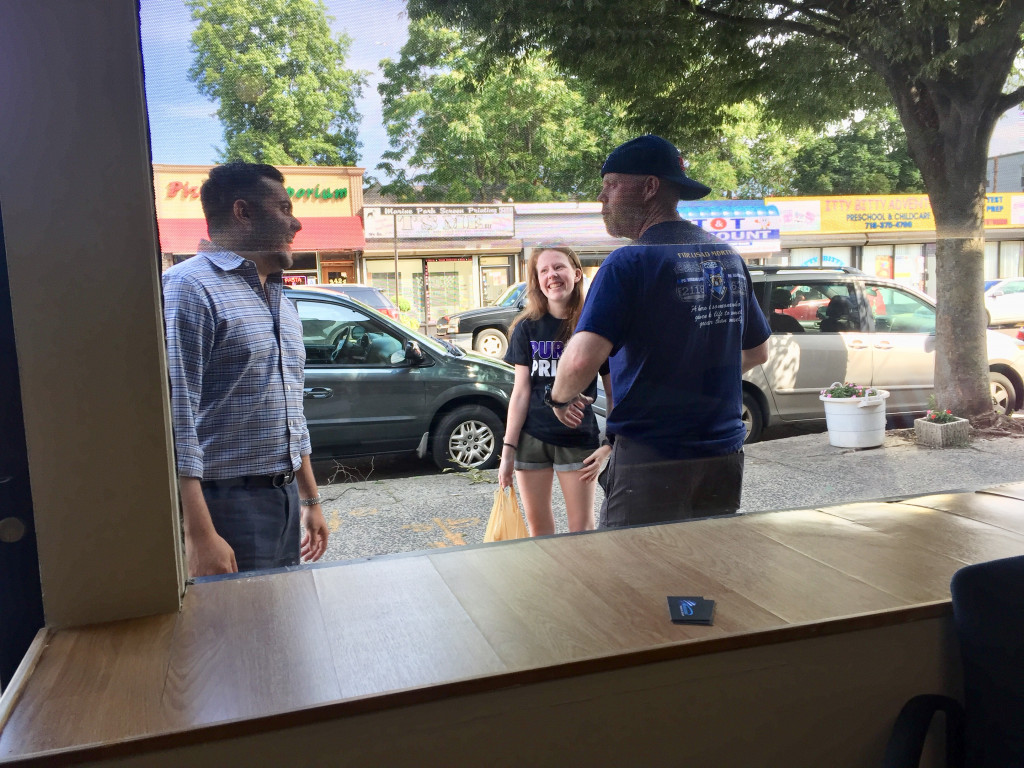 Because there is no building guard or front desk person, customers can stop by whenever they like. As if in a sitcom, a man walked into the store saying to the brothers, “Don’t be mad at me.” It was a customer, the owner of a local paint store. “It’s not completely my fault, but I broke the phone swiper on the job.”
Reassuringly, John told him to come to his desk and he helped the customer with a replacement for a piece of credit card processing equipment.
The brothers have each been working in the small business financing industry independently for more than a decade. James established Horizon Financial Group by himself in 2009 while John was working for a different company in the credit card processing and MCA space. John joined James at Horizon Financial Group in September 2017.
John said he prefers co-leading Horizon Financial Group, itself a small business, to running a larger operation in Manhattan.
“Compared to somebody in the city with a huge rent and a huge payroll, I don’t need to do the same numbers he’s doing to end up making the same amount of money.”
John also noted that he doesn’t have to sit on a train for an hour and a half because he lives just six blocks away from the storefront office.
“A lot of people don’t like to say they’re a small company,” John said. “I couldn’t be happier that we’re a small company.”
Running a small business is familiar to the Celifarcos. Horizon Financial Group gets its name from Horizons Dance Center, a successful Brooklyn dance school founded by James and John’s mother. It has been in business for 46 years and is still going strong.
“The name is good luck,” James said.
James lives a short drive away in Rockaway with his wife and daughter. On running a small business like Horizon Financial Group, James said: “It’s also about quality of life. You don’t need to work 7 to 7. I can be on the beach with my daughter. It’s really a different approach.”
Lawyers Weigh in on Federal Decision That CFPB is Unconstitutional
June 22, 2018In light of a federal court ruling yesterday that the structure of the Consumer Financial Protection Bureau (CFPB) is unconstitutional, AltFinanceDaily spoke with some lawyers to get their perspective on what this decision could mean.

Alan Kaplinsky, Partner, Ballard Spahr
“I think it will sow more confusion related to the CFPB. I think it’s important to note that this opinion – while it is precedent that could be cited in other cases…it’s not binding on any other court anywhere in the country, including in the Southern District of New York. That being said, I anticipate that the CFPB will appeal [the decision] if for no other reason than because they have other cases. Ultimately, I would anticipate that the case will end up in the U.S. Supreme Court.”
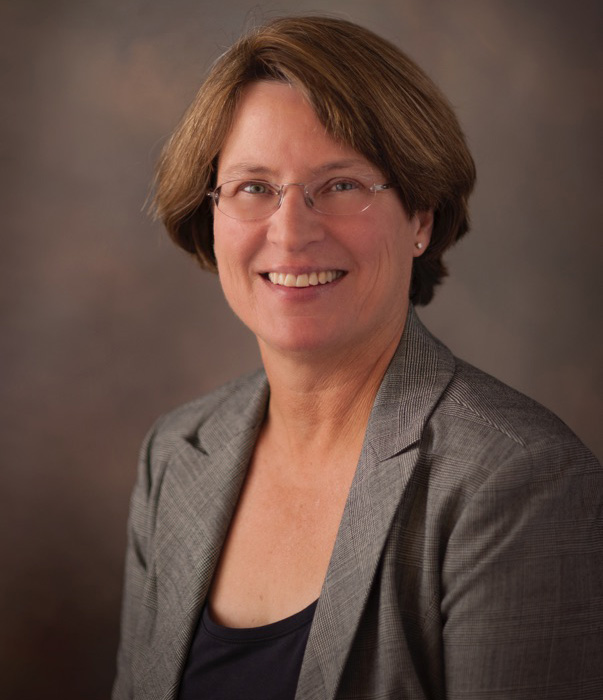
Lucy Morris, Partner, Hudson Cook (previously a Deputy Enforcement Director at the CFPB)
“The bottom line is that it creates yet more uncertainty for the bureau, for industry and for consumers. Is this bureau legitimate or not? And if not, what does that mean for all of the many decisions and actions taken by the former [CFPB] director Cordray and the current acting director, Mulvaney.
Maybe this can add to a momentum to create a bipartisan commission to finally resolve this, and to give everyone a commission that…avoids the wide pendulum swings that have been happening. This requires a legislative fix, which is challenging of course.”

Lawrence Kaplan, Of Counsel, Paul Hastings
“Typically, in a case like this, you would have a circuit split, where now you have one circuit saying yes and one circuit saying no. And ultimately that would go up to the supreme court. But you could have the administration saying ‘We’re not going to defend this.’ [Given the administration’s unfavorable attitude toward the CFPB], it’s likely that you’re not going to see anyone vigorously defend the agency.
As for alternative lenders, [these] are state issues. And as a result, [lenders] are not off the hook…At the end of the day, everyone will still have to comply with a patchwork of state laws. You’re really taking away the federal hammer. So, [certain cases] may no longer be a federal case. Now, in some ways, be careful what you wish for, because now you have to face 50 executioners [because] a lot of the states would defer to and join with the feds.”
Stacking Lawsuit Results in Settlement Before Trial
June 19, 2018A lawsuit between RapidAdvance and Pearl Capital over tortious interference will not be going to trial after all, AltFinanceDaily has learned. Originally scheduled to begin on June 25th, the parties have reportedly reached a settlement.
Neither party would respond for comment.
RapidAdvance filed its lawsuit against Pearl in November 2015 with the hope that they could set a precedent against “stacking.”
The suit was filed in the Circuit Court of Maryland under Small Business Financial Solutions, LLC v. Pearl Beta Funding, LLC, Case No. 411478-V.
It’s Back to Business For Alternative Funding in Puerto Rico
June 15, 2018
Last year, alternative funding in Puerto Rico ground to a halt after the island was ravaged by two devastating hurricanes in close proximity. Now, however, the alternative funding business in Puerto Rico is getting its second wind, after a several-month hiatus.
Puerto Rico got lashed by high winds and rain from Hurricane Irma in early September 2017, causing large-scale power outages and damage. Then, about two weeks later, Hurricane Maria hit the island square on, causing even more catastrophic destruction. Millions were without power for months (thousands still are), homes were destroyed, multiple lives were lost, businesses were decimated and the island’s already shaky economy teetered on the brink of disaster.
More than half a year later, residents are still trying to pick up the pieces of the epic humanitarian crisis. Hurricane Maria caused an estimated $90 billion in damage, according to the National Hurricane Center, making it the costliest hurricane on record to strike Puerto Rico and the U.S. Virgin Islands. The hurricane knocked out 80 percent of Puerto Rico’s power lines and destroyed its generators. Even months later, the lives of many residents are still in disarray as they wait desperately for insurance payments to materialize and get back to a semblance of their former lives. The island faces additional challenge—and uncertainty— with another hurricane season just around the corner.
In the midst of this turmoil, however, there’s a glimmer of hope for the budding alternative funding sector. Some businesses are once again seeking funds to rebuild or expand, and alternative funders are once again dipping their toes into the Puerto Rican market—albeit somewhat slowly. While some funders have exited the Puerto Rican alternative lending market, other new entrants are starting to stake a claim, citing an expected uptick in economic development that tends to follow natural disasters. Some funders also see Puerto Rico as a sweet spot because the market isn’t as mature as the U.S. and competition from other alternative funders is scant. Banks on the island aren’t always willing to provide businesses there with much- needed funds, so opportunities for non-bank funders are considered plentiful.
Businesses struggling to rebuild from the storms need more help than ever before, says Sonia Alvelo, president of Latin Financial LLC, an ISO that has been arranging funding for business owners in Puerto Rico for three years. “There is no doubt that Puerto Rico has a long, hard road ahead,” she says. But “I can assure you the entrepreneurial spirit is alive and well,” she says.
Latin Financial and other ISOs and funders are back to business—courting merchants and trying to help them get back on their feet. In December, Latin Financial processed its first renewal since Maria; in January it funded its first new client since September. Latin Financial continues to arrange funding of between $500k and $1 million per month on average in Puerto Rico, after some hurricane-related downtime.
“The storm destroyed a lot, but it didn’t set the small business drive back. They’re still pushing hard and really trying to maintain and grow business,” says Brendan P. Lynch, business partner and fiancé to Latin Financial’s Alvelo.
 Greenbox Capital in Miami Gardens, Fla., an early entrant to the Puerto Rican alternative funding market, has also returned to funding small businesses on the island after a few-month hiatus. The company put off new deals right before Maria hit, and as a goodwill measure suspended the payments of existing customers for 90 days. Given the extension, almost all customers were able to stay on track and the firm suffered very few losses, says Jordan Fein, the company’s chief executive. Greenbox began funding again in January, he says.
To be sure, it’s not exactly business as usual, since many businesses in Puerto Rico are still struggling, Fein says. While the situation should continue to improve, it will take time for the economy and businesses to fully recover, he says.
“They’ve come a long way since September, but they still aren’t fully back. We’re not seeing the same type of submissions that we saw before,” Fein says. Nonetheless, Fein remains positive about the market’s long-term prospects. “I think they are going to come back stronger, I really do,” he says.
To be sure, not all funders are interested the Puerto Rican market. Ripe with political uncertainty and economic instability, Puerto Rico already posed challenges that made many funders hesitant to do business there. The devastation wrought by Irma and Maria complicated matters further, and some funders pulled out of the market completely.
For others, however, the market’s still an opportune one, albeit not as stable as the U.S. market. Certainly, there are reasons for alternative funders to be optimistic. Despite its recent troubles, Puerto Rico is still considered a growth market. What’s more, with new businesses popping up in the wake of the storms, new infrastructure being instituted and businesses anxious to bounce back even bigger and better than before, some funders are striking while the iron is hot.
“This is the right time, as the island is growing,” says Paul Boxer, chief marketing officer and vice president of business development at Quicksilver Capital, a New York-based small business funder. Quicksilver funded its first deal in Puerto Rico in late April.
The company had been mulling over the possibility of doing business in Puerto Rico when an actual funding prospect arose. The company decided to give it a shot, sensing a potentially viable business opportunity. Existing businesses are rebuilding after the hurricane, there’s plenty of new business development and there’s a pressing need for new infrastructure as Puerto Rico continues to recover from the devastation, Boxer says.
Accordingly, Boxer says his company is in the process of vetting additional funding opportunities in Puerto Rico and hopes to continue growing this business in what he says is a largely untapped market. “I see it as a positive addition to what we offer, and I see a lot more opportunity in the future,” Boxer predicts.
California Commercial Financing Disclosures Bill Still a Work in Progress
May 8, 2018 SB-1235, a bill that would require APR disclosures on all types of commercial financing products transacted in California (including some types of factoring, leasing, and merchant cash advance), survived the Judiciary Committee hearing on Tuesday. The bill was previously debated by the Senate Committee on Banking and Financial Institutions, where key provisions like a uniform APR disclosure came under fire.
Since then, Senator Steve Glazer, the bill’s author, is now proposing an alternative Annualized Cost of Capital metric rather than an Annual Percentage Rate in an attempt to compromise with the opposition that says the metric will not work for non-lending products.
On Tuesday, two trade association representatives continued to press their case for a collaborative solution that would work best for all parties, especially small businesses.
Scott Riehl, VP, State Government Relations at the Equipment Leasing and Finance Association (ELFA) said that his association, whose members include Caterpillar and Hewlett Packard, was not on board with the bill as currently drafted. No one in the financial community has ever even heard of the term Annualized Cost of Capital, Riehl said.
Katherine Fisher, Partner at Hudson Cook, LLP, who was there on behalf of the Commercial Finance Coalition, testified that it would not be possible to calculate an annualized rate when the timeframe of products like factoring and merchant cash advances were indeterminate.
Judiciary Committee Chairwoman Hanna-Beth Jackson wrapped up the lively debate by saying that ultimately California “wants a robust small business community” after several of her committee members voiced concerns that the bill in its current form could potentially deter commercial finance companies from providing capital in their state.
The hearing concluded with only 3 aye votes, putting the bill “on call,” wherein no decision was formally reached.
Update: Before the close of the day, the committee secured a 4th aye vote, pushing the bill forward.