Generating Leads and Acquiring Borrowers Not Easy in Business Lending
July 21, 2015 “Banks are almost always losing money on small business lending,” said Manish Mohnot, TD Bank’s Head of Small Business Lending, on a panel at the AltLend conference in New York City. It’s a loss leader within the small business segment, he explained, because banks want to bring in deposits.
Funding Circle’s Rana Mookherje concurred. “Banks just can’t make a loan under $500,000 profitably,” he said.
It’s a conundrum few outside banking think about. When consumers and businesses picture banks, they might think of loans, but when banks think of consumers and businesses, they think of deposits. The sentiment amongst the experts at AltLend was that traditional banks and alternative business lenders were not competing with each other for the same customers because each party was after a different objective.
And even when banks think about loans, because obviously they do, they just don’t approach them the way that alternative business lenders do. To that end, ApplePie Capital CEO Denise Thomas said, “Most community banks are looking to make loans backed by an asset. They just don’t want to underwrite [loans] one by one under a million dollars.”
Bankers are genuinely surprised by how alternative lenders subjectively or manually approach business loans, a subject covered just yesterday here on AltFinanceDaily. Charles Green, the Managing Director of the Small Business Finance Institute and moderator of the New Pioneers panel said he never saw banks use bank transaction history to make underwriting decisions in his 35 years of banking.
The factors paraded as being more important above everything else in alternative lending today have apparently been non-factors in traditional lending for years. “There is no substitute for banking information when reviewing a client for approval,” said Andrew Hernandez, a co-founder of Central Diligence Group, in Do Bank Statements Matter in Lending? Business Lenders and Consumer Lenders Disagree. These kind of statements are mind-blowing in traditional lending circles.
Nevertheless, banks watch in awe as alternative lenders not only make small commercial loans, but do it profitably. But how they source borrowers isn’t rocket science. Jim Salters, the CEO of The Business Backer pointed out that some alternative lenders are marketing on a large scale by running TV or radio commercials. But that level of investment isn’t for everyone, especially younger companies.
“Direct mail isn’t sexy, but it converts,” said Candace Klein, the Chief Strategy Officer of Dealstruck. She also said that her company is doing radio advertising.
Matt Patterson of Expansion Capital Group is well versed in digital marketing and incorporates SEO and online paid advertising such as Facebook in his strategy. There’s a difference in the conversion rate in advertising on Facebook versus something like Google, he explained. On Google, business owners are looking for something whereas on Facebook they stumble across it.
Everyone agreed that Pay-Per-Click marketing such as Google Adwords was very expensive in this competitive landscape.

Jim Salters, CEO of The Business BackerBut where can funders and lenders reliably turn to acquire deal flow cost effectively? Salters revealed the industry’s worst kept secret, brokers. The Business Backer acquires about half of its volume from brokers and the other half directly, according to Salters.
“The broker channel is one of the most cost effective channels for us,” said Klein, who would not say on the record exactly how much of Dealstruck’s total business was from brokers.
Patterson agreed with the favorable ROI of using brokers, but saw benefits to communicating with small businesses directly. “Everything about that relationship is better when you’re talking directly to that merchant,” he said. And yet, “our direct leads convert much lower than our broker leads will,” he added.
The panelists generally agreed that this was because brokers have essentially already gathered the documents and closed the deal by the time the lender or funder is finally seeing it.
But aren’t brokers and humans the antithesis of tech-based lending?
Brett Baris, the CEO of up-and-coming lender Credibility Capital said, “We were actually a little surprised by how much a human is needed.” Baris’ company acquires most of its leads through a partnership it has with Dun & Bradstreet. Most of their borrowers are prime credit quality.
“The human element is very important to get the higher quality borrowers to the finish line,” Baris noted. TD’s Mohnot was not surprised. For applicants doing $5 million to $6 million a year in revenue, they want somebody to walk them through the loan process, he opined.
“Merchants love talking to people,” Patterson said. “Some of that comes from the frustration of calling their bank and not being able to talk to people.”
But would that mean the assumptions about automation are wrong? Not quite, explained Mohnot. It’s the younger business owners who have the impulse desire to do things fast or online, he said.
And Klein said that observing merchant behavior at least at her company has shown that those all too eager to apply for a loan in an automated online fashion are typically looking for smaller amounts like $20,000 to $40,000. Meanwhile Dealstruck’s loan minimum is $50,000.

Not everyone is as fortunate as Baris, who is able to generate leads through the trust inherent in a conversation that originated with a D&B rep, but real actual bank declines are making their way to alternative lenders. They’re not the holy grail that everyone thinks they would be though.
“Conversions tend to be lower from bank leads because they’re expecting 6% and are insulted when they hear [a higher %],” said Klein. And Salters who refers to his company as a “turndown partner of choice for upstream lenders,” shared how hard it is for a bank to partner with an alternative lender in the first place. Years ago, banks were aghast by his hands-on, manual underwriting approach that he felt was his company’s core competency. The banks were afraid their regulators would freak out over something so subjective.
And yet Merchant Cash and Capital’s founder, Stephen Sheinbaum and Credit Junction’s CEO Michael Finkelstein both told an audience that they saw banks as collaborative partners.
Meanwhile, Dealstruck actually has a graduation system where merchants graduate out of their loan program and become eligible for a real bank loan. Klein explained that a small business could be referred to them by the bank and then after a couple of years of good history, they’ll refer it back to them.
The acquisition secret however seems to be in finding your strength. ApplePie is focused exclusively on franchises. Expansion Capital Group has formed relationships with several trade organizations. Credibility Capital goes hand-in-hand with D&B.

Still, there is no doubt that the broker channel is alluring, but it can be a slippery slope. Raiseworks CEO Gary Chodes cautioned that “brokers are incentivized to follow the money.” Klein also expressed concern. She knows firsthand how challenging brokers can be since she’s had to terminate some in the past for bad behavior.
“Transparency is extremely important,” Finkelstein proclaimed in regards to the customer experience. This means that lenders can’t simply work off the ROI metric alone. But that ROI is the envy of banks nationwide.
Banks want to refer their clients to alternative lenders because if they get approved, then the lender is going to deposit those funds at their bank, Mohnot alluded.
It would seem that there is not one particular methodology that works better than all the others to acquire a borrower and that’s okay. Alternative lenders struggling to maximize their ROI can take comfort in the fact that banks, with all the resources they have at their disposal, accepted a long time ago that it was impossible to even make money at all in small business lending.
If you’re at least in the black, you’re probably doing just fine…
The Broker’s Future: Are The Good Times Over?
June 1, 2015 As we continue the Year Of The Broker discussion, we must take an honest look at The Future. Due to the low barrier to entry into our space, there isn’t a week that goes by that I don’t see another recruiting ad informing the reader that all they need is a heartbeat, a UCC list, and an industry list of SIC Codes to make big money in our space. But is everything really as rosey as promoted, or if you are a new broker, should you consider investing your capital (time, energy, money and mental health) in another industry?
The Past
To understand The Future, sometimes we have to look at The Past. Instead of a year of the broker, there was instead an actual era of the Broker, and that was from 2000 to about 2013:
(( 2000 – 2007 ))
Few firms offered a “Merchant Cash Advance” as either a direct sell or value add, and very few merchants were receiving telephone solicitations in regards to the having “working capital” other than those involved in the Equipment Leasing or A/R Factoring sectors. While the market was wide open, most merchants wouldn’t entertain an advance for 6 months with a 1.25 – 1.30 factor rate when banks were lending pretty well at much lower borrowing costs.
(( 2008 to 2013 ))
When the economy and markets took a downturn in 2008 creating The Great Recession, and banks halted most of their lending to small business applicants, the Merchant Cash Advance product was more aggressively sold by the pioneers of the industry through their Merchant Processing ISO relationships, direct selling, online advertisements, and more. The pioneers also introduced risk based pricing and premium priced products, allowing them to appeal to the higher credit graded merchants who were finally entertaining the product due to banks not lending as efficiently as previously. The pioneers also introduced multiple formats of repayment including through ACH, which allowed them to service merchants that they couldn’t tie the repayment to their merchant processing volume due to the merchant’s inability to switch or the merchant’s low monthly processing volume.
Awareness of the Merchant Cash Advance skyrocketed, hundreds of millions in equity capital began pouring in, major media outlets such as CNBC gave the product coverage, and annually the industry was funding over $1 Billion to small business applicants.
This boom period also started the trend of new lenders and brokers popping into the industry overnight using mainly the same marketing strategies such as UCC Lists, SEO, PPC, Bankcard Portfolio Marketing, and Cold Calling Various SIC Codes. These strategies worked in a decent fashion until the flood of new direct lenders and brokers coming into the industry continued, with these new entrants using mainly the same strategies. Profits were being driven down, new client acquisitions were being driven down, and because a funder’s UCC filings were being called so much, they decided to begin filing them under fake names or only filing them on riskier merchants, or never filing a UCC at all. Also most of the Online Marketing methods became too expensive, pricing the little guy out of the market.
The Future
Now we are in 2015 and new broker entrants are mainly using the exact same strategies from 2008 – 2013, discovering that UCC lists and Cold Calling SIC Codes just will not work efficiently going forward. The Future of profitability and new client acquisition in our space is going to be through Strategic Partnerships. There are three sections of your Strategic Partnerships and they are your Professional Network, Mom and Pop Network, and Online Network.
• Professional Network – The creation of a professional network from referrals such as Banks, Credit Unions, Accountants, Business Brokers, Merchant Processing ISOs, etc., to bring in a high amount of consistent leads of small business applicants who are currently seeking capital.
• Mom and Pop Network – The creation of an external independent broker channel that includes hundreds of random brokers that you sign up to resell your services. You would use the same tongue and cheek, everything is rosey, recruiting ads that I see every week just to get a rush of people on the telephone making cold calls to SIC codes, trying to compete in online marketing, or calling the remains of UCC lists, all with the dream of making a lucrative payday. The volume produced on an individualized basis will be so small it’s irrelevant, but as a collective, they will make up a major chunk of volume. This why I call these sources Mom and Pop.
• Online Network – This is your SEO, PPC, High Traffic Website Ads, and other online advertising methods. These methods will become more expensive going forward and only those with large marketing budgets will be able to truly capitalize in this area with positioning, listings, etc.
Summary
Our space is changing and new broker entrants might want to reconsider investing their capital (time, energy, money and mental health) into this venture. Only direct lenders with team members that were pioneers of this space as well as with the right networks and equity sources, are capable of truly seizing The Future. Those just now trying to come in and ride the wave will soon discover that just like with the Stock Market, the real money has already been made and most of the future returns are already capitalized. As a new broker, you more than likely will fall into that dreaded Mom and Pop category, which isn’t a good position to be in for The Future.
Search Engine Lead Generation Is Probably Rigged
March 21, 2015 Hoping to do some nifty SEO to boost your site to the top of search results for valuable keywords? Don’t bother. In August, 2014, I presented six signs that alternative lending is rigged, at least as far as search was concerned.
Two days ago, the Wall Street Journal ran a story that exposed a confidential FTC report on Google. The article opens with, “Officials at the Federal Trade Commission concluded in 2012 that Google Inc. used anticompetitive tactics and abused its monopoly power in ways that harmed Internet users and rivals, a far harsher analysis of Google’s business than was previously known.”
The conclusion? Google indeed skewed search results to favor its own services.
The 160 page report that the WSJ draws its analysis from was not supposed to be made public. Only a handful of pages are presented on the WSJ’s website in their entirety. Below are two of them:


Though I cannot find the specific comment anymore on LinkedIn, one of the responses I received on my August post regarding Google’s search results came from a former Google employee. They informed me that my suspicion was preposterous and that Google would never ever manipulate results.
While I made no effort to assert my evidence as anything more than circumstantial, the outright dominance of Google-owned lending companies for high value lending keywords was impossible to ignore. The WSJ story adds fuel to this fire.
Admittedly, the WSJ story doesn’t mention lending, nor do I think lending keywords were a subject of the FTC report (There are 156 pages the WSJ didn’t share). What I think is compelling here is a conclusion that Google did indeed manipulate results and penalized competitors to favor its own financial goals.
Despite the findings, the FTC ultimately did not bring any action against Google.
Is the game rigged? I feel a little bit better about saying, yes. Don’t put all your eggs in the SEO basket.
How to Use Bitcoin
December 8, 2014 The best way to get comfortable with bitcoin is to just try using it yourself. Even though there are many technological, mathematical and confusing layers to bitcoin, the currency aspect of it is by far the easiest to use and understand.
With that said, here’s how you can dip your toes in and become a big bitcoin kahuna:
1. Open an account on Coinbase.
2. You will need to buy/exchange bitcoins using your regular currency such as US dollars. To do this you will need to connect your bank account to Coinbase. This is what I did. Also it will ask you to enter your cell phone number for two-factor password authentication to prevent hacking.
3. Decide how many bitcoins you want to buy. I bought 1 whole BTC but you can buy fractions of 1 if it makes you feel comfortable. Choose whatever amount you want. You can always buy more or sell your bitcoins back into dollars.
4. Bitcoins will be deposited in your account. Coinbase will store them for you along with the private key to use them. You can choose to export your bitcoins but you don’t have to. I keep mine at Coinbase.
5. Shop anywhere that accepts bitcoin. I shopped at overstock.com.
6. On overstock.com, I selected the item I wanted and placed it in my shopping cart. For payment method, I selected bitcoin.

7. There are two ways you can initiate the bitcoin payment to overstock:
— A. Manually send bitcoins to the address provided. A random receiving address is created for each transaction.
— B. Use your Coinbase wallet (the option on the left. This is easiest and what you should do)

8. If you used option B above, Coinbase will automatically transfer the bitcoins to overstock.com and your order will be placed instantaneously.
All finished. You’ve officially joined the world of bitcoin!
—————–
Need to send a payment manually? It’s easy!
1. Log on to Coinbase.
2. Click “My Wallet” on the left hand side.
3. Click “Send”

4. Make sure you know the recipient’s bitcoin address. If you are making a payment to advertise here on debanked.com, this is an address I will supply you with. Some parties create a unique receiving address for each transaction but they can be reused.

5. Internet connected bitcoin miners around the world will automatically facilitate the transaction. This should take about 10 minutes at most. There is nothing you need to do other than wait for the receiving party to confirm. It is impossible for them to deny receipt of the bitcoins as all transactions are verified and public in the Bitcoin Blockchain.
All finished. You’re now a pro!
Six Signs Alternative Lending is Rigged
August 3, 2014There’s a lot of players at the alternative lending table but there are two that have won a string of lucky hands to put them on top. Neither were the first to draw cards, nor do either of them offer something that everybody else does not. These two lenders have something in common of course, special favor with the Internet gods. Is the game rigged?
OnDeck Capital is the most celebrated alternative business lender of our time. Their daily repayment loans and fast approval times are a hit with customers. In fact, as told in their recent securitization prospectus, OnDeck has been eroding its reliance on brokers and third parties to accommodate growth through their direct channel. Direct has been good for OnDeck, very good.
LendingClub on the other hand is the big dog in consumer lending, having funded more than $5 billion since inception. Every month they shatter the previous record for volume of loans funded and they’re expected to go public within the next year. LendingClub continues to pound their distant rival Prosper in monthly loan production. Are they just better at marketing?
Curiously I can’t help but notice they have something in common, they’re both owned by Google. Google Ventures led OnDeck Capital’s series D round and Google Ventures’ Karim Faris sits on OnDeck’s board of directors. Similarly, Google owns a minority stake in LendingClub.
While neither is outright owned or controlled, It’d be surprising if Google didn’t do something to foster the success of their investments. What could a billion dollar Internet giant possibly do to give them a little push?
Stop backlinking and SEO. The game is rigged
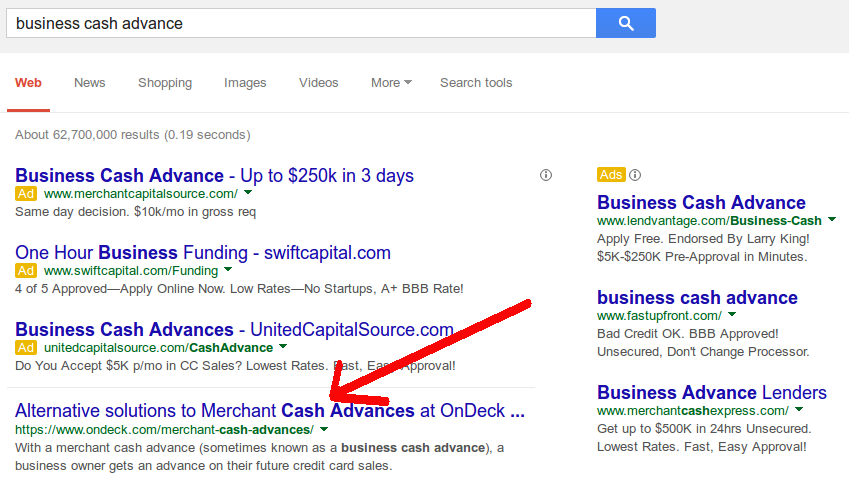
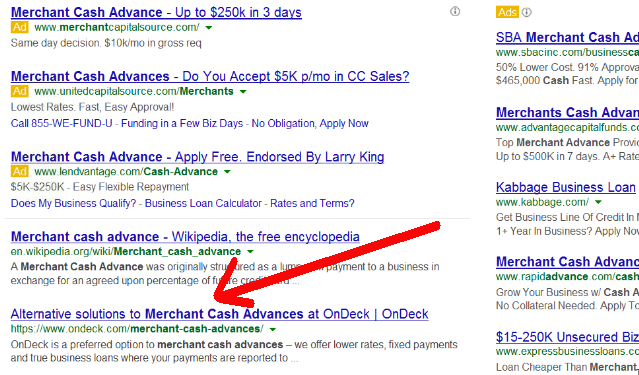
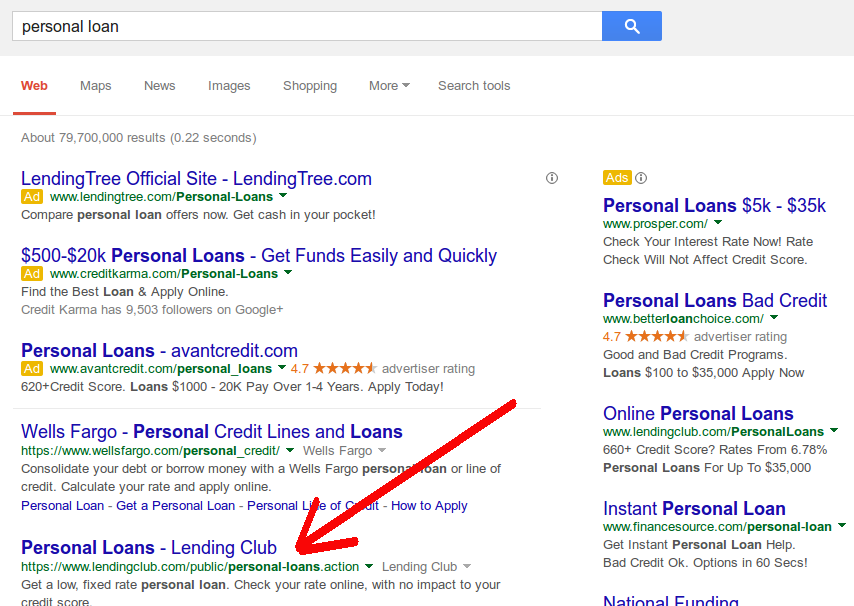

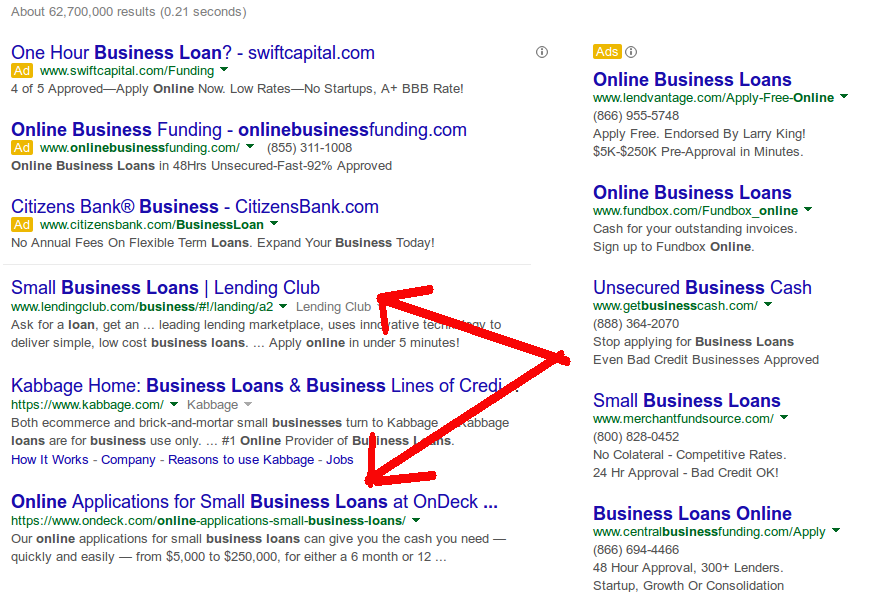

If you reproduce a search for the same keywords, you should know that results vary depending on what kind of device you’re using (mobile vs. desktop), what zip code you’re in, what time of the day it is, whether or not you’re logged into Gmail/Google+/Youtube, and whether you’ve searched for related topics before. I performed my searches with a fresh desktop browser on a Sunday evening in NYC with all cookies, cache, and Google account sessions wiped clean.
 You might not get exactly what I get and I realize that obfuscates the conspiracy I’m trying to establish here. If you do witness peculiar keyword domination though, keep an open mind that there might be more going on than good SEO and strong natural backlinking brought on by mainstream media publicity. Plenty of big businesses that dominate offline fail to rank well in the top ten results online.
Search engines say that if you’re popular, you’ll rank well. But there are plenty of cases where ranking well has made businesses popular.
Maybe, just maybe the game is rigged…
Google Penguin 2.1 Takes Swing at Merchant Cash Advance Industry
October 5, 2013 If you noticed a shuffle in search rankings for industry keywords last night, it’s because Google unleashed Penguin 2.1.
Penguin 2.1 launching today. Affects ~1% of searches to a noticeable degree. More info on Penguin: http://t.co/4YSh4sfZQj
— Matt Cutts (@mattcutts) October 4, 2013
Penguin focuses on spammy or purchased backlinks so if you did one or the other, you probably got harmed. Given the high cost of traditional marketing and Pay-Per-Click Internet Marketing, many funders, ISOs, and lead generators have turned to SEO to boost their visibility in organic search. Whether undertaken by inside employees or outside contractors to do the job, there is no doubt that building links has been part of the strategy. Some have had major success in rising up through Google’s search results but most haven’t. It’s not easy getting to page 1, but if you get there, don’t celebrate. You won’t be there forever.
Less than two weeks ago on DailyFunder, someone took to the board to pat themselves on the back for ranking #2 for the keyword: merchant cash advance. Wikipedia is #1. They admitted it took a lot of hard work over the course of 8 months. Last night they were thrust back to position #65. That’s on page 7 where they will never be found. 8 months of work for 2 weeks of ranking. You might be saying, “Well my SEO guy will just roll with the punches and get us right back.” Unfortunately with Penguin, it doesn’t work that way. Penguin is basically a permanent penalty, an algorithmic barricade to prevent you from ever ranking for your keywords again. According to a poll on Search Engine Roundtable, only 7% of respondents claimed to have made a full recovery after Penguin 2.0. Most SEOs would advise that you torch your domain, buy a new one and start a whole new website. That’s not exactly an easy thing for a big brand or company to do.
There’s a flaw in all the SEO being done in the merchant cash advance industry anyway and that’s the notion of being on page 1 to begin with. If you read David Amerland’s Google Semantic Search, he explains that “there is no longer a first page of Google”. The results you see on the first page of Google depend completely on whether or not you’re using a desktop or mobile device, what zip code you’re accessing the internet from, what you’ve searched for in the past, and whether you’re logged into your gmail account. And if you use Google+, then forget it! The first page results for someone that uses Google+ are ultra personalized. To rank on their first page, they’ll pretty much need to follow you socially first.
So if you’re thinking about ranking higher in search as a means to generate more leads, you sure as heck better understand how the results work these days. What you see on your screen is not what I see on mine. A site that’s #65 for me, may be #4 for you.
The other angle of Google’s foray into Semantic Search is their desire to be an answer engine, not a search engine. Google wants to answer questions for searchers without them having to click a link. Here’s an example of Merchant Processing Resource acting in that role:
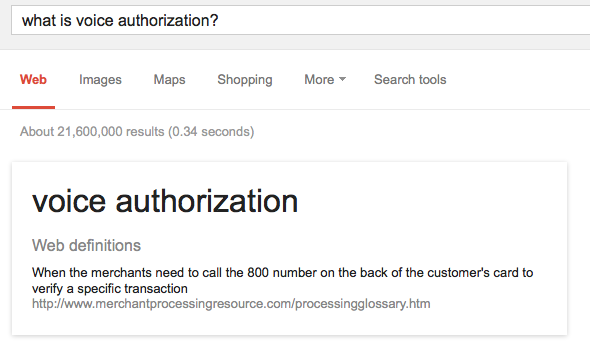
What is voice authorization you ask? Boom! Answered! No need to click anything. That’s where search is going. What this means for companies that are trying to get customers is that they either need to become the absolute authority within their industry or they need to throw in the towel and do Pay-Per-Click.
When I search for merchant cash advance from my desktop in NYC, 7 out of the top 10 results are not company pages, which is astounding considering how much effort companies are putting in to rank high for this keyword. I see:
- 1 Wikipedia
- 4 News articles
- 1 Press release
- 1 Youtube video
Did you get hit by Penguin 2.1? Are you optimized for Semantic Search?
Previous merchant cash advance SEO articles:
- Your Merchant Cash Advance Press Release May be Hurting You 8/8/13
- Is Google Your Only Web Strategy? 12/31/12
- The Other 93% 7/13/12
- Google Penguin Kills Survivors 5/6/12
- The SEO War Continues 4/4/12
- The SEO War for Merchant Cash Advance 2/12/12
Your Merchant Cash Advance Press Release May be Hurting You
August 8, 2013Part of keeping up with the merchant cash advance industry means reading up on the press releases published online, but it’s not such an easy job. Legions of funders, ISOs, and lead generators are competing for valuable real-estate in search results and they’ll use every trick in the book to get it. It almost always comes with a price and these tricks don’t always work. By tricks here, I’m referring to using optimized anchor text in press releases as a way to build backlinks.
 Have you ever seen a press release with thin information but lots of embedded links that say something like “best small business loan companies”? There’s a reason for that. These companies are trying to manipulate PageRank, a Google search ranking factor that calculates the value of the page the link is on, calculates the value of the website it’s on, uses the anchor text as a signal of what the page is about, and then passes that value onto the destination page. PRWeb has a solid PageRank of 7 out of 10 and last I checked, they don’t nofollow the links. That means a webpage can gain some serious ranking points by using optimized anchor text in a press release. But that’s just on PRWeb’s domain. Consider the fact that press releases are usually syndicated to tens, hundreds, or even thousands of other websites, most of which will keep the links intact, and multiplying the value being passed to the destination site.
One press release could result in hundreds of powerful ranking signals for the keyword, “best small business loan companies.” Now if there were on-page signals for that keyword and additional external factors at work, then there’d be no reason for that page not to rank high in search results for best small business loan companies. And so anyone not totally asleep at the wheel has been using that method for months, if not for years.
There’s only one problem. Google’s Director of web spam (yes, this is a real title) had said back in December of 2012 that links in press releases shouldn’t count.

The Internet went wild over this statement especially since his choice of words implied that there is a chance they did count, he just wouldn’t expect them too. Search Engine Optimization (SEO) diehards decided this was a battle worth fighting and optimized anchor text in press releases became more used than ever before, that is until Google decided to take action.
Wouldn’t expect was apparently proven to mean definitely does. The fact is that links in press releases were passing PageRank and the sites on the other end of them were getting valuable ranking signals. That’s why to this day we see merchant cash advance releases read like an itemized list of keywords on PRWeb…
The best merchant cash advance company has announced a new program to help provide bad credit business financing to restaurants in need of a fast cash loan.
If you’ve stopped reading the article at this point, you’re in trouble. The gravy train is no longer running express. Less than two weeks ago, Google conceded that optimized anchor text in press releases works and are a form of cheating the system. That means that overuse or quite possibly any usage of a keyword rich anchor in a release means your website is at risk of a rankings penalty. Google advises that in order to be safe, webmasters should nofollow the links. There’s just one problem with that; Credible wire and release services do not under any circumstances allow companies to code in HTML attributes in their releases, rendering this feat impossible.
That means the burden of nofollowing the links is on the release services and syndicating websites, something that isn’t likely to happen anytime soon. Release services have not been shy about the potential SEO benefits they can provide, with some going so far as to offer paid consulting services to clients on how to optimize their anchor text for search engines. To them, a crackdown on links in releases means a crackdown on a very profitable portion of their business model.
Watch Matt Cutt’s explanation of links in advertorials:
Google offers the following guidance on link schemes:
The following are examples of link schemes which can negatively impact a site’s ranking in search results:
- Buying or selling links that pass PageRank. This includes exchanging money for links, or posts that contain links; exchanging goods or services for links; or sending someone a “free” product in exchange for them writing about it and including a link
- Excessive link exchanges (“Link to me and I’ll link to you”) or partner pages exclusively for the sake of cross-linking
- Large-scale article marketing or guest posting campaigns with keyword-rich anchor text links
- Using automated programs or services to create links to your site
Additionally, creating links that weren’t editorially placed or vouched for by the site’s owner on a page, otherwise known as unnatural links, can be considered a violation of our guidelines. Here are a few common examples of unnatural links that violate our guidelines:
- Text advertisements that pass PageRank
- Advertorials or native advertising where payment is received for articles that include links that pass PageRank
- Links with optimized anchor text in articles or press releases distributed on other sites. For example:
There are many wedding rings on the market. If you want to have a wedding, you will have to pick the best ring. You will also need to buy flowers and a wedding dress.- Low-quality directory or bookmark site links
- Links embedded in widgets that are distributed across various sites, for example:
Visitors to this page: 1,472
car insurance- Widely distributed links in the footers of various sites
- Forum comments with optimized links in the post or signature, for example:
Thanks, that’s great info!
– Paul
paul’s pizza san diego pizza best pizza san diegoNote that PPC (pay-per-click) advertising links that don’t pass PageRank to the buyer of the ad do not violate our guidelines. You can prevent PageRank from passing in several ways, such as:
- Adding a rel=”nofollow” attribute to the < a > tag
- Redirecting the links to an intermediate page that is blocked from search engines with a robots.txt file
You can watch John Mueller, one of Google’s lead Webmaster Trends Analyst answer questions to Google’s new link policies in the hangout below:
There are other purposes for publishing thin releases as both Google and Bing can decide to display a snippet of the release on the first page of the results for the keywords used in the announcement. So no, it’s not just about links, at least that isnt’t all of the SEO benefit to be gained.

These news snippets can last up to a week, helping companies that might not be ranking well jump to the front of the line for exposure.
Link Removal
We’re not going to call anyone out by name but ever since Google Penguin 1.0 was released, many merchant cash advance companies and payment companies have hired link removal experts to identify bad links for them and are paying them to have them taken down. The only way to take down a link is to ask the webmaster hosting the site to take it down. Unfortunately, this has led to some companies finding the cheapest link removal service they can find, resulting in a poorly qualified consultant setting off to remove 100% of a site’s links instead of just the bad ones. We know this firsthand because we have had no shortage of e-mails from people claiming to be the hired link removal representative of a merchant cash advance related company.
The e-mails usually look like this:
Hello sir,
I am contacting you on behalf of Cash Advance Funder ABC and recently we have been instructed by Google to remove all of our links to have a penalty removed. Therefore we are asking that you remove our spam link from your website. We appreciate your immediate assistance in this matter.Sincerely
sfahfdspfu547@spamlinkremovalservicecompanyseobest.com
A great way to make sure your website never ranks ever again is to remove all your good links too. We can assure you that links on this website are not bad.
So…
In conclusion, if your hired SEO consultant is still banging away on optimized anchor text in press releases, there’s a good chance now that they’ll be causing damage over the long term. Press releases are for the purpose of making important company announcements and Google is on to anyone using them for any other reasons.
Your press releases might be hurting you with Google. Bing on the other hand…
Other SEO related articles on Merchant Processing Resource:
- Is Google Your Only Web Strategy?
- Google Penguin Kills Survivors
- The SEO War for Merchant Cash Advance Continues
- The SEO War for Merchant Cash Advance
../../
Is Google Your Only Web Strategy?
December 31, 2012Every business wants to be found in search. To most, being found means top placement in Google’s search results for keywords or phrases that are most likely to convert into a lead, sale, or customer. That begs the question… how does one get that top placement?
While many are now accusing Google of monopolizing or manipulating the search results to promote pages and products that earn them revenue, they are still unique in the sense that one simply cannot buy top placement in organic rankings. The Google search system was originally designed to rank pages based on both how many other pages linked to a page and how important those linking pages were. It was a relational system called PageRank that theoretically gave little guys a chance of being ranked alongside or even ahead of major corporations.
When it came to being talked about or linked to from other sites (these incoming links are called backlinks), mega corporations with large sums of money had a tremendous advantage. Media outlets seemed to always be linking to them naturally and they could buy linking ads on websites that didn’t. They could even buy backlinks on irrelevant pages just to up the ante. In 2011, Overstock.com was penalized by Google after one such linking scheme was discovered. Overstock was offering discounts to students and faculty that placed a link to their website on a school web page ending with .edu. It was believed that .edu top level domains (TLDs) carried far more weight than .com, .net, and .org. Overstock tried to capitalize on that.
Where a company ranks in the result listings can mean the difference between success and failure. For the mega corporations, millions of dollars in revenue can be gained by being listed 1st as opposed to 4th. The reality is that searchers tend to click on top results more often, ultimately leading to more sales for the companies that rank well.
According to a study conducted by Slingshot SEO, the top search result is clicked 18.2% of the time, whereas the last result (#10 on the page) is selected 1% of the time. These statistics make a few things clear. If you’re not on the first page, you might as well be in outer space. Additionally, a ranking on the first page must be for a search term or phrase that is frequently searched. Sure, we’re happy to be listed 4th for the search phrase “greatest merchant cash advance company in the world,” since it links to our free directory of verified MCA providers, but since no one is using that search phrase, it really doesn’t matter.

A hypothetical business does research and determines that 100 people per month are entering this phrase into the Google search bar: “I want a merchant cash advance this minute.” It looks promising because it shows that the end user is in buying mode. One could make the case that they are more likely to apply for business financing than a user searching for “the history of merchant cash advance.” 100 searches for the initial phrase might seem like an opportunity, but you have to make an effort to achieve a listing for that keyword, at least that’s what Search Engine Optimization (SEO) gurus will tell you.
All Hail the King
Since Google is the omnipotent dictator that determines where every website falls, there is nothing that can 100% guarantee a website will be visible for the terms and phrases a webmaster wants. There is no shortage of tips, methods, and tricks to boost the odds but all of those things require time, money, or both. Neither will get the webmaster far unless the Search Engine Optimizer (SEOer) knows how to modify a website, analyze search phrases, and implement a strategy to increase rankings. If the SEOer isn’t tech savvy, stay away.
The SEOer’s strategy will likely fall into one of two categories, white hat or black hat, but it’s important to note that wearing any kind of hat is technically a violation of Google’s Terms of Use. It’s easy to label an SEOer that places thousands of irrelevant comments with a backlink on blogs all over the Internet as a black hatter. But contrast that technique with a white hatter that does nothing more than write interesting articles and get them published on other websites with a backlink.
The latter may seem innocuous, but both attempt to manipulate Google’s algorithm and can lead to serious ranking devaluation penalties. A penalty can be crippling for a business that depends on acquiring leads or customers online. Worse yet, the webmaster is not tried before a jury of his/her peers before being sentenced to page infinity for all search terms. This is the downside of the playing field Google creates. John Doe business owner can be listed alongside multi-million dollar corporations and can enjoy that visibility to grow into a million dollar business themselves. But if it is Google that brought him into this world, it is Google that can take him out.
 In late April, 2012 Google announced they were cracking down on “blog networks.” This algorithm update became known as Google Penguin and hit the web like a hammer. 3.1% of all english search queries were affected. Penalized webmasters that paid to have self-written articles published on other websites to get the link juice were left wondering how the practice could be a violation. Analogies were used to explain that paying to promote oneself is standard business practice. They likened article marketing to the basic trade of journalism. They argued it was their constitutional right to promote articles without fearing the total loss of business or retribution from Google.
Google’s position though is that it is perfectly okay to link to a friend’s website or to pay to have articles placed elsewhere. They respect that those decisions are not theirs to judge in respect to the global Internet. However, if the intent (or perceived intent!) of these practices is to achieve higher ranking in Google’s search results, then they reserve the right to protect the integrity of their ranking system accordingly. Essentially, anyone can do what they want, but it might affect how things are scored within their private system. So if you don’t care about your valuation in Google, you can use all the linking schemes in the world if you so choose. The problem is that most people do care about their score in Google and many people view Google as the global Internet. Google can argue that they are simply policing their own private system but to millions of web users around the world, they are viewed as policing the Internet.
The Revolution
It’s not their fault. Google’s system was so good and their interface so simple, that millions of people started using it and never went back. They became the Internet. Search engines existed previously but had many flaws. Back then, millions of websites that provided answers to questions or sold solutions for problems went undiscovered to the vast majority of humanity. Google found them, ranked them, and then went on to check them frequently to make sure users were still likely to find what they wanted.
They made the world a better place until the laws of their kingdom began to contradict common sense. For example, it would seem practical for a video game company to buy a banner ad on a video game enthusiast web forum. They could benefit from the targeted traffic and hopefully sell some video games. But at the same time, Google might view this banner link as an attempt to manipulate their algorithm.
 To resolve this dilemma, Google created a tagging system to allow their search crawlers to identify which links were paid for and then direct their algorithm to make sure the buyers did not benefit in search from them. This directive was controversial because it forced webmasters that cared about their rankings to worry about the nature of their outbound links. Could a website selling banner ads hurt both the buyer and the seller at the same time? They sure could. If buying and selling backlinks is forbidden, then both parties have something to worry about. Today, it is important to include the rel=”nofollow” attribute in html coded links that are paid for.
Since the majority of web users use Google in some way, the challenge and effort to achieve better placement has become a billion dollar industry. Prestigious advertising firms claim they can improve search placement using white hat guidelines Google itself created. The fact remains that there is no way to be safe, no matter how prestigious, knowledgeable, expensive, or innocuous the SEOer is. Having a page on a website that discusses a topic that another page on the same website already talks about can be grounds for a penalty. Interlinking your pages too much can be grounds for a penalty, discussing too many broad topics can be grounds for a penalty. Writing with imperfect english can be grounds for a penalty. Mentioning your product or service too many times in an article or throughout your website can be grounds for a penalty. Not using enough visual aids such as images or videos can be grounds for a penalty. Adding new content to the website too frequently can be grounds for a penalty.
Everybody’s Doing it
 Smart webmasters approach the web like their health. Do everything in moderation. It seems like every year there is a study that proves a correlation between a daily household food item with a certain untimely death. We’ve all heard something like this before: “The study determined that people that eat less than 2 carrots a day are more likely to die before the age of 70 than people that eat 2 or more carrots per day.” It’s the kind of fear mongering that causes someone to worry obsessively about meeting the 2 carrot daily minimum only to get hit by a bus as they cross the street three decades before they turn 70. Webmasters can spend their days worried about how Google will view them and ultimately never be found by their potential customers or they can do what everyone else does and work on getting backlinks and add content to their websites.
Is a compliant website that is never found by customers better than a website that has a good run, makes a lot of money, but takes the risk of getting penalized in the end? Some believe it is better to have loved and lost than to have never loved at all. Afterall, an online business that has no web visitors is not really a business is it?
 White hatters, the SEOers that wrongly believe they are immune from repercussions argue that their strategies take far longer to create results because they are in it for the long haul. Coincidentally, these long-haul strategies tend to have a high monthly price, do not guarantee results, and cannot predict what changes Google will make in the future. For example, if an SEOer says their slow and steady method will take 6-12 months, the webmaster should understand that the ranking algorithm could change in 5 months. All the work performed could be rendered obsolete in the blink of an eye or worse, devalue the ranking further from where it was originally.
In the quest for a quick fix or even as part of a long-term strategy, SEOers can’t help but notice that websites maintained by news media seem immune to all the rules. They republish countless amounts of duplicate news reports and they buy and sell exposure like its going out of style. In a way, they are a multiplied version of everything Google says not to do. But while they might get tons of traffic from search engines, they are not entirely dependent on them. Big news media has incredible brand name recognition. An individual seeking information about the Fiscal Cliff may simply type “CNN.com” in the browser address bar and bypass Google altogether.
Companies like Reuters, The Wall Street Journal, Fox, and CNN, etc. are highly authoritative and could be categorized as the holy grail of backlinks. If one of the major ranking factors is the importance of the website the link is on, then there is nothing more important than being mentioned by national mainstream news media. The media outlets know the perceived value of their links and are hungry to find new streams of revenue. Thus, an opportunity presented itself to them just as printed newspapers began going the way of the dinosaur. And so they began to peddle link juice.
The age of buying links is not dead and it is now much more difficult for Google to punish the parties involved. Webmasters can pay public relations firms to get a “company press release” published on big news media sites and get the backlink of course. This tactic has been around for years but it has become one of the last great bastions for white hat SEO. Others would argue that social media is the next frontier but for SEOers grinding it out in the trenches, traditional backlinks seem to work better above all else.
Many public relations firms have been warned by Google not to promote the backlinking aspect of their service, but all of them offer some kind of SEO package to target webmasters that are interested in using their service for the purpose of link juice. Searchengineland.com ran a great article that exposed what the press release as SEO tactic revolution has done to the news. (http://searchengineland.com/how-prweb-helps-distribute-crap-into-google-news-sites-140597)

There is now a surge in boring, irrelevant, and oftentimes non-sensical company announcements on big media sites across the Internet. It is a popular SEO method in many fields, making it difficult to find actual industry news amongst the clutter of backlink driven stories.
But if it works, then why stop? That of course implies that it works in the first place. Several days ago, Matt Cutts, the director of Webspam at Google informed inquisitive webmasters that links in these press release articles DON’T COUNT. Helpful SEOers explained to the original poster that most links in press releases have the no-follow attribute added to the links to make sure that they don’t pass juice. Upon our own examination however, we couldn’t find any news media or public relations firm that implements no-follow. It would probably hurt their bottom line if the junk releases they were peddling suddenly didn’t count for anything.
The debate rages on about whether or not the director of Webspam is to be trusted. Is the ranking algorithm as powerful as Google claims it is? Or are they spreading fear and misinformation to make up for their shortcomings? There is a lot of interesting feedback to consider in the comments section of seroundtable’s short article regarding press releases.
In the past, many webmasters have used obvious black hat techniques for favorable placement and gotten burned in the end. Many innocent websites have been caught in the crossfire. Success on the Internet is believed by many to be achieved only by being visible on Google.
The War
Individuals that have never managed a business website in their life have little idea how Google works. They know it will provide them with the answers they’re looking for and rank them in order from best to worst. To everyday users it is nothing short of magic. To an SEOer, being #1 for a search term may mean weeks, months, or years of trial, error, and patience. It requires time, money, or both. It is a tireless quest to become #1 or to die trying. It is the difference between getting 18.2% of visitors for a keyword searched 5,000,000 times a month or 1% of visitors for a keyword searched 100 times a month. It is a battle against not only Google, but against competitors in the same field that are using the same tricks to move up. It is a system that gives little guys a chance to be ranked alongside major corporations. It is way to be found in the sea of a trillion websites. But it is also a dictatorship. Google can sneak into your house in the middle of the night and banish you to page 50 with the accusation that you were buying backlinks. Google can lock the front door of your virtual store to prevent shoppers from getting in. Google can label non-native English speakers as spammmers and silence those that won’t stop writing about the same thing over and over again. This is the challenge with a single company being tasked with policing the entire Internet.
The Perks
 There are alternatives out there like Bing and Yahoo, but the problem is that when people go to those sites, they tend to type Bing or Yahoo into Google just to get there. Such is the habit these days for getting anywhere on the web. In 2008, blogger Marshall Kirkpatrick wrote about this phenomenon. He argued that mainstream users of the Internet do not even know how to navigate it. While tons of responders to the article seem to agree, there are plenty of folks that make a compelling case as to why using a search engine is superior to a browser’s address bar.
It isn’t easy typing ../../ perfectly if you’re a fast typer, which might explain why a significant portion of our visitors type this url into Google instead. They want to get to the right place the first time even if they type it in wrong. They might not even be exactly sure what our website is called or how to spell it. It’s not uncommon to see incorrect urls somehow end up in our traffic reports anyway.
- Merchant Processing Esource
- Merchant Processing Source
- Merchant Processing Resources
- Merchant Proccesing Resource (2 Cs or 1s)
- Merchant Processor Resource
The list of mistakes continues, but Google points them in the right direction anyway. If this didn’t happen, we might seriously consider rebranding the site with a much shorter domain name. Unfortunately, in mid-2010 when Merchant Processing Resource started, we didn’t give much thought to the difficulty in remembering a 7-syllable name, nor the likelihood of miskeying a single character in a 34 character address (www.merchantprocessingresource.com). This shove in the right direction is a benefit that an address bar can’t offer.
Not Evil?
The user oriented focus of Google arguably ended once and for all on May 19, 2010, the day they went public. While #6 on the list of Google’s official philosophy is that “You can make money without doing evil,” shareholders may have qualms with #1. It states, “Focus on the the user and all else will follow.” This motto doesn’t scream maximum profit. Besides, being public doesn’t allow Google to focus on the user, but instead tasks them with increasing the value of their stock. Of course they can’t earn a profit if they disregard the users altogether and so they are faced with the challenge of maximizing profit without alienating their users.
Adhering to their own philosophy is tricky, not to mention that many state and national governments believe that Google is manipulating the results to promote their own products. Products? one might ask; What possible products does Google have? Oh you mean you haven’t heard of Maps/Earth, Youtube, Zagat, Google Reviews, Google Plus, Gmail, Blogger, Picasa, Google Wallet, Translate, the Droid OS, driverless cars, the Chrome web browser, or the many other products they control?
Google isn’t content with just controlling search. They want to control the entire Internet experience. Companies like Facebook threaten that monopoly and as such Google has made social networking a top priority to counter them. Not evil?
The Google universe is exhausting. Webmasters must do more than just design great websites to continue enjoying the luxury of being found. Paid links must be marked as no-follow, backlinks on bad websites must be disavowed, private pages must be marked as no-index, similar or duplicate content must be avoided, URLs must be descriptive, title tags should be relevant, HTML should be used over Flash, and moved pages should be redirected if for no other reason than to retain the page value of the original URL.
Is There Life After Dea.err…Google?
As we draw near our conclusion, we argue that Google continues to play a large role in Internet Marketing, but advise that Google is not the Internet, no matter how much you’ve come to believe otherwise. There is LinkedIn, Facebook, Twitter, web forums, blogs, email newsletters, and a zillion other places to promote oneself and be found. Too many people fail to utilize the infinite other opportunities to market themselves online simply because they believe ranking in Google is the only way or because they’ve received a penalty and give up. “Getting ranked” has become an all consuming challenge that blinds webmasters from their true goal of attracting customers. People bought products and services online before Google came around. They might make things easier for the average user that believes search results are a product of magic, but in reality they are just one of many systems to find things. They are an imperfect ecosystem that has become tainted by their motivation for profit. And let’s not forget the millions of white hatters and black hatters that are driving the algorithm wild as they seek better placement for themselves or their clients.
Do we care about Google? Certainly, but only about half of our visitors originate from the search engine. People actually see us mentioned on LinkedIn, Facebook, and actual trade publications. And guess what? Those people visit us, bookmark us, and return. There may come a day when Google decides too many incoming links from Facebook is grounds for a penalty, causing outrage among webmasters, a move that might force many to give the social network up, and even disavow it officially. White hatters could end up having to eat their white hats down the road. The whole system of the Internet will no longer seem to make any sense. Maybe a reality check is okay. Perhaps too many hours and megabytes are wasted on trying to gain favor with Google. So much junk exists out there these days that isn’t even meant to be read or followed, but rather exists for the sole purpose of gaining link juice. If a poorly designed website in China links to a good website in the U.S., should the webmaster have to spend time tracking it down, identifying it, and disavowing it just to appease the king? Does this make any sense?
The next time you spend $300-$500 on a press release with carefully crafted link text, think about whether or not Google is really going to reward you with placement for a search term. Their director of Webspam says you’re not going to score any points, yet you may believe otherwise. Consider how else that money could be spent online outside the context of Google SEO. Are you looking to attract customers or simply gain favor with a king that MIGHT lead to customers? Imagine for a minute that Google, Bing, and Yahoo have banished you from being found forever. Would you close up shop or start to think outside the box?
White hatters that read this may be mumbling to themselves that they need not think this way because they have a surefire strategy that works, something along the lines of “Content is King.” This “Content” revolution involves publishing tons of articles to ones website to give the impression to Google that a website is constantly being updated with helpful information. An SEOer will tell you that Google “wants” this. In reality though, this has created a new phenomenon, the practice of webmasters spamming their own websites. The content may be informative, well written, and on-topic but if it’s being done to please Google instead of making sales or helping visitors, then it’s really nothing more than the black hat trick of the day. “Content is King,” that is until it’s not because 100 million websites are doing the same thing, leading to a vast pile of junk in cyberspace.
People forget that the word ‘marketing’ exists in Internet Marketing. They focus their time and effort on Internet Manipulation. They either have systems to make a quick buck or they slowly march onwards towards a promise that can’t be kept. As we approach 2013, it remains true that Google can’t be ignored, but the rest of the global Internet shouldn’t be either. There are billions of people out there that are looking for what you offer and you need to learn how to reach them. Coincidentally, there are 100 million articles on the web that claim they can teach this very trade. 99 million of them exist for the purpose of getting a backlink. That means the information is questionable at best. Take a marketing course, read a marketing book, or hire a marketing consultant. Go back to the basics if you must. Plan for the day where you won’t exist in search even though your business exists in real life. If the moment comes where Google replaces the search results with only paid advertisements or you get penalized because you told all of your friends to link to your website, you can shrug it off. If you want to be in Internet Marketing for the long haul, stop thinking about search. Google can’t be your only web strategy forever.
– Merchant Processing Resource
../../
Find tons of great Matt Cutts memes here

A Great Thread That Discusses Business Survival Without Google