Kabbage Extends Credit Lines to $250,000
February 2, 2018 Kabbage, the online business lender, is now offering credit lines of up to $250,000, which it says is the largest credit line available from any online lender and will allow the company to expand its customer base to serve larger companies.
“Increasing our lines of credit to $250,000 significantly enhances our ability to solve financial hurdles for larger and more specialized businesses,” said Bob Sharpe, COO of Kabbage.
The company finished 2017 having crossed the $4 billion threshold for loans issued to more than 130,000 small businesses. And its Chief Revenue Officer, Victoria Treyger, told AltFinanceDaily back in December that loans were getting larger.
“Our lines of credit and amounts taken continue to increase as we begin serving more and larger small businesses,” she said. “We see great momentum across all industries in all 50 U.S. states.”
Back in September, the Atlanta-based company received an investment of $250 million from Japanese telecommunications company, SoftBank, and the company has been thriving.
By the end of last year, it had lent a total of $4 billion since it was founded in 2009. According to American Banker, Kabbage worked with its banking partner, Salt Lake City-based Celtic Bank, to develop the larger line of credit.
Kathryn Petralia, Kabbage’s president and co-founder, is excited about this new development.
“[This] helps us close the capital gap that businesses encounter today,” she told American Banker. “It allows us to better the customers we have who qualify for more credit.
Kabbage Crosses $4 Billion in Loans, Taps C-Suite Exec for Intl Expansion
December 6, 2017
Alternative lender Kabbage is exiting 2017 with a bang, having just crossed the $4 billion threshold for loans deployed across more than 130,000 small businesses so far. The latest milestone represents a 30% spike in both total funding and the number of merchants on its platform since April 2017, which is when they celebrated their previous new threshold. Victoria Treyger, chief revenue officer for Kabbage, took some time to talk with AltFinanceDaily about the latest milestone, international expansion and mobile strategy.
“Our lines of credit and amounts taken continue to increase as we begin serving more and larger small businesses. We see great momentum across all industries in all 50 U.S. states,” Treyger said, adding that the momentum is particularly evident among the restaurant, construction, professional services and automotive industries for funding strategic investments such as new locations, specialty equipment, business expansion, etc. The $4 billion milestone is the result of the company’s direct business in America only.
According to recently released data by Kabbage cited in CrowdFund Insider, nearly three-quarters of 400 small business owners polled are forecasting higher revenues by year-end. More than 50% of those merchants are targeting a jump of at least 10%. Kabbage certainly appears to be benefiting from this optimism and an economy that is functioning on all cylinders. Treyger points to the lender’s “fully automated lending process and unique, live data connections with our customers.”
Fintechs & Banks
The relationship between alternative lenders and banks has been at the forefront, and Kabbage has been involved in some of the most high-profile pairings, evidenced by SoftBank’s famous investment. And while there’s no crystal ball, fintech and bank partnerships are one of the trends that will likely persist in 2018.
“Data will be at the heart of everything, how it’s shared, accessed, applied, protected and given back. Expect to hear more about the personalization of lending and to see stronger partnerships between fintechs and banks,” said Treyger. Consumer data, of course, is the Holy Grail for lenders, with banks having a tendency to keep that information close to the vest. And with the Equifax breach so recent in the rearview mirror, the importance of data security is certainly paramount.
“The CFPB recently published data-sharing guidelines between banks, their customers and financial services they choose to permission their data. Kabbage applauds the CFPB guidelines, small business owners should control how, where and with whom their data is shared to best serve their needs. Security is the primary concern, as it should when handling customers’ data. All entities, from fintechs to data aggregators should be held accountable to the same security standards as banks,” Treyger said.
She also pointed to a mobile push in yet another sign that the industry has turned a corner. “Anticipate greater adoption in mobile lending. Today, approximately 20% of Kabbage’s originations come from mobile. We’re the only provider that allows its customers to apply, qualify and draw funding from a mobile app; we have seen growth and expect to see more in 2018,” she said.
Kabbage’s Global Ambitions
Meanwhile, as Kabbage sets its sights on global expansion, they’ve tapped a C-Suite executive from the consumer goods industry who has held leadership roles across North America, Europe and Asia. Robert Sharpe was tapped for the newly created position of COO at Kabbage. Most recently, Sharpe served as president and COO at National DCP, LLC, a supply chain management company. He has also led CSM Bakery Solutions and Spain’s Campofrio Food Group, serving as chief executive at both companies.
According to the press release: “Sharpe will be responsible for Kabbage’s continued growth and operational oversight as the company expands internationally and scales its services to serve more and larger small businesses.”
As Kabbage readies its 2018 roadmap, notwithstanding its $200 million revolving credit facility with Credit Suisse in November, don’t be surprised to see them revisit the capital markets.
“Continuing to diversify our funding options for small business lending is certainly of interest,” noted Treyger.
Kabbage Taps Debt Capital Markets for a Cool $200 Mil
November 16, 2017 Kabbage has been accessing the capital markets fast and furiously, most recently on the debt side. Today they’ve announced a new $200 million asset backed revolving credit facility with Credit Suisse. Just a couple of months ago, Kabbage attracted $250 million in equity to its coffers from SoftBank, which the alternative funder will direct toward ongoing operational expenses and expansion.
With the Credit Suisse deal, the tally for Kabbage’s debt funding capacity reaches $750 million. “The new revolving credit facility will be issued by Kabbage Asset Funding 2017-A LLC, a wholly owned subsidiary of Kabbage Inc,” according to a press release.
Kabbage expects the credit facility will help them to scale faster. They plan to use the credit to add bigger small businesses to its client roster as well as extend higher lines of credit with longer durations.
“The new revolving credit facility with Credit Suisse is a debt round. Those funds are for our small business customers, and will be used to continue to provide them with easy access to working capital,” Deepesh Jain, Kabbage Head of Capital Markets, told AltFinanceDaily.
It’s Kabbage’s maiden credit facility to be rated by credit rating agency DBRS. “The top two classes of the multi-class transaction earned investment-grade ratings of ‘A’ and ‘BBB’ and are collateralized entirely with assets originated through Kabbage’s fully-automated underwriting technology,” according to the press release.
Jain told AltFinanceDaily the DRBS rating is highly significant. “It strongly demonstrates the proven success of Kabbage’s fully-automated platform and its data-driven risk analysis for small business lending. It speaks to the company’s leading position in the SMB-lending marketplace and Wall Street’s confidence in Kabbage,” he noted.
As Jain pointed out, Credit Suisse has been an early supporter of fintech. Indeed, the Swiss bank a year ago similarly provided a $200 million asset-backed revolving credit facility to another alternative funder, OnDeck.
Alternative Funders and Bank Partnerships in the Spotlight
Jain declined to comment on whether Credit Suisse might be interested in Kabbage’s lending platform for its own use. Alternative funder and banking partnerships were recently thrust into the spotlight with a lawsuit filed by a Massachusetts-based small business owner against Kabbage and Celtic Bank, which have had a partnership for at least several years.
The lawsuit alleges that the funding model of the defendants “was designed to evade usury laws,” according to The National Law Review. Apparently, the plaintiffs, which are listed in the public filing as Alice Indelicato and NRO Boston, had several small business loans and now accuse Kabbage of “renting” Celtic’s bank charter. Jain declined to comment on the lawsuit and the plaintiffs couldn’t be reached.
Capital Markets Pipeline
Meanwhile, at the rate they are going, we could see Kabbage tap the capital markets again in 2018. “Capital markets are something we will continue to explore to further diversify our funding options,” said Jain.
Kabbage’s Petralia Talks Big Tech, Fintech and Lending
October 2, 2017 Kabbage co-founder and head of operations Kathryn Petralia was in New York last week for The Economist’s Finance Disrupted 2017 conference where she was a panelist on in an Oxford-style debate about whether tech giants Alibaba, Amazon, Apple, Facebook and Google pose a greater challenge to traditional banks than the fintech startup community. Her position is that no, they do not, and there appears to be room for both.
“Fintech can be anywhere. Alternative lenders, whatever you want to call them, I think they’re disrupting the space but not by trying to put people out of business. In our case we make loans to small businesses, but these are folks that are having a hard time borrowing from banks. So, we’re not taking business from banks. We’re drawing the circle a little bit bigger around access to capital.”
It’s only been a few weeks since the blockbuster announcement that SoftBank is investing $250 million into Kabbage, which thrust the small business lender into the spotlight for a few reasons, not the least of which was the more than $1 billion valuation that has been speculated for Kabbage.
This valuation, of course, is in stark contrast to that of OnDeck, which also lends to small businesses. As Petralia points out, however, OnDeck is a very different company than Kabbage and in fact not a very good comparable at all. For instance, Kabbage has never turned to brokers to find customers, and their application process has been fully automated since day one. She highlighted other differences too.
 “All of our bank partnerships are technology integrations where our technology sits in their systems. They use our technology to deliver the customer experience. And I think what SoftBank saw in us was that potential. Whatever the valuation was I can assure you it was a result of a lot of due diligence on the part of SoftBank,” she said.
SoftBank may now be sitting on Kabbage’s technology but they’re also sitting on a vast treasure trove of customer data that Kabbage may gain access to in the future.
“Certainly, that’s something we’re interested in and that’s something they talked with us about. They have a lot of access to a lot of businesses in global markets certainly in Asia including Japan and India, so I think we’ll see more relationships forming from that alliance over time,” said Petralia.
And the SoftBank deal seems to support Kabbage’s ambitious expansion plans. “We always thought we would be in almost all of the global markets five years from now. SoftBank is a continuation of our strategy for growth.”
As Kabbage pursues its aggressive growth strategy, it’s hard to ignore some of the headwinds other industry players have experienced.
“I don’t think anyone’s immune to macroeconomic changes and changes to access to the debt markets. Our focus is on technology automation from the beginning, and I think that gives us an advantage in the way we manage our customer base. Debt investors can see it, the ratings agencies can see it. One problem with a lot of the lenders is that they’re not able to access the debt markets because there’s not enough history or their portfolios haven’t performed the way they need,” said Petralia, adding that Kabbage has had the benefit of time on its side.
Kabbage’s vision is to “dynamically deliver products that small businesses need to run their businesses and to stay connected to the data that drives the underwriting process for lines of credit,” Petralia says, adding: “This could be growth capital and it could be other products and services that work around small businesses, whether it’s data processing or insurance or payments, any of those things. We want to deliver big business tools to the little guys.”
In terms of customer interest rates, everybody would rather have a lower rate Petralia says, but customers in their ROI equation know they will be able to generate more revenue to offset that. And Kabbage doesn’t require small businesses put up any collateral, which is what a bank would require them to do.
Kabbage’s Culture
Meanwhile in addition to industry headwinds some funders have experienced company-specific issues that had more to do with internal culture than any macroeconomic influence.
“From our perspective, culture is incredibly important. We were No. 16 for Glassdoor reviews for mid-sized businesses and that’s because employees really enjoy working here. If I had to characterize our culture with one term I’d say connected – our employees are connected to one another and to our customers. There is transparency and trust and a culture of caring deeply about one another. That’s really important to us,” said Petralia.
As for future growth avenues for Kabbage, there’s a lot of stuff in the works none of which she was at liberty to discuss.
Marcus Lemonis Rebuked Kabbage on Twitter
August 3, 2017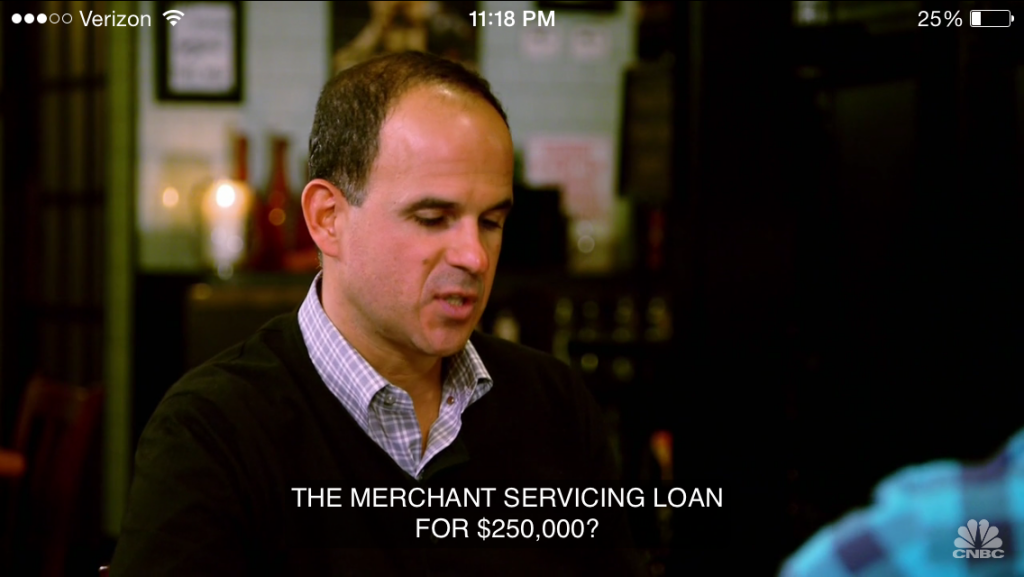
While the fintech community heralded Kabbage’s $250 million Series F round this morning, small business fixer and CNBC TV star Marcus Lemonis was not impressed.
On twitter, Lemonis wrote to Squawk Box host Carl Quintanilla, who was airing a segment about Kabbage, to say that Kabbage charged ridiculous rates. The short rant, which totaled 4 tweets, zinged Kabbage by calling them a lender of last resort and “not a friend of small business.”
Wouldn't call @KabbageInc #kabbage a lender. Ridiculous rates @carlquintanilla @SquawkAlley
— Marcus Lemonis (@marcuslemonis) August 3, 2017
Not a friend of small business. Lender of last resort with fees and rates
— Marcus Lemonis (@marcuslemonis) August 3, 2017
@SoftBank likes the high rate account sweep tactics
— Marcus Lemonis (@marcuslemonis) August 3, 2017
He should be glad I'm not there
— Marcus Lemonis (@marcuslemonis) August 3, 2017
Though Lemonis did not respond to my tweet that asked him if there were any online lenders he thought positively of, he likely is no stranger to the phenomenon. Last year, I pointed out that several small businesses that have appeared on his show, The Profit, have used nonbank alternatives.
In Season 3, Da Lobsta, a Chicago Sandwich shop, reported owing $140,000 to an internet lender and $40,000 to Square.
Square Capital, which has since traded merchant cash advances for actual loans, reported making 49,000 loans to small businesses last quarter alone for a total of $318 million. Kabbage, meanwhile, has lent $3.5 billion to more than 115,000 small businesses in their lifetime.
Kabbage’s Next Growth Phase
May 9, 2017Victoria Treyger, Chief Revenue Officer, KabbageWhen you consider the recent milestones Kabbage has achieved it makes it difficult to think of the fintech lender as a startup. In recent weeks Kabbage surpassed a couple of major milestones comprised of extending $3 billion in funding to 100,000-plus small businesses. More than half of those loans were directed toward existing credit lines. Kabbage also recently priced a $525 million private securitization, which tips the company’s hand on strategy.
After barely letting the paint dry on those achievements, Kabbage already has the next phase of growth in its sights. Victoria Treyger, Kabbage’s chief revenue officer, took some time to discuss those details with AltFinanceDaily, ranging from serving larger businesses with bigger loans, to expanding its partnerships to providing more niche-based features to customers.
Kabbage is pursuing its growth plans all while performing a confidential search for a new chief technology officer, details for which are expected to unfold in the coming months.
Personal Touch
As chief revenue officer, Treyger oversees the customer experience across both sales and marketing. She describes the Kabbage experience as a cross between a loan and a credit card.
“Ours is a living, breathing product that automatically adjusts for the needs of a business. Once you apply with Kabbage and link your data sources, you never have to do anything again,” said Treyger, pointing to the example of an ad agency. “If you’re an ad agency your highest cash needs are January through March. That’s when the agency’s customers invest their marketing budgets. So the Kabbage credit line automatically adjusts your credit line during your busiest time.”
And while most customers already take out multiple loans per year, with some accessing as many as 10-20, Kabbage is looking to streamline the customer experience even more. “The next stage of Kabbage is about personalization,” said Treyger, pointing to its automated underwriting platform that is connected to over a million live data points about business’ performance and allows the company to understand the cash flow needs of customers across industries.
Kabbage’s sales and customer service teams are also staffed with team members possessing industry vertical expertise ranging from e-commerce to construction.
Partnership Pipeline
At the LendIt USA 2017 event, Kabbage co-founder & CEO Rob Frohwein alluded to the online lender’s plans to reach new territories, details for which were scarce. Treyger shared, however, that Kabbage’s global growth plans are somewhat tied to the company’s pipeline of banking partnerships.
“They are all very large, global banks. I can’t say who they are but there are over half a dozen large relationships that are in the works,” said Treyger, adding that details surrounding those new partnerships will unfold over the next year.
“It’s not that banks don’t want to serve smaller small businesses. But with manual processes they often don’t have the capacity to serve these customers. Kabbage’s automated platform allows them to automate these manual processes and therefore serve more businesses of every size,” said Treyger.
Kabbage already counts as partners household names including Santander, ScotiaBank, and ING, all of which license software from Kabbage. Meanwhile, as big banks are accessing smaller businesses, Kabbage’s growth blueprint includes serving larger ones.
For instance, Kabbage is drawing on its recent $525 million securitization to fund small business loans. The credit facility is larger than previous deals, and for a good reason.
“One reason it is larger is that it was designed to support Kabbage in expanding our product offering to serve larger small businesses, which means two things — larger credit lines of $150,000 to $200,000 and eventually higher; and also longer-term products, not just six-to-12-months but 24, 36 months and different terms. The new larger facilities allows us to expand to serve even more small businesses across all size and funding needs,” said Treyger.
Early Innings
Meanwhile in terms of the small business community’s awareness of fintech and tech-based lenders, Treyger believes the industry is in the early innings. “That’s a great thing. There is a tremendous growth opportunity for the company,” she said.
If Kabbage Wanted to Buy, Would OnDeck Sell?
March 24, 2017 A single line in a Reuters story was enough to cause OnDeck’s stock to jump by as much as 11% on Thursday. Industry blogs and news outlets had reacted pretty quickly to word of an unnamed source claiming that OnDeck is a potential acquisition target if Kabbage raises a new equity round. OnDeck closed for the day up only 6.5%.
BloombergGadfly columnist Gillian Tan, wrote that a deal was not very likely because of how much investors are already down since the IPO. “Assuming Kabbage were to propose a traditional takeover at a standard premium, it probably would be swiftly rejected by On Deck’s earliest investors, who still own a combined stake of more than 45 percent, according to data compiled by Bloomberg,” she wrote. “With the stock trading at less than a quarter of its 2014 initial public offering price, it would take a generous premium to get them interested.”
OnDeck also lent nearly twice as much as Kabbage last year and obviously still has faith in leadership considering that their pre-IPO CEO is still in charge. There’s little to suggest at this time that OnDeck would be willing to throw in the towel and sell out to a smaller, younger competitor and book a big loss for shareholders who have been with them since the beginning.
The day before the rumor started, OnDeck actually announced that it had increased its asset-backed revolving credit facility with Deutsche Bank by approximately $52 million to a total of up to approximately $214 million.
Citing Unnamed Sources, Reuters Reports Kabbage Possibly Looking to Acquire OnDeck
March 23, 2017 Reuters is reporting that Kabbage is in talks to raise equity capital to potentially use for acquisitions and that OnDeck is one of several targets under consideration. As Reuters attributed the OnDeck portion to just one of their multiple unnamed sources, it’s entirely speculative at this point.
From a theoretical perspective, would such a thing make sense?
Kabbage has momentum on their side right now. Their recent half billion dollar securitization that was finalized earlier this month was oversubscribed. Although they only originated about half the loan volume of OnDeck last year, Kabbage’s last private market valuation ($1 billion in Oct 2015) is nearly 3x as large as OnDeck’s current market cap.
Valuations in the industry have changed a lot over the last 18 months but there’s no doubt that Kabbage has become a unique competitor. At LendIt, company CEO Rob Frohwein revealed a bit of their secret sauce when he said that their customers borrow from them on average 20-25 times over the course of 4 years, whereas their competitors make only 2.2 loans to their customers on average.
There is a general view in this industry that acquiring a competitor adds little value other than more marketshare. Kabbage, however, may potentially believe that (1) OnDeck is too undervalued to pass up (2) That OnDeck could generate better margins using Kabbage’s strategy (3) That OnDeck’s partner relationships would add additional value (4) That the company cultures are compatible enough to make an acquisition work (5) that the combined entity would allow them to better align their political and regulatory agendas.
We mustn’t forget however that a single unnamed source is pretty weak to go off of. One possible reason that someone would want to report that OnDeck is an acquisition target is to cause a temporary spike in their stock price. (and I certainly do not have any position in the stock)
For now, it’s fun to think about such an acquisition scenario and we’ll report more, if and when we hear anything.