
Fundomate Announces $50 Million Line of Credit to Bring Embedded Automated Funding and Real-Time Banking to Payments and SMB Marketplaces
September 30, 2021
Los Angeles, September 30, 2021 — Fundomate, a leading embedded finance provider of automated business funding solutions and real-time banking tools for merchant-facing platforms, announced the closing of a $50 million line of credit with Revere Capital today. The new line of credit is Fundomate’s largest to date.
Fundomate will leverage the credit facility to scale up its partnerships with merchant-facing businesses and grow the company’s new white-label banking platform. The platform enables merchant-facing platforms and marketplaces to rapidly expand their product suite and enhance engagement by offering automated financing and embedded banking tools under their own brand.
 “With the closing of the $50 million credit line, Fundomate can scale its proven automated funding platform via its one-touch funding tool already embedded within 100+ payment processing partners and marketplaces”, says Sam Schapiro, CEO and Founder of Fundomate. “We’re excited to also focus on our new embedded real-time banking platform, which uses AI and advanced forecasting to provide our partners the ability to offer their customers free short-term working capital that’s available for immediate use.”
Revere Capital Managing Director Christopher Gilker said, “We’re incredibly excited to grow with Fundomate. As I tell all my colleagues, Fundomate is a company at the right place at the right time. The team is ambitious, and I have no doubt the company will disrupt the fintech, payments, and banking space in a big way.”
Revere Capital Managing Director Suman Mallick commented further, saying, “I’m very excited about Fundomate’s potential to change how businesses manage their banking and credit needs. I believe the company will benefit from strong secular tailwinds and has vast opportunities for growth with merchant-facing businesses throughout the US.”
Waterford Capital structured and arranged the line of credit on behalf of Fundomate. Dave Piotrowski, Managing Director at Waterford Capital, said, “Fundomate has an advantage over others in the merchant finance space through the products offered through their payment processor partners. This financing relationship with Revere Capital will help take the company to the next level and further broaden their competitive advantage.”
About Fundomate
Fundomate is an innovative fintech company that operates in the alternative lending space and provides both direct-to-business and white-labeled turnkey solutions, enabling merchant-facing platforms to offer alternative funding products to their customers as a value-added proposition.
The company has deployed over $100M to more than 2000 merchants across various industries in
the United States.
About Revere Capital
Revere Capital is a private credit manager with expertise in lower middle-market real estate bridge lending & specialty finance. The firm’s disciplined underwriting utilizes fundamental real estate analysis and research, emphasizing intrinsic value to create a diversified portfolio for investors. Revere also specializes in financing other commercial interests, consumer interests and insurance-backed interests. With a national footprint, Revere Capital offers speed, certainty of execution, and creativity to structure loans to fit borrowers’ needs and provide contractual income for investors.
About Waterford Capital
Waterford Capital is a leading arranger of structured finance and asset securitization transactions. The firm advises specialty finance companies and asset managers in connection with warehouse credit facilities, private placements of asset-backed securities, whole loan sale programs, and mezzanine and equity capital raises.
Aquila Services Inc. Has Ceased Operations
September 9, 2021Aquila Services Inc, a data-driven small business cash flow management platform, ceased operations sometime early last year, AltFinanceDaily has learned. The company had been trying to pivot even before the pandemic began. CEO and Founder Taariq Lewis, who had spoken about AI and machine learning at some length to us in 2018, updated the company’s website with the bad news.
Aquila is now closed for business and we have shut down our servers after a three year run. Thanks to all our 9,688 customers and our many investors for allowing us to provide cash flow analysis for small businesses.
If you are seeking business funding, please be sure to check our partners at Rapid Finance, Credibly, Kabbage, and others for access to capital and please check with Home Depot for discounts on construction equipment.
Lewis is now listed as a co-founder of UniFi DAO, according to LinkedIn.
Robinhood Posts Q2 Net Loss of $502M, Shareholders/Fans Pick Management’s Brain on the Call
August 19, 2021 Robinhood posted a massive net loss last quarter to the tune of $502M on only $565M in revenue.
Following the announcement, the company’s earnings call was a bit unusual, sounding more like a live AMA Reddit thread as the platform’s shareholders were given an opportunity to talk to senior management, a platform usually reserved only for Wall Street analysts. This format led to the submission of 1,300 questions, way more than could be answered in the time allotted, so only the most upvoted were selected to be answered on the call itself.
One person asked if they could get a Robinhood hat and hoody jacket, a surreal insight into how shareholders are thinking about a company that lost $2 for every dollar it brought in last quarter. Another shareholder asked if Robinhood was getting a crypto wallet.
“…I know that there’s been a ton of enthusiasm from the crypto community and the Dogecoin community in particular, on getting access to wallets and it’s something that our teams are working on,” said Robinhood CEO Vlad Tenev.
When the shareholders’ turn was over, the analysts took control, asking more pointed questions, like what happens when Robinhood runs out of potential customers that have so far comprised the demographic that led to the company’s early success.
Tenev said that “I think more and more, you’re going to see Robinhood, particularly with our mobile first platform and ease of use, be become incredibly attractive to folks that haven’t previously considered Robinhood, is the go to place. So we’re pretty optimistic about the opportunity ahead of us. And that’s limiting the response to investing. I think there’s a lot more that we can do, when we talk about being the single money app for our customers.”
The company’s stock went down slightly after earnings.
Drama, Health Challenges Revealed in CircleUp’s CEO Switch-Up
October 19, 2020 CircleUp, a fintech company that’s raised more than $250M between debt and equity, saw a change in leadership last week, with more than a fair share of transition drama. Co-founder and CEO Ryan Caldbeck stepped down, giving way to President Nick Talwar.
After stepping down, Caldback took to Twitter and Medium, opening up in a 41 tweet story about why he chose to leave. A scathing private letter from Caldbeck to an unknown investor and chair of the board at CircleUp also circulated social media.
“I made many mistakes during this time, thinking I could just grit it out alone,” Caldbeck wrote. “I thought keeping everything to myself would allow me to handle the professional challenges more effectively. My approach was wrong.”
CircleUp is a tech-driven entrepreneurial investment company, known for supplying funding to consumer firms like Halo Top Ice cream. Caldbeck founded the firm in 2012 with Roy Eakin, as a platform to connect entrepreneurs to investors.
On Twitter, Caldbeck shared his internal hardships during the C Series pivot. Facing immense stress at work while his company pivoted, fertility troubles at home, and cancer diagnoses beginning around 2017 and continuing into the present, Caldbeck went from burnout to drawn-out depression.
“There’s no doubt my mental health was suffering during that period,” Caldbeck wrote. “Some think they have no choice but to ‘tough it out’ in front of the teams, customers or investors, despite what’s going on inside their heads because doubt isn’t respected in venture.”
Caldbeck said that the “normal level” of CEO exhaustion was something he thrived on, including catching sleep in the restroom in the spare minutes he had before board meetings. But when his fertility testing found cancer, and his stress brought headaches that were feared to be brain cancer, Caldbeck said even a papercut would set him off.
Simultaneously, a board member at CircleUp was acting so disruptive that Caldbeck later complained that he was throwing the entire team off. Just this past week, Caldbeck sent an email that got shared all over the internet to that board member as advice, and in part retribution for how the investor acted.
According to Caldbeck’s letter, the disrupter invested their way onto the team and treated the rest of the board with disrespect. They talked down clients, disrupted meetings, projected insecurity and paranoia, and forced the sales team to market their stake when they wanted out.
“The data suggests that venting doesn’t actually help mental health- it hurts,” Caldbeck said. “I’m not writing this to vent, I am writing this because I am hopeful it will help future entrepreneurs you invest in.”
While Caldbeck was facing cancer, the board member was reportedly putting down the entire company. Caldbeck said he should have seen a red flag that he didn’t even meet the investor before they were sitting on the board and that many other executives share his negative opinion.
“Your involvement was incredibly difficult for all of CircleUp and our board,” Caldbeck said. “My hope is that over time you can process some of this information below and make the necessary changes if you decide to stay in venture.”
Luckily, his brain scans came back negative, and his cancer was removed by operation, and Caldbeck and his wife had a secound child. However, the 12 to 18 month period of exhaustion had taken its toll. Caldbeck had reached the end of his rope, signified when his five-year-old daughter said, “Daddy, you always look sad.”
In 2019, Caldbeck sent a letter to his board explaining his intent to step down, after serving as CEO since founding in 2012.
After a long transitionary period waiting for a replacement, Caldbeck finally shared his story, hoping to inspire other leaders to be open about their struggles and feel less alone. Nick Talwar, a 20-year industry vet, was hired as president of CircleUp in July. Caldbeck wrote that he is excited for the CircleUp team despite his time of struggle as he becomes the Executive Chairman.
“I feel immensely proud of what we have built at CircleUp,” Caldbeck wrote. “The team is truly extraordinary, and I think the technology (Helio) will transform consumer and private investing. We’ve helped hundreds of entrepreneurs to thrive, and we will help thousands more.”
Square, Stripe, Intuit, Shopify, Talked SMB Lending at LendIt Fintech 2020
October 8, 2020 The LendIt Fintech digital conference last week was a sign of the times. This year, millions of average businesses and consumers have had to go virtual: they had no choice. 2020 has been a year of struggle and survival, and a time of great fintech adoption.
Some firms have been more successful than others. Going full digital, LendIt introduced virtual networking at the conference- the first day alone saw 2,171 meetings. Zoom meetings and virtual greetings took the place of handshakes and elevator pitches that would regularly accompany the convention.
On day three, LendIt hosted a panel of SMB lending leaders from Stripe, Shopify, Square, and Quickbooks Capital. Bryan Lee, Senior Director of Financial Services for Salesforce, served as moderator and he focused the discussion on “How the leading fintech brands are adapting.”
THE PIVOT
Lee began the talk by asking Eddie Serrill, Business Lead from Stripe Capital, about how the industry has pivoted.
Serrill talked about how Stripe was powering online interactions and saw an influx of traditionally offline businesses switching over to their platforms. Stripe also saw an increased demand for online purchases and payment.
“We’ve been trying to find that right balance between supporting users that have been doing incredibly well,” Serrill said. “While trying to support our users who are seeing a bit of a setback.”
Stripe introduced a lending product in September of last year and now SMBs can borrow from Stripe and pay back by diverting a percentage of their sales, much like the other panelists’ companies offer.
Jessica Jiang, Head of Capital Markets at Square Capital, talked about how her firm adjusted. Square reacted to fill the niche of their underserved customers by introducing a main street lending fund, serving industries hard hit by the pandemic, Jiang said. Small buinesess that relied on in-person action like coffee shops and retail community businesses were given preferential lending options.
Product Lead at Shopify, Richard Shaw, said that this year his firm learned to be prepared for anything. Everything that Shopify was potentially going to do or planning on implementing in the coming years suddenly became a here-and-now necessity.
“We tore up our existing plans,” Shaw said. “It was like the commerce world of 2030 turned up in 2020. You need to do ten years of work, but you need to do it today.”
Shopify, the Canadian e-commerce giant has doubled in value this year. The firm launched Shopify Capital in the US and Canada in 2016 and has originated $1.2 billion in funding to small businesses since that time.
Luke Voiles, the VP of Intuits QuickBooks Capital, talked about how his team handled pandemic conservatively.
“Five years of digital shift has happened instantaneously due to COVID,” Voiles said. “Intuit is pretty recession-resistant in the sense that you have to do taxes, you have to do your accounting, and the shift to digital helps a lot.”
Business lending was different, Voiles said, as soon as his team saw COVID coming, they battened down the hatches, slowed lending, and pivoted to facilitating PPP.
PPP
Voiles said the craziest thing he has seen in his career was what Quickbooks did to deploy PPP aid.
Within about two weeks, almost 500 people from across Intuit came together to shift all the data they carried on customers to aid applications.
“We were uniquely positioned to help solve and deploy that capital,” Voiles said. “We have a payroll business where 1.4 billion business use us, we have a tax business where we have Schedule C tax filings, and we have a lending business. We were able to pivot and put the pieces together quickly.”
QuickBooks Capital deployed $1.2 billion to 31,000 business in a process that Voiles said was 90% automated. Now customers are awaiting other rounds of government aid.
Square’s Jiang said the initial shutdown weeks in March and April saw hundreds of Square team members working on PPP facilitation through the night and weekends. As the funds dried up those first two weeks, it was clear to Jiang the program was favoring larger firms and higher loan amounts, leaving out small businesses.
“That’s typical of investment bankers, but not very typical of tech,” Jiang said. “PPP is a perfect example of how small businesses are continuing to be underserved by banks.”
THE SHAKEOUT AND THE FUTURE
2020 has been a major shock to the lending marketplace. Voiles from Quickbooks said the amount of work it took to make it through the first wave was a significant shakeout.
“You’ve seen what’s happening with Kabbage and OnDeck and other transactions with people getting sold; there is a shakeout happening in the space,” Voiles said. “The bigger players will make it through and will continue to help small businesses get access to capital that they need.”
When asked about the future roadmap of QuickBooks Capital, Voiles said it wasn’t just about automating banking. Using Intuit’s resources to build an automated system is only half of the picture- the firm believes in an expert-driven platform. After the automated process, customers will be able to talk to an expert to review the data, and “check their work.” Voiles said Quickbooks wants to offer a service that is equivalent to the replacement of a CFO.
“These small businesses that have less than ten employees, they can’t afford to hire a pro,” Voiles said. “They need automated support to show them the dashboard and picture of what their business is.”
Pointing to Stripe’s online infrastructure, Serrill exemplified what successful lenders will offer next year: a platform that combines many needs of SMBs in one place.
“I think it’s really about linking all of this data, making it super intuitive and anticipating the need for their users, so they don’t need a team of business school grads to manage their finances,” Serrill said. “So they can get back to building the core of their business, not figuring out whether they have enough cash flow tomorrow.”
Jiang said the future of small business would be written in data, contactless payments, and digital banking. She sees consolidation in the Fintech space and has a positive outlook on bank-fintech partnerships.
The FDIC granted Square a conditional approval for the issuance of an Industrial Loan Company ILC in March this year. Jiang outlined plans on launching an online SMB lending and banking service next year called Square Financial Services if the conditional charter remains in place.
For Shopify’s future, Shaw was excited to look forward to the launching of Shopify balance- a cash flow management system, and Shopify installment payments. He reiterated that the success of Shopify’s lending division was due in part because making loans was not the entire business.
“Shopify Capital is one piece of a wider ecosystem,” Shaw said. “All these things together are more powerful than individual parts.”
IN DEFAULT OR ABOVE WATER: How PPP Saved or Didn’t Save America
July 31, 2020 Kristy Kowal, a silver medalist in the 200-meter breast stroke at the 2000 Olympic games in Australia, had recently relocated to Southern California and embarked on a new career when the pandemic shutdown hit in March.
After nearly two decades as a third-grade teacher in Pennsylvania, Kowal was able to take early retirement in 2019 and pursue her dream job. At last, she was self-employed and living in Long Beach where she could now devote herself to putting on swim clinics, training top athletes, and accepting speaking engagements. “I’ve been building up to this for twenty years,” she says.
But fate had a different idea. The coronavirus not only grounded her from travel but closed down most swimming pools. At first, she tried to collect unemployment compensation. But after two months of calling the unemployment office every day, her claim was denied. “‘Have a great day,’ the lady said, and then she hung up,” Kowal reports. “She wasn’t rude; she just hung up.”
Then, in June, the former Olympian heard from friends about Kabbage and the Paycheck Protection Program. Using an app on her smart phone, Kowal says, she was able to upload documents and complete the initial application in fewer than 20 minutes. A subsequent application with a bank followed and within a week she had her money.
“I was down to ten cents in my checking account,” says Kowal, who declined to disclose the amount of PPP money for which she qualified, “and I’d begun dipping into my savings. This gives me the confidence that I need to go back to my fulltime work.”
 Kowal is one of 4.9 million small business owners and sole proprietors who, according to the U.S. Small Business Administration, has received potentially forgivable loans under the Paycheck Protection Program. The PPP, a safety-net program designed to pay the wages of employees for small businesses affected by the coronavirus pandemic, is a key component of the $1.76 trillion Coronavirus Aid, Relief, and Economic Security Act (CARES Act). Since the U.S. Congress enacted the law on March 27, the PPP has been renewed and amended twice. It’s now in its third round of funding and Congress is weighing what to do next.
Kowal’s experience, meanwhile, is also a wake-up call for the country on the prominent role that both fintechs like Kabbage as well as community and independent banks, credit unions, non-banks and other alternatives to the country’s biggest banks play in supporting small business. Before many in this cohort were deputized by the SBA as full-fledged PPA lenders, a significant chunk of U.S. microbusinesses – especially sole proprietorships — were largely disdained by the brand-name banks.
“After the first round,” notes Karen Mills, former administrator of the U.S. Small Business Administration and a senior fellow at the Harvard Business School, “more institutions were approved that focused on smaller borrowers. These included fintechs and I have to say I’ve been very impressed.”
Among the cadre of fintechs making PPP loans – including Funding Circle, Intuit Quickbooks, OnDeck, PayPal, and Sabre — Kabbage stands out. The Atlanta-based fintech ranked third among all U.S. financial institutions in the number of PPP credits issued, its 209,000 loans trailing only Bank of America’s 335,000 credits and J.P. Morgan Chase’s 260,000, according to the SBA and company data. Kabbage also reports processing more than $5.8 billion in PPP loans to small businesses ranging from restaurants, gyms, and retail stores to zoos, shrimp boats, beekeepers, and toy factories.
To reach businesses in rural communities and small towns, Kabbage collaborated with MountainSeed, an Atlanta-based data-services provider, to process claims for 135 independent banks and credit unions around the U.S. The proof of the pudding: Eighty-nine percent of Kabbage’s PPP loans, says Paul Bernardini, director of communications at Atlanta-based Kabbage, were under $50,000, and half were for less than $13,500.
The figures illustrate not only that Kabbage’s PPP customers were mainly composed of the country’s smaller, “most vulnerable” businesses, Bernardini asserts, but the numbers serve as a reminder that “fintechs play a very important, vital role in small business lending,” he says.
The helpfulness of such financial institutions contrasts sharply with what many small businesses have reported as imperious indifference by the megabanks. Gerri Detweiler, education director at Nav, Inc., a Utah-based online company that aggregates data and acts as a financial matchmaker for small businesses, steered AltFinanceDaily toward critical comments about the big banks made on Nav’s Facebook page. Bank of America, especially, comes in for withering criticism.
“Bank of America wouldn’t even take my application,” one man wrote in a comment edited for brevity. “I have three accounts there. They are always sending me stuff about what an important client I am. But when the going got tough, they wouldn’t even take my application. I’m moving all my business from Bank of America.”
Lamented another Bank of America customer: “I was denied (PPP funding) from Bank of America (where) I have an individual retirement account, personal checking and savings account, two credit cards, a line of credit for $20.000, and a home mortgage. Add in business checking and a business credit card. Yesterday I pulled out my IRA. In the next few days I’m going to change to a credit union.”
Many PPP borrowers who initially got the cold shoulder from multi-billion-dollar conglomerate banks have found refuge with local — often small-town — bankers and financial institutions. Natasha Crosby, a realtor in Richmond, Va., reports that her bank, Capital One, “didn’t have the applications available when the Paycheck Protection Program started” on April 6. And when she finally was able to apply, she notes, “the money ran out.”
Crosby, who is president of Richmond’s LGBTQ Chamber of Commerce, is media savvy and was able to publicize her predicament through television appearances on CNN and CBS, as well as in interviews with such publications as Mother Jones and Huffington Post. A “friendly acquaintance,” she says, referred her to Atlantic Union Bank, a Richmond-based regional bank, where she eventually received a PPP loan “in the high five figures” for her sole proprietorship.
“It took almost two months,” Crosby says. “I was totally frozen out of the program at first.”
Talibah Bayles heads her own firm, TMB Tax and Financial Services, in Birmingham, Ala. where she serves on that city’s Small Business Council and the state’s Black Chamber of Commerce. She told AltFinanceDaily that she’s seen clients who have similarly been decamping to smaller, less impersonal financial institutions. “I have one client who just left Bank of America and another who’s absolutely done with Wells Fargo,” she says. “They’re going to places like America First Credit Union (based in Ogden, Utah) and Hope Credit Union (headquartered in Jackson, Miss.). I myself,” she adds, “shifted my business from Iberia Bank.”
 Main Street bankers acknowledge that they are benefiting from the phenomenon. “In speaking to our industry colleagues,” says Tony DiVita, chief operating officer at Bank of Southern California, an $830 million-asset community bank based in San Diego, “we’ve seen that many of the big banks have slowed down or stopped lending small-dollar amounts that were too low for them to expend resources to process.”
At the same time, DiVita says, his bank had made 2,634 PPP loans through July 17, roughly 80% of which went to non-clients. Of that number, some 30% have either switched accounts or are in the process of doing so. And, he notes, the bank will get a second crack at conversion when the PPP loan-forgiveness process commences in earnest. “Our guiding spirit is to help these businesses for the continuation of their livelihoods,” he says.
Noah Wilcox, chief executive and chairman of two Minnesota banks, reports that both of his financial institutions have been working with non-customers neglected by bigger banks where many had been longtime customers. At Grand Rapids State Bank, he says, 26% of the 198 PPP applicants who were successfully funded were non-customers. Minnesota Lakes Bank in Delano, handled PPP credits for 274 applicants, of whom 66% were non-customers.
“People who had been customers forever at big banks told us that they had been applying for weeks and were flabbergasted that we were turning those applications around in an hour,” says Wilcox, who is also the current chairman of the Independent Community Bankers of America, a Washington, D.C.-based trade group representing community banks.
Noting that one of his Gopher State banks had successfully secured funding for an elderly PPP borrower “who said he had been at another bank for 69 years and could not get a telephone call returned,” Wilcox added: “We’ve had quite a number of those individuals moving their relationships to us.”
For Chris Hurn, executive director at Fountainhead Commercial Capital, a non-bank SBA lender in Lake Mary, Fla., the psychic rewards have helped compensate for the sometimes 16-hour days he and his staff endured processing and funding PPP applications. “It’s been relentless,” he says of the regimen required to funnel loans to more than 1,300 PPP applicants, “but we’ve gotten glowing e-mails and cards telling us that we’ve saved people’s livelihoods.”
Yet even as the Paycheck Protection Program – which only provides funding for two-and-a-half months – is proving to be immensely helpful, albeit temporarily, there is much trepidation among small businesses over what happens when the government’s spigots run dry. The hastily contrived design of the program, which has relied heavily on the country’s largest financial institutions, has contributed mightily to the program’s flaws.
“The underbanked and those who don’t have banking relationships were frozen out in the first round,” says Sarah Crozier, director of communications at Main Street Alliance, a Washington D.C.-based advocacy organization comprising some 100,000 small businesses. “The new updates were incredibly necessary and long overdue,” she adds, “but the changes didn’t solve the problem of equity in access to the program and whom money is flowing to in the community.”
Professor David Audretsch, an economist at Indiana University’s O’Neill School of Public and Environmental Affairs and an expert on small business, says of PPP: “It’s a short-term fix to keep businesses afloat, but it missed in a lot of ways. It was not well-thought-out and a lot of money went to the wrong people.”
The U.S. unemployment rate stood at 11.1% in June, according to the most recent figures released by the Bureau of Labor Statistics, about three times the rate of February, just before the pandemic hit. The BLS also reported that 47.2% of the U.S. population – nearly half –was jobless in June. Against this backdrop, SBA data on PPP lending released in early July showed that a stunning array of cosseted elite enterprises and organizations, many with close connections to rich and powerful Washington power brokers, have been feasting on the PPP program.
In a stunning number of cases, the program’s recipients have been tony Washington, D.C. law firms, influential lobbyists and think tanks, and even members of Congress. Many businesses with ties to President Trump and Trump donors have also figured prominently on the SBA list of those receiving largesse from the SBA.
 Businesses owned by private equity firms, for which the definition of “small business” strains credulity, were also showered with PPP dollars. Bloomberg News reported that upscale health-care businesses in which leveraged-buyout firms held a controlling interest, were impressively adept at accessing PPP money. Among this group were Abry Partners, Silver Oak Service Partners, Gauge Capital, and Heron Capital. (Small businesses are generally defined as enterprises with fewer than 500 employees. The SBA reports that there are 30.7 million small businesses in the U.S. and that they account for roughly 47% of U.S. employment.)
Boston-based Abry Partners, which currently manages more than $5 billion in capital across its active funds, merits special mention. Among other properties, Abry holds the largest stake in Oliver Street Dermatology Management, recipient of between $5 million and $10 million in potentially forgivable PPP loans. Based in Dallas, Oliver Street ranks among the largest dermatology management practices in the U.S. and, according to a company statement, boasts the most extensive such network in Texas, Kansas and Missouri.
Meanwhile, the design of the program and the formula for the looming forgiveness process is proving impractical. As it currently stands, loan forgiveness depends on businesses spending 60% of PPP money on employees’ wages and health insurance with the remaining 40% earmarked for rent, mortgage or utilities.
 Many businesses such as restaurants and bars, storefront retailers and boutiques – particularly those that have shut down — are preferring to let their employees collect unemployment compensation. “Business owners had a hard time wrapping their heads around the requirement of keeping employees on the payroll while they’re closed,” notes Detweiler, the education director at Nav. “They have other bills that have to be paid.”
The forgiveness formula remains vexing for businesses where real estate costs are exorbitant, particularly in high-rent cities such as New York, Boston, Washington, D.C., San Francisco, and Chicago. Tyler Balliet, the founder and owner of Rose Mansion, a midtown Manhattan wine-bar promising an extravagant, theme-park experience for wine enthusiasts, says that it took him a month and a half to receive almost $500,000 from Chase Bank. Unfortunately, though, the money isn’t doing him much good.
“I have 100 employees on staff, most of whom are actors,” he says. “We shut down on March 13. I laid off 95 employees and kept just a few people to keep the lights on.”
At the same time, his annual rent tops $1 million and the forgivable amount in the PPP loans won’t even cover a month’s rent. “I haven’t paid rent since March and I’m in default,” Balliet says. “Now I’m just waiting to see what the landlord wants to do.”
Like many business owners, Balliet financed much of his venture with credit card debt, which creates an additional liability concern, notes Crozier of the Main Street Alliance. “It’s very common for borrowers to have signed personal guarantees in their loans using their credit cards,” she says. “As we get closer to the funding cliff and as rent moratoriums end,” she adds, “creditors are coming after borrowers and putting their personal homes at risk.”
Mark Frier is the owner of three restaurants in Vermont ski towns, including The Reservoir — his flagship — in Waterbury. In toto, his eateries chalked up $6.5 million in combined sales in 2019. But 2020 is far different: the restaurants have not been open since mid-March and he’s missed out on the lucrative, end-of-season ski rush.
Consequently, Frier has been reluctant to draw down much of the $750,000 in PPP money he’d secured through local financial institutions. “We could end up with $600,000 in debt even with the new rules,” Frier says, adding: “We live off very thin margins. We need grants not loans.”
As the country recorded 3.7 million confirmed cases of coronavirus and more than 141,000 deaths as of mid-July, PPP money earmarked by businesses for health-related spending was not deemed forgivable. Yet in order to comply with regulations promulgated by the Occupational Safety and Health Administration and mandates and ordinances imposed by state and local governments, many establishments will be unable to avoid such expenditures.
“What we really needed was a grant program for companies to pivot to a business environment in a pandemic,” says Crozier. She cites the necessity businesspeople face of “retrofitting their businesses, buying masks, gloves and sanitizers and cleaning supplies, restaurants’ taking out tables and knocking down walls, installing Plexiglass shields, and improving air filtration systems.”
 Meanwhile, as Covid-19 was taking its toll in sickness and death, the economic outlook for small business has been looking dire as well. The recent U.S. Census’s “Pulse Survey” of some 885,000 businesses updated on July 2 found that roughly 83% reported that Covid-19 pandemic had a “negative effect on their business. Fully 38% of all small business respondents, moreover, reported a “large negative effect.”
Amid the unabated spikes in the number of coronavirus cases and the country’s grave economic distress, PPP recipients are faced with the unsettling approach of the PPP forgiveness process. As Congress, the SBA, and the U.S. Treasury Department continue to remake and revise the rules and regulations governing the program, businesses are operating in a climate of uncertainty as well. Currently, the law states that the amount of the PPP loan that fails to be forgiven will convert to a five-year, one-percent loan — a relaxation in terms from the original two-year loan which is not necessarily cheering recipients.
“One of the biggest problems with PPP is that the rule book has been unclear,” frets Vermont restaurateur Frier, glumly adding: “This is not even a good loan program.”
Ashley Harrington, senior counsel at the Center for Responsible Lending, a research and policy group based in Durham, N.C., argued in House committee testimony on June 17, that there ought to be automatic forgiveness for PPP loans under $100,000. Such a policy, she declared, “would likely exempt firms with, on average, 13 or fewer employees and save 71 million hours of small business staff time.”
She also said, “The smallest PPP loans are being provided to microbusinesses and sole proprietors that have the least capacity and resources to engage in a complex (forgiveness) process with their financial institution and the SBA.”
William Phelan, president of Skokie (Ill.)-based PayNet, a credit-data services company for small businesses which recently merged with Equifax, sounded a similar note. Observing that there are some 23 million “non-employer” small businesses in the U.S. with fewer than three employees for whom the forgiveness process will likely be burdensome, he says: “Estimates are that it will cost businesses a few thousand dollars just to get a $100,000 loan forgiven. It’s going to involve mounds of paper work.”
The country’s major challenge now will be to re-boot the economy, Phelan adds, which will require massive financing for small businesses. “The fact is that access to capital for small businesses is still behind the times,” Phelan says. “At the end of the day, it took a massive government program to insure that there’s enough capital available for half of the U.S. economy” during the pandemic.
For his part, Professor Audretsch fervently hopes that the country has learned some profound lessons about the need to prepare for not just a rainy day, but a rainy season. The pandemic, he says, has exposed how decades of political attacks on government spending for disaster-preparedness and safety-net programs have left the U.S. exposed to unforeseen emergencies.
“We’re seeing the consequence of not investing in our infrastructure,” he says. “That’s a vague word but we need a policy apparatus in place so that the calvary can come riding in. This pandemic reminds me a lot of when Hurricane Katrina hit New Orleans,’ he adds. “The city paid a heavy price because we didn’t have the infrastructure to deal with it.”
Clearbanc Launches Runway in Response to Covid-19
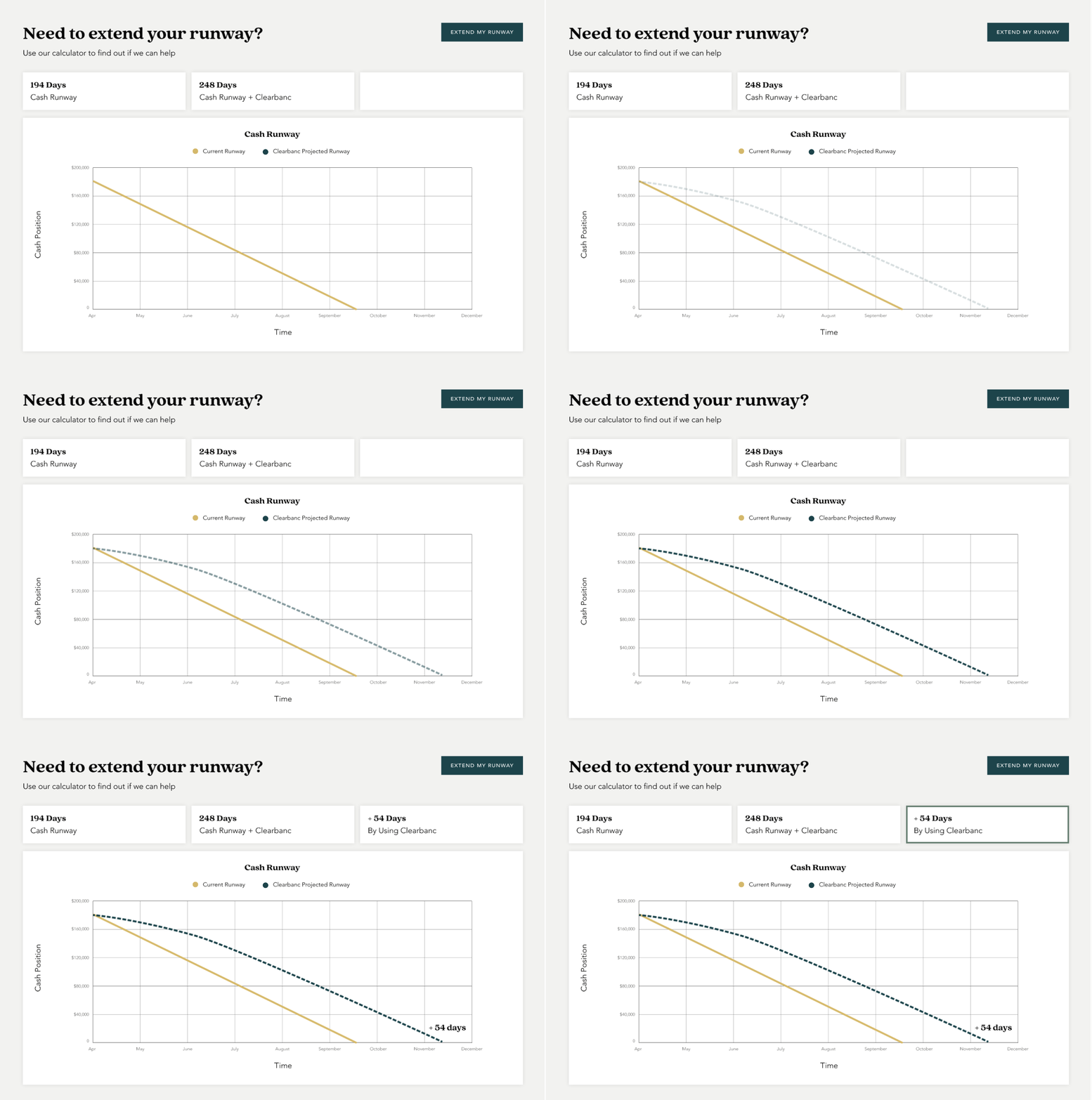
April 16, 2020 This month Clearbanc announced its latest product, Runway, in response to the impact of the novel coronavirus. Having historically served the needs of those businesses that are seeking funds for digital marketing, with Runway Clearbanc is expanding into capital for more generalized purposes in the face of covid-19.
“All companies are concerned about one thing and that thing is runway: ‘how many months do I have left and how do we extend that?’ Clearbanc CEO Michele Romanow explained. “So we built this really cool product, where you can give us a little bit of information and we can show you how much runway you have today at your current economics, and then how much we could extend that runway.”
Open to e-commerce, D2C, and enterprise SaaS businesses, Runway has already begun issuing funds. Amounts begin at $10,000 and can run up to $10 million, with monthly cash injections being an option if Clearbanc deems it suitable. Fees range from 6-12% and funding is equity-free.
“These is no playbook for the current economic crisis and recovery, and every founder needs more insight and options to navigate this incredibly difficult time. In addition, venture capital is even harder to come by. Capital is the most important tool to sustain and grow a business, and is now needed more than ever.”
Online Small Business Borrowing Decisions Not Driven By Costs or Disclosures, Fed Study Finds
December 23, 2019 A new study on transparency conducted by the Federal Reserve on non-bank small business finance providers indicates that borrowers are not driven by costs or disclosures. The #1 reason for a business to apply with an online lender was the speed of the process, the study showed. #2 was the likelihood of being funded. Cost ranked near the bottom of the list.
While a focus group pointed out many areas that are ripe for improvement, the Fed was left to conclude that “clearer information—in the form of standardized disclosures—will not necessarily alter the decisions of some small business borrowers about whether and where to obtain financing.”
The Fed further commented that some loan applicants revealed that they had already “committed the expected loan proceeds” before a lender could even present rates and terms. Others borrowers wished they could know their approved rate and terms before even providing a lender with any data. These findings seem to undermine the potential value of enhanced uniformity in disclosures.
The report, which attempts to paint a bleak picture of online lending in spite of the data, seems to validate what online lenders have been saying all along, that speed is supreme. Even where transparency is lacking, it cannot be overstated that big banks scored lower on transparency than online lenders did.
Uncertain Terms: What Small Business Borrowers Find When Browsing Online Lender Websites evaluated BFS Capital, CAN Capital, Credibly, Fundation, Funding Circle, Kabbage, Lending Club, National Funding, OnDeck, Rapid Finance, PayPal Working Capital, and Square Capital.