BlueVine doubles invoice financing credit lines to up to $5 million
January 30, 2018BlueVine also increases business line of credit to $200,000; opens New Jersey office
REDWOOD CITY, Calif. – January 30, 2018 – BlueVine has doubled the credit line size for its invoice factoring product to up to $5 million, underscoring the online business lender’s push to offer fast and flexible working capital financing to small and medium-sized businesses.
BlueVine also increased the limit for its business line of credit product to $200,000 from $150,000, making its Flex Credit product an even more attractive financing option for larger or fast-growing companies.
“In just four years, we’ve dramatically increased our invoice factoring credit line to $5 million, and our business line of credit to $200,000,” BlueVine CEO and founder Eyal Lifshitz said. “We continue to be fully committed to providing business owners with robust financing options to help them thrive.”
BlueVine helped Mindstar Aviation unlock capital trapped in unpaid invoices. The Virginia-based company, which develops and writes software for flight simulators, used to wrestle with cash flow gaps while waiting for customers to pay their bills, which often took 45 days or longer.
BlueVine allowed Mindstar to get cash advances on those invoices.
“Because we have BlueVine in place to make a purchase, we could proceed immediately,” said Johnny Johnson, the company’s executive vice president. “We don’t have to wait, which could impact a project timeline. BlueVine financing is easy. It’s quick. No hassle. BlueVine is not nickel-and-diming people, charging fees here and fees there. It’s really straightforward and easy to understand.”
A business line of credit from BlueVine enabled entrepreneur Jesse Urrutia, owner of MarketMe, a video production company in San Carlos, California, to take on bigger clients and grow his business.
“In the past, if I didn’t have cash to pay for a production, I would just turn down the project,” Urrutia said. “It’s ridiculous to turn business down because you don’t have the money. BlueVine fixed that for us.”
BlueVine also announced the opening of its new office in Jersey City, New Jersey, from where the company hopes to better serve customers and partners on the East Coast. Aside from its headquarters in Redwood City, BlueVine also has offices in New Orleans and Tel Aviv.
BlueVine revolutionized business lending with a highly automated, completely online invoice factoring platform that allows businesses to get advances on unpaid invoices.
In 2016, BlueVine introduced a 6-month business line of credit called Flex Credit based on weekly payments. The company introduced a 12-month line of credit based on monthly payments in 2017.
About BlueVine
BlueVine provides flexible working capital financing to small and medium-sized businesses, giving them quick access to funds needed to purchase inventory, cover expenses, or expand operations. A fintech pioneer, BlueVine developed a fully-online cloud-based platform for invoice factoring, revolutionizing the 4,000-year old financing system that allows businesses to receive cash advances on outstanding invoices. BlueVine also offers FlexCredit, business line of credit financing based on 6-month and 12-month payment terms. Based in Redwood City, Calif., BlueVine has raised $273 million in equity and debt funding and is funded by Lightspeed Venture Partners, 83NORTH, Correlation Ventures, Citi Ventures, Menlo Ventures, Rakuten Fintech Fund and other private investors.
Bizfi Hits $2B Origination Milestone; Providing Financing to More Than 35,000 U.S. Small Businesses
December 22, 2016 NEW YORK–(BUSINESS WIRE)–Today, Bizfi, the premier fintech company with a platform that combines aggregation, funding and a marketplace on a single platform for small businesses, announced that it has surpassed $2 billion in financing – through both growth and working capital – to more than 35,000 small businesses across America.
The Bizfi.com marketplace was launched in 2015 to provide small business owners with access to multiple financing options from more than 45 lending partners. These financing options include short-term financing, franchise financing, lines of credit, equipment financing, medical financing, invoice financing, medium-term loans and long-term loans guaranteed by the U.S. Small Business Administration.
“Over eleven years ago, when Bizfi became one of the first alternative finance lenders, we understood that if we remained committed to the principle of providing business owners with fast access to smart capital, we could achieve growth while supporting the number one job engine in the economy,” said Stephen Sheinbaum, founder, Bizfi. “During the last decade we have invested in creating the best platform and user experience with the most advanced technology to ensure business owners can access the financing they need. Hitting this milestone reinforces that our business fundamentals are strong and we are providing a much needed service in this growing economy.”
“Every dollar we provide to a small business owner returns multiples of GDP,” said John Donovan, CEO of Bizfi. “Being able to support the small business community is at the heart of our company. We believe there is tremendous opportunity to grow our marketplace offerings. We have funded over 35,000 small businesses and we look forward to greatly expanding that number.”
Donovan continued, “One of the key reasons why I joined Bizfi as its Chief Executive Officer was its growth trajectory. In just two years, the company has gone from supplying $1B to small businesses to $2B. This is a testament to our unique business model of providing both a financial product and a marketplace.”
Built from proprietary technology, Bizfi’s platform uses application program interface (APIs) to leverage a wide variety of sources to quickly offer loans and other financial products to small businesses. The platform is strengthened by strategic relationships with more than 45 funding partners, 15 of which are integrated within the platform, including OnDeck (NASDAQ:ONDK), Funding Circle, Bluevine, and Kabbage. Bizfi is also a direct lender on the platform.
About Bizfi
Bizfi is the premier fintech company combining aggregation, funding and a marketplace on a single platform for small businesses. Founded in 2005, Bizfi and its family of companies have provided $2 billion in financing to more than 35,000 small businesses in a wide variety of industries across the United States.
Bizfi’s connected marketplace instantly provides multiple funding options and real-time pre-approvals to businesses from a wide variety of funding partners. Bizfi’s funding options include short-term financing, franchise financing, lines of credit, equipment financing, medical financing, invoice financing, medium-term loans and long-term loans guaranteed by the U.S. Small Business Administration. The Bizfi API provides a turnkey white label or co-branded solution that easily allows strategic partners to access the Bizfi engine and present their clients with financial offers from Bizfi lenders all while maintaining their customer’s user experience. A process that once took hours, now takes minutes.
Contacts
Media
KCSA Strategic Communications
Kate Tumino, 212-896-1252
ktumino@kcsa.com
or
Bizfi
Sales, 855-462-4934
bizfisales@bizfi.com
or
Bizfi
Marketing, 212-545-3182
marketing@bizfi.com
Brief: LiftForward Secures Up to $100 Million Credit Facility from Monroe Capital
November 17, 2016Chicago-based investment firm Monroe Capital arranged a credit facility of up to $100 million for New York City-based small business lender LiftForward.
LiftForward provides small business loans up to $1 million using automated underwriting. The company also sells “hardware-as-a-service” like Microsoft Surface to manufacturers, distributors and retailers, and supports the financing of these transactions.
Monroe Capital makes debt and equity investments in middle-market companies in healthcare, technology, media, specialty finance across the U.S. and Canada.
Bizfi Secures $65 Million in Financing
December 15, 2015NEW YORK–(BUSINESS WIRE)–Bizfi (www.bizfi.com), the premier FinTech company whose online small business finance platform combines aggregation, funding and a participation marketplace, announced that Metropolitan Equity Partners (“Metropolitan”) has provided a structured financing facility of $65 million to the company to drive growth.
Closing this financing round enables Bizfi to:
- Expand its suite of funding programs, increasing its ability to fund America’s small business capital needs.
Increase the speed at which funding applicants access direct financing from Bizfi. - Develop and implement a national marketing campaign designed to increase the awareness of the Bizfi brand and platform within the small to medium-sized business community.
- Bizfi and its proprietary marketplace and funding technologies have provided in excess of $1.3 billion in financing to over 26,000 small businesses across the United States since 2005. Since Bizfi launched its aggregation platform in 2015, the Company has experienced 72% growth in year-over-year gross originations.
“The Bizfi platform is the simplest, fastest and most frictionless process for small businesses to access funding. Metropolitan’s financing will propel our growth plans to the next stage,” said Stephen Sheinbaum, founder of Bizfi. “Every day more and more businesses are turning to Bizfi because of our strong channel partners, enabling business owners to compare all their funding options in one place. The Metropolitan partnership provides Bizfi with additional capital to develop new products and fund more small businesses from its own branded product set.”
Metropolitan’s investment provides the financial flexibility and strength to support Bizfi’s growth plans. The new investment expands upon Metropolitan’s prior involvement as an active buyer of loan participations and a mezzanine lender to the Company for the past three years.
Bizfi’s proprietary technology and aggregation platform efficiently gathers applicant information from a wide variety of sources to quickly offer commercial funding products including loans and other capital products to small businesses. Bizfi’s technology is further strengthened by strategic relationships with more than 45 funding partners, including OnDeck, Funding Circle, IMCA Capital, Bluevine and Kabbage. Bizfi also participates as a lender on the platform. Regardless of what kind of capital is sought from any of the funding partners, the small business owner is guided through the entire process by a Bizfi funding concierge that is assigned specifically to him or her.
Paul Lisiak, managing partner of Metropolitan Equity Partners stated, “Metropolitan believes that the future of small business lending is being built by Bizfi. Their aggregation and direct lending marketplace is disrupting the fast growing FinTech industry. Our new investment is the result of the impressive performance we have directly experienced as a lender and participant in the company’s financing products over the past three years. In the rapidly evolving FinTech space, Bizfi’s management team has elegantly expanded their product offerings to create a platform that holistically meets the dynamic funding needs of small businesses. We look forward to being a part of Bizfi as they further solidify their position as a leader in the financial technology space.”
Metropolitan has been an active investor in the alternative lending and FinTech space with over $100 million committed in 2015 including investments in JH Capital Group, Debt Away, New Credit America and PledgeCap.
Mr. Sheinbaum concluded, “Bizfi has seen radical growth over the last 18 months. Not only have we developed one of the most robust FinTech platforms for the small business lending space, but we have cultivated significant deals with third party companies that service small businesses. These companies will utilize white label versions of Bizfi’s platform to offer financing to their clients. Now, with the Metropolitan financing supporting our growth, we can continue to expand our products, increase our market share and provide solutions to the critical financing needs of the companies that fuel our economy.”
About Bizfi
Bizfi, is the premier FinTech company combining aggregation, funding and a participation marketplace on a single platform for small businesses. Founded in 2005, Bizfi and its family of companies have provided more than $1.3 billion in financing to over 26,000 small businesses in a wide variety of industries across the United States.
Bizfi’s connected marketplace instantly provides multiple funding options to businesses from more than 45 funding partners and real-time pre-approvals. Bizfi’s funding options include short-term financing, medical financing, lines of credit, equipment financing, invoice financing, medium-term loans and long-term loans guaranteed by the U.S. Small Business Administration. The Bizfi API provides a turnkey white label or co-branded solution that easily allows strategic partners to access the Bizfi engine and present their clients with financial offers from Bizfi lenders all while maintaining their customer’s user experience. A process that once took hours, now takes minutes.
About Metropolitan Equity Partners
Metropolitan Equity Partners Management, LLC is an alternative investment manager that provides expansion capital to growing private companies via collateralized loan structures. Metropolitan was founded by Paul Lisiak who has 20 years of experience investing in private U.S companies through both debt and equity. Metropolitan traces its roots to a successful equity strategy managed by the current Metropolitan Principals which was backed by the Man Group plc. Since 2008, Metropolitan has committed over $300MM in collateralized debt investments through call funds, blind pools and institutional managed accounts. Metropolitan is based in New York City.
Contacts
KCSA Strategic Communications
Abbie Sheridan, 212-896-1207
asheridan@kcsa.com
or
Kenneth Cousins, 212-896-1254
kcousins@kcsa.com
or
Bizfi Sales:
855-462-4934
bizfisales@bizfi.com
or
Bizfi Marketing:
212-545-3182
marketing@bizfi.com
Merchant Cash Advance | A Look Back and Plan Forward
November 29, 2015 Merchant Cash Advance is still a relatively unknown term and product to the masses, but amongst most of its target customer base, it definitely has a stigma that is rightly deserved in some ways, but I believe that it is also misunderstood in many other ways. Having been in the industry for nearly 10 years, I can say that I have seen my fair share of positive and negative events as they relate to the industry, but I believe that it has all been for its betterment and growth. Furthermore, by having been on the underwriting side for a majority of that time, I can say with great certainty that I have seen this product help several small business owners over the years, and it will continue to do so as the stigma fades away and acceptance increases.
For those of us working in this industry now, let’s face it – most small business owners that have taken a merchant cash advance or have been solicited for the product would much rather go to their bank for the money. The problem, as many merchants have come to realize in recent years, is that lending in general essentially dried up after the recession. The faucet is now running again, but small businesses were all but forgotten. Only the most well qualified borrowers are able to obtain the desired amount of capital needed at a reasonable cost through traditional bank loans. In addition to meeting all of the necessary criteria for a bank loan or line of credit, a borrower must also be prepared to wait months for the process to be finalized.
The days of a small business owner being able to go down to his or her community bank or local branch for a quick cash injection are long gone, but that’s where we come in. We are catering to a customer base that has been left out to dry. We are dealing in a marketplace that is grossly underserved by the larger financial institutions. We are charging a premium for taking on risk that most cannot stomach. We are keeping America running. That might sound ambitious, but is realistic when you put things in perspective.
SBA and IDC data show that small businesses employ at least half of the US workforce and produce anywhere from 60% – 80% of the new jobs annually while also accounting for nearly half of total US private payroll. As if that weren’t enough, small businesses also produce six trillion dollars or over 50% of all non-farm GDP in the US. When looking at additional SBA data which also states that more than 80% of all small businesses need to use some sort of financing to grow their business, it’s perplexing as to why banks have turned their backs on the people that have put America on their very own backs.
However, I do not want to go into great detail or make any assumptions on why “big banks” are not lending to small businesses. Rather, I would like to take some time to focus on how we can continue to support the growth of small businesses across America. The MCA product in particular has evolved quite a bit over the past 10 years, but a lot of that development has taken place in the past 3-5 years, and the industry has grown leaps and bounds as a result. When I started working as an underwriter several years ago, there were less than 10 lenders and 50 brokers operating within the space. Nowadays, there are hundreds on both sides of the fence, and there are multiple new entrants every day – senior guys starting their own operations, one man rogues from the insurance and mortgage businesses, consumer payday lenders, et cetera. – all looking for our piece of the pie, but who out there is really looking to improve upon and grow the product for the better?
 I suppose therein lies the problem. Unfortunately, the tremendous growth we have recently witnessed also comes with a flood of unqualified and unknowledgeable management and staff that are simply following the direction of their unqualified and unknowledgeable employers. As an industry, if we expect to continue making headway in the small business lending environment, we must first better ourselves by taking the time to learn and understand the product in order to better educate our customers. If you know me, you have heard me say on a few occasions that it is easy to put the money on the streets, but the problem for most people is getting it back.
As with anything in life, you cannot jump into something and expect to master it. Over time, you get a grip of what you are doing, and you begin to build on that understanding. Therefore, no one should enter the market expecting to make huge returns without learning the ins and outs of the business. I, along with several of my peers, have seen plenty of well-intentioned but aggressive entrants “lose their shirts,” so to speak, because they did not do the proper diligence on the industry or the actual diligence required to operate within the space. Lending money with only a UCC-1 in place only on future receivables or sometimes no collateral at all is risky business as it is, but not taking the necessary steps to mitigate that risk is only asking for a rough road ahead – not only for the lender itself, but also for their potential clients, brokers, other lenders, and the industry as a whole.
Our underwriters and sales people, in addition to management, should have a solid understanding of the product they are working on. They should be able to educate customers as well as their peers. Transparency throughout the process is key for maintaining a long and mutually benefiting relationship with the client. By having this firm grip and understanding of the product, we reduce the risk of an unsatisfied customer. As with the mortgage and insurance industries, sales and underwriting must work together to determine the best possible result for both the client and the company. This is definitely a challenge for most groups due to the amount of balancing required to meet the needs of the company, but by establishing best practices and procedures in both the sales and underwriting processes, we can begin to think and work within separate verticals and group goals but streamline the process to achieve the agenda of alternative small business lending which should be to help provide small business owners with the fast and efficient capital they need.
Whether you have been in the industry for years, you have just joined this year, or you are considering taking the dive now, it’s only fitting that at this time of year we give thanks to those small business owners and celebrate their entrepreneurial spirits because they are the reason we, ourselves, are currently employed. But more importantly, they are setting us up for quite an adventure which will change the landscape of small business lending for good. I, personally, cannot wait for the next 3-5 years of continued growth because I can only see a bright future if we are able to collectively educate ourselves and pass that knowledge along to our clients. As long as the proper steps to learn have been taken, the competition from new entrants mentioned previously is also welcomed because this further drives new ideas and developments within the space – new financial products to offer clients, lower costs, and most importantly easier and efficient access to quick capital for the busy small business owners constantly on the go in an effort to grow their business while putting the rest of us on their backs.
Palladium Equity Partners Announces Investment in Fora Financial, a Provider of Working Capital Financing to Small- and Medium-Sized Businesses
October 14, 2015 Palladium Equity Partners, LLC (along with its affiliates, “Palladium”), a private investment firm with over $2.0 billion in assets under management, today announced that one of its affiliates has made a significant investment in partnership with the co-founders and management of Fora Financial LLC (together with its affiliates, “Fora Financial” or the “Company”), a technology-enabled provider of financing to small- and medium-sized businesses nationwide.
Founded in 2008, Fora Financial offers loans and merchant cash advances of between $5,000 and $500,000 to small businesses throughout the country. Since inception, the Company has provided total funding of nearly $400 million to more than 8,000 businesses. It has experienced rapid growth and recently was ranked among the fastest-growing companies in America in the Inc. 5000 list. Fora Financial recently expanded its New York City offices to accommodate its growing roster of over 100 employees as it bolsters key capabilities in analytics and technology and aims to continue to execute on its strategy of delivering capital in a timely and cost effective way.
Fora Financial will continue to be led by its two founders, CEO Jared Feldman and President Dan Smith.
“We believe Fora Financial has developed a highly attractive credit offering and technology platform that have made it a valued provider of financing to thousands of small businesses seeking capital,” said Justin Green, a Principal of Palladium. “My partners and I look forward to supporting Jared, Dan and the Fora Financial management team to continue the strong growth trajectory of the Company, including through new partnerships, expanded product offerings and increased lending capabilities.”
Feldman said, “We are excited to partner with Palladium, a firm with extensive financial services expertise and many years of experience supporting founder-owned businesses.”
Smith added, “With this partnership in place, we are well-capitalized to continue offering the small business community the custom, innovative funding solutions that have enabled us to build this Company into a market leader.”
Terms of the investment were not disclosed. Fora Financial was advised by Raymond James & Associates.
About Fora Financial
Fora Financial offers flexible, working capital solutions to small businesses in need of financing to sustain or grow their enterprise. The Manhattan-based company places a high value on trust and transparency and provides businesses with quick, customized financial solutions utilizing its state-of-the-art technology platforms. Founded in June 2008, Fora Financial has more than 100 employees who have provided nearly $400 million to over 8,000 customers. For additional information, please visit www.forafinancial.com, call (855) 515-2413 or follow Fora Financial on Facebook at facebook.com/Fora.Financial.
About Palladium Equity Partners, LLC
Palladium is a middle market private equity firm with over $2.0 billion in assets under management. The firm seeks to acquire and grow companies in partnership with founders and experienced management teams by providing capital, strategic guidance and operational oversight. Since its founding in 1997, Palladium has invested over $1.5 billion of capital in more than 25 platform investments and over 50 add-on acquisitions. The firm focuses primarily on buyout equity investments in the range of $50 million to $150 million. The principals of the firm have significant experience in financial services, business services, food, healthcare, industrial and media businesses, with a special focus on companies they believe will benefit from the growth in the U.S. Hispanic population. Palladium is based in New York City. For more information, visit www.palladiumequity.com.
For media inquiries, please contact:
Todd Fogarty or Peter Hill of Kekst and Company
212-521-4800
todd-fogarty@kekst.com or peter-hill@kekst.com
The Importance Of A Profitable Business Model And Creative Financing For Your Broker Office
August 10, 2015 Continuing The Year Of The Broker Discussion, I wanted to touch on another aspect that isn’t discussed too often in our space (Independent Broker or Independent Agent space), and that’s the importance of creating a profitable business model and rounding up creative debt financing for our Office.
I believe it was the Roman Playwright, Plautus, that said, You must spend money to make money. This is certainly true for Independent Brokers and Agents, as we are entrepreneurs in every sense of the word, or if you operate a one man show like I do, then you would be more along the lines of a solopreneur which is new terminology floating around that refers to certain special entrepreneurs who run their business solo with full responsibility over the day-to-day operations.
However, despite the fact that one must spend money in order to make it, it begs the question as to why many new Brokers have very little networks, resources and other sources for financing?
Not only do they lack these resources, but many new Brokers also have not truly developed a scientific business model for their office based on: If I invest XYZ in data, marketing and all other aspects in association of producing 1 new closed deal, I would receive XYZ back into terms of the revenue off the initial closed deal as well as XYZ back in terms of recurring revenues on the renewals of said merchant.
Many new brokers lack both a scientific and profitable business model, along with efficient financing for said business model, which threatens their survival going forward.
Your Profitable Business Model
I argue with investors across the Investment Community all of the time in relation to which is better in terms of building the most Wealth, is it investing in Stocks or operating your own Profitable Business Model? I have always believed creating your own Profitable Business Model was the fastest way to Wealth due to the lack of control one has over the returns you can generate through the Stock Market. Commentators like James Altucher tend to agree with my mentality as he says: The best way to take advantage of a booming stock market is to invest in your own ideas. If you have an extra $50,000 don’t put it into stocks. Put it into yourself. You’ll make 10,000% on that instead of 5% per year.
I’ve always used a model of at least a 400% return within 24 months for operating my office because, not only did I have to cover business expenses and taxes, but I also had to cover my personal expenses, the funding of my emergency funds/savings, and the funding of my retirement accounts which includes SEP IRAs, Social Security, and Health Saving Accounts.
So for example, my model might have it to where if I invest $30,000 into my office, that should produce revenues of around $180,000 within 24 months, revenues include commissions from new deals, renewal deals, side processing residuals and other valued added products. This would leave a profit before taxes of $150,000 or a 500% return. Now the 500% range is just the benchmark used, in terms of actual returns, they have been at least double this amount due to my focus on maintaining clients for the long term as with recurring clients, there are no investment dollars spent on the acquisition of those additional revenues but they do continue to add to the overall “profitability” measurement of the original investment.
Utilizing this predictable model allows for the use of creative financing for leverage, cashflow management, along with the preservation of savings, and other investment portfolios. One of the tools I have been using for creative financing have been Credit Card No Interest Promotional Offers.
Using Credit Card Promotional Offers To Finance Your Office
I’m a Dave Ramsey fan like many Americans, but I’m totally against Mr. Ramsey’s consistent hammering of the use of “debt,” specifically the use of Credit Cards. Credit Cards are just like hand guns, if you put the gun in the hands of a solider, police officer, hunter, or a responsible home owner, then you protect human life, build nations and protect communities. If you put the gun in the hands of the common Chicago inner city street thug, then you get crime and homicide. If you put a Credit Card in the hands of a responsible person, the Credit Card is used to bring a variety of additional benefits to said user. But in the hands of an irresponsible person, the Credit Card just adds to their financial woes.
If you strive to keep your personal credit profile clean and with high efficiency, you should qualify for a number of Credit Cards that not just provide cashback rewards, but they provide short term financing in the form of 0% interest for 12 – 18 months, with a 1% – 3% upfront fee. This means you can receive an up to 18 month loan for only 1% – 3% in borrowing costs. These offers are not presented just when the card is opened, but they are generated usually on a monthly or quarterly basis.
So coming back to my business model, I might put that entire $30,000 on a credit card promo deal for 18 months with an upfront fee of 3%, which means the borrowing costs are $900. I would continue paying the minimum payment every month which is usually calculated as no more than 0.5% – 1% of the outstanding balance. I would invest the $30,000 into my business model and would have obtained the break-even return and profit measurement in a relatively short period of time (usually 3 – 5 months) and then be profitable on the investment. I would eventually end up paying off the outstanding balance on the Credit Card well before the promo period ends, which further increases my positive credit history allowing for larger credit limits to be requested.
Other Benefits Of Credit Cards Over Other Payment Options
Credit Cards also provide a host of other benefits including cashback rewards of anywhere from 1% – 45% depending on the reward category, these rewards and savings are not available through any other form of payment option. If you seek out cards with no monthly fees, setup fees or annual fees, you could run up balances, pay them off before the grace period ends, and obtain a stream of free income.
Credit Cards also include Chargeback Protection that can save you a significant amount of headaches down the line should you run into an unscrupulous vendor, or if you are the unfortunate victim of theft such as a robbery, identity theft, strong-arm theft, etc. For example:
- If someone steals your wallet and goes on a “card swiping spree”, once you report your Credit Card stolen then you aren’t responsible for any of those transactions. This isn’t as efficient if you carried a Debit Card, as the money would be gone from your Checking Account until the Bank recovers the funds in 30 – 90 days, which might cause you some cashflow issues. If you carried Cash, the money might never be recovered.
- If you ordered something from a vendor and didn’t receive it, you are protected with the use of Credit Cards. With a Debit Card or Check, it will again take 30 – 90 days for the dispute to complete with the Bank, however, throughout this period of time the money is still gone from your account until the dispute is over, which might cause some cashflow issues. If you used Cash for the order, the money might never be recovered in this case as even though you are likely to obtain a judgment by suing the vendor, the Courts do not assist you with collections.
To Wrap
In order to survive going forward as an Independent Broker or Agent, remember the importance of developing a profitable business model as well as having low cost sources of financing for said model. Credit Cards are one of the ways you can creatively finance your business model.
I’m on track to end the year with near or over $200,000 in total credit limit availability. This credit limit availability is spread out over a number of different accounts, but some of my favorite Credit Card Accounts include: The Double Cash Card ™ from CitiBank, The Discover IT Card ™ from Discover Bank, The BankAmericard Cash Rewards Card ™ from Bank of America, The Chase Freedom Card ™ from Chase Bank, The Upromise Mastercard ™ from Barclay’s Bank, The QuickSilver Rewards Card ™ from Capital One Bank, and The Blue Cash Everyday Card ™ from American Express.
Forward?
November 8, 2012The election is over and now it seems we will be “Moving forward, not back.” The republicans that have already come to accept Romney’s defeat are sounding a lot like Sookie Stackhouse:

Onwards we go to help the little guy, a process many feel can’t happen until we end trickle-down economics. It’s the trickle part that doesn’t sound good. Money should flow freely gosh darn it, not trickle! We couldn’t agree more. Here’s a broad diagram of the economy at work:
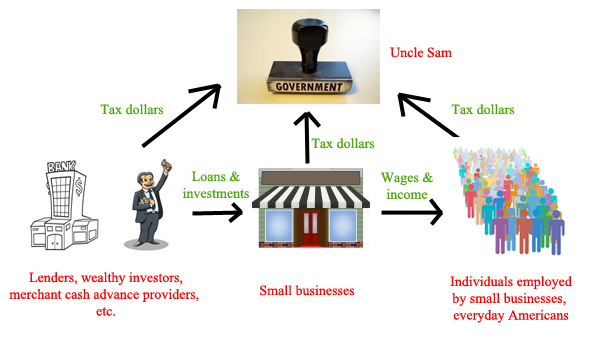
It’s popular to hate Wall Street, but Wall Street provides small businesses with financing to expand, who in turn employ more people in the process. Wall Street is not just banks and Merchant Cash Advance companies. It is any party that has enough money to invest in others while being able to absorb potential losses. A private investor is Wall Street. Wealthy friends or family members are Wall Street.
Tax these parties more and there is less money to invest in small businesses which means fewer businesses will receive capital to expand and hire. Wall Street will make less money as a result of less money being invested and therefore tax revenue will decrease. With fewer businesses hiring, less people will be employed and therefore less people will be paying taxes. Taxing Wall Street more does not necessarily mean more net tax dollars.
This Darn Trickle
One can dislike the economic chain since the flow of money between parties may not happen perfectly or because it allows Wall Street to get richer. There is nothing wrong with the rich getting richer, so long as the middle class and poor get richer too. If small businesses use the money invested by Wall Street wisely, they too will eventually become Wall Street. The amount of new jobs created as a result of a small business’s success means more wage earners will have a shot at becoming small businesses. In economics, a wide divide between rich and poor can be positive, for it creates a ladder that anyone can climb with no cap.
Empower the Little Guy
There is a competing theory and that is to believe that the economic chain starts with middle class wage earners. One could argue to significantly lower taxes on the middle class and the poor and impose much higher taxes on the rich. By doing so, consumers would have more money to spend at small businesses, prompting those small businesses to draw up plans to expand. That expansion capital still needs to come from somewhere and less of it will be there if Wall Street has been further taxed. Perhaps a small business could save money for a few years and use their savings to self-finance their own expansion. Under this theory, everyone becomes part of a very broad middle class. The extremes disappear.
Whoops
When the extremes disappear, there will be few investors with the capability to make large investments or investments that are particularly risky. A small business owner could save up for several years and open a 2nd location without an investment, but could he open 200 nationwide? Not without Wall Street. How many jobs will be created by the opening of 1 store? How many would be created by the opening of 200?
Now calculate how much new tax revenue is generated in each scenario, as well as the number of people that move up from being poor and unemployed to middle class and employed.
When the rich aren’t getting richer, the other classes can’t really move up either. Everyone stays in a broad middle class and innovation and advancements decline. The consumer or small business owner with a potential $100 million innovative idea won’t be able to raise the capital to see it through. How can they when the rich have been prevented from becoming really rich? What if they had a $10 billion idea?
One could argue as a single class society, that a $100 million idea or $10 billion idea could be financed by the government. This is true. It is also textbook state socialism. A one class society is also the premise of Marxism, where everyone is getting their needs met through cooperative work.
Marxism ignores the realities of a global economy. Ultimately, Americans need to obtain resources from other nations, and stay ahead technologically so as not to be conquered by outside forces. A classless society is a stale society, with no economic movement, social movement, or technological advancements.
How will the Merchant Cash Advance Market be Affected?
Merchant Cash Advance companies typically invest in businesses with less than 50 employees. Under Obamacare, any business with less than 50 employees does NOT HAVE to provide health insurance. This program may not affect the business as a whole, but the law mandates that all individuals purchase health insurance for themselves if they don’t have coverage already. Small business owners in the MCA market may be incrementally stressed by having to purchase health insurance. Their employees will be further stressed by having to buy it as well. As a result, wages may need to go up to help workers pay for their own insurance and less money will be available to grow and hire.
The total public debt outstanding has exceeded $16 trillion. That debt has to be paid for somehow and it is more likely than ever that Wall Street is going to have to pay up. This will not stimulate growth and as such, the economy is not likely to pick up any time soon.
Traditional lenders are going to remain quiet while the alternative lenders are going to power through it. A business could save up for three years and open a 2nd location or it could open it today with a Merchant Cash Advance. In three years, the location they want may no longer be available and that individual looking for a job will have run out of unemployment benefits long ago.
A Merchant Cash Advance helps small businesses expand today, hire today, generate more tax revenue for the government today, and helps everyone move up the economic ladder. Baby steps are better than none at all. What starts with a 2nd location may lead to a dream of owning 200 locations nationwide. They’ll need a bigger fish than MCA to get there. Let’s make sure we don’t tax those fish to death.

What do you think Michael?

Forward!
– Merchant Processing Resource
../../