
Aspiria Co-Founder On Successful Funding in Mexican SME Space: Still Lots of Room to Grow
December 5, 2020 After 38 years, Guillermo Hernandez has seen the boom and busts of the Mexican financial markets, weathering seven recessions in all, he said. But until 2020, he had never led a company through a pandemic.
Aspria, Hernandez’s online lending firm, had planned on completing a Series A from international investor Oikocredit, but the deal went into the icebox as the cases came.
“In the beginning of the year, things were doing very well in Mexico, the whole economy was booming,” Hernandez said. “Out of nowhere, we got hit by the pandemic. And the transaction that we were supposed to be closing in March 2020, our investor said, ‘you guys are fantastic, but there are too many unknowns.'”
But due to Aspiria’s resilience and the fact that they went into 2020 with a rock-solid business, Hernandez said Oikocredit decided to complete the investment deal. Aspiria was growing and profitable, and though it was unclear if the markets were going to fall apart, Hernandez said he and his team put the nose to the grindstone and worked through it.
Oikocredit is a worldwide cooperative that provides loans and investments to promote financial inclusion while empowering people by improving livelihoods. That vision is what Aspiria aims to accomplish as an SME lender, Hernandez said, helping businesses access funds to grow.
The Mexican financial space has ample room for growth, and Hernandez said Aspiria is one of the first alternative business lending firms to capture the market.
 Hernandez said the banking world in Mexico is twenty years or more behind the US, and he founded Aspiria to bring some change to the financing space.
“The whole financial services industry, I mean it’s light-years behind the US,” Hernandez said. “I saw that the way that people would do the underwriting, the way that people provided financing for small businesses was just so outdated; it was more of an old school market here. I decided there was this huge opportunity for the market.”
For example, Mexico has a third of the US population, but only 30 banks to the 7,000-10,000 the US has. That population is also a younger demographic than up north. In Mexico, the average age is 27 (It’s 38 in the US); Hernandez said: the Average Mexican is trying to establish themselves and reach the middle class, young, educated, and ready to start a business.
 Hernandez has been working in finance all his life, starting in Mexico as a banker and consultant for new financial companies before leaving to get his MBA on an HSBC scholarship in Manchester, England. He worked for a time in financial services there before joining a payment startup in the US, where he found his love of startup tech culture.
“It was my first exposure to technology, and I was completely amazed. I fell in love with it,” Hernandez said. “At that moment, I was actually thinking about changing careers. I was completely fed up with financial services because it’s boring sometimes. I thought it was not sexy anymore.”
Co-founding Aspiria, Hernandez went on to become the major funder in the space. He said there is so much demand for capital in a standard year that his firm can see 100% year-over-year growth. Even in a pandemic, his firm received a confident investment that will go directly toward building the shop, scaling up funding, hiring, and aiming toward a firm that will one day put it on par with the rest of North America’s leading alternative finance firms.
From Sales to Founder: Craig J. Lewis Talks Gig Wage’s $7.5 Million Funding Round
November 27, 2020 Coming to you from the heart of Dallas, Texas is a digital payroll startup, Gig Wage, that received a $7.5 million Series A funding round just last month. The founder, CEO, and writer of The Sport of Sales, Craig J. Lewis, talked about his goal to make it easier for 1099 gig workers to get paid.
Lewis made $10 million in payroll tech sales before going on to lead a firm that has seen 30% month-to-month growth this year, during a pandemic no less.
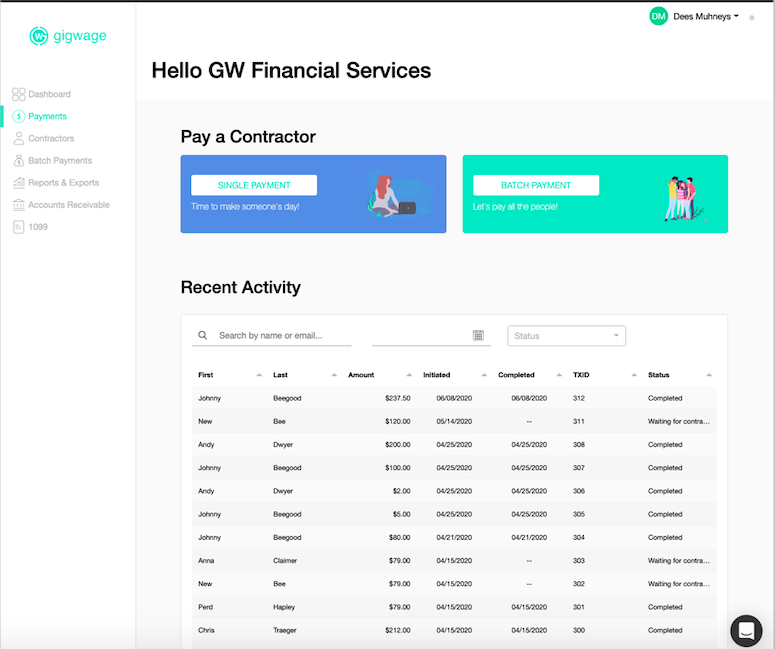
“We help businesses pay independent contractors, but because we’re so tech-centric, it’s evolved beyond just payroll,” Lewis said. “What we ended up building was financial infrastructure for the modern workforce. We help businesses get money from their customers to their contractors as fast and as flexibly as possible.”
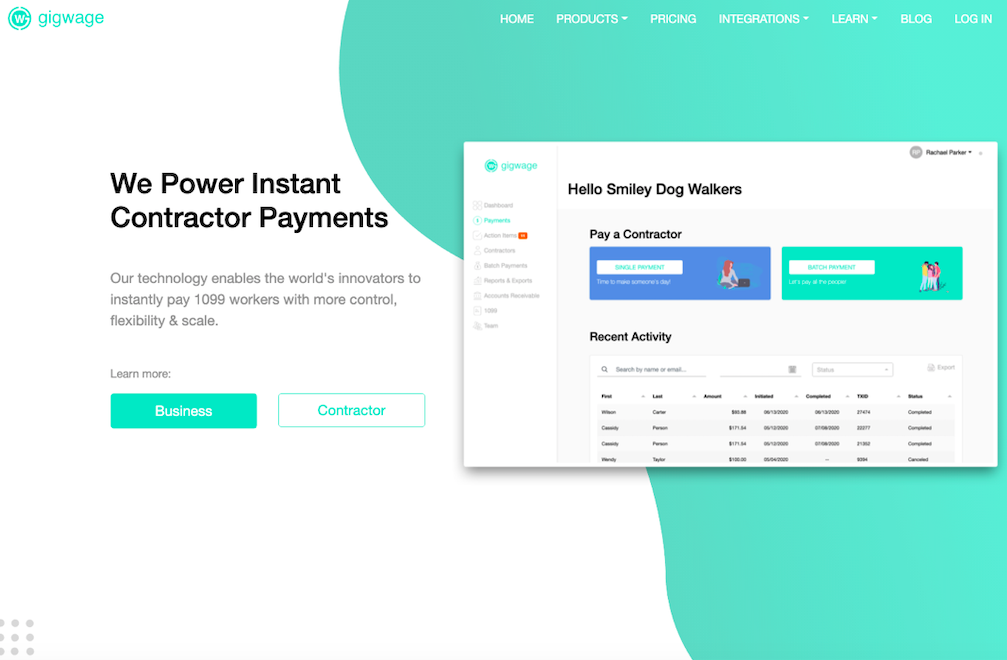
The way Gig Wage does this, Lewis said, is by offering an online platform for the hybridization of payroll, payments, and banking from a single login. Businesses can manage their payroll needs for 1099 workers, then shift to payment needs quickly, through direct to debit, all major cards, bank transfers, and accounts receivables.
“One of the only- the only platform in the world actually that has embedded banking into payroll and payments, which is what kind of allows for this speed and flexibility that we offer,” Lewis said. “We’re like B to B to C: We help the businesses with technology and operational excellence, and because independent contractors are separate from the workplace, we provide tools for them.”
Lewis has years of experience in the payroll space- starting as a salesman for ADP small business payroll products back in 2008. Realizing he had a passion for payroll tech and getting customers the best services possible, Lewis went on to learn anything he could about the industry. Selling $10 million in software while moving across the country, Lewis landed in Silicon Valley, where he studied what it took to start a company.
“I was just awed how they thought about technology and products and company building,” Lewis said. “And I vowed to bring that to the payroll industry.”
Lews joined a startup, learned the Silicon Valley way of creating a company through an African American tech acceleration program. In 2014, Lewis founded Gig Wage to do something disruptive in the payroll space.
 As Gig Wage attests, disruption is what the 1099 gig industry needs at the very least. Lewis believed the gig economy was going to keep growing when Gig Wage started. As he watched, the gig economy ballooned into a $2 trillion industry with an estimated 65-75 million person workforce. These workers suffer from an outdated payroll system, losing an estimated 2-20% of their income to flaws in the payments system Gig Wage found.
“With the maturation of Uber, Lyft, Postmates, Doordash, Grubhub, Upwork, all of these kinds of gig economy freelancer companies, we had great growth going into 2020,” Lewis said. “In Q1, we were set up to raise our series A, and then March happened, and the terms got pulled off the table.”
 But when the dust settled after those first shutdown weeks, Gig Wage looked at the damage and found the skyrocketing unemployment rates and furloughs had only accelerated their growth as a company.
“The gig economy was right there waiting on the workforce to provide opportunities to earn, and we were positioned perfectly to help people compete for that talent and pay people in a modern way,” Lewis said. “The pandemic has been a huge growth accelerant for us, and we think those tailwinds will only continue.”
Those winds of success came during a time of protest. Amplified in the pandemic’s backdrop, the country was waking up to the unequal disenfranchisement black people faced. Only 1% of black founder entrepreneurs ever receive VC funding, and Lewis said he is proud to have raised a significant round, given that unfair stat.
“With so much controversy and negative energy around black people in general,” Lewis said. “I think putting this positive story out there and showing this black excellence, black tech, I think it’s super important, and it’s been something that I’ve embraced. We’ve been able to be a part of putting something extremely powerful and positive into the market.”
America is finally waking up to realize something Lewis said was obvious, that black people matter, even though it can be controversial to say so. He hopes his success can help others but affirms the funding round was no charity drive.
“This is a great opportunity for us to be clear about the fact that like hey, we’ve been working on this, we’ve built a good business and a good technology,” Lewis said. “This is a big business opportunity for our investors and us. It wasn’t charity, right: This isn’t like, oh he’s black, give him some money.”
The successful funding round shows confidence in the Gig Wage platform from Green Dot, which will allow Gig Wage to offer bank accounts and debit services to independent contractors. Green Dot is one of the only fintechs with a national banking license, Lewis said, and Gig Wage is joining the Banking-as-a-Service direction that the fintech industry is headed.
Beyond payroll, Lewis can’t wait to offer other financial products to businesses as the company grows.
“When you think about the gig economy, it’s important that people get paid fast and flexibly: You’ve got to have the cash to be able to do that,” Lewis said. “We see some unique opportunities to get involved in the lending space down the line as well as we continue to build out our technologies.”
Joe Camberato Named CEO of National Business Capital & Services
November 9, 2020 November 9, 2020, Bohemia, NY – National Business Capital & Services, the nation’s leading FinTech lending marketplace which streamlines the application and approval process for small business owners, today named Joe Camberato CEO. He succeeds James Webster, who has exited the company to pursue new endeavors.
The announcement comes as the COVID-19 crisis has crippled small businesses across America. Not only are business owners challenged with the overwhelming stress of meeting near-term financing demands simply to survive, but they are also tasked with re-imagining how to best position their businesses for growth in the post pandemic ‘new normal’.
“Through booming and challenging times, National’s priority has always been to serve as the go-to source for small businesses to find competitive financing options, revenue-generating services and consultative support to help them at every step of their growth journey,” said Camberato.
“When it comes to small business loan approvals, banks are highly conservative, tending to lend an umbrella when the sun is shining. With COVID-19, the sun is not shining. We recognize how crucial it is to provide access to competitive financing options to help businesses survive, but they also desperately need help to rebuild and grow.”
In a recent survey of small to mid-sized businesses by CBIZ, over half (51%) of respondents reported a significant decrease in sales due to the pandemic. Smaller businesses have been disproportionately impacted, with nearly half of businesses with 1-4 employees reporting a significant or severe impact, and 37% of businesses with 20-49 employees noting a significant or severe impact.
 In taking reins as CEO, Camberato is steadfastly committed to National’s vision to Innovate the Way Entrepreneurs Grow by offering essential resources beyond just financing. His plans include enhanced business growth consulting and coaching offerings, which he anticipates will be a dire post-pandemic need, but is currently a significant gap across the competitive landscape.
Michael Gerber, a mega bestseller who was named “The World’s #1 Small Business Guru” by Inc. Magazine, commended National’s efforts toward empowering small business owners by providing streamlined access to capital, among other game-changing resources.
“I’ve admired Joe since the day we met. He shares my mission to transform the state of small business and has unmatched knowledge of small business lending practices. His personal success building a scalable business, and passion for helping entrepreneurs and small business owners invest their efforts in the right areas to create sustainable, growth-oriented companies have been invaluable as we work together to co-author our new book,” says Gerber.
Gerber is currently collaborating with Camberato to write “The E-Myth Money Book”, which will educate small business owners about the various avenues they can take to obtain and successfully utilize small business financing while growing their businesses.
As one of National’s original founders and previous President, Camberato spearheaded significant technological innovations, implemented process enhancements, and helped build an amazing company culture on his mission to simplify the previously laborious business financing process for small business owners, securing over $1 billion in financing in the process.
Now, business owners can apply in one simple place and securely connect their bank accounts to receive tailored financing options in minutes, with funding following in as little as a few hours.
Beyond streamlined technology and processes, Camberato credits National’s success to its award-winning team and applauds their role in helping business owners get back to business amid the pandemic.
“By taking the time to understand business owner challenges or opportunities, our amazing team has established the National brand as a trusted source of capital and counsel. I couldn’t be prouder of my team’s dedication to helping small business owners, but also for their significant role in helping our clients overcome the COVID-19 crisis and get back to business. They rally behind our mission to be the trusted resource business owners turn to for financing, revenue-generating services, and business coaching and will play a pivotal role as we add new offerings to help businesses not only survive but thrive and grow.”
Camberato regularly shares his insights about FinTech lending, access to capital and small business growth strategies through his seat on the Forbes Finance Council and his YouTube channel, GrowByJoe. He is also an active member of the Young Presidents Organization (YPO) and is actively involved in giving back, locally and nationally.
ABOUT NATIONAL BUSINESS CAPITAL & SERVICES
National Business Capital & Services is the #1 FinTech marketplace offering small business loans and services. Harnessing the power of smart technology and even smarter people, we’ve streamlined the approval process to secure over $1 billion in financing for small business owners to date.
Our expert Business Financing Advisors work within our 75+ Lender Marketplace in real time to give you easy access to the best low-interest SBA loans, short and long-term loans and business lines of credit, as well as a full suite of revenue-driving business services. We strengthen local communities one small business loan at a time. For every deal we fund, we donate 10 meals to Feeding America!
CONTACT:
Matt Carrigan
press@National.biz | www.National.biz
National Business Capital & Services
1 Corporate Dr, Suite 202, Bohemia NY 11716
Toll Free: (877) 482-3008 | Fax: (631) 446-6016
SOURCE National Business Capital & Services
Fintech Equality Coalition: meet disparity in minority PPP funding
September 9, 2020 Last month, a group of fintech companies christened the Fintech Equality Coalition. Dedicated to ensuring racial equality is a right extended to everyone, the group pledges to focus on enhancing access to financial services for the underrepresented- particularly within the black community.
The coalition comes at a pivotal time for fintech, currently facing the challenges created by the 2020 pandemic.
In August, the Federal Reserve Bank of New York released a study into the distribution of PPP and how the funds affected black communities. The institution found that the number of small business owners fell by 22% from February to April- the largest drop on record. But the closure of businesses was not felt equally.
“Black businesses experienced the most acute decline, with a 41 percent drop,” The study said. “Latinx business owners fell by 32 percent, and Asian business owners dropped by 26 percent. In contrast, the number of white business owners fell by 17 percent.”
The study also showed that forty percent of Black-owned businesses are concentrated in 30 counties across the country. 19 out of 30 of these counties were the hardest hit by COVID 19 in the nation.
Unfortunately, other studies have shown that the PPP did not accurately get funds to areas hit by the virus. The National Bureau of Economic Research (NBER) published in July, found that companies more negatively affected by COVID were less likely to be approved.
This may explain why the Small Business Majority study into PPP found that while 63% of Black and Latino small business owners applied, less than two-thirds received funding.
The Fintech Equality Coaltion’s pledge is overall a promise to do more for minority communities, stating:
- Because the Black community is underserved by financial services
- Because there are Black voices and issues in our industry that should be but are not currently amplified
- Because Black employees and Black-owned businesses are underrepresented in the tech community, including at many of our companies
- Because the Black community is underrepresented in leadership roles, including at many of our companies
- Because these promises are meaningless without accountability
The coalition is a pledge to host and sponsor events like forums that feature black speakers. The pledge is also a recognition that the black community has been underserved by financial services in the past, and the signers aim to incorporate more black-owned businesses than before.
Who’s signed

Betterment | Jon Stein, CEO

Blend | Nima Ghamsari, CEO

Carver Edison | Aaron Shapiro, CEO

Cadre | Ryan Williams, CEO

Commerce Ventures | Matt Nichols, CEO

Credit Karma | Ken Lin, CEO

Commonbond | David Klein, CEO

Divvy Homes | Adena Hefets, CEO

Dosh | Ryan Wurech, CEO

Earnest | Susan Ehrlich, CEO

Fabric | Adam Erlebacher, CEO

Freedom Financial Network | Brad Stroh & Andrew Housser, co-CEOs

Guidefi | Charlene Fadirepo, CEO

Halo | Taylor Simpson, CEO

Harness Wealth | David Snider, CEO

Jetty | Luke Cohler, President & Michael Rudoy, CEO

Kard | Ben Mackinnon, CEO

Kindur | Rhian Horgan, CEO

Manifest | Anuraag Tripathi, CEO

Marqeta | Jason Gardner, CEO

Mass Challenge | Siobhan Dullea, CEO

MoneyLion | Dee Choubey, CEO

Monzo | TS Anil, CEO

Nova Credit | Misha Esipov, CEO

Oneblinc | Fabio Torelli, CEO

Oportun | Raul Vazquez, CEO

Petal | Jason Gross, CEO

Renaissance Payments | Joseph Akintolayo, CEO

Rhino | Paraag Sarva, CEO

Scratch | Sameh Elamawy, CEO

Spruce | Patrick Burns, CEO

SoFi | Anthony Noto, CEO

Stash | Brandon Krieg, CEO


Varo | Colin Walsh, CEO

Zest AI | Mike de Vere, CEO
The Broker: Funding Businesses The Irish Way
October 10, 2019 I’m sitting in the lobby of The Marker Hotel, a 5-star 7-story property on the edge of Dublin’s Grand Canal Dock. Here in Ireland’s major tech hub, I’m waiting for a self-identified corporate finance broker by the name of Rupert Hogan, the managing director of BusinessLoans.ie. Outside of our email exchanges, I don’t really know what to expect. I’ve met brokers from the US, Canada, Mexico, UK, and Hong Kong, but never Ireland.
When he arrives, he doesn’t disappoint. Hogan is full of energy and enthusiasm. He has a natural charisma and friendly manner that’s well-suited for a relationship-based business. It just so happens that SME finance in Ireland is still heavily reliant on person-to-person contact and Hogan is at the forefront of helping potential borrowers look beyond the bank for their financing needs.
SMEs are looking for speed and ease in the loan process, Hogan says. Historically, business owners would call on their bank for financing, invoking the sanctity and reliability of decades-old personal relationships, but Hogan explains that relationships between SMEs and banks just aren’t what they used to be. “[SMEs] feel like they’re going to get the runaround,” he says.
 That’s where he comes in. And it could be any kind of business, he explains. Hogan jumps from a call with an import/export business to one in retail, followed by one with an agricultural equipment company. He has to understand a bit about them all no matter what it is, to figure out a proper financial solution. BusinessLoans.ie doesn’t charge for their service but they do receive a commission from the financial company if a deal closes.
“Corporate” finance may evoke images of big city corporations engaged in international commerce but Hogan’s company can connect SMEs with as little as €5,000 through an unsecured business loan or merchant cash advance. Invoice Financing, leasing, and trade finance are also tools at his disposal. It’s not all small, however, as he hands me a rate sheet for one lender that will go up to €25M. Interest rates on these products when compared with their American and UK brethren are quite reasonable, and suggest also that the target clientele is not subprime.
As we sit there drinking coffee, Americano style in my honor, an executive for a local SME lender happens to spot him while passing by. After they exchange pleasantries, Hogan explains to me that he submits deals to that lender through their online broker portal. And so I ask him if doing everything online has become the standard in Ireland.
“It’s getting there,” he says, while acknowledging there’s still a ways to go with the population that’s conditioned to handling their financial dealings offline. The company’s domain name is perhaps perfectly positioned to capture that transitioning audience. When businesses decide to look for a loan online, he explains, “I hope they go to BusinessLoans.ie”
A Side-By-Side Look At Small Business Funding Securitization Pools
September 6, 2019Several small business funding companies have closed majored securitization deals since 2018 with Kroll Bond Rating Agency rating the transactions. For the most recent transaction with National Funding, Kroll compared each securitized pool side-by-side in a chart. An abbreviated version of it is below:
| NFAS 2019-1 (National Funding) | RFS 2018-1 (Rapid Finance) | CRDBL 2018-1 (Credibly) | SFS 2018-1 (Kapitus) | |
| Weighted Avg Original Expected Time (months) | 9.9 | 11.7 | 11.5 | 7.8 |
| Weighted Avg RTR Ratio | 1.36x | 1.27x | 1.32 | 1.35 |
| Weighted Avg Credit Score | 664 | 665 | 679 | 649 |
| Weight Avg Time in Biz (years) | 9.6 | 14.6 | 12.3 | 12.5 |
| Percentage of MCA | 0.0% | 14.1% | 45.8% | 60% |
| Percentage of Loan | 100% | 85.9% | 54.2% | 40% |
Funding Circle Originated $377M of US Loans in First Two Quarters of 2019
August 8, 2019Funding Circle originated $377M of loans in the US in the first six months of 2019, according to their latest public report. The company said that “growth was proactively controlled” and that they tightened higher risk band lending and increased prices. They’ve now loaned more than $2B cumulatively in the US since inception and their growth is being led by “new borrowers” that are being lured away from traditional lenders.
Funding Circle still lags behind PayPal, OnDeck, Kabbage, Square Capital, and Amazon in the US in loan origination volume, according to the AltFinanceDaily small business finance rankings. Its closest competitors by volume are BlueVine, National Funding, and Kapitus.
Funding Circle Partners with Stripe
January 23, 2019 Funding Circle announced this morning that it has joined the Stripe Partner Program, which will allow the company to provide financing to Stripe customers in the United States. Funding Circle is a small business loan funder that offers fully amortizing small business term loans. Their loans range from $25,000 to $500,000 and have terms between six months and five years.
“We’re excited to work with Stripe to connect even more business owners with the affordable capital they need to go further,” said Bernardo Martinez, U.S. Managing Director of Funding Circle. “Funding Circle and Stripe are both dedicated to helping companies scale their businesses in the digital age, ultimately creating jobs, opportunities, and driving growth in the broader economy.”
This is Funding Circle’s first integration partnership with a payments platform in the U.S. With the partnership, Funding Circle gets access to Stripe’s small business owners, but Stripe also wins by providing more services to its customers.
“We are enabling Stripe customers to finance their growth and the end result is that, as these companies grow, [Stripe] has a higher number of payments go through their system,” said Martinez.
No money will exchange hands between Funding Circle and Stripe, Martinez said. While this partnership will start with Stripe’s U.S. small business customers, Martinez said that Funding Circle is excited about the opportunity to scale with Stripe, which serves customers internationally.
Funding Circle is not the only small business lender that has partnered with Stripe. Another company called Bitbond, based in Berlin, is listed on the company’s Stripe Partner Program.
Founded 2010, Funding Circle is headquartered in London and has lent $8.6 billion to 62,000 businesses globally. Listed on the London Stock Exchange as FCH, the company employs about 1,000 people and has offices in San Francisco and Denver.