Merchant Cash Advance Risks and Myths
October 24, 2014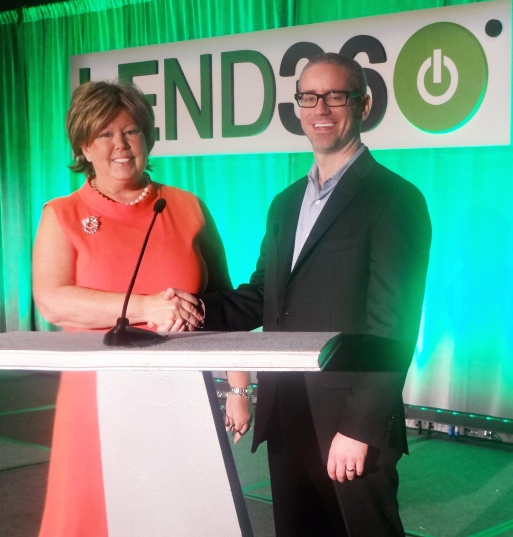 The Lend360 Conference in New Orleans last week had a different vibe from the five other conferences I’ve attended this year. For one, I was a partner in it through DailyFunder. And further, there was a huge focus on best practices, ethics, and regulations. Expert speakers and panelists aired it out to dispel myths and disclose risks.
Most telling about the future was a response from Victory Park Capital’s Brendan Carroll about whether or not he feared looming regulations could hurt the merchant cash advance and alternative business lending industry. As someone who has invested heavily in Kabbage and more recently in Square Capital, he expressed concern about regulations in general but clearly was not convinced they were on the immediate horizon for the industry.
Lisa McGreevy, president of the Online Lenders Alliance moderated the two-man panel which also consisted of John Hecht of Jefferies and she did a great job of digging out the true thoughts from one of the room’s most powerful investors. It’s unlikely a company like Victory Park Capital would invest hundreds of millions of dollars in an industry they believed faced imminent regulatory upheaval.
Merchant Cash Advance regulation is not on any regulator’s immediate agenda but they are doing their homework. At Lend360, it was revealed that several members of the North American Merchant Advance Association met with the Federal Reserve in Washington D.C. months ago for a Q&A. There’s communication occurring now on some levels. Even I’ve been contacted by the Federal Reserve to comment as a part of a broad research assessment.
Eventually I believe the CFPB will try to play a role in the industry through Section 1071 of the Dodd-Frank Act. We’re a long way from there though and it doesn’t mean they’ll be successful. Even internal operatives have expressed doubt on business-to-business jurisdiction.
In the meantime, it’s not all blue seas and sunny skies. Robert Cook, an attorney at Hudson Cook, LLP explained at the conference that the industry is already in many ways supervised by the FTC. And with the FTC, it’s not a question of how high the costs are, it’s about how transparent those costs are. If they’re high, fine, but do the customers understand them and are they marketed accordingly?
Terms like guaranteed, 99% approval rate, and lowest rates can be deemed deceptive if not true.
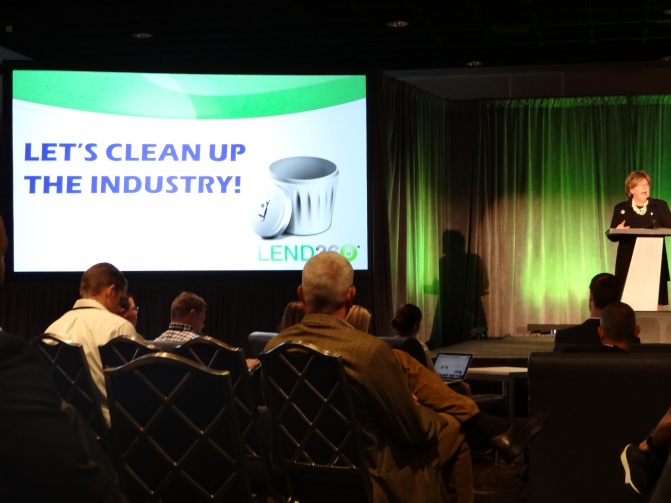 Transparency, ethics, customer experience, that’s what people in the business need to be focused on right now. Stacking, while a polarizing topic, seems to be a matter of contract law. Everybody’s caught up in the stacking debate believing it’s the lightning rod that will attract regulation. If left unchecked, it might draw interest, but it’s the fundamentals that get overlooked that could draw the ire of an agency like the FTC.
If your marketing says “rates from 1.10 and up”, while actually contracting 99% of your customers with 1.49s, that’s something you’ll probably want to address now. Think about the net cost your customer is likely to be charged. If a 1.10 is a buy rate and there’s a 10 point upsell, a 10% closing fee, and 10% origination fee that makes the end cost closer to a 1.40, you probably don’t want to market the cost as 1.10.
Right now it all basically comes down to doing good business in a transparent manner. Costs may be high but explain those costs, make sure the customers understand them. Don’t be deceptive. There will always be critics of high costs, but rational people are being exposed to the sober reality that you can lose money even at a 50% interest rate.
As a word of advice for new ISOs and brokers, stay away from funding companies that don’t even have a paid email account. If a funder is too financially strapped to afford a web domain, they probably are going to cut corners in other places too. The story about working off a gmail or hotmail account in the interim while they try to get their website set up is indicative that they’re getting ahead of themselves. There are way too many solid funding companies to choose from for you to entertain doing business with hotFunding4ISOsNow@hotmail.com. Even middlemen are accountable in the grand scheme of best practices and the customer experience.
Fund intelligently…
– AltFinanceDaily
Also read:
4/11/14 Regulatory Paranoia and the Industry Civil War
8/13/14 Should Licensing and Accreditation come to Merchant Cash Advance?
Industry Takes ALS Ice Bucket Challenge
August 24, 2014Have you been nominated to take the ALS ice bucket challenge yet?
Kabbage below:
Their video made the local Atlanta news.
OnDeck in Times Square NYC:
Noah Breslow, their CEO also did it:
Funding Circle:
PayPal
Coincidentally, in the industry’s 2012 fantasy football competition for charity, league winner Sure Payment Solutions chose to donate all funds raises ($7,100) to the ALS Association.
Whether you get nominated or not, you can donate at http://www.alsa.org/.
Feel free to tweet @financeguy74 if you or your company accepted the challenge. 🙂
What Would Barney Frank Say?
July 16, 2014While crowd funders navigate the JOBS Act and a possible revision to what constitutes an accredited investor, non-bank business lenders are raising eyebrows with sky high interest rates. Annual Percentage Rates (APRs) are reaching into the triple digits and critics are reaching for their megaphones to say something about it.
Unfortunately APRs don’t spell out the true dollar for dollar cost, a flaw pointed out by OnDeck Capital CEO Noah Breslow in regards to daily amortizing loans. In the June Access to Capital Small Business Panel, Breslow explained that a 60% APR loan could actually only cost 15% on a dollar for dollar basis over 6 months simply because of daily amortizing.
Still, the figures make for enticing headlines and it is to be expected that they will come under greater public scrutiny as time goes on.
In an opportunity I got to speak one-on-one with former Congressman Barney Frank in June, he offered some pretty interesting thoughts on the governance of business to business transactions.
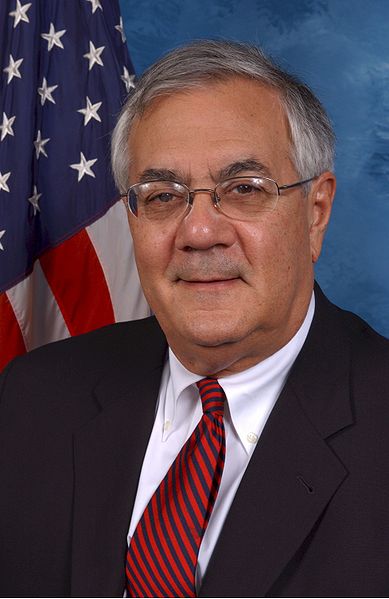 Frank, who was the key author of the Dodd-Frank Wall Street Reform and Consumer Protection Act that was signed into law in 2010, was a longtime champion of consumer financial protections. But he sings a different tune when it’s all about business. Many people may not realize that he opposed the Durbin Amendment of the Dodd-Frank Act, the addition that placed caps and restrictions on debit card interchange fees. Federal restrictions on how much a business can charge another business? Not his thing…
Unsurprisingly then when I asked him if he’d be in favor of a federal cap on business loan interest rates, he sternly replied, “no.” He went on to say that he supported transparency in business loan transactions, such that the borrower should be easily able to identify the terms, but that the premise behind consumer loan protections was that consumers were less sophisticated.
Curiously, there are a few states that impose caps on commercial interest rates, making the regional landscape for high rate business lenders a little bit tricky. In a recent publication by financial law firm Hudson Cook, they spelled out federal laws that already govern business loans.
To date there has been no legislative activity related to merchant cash advance or alternative business lenders. If such discussion did arise though, it’s ironic to say that one of the most liberal congressmen of the last decade, a man who wrecked Wall Street, would stand to make an excellent champion of the alternative business lending cause.
I never thought I’d say this, but too bad the guy retired.
Securitization Begins in Alternative Business Lending
May 1, 2014 It’s official, alternative business loans can now be pooled up and sold off to investors. On Wednesday, OnDeck Capital announced a $175 million transaction made possible by issuing fixed rate notes backed by their loans.
Their Class A notes were rated BBB by DBRS while the Class B notes received a BB.
According to DBRS, BBB grade are of “Adequate credit quality. The capacity for the payment of financial obligations is considered acceptable. May be vulnerable to future events.”
BB grade are “Speculative, non-investment grade quality. The capacity for the payment of financial obligations is uncertain. Vulnerable to future events.”
While it’s popular to refer to alternative business lending as highly speculative and fraught with risk, it’s notable that a highly respected ratings agency would not officially bestow OnDeck’s loans with a label to match that. A single B would’ve signified a highly speculative investment and CCC, CC, and C would signal danger. But OnDeck’s Class A notes are up to snuff as investment-grade level material.
OnDeck has been dogged by critics over the last few years, most of whom are their competitors. The argument goes that their practice of undercutting the rest of the industry on rates is doomed to fail. Those theories are bolstered by the very public knowledge that they have yet to turn a profit. Back in March, CEO Noah Breslow was quoted in the Wall Street Journal as saying they were “imminently profitable“, an optimistic yet openly ambiguous indicator of where they stand. Since they are not a publicly traded company, they are not required to disclose their financial statements.
While DBRS serves to validate OnDeck’s policies and approach, word that they had achieved “investment-grade” status did little to pacify their critics. Yet, for a company that places a remarkably heavier focus on credit modeling and technology infrastructure than the majority of their peers, there is always the possibility that OnDeck is actually as smart as they want everyone to believe. Four months ago it was reported that “fifty-six of their 225 employees have backgrounds in math, statistics, computer science, or engineering.” Contrast that with some of the small and mid-sized players that are largely focused on ISO recruitment and sales.
While I haven’t seen a prospectus in its entirely, I’ve learned there are quite a few ground rules in place for these notes. For one, these loan pools have to be diversified. That means no secretly packaging up all the loans in a risky zip code in Nevada and selling them off as a BBB rated note. There are concentration limits in place to reduce risk. Below are the maximum thresholds allowed in a pool based on their location:
Obligor Located in California 20.0%
Obligor Located in Florida 15.0%
Obligor Located in New York 15.0%
Obligor Located in Texas 15.0%
Obligor Located in Any Other State 10.0%
 If a concentration limit is exceeded, the issuer is required to maintain additional credit enhancement. I’m not surprised at all that California, Florida, New York, and Texas are singled out. In addition to being among the most populous in the country, they are the heaviest users of alternative business loans and merchant cash advances. There’s also the theory that Floridians are statistically the least likely to repay a loan, as openly discussed in The Joy of Redlining, a controversial assessment borne out of the peer-to-peer lending crowd.
There are other concentration limits to adhere to such as the OnDeck Score range (not FICO score range), size of the outstanding principal, industry type, and repayment time frame.
Notably, recognition and acceptance of the proprietary OnDeck Score in concentration limits is a major achievement for them. Breslow previously referred to the OnDeck Score as “the Main Street equivalent of FICO” in American Banker.
Additionally, OnDeck’s reliance on ISOs/brokers for originations is shrinking. In 2013, their direct marketing channel accounted for 43% of their deal flow, compared to only 12% back in 2010. This is a step in the right direction for them financially as broker commissions are on the rise. Increasing the direct marketing percentage will serve as a hedge against increasing third party origination costs.
So what’s next?
For now, OnDeck Capital can enjoy the liquidity gained through securitization and focus on more important things like growth and profitability. Profits are a must in the current IPO environment. Payment company Square had their IPO hopes dashed when word of their losses were leaked to the Wall Street Journal. That came as a shock to the general public. Meanwhile everybody already has an idea of where OnDeck stands, sort of. They’re either brilliant or doomed to fail. I’d say an independent assessment that they’re capable of issuing investment grade notes, increases their odds of brilliance.
Whatever your feelings, they have set a powerful precedent for secuitization. As these notes were reportedly oversubscribed, investors will be looking to their competitors for a taste. OnDeck just whet the appetite. Additional securitization in this industry could be right around the corner. One might say it’s… imminent.
Is Alternative Lending a Game of Thrones?
April 8, 2014 It was the best of times, it was the worst of times, it was the age of wisdom, it was the age of foolishness, it was the epoch of belief, it was the epoch of incredulity, it was the season of Light, it was the season of Darkness, it was the spring of hope, it was the winter of despair, we had everything before us, we had nothing before us…
This blog has been many things over the years, all of it relative to who the reader was. It has encouraged and deterred, informed and confused, made people laugh or stoked their anger. The merchant cash advance industry it spoke of had been small. Annual funding volume was a billion or two or three, a blip of a blip on nobody’s radar. There was a sense of unity, a shared objective amongst competitors. They were guided by one dictum, “grow, but don’t rock the boat.”
But opportunity enticed everyone, the good, the bad, and the unexpected, and it brought a relatively peaceful chapter to an end. Winter is coming, Eddard Stark would likely say of the uncertainty that hangs in the air. Merchant cash advance has become a spoke in the alternative lending wheel that is spinning forward uncontrollably. Non-bank financing has become a worldwide phenomenon virtually overnight, setting the stage for the lords of funding to play a game of thrones. Investors with bottomless pockets are emptying them, government agencies are assessing the landscape or crafting responses, and journalists stand ready to shape public opinion.
This is a transformational moment in human history, perhaps bigger than what Facebook did for social media. Individuals are taking control of the monetary supply. Strangers pay each other in bitcoins, neighbors are bypassing banks for loans and lending to each other instead, and businesses are rising and falling with the funding they get from other private businesses. Winter is coming for traditional banking. The realm calls for a new king.
Wonga’s epic rise is being countered by both regulatory and religious resistance, and the man who dared the world to lend algorithmically has admitted defeat. Peer-to-peer lenders have encountered massive regulatory setbacks on their road to stardom and merchant cash advance companies are currently engaged in a civil war over best practices. Winter is coming indeed.
The Kings
 Lending Club
In what is perhaps their first step towards an IPO this year, Lending Club is reducing transparency over its loan volume. Up until April 3rd, anyone could see how many loans they issued on a daily basis. Now this information will only be available quarterly. Peter Renton in his Lend Academy blog shared his belief that the move was entirely tied to the impending IPO. “Without this daily loan volume information their stock price will be less volatile and they will be able to “manage the message” with Wall Street every quarter,” Renton wrote.
OnDeck Capital
OnDeck Capital is also in contention for an IPO this year. A year ago a company executive hinted that becoming a public company would not be on the agenda for consideration until 2015, yet I am hearing rumors that they may make a late 2014 go at it. Such rumors hold weight in light of reports that they are cleaning up their ISO channel. Insiders on DailyFunder are saying that resellers with abnormally high default rates are in jeopardy of being cut off.
OnDeck Capital is unique in that outsiders chastise them for their rates being too high while insiders argue their rates are too low to be profitable. It’s a classic example of how tough the court of public opinion can be on a lender even if they are not getting rich off their loans.
Kabbage
Kabbage came and conquered the entire online space before anyone had a chance to blink. PayPal, ebay, Amazon, Etsy, Yahoo, Square, they claimed those territories for themselves and then launched an attack into the brick and mortar space. Kabbage’s secret value is their patents. They are a serious player on a serious path.
CAN Capital
CAN Capital’s greatest weakness is their lifespan. They’ve managed to stay on top after 16 years in the business but that makes them old enough to be Kabbage’s grandfather by today’s tech standards. As a pre-dot com era business, it’s impossible to argue against their sustainability. If anyone has alternative lending figured out for both the good times and the bad, it’s CAN Capital.
The Lords
The Government
 Peer-to-peer lending has already been under strong scrutiny from the Federal Government. Lending Club and Prosper are regulated by the Securities and Exchange Commission these days, but they may never be free of oversight. Just two months ago, the Federal Reserve published a report on trends in peer-to-peer business lending. They hinted at further regulation.
As small business owners are increasingly turning to this alternative source of money to fund their businesses, policy makers may wish to keep a close eye on both levels and terms of such lending. Because such loans require less paperwork than traditional loans, they may be considered relatively attractive. However, given the relatively higher rate paid on such loans, it may be in the best interest of the business owner to pursue more formal options. More research is required to understand the long-term impact of such loans on the longevity of the firm and more education to potential borrowers is likely in order.
– a 2014 Federal Reserve study
The Merchants
Once upon a time nobody talked about alternative lending online except for the companies offering it. Merchants didn’t talk about it with each other or there were too few businesses to give rise to centralized discussions. Today, merchants communicate and compare notes:
Merchants discuss PayPal’s working Capital program: http://community.ebay.com/t5/PayPal/PayPal-Working-Capital-Loan-DONT-SIGN-UP/td-p/17630207
Merchants discuss Square’s merchant cash advance program: http://www.mrmoneymustache.com/forum/welcome-to-the-forum/square-to-offer-small-business-loans-at-exorbitant-interest-rates/
Merchants discuss Kabbage: http://community.ebay.com/t5/Part-time-eBay-Sellers/Kabbage-quot-loans-quot/td-p/3002329
OnDeck Capital’s 30+ Yelp Reviews: http://www.yelp.com/not_recommended_reviews/FOndxpkaBRP6LVIlOv6Dfw
Potential Lending Club borrowers make their cases: http://www.lendacademy.com/forum/index.php?board=3.0
The Machines
Are computers better predictors of performance than humans? Some people think so. This debate will play a pivotal role in the future of alternative lending.
The Media
Public opinion will be at their mercy.
The Vulnerabilities
 Commissions
The bigger alternative lending gets, the juicier the stories become. Just last week, Patrick Clark of BusinessWeek dove head first into the reseller model, revealing insider commissions, the truth about buy rates, and the alleged antiquated practice of enlisting a broker to secure funding. On trial was a documented 17% commission, an example I believed to be an extreme case. For a long time commissions ranged between 5% and 10% on average. But there are some big names paying up to 12 points and others boasting of 14. All were topped by the mass solicitation I received a few days ago that promised a 20% commission. These kind of figures if they continue will become an easy target for journalists looking to portray the industry in a negative light.
Stacking
There is a raging civil war within the merchant cash advance community specifically over stacking. This is the instance that a merchant sells their future revenues to two or more parties at the same time, leading to multiple daily deductions from their sales. This debate is bound to spill out into the mainstream if it cannot be resolved on its own.
Technology
Some funding companies intend to license their automated underwriting technology to banks, potentially handing the keys of alternative lending’s greatest asset (speed) to traditional bankers. It is unlikely that banks would engage in some of the high risk deals that alternative lenders target but they could recapture the top credit tier borrowers that have been flocking away from them.
Also at stake here is the sustainability of algorithmic underwriting. There are critics that believe computers appear to make great decisions during good economic periods but suffer during downturns. Do the technology based funding companies have enough data to weather a future economic storm?
So many things are happening at once, that it’s impossible to know what fate awaits the realm. Will there be a new king or will alternative lending fall apart like a house of cards?
For those of us climbing to the top of the food chain, there can be no mercy. There is but one rule: hunt or be hunted.
-Frank Underwood
May the best man win.
TakeCharge Capital Acquires SBS Capital
July 29, 2013For early release on Merchant Processing Resource:
 NEWINGTON, CT- TakeCharge Capital, LLC, an MCA and Loan Service Provider based in Connecticut, proudly announces the acquisition of SBS Capital, LLC a financial services company providing merchant cash advances and credit card processing based in Newington, Connecticut. SBS Capital will rebrand its company under TakeCharge Capital and has appointed Aaron Shimkowitz COO of TakeCharge Capital, former VP of SBS. “TakeCharge’s MCA Portfolio now encompasses 28 Million in Funding to small-mid sized businesses nationwide, including 400+ credit card processing merchants added to the TakeCharge Payments Portfolio respectively.” stated Sam Kota, CEO at TakeCharge.
To accommodate growth, TakeCharge Capital has relocated from 705 North Mountain Road in Connecticut to prime 4,000 square ft facility located on 2600 Berlin Turnpike in Newington Connecticut. “With about 100,000 drivers passing through the turnpike everyday and over 32,000 businesses within a 30 Mile Radius, the Berlin Turnpike marks the first storefront location in our New Retail Strategy. The end-to-end model coupled in a retail environment is by far the best user experience, as we’ve learned from outside industry leaders such as apple and the gap” states Shimkowitz.
In addition to the expansion, TakeCharge Capital has promoted:
- George Korhonen- SVP of Business Development at TakeCharge Capital. In this new role, Mr. Korhonen will continue to develop TakeCharge’s core business and lead new partnerships within the trucking and medical industries.
- Rebeqa Abrams- VP of Operations at TakeCharge Capital. In this new role, Ms. Abrams will continue to manage business operations and direct new operational initiatives to reduce costs and increase overall company efficiency.
And newly appointed:
- Aaron Shimkowitz- Chief Operations Officer at TakeCharge Capital, former VP at SBS. In this new appointment, Aaron will spearhead and oversee all operations, accounting and day to day corporate responsibilities.
- Nicole Beaudry- VP of Funding at TakeCharge Capital, former Director of Cash Management at SBS. In this new appointment, Nicole will oversee funding partnerships and refinance department.
- Jennifer Burke- VP of Sales at TakeCharge Capital, former Executive Underwriting Specialist at SBS. In this new appointment, Jennifer will oversee sales and portfolio retention.
“This partnership with Aaron’s team, further attributes to our long-term strategy of creating a google-like culture with top notch talent and a passion to design technology specifically for the small business community we serve.” states Kota.
TakeCharge Capital, LLC, based in Newington Connecticut is a privately-held financial technology company providing loan and payment services to business owners nationwide. For more information, visit http://www.takechargecapital.com or email info@takechargecapital.com. To speak directly with a TakeCharge Representative reach us Toll-free at 877-417-9473.
Merchant Cash Advance Competition
June 3, 2013 If I had a dollar for every time someone told me that Kabbage wasn’t a competitor in the Merchant Cash Advance space, I’d have my own funding company. It’s been argued that they only care about Ebay or Paypal and that their business model revolved around strengthening Ebay’s PowerSellers for the good of Ebay. I never really believed that was the case.
On September 11, 2012 I wrote this about Kabbage:
Some people feel that they are not a serious challenger to the status quo and that their tactics, methods, and headlines are merely shock value fodder for the rest of us to laugh at while we all rant and rave about ACH deals being the hottest thing since Square. We believe Kabbage is a company everyone should keep an eye on.
Kabbage analyzes many pieces of data in their underwriting including how many facebook fans a business has or added. And as of 2 weeks ago, what do you think happened?
Kabbage expanded their cash advance programs to brick and mortar businesses… (BusinessWeek)
And so here we are with yet another fierce well-capitalized competitor, a company that isn’t struggling to add technology but is rooted in it. Not only that, but last I heard they don’t work with brokers or agents. They cut out the middleman, much like Square did with ISOs.
Which brings me to the next few companies to keep an eye on:
Amazon: People say that their goal is to finance Amazon retailers for the good of Amazon. Sound familiar? I admit that Kabbage wasn’t owned by Paypal but there was a solid relationship there. Is it that ludicrous to think that Amazon will enter the brick and mortar cash advance business?
Groupon: They’ve been sniffing around this industry for quite a while. Keep an eye on them.
American Express: They already have their own cash advance program for premium merchants that accept a high volume of amex transactions. Every six months or so, their standards loosen. It’s only a matter of time until they have enough data to loosen their standards even more and compete head to head with the rest of the alternative business lending industry and cash advance industry.
———-
Scott Griest, the CEO of American Finance Solutions wrote in Disruption in the Alternative Business Lending Space that when all the dust settles in a couple years down the road, there will be only 4-5 large alternative business lenders. Consolidation and competitive pressure will thin out the herd and the strongest will prevail. The question is, will those 4-5 funding companies be the grass roots companies that propelled the industry to where it is today or will it be the big mega-corporations who are looking at our the industry like a delicious snack?
In one of the most read ever articles of MPR, I made this prediction in The End of an Era:
2014 will eliminate the weaker firms that remain and by 2015, Merchant Cash Advance will no longer be a term that anyone uses. Big banks and billion dollar technology companies will go on to rebrand all that which the funding warriors of the last decade have worked so hard to establish. MCA will simply assimilate into other financial products. The metaphorical Sally, Joe, and Tom will probably still be in the business, but be working for companies like Capital One, Wells Fargo, and American Express.
We weren’t kidding…
More Companies Cheer For Charity
October 5, 2012The alternative business lending industry has raised even more money for charity thanks to four new companies. Through a fantasy football competition that started with the beginning of the NFL season, each of the twelve participants are representing individual non-profit organizations. At the end of the season, all of the money raised will be donated to the winning team’s charity. Though registration to compete ended five weeks ago, outside individuals and companies are free to add to the total. One of the following charities with be the lucky recipient of the prize:
- Network For Teaching Entrepreneurship
- Epilepsy Foundation
- Society of St. Vincent De Paul
- Kiva
- ALS Association
- 100 Urban Entrepreneurs
- Gift of Life Bone Marrow Foundation on behalf of the The Silver Project
- The Missionaries of Our Lady of Divine Mercy
- Smile Train
- Cystic Fibrosis Foundation
- American Heart Association
- Distressed Children & Infants International
Special thanks to the new contributions from:
Entrust Merchant Solutions
Based in New York City, Entrust has been helping small businesses get financing for more than five years.
Strategic Funding Source
From the flashy district of Times Square in New York City, Strategic is one of the oldest and most successful firms in the Merchant Cash Advance (MCA) industry. They can teach you how to become your own MCA company:

Capital Stack, LLC
Capital Stack is a Brooklyn, NY based financing provider that specializes in high risk deals structured via ACH. They’re also a co-founder of a new industry forum, DailyFunder.com.
Paramount Merchant Funding
Yet another New York City merchant financing company, Paramount is one of the fastest growing firms in the industry.
They’re also helping a separate cause at the same time. Help Paramount raise money for Noah’s Hope!

Dear Friends and Family,
Paramount Merchant Funding is hosting a bowling night on November 2nd to help raise money for Noah’s Hope.
About Noah’s Hope:
Noah’s Hope was started by Jennifer and Tracy VanHoutan, the parents of Noah and twin girls Laine and Emily. Noah and Laine are both battling LINCL-Batten Disease, a rare genetic illness. They have lost the ability to speak, as well as their balance and mobility. At this time, LINCL-Batten Disease is always fatal, usually between the ages of eight and 12.
Fewer than 450 children in the United States have LINCL-Batten Disease, so it doesn’t receive the attention it should. Paramount Merchant Funding has decided to help this great cause. We are raising money to donate to Noah’s Hope in the hopes of finding a cure for LINCL-Batten Disease. All donations, no matter how big or small, help make a difference in the fight against LINCL-Batten Disease.
CLICK HERE TO SEE HOW YOU CAN HELP!
About Paramount Merchant Funding:
Paramount Merchant Funding is a merchant funding company based in Midtown, New York City. We provide capital to businesses in the United States, as well as Canada. Paramount was founded in 2008 and provides professionals with a whole host of funding options depending on their stage of business.
Choose how you want to help!
1. Click HERE to donate money.
2. Donate something to give away at our raffle.
For more information email erika@empiremerchantadvance.com.
We appreciate any and all donations made for this cause!
Sincerely,
The Paramount Merchant Funding Team
It’s awesome what everyone is doing. You’re making the country a better a place!
– Merchant Processing Resource
../../