
Six Signs Alternative Lending is Rigged
August 3, 2014There’s a lot of players at the alternative lending table but there are two that have won a string of lucky hands to put them on top. Neither were the first to draw cards, nor do either of them offer something that everybody else does not. These two lenders have something in common of course, special favor with the Internet gods. Is the game rigged?
OnDeck Capital is the most celebrated alternative business lender of our time. Their daily repayment loans and fast approval times are a hit with customers. In fact, as told in their recent securitization prospectus, OnDeck has been eroding its reliance on brokers and third parties to accommodate growth through their direct channel. Direct has been good for OnDeck, very good.
LendingClub on the other hand is the big dog in consumer lending, having funded more than $5 billion since inception. Every month they shatter the previous record for volume of loans funded and they’re expected to go public within the next year. LendingClub continues to pound their distant rival Prosper in monthly loan production. Are they just better at marketing?
Curiously I can’t help but notice they have something in common, they’re both owned by Google. Google Ventures led OnDeck Capital’s series D round and Google Ventures’ Karim Faris sits on OnDeck’s board of directors. Similarly, Google owns a minority stake in LendingClub.
While neither is outright owned or controlled, It’d be surprising if Google didn’t do something to foster the success of their investments. What could a billion dollar Internet giant possibly do to give them a little push?
Stop backlinking and SEO. The game is rigged
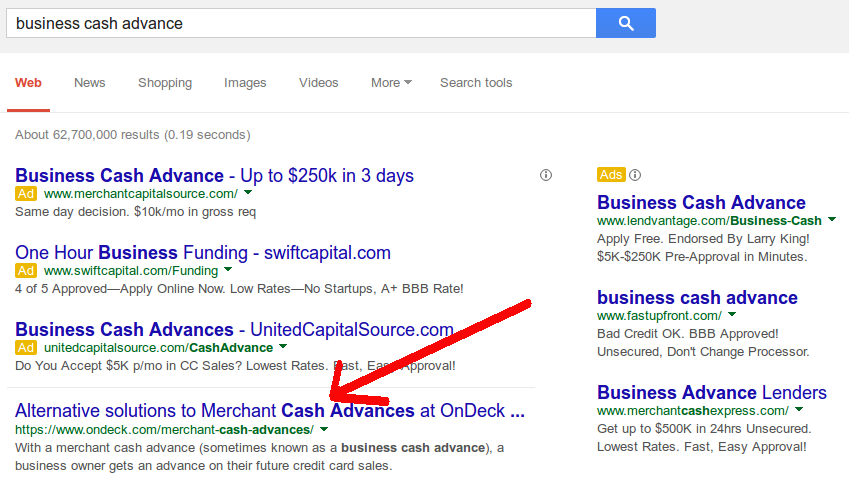





If you reproduce a search for the same keywords, you should know that results vary depending on what kind of device you’re using (mobile vs. desktop), what zip code you’re in, what time of the day it is, whether or not you’re logged into Gmail/Google+/Youtube, and whether you’ve searched for related topics before. I performed my searches with a fresh desktop browser on a Sunday evening in NYC with all cookies, cache, and Google account sessions wiped clean.
 You might not get exactly what I get and I realize that obfuscates the conspiracy I’m trying to establish here. If you do witness peculiar keyword domination though, keep an open mind that there might be more going on than good SEO and strong natural backlinking brought on by mainstream media publicity. Plenty of big businesses that dominate offline fail to rank well in the top ten results online.
Search engines say that if you’re popular, you’ll rank well. But there are plenty of cases where ranking well has made businesses popular.
Maybe, just maybe the game is rigged…
Is Awareness of Alternative Lending Still Low?
July 4, 2014 Prosper’s President Ron Suber and LendingClub’s CEO Renaud Laplanche have previously explained that there is still a large opportunity for growth because most people still don’t know non-bank lending options exist.
As cited on LendingMemo, Renaud Laplanche admitted the reason they are even considering an IPO is “to use it as an opportunity to raise awareness for the company.” He continued by saying that they don’t need capital so the purpose of their IPO aspirations “is a lot of free advertising.”
In casual conversations with business owners, friends, and new acquaintances I’ve asked if they’ve ever heard of merchant cash advance, p2p lending, or companies like OnDeck Capital and LendingClub. The answer is almost always ‘no’.
That means there is still a lot of work to do.
In this CNBC interview Funding Circle acknowledges that many business owners aren’t aware of alternatives and explains what makes them different.
Does Culture Make a Difference?
June 30, 2014I came across this video that describes the work culture of Kabbage, an Atlanta-based business lender. It’s strikingly different from the way many of the MCA and business lending companies in New York operate.
Though New York is well-known for its medieval dungeon-like office environments, especially for smaller companies just getting started, do it too long and you start to believe that offices are like that everywhere.


What do you think? Is the Kabbage work environment more conducive to productivity and growth?
Do Opportunities Abound?
June 8, 2014 Just recently I found myself in an office surrounded by some folks who had each worked in the merchant cash advance business for more than 10 years. The first generation of MCA pioneers are still out there of course but it’s rare to be in the presence of so many at one time. It was weird. Weirder still was the realization that no matter how much things have changed, some things continue to be exactly the same.
Me: You guys looking to recruit ISOs?
Them: Damn right
As far as the industry is concerned, these guys might as well have fought in ‘Nam. They’re from another generation where life was hard and men were still men. When businesses couldn’t get bank loans, these guys were splitting payments with their bare hands and reprogramming credit card machines with nothing more than a paper clip and a ball of twine. Funding a deal wasn’t a product of technology, it was one of sweat, tears, and blood. Have you ever bled for your deals?
This August I celebrate my 8th year in the industry. Next month marks the 4 year anniversary of this blog. I enjoy reading some of my posts from back then, particularly since most of them discuss the ordeals of credit card processing. A lot of what I’ve written no longer applies and some of what I’m writing these days will be outdated years from now. As I approach 600 articles and blog posts on this subject matter, I’ve had to stop and ask myself if everything has already been written. What more can possibly be said about this business? Perhaps the tale of the industry has already been told and I am on my way to retelling exaggerated stories to anyone who will listen. I don’t want to be that wrinkled up old man swaying back and forth in a rocking chair talking about how ISOs got it so easy these days.
 Sadly, even the name of the website is reflective of a previous era. This is the Merchant Processing Resource, not exactly what you’d expect a top destination to be called on the subject of alternative business lending.
But the story’s not finished. Every passing month is filled with events that inspire a dozen new chapters, which is more than one man can keep up with. Last month at the LendIt conference, I got a glimpse of just how many opportunities still lie ahead.
Some alternative business financing companies such as Funding Circle and DealStruck are diverging away from merchant cash advance and going back to the traditional roots of term lending. Funding Circle is doing it with a 21st century twist, by making their system peer-to-peer based.
Still other firms have sprung up around LendingClub’s and Prosper’s APIs and offer their users ways to make better loan investment decisions.
And even among the players we’re all familiar with, there is innovation, growth, and new ideas. Just recently CAN Capital launched CAN Connect, a software application that can be integrated with any other company’s software. According to CAN’s release,
Through CAN Connect™, merchants will be able to receive a CAN Instant Quote™ based solely on data provided by the partner. Once the merchant elects to proceed, they are taken through a simple online application process and can obtain access to working capital without ever leaving the partner’s platform.
Indeed technology has even allowed me to become a lender myself,

My LendingClub portfolio, which is still very young and made up by hundreds of $25 consumer loan contributions has a current Net Annualized Return of more than 10%. Contrast that against the average U.S. savings account that pays out less than 1%.
While it’s certainly not the 54% yield that OnDeck Capital enjoys, there are levels of risk and markets set up for just about anyone interested in alternative lending.
And what might come next may not all be broker/funder related. As the industry flies in a thousand different directions, entire new industries and services are going to grow up around them. That brings me back full circle. Has everything already been written? 4 years of blogging here and this might as well be my first day.
Some things haven’t changed a bit, but the rest of it, well… we must soldier on in this strange new world.
Do you see opportunities ahead? Discuss with industry insiders on DailyFunder.
Big Deal #2 Struck in MCA Industry
May 21, 2014 Another day, another capital raise for some company or other involved in alternative business lending. That’s the way it is these days, but the news about the American Finance Solutions (AFS)/CapFin Partners deal announced on Wednesday is markedly different.
It’s the Rockbridge Growth Equity (RGE)/RapidAdvance deal all over again, the welcoming of a major MCA company into a wider lending family. Though the release does not specify the amount of equity CapFin Partners acquired in the transaction, nor any valuation figure, the headline literally says it’s significant.
CapFin Partners is also a significant investor in Contintental Business Credit (CBC), an asset-based lender that’s been in operation since 1989. The CapFin deal will bring AFS and CBC together strategically. As said in the release, “the union of these two financial lending companies will widen the portfolio of services offered, which now include merchant cash advances, factoring and asset based loans.”
The design is strikingly similar to the RapidAdvance/RGE deal.
AFS/CapFin
The investment and close relationship with CBC will provide operational expertise, a diversified client base and a larger pool of capital for funding customers
RapidAdvance/RGE
By aligning with Rockbridge, we will leverage our new relationship with its portfolio of companies, bringing best practices and expertise to nearly every aspect of our business.
Both funders were founded in the pre-recession era, giving investors a chance to review performance and returns both through good times and bad.
Two years ago I predicted that “MCA will simply assimilate into other financial products.” As is the case with these two deals, it’s already becoming just one product out of many offered by financial institutions. Elsewhere in the industry, MCA companies are offering true loans to stay competitive and some funders are passing on MCA completely to focus just on traditional business loans with terms up to 10 years and traditional interest rates.
The AFS deal proved yet again though that there is a market to buy (or buy into) established reputable merchant cash advance companies. That should give hope to new funders that are trying to formulate a long-term exit strategy.
Congratulations to American Finance Solutions.
LendIt Conference: The State of Alternative Business Lending
May 6, 2014 Have you heard? Banks aren’t lending. Nobody at LendIt seems to mind though. Ron Suber, the President of Prosper Marketplace, said earlier today that banks are not the competition. That’s an interesting theory to digest when contemplating the future of alternative lending. If banks are not the competition, then who is everyone at LendIt competing against? I think the obvious answer is each other, but much deeper than that, the competition is the traditional mindset of borrowers.
The biggest challenge the wider alternative lending industry faces is awareness and understanding. Those happen to also be two of Suber’s three edicts for growth. The third is education. Just because alternatives are available today doesn’t mean that potential borrowers know about them or feel comfortable enough to use them. Today we are competing against the old way of thinking.
Revolution?
Other products in the new “share economy” have encountered a similar struggle. Several presenters today cited Uber as having revolutionized the way people use taxis. “A long time ago, people used to stand on corners and hold out their hand to get a cab, but that’s all changed,” was the oft-paraphrased proof that age-old industries were falling like dominoes. But as a New York City resident, I hadn’t quite noticed a change at all. Hailing cabs off the street is still very much the norm. It is only by sheer coincidence that I used Uber for the very first time to travel to JFK airport on my way to this conference.
I first encountered Uber a year ago when an acquaintance dazzled me with his ability to summon a car using an app on his phone. It was then that I became aware, but I did not understand how it worked. It took me 12 months to get comfortable enough to try it myself, and the experience was okay I guess if you discount the fact that my driver went through the E-ZPass lane without actually having an E-ZPass. Needless to say, that led to a major holdup that caused me to almost miss my flight.
If it took me a year to get past the confusion of hailing a cab from my phone, I can only imagine what potential borrowers must think when told they can raise money from their peers, the crowd, or a lender that requires payments to be made every single day.
Perhaps most telling about the awareness challenge, is that many people I’ve spoken to at LendIt had never heard of a 16 year old product known as merchant cash advance. That speaks volumes about how much more work merchant cash companies still have to do in order to gain mainstream awareness.
Even those fully aware were not entirely certain about how to define the product. In the Online Lending Institutional Investors Panel, merchant cash advance was briefly discussed as a topic but it was almost entirely spoken in the context of being something that OnDeck Capital does. That would come as disheartening news to OnDeck since they have spent considerable resources in positioning themselves as anything but a merchant cash advance company. Confusion over what somebody is or isn’t will probably increase especially as alternative lenders from different industries start to compete for the same clients.
Funding businesses instead of people
Brendan Ross, the President of Direct Lending Investments, and the moderator of the Short Term Business Lending panel pointed out that a dentist could pursue two different loan options and get completely different results. With excellent credit a dentist could expect to land a 3-5 year personal loan at 7-8% APR on a P2P platform. If he were to apply for the loan using his dental practice though, he could expect to incur costs over 25% and get nothing longer than 2 years.
Ross, who was a very active moderator, subscribes to the belief that businesses are overpaying for credit. Unlike the consumer loan space, there hasn’t been price compression. The cost of business capital remains high, perhaps higher than what is necessary to turn a reasonable profit. Ross argued that the padded cost serves as a hedge against defaults and economic downturns. “The asset class works even when the collection process doesn’t,” Ross said. “The model works with no legal recovery.”
Building on that premise, Ross asked the panelists if an increase in defaults were simply the cost of doing business towards automating the underwriting process.
Stephen Sheinbaum, the CEO of Merchant Cash and Capital argued that just the opposite had occurred, that automation had led to a decrease in defaults. Others on the panel confirmed a similar outcome, though Rob Frohwein of Kabbage admitted they could potentially weather higher defaults through automation by offsetting it against decreased infrastructure costs.
Noah Breslow of OnDeck echoed something similar to Frohwein in the Small Business Term Lending Panel. He asked this question, “Do underwriters add value or not?” and followed up by saying that 30% of their deals were still manually underwritten, usually the deals that are larger.

Is full automation right around the corner?
The debate between humans and computers in risk analysis is a featured segment in the third issue of DailyFunder that is being mailed out this week, but there is another angle that is seldom discussed, whether or not customers want automation. Breslow said today that, “if customers want full automation, we are prepared to deliver it.” They’ve learned over time that “many customers want someone to talk to at some point in the transaction.” Rohit Arora, the CEO of biz2credit expressed much of the same in a recent interview with DailyFunder’s Managing Editor Michael Giusti.
The only dissenting voice was Gary Chodes, the CEO of Raiseworks who seemed to be of the belief that human involvement in underwriting was nothing short of ridiculous. He stated that, “if you look back over the last 20 years, the loss rates on business loans under 24 months has been really low.” To him, that data seemed to be proof enough that complete automation could and should be achieved, though he admitted to performing back-end checks such as landlord verifications. They currently have no physical underwriters however.
Is there a transparency problem?
Tom Green, a VP of LendingClub shared an interesting tale. While trying to convince potential borrowers to ditch a merchant cash advance in favor of a LendingClub business loan, they get pushback on the cost of their money. The reason being? Some borrowers think they’ve already got a great deal or at least a better deal than what LendingClub is offering. The problem stems from the borrower’s belief that the holdback percentage set up in their future revenue sale (the most common way a merchant cash advance is set up) is the APR.
 Merchant Cash Advance Companies pay cash upfront in return for a specified amount of a businesses’s future sales. They collect these sales by withholding a percentage of each credit card transaction or bank account deposit until the agreement is satisfied in full. On a dollar for dollar basis, the cost of these programs typically range from 20%-49%, but on an APR basis, substantially higher. The holdback % is not even a factor in the APR. Green said they’ve learned that some small business owners are not sophisticated when it comes to finance.
Ethan Senturia, the co-founder of Dealstruck would probably agree. Earlier today he said, “you need to speak the borrower’s language.” Some understand APR, some don’t. “Dealstruck offers more than just APR comparisons to borrowers,” Senturia said. “Whatever helps them understand.”
When the OnDeck Capital model and merchant cash advance model were questioned as possibly being bad for borrowers, Tom Green was quick to clarify. “There are different capital needs that small businesses have,” he said. And “there is a trade-off between the length of the term and the risk.”
OnDeck Capital’s clients are not entrepreneurs born yesterday. “The typical customer has been in business for 10 years,” Breslow said. Their deals are “structured to protect through daily and weekly payments in addition to the interest rates we charge,” something he reminded everyone was “not single digits.”
Still, transparency issues remain in business lending. Sam Hodges, the Managing Director of Funding Circle explained that when he was previously a small business owner, there were hardly any lenders willing to provide him with an amortization schedule. Ashees Jain, a managing partner of Blue Elephant Capital Management admitted he would find it hard to justify the high rates of merchant cash advance if asked by a regulator, so he’d rather not invest in that market. When it comes to those types of transactions, they “don’t want to have to explain themselves” at some point in the future.
Scott Ryles, the managing member of Echelon Capital Strategies, LLC commented on OnDeck capital’s model as unbelievable. “The arbitrage is huge,” Ryles said. And Eric Thurber the managing director of Three Bridge Wealth Advisors believes that alternative business lenders are at odds with themselves. “They always talk about their risk management,” Thurber said, but he feels that players in that industry are concerned with how much market share they have. That conflicts with risk management in his opinion.
They pay or they don’t
At the end of the day Ashees Jain said as far as unsecured loans go, “borrowers pay or they don’t.” The recovery process on secured loans can be 12-18 months Jain said, a statistic cited by Brendan Ross earlier in the day.
It’s clear at LendIt that there are a lot of products available, but Ryles summed it up nicely. In the consumer space, all the volume is in the 36 month installment loans, he reckoned. For businesses it’s merchant cash advance. “It’s an awareness thing,” Ethan Senturia said in regards to getting businesses to use alternative lending sources.
It is indeed. Awareness, education, and understanding…
Securitization Begins in Alternative Business Lending
May 1, 2014 It’s official, alternative business loans can now be pooled up and sold off to investors. On Wednesday, OnDeck Capital announced a $175 million transaction made possible by issuing fixed rate notes backed by their loans.
Their Class A notes were rated BBB by DBRS while the Class B notes received a BB.
According to DBRS, BBB grade are of “Adequate credit quality. The capacity for the payment of financial obligations is considered acceptable. May be vulnerable to future events.”
BB grade are “Speculative, non-investment grade quality. The capacity for the payment of financial obligations is uncertain. Vulnerable to future events.”
While it’s popular to refer to alternative business lending as highly speculative and fraught with risk, it’s notable that a highly respected ratings agency would not officially bestow OnDeck’s loans with a label to match that. A single B would’ve signified a highly speculative investment and CCC, CC, and C would signal danger. But OnDeck’s Class A notes are up to snuff as investment-grade level material.
OnDeck has been dogged by critics over the last few years, most of whom are their competitors. The argument goes that their practice of undercutting the rest of the industry on rates is doomed to fail. Those theories are bolstered by the very public knowledge that they have yet to turn a profit. Back in March, CEO Noah Breslow was quoted in the Wall Street Journal as saying they were “imminently profitable“, an optimistic yet openly ambiguous indicator of where they stand. Since they are not a publicly traded company, they are not required to disclose their financial statements.
While DBRS serves to validate OnDeck’s policies and approach, word that they had achieved “investment-grade” status did little to pacify their critics. Yet, for a company that places a remarkably heavier focus on credit modeling and technology infrastructure than the majority of their peers, there is always the possibility that OnDeck is actually as smart as they want everyone to believe. Four months ago it was reported that “fifty-six of their 225 employees have backgrounds in math, statistics, computer science, or engineering.” Contrast that with some of the small and mid-sized players that are largely focused on ISO recruitment and sales.
While I haven’t seen a prospectus in its entirely, I’ve learned there are quite a few ground rules in place for these notes. For one, these loan pools have to be diversified. That means no secretly packaging up all the loans in a risky zip code in Nevada and selling them off as a BBB rated note. There are concentration limits in place to reduce risk. Below are the maximum thresholds allowed in a pool based on their location:
Obligor Located in California 20.0%
Obligor Located in Florida 15.0%
Obligor Located in New York 15.0%
Obligor Located in Texas 15.0%
Obligor Located in Any Other State 10.0%
 If a concentration limit is exceeded, the issuer is required to maintain additional credit enhancement. I’m not surprised at all that California, Florida, New York, and Texas are singled out. In addition to being among the most populous in the country, they are the heaviest users of alternative business loans and merchant cash advances. There’s also the theory that Floridians are statistically the least likely to repay a loan, as openly discussed in The Joy of Redlining, a controversial assessment borne out of the peer-to-peer lending crowd.
There are other concentration limits to adhere to such as the OnDeck Score range (not FICO score range), size of the outstanding principal, industry type, and repayment time frame.
Notably, recognition and acceptance of the proprietary OnDeck Score in concentration limits is a major achievement for them. Breslow previously referred to the OnDeck Score as “the Main Street equivalent of FICO” in American Banker.
Additionally, OnDeck’s reliance on ISOs/brokers for originations is shrinking. In 2013, their direct marketing channel accounted for 43% of their deal flow, compared to only 12% back in 2010. This is a step in the right direction for them financially as broker commissions are on the rise. Increasing the direct marketing percentage will serve as a hedge against increasing third party origination costs.
So what’s next?
For now, OnDeck Capital can enjoy the liquidity gained through securitization and focus on more important things like growth and profitability. Profits are a must in the current IPO environment. Payment company Square had their IPO hopes dashed when word of their losses were leaked to the Wall Street Journal. That came as a shock to the general public. Meanwhile everybody already has an idea of where OnDeck stands, sort of. They’re either brilliant or doomed to fail. I’d say an independent assessment that they’re capable of issuing investment grade notes, increases their odds of brilliance.
Whatever your feelings, they have set a powerful precedent for secuitization. As these notes were reportedly oversubscribed, investors will be looking to their competitors for a taste. OnDeck just whet the appetite. Additional securitization in this industry could be right around the corner. One might say it’s… imminent.
Regulatory Paranoia and the Industry Civil War
April 11, 2014Stacking is on everyone’s minds in the merchant cash advance (MCA) industry but that war is little more than smoke compared to the fire burning in our own backyard. One of the major topics of debate at Transact 14 has been Operation Choke Point, a federal campaign against banks and payment processors to kill off the payday lending industry and protect consumer bank accounts. Caught in the mix are law abiding financial institutions, some of which if affected, could potentially disrupt the merchant cash advance and alternative lending industries. Both have become heavily dependent on ACH processing. Could their strength become their Achilles heel?
Indeed, there was a rumor circulating around the conference that a popular ACH processor in the MCA industry is no longer accepting new funding companies. I know the name but was not able to confirm it as fact. There is a two-fold threat on the horizon:
1. The probability that ACH processors in this industry are also processing payments for payday lenders or other high risk businesses.
2. The likelihood that a bank or ACH processor would take preemptive action and terminate relationships with merchant cash advance companies and alternative business lenders, not because it’s illegal but as a way to make their books squeaky clean.
The sentiment at the conference however was that MCA providers and alternative business lenders had little need to worry. While Operation Choke Point specifies online lenders, they are narrowly defined as businesses making loans to consumers. MCA and their counterparts do not fall under that scope, even if they themselves lend exclusively online.

Is regulation coming?
There seems to be both a call for and paranoia about regulation, especially in the context of stacking merchant cash advances and daily repayment business loans. On the popular online forum DailyFunder, several opponents of stacking are under the impression that regulators will be busting down doors any day now to put an end to businesses utilizing multiple sources of expensive capital simultaneously. Many insiders who have had their merchants stacked on view the issue as both a legal and a moral one. Opponents get worked up about it for many reasons. They believe any one or multiple of the following:
- The merchant can’t sell something which has already been contractually sold to another party.
- That the merchant ends up borrowing and selling their future revenues at their own peril, endangering their cash flow and their business.
- That the stackers endanger the first lender or funder’s ability to collect.
- That the merchant taking on stacks won’t be eligible for additional funds with the first company, hurting the retention rate.
Stacking is not illegal, but it may be tortious interference. That allegation is the one that gets thrown around the most, but it’s important to recognize that actual damages are an integral part of any such case. If I stack on your merchant and the deal performs as expected for you, then what damages would you have suffered? But if I stack on your deal and it defaults 3 weeks later, you might be able to allege that I was the cause of it.
Insiders on DailyFunder’s forum that wonder how they might be able to get stacking to stop, only need to follow the example of what a few select funders are already doing, going on the offensive. The first thing one west coast MCA company does when they have a merchant default is find out if there was a stack that came on top of them. If they find out who it was, they send the offending funder a bill for the outstanding balance. That may sound cheesy, but given their industry prowess and litigious nature, they said that some stackers quietly mail them a check, rather than risk things escalating to the next level. The threats only hold weight of course if you’re actually prepared to bring the case to court.
I’ve spoken with dozens of proponents for stacking, many of sound character, high intelligence, and business acumen. They buck the stereotype of stackers as sleazy wall street guys with pinky rings. Few of these proponents believe that future revenue is a precise asset. It’s been said that, “future revenues are unknowable and possibly infinite. A business should be able to sell infinite amounts of these future revenues if there are investors out there that will buy them.” The general consensus on this side of the aisle is that a 2nd position stack, or “seconds” are here to stay. There’s a sense of calm and conviction, as if seconds were a boring subject of little contention. Many are okay with thirds “if the math works” but discomfort sets in on fourths, fifths and beyond. If they believe it’ll be a good investment, they’ll do the deal. They scoff at the notion that they’d willingly chance putting a merchant out of business since that would jeopardize their own investment.
To date, I’ve seen no data to support that stacking causes merchants to go out of business. I would not be surprised if there was a correlation between defaults and stacks, but that would not imply causation. A business that is on its way towards bankruptcy regardless may be able to obtain a few stacks in the process as a last ditch effort to stave it off. When the business finally fails, it may appear to look like the stacks caused it, even if they didn’t.
For those that don’t want to play cat and mouse with threats and lawsuits, there’s a growing call for regulation, both self-regulation and federal. That call feeds off the paranoia that regulators are knocking at the industry’s door already anyway.
NAMAA
In regards to self-regulation, insiders have been looking to the North American Merchant Advance Association (NAMAA) to create rules and become an enforcer. It’s no secret that their members are opponents of stacking, but as a powerful body of industry leaders, they’re up against a threat of their own, antitrust laws. Creating rules and enforcing them could be construed as anti-competitive. In truth, a lot of the MCA industry’s growth over the last 2 years can be attributed to stacking. A private association of the largest players actively working to establish rules to squash the fast growing segment of new entrants could indeed be perceived as anti-competitive.
But that doesn’t mean NAMAA is powerless to promote their views. Following in the footsteps of the Electronic Transactions Association, they could create a set of best practices, host workshops, and offer courses and sessions to train newcomers on these best practices. Such benefits and opportunities are a standard in the payments industry, but nothing like it is available in MCA or alternative business lending.
But is it too late for self regulation?
With all the government enforcement occurring in the rest of the financial sphere, fears of imminent federal involvement in MCA and alternative business lending are not unfounded… or are they?
In the wake of the financial crisis, the Consumer Financial Protection Bureau (CFPB) was formed to protect consumers in financial markets. The CFPB was instrumental in Operation Choke Point and they would be the most likely federal agency to field complaints about stacking. Unlike the Office of the Comptroller of the Currency which has jurisdiction over banks, the CFPB’s oversight extends to non-bank financial institutions. They’re the wild card agency that has financial companies across the nation on their heels.
I had the opportunity to speak with a former lead attorney of the CFPB off the record today about the definition of consumer. Could a small business be construed as a consumer? The short answer was no. The long answer was that there is no specific definition of consumer at the CFPB but it was meant to represent individuals. Although businesses at the end of the day are run by individuals, I got a pretty confident response that the CFPB would not have jurisdiction over a business lending money to a business, even if it was a very small 1 or 2 man operation. If they were acting in a commercial capacity, then they’re no longer consumers.
The other side of her argument was that it would take up too much resources to take on a case where the victim class was basically outside of their scope. The CFPB already has enough on their plate.
Is the government busy?
I also spoke with a few lobbyists and payments industry attorneys off the record and the unilateral response was that MCA and alternative business lending were not on any agenda, nor does the government have the resources to juggle something that is basically…insignificant in their eyes.
In the grand scheme of financial issues, a few billion year in small business-to-business financing transactions isn’t worth anyone’s breath. “A business acting in a business capacity was unhappy with a business contract they entered into? Take it up in civil court,” I imagine a regulator might say.
Regulators aren’t completely in the dark about MCA. Just a month or two ago, several industry captains and myself included were contacted by the Federal Reserve as part of a research mission to basically find out what this industry even was. The feds appear to have stumbled upon the MCA industry as part of their research into peer-to-peer lending. Who would’ve thought a 16 year old industry could be so stealthy?
If the big PR machines like Kabbage, Lending Club, and OnDeck Capital didn’t exist, I’m inclined to believe no one in the government would’ve heard of MCA for at least another 10 years. In 2014, they’re just now discovering it.
My gut tells me we’re a long way from any kind of regulatory enforcement. In a session I attended at Transact 14 today, a former member of the Department of Justice and a current member of the Office of the Comptroller of the Currency both offered examples of cases that took 3-8 years before there was an enforcement action. In each scenario, they alerted the parties there was a problem and they were given time to correct it. They had to show progress along the way and eventually when no such progress was made after years of warnings, they acted.
In the conversation of regulation, alternative business lending and MCA are relatively tiny. Lending Club does more in loan volume each year than the entire MCA industry combined. So long as there’s no fraud involved, small business-to-business financing transactions are not likely to make it on the agenda for federal regulators for a long time. That doesn’t mean it won’t be there some day in the future.
I think it was Brian Mooney, the CEO of Bank America Merchant Services that said in the Transact 14 roundtable discussion that if something feels wrong in your gut, don’t do it. Debra Rossi, the head of Wells Fargo Merchant Services added that you can’t tell a regulator, “I didn’t know.” Keep those suggestions in the front of your mind.
No police
For the foreseeable future it’s on us as an industry to find a resolution to stacking. There’s no such thing as the cash advance police. On one side is tort law. On the other is creating best practices and actively educating newcomers. That’s where the blood boiling debates need to turn to. After all, there’s already a large crowd that yawns over seconds, a group that wholeheartedly believes a stack is just as legitimate as a first position deal.
Instead of waiting for a referee to call foul on somebody, I think 2014 is the year to realize that you might be stuck in the room with the person you hate. Could you bring yourself to tolerate them for years to come?
Blind spot
We should consider that the greatest threat to the industry may not come from within, but from outside. More than 50% of MCA/alternative business lending transactions are repaid via ACH. Government action on ACH providers or the banks that sponsor them could end up hitting this industry as collateral damage.
One metric that banks and regulators consider is the return rate of ACHs, namely the percentage of ACHs rejected for insufficient funds or rejected because the transactions weren’t authorized. Daily fixed debits run the risk of rejects and boost the return rate. Could the frequency of your rejects eventually scare the processor into terminating the relationship? With the pressure they’re getting from the Department of Justice, there’s always the possibility.
Data security is another sleeping giant to consider. Do you keep merchant data safe? Are you protected from hackers?
Know your merchant. The push towards automated underwriting seems dead set on eliminating humans from the analysis. But what if the algorithm misses something and loans get approved to facilitate a money laundering scheme? Or what if it approves a known terrorist?
Paranoia
If you’re paranoid you’re doing something wrong, then maybe you are doing something wrong even if there’s no current law against it. Follow your gut, create value, and work together. Who knows, maybe one day there will be an ETA-like organization for MCA and alternative business lending. Now is a good time to be proactive.