
Mr. Broker: Stop Helping ME, Compete With YOU
November 29, 2015 To quote comedian Dennis Miller, “I rant, therefore I am.” I know everyone is in the holiday spirit and I surely would hate to kill off that jovial mood, but I thought that it was time for Part Three of my Rants, this time on one of the most crucial elements of our industry, The Brokers.
A Look Back At Prior Rants
In Part One I looked at the merchants, and explored some of their questionable behavioral choices. These choices (which a lot of them could be considered flat out stupid) hinder professionals within our industry from truly assisting merchants with their alternative financing needs. These questionable behavioral choices included: not meeting basic deadlines, bank statements being out of order, not being able to find financials, having very bad credit, running the business on overdraft protection, excessive stacking, sending in fake statements/financials, and not disclosing liens, bankruptcies or landlord/mortgage issues.
In Part Two I looked at the funders/lenders and explored some of their questionable practices. These choices hinder broker shops from progressing forward in an industry that’s oversaturated and highly competitive. These choices included: having new deal requirements to keep renewal portfolios, having an incompetent process, allowing merchants to stack, still filing UCCs on good accounts, and 30+ day commission clawbacks.
Stop Helping ME, Compete With YOU
It’s now time for Part Three of the Rants. Mr. Broker, unlike with the merchants and funders where I pleaded with them to “Help ME, Help YOU,” I’m actually going to do the opposite here and plead with you to “Stop Helping ME, Compete With YOU.”
We all know why you are in this industry, you (like myself), believe there is still great opportunity for growth. But some of the things that you do Mr. Broker make it hard for me to figure out if you are competing with me for market share or helping me take market share from you. Please allow me to list some of the things that you do that make it difficult for me to figure out if you are truly against me.
Not Pricing Based On Paper Grade
I understand Mr. Broker, that you believe in the mythical smooth talking, walking, charismatic sales machine, you know, the guy that can sell fire in hell and ice to an Eskimo, but I’m sorry to inform you that no such person exists. If you believe you are going to close your A-paper client by pushing them your 6 month 1.35 factor rate cash advance using your smooth talking skills, then I will not feel sorry for you if your merchant were stolen away by another broker pitching him 6 months at 1.12 – 1.20, which is what I consider to be the proper pricing based on their paper grade.
Forgetting the Endgame
So Mr. Broker, you seem to believe that we are in the lead generation business and not the brokering business. We aren’t paid on lead generation, we are only paid when we successfully broker a deal. To successfully broker a deal, we must find an interested client and match them with a funder that’s interested in funding them. We aren’t paid just to get people to send back an application that we can’t fund anywhere.
So if you propose potential terms without pre-qualifying them just to get an application package back, don’t be surprised if they decide to work with your competitor, the other broker who took the time to pre-qualify them from the beginning.
UCC Marketing
Mr. Broker, it’s understandable that you decided to open up shop in our industry because you heard about something called UCCs, but I know that you will soon figure out that the UCC Boom is Over.
Using Outdated Marketing Tactics
Speaking of UCCs, Mr. Broker why must you only rely on outdated marketing tactics, including UCCs and aged leads, leading to said merchants having 25 calls per week about funding to where they hang up in your face if you even mention you are from a funding company? Do you know that while you fight with 50 other brokers over the attention of one merchant (that doesn’t want to talk to any of you), there’s other brokers out there calling on data that nobody (or very few) people are calling on?
Not Running A Profitable Office
Every business must have a business plan and every business plan must have return on investment (ROI) projections. What are all of the estimated costs that you will have in acquiring a newly funded merchant? What are all of the estimated revenues that will come along with that, such as the new deal commissions, renewal commissions, merchant account conversion residuals, etc? Too many brokers have no idea what their costs are nor estimated revenues are to produce any type of true ROI forecasts. That begs the question, what kind of business are you running, Mr. Broker? It’s a wonder why so many offices fail, they don’t do any planning.
Not Properly Pre-Qualifying The Merchant
Why clog up your funder’s underwriting queue with applicants that have zero chance of being funded because either their cash advance balances are too high, credit scores are too low, bank statements are bad, they are in a restricted industry, or an assortment of other issues? Why not learn the underwriting criteria of your funder and then do efficient pre-qualification on your clients to where you can build a profile of them, estimate their paper grade, and determine if you even have a funder that could review them at this point in time? Or if the merchant is on the cusp of being eligible, help them get to that point. By not pre-qualifying the merchant, all you do is waste your merchant’s time which reduces the chances that they will work with you again in the future.
Submission Hot Shots
This goes with the situation from above. It’s already established Mr. Broker that you might not properly pre-qualify merchants which does nothing but waste their time, but you also hot shot them to 8 lenders. The key here, as mentioned, is that you have to efficiently pre-qualify the merchant to know where they stand and to know the 2 or 3 funders likely to approve them.
Final Word
I rant, therefore I am, as comedian Dennis Miller would say. I surely hope I didn’t kill off your jovial mood this holiday season. This has been the Year of the Broker, and my goal is to help the inexperienced and experienced smaller broker shops. So with that being said, I plead with you Mr. Broker to “Stop Helping ME, Compete With YOU” by no longer repeating these mistakes listed above.
Building An Alternative Lending Sales Profile
November 24, 2015 Merriam-Webster dictionary defines the word, independent, in a number of different ways, but one of the definitions provided relates this word to the concept of freedom. Most of us operate in this industry on an independent basis, which gives us a significant level of freedom that revolves around not having a boss, freedom to set our own schedules, freedom from being down-sized, freedom from office politics, but more importantly:
- freedom to craft our own business plans
- freedom to target our own market segments
- freedom to decide what we will sell
- freedom to create our own products
- freedom to negotiate our own market pricing
- … and freedom to innovate
With such high levels of freedom, you have to wonder why a lot of brokers in our industry don’t exercise such liberties? Why do we sell the same products (cash advances and alternative business loans)? Why do we use the same marketing tactics (UCCs and aged leads)? Why do we market, promote and sell to the same merchants (UCCs)? Why do we use the same “pitch”? Why do we submit to the same funders?
If we are truly independent contractors, why do we all look, act and sound the same?
As we continue The Year Of The Broker, I wanted to begin a discussion on a concept that integrates your capability of independent expression. It’s the concept of constructing an alternative financing sales profile. It allows you to display your level of true independence by pre-qualifying your prospective clients and recommending solutions that are different from the pack of brokers recommending the same “me too” solutions, seeking to submit the merchant to the same “me too” funders.
ARE YOU A “BROKER” OR NOT?
Are you paid only when you broker (fund) a deal?
If so, the generation of a financing lead or application in and of itself, doesn’t produce value as it doesn’t create revenue. Revenue is only created when you successfully broker a deal, which is to match a merchant with alternative funding needs and with a particular terms/conditions comfort range, with products funded by lenders whose pricing lines up with the particular comfort level of your prospective client.
As a broker, you are much more than a salesperson, you are more of a match-maker, an arbitrator, and an consultant. You can’t consult someone if you don’t know their current situation for one, and two, you can’t consult someone unless you have the resources to prescribe appropriate solutions.
See yourself more as a doctor than a salesperson, where as a salesperson has one or two products that he’s looking to “push” on a prospect using various tactics such as cost cutting and overcoming objections, a doctor isn’t trying to “push” anything out of the gate without firstly diagnosing the client through a series of questions. After said questions have been inquired and answers provided, the doctor creates a “profile” of said client and through his wealth of medication, he prescribes a couple of solutions to assist the client.
To help increase your chances of brokering (funding) your deals, you want to increase your level of pre-qualification and increase your level of product offerings, both of which will allow you to create firstly an alternative financing sales profile of your client, and then secondly allow you to go into your wealth of alternative financing products to prescribe an array of products.
EFFICIENT PRE-QUALIFICATION
Going forward, make sure to do serious pre-qualification to create an estimated risk profile as well as an estimated sales profile. You want to know all of the following: their credit, time in business, annual sales, cash flow situation, level of profitability, type of assets, outstanding commercial debt, any current tax or judgment liens, recent bankruptcies, and current status of commercial mortgage or commercial lease agreements.
From this information you are able to create an Alternative Financing Sales Profile along with an occupying Risk Profile for each product you will soon be recommending, to know which lender within that product category is best to serve your client.
YOUR WEALTH OF ALTERNATIVE FINANCING RESOURCES
So for example, say we have a restaurant owner that’s in need of $250k in working capital for expansion. You shoot him over the pre-qualification survey and receive the following: 700 FICO, 5 years in business, $1 million sales, zero NSFs/Overdrafts for 6 months, $10k average bank balances over the last 6 months, company has been profitable for the last 3 years, no tax liens, no judgment liens, no bankruptcies, current on commercial lease payment, outstanding debt that includes $25k on a credit card with $50k outstanding on a bank loan. The merchant’s commercial assets includes business equipment, free and clear, with appraised value of $150k.
As an alternative financing broker, you should have access to more than just merchant cash advances and alternative business loans, you should also have access to: merchant processing, equipment leasing, asset based lines of credit, inventory loans, SBA loans, business credit cards, factoring, purchase order financing, commercial mortgages and real estate hard money loans.
So based on the answers to the pre-qualification survey completed by the restaurant owner, in conjunction with his total financing needs, you might be prescribing an SBA loan, a merchant cash advance, and a sale-leaseback.
- You would seek to get him an SBA loan first and let’s just say he only gets approved for $50,000. So you guys complete the process to fund the SBA loan.
- Next, you would look at doing either a merchant cash advance for let’s say another $100,000 using split funding. You notice that his current processing rates are a little higher than market average pricing for Restaurants and show him a savings analysis with your interchange plus pricing structure with a 10BP mark-up that should be saving him $400 a year which is $1,200 over three years. So in the process of this you also convert his merchant processing over to one of your processing platforms that can handle split funding. Now you have raised $150,000 of the $250,000 funding goal that the merchant has in mind.
- Finally, you would look at doing a sale-leaseback on his pre-owned equipment that’s appraised for $150,000. With a 70% LTV, this comes to $105,000 in funding. Now you have successfully funded the merchant over $250,000 and in the process closed three different alternative funding products as well as converted over his merchant processing at the same time.
In an upcoming article, I will continue this discussion on pre-qualification by going into information on how this level of efficiency includes the creation of Risk Profiles that allow you to limit your submissions to your funders/lenders as to not clog up their underwriting pipelines with unnecessary submissions. It allows you to focus on submitting 10 applications and funding 5, instead of submitting 50 applications and funding 5.
Letter From the Editor – November/December 2015
November 1, 2015 Somehow 2015 is already over. It started off as the year of the broker but it ended up as a culmination of many things. It was the year of capital raising and rebrands, the year of regulatory interest and RFIs, the year of unicorns and leaderboards. 2015 solidified alternative lending’s place across multiple continents. Bankers started talking like technologists and technologists like bankers.
In 2015, we introduced William Ramos who went from working at a Lowes Home Improvement store to driving a Maserati after he landed a temporary job as a financial cold caller. We also showed you Jared Weitz, who went from working as a plumber to running a financial company that’s now on pace to originate $100 million in small business funding a year.
As we close out 2015 here, we’ll introduce you to the man whose company is producing billions (that’s billions with a ‘b’) of small business funding. Daniel DeMeo is the CEO of CAN Capital, a company who has weathered both the dot-com bust and the financial crisis and still manages to be one of the industry’s top players. DeMeo shared what he’s all about and the story of CAN you haven’t read anywhere else.
That’s the good stuff, but there’s some bad stuff too. While critics have broadcast some of the not so flattering stories in alternative lending’s rise, there’s a darker side that no one has dared write about, bad borrowers. Perhaps a byproduct of rapid technological change, merchant fraud has become an all too common occurrence. These predatory merchants are causing chaos, damaging margins, exploiting underwriting weaknesses and potentially driving up the cost for the good guys. In this issue, we explore the reality of bad guys and their tactics.
And that’s not all we have of course. In 2015, we compiled the first report on merchant cash advance and small business lending in collaboration with Bryant Park Capital. We measured the industry’s growth, learned of its diversity, and got a numerical sense of the confidence for the future. A sample of that report is included within.
That was 2015 summed up, the year that Marty McFly met us all in the future. 2016 will undoubtedly mean robots, laser beams and interplanetary colonization. Sprinkled in between all that will be online loans, merchant cash advances, bitcoins, and financial disruption. In 2016, the world may become AltFinanceDaily once and for all.
–Sean Murray
Blurring Small Business: A Troubling Narrative is Gaining Steam
October 30, 2015Almost 18 months ago at LendIt’s 2014 conference, Brendan Carroll, a partner and co-founder of Victory Park Capital said that in regards to business lending, “the government doesn’t have the same scrutiny on this sector as it does in the consumer space.”
This double standard is the crux of American capitalism. In business you can win or lose, be smart or foolish, risk it all or play it safe. Government regulations don’t let the average consumer be subjected to the same stakes. They are viewed to be at a natural disadvantage against businesses and thus there are laws to protect them, and perhaps rightly so.
Since entrepreneurship is a choice, businesses and the people that own businesses are held to a higher standard of acceptable risk taking. In the free market, the pursuit of profit holds the system together.
This economic worldview is part of the reason why entrepreneurial TV shows such as Shark Tank are so popular. In the Tank, contestants can just as easily walk away with a terrible deal as they can a good one. And when bad deals get made, and they do, I’ve yet to see regulators descend on the set to fine or arrest Daymond John, Kevin O’Leary, or Barbara Corcoran.

But Shark Tank features entrepreneurs on a remote stage detached from their daily environment, giving it the look and feel of a game show. If you want to see cold hard dealmaking with mom-and-pop shops on an up close and personal level, just watch CNBC’s The Profit. On the show, small business expert Marcus Lemonis does not sugarcoat what he is. “I’m not a bank. I’m not a consultant. And I’m not the fairy godmother,” he bluntly told one small business owner. It doesn’t matter if it’s a family owned store or a full fledged corporation, Lemonis is looking to make a deal and make some money. When it comes to business, he is well… all business.
Just as the CFPB hasn’t shut down Shark Tank, (which one has to wonder if they’ll be subject to Reg B of Dodd Frank’s Section 1071) none of Lemonis’ deals have been scrutinized by a Federal Reserve study, nor has the Treasury Department issued an RFI to better understand why entrepreneurs go on the show in the first place.
It’s no wonder then at LendIt 2014, Carroll also said that there wasn’t the same sort of moral hurdle when it came to institutional capital investing in business lenders as opposed to consumer lenders.
Moral was a telling word choice because the morality of certain commercial transactions have recently come under fire by groups claiming to represent small businesses. The premise of their argument is that commercial entities are no more sophisticated than consumers, that a corporation and the average joe are equal in their ability to take risks and make decisions for themselves.
Their evidence is that sometimes in business-to-business transactions, particularly in lending, one side accepts terms that would be considered far outside the norm for consumers, terms that violate a moral threshold. One has to wonder where a loan with an infinity percent interest rate ranks on this morality scale, a deal that’s actually been made and accepted several times on a TV show. Referred to as a “Kevin deal” since they are Kevin O’Leary’s favorite, the borrower is obligated to pay a perpetual royalty on top of repaying the loan itself. In simple terms, it’s a loan that can never be paid off.
 In the case of Wicked Good Cupcakes, a business that appeared on Shark Tank in 2012, a mother-daughter team struck a deal that would cost them 45 cents per cupcake in perpetuity to Kevin O’Leary. Many fans criticized them for it and yet the two have said that they have no regrets.
The fact that Wicked Good Cupcakes decided what made sense for them and was happy about it, damages the storyline that businesses need to be saved from their own decisions. But there’s another problem, government entities themselves may be inadvertently effectuating this false narrative by inferring incorrect conclusions from their own research.
Nowhere is this more evident than in a report recently published by the Federal Reserve Bank of Cleveland that analyzed small businesses and their understanding of “alternative lending.” The report shared the results of two focus groups that had been shown terms for three hypothetical products that supposedly represented actual products in the real world.
Unsurprisingly, the report concedes “when comparing the products, participants initially reported the three were easy to compare and that they had all the information to make a borrowing decision.” But the researchers pressed on until they got an answer that fit their expectations, that small businesses are confused when it comes to money and finance.
In a hypothetical scenario where a commercial entity sold $52,000 of future receivables for $40,000 today, it stated that the “lender” would withhold 10% of each debit/credit card transaction until satisfied. Participants were then asked to guess the interest rate on this loan if they paid it back in one year. That caused a lot of folks to scratch their heads and that’s because it was a trick question.
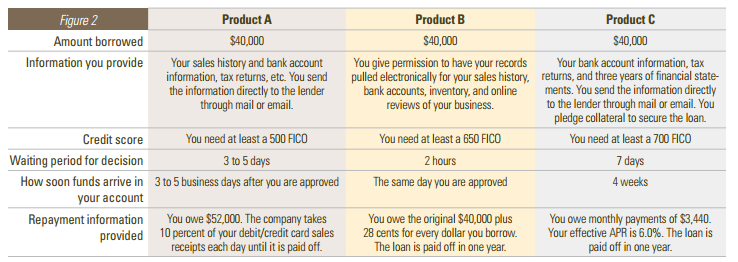
The question itself introduced conflicting facts and lacked crucial variables to make an intelligent guess. Nevermind that respondents prior to that question said that there was “nothing confusing” about the products presented as is. The original feedback should’ve been enough. Below are some of the responses offered before they were deliberately tricked.
- “Nothing Confusing.”
- “No, it’s pretty straight-forward.”
- “I can’t think of anything more I would need to see, really.”
- “This is enough info for me to make a decision.”
The researchers concluded however that the answers to their trick question suggested there were “significant gaps in their understanding of the repayment repercussions of some online credit products and the true costs of borrowing.”
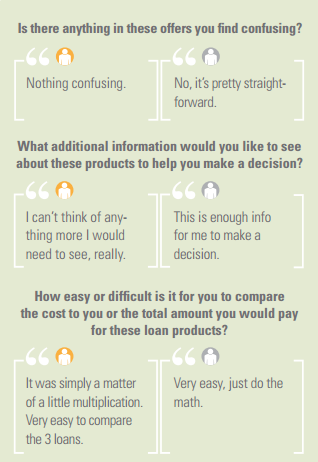 And while it might be true that they semi-admit to what they did when they wrote, “using only this information, calculating a true effective interest rate would not have been possible without making some assumptions,” the headline that spread thereafter was that small business owners are confused by alternative lenders.
But even if that was the case, at what point does confusion become unfair in a purely commercial transaction? And what would be an appropriate remedy?
We’ve been down this road before where federal regulators have set mandatory disclosures in order to bring transparency to a lending environment believed to be obscure. And just recently on September 17th, 2015, the House Committee on Small Business Subcommittee on Economic Growth, Tax and Capital Access pressed community bankers on the impact of such measures dictated by Dodd-Frank.
Congressman Trent Kelly asked if all the added new pages to loan agreements make it easier for their borrowers to understand. “Do they understand what they’re signing?” he asked.
B. Doyle Mitchell Jr., the CEO of Industrial Bank that was speaking on behalf of the Independent Community Bankers of America responded that they do not. “It is not any more clear,” he answered. “In fact it is even more cumbersome for them now.”
If anything, the Federal Reserve study offered compelling evidence that small businesses are happy with the way alternative lenders are currently disclosing their terms. It is only when government researchers tricked them that they became confused. That should say it all.
One consequence of entrepreneurship is that businesses are not created equal in their ability to assess financial transactions and no amount of disclosures or intervention can save them. There must be losers in order for there to be winners.
Case in point, there are lenders out there doing deals so lopsided that they actually turn to each other and say, “I can’t believe she took that.” Such is the case of RuffleButts, a children’s fashion line that appeared on Shark Tank in 2013.
“When they wake up, they’ll realize they messed up,” said Mark Cuban in reference to the deal Lori Greiner proposed and closed. An article on BusinessInsider.com covered the episode and unabashedly concluded, “Shark Tank isn’t a charity. The investors are putting in their own money, so they have every incentive to push to get the best deal possible for themselves.”
Shark Tank has risen in popularity because it is a reflection of a culture that believes dealmaking, both good and bad, is inherent to the endeavor of entrepreneurship. When a bad deal is made, regulators don’t come on the show to urge a do-over.
 But what’s dealmaking got to do with the local pizza joint seeking $20,000 that doesn’t have the time to mess around on TV shows? Unlike lenders who refer to their transactions as loans or units, merchant cash advance companies and the agents who negotiate the transactions appropriately refer to their agreements as deals. How else would one label an agreement in which a commercial entity sells future receivables for a mutually agreed upon price?
And if the Federal Reserve study indicated anything, it’s that business owners feel there’s nothing confusing about these deals.
So it would seem that everything as Americans know it, watch it and understand it, is business as usual.
Even Brendan Ross, the president of Direct Lending Investments, was quoted by the BanklessTimes as saying, “I want to emphasize there’s absolutely nothing novel about lending money to businesses. This isn’t some phenomenon we are rediscovering. There isn’t going to be increased regulation because this isn’t new.”
Perhaps the only thing that could be considered new is that loan sizes have gotten smaller and the types of products small businesses can access has diversified. Along the way, some of these new startups have decided to offer products in line with a self-professed moral code, which is to deliberately lend money at a loss and lash out at lenders who seek profit.
There’s a term for lending startups that don’t make money. They’re called “failed startups.” By casting small businesses as being no different from unsophisticated consumers, it’s quite possible that shows like Shark Tank and The Profit would become illegal in the process. Disclosures meant to help make things more transparent could actually make things less clear and more cumbersome, just as they have in the past.
I don’t think anybody is in favor of small business failure or an environment where confusion prevails, including the guys making infinity percent interest loans like Kevin O’Leary. But if the goal is to increase transparency, it should be in a way that businesses on both sides are content with.
The Federal Reserve study showed the system is working well as is and that prescribing mandatory changes to fit some universal standard would only serve to usher in an era of confusion that everyone is trying to avoid. Lenders can always do better to serve their clients, but the free market must prevail. As Mitchell, Industrial Bank’s CEO said when he testified in front of the Small Business Committee, “the problem with Dodd-Frank is you cannot outlaw and you cannot regulate a corporation’s motivation to drive profit at all costs so while it has a lot of great intentions in over a thousand pages, it has not helped us serve our customers any better.”
The Industry’s First Small Business Financing Report Revealed
October 25, 2015AltFinanceDaily teamed up with Bryant Park Capital, an investment bank providing M&A and corporate finance advisory services to emerging growth and middle market public and private companies, to conduct the industry’s first comprehensive report.

Our initial findings are drawn from a survey of twenty-seven C-level participants, whose companies primarily offer merchant cash advances and small business loans. Combined, the participants represent more than $1.9 billion in annual origination volume. The survey was sent to over one-hundred eligible respondents, with participation open to all of them equally and included both direct funders and brokers.
- Thirteen respondents reported being on pace to originate $50 million or more in 2015.
- Seven respondents reported being on pace to originate $100 million or more in 2015.
Analyzing the origination volume of participants over a three-year period, the industry was determined to have a:
Compound Annual Growth Rate of 56%.
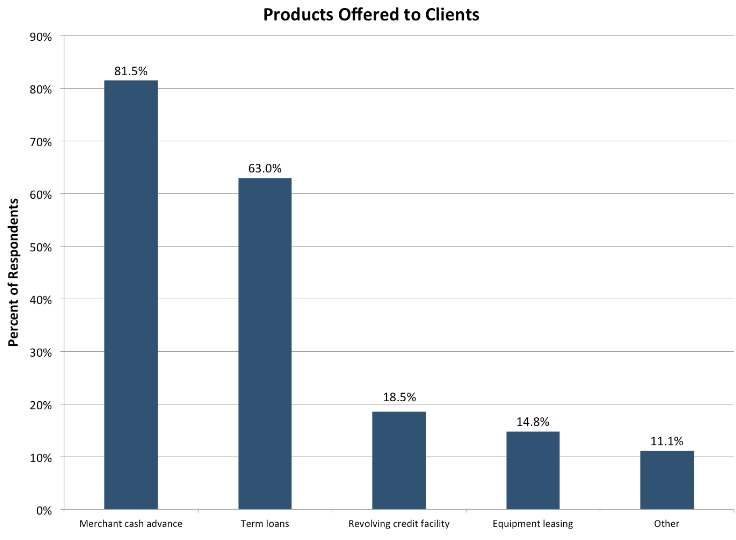
THE INDUSTRY HAS A DIVERSIFIED PRODUCT MIX
Respondents revealed a diversified product mix beyond merchant cash advance. Five participants actually reported originating no merchant cash advances at all and instead offered term loans or other products.
THE INDUSTRY CEOS HAVE A CONFIDENCE INDEX OF 83.7
Based on responses from CEO/participants asked to give their confidence level in the continued success of the small business lending/MCA industry over the next 12 months on a scale of 0–100, with 100 being the highest.
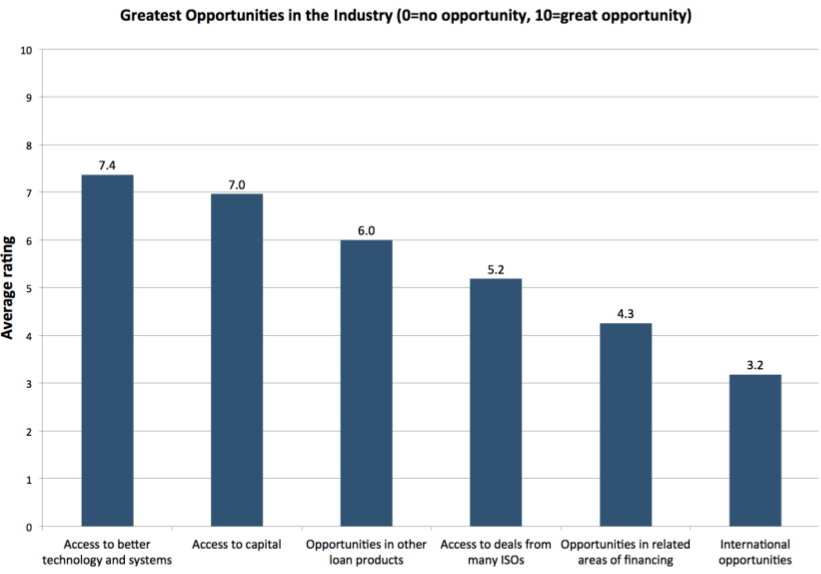
ACCESS TO BETTER TECHNOLOGY AND SYSTEMS IS THE GREATEST OPPORTUNITY IN THE INDUSTRY
Based on responses from participants asked to score the importance of opportunities on a scale of 0–10, with 10 being the highest.
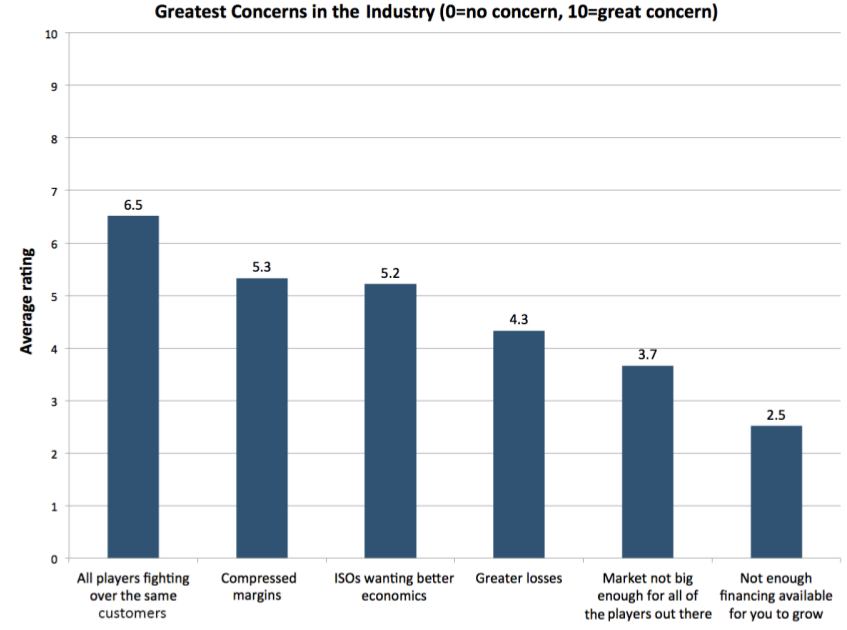
ALL PLAYERS FIGHTING OVER THE SAME CUSTOMERS IS THE GREATEST CONCERN IN THE INDUSTRY
Based on responses from participants asked to score their concerns on a scale of 0–10, with 10 being the highest.
The identities of participants and their individual responses are confidential. Participants were asked a total of 27 questions and had the ability to waive a response to any question, including the disclosure of their identity to the surveyors themselves.
Survey participants are eligible to receive the full anonymized report. Industry players who complete the full survey will automatically receive a full copy of this report. If you are not part of an operating company in the industry and you would like to obtain a copy of the report or participate in the survey, please contact Bryant Park Capital or AltFinanceDaily.
DOWNLOAD THE PDF VERSION
Meet the Source: How Jared Weitz and United Capital Source became one of the industry’s fastest growing shops
October 23, 2015Jared Weitz came from humble beginnings and nearly settled for a humble fate. But associates say an ordinary, uneventful life wouldn’t have suited him – he works too hard and figures things out too quickly.
Almost ten years ago Weitz, 33, was parking cars to earn money for community college. After finishing at St. Johns University, he almost made plumbing his career. But now he’s CEO of United Capital Source LLC, an alternative-finance brokerage with deal flow of between $9 million and $10 million a month and an annual growth rate of over 65 percent.
Business associates, former bosses and his small cadre of employees all seem to revere Weitz for his honesty and straightforwardness. They consider him a personal friend. They say he continues to grow as a businessman and as a human being while taking pleasure in helping others do the same.

Geographically, Weitz has the good fortune to know where he belongs – the city of New York is in his DNA. “Every time I fly back,” he said, “I’m so happy to land.”
His love affair with the city began in Brooklyn. He was born there and raised in a Brighton Beach apartment in the shadow of Coney Island. When he was 16, the family moved to Oceanside on Long Island.
As the second of six children, Weitz had to come up with the money for college on his own. “My older sister and I had to pay our way,” he said. “Everybody else, my dad was able to cover.” He started school at Nassau Community College, selling cell phones and parking cars at night.
 But then came an abrupt change. Once Weitz saved enough money, he transferred to Tulane University in New Orleans to pursue a relationship with a woman who was finishing her studies there. He attended classes part-time, worked as the athletic director at the Jewish Community Center, tended bar in a Mexican restaurant and served summonses for a law firm.
The relationship with the woman fizzled, but Weitz made lasting friendships during his days down south. His old roommate in New Orleans, who now practices law in Atlanta, serves as counsel for United Capital Source.
When Weitz had been in New Orleans for two years, Hurricane Katrina struck. He evacuated to Houston, where he stayed in a Holiday Inn for two weeks before realizing he wouldn’t be able to return to southern Louisiana anytime soon. The magnitude of the devastation was just too great.
Shouldering the duffel bag of belongings he had managed to pack on his back during the evacuation, he returned to New York, enrolled in St. John’s University and began working in sales for Honda Financial Services and parking cars.
Weitz had started school expecting to become a teacher. He had grown up with younger siblings and liked leadership roles, which convinced him teaching would be a good fit.
Still, many of his college jobs had required him to sell. As a bartender, for example, he promoted drink specials. As an athletic director he convinced people to sign up for classes. “Everything that I took to naturally wound up being in the sales, marketing and finance arena,” Weitz observed.
When he was nearly finished at St. John’s, Weitz was parking a car for an acquaintance who offered him a job as a union plumber. Suddenly, he was making $27 an hour and had health benefits. “It was a big breather for me,” Weitz recalled.
He quit his three jobs and labored as a plumber from 7 a.m. to 3 p.m. School started at 3:30 p.m. for him and stretched into the evening. But when he finished his degree, working as a teacher for $35,000 to $40,000 a year no longer seemed attractive.
Besides, his plumbing work didn’t center on toilets. On typical commercial plumbing jobs he did things like install air, medical and gas lines in hospitals. He was reading blueprints and bidding for jobs. A promotion to foreman didn’t seem that far off.
At about the same time, near the end of 2006, a friend, Mike Caronna, landed a job at Bizfi, formerly known as Merchant Cash and Capital (MCC), The company, which had just started and had only a few employees, was looking for underwriters.

As fate would have it, Weitz fell into a conversation with a fellow union plumber, one who had been on the job for 30 years. The older man reminded him that his wages would never climb much higher than they were right now. The veteran plumber then showed the younger man his hands, bent from decades of holding tools. “That got me thinking,” Weitz said.
He asked his friend Caronna to arrange a job interview at MCC. He got an offer and took a 90-day leave from his plumbing job to give the world of finance a try. “After about two weeks, I knew it was for me,” he said of the alternative-finance industry. It was by then the beginning of 2007.
Weitz excelled as an underwriter, and the company CEO, Stephen Sheinbaum, picked him and four others for a sales contest. Sheinbaum gave them some leads and turned them loose. Weitz won the competition but asked his boss to help him gain experience in business development and operations before taking on a sales position.
Sheinbaum was happy to comply. “He is one of the best and the brightest in the space,” he said of Weitz.
So, at age 25, Weitz found himself building a business development department by cultivating relationships with ISOs and persuading them to send business to MCC. “It was amazing,” he said of those days. “That was a big opportunity.”
Weitz learned the mechanics of the business. He found that the right ISO can originate good deals and a bad ISO can ruin deals. He learned the politics of when to talk, when to remain silent and when to let someone vent.
Then Weitz and a good friend at MCC, Anthony Giuliano – who’s now managing partner of Sure Payment Solutions – worked out how they could improve the MCC sales effort. They pitched Sheinbaum on the idea of having a second internal sale force, and that led to the birth of Next Level Funding (NLF), a division of MCC.
Weitz and Giuliano each owned 10 percent of NLF, and MCC owned 80 percent. “I’m 26, about to be 27, and I’m like, ‘You did it, Man,’” Weitz said as he looked back.
After about four months, NLF absorbed MCC’s original sales division. Next, Giuliano and another executive, Paul Giuffrida, decided to leave MCC. Weitz felt torn. He felt an allegiance to Giuliano and respected Giuliano’s knowledge of programming – a subject that was alien to him. Yet Sheinbaum had provided Weitz a series of opportunities.
Weitz stayed at MCC but felt he deserved to become chief sales officer. When that didn’t happen, he sold his shares back to the company at a dramatically reduced price to extricate himself from a non-compete clause and set off to start United Capital Source (UCS).
With a five-figure investment, Weitz and his then partner, started UCS in January of 2011 in a 250-square-foot office in Long Beach, L.I. Weitz invested about 90 percent of the money he had saved while working at MCC.
 Jon Baum left NLF with Weitz and became the first UCS employee. Within a week or two, Danielle Rivelli, left NLF to join UCS, and Weitz put the remaining 10 percent of his savings into the business to meet the expanded payroll. Today, Baum and Rivelli are UCS sales managers.
The first month UCS was open, it funded $240,000 in deals. “It just felt good to be on my own and start funding deals,” Weitz said. From the beginning of UCS, he won praise from funders for bringing them the right kind of deals with merchants who were likely to repay.
“He really has the pulse of the marketplace and what a lender is looking for,” said Todd Sherer, who handles business development for Entrepreneur Growth Capital. “He doesn’t waste time giving you transactions that don’t fit in your box.”
That’s because doing things right means a lot to Weitz. “He is one of the most straightforward, honest, high-integrity people I have met in the industry,” said Steven Mandis, adjunct associate professor at the Columbia University Business School and chairman of Kalamata Capital LLC.
He’s won the OnDeck seal of approval. “OnDeck has a rigorous and extensive background check process as part of our broker certification process,” said Paul Rosen, OnDeck’s chief sales officer. “Jared Weitz and United Capital have passed our screens and process and are currently active brokers for OnDeck.”
And with time, Weitz has learned patience. He was sometimes short with funders when he started his company but has matured into a pleasant person to deal with, said Heather Francis, CEO of Elevate Funding. “I’ve seen that growth with him,” she said.
All of those good qualities soon came together to help UCS succeed. Within four months of its launch, the company rented a 1,500-square-foot office in Garden City and hired two more people. Next came a 3,200-square-foot office in Rockville Centre and three more employees.
“The company was growing and gaining traction,” Weitz recalled. “I bought out my original partner.” Since then, Vincent Pappalardo has invested in UCS and become a minority partner.
Meanwhile, the lease was expiring on Long Island, and Weitz felt the time had come to move to Manhattan. That would enable the company to draw employees from throughout the region and not just Long Island.
“We decided to bite the bullet and pay the excess money to move to the city because we believed it would be better for the business,” Weitz said. He added two people and rented a 5,500-square-foot space near Penn Station in the Garment District in September of 2014.
 Within three months of making the move to Manhattan, business doubled. “Being in a faster-paced environment caused the business to go through another growth phase,” he said. After nine months in the city, UCS is now taking over a whole 8,500-square-foot floor of the same building.
UCS remains a small shop in terms of headcount with 21 people, but the company’s funding numbers equal the output of many brokerages five times its size. Twelve of the UCS employees work in sales, with the others engaged mainly in underwriting, operations and customer service.
Less than 2 percent of UCS’s funding volume comes from broker business. “We self-generate all of our business,” Weitz said, declining to elaborate too much on his company’s marketing efforts.
“My salespeople – bar none – are the best in the industry,” he claimed. “Much like the Navy has the SEALS and the Army has the Rangers, there are groups in the industry that can do triple or quadruple what other people do because that’s just the way they are.” His people fund an average of $750,000 per month per person in new business, while his renewals reps fund well into the 7-figure range per person.
UCS salespeople achieve their results because they have detailed knowledge of the industry, Weitz said. The staff’s understanding of alternative finance doesn’t end with sales but also includes underwriting and finance, he noted. “That’s what makes you a very good and knowledgeable sales rep,” he maintained.
His salespeople don’t just tell a client what he or she wants to hear. They take the time to understand the client’s financial situation. “They know how to read a profit and loss statement, a balance sheet and tax returns,” Weitz said.
ARE THE BEST IN THE INDUSTRY”
While 90% of Weitz’s sales team has a college degree, most of the salespeople have come from outside the industry, he said, noting that one was with Sleepy’s, the mattress company. Another was selling memberships at a gym, one worked for a credit card processing company, two were barbers and one had just graduated from college.
UCS doesn’t make double-digit commissions because the company isn’t over-charging merchants, Weitz maintained. The company does not obtain excess funding that a customer can’t afford or increase the factor rate to dangerous levels, he noted.
“You’re not really helping the merchant” by providing too much capital, Weitz asserted. “You’re sucking the blood out of him before he goes away. That’s not why I’m in business.”
A clean record will also prove beneficial when federal regulation comes to the industry, he said. Integrity in the workplace can also spill over into other parts of a person’s life, Weitz believes.
 As UCS grew larger and Weitz grew older, he saw his employees rent their first apartments and then buy their first homes. He learned then that he had taken on more responsibility than was apparent to him at first.
To accommodate the employees he added a human relations department and commissioned a company handbook. He’s also started marketing, finance, operations and other departments.
He’s lost only four employees because he pays them well, respects their time and doesn’t view their youth as a liability.
Meanwhile, talking daily to merchants and hearing about their heartaches and triumphs has humbled and matured Weitz. Seeing how the merchants’ choices panned out or fell short also shaped him and helped him grow up a little, he said.
Weitz has found time in his 70-hour workweek to meet his future bride. They’re planning to wed next year, and he plans to invite his entire staff. “It wouldn’t feel right without them,” he said.
Weitz has skipped the Ferrari, Rolls Royce and mansion because he didn’t feel he needed them. But even without those status symbols, it’s clear that Weitz has avoided settling for a humble fate.
As for what comes next, UCS is said to be developing an online marketplace to take their business to the next level, though Weitz declined to provide specific details about how it will work. “We’re on pace to do more than $100 million worth of deals a year,” Weitz said. “And as far as we’ve come, I feel like this is still just the beginning.”
Alternative Business Funding’s Decade Club
October 22, 2015 The working capital business is a very different animal now than it was a decade or so ago when many of today’s established players were just starting out.
“At that time, the industry was a bunch of cowboys. It was an opportunistic industry of very small players,” says Andy Reiser, chairman and chief executive of Strategic Funding Source Inc., a New York-based alternative funder that’s been in business since 2006. “The industry has gone from this cottage industry to a professionally managed industry.”
Indeed, the alternative funding industry for small businesses has grown by leaps and bounds over the past decade. To put it in perspective, more than $11 billion out of a total $150 billion in profits is at risk to leave the banking system over the next five plus years to marketplace lenders, according to a March research report by Goldman Sachs. The proliferation of non-bank funders has taken such a huge toll on traditional lenders that in his annual letter to shareholders, J.P. Morgan Chase & Co. chief executive officer Jamie Dimon warned that “Silicon Valley is coming” and that online lenders in particular “are very good at reducing the ‘pain points’ in that they can make loans in minutes, which might take banks weeks.”
The burgeoning growth of alternative providers is certainly driving banks to rethink how they do business. But increased competition is also having a profound effect on more seasoned alternative funders as well. One of the latest threats to their livelihood is from fintech companies, like Lendio and Fundera,for example, that are using technology to drive efficiency and gaining market share with small businesses in the process.
“Established lenders who want to effectively compete against the new entrants will need to automate as much decisioning as possible, diversify acquisition sources and ensure sufficient growth capital as a means to capture as much market share as possible over the next 12 to 18 months,” says Kim Anderson, chief executive of Longitude Partners, a Tampa-based strategy consulting firm for specialty finance firms.
Of course, there is truth to the adage that age breeds wisdom. Established players understand the market, have a proven track record and have years of data to back up their underwriting decisions. At the same time, however, experience isn’t the only factor that can ensure a company will continue to thrive over the long haul.
WORKING TOWARD THE FUTURE
Indeed, established players have a strong understanding of what they are up against—that they can’t afford to live in the glory of the past if they want to survive far into the future.
“With every business you have to reinvent yourself all the time. That’s what a successful business is about,” says Reiser of Strategic Funding. “You see so many businesses over the years that didn’t reinvent themselves, and that’s why they’re not around.”
Strategic Funding has gone through a number of changes since Reiser, a former investment banker, founded it with six employees. The company, which has grown to around 165 employees, now has regional offices in Virginia, Washington and Florida and has funded roughly $1 billion in loans and cash advances for small to mid-sized businesses since its inception.
One of the ways Strategic Funding has tried to distinguish itself is through its Colonial Funding Network, which was launched in early 2009. CFN is Strategic Funding’s secure servicing platform which enables other companies who provide merchant cash advances, business loans and factoring to “white label” Strategic Funding’s technology and reporting systems to operate their businesses.
“When you’re in a commodity-driven business, you have to find something to differentiate yourself,” Reiser says.
FINDING WAYS TO BE DIFFERENT
That’s exactly what Stephen Sheinbaum, founder of Bizfi (formerly Merchant Cash and Capital) in New York, has tried to do over the years. When the company was founded in 2005, it was solely a funding business. But over the years, it has grown to around 170 employees and has become multi-faceted, adding a greater amount of technology and a direct sales force. Since inception, the Bizfi family of companies has originated more than $1.2 billion in funding to about 24,000 business owners.
 Earlier this year, the company launched Bizfi, a connected online marketplace designed specifically to help small businesses compare funding options from different sources of capital and get funded within days. Current lenders on the platform include Fundation, OnDeck, Funding Circle, CAN Capital, SBA lender SmartBiz, as well as financing from Bizfi itself. Financing options on the platform include short-term funding, equipment financing, A/R financing, SBA loans and medium term loans.
Sheinbaum credits newer entrants for continually coming up with new technology that’s better and faster and keeping more established funders on their toes.
“If you don’t adapt, you die,” he says. “Change is the one constant that you face as a business owner.”
David Goldin, chief executive of Capify, a New York-based funder, has a similar outlook, noting that the moment his company comes out with a new idea, it has to come up with another one. “If you’re not constantly innovating you’re in trouble,” he says. “It’s a 24/7 global job.”
Capify, which was known as AmeriMerchant until July, was founded by Goldin in 2002 as a credit card processing ISO. In 2003, the company began focusing all of its efforts on merchant cash advances. Four years later, the company made its first international foray by opening an office in Toronto. The company continued to expand its international presence by opening up offices in the United Kingdom and Australia in 2008. The company now has more than 200 employees globally and hopes to be around 300 or more in the next 12 months, Goldin says. The company has funded about $500 million in business loans and MCAs to date, adjusted for currency rates.
THE CULTURE OF CHANGE
Five or six years ago, Capify’s main competitors were other MCA companies. Now the competition primarily comes from fintech players, and to keep pace Capify has made certain changes in the way it operates. From a human resources standpoint, for instance, Capify switched from business casual attire to casual dress in the office. The company has also been doing more employee-bonding events to make sure morale remains high as new people join the ranks. “We’ve been in hyper-growth mode,” he says.
CAN Capital in New York, another player in the alternative small business finance space with many years of experience under its belt, has also grown significantly (and changed its name several times) since its inception in 1998. The company which began with a handful of employees now has about 450 and has offices in NYC, Georgia, Salt Lake City and Costa Rica. For the first 13 years, the company focused mostly on MCA. Now its business loan product accounts for a larger chunk of its origination dollars.
This year, the company reached the significant milestone of providing small businesses with access to more than $5 billion of working capital, more than any other company in the space. To date, CAN Capital has facilitated the funding of more than 160,000 small businesses in more than 540 unique industries.
Throughout its metamorphosis to what it is today, the company has put into place more formalized processes and procedures. At the same time, the company has tried very hard to maintain its entrepreneurial spirit, says Daniel DeMeo, chief executive of CAN Capital.
One of the challenges established companies face as they grow is to not become so rule-driven that they lose their ability to be flexible. After all, you still need to take calculated risk in order to realize your full potential, he explains. “It’s about accepting failure and stretching and testing enough that there are more wins than there are losses,” says DeMeo who joined the company in March 2010.
ADVICE FOR NEWCOMERS
As the industry continues to grow and new alternative funders enter the marketplace, experience provides a comfort level for many established players.
“The benefit we have that newcomers don’t have is 10 years of data and an understanding of what works and what doesn’t work,” says Reiser of Strategic Funding. With the benefit of experience, Reiser says his company is in a better position to make smarter underwriting decisions. “There are many industries we funded years back that we wouldn’t touch today for a variety of reasons,” he says.
Experienced players like to see themselves as role models for new entrants and say newcomers can learn a lot from their collective experiences, both good and bad. Noting the power of hindsight, Reiser of Strategic Funding strongly advises newcomers to look at what made others in the business successful and internalize these best practices.
One of the dangers he sees is with new companies who think their technology is the key to long-term survival. “Technology alone won’t do it because that too will become a commodity in time,” he says.
Over the years Strategic Funding has learned that as important as technology is, the human touch is also a crucial element in the underwriting process. For example, the last but critical step of the underwriting process at Strategic Funding is a recorded funding call. All of the data may point to the idea that a particular would-be borrower should be financed. But on the call, Strategic Funding’s underwriting team may get a bad vibe and therefore decide not to go forward.
“We look at the data as a tool to help us make decisions. But it’s not the absolute answer,” Reiser says. “We are a combination of human insight and technology. I think in business you need human insight.”
Seasoned alternative funding companies also say that newbies need to implement strong underwritingcontrols that will enable them to weather both up and down markets.
The vast majority of newcomers have never experienced a downturn like the 2008 Financial Crisis, which is where seasoned alternative financing companies say they have a leg up. Until you’ve lived through down cycles, you’re not as focused as protecting against the next one, notes Sheinbaum of Bizfi. “Every 10 years or 15 years or so, there seems to be a systemic crisis. It passes. You just have to be ready for it,” he says.
Goldin of Capify believes that many of today’s start-ups don’t understand underwriting and are throwing money at every business that comes their way instead of taking a more cautious approach. As a funder that has lived through a down market cycle, he’s more circumspect about long-term risk.
 One of the biggest problems he sees is funders who write paper that goes two or three years out. His company is only willing to go out a maximum of 15 months for its loan product, which he believes is s a more prudent approach. He questions what will happen when the economy turns south—as it eventually will—and funders are stuck with long dated receivables. “You’re done. You’re dead. You can’t save those boats. They are too far out to sea,” Goldin says.
Having a solid capital base is also a key to long-term success, according to veteran funders. Many of the upstarts don’t have an established track record and need to raise equity capital just to stay afloat—an obstacle many long-time funders have already overcome.
Goldin of Capify believes that over time consolidation will swallow up many of the newbies who don’t have a good handle on their business. Hethinks these companies will eventually be shuttered by margin compression and defaults. “It can’t last like this forever,” he says.
In the meantime, competition for small business customers continues to be fierce, which in turn helps keep seasoned players focused on being at the top of their game. Getting too comfortable or complacent isn’t the answer, notes DeMeo of CAN Capital. Instead, established funders should seek to better understand the competition and hopefully surpass it. “Competition should make you stronger if you react to it properly,” he says.
LeaseQ Partners with Fund Simple to Offer Customized Equipment Financing to Small Business Owners
October 16, 2015 LeaseQ, an online marketplace connecting businesses, equipment sellers, and equipment finance companies to make selling and financing equipment fast and easy, today announced a partnership with alternative lending platform Fund Simple, Inc., a trusted and reliable source for small and medium-size businesses to obtain loans for expansion and growth. The strategic pairing of LeaseQ’s automated equipment financing platform and Fund Simple’s diverse customer base ensures that more borrowers, regardless of equipment type or credit profile, can shop for and secure the best financing option for their business.
Investment in business equipment and software is expected to grow 4.1 percent in 2015, according to a Q4 market report from the Equipment Leasing & Finance Foundation (ELFF). In fact, the equipment financing industry is growing consistently year over year, with new deal originations expected to top $1 trillion in 2015. With a cloud-based, automated platform and instant quotes, LeaseQ is capitalizing on the growth of the market, connecting lenders and equipment sellers in over 30 vertical equipment markets with small business borrowers in all credit classes looking to expand, while preserving cash flow.
“Equipment financing is a highly-fractured industry, and we pride ourselves in being experts who help borrowers, lenders and vendors navigate the messiness,” said Vernon Tirey, LeaseQ co-founder and CEO. “Our partnership with Fund Simple underscores our focus on professionalism, and allows us to reach more borrowers, with more financing options both online and on the dealer floor.”
Douglas Rovello, Fund Simple’s chief financial officer, said as Fund Simple’s equipment financing arm, LeaseQ has the ability to deliver a customized platform for their clients.
“LeaseQ’s automation in equipment financing gives us a level of diversity and transparency we can offer our end-merchant and vendor clients,” Rovello said. “The partnership benefits all parties involved, because we’re now offering a product and a program on a customized platform that no one else out there is offering.”
LeaseQ significantly lowers the cost of sales by delivering highly qualified lease applications to financing companies. A free underwriting engine, real-time-credit processing capability and BPO management system enables leasing companies to create an Nth number of risk tiers with variable lease pricing for each vertical market segment, generate instant lease quotes, and manage the lease application and lease closing process all online.
About LeaseQ
LeaseQ is an online marketplace that connects businesses, equipment sellers, and equipment finance companies to make selling and financing equipment fast and easy. The LeaseQ platform is a free, cloud-based SaaS solution with a suite of on-demand software and data solutions for the equipment leasing industry. LeaseQ provides business process optimization (BPO) and information services that streamline the purchase and financing of business equipment across a broad array of vertical industry segments. For more information about LeaseQ visit www.leaseq.com.
About Fund Simple, Inc.
Fund Simple is an alternative lender that funds and tailors loans for small to medium-size businesses to provide borrowers with capital for expansion and growth. Unlike traditional bank loans, Fund Simple programs offer alternatives to cash flow financing, including term loans, debt consolidation loans, lines of credit and instant quotes for equipment financing. Fund Simple aims to accelerate the vision of entrepreneurs and business leaders who are looking to become proficient in all aspects of their business and need a partner for growth. For more information about Fund Simple, Inc. visit www.fundsimple.org.
Media Contact:
Matter Communications
McKenzie Mayer
978.518.4822
LeaseQ@matternow.com