Platinum Rapid Funding Group Sets Annual Funding Record
January 25, 2016Platinum Rapid Funding Group, a Long Island, NY based merchant cash advance provider, set a new personal-best funding record last year, according to company VP of Partner Relations Corey Cicero. Through direct and indirect channels, the company originated more than $100 million worth of funded deals during 2015.
The growth has led to what seems like a never-ending hiring spree at their Uniondale office. Cicero told AltFinanceDaily that they plan to beat their 2015 figures this year by a wide margin. “We are still hiring,” he said.

AltFinanceDaily visited their office back in September and as evidenced by the above photo, they are not a small shop.
You Close The Sale Before The Sales Process Begins
January 22, 2016 YOU WRITE THE END OF THE STORY AT THE BEGINNING OF THE PROCESS
As an adolescent, I had a dream of becoming an actor. There was no true purpose, direction or vision behind the dream, the dream was based mainly on the fact that I had seen a lot of A-list celebrities on television and they always seemed to have had the world in the palm of their hands. During my time studying and performing as an actor, I also learned a little bit about the sequence involved in writing a screenplay. It was peculiar to me at the time to note that a lot of the best writers would always write the end of the story at the beginning of the process. At the time, I thought to myself: “How can you establish an ending without first establishing a beginning?”
IT DAWNED ON ME
As I grew older I changed my dream from becoming an actor to becoming a successful B2B sales rep. As I got deeper into my commercial finance B2B sales role, it finally dawned on me as to why those screenwriters wrote the end at the beginning, and it was because the engagement of any process is the journey to the destination, not the destination itself. However, for the journey to be engaging, we must first establish a destination for which the journey is based upon, then fill the journey with a variety of ups, downs, twists, turns and character growth as we arrive at the end.
B2B SALES IS SIMILAR
The profession of B2B sales is similar, especially when it comes to the selling of financing, whereas discussion and debate over how the ending should look, should be done with the merchant upfront (during the pre-qualification stage) as well as discussion on the journey (underwriting process) to the destination.
When it comes to B2B sales, especially the selling of commercial financing, I believe you “close” at the beginning, that is, I believe you write the end of the story at the beginning of the process, not at the end. If I cannot come to an agreement with the merchant on the “ending,” such as the realistic potential terms (even if it’s just a range), then the sales and underwriting process should never begin, and we both walk away.
STOP WASTING RESOURCES
Some brokers choose to keep the potential terms a secret until the end, and hope that the deal doesn’t fall apart when the time comes to finalize everything. Why keep the potential terms a secret and have the merchant fill out apps, fax over statements, have my funder key in the data, spit out approvals, only for the merchant to eventually tell you that the numbers aren’t what they had in mind? That makes absolutely no sense.
I believe that by the time I submit the deal to my funder, it should be already closed with the merchant, and all I have to do at that point is close the funder in approving the deal I proposed to the merchant from the beginning.
To Syndicate or Not to Syndicate?
January 20, 2016 Someone once asked the question of, “To love or not to love?” But I believe soon every broker will have to ask the question of, “To participate or not to participate?” Is it time we all get into the game?
THE YEAR OF THE BROKER OR THE YEAR OF ROSY PROMISES?
AltFinanceDaily writers such as Sean Murray, Ed McKinley and myself, referred to 2015 as the Year of The Broker, as a stream of new brokers continued to rush into our space to take advantage of the perceived opportunities.
THE YEAR OF PARTICIPATION?
For experienced brokers, I’ve written two pieces so far here on AltFinanceDaily in relation to the broker’s future. I’ve talked about how I believe the future of our industry will be dominated by Strategic Networks and those who utilize these networks efficiently will not just be the dominant players going forward, but they will be pretty much the only “real” players going forward. I also talked about how success in our industry is based mainly on leveraged resources and networks, rather than having some sort of “superior” selling capability.
But with that being said, I wanted to use this article as a way to add to this discussion of the future by outlining my recommendation that experienced brokers “get into the game” when it comes to syndication and deal participation. DeBanked reported back in April of 2015 about how Strategic Funding Source’s syndication network of over 200 partners (at the time) invested over $260 million of their own capital into funded deals. This level of investment, according to the reporting, helped amass significant wealth for the 200 syndication partners that participated. If 2015 was the Year of The Broker, could 2016 be the Year of Participation?
IT’S NOT THE SAME ANYMORE
It’s no longer 2000 – 2013, when quite frankly a broker could amass great income by just strategically utilizing the Uniform Commercial Code (UCC) as a marketing model. But pretty soon the word got out and everybody rushed in to duplicate the methodology. What was once a great idea became a complete waste of marketing dollars.
UCCs are so bad today, that when you call a merchant and just mention the fact that you are from a funding company, they immediately hang up the telephone. Sometimes, I would call and before I would even have the chance to say a word, the staff member on the telephone would ask, “Are you calling about a cash advance?” Once I would reluctantly answer in the affirmative, they would of course immediately inform me to put them on the do not call list, never call again, and either in nice language or a language full of swearing, they would inform me that they aren’t interested and how I’m the 19th guy that has called them this week. This is the result of a merchant getting 20 calls a week from 20 different companies, about 20 different merchant cash advance products.
As a result, brokers are going to have to specialize in the Strategic Networks and leveraged resources that I have been discussing for nearly a year now on AltFinanceDaily. We will also have to juggle the rising marketing costs and increasing pressures on pricing as our industry goes more mainstream. You might not want to operate as a full-fledged direct funder, as I understand that the investment outlay for such a task is significant. But I believe going forward, you aren’t going to be able to “make it” like you used to by solely relying on commissions from brokering deals. You are going to have to get into the game and put some money in deals not just to sustain the amount of income you were making in commissions historically, but to potentially make more money than you ever made before.
A SHOUT OUT TO WBL
Also back in April of 2015, there was a pretty popular online discussion that discussed World Business Lenders’ (WBL) new ISO/Broker acquisition program. I had a conversation by telephone with Lenny Steigman from WBL on April 21st of last year to discuss the program in detail.
One of the things that Lenny mentioned on that call was the notion of the broker’s office requiring a shift in structure in order to survive in the upcoming future. Lenny discussed that brokers who chose to continue to operate on the sidelines relying solely on commissions from brokering deals, without getting involved in some sort of equity or syndication participation, might find the future of their involvement in our space limited as continued growth through strategic networks drive the progression of the industry. I could not agree more with Lenny Steigman. It’s certainly time for a shift and one of those shifts I believe will require more experienced brokers to become syndication partners through putting up a portion of the capital to fund the merchants that they service.
GET YOUR DUCKS IN ORDER
As you prepare for this shift and look to get into the game, make sure that you have your ducks in order:
Legal Representation: This is important, you need an attorney to review your syndication agreements as well as review the legal structure of the funder you are partnering with, to make sure that all of the legal terminologies are outlined properly.
Understand The Deals You Are Funding: Know the type of client you are funding, such as if they are A Paper, B Paper, C Paper, D Paper or E Paper. Your level of risk on the deal in terms of default increases when you get into the higher risk paper grades, thus, make sure you are getting a significant enough “return” on said deals to accommodate the risk you are tolerating.
Examine Your Funder’s Finances: By syndicating, you are doing more than just investing in the merchants that you serve, you are also investing in the financial soundness of the funder you are syndicating with. Make sure your funder is not on the verge of bankruptcy, profitable, and will actually be around a year from now.
Examine Your Funder’s Operational Structure: I’ve talked about the importance of making sure you vet who you partner with in relation to being a broker. Now that you are syndicating, you most definitely make sure you are dealing with a funder that’s “proven.” The funder should have at least 2 years in business, have funded in the eight digits in terms of volume, have a proven and profitable underwriting formula, have an office full of employees, not have a significant amount of bad reviews, be in good standing with the BBB, having an actual online presence, and they should be running a professional and competent organization overall.
Round Up Your Capital: The secret of many of the wealthy has always been their unique ability to utilize the money of other people for their business investments. They find equity investors seeking a return on their capital, invest said capital with a high return and collect a management fee off of the transaction. Or, they borrow money from a creditor at a particular interest rate, invest the monies for a higher rate of return, then pay off the loan with interest and pocket the profits. Whichever way you prefer, how about you utilize OPM (other people’s money) to your advantage (leverage) as well for your participation efforts?
TO PARTICIPATE OR NOT TO PARTICIPATE?
I believe we might be entering the year of participation, which means it’s time for the experienced brokers to join in on the strategic networks which will dominate our space going forward. New entrants who don’t know the space and still can’t spell “merchant cash advance” will be in for a bumpy ride going forward, but those with the experience, it’s time to add to your industry influence by coming off of the sidelines as brokers solely, and becoming broker/syndicates in the truest form.
Year of The Broker Concludes – 2015 Recap
December 31, 2015 It was the Year of the Broker, a phrase that often conjured up images of easy money and inexperience. Lenders like OnDeck reacted by reducing their dependence on them. Responsible for 68.5% of their deal flow in 2012, OnDeck only sourced 18.6% of their deals from brokers in the third quarter of 2015.
But there’s money being made. One broker is on pace to do more than $100 million worth of deals annually after working as a plumber eight years ago. Another went from sleeping in his car to driving a Ferrari. Meanwhile, brokers like John Tucker are basically saying just the opposite. Tucker has repeatedly taken to AltFinanceDaily to preach things like “minimalism,” a practice of living below your means to a point where you can survive, and telling everyone it’s okay to embrace the satisfaction of a middle class life.
So is it the end of days or just the beginning?
In October, initial survey results of top industry CEOs revealed a confidence index of 83.7 out of 100, but out there on the street for the little guy, it’s been a tumultuous year. Things like commission chargebacks have hit brokers at unexpected times, with several funders privately telling us over the year that rogue brokers have closed their bank accounts or frozen the ACH debits in order to avoid giving the commissions back.
In 2015, brokers sued their sales agents and sales agents sued their employing brokers. Deals got backdoored, deals got co-brokered, and soliciting deals anonymously got banned from industry forums. Stacking continued mostly unfettered but is being pursued in the court system by funders allegedly injured by it. Brokers took over Wall Street and are supposedly being watched by regulators. Oh, and robo-dialing? Brokers should probably steer clear of that, just as underwriters should ditch paper bank statements.
It’s a lot to manage. Sometimes for a broker, just losing a deal can make them so sick that they have to go home. That’s apparently what happens when you don’t answer the phone fast enough. At least one said there’s no room left for more competitors so if you were thinking of starting a brokerage now, $2,000 won’t be enough.
But things could be worse. In 2015, IOU Financial was under attack by Russian nuclear scientists, a story that was more truth than exaggeration. In the end, Qwave Capital acquired a 15% stake in IOU.
An OnDeck class action lawsuit that looked bad at first turned out to be mostly based on the words of a convicted stock manipulator with a short position in the stock. The case is still ongoing and OnDeck’s stock price is down 50% from their IPO.
In 2015, two guys lost God but found $40 million (although numerous sources say that number is off).
“Madden” no longer means the football video game and Section 1071 is not a seating area in a stadium.
An RFI turned out to be something not to LOL about. Despite an overwhelming response from lenders and funders, the Treasury isn’t completely sold.
 Things weren’t so automated in 2015 despite the cries of technological disruption. Maybe that’s why it feels like 1997. Manual underwriting still dominated and bank statements still matter as much as they ever did. God declined loan applications, Google rigged the search results, and a mayor declared war on merchant cash advance (and then never spoke about it ever again after being re-elected).
Lobbying coalitions formed. NAMAA became the SBFA. The CFPB lied and community bankers testified.
But things are looking up. Brokers can obtain outside investments, get acquired, or make millions through syndication.
Bad Merchants are now ending up in more than one bad database, though a deal for the ages slipped through the cracks. Other merchants went to jail. Square went public and brought merchant cash advances along with them. The industry beamed its message through Times Square and one Democratic congressman has asked God to bless it all.
It was a crazy year. Marketplace lending became an acknowledged term (and the name of a conference) and already companies under that umbrella have been linked to presidential candidate (and desperate loser) Jeb Bush and the San Bernardino Terrorists. The FDIC had a few things to say and SoFi went triple-A. Marketplace lending is making a lot of people money, but when looking at the tax implications is there something funny?
In 2015, the big boys shared their wisdom and their figures. Turns out, it was beyond hyperbole. Brokers experienced an incredible rise or they pawned their ferrari to the other guys. Some focused on a specific crop, while others are trying it over the top. California sucked, John Tucker tucked, and one lender got totally F*****. In 2015 some funders got tanked, so in 2016 we’ll all be AltFinanceDaily.
Happy New Year!
The First Ever Comprehensive Industry Report is Now Available
December 29, 2015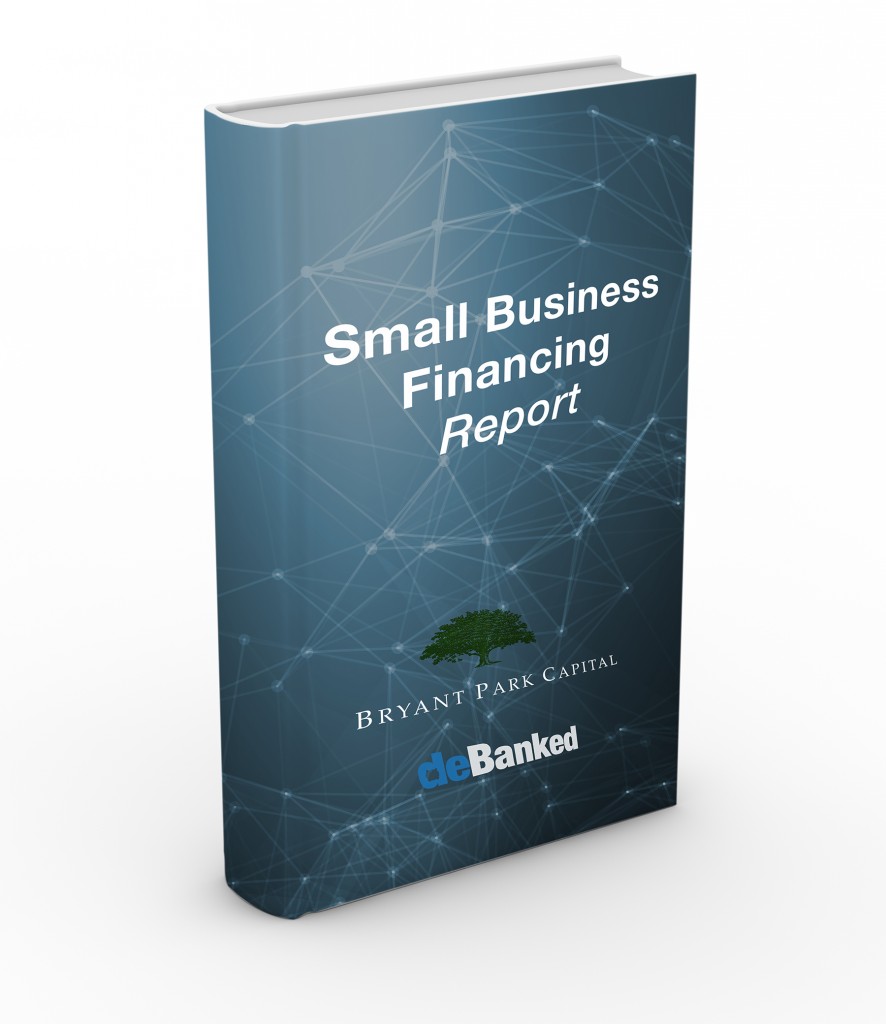 Months ago, investment bank Bryant Park Capital teamed up with us to conduct the first ever industry CEO survey of its kind. A sample of the initial findings were distributed at Money2020 in Las Vegas. Eligible participants that disclosed their identities to the surveyors have already received a complementary copy of the full anonymized report.
Today, those that either weren’t eligible to take the survey or missed the deadline to participate, can buy a copy of it.
With a sample size of small business funding companies that originate more than $2 billion annually, the final report reveals the industry’s Compound Annual Growth Rate, Average Annual Revenues, Average Annual EBITDA, Portfolio Loss Rates, Approval Rates, M&A Expectations, Valuation Expectations, Syndication Data, and much more.
This report is highly recommended for all funders and ISOs seeking to raise capital or for those that want to eventually sell their company. It’s also a must-have for any company that seeks to set short-term or long-term goals, that wants to compare themselves against the industry, or is creating a realistic business plan.
Investors in the industry also stand to benefit from this data.
If you are interested in buying the full report, e-mail sean@debanked.com.
The original report sample for public distribution
Mentioned in Forbes
Bryant Park Capital’s professionals have completed approximately 400 assignments representing an aggregate transaction value of over $80 billion.
Got a Ferrari or Fine Art? If So, You May Have More Leverage Than You Think
December 23, 2015If you own a Ferrari, fine art or expensive wine, getting access to capital may be easier than you think.
Although it’s still a niche market, luxury asset-backed lending has been gaining traction lately, particularly with small and mid-size business owners. These executives are enticed by the ability to use certain high-priced valuables as a means of getting large amounts of cash quickly and often at a lower cost than other funding sources.
“People are increasingly learning that this is another option. It’s not for everybody, but it’s another option,” says Tom McDermott, chief commercial officer at Borro, a New York-based asset-backed lender that deals exclusively with luxury asset-based loans.
It’s notable that luxury asset-based lending by alternative funders is gaining ground at a time when unsecured money is so easy to come by. There are several reasons business owners are attracted to the idea of leveraging their valuables to attain cash. First off, they don’t need stellar credit or a proven track record in business to qualify. Secondly, they can typically get larger sums of money and at better rates than they might through other financing channels. A third reason is that many of them have already tapped out other funding options and leveraging their assets allows them to obtain additional funds quickly.

“A lot of small business owners have assets, so it’s something else for them to utilize in getting access to attractive small business financing,” says Steven Mandis, chairman of Kalamata Capital LLC, an alternative finance company in Bethesda, Maryland.
Here’s how the process typically works at most luxury asset-based lenders. Say a business owner wants to borrow against a high-priced item such as a top-of-the-line car, fine art or wine, jewelry or a luxury watch. First the luxury-based lender hires a third-party to appraise the item. Generally, depending on the asset and its marketability, lenders will lend 50 percent to 70 percent of the asset’s value. If the owner moves forward, the item or items are held and insured in a lender’s secure storage area until the loan is paid back. Default rates on these types of loans are relatively low, lenders say.
“People don’t want to put their house at risk when they need capital,” says McDermott of Borro. “They’d rather lose the Maserati or a lovely piece of art than the house,” he says. And even then, it doesn’t happen very often, he says. Borro clients only default on their loans about 8 percent of the time, McDermott says.
Barriers to Entry
To be certain, luxury-based lending is not a business that every funder wants to be in. For starters, there are a lot of regulatory hoops a funder has to jump through in order to do it. You need a pawnbroker’s license and a second-hand dealer license. You also need a secure facility or facilities to house the collateral, have secure ways of transporting the valuables, and you need to carry large amounts of insurance for the transfer of the items as well as during the holding period.
Indeed, keeping the items secure is critical. PledgeCap, a Lynbrook, New York-based funder, says on its website that it uses “cutting edge technology, top of the line bank vaults and armed guards” to keep a customer’s items safe. What’s more, all items are insured during transit and storage. All items are shipped through secured and insured FedEx shipping vendors for pickups and drop-offs.
“There aren’t a lot of players in the market because there are a lot of operational and legal requirements to adhere to. There are a lot of barriers to entry,” says Gene Ayzenberg, the company’s chief operating officer.

Putting Things in Perspective
Luxury asset-based lending is only a small subset of the overall asset-based lending market, which as a whole has been gaining ground in the past few years. After getting badly burned in the most recent recession, many lenders have come to appreciate the security blanket that collateral offers. According to the Commercial Finance Association’s quarterly Asset Based Lending Index, U.S. ABL loan commitments rose 7.2 percent in the second quarter, compared with the year-earlier period. In addition, new ABL credit commitments were 6.3% higher than the same period a year ago.
“Asset-based lending at one time used to be the lending of last resort. Now it’s the type of lending that it is accepted globally,” says Donald Clarke, president of Asset Based Lending Consultants Inc., a Hollywood, Florida-based company that provides due diligence services for lenders. “Today, everybody wants an asset.”
There’s not a lot of public data to gauge the size of the luxury market within the broader asset-based lending market. But a 2014 report that focuses on art lending gives more perspective to at least one facet of luxury asset-based lending.
Thirty six percent of the private banks polled said they offer art lending and art financing services using art and collectibles as collateral. That’s up from 27 percent in 2012 and 22 percent in 2011, according to the report by consulting firm Deloitte and ArtBanc, a company that provides art sales alternatives, valuations and collections management services.
Meanwhile, 40 percent of private banks said this would be a strategic focus in the coming 12 months, up considerably from the 13 percent who named this as a priority in 2012.
These market changes are likely driven by client demand. The Deloitte/ArtBanc survey found that 48 percent of establishes art collectors polled said they would be interested in using their art collection as collateral for a loan, up from 41 percent in 2012.
Many big banks won’t touch asset-based lending deals unless they are worth north of $5 million. Some community banks will do smaller deals, but many don’t have the necessary infrastructure or skill sets, explains Clarke, of Asset Based Lending Consultants. This, of course, leaves an opening for alternative funders to capture market share.
Luxury asset-based lending expected to experience growth
Some lenders say they expect demand for luxury asset-based loans to continue to increase over time as more people accumulate big-ticket items and they become more aware that they can satisfy their capital needs by leveraging those assets. “A lot of times they don’t even know they have this option available to them,” says Ayzenberg of PledgeCap.
He says most of his company’s customers are small and mid-size business owners. Often they have temporary cash flow issues, but bank loans aren’t necessarily an option for them for any number of reasons. For instance, some may have bad credit. Others may have excellent credit but not enough of a business track record to qualify for a bank loan. Others may not have the cash flow to secure the amount of money they need, or they may need the money very quickly. Asset-based lenders can generally make the money available within a day, whereas bank loans require a lot of paperwork and can take months to obtain.
Mandis, of Kalamata Capital, says his company has seen an increased willingness by business owners to put up their luxury assets as collateral in order to get larger amounts of money at more favorable terms. Many times business owners have a high-priced asset that they don’t want to sell and pay a tax or can’t easily unload within a short-time frame. By borrowing against the luxury asset, they will get the capital to take advantage of a short-term opportunity and make an attractive return quickly without having to worry about finding a buyer or paying taxes on the sale of the asset, he explains.
Certainly luxury asset-based lending is not for every customer. Not only do you have to have a valuable asset to be used as collateral, but you also have to be willing to part with the item while the loan is outstanding. The risk of default and not getting the item back may also be a barrier for some people.
“I would be very hesitant to put up my wife’s diamond ring for my business. I don’t think it’s typically someone’s first choice,” says Ami Kassar, chief executive and founder of Multifunding LLC, a company in Ambler, Pennsylvania that helps small businesses find the best loan for their business. He remembers considering this option for a client only once in the past several years and the client ultimately chose another funding source.
But companies that focus on luxury asset-based lending say there is a viable market for their services that will continue to grow as more people hear about it and use it successfully to fulfill their funding needs. People have been taking their small items to pawn shops for many years. Working with a licensed lender to leverage their larger and often more expensive items gives them an option they may not have had previously. “You can’t just drive a tractor into a local pawnshop and say, ‘Here just put this in your safe,’” says Ayzenberg of PledgeCap.
Also, unlike pawn shops, luxury asset-based lenders say they aren’t looking to sell the items to make a quick buck and will only sell the item as a last resort if a customer defaults and they can’t reach agreeable terms. “We want them to keep their items,” says Ayzenberg whose company has been in business since 2013. For every 100 loans, there are only a small percentage of customers that default and lose the items, he says.
Every lender runs their business slightly different. At Borro, for example, loans typically range between $20,000 and $10 million and span in time frame from three months to three years. Rates start in the mid-teens and are based on the size of the loan, the time frame and how easy the asset would be to sell. In order to work with Borro, the asset typically has to be worth more than around $40,000, McDermott says.
Borro, which has been in business since 2009, deals with customers directly. But it also gets a good number of referrals from other lenders. Let’s say a customer needs $500,000 and a particular lender can only offer a maximum of $350,000. That lender might refer the client to Borro, which kicks in $150,000 based on the value of a leveraged asset. The referring company gets a commission based on the loan value and doesn’t lose the whole deal. “It’s a way to keep your customers tied in with you,” McDermott says, adding that Borro has no intention of getting into other types of lending. “We complement each other. We don’t compete.”
 PledgeCap also focuses exclusively on asset-based lending. The company typically funds loans between $1,000 and $5 million. The length of each loan is four months. Customers don’t have to pay every month, though most do. For every month the loan is outstanding customers pay a rate of 3 percent on average. Other fees, payable at the end of the loan, are assessed based on costs PledgeCap incurs and depend on factors such as the cost of insurance, the appraisal fee and the cost of transporting the item to the secure facility.
By contrast, Kalamata Capital, which has been in business since 2013, offers asset-backed loans in connection with several other small business financing options—such as working capital loans, SBA loans, lines of credit, merchant cash advance and invoice factoring—to give customers more flexibility in terms of rates.
In Kalamata’s case, it will evaluate the cash flow and other assets of a small business for financing options. Kalamata then combines both the amount it would lend against an asset and the amount it would lend to the small business, possibly giving the business a lower rate—and more options—in the process.
While it’s not a type of funding that works for everyone, Mandis, the chairman of Kalamata, expects to see continued growth in this area. “I don’t think the loan market for luxury assets is as large as many of the traditional small business finance areas, but it is something that can be helpful to small business owners,” he says.
CAN Capital: Beyond Hyperbole
December 11, 2015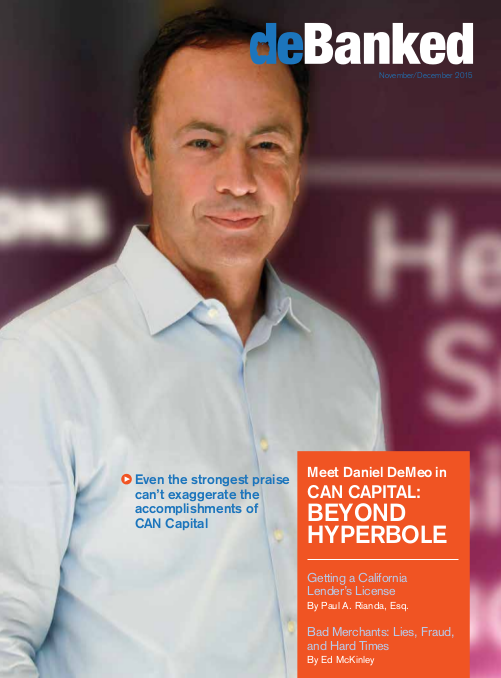 It’s usually risky to say “first,” “largest” or “best,” but CAN Capital invites those superlatives and more.
Asked whether the company’s the biggest in the alternative funding business, CEO Dan DeMeo hedges only a little with qualifiers like “might” or “probably” before proudly announcing that the company has provided access to more than $5.5 billion in working capital through 163,000 fundings to merchants operating in over 540 different kinds of businesses.
Glenn Goldman, the company’s CEO from 2001 to 2013 and now Credibly’s chief executive, doesn’t mince words about his former employer when he calls CAN Capital the biggest and most profitable small business alternative finance company in the U.S.
Cofounder and Chairman Gary Johnson proclaims without hesitation that CAN Capital was the first alternative small business finance company. His wife and cofounder, Barbara Johnson, came up with the idea of the Merchant Cash Advance in 1998 when she had trouble raising funds to promote her business, he said.
CAN Capital developed the first platform to split card receipts between the merchant and funder, and it gave birth to the idea of daily remittances, Johnson continued. Within a few years of its founding the company was turning a profit, another first in alternative finance, he claimed.
The innovation continued from there, according to Andrea L. Petro, executive vice president and division manager of Lender Finance, a division of Wells Fargo Capital Finance. She cited a couple of possible firsts she’s witnessed in her dealings with CAN Capital.
When CAN Capital received a loan from Wells Fargo in 2003, it may have been the first sizeable placement in the alternative finance industry by a major traditional financial institution, Petro said. In 2010, CAN Capital was among the first alternative funders to offer direct loans, she noted.
Petro stopped short of characterizing CAN Capital as the best in the alternative finance business, but she praised the company’s management and lauded its systems for underwriting and monitoring funding. “They continually upgrade their systems, upgrade their software, upgrade their people,” she said.
Calling CAN Capital one of the best comes naturally to Kevin Efrusy, a partner at Accel Partners and a CAN Capital board member. Accel saw opportunity in alternative finance because banks were reluctant to lend at the same time that an explosion of data on small businesses was informing the underwriting process. When Accel sought a position in the industry, it contacted CAN Capital, he said.
“Frankly, CAN Capital didn’t need or want our money,” Efrusy said. “We approached them.” Five years ago, Accel convinced CAN Capital that additional resources could help the company grow, and it bought a stake in the company.
With so many extolling the virtues of CAN Capital, AltFinanceDaily asked DeMeo for a look at the thinking that underlies the success.
PLOTTING STRATEGY
CAN Capital pursues a strategy that DeMeo visualizes as a honeycomb. In the center cell, he places the objective of “helping small businesses succeed.” The compartmental element above that provides a place for the goal of serving as “the preferred provider of financial solutions to small business,” he said. The company’s cultural values, summarized as “Care, Dare and Deliver,” reside in the compartment below the center cell as table stake underpinnings, he added.
DeMeo also describes the company as driven by four strategic planks: “1) Expand the market, 2) broaden the product set, 3) deepen relationships with customers, and 4) achieve operating excellence,” he said.
What does success look like to the company? To DeMeo, it’s dramatic growth in the number of customers, resulting in increased revenue, a more valuable company and better career opportunities. “Digital automation and customer experience are at the center of those efforts,” he said.
CAN Capital operates with a “huge appetite for ‘test and learn,’” according to DeMeo. “That’s how we keep innovation alive,” he said.
And the result of all that? The company has increased fundings by 29 percent (CAGR) and revenue by 24 percent (CAGR), with corresponding growth in earnings, DeMeo said. It has also grown its digital business by 600 percent since 2014, he noted.
 AT THE WHEEL
DeMeo, the man at the top of CAN Capital, joined the company in 2010 as chief financial officer and became CEO early in 2013. He was previously CFO at 1st Financial Bank, and also served as CFO for JP Morgan Chase’s consumer and small business unit. DeMeo also was chief marketing officer and ran business development head for GE Capital’s consumer card unit. His career began at Citibank, where he held senior roles in marketing and customer analytics.
“I was very fortunate to work for some pedigree companies earlier in my career,” DeMeo said. “Those companies emphasized market based training and development, and I worked with very smart and hardworking people. I also had great experience in unsecured lending.” His formative years left him with great appreciation for “behavioral analytics and the quantitative, information-based approach to business finance.”
Experience convinced him, as a CEO, the importance of attention to the balance sheet and income statement. It’s vital to combine that with innovation and growth orientation, DeMeo said. He seeks to lead, inspire and motivate employees, he emphasized.
DeMeo grew up in Atlantic City, NJ, with parents who valued hard work, education and maximizing opportunity. His wife and three children have supported him in his career despite the long hours and dedication necessary for success.
At CAN Capital DeMeo has faced the challenge of managing the business through internal and external cycles. Running the company often comes down to balancing what customers want with what makes economic sense, he said. “Pigs eat, and hogs get slaughtered,” he maintained. “You can’t get too greedy.”
DeMeo runs the company without the help of a President or Chief Operating Officer. While DeMeo serves as the public face of the company, he also devotes himself to every aspect of operations, he said.
WHAT’S IN A NAME?
Although CAN Capital’s drive for technological innovation and its measured approach to fundings have remained constant, the company has renamed itself several times to fit changing times.
In November 2013, it rebranded itself publicly as CAN Capital, and the company now provides access to business loans through CAN Capital Asset Servicing Inc, and Merchant Cash Advances through CAN Capital Merchant Services.
With the CAN Capital rebranding, it dropped the umbrella name of Capital Access Network. At the same time, it retired the AdvanceMe, New Logic Business Loans and CapTap names.
Most of the company’s old names applied to products or distribution channels, DeMeo said. The company had added them when it presented a new product, such as loans, or introduced a way of going to market, like end-to-end digital technology.
Consolidating the names reflected the company’s decision to put its direct marketing efforts on equal footing with business generated by partner companies, DeMeo said. Having just one name would result in a more efficient approach to building a stronger brand, he noted.
“The opportunity is to create one brand, multiple products and omni channel distribution under one company,” he said. “For a company our size, it would be hard to create brand awareness if you had to put significant promotional support behind every one of those sub brands.”
CAN Connect is a sub-brand that has survived. “That’s not a product name or distribution channel name,” DeMeo said. “It’s the technology suite we use to connect with partners so that we can exchange information in real time.”
CAN Connect is a way to speed up the process and eliminate friction for customers and partners. For example, a partner is able to link their CRM directly into CAN Capital’s decision engine, eliminating manual steps in submitting and generating offers. For partners with a customer-facing portal, CAN Connect enables an offer to be made available in real time to a small business owner, taking advantage of data sharing APIs to tailor the marketing message to fit the prospective customer’s needs.
Attention to detail pays off in repeat business for CAN Capital, in DeMeo’s view. “Almost 70% of our merchants return for another contract,” he said
THE GENESIS
By all accounts, CAN Capital is a company born of necessity. Barbara Johnson, who had the brainstorm that became CAN Capital, was running four Gymboree playgroup franchises in Connecticut and needed funds to finance summertime direct marketing efforts for fall enrollment.
But her company didn’t have much in the way of assets to pledge, so banks weren’t interested in providing funds. Why, she reasoned, couldn’t she just borrow or receive an advance against the credit card receipts she knew would flow in when the kids came back in the autumn? Thus, she gave birth to an industry.
Barbara Johnson and her husband, direct marketing executive Gary Johnson, cofounded the company as Countrywide Business Alliance and put up their own money to build a computerized platform to split card revenue, Gary Johnson said.
Then they persuaded a card processor to partner with them. Once they were operating and had signed their first customer, venture capital began flowing their way to grow the business. These days, the Johnsons remain major shareholders.
“What made it an interesting concept was how huge the market potential was,” Gary Johnson said. “That’s what the attraction still is today.” Although Merchant Cash Advances may now seem commonplace, they were startling at first, he said. “When we first went out in the marketplace, everybody thought it was a crazy idea,” he noted.
The company earned patents on processing related to Merchant Cash Advances and daily remittances, Gary Johnson said. At first, the patents deterred potential competitors from entering the business, but the company was unable to defend the patents successfully in court. Rivals then entered the fray.

Just the same, the company became profitable early on through “deliberate decision-making, having the right people in place and being bigger than everybody else,” he said.
Much of the company’s early business came through firms that provide merchants with transaction services, and that remains the case today, DeMeo said. Many were placing point of sale terminals in stores and restaurants to accept credit cards, and working capital became an upsell or cross-sell, he noted.
The large base of business CAN Capital built with merchant services companies means it will always be an important channel for the company. Recently, new merchant sign-ups have come from more diverse channels, including cobranded and referral partners, and the fast-growing direct marketing channels.
From the beginning, the merchants receiving capital used it to grow their businesses, DeMeo said. “That feeds the whole economic system and creates jobs,” he said.
 TODAY’S NUTS AND BOLTS
Daily remittances give CAN Capital nearly constant insight into how well customers are performing, which enables the company to discover potential issues quickly and take action. Such close monitoring also provides the company with enough information to enable funding opportunities that competitors might pass up, DeMeo said.
“The basis for our decisions is how the business performs and business-specific indicators, such as capacity and consistency, versus looking at the personal credit history of the business owner,” DeMeo noted.
Having that data also helps the company create models it can use to serve other businesses in the same classification, DeMeo said. “It’s poured into machine learning for future decisioning,” he maintained. “It’s a cool concept, right?”
The company’s 450 or so employees work in several locations. Three hundred of the total are attached to the office in Kennesaw, GA, the region where the company first set up operations. To this day, that’s where the company conducts most of its business, DeMeo said.
About 25 employees work in technology and operating support in offices in Salt Lake City because the area offers a strong talent pool and provides the company with additional time zone coverage, DeMeo said.
Some of the company’s former executives came from Western Union, which had a presence in Costa Rica. About a hundred employees are now stationed there, working on technology, maintenance and development. That location also houses back-office redundancy for the company, too.
 On Manhattan’s 14th Street, the company has 30 or so employees, who include digital engineers, marketing and business development teams, the human resources lead, the chief financial officer, the chief legal officer, and the chief executive officer. The company moved its executive office there from Scarsdale, NY to take advantage of the digital boom, he said, adding that, “Google’s right around the corner.”
Compared with most companies in alternative finance, CAN Capital has little venture capital as part of its ownership structure, DeMeo said. “It’s a self-sustaining business. We’re not forced to approach the capital market to cover our burn rate. We’re cash-flow positive.” Competitors have to borrow to fund their growth, he noted.
The company has taken on infusions of debt financing, not equity financing. In the latter, a company is selling part of itself, DeMeo said. “We raised $650 million from a syndicate with five new banks and 10 banks in total.” The company completed a securitization of $200 million the year before, he said.
CAN Capital recently introduced the new TrakLoan product that has no fixed maturity date, with daily payments that are based on a fixed percentage of card receipts. This way, payments ebb and flow with the merchant’s card sales. CAN Capital is also testing “bank-like” installment loans of as much as $500,000 with a payback period of up to four years.
And there’s nowhere to go but up, in the view of CAN Capital executives. With a market of 28 million small American merchants and penetration of between 5 and 10 percent, they see plenty of potential to keep earning superlatives.
Stop Being A Sub-Broker
December 10, 2015 In an industry with increasing competitive forces putting downward pressures on offer pricing, while simultaneously driving up demand for particular marketing channels (like SEO and quality data) which increases marketing costs, we are seeing massive downward pressures on profits. With this phenomenon occurring, you would have to wonder why in the world would anyone continually operate as a sub-broker today (willingly)? Are there any particular benefits to this, or is it just flat out non-sense? I wanted to explore this topic head on as we wrap up The Year Of The Broker.
THE VAST MAJORITY OF THE TIME, IT MAKES LITERALLY NO SENSE
There are times when I believe being a sub-broker makes some level of sense, but in my opinion those times (looking at our industry specifically) are very rare and most of the time being a sub-broker makes literally no sense based on the setup. The usual setup for a sub-broker is the same as a broker, which means you are going to be required to go out and spend money on marketing or other forms of lead generation to attract applicants.
Once you get those applications, you would forward them to the brokerage house so they can “close” the deal. A lot of sub-brokers believe this is some sort of grandiose deal, allowing them to as they say “free up time” to do other things. But this line of thinking makes literally no sense, because you have already done 98% of the work, which in our industry is just the consistent generation of high quality leads. Once you have done that and are doing that consistently, emailing the package over to a funder and chasing paperwork is the easiest part.
Why would you take only 25% – 50% of the commission structured on a deal, as well as most likely lose your ongoing renewal compensation, when you can instead take 100% of the commission, control your renewal portfolio and make renewal compensation going forward, which is the lifeblood of our industry?
LIES, LIES AND MORE LIES
Sub-brokers need to stop falling for the lies of larger brokerage houses which include the following:
“We are closers, you aren’t a closer, so let us handle it!”
This is rubbish. In our industry we don’t close, we are match-makers. The merchant comes to us looking for working capital, we pre-qualify their current standing and recommend a potential solution. If the merchant disagrees with the potential solution and we have nothing else that would work, the discussion ends. If the merchant agrees to the estimates and the product overview, we collect an application package to submit it to the funder that we believe can do an appropriately-priced deal. As long as we can get approval inline with expectations, everything moves forward on its own accord.
“We have access to special underwriting, platforms and pricing that you don’t have access to!”
More rubbish. When lenders get an A-paper deal, they give you A-paper quotes. When they get a B/C-paper deal, you get B/C-paper quotes. Look to establish a good relationship with a funder/lender. Let them know upfront that you are a small office so a smaller amount of volume will be coming through you. As long as you don’t have a high default rate, you will have access to the same systems, underwriters, base pricing, and innovative products of the funder/lender that the larger brokerage House has.
“We have access to special industry knowledge that you don’t have access to!”
More rubbish. With sources like AltFinanceDaily and other popular forums, the industry has been exposed. Everything you need to know, learn and be trained on has been covered. Also the assortment of direct funder and lender blogs/websites, media publications, and all of the like covering the industry, there’s no special industry knowledge that you can’t go out and attain on your own.
YOU MIGHT NOT EVEN GET PAID
Being a sub-broker might put you in a position of not even getting paid on new deal revenue as promised, as the large (or more experienced) brokerage is fully aware of your inability to truly challenge them legally or professionally.
- Sue If You Want, It Won’t Make A Difference: You can sue the broker for the $5,000 or so that they didn’t pay you on a couple new deals in Small Claims Court. But even though you can obtain a judgment, collecting on that judgment will be nearly impossible.
- Complain Online If You Want, It Won’t Make A Difference: You can also choose to damage their reputation online through posting various negative reviews, but do you think they will care? Go on the RipOffReport all you want, the largest merchant processing ISOs are all over those reports and that doesn’t do anything to stop their growth. The organizations getting these negative reviews will just say, “we serve thousands of clients and when you are as large as us, you are bound to have unhappy customers.” And that’s exactly what the brokerage house will say to their prospective merchants who bring up these negative review listings that you made.
BUT DOES BEING A SUB-BROKER “SOMETIMES” MAKE SENSE?
On very rare occasions do I believe being a sub-broker makes sense, and it includes if there’s some sort of initial training period and if the larger brokerage has significant marketing competitive advantages.
Training
So if you have zero experience, can’t spell Merchant Cash Advance, and believe you could benefit from a 6 month period with an established broker to show you the ropes, then being a sub-broker for a short period of time could make sense. However, I still believe that with the industry being exposed the way it is, you can train yourself and have to deal with insane non-compete agreements.
Marketing Competitive Advantages
So as a small shop, your marketing budget might be limited to $1k a month, whereas the larger brokerage is spending $20k a month and in a perfect world, might give you a deal where you can work with them without being required to generate your own leads.
They’ll claim to supply everything in terms of your dialer and warm leads, with funder networks already established. So all you have to do is come in, sit down, pick up the telephone, and sell all day to the warm leads coming in from their $20k in marketing. You don’t have to do any cold-calling. So you might be getting 50 leads a week that you convert to 12 applications, which you then convert to 4 new deals. If the average funding is $30k, then that’s $120k in funding with let’s say an average 6% commission that you would split 50/50 (3%/3%), giving you $3,600 per week which is $14,400 per month.
But we don’t live in a perfect world, now do we? Do you honestly believe the structure will be established as promoted? Such as more and more of the 50 leads you receive per week turn into mainly start-ups that don’t qualify for anything. Or, most weeks you don’t receive any warm leads at all, and are required to call UCCs, aged leads, or random listings out of the Yellow Pages, which are all horrible marketing mediums.
EITHER YOU GET IN ALL OF THE WAY, OR MAYBE YOU SHOULD GET OUT
If you are going to be in this industry, then properly set up your office, marketing plan, business plan, funder network and work your own deals. Get 100% of commission structured on new deals and control your renewal portfolio (the lifeblood of our business). If you are going to operate as a sub-broker, for the most part you are going to get a raw deal as we don’t live in a perfect world. We live in a world full of inefficiencies, “rah-rah” sales motivational speeches, and promises that don’t get kept.