
IN DEFAULT OR ABOVE WATER: How PPP Saved or Didn’t Save America
July 31, 2020 Kristy Kowal, a silver medalist in the 200-meter breast stroke at the 2000 Olympic games in Australia, had recently relocated to Southern California and embarked on a new career when the pandemic shutdown hit in March.
After nearly two decades as a third-grade teacher in Pennsylvania, Kowal was able to take early retirement in 2019 and pursue her dream job. At last, she was self-employed and living in Long Beach where she could now devote herself to putting on swim clinics, training top athletes, and accepting speaking engagements. “I’ve been building up to this for twenty years,” she says.
But fate had a different idea. The coronavirus not only grounded her from travel but closed down most swimming pools. At first, she tried to collect unemployment compensation. But after two months of calling the unemployment office every day, her claim was denied. “‘Have a great day,’ the lady said, and then she hung up,” Kowal reports. “She wasn’t rude; she just hung up.”
Then, in June, the former Olympian heard from friends about Kabbage and the Paycheck Protection Program. Using an app on her smart phone, Kowal says, she was able to upload documents and complete the initial application in fewer than 20 minutes. A subsequent application with a bank followed and within a week she had her money.
“I was down to ten cents in my checking account,” says Kowal, who declined to disclose the amount of PPP money for which she qualified, “and I’d begun dipping into my savings. This gives me the confidence that I need to go back to my fulltime work.”
 Kowal is one of 4.9 million small business owners and sole proprietors who, according to the U.S. Small Business Administration, has received potentially forgivable loans under the Paycheck Protection Program. The PPP, a safety-net program designed to pay the wages of employees for small businesses affected by the coronavirus pandemic, is a key component of the $1.76 trillion Coronavirus Aid, Relief, and Economic Security Act (CARES Act). Since the U.S. Congress enacted the law on March 27, the PPP has been renewed and amended twice. It’s now in its third round of funding and Congress is weighing what to do next.
Kowal’s experience, meanwhile, is also a wake-up call for the country on the prominent role that both fintechs like Kabbage as well as community and independent banks, credit unions, non-banks and other alternatives to the country’s biggest banks play in supporting small business. Before many in this cohort were deputized by the SBA as full-fledged PPA lenders, a significant chunk of U.S. microbusinesses – especially sole proprietorships — were largely disdained by the brand-name banks.
“After the first round,” notes Karen Mills, former administrator of the U.S. Small Business Administration and a senior fellow at the Harvard Business School, “more institutions were approved that focused on smaller borrowers. These included fintechs and I have to say I’ve been very impressed.”
Among the cadre of fintechs making PPP loans – including Funding Circle, Intuit Quickbooks, OnDeck, PayPal, and Sabre — Kabbage stands out. The Atlanta-based fintech ranked third among all U.S. financial institutions in the number of PPP credits issued, its 209,000 loans trailing only Bank of America’s 335,000 credits and J.P. Morgan Chase’s 260,000, according to the SBA and company data. Kabbage also reports processing more than $5.8 billion in PPP loans to small businesses ranging from restaurants, gyms, and retail stores to zoos, shrimp boats, beekeepers, and toy factories.
To reach businesses in rural communities and small towns, Kabbage collaborated with MountainSeed, an Atlanta-based data-services provider, to process claims for 135 independent banks and credit unions around the U.S. The proof of the pudding: Eighty-nine percent of Kabbage’s PPP loans, says Paul Bernardini, director of communications at Atlanta-based Kabbage, were under $50,000, and half were for less than $13,500.
The figures illustrate not only that Kabbage’s PPP customers were mainly composed of the country’s smaller, “most vulnerable” businesses, Bernardini asserts, but the numbers serve as a reminder that “fintechs play a very important, vital role in small business lending,” he says.
The helpfulness of such financial institutions contrasts sharply with what many small businesses have reported as imperious indifference by the megabanks. Gerri Detweiler, education director at Nav, Inc., a Utah-based online company that aggregates data and acts as a financial matchmaker for small businesses, steered AltFinanceDaily toward critical comments about the big banks made on Nav’s Facebook page. Bank of America, especially, comes in for withering criticism.
“Bank of America wouldn’t even take my application,” one man wrote in a comment edited for brevity. “I have three accounts there. They are always sending me stuff about what an important client I am. But when the going got tough, they wouldn’t even take my application. I’m moving all my business from Bank of America.”
Lamented another Bank of America customer: “I was denied (PPP funding) from Bank of America (where) I have an individual retirement account, personal checking and savings account, two credit cards, a line of credit for $20.000, and a home mortgage. Add in business checking and a business credit card. Yesterday I pulled out my IRA. In the next few days I’m going to change to a credit union.”
Many PPP borrowers who initially got the cold shoulder from multi-billion-dollar conglomerate banks have found refuge with local — often small-town — bankers and financial institutions. Natasha Crosby, a realtor in Richmond, Va., reports that her bank, Capital One, “didn’t have the applications available when the Paycheck Protection Program started” on April 6. And when she finally was able to apply, she notes, “the money ran out.”
Crosby, who is president of Richmond’s LGBTQ Chamber of Commerce, is media savvy and was able to publicize her predicament through television appearances on CNN and CBS, as well as in interviews with such publications as Mother Jones and Huffington Post. A “friendly acquaintance,” she says, referred her to Atlantic Union Bank, a Richmond-based regional bank, where she eventually received a PPP loan “in the high five figures” for her sole proprietorship.
“It took almost two months,” Crosby says. “I was totally frozen out of the program at first.”
Talibah Bayles heads her own firm, TMB Tax and Financial Services, in Birmingham, Ala. where she serves on that city’s Small Business Council and the state’s Black Chamber of Commerce. She told AltFinanceDaily that she’s seen clients who have similarly been decamping to smaller, less impersonal financial institutions. “I have one client who just left Bank of America and another who’s absolutely done with Wells Fargo,” she says. “They’re going to places like America First Credit Union (based in Ogden, Utah) and Hope Credit Union (headquartered in Jackson, Miss.). I myself,” she adds, “shifted my business from Iberia Bank.”
 Main Street bankers acknowledge that they are benefiting from the phenomenon. “In speaking to our industry colleagues,” says Tony DiVita, chief operating officer at Bank of Southern California, an $830 million-asset community bank based in San Diego, “we’ve seen that many of the big banks have slowed down or stopped lending small-dollar amounts that were too low for them to expend resources to process.”
At the same time, DiVita says, his bank had made 2,634 PPP loans through July 17, roughly 80% of which went to non-clients. Of that number, some 30% have either switched accounts or are in the process of doing so. And, he notes, the bank will get a second crack at conversion when the PPP loan-forgiveness process commences in earnest. “Our guiding spirit is to help these businesses for the continuation of their livelihoods,” he says.
Noah Wilcox, chief executive and chairman of two Minnesota banks, reports that both of his financial institutions have been working with non-customers neglected by bigger banks where many had been longtime customers. At Grand Rapids State Bank, he says, 26% of the 198 PPP applicants who were successfully funded were non-customers. Minnesota Lakes Bank in Delano, handled PPP credits for 274 applicants, of whom 66% were non-customers.
“People who had been customers forever at big banks told us that they had been applying for weeks and were flabbergasted that we were turning those applications around in an hour,” says Wilcox, who is also the current chairman of the Independent Community Bankers of America, a Washington, D.C.-based trade group representing community banks.
Noting that one of his Gopher State banks had successfully secured funding for an elderly PPP borrower “who said he had been at another bank for 69 years and could not get a telephone call returned,” Wilcox added: “We’ve had quite a number of those individuals moving their relationships to us.”
For Chris Hurn, executive director at Fountainhead Commercial Capital, a non-bank SBA lender in Lake Mary, Fla., the psychic rewards have helped compensate for the sometimes 16-hour days he and his staff endured processing and funding PPP applications. “It’s been relentless,” he says of the regimen required to funnel loans to more than 1,300 PPP applicants, “but we’ve gotten glowing e-mails and cards telling us that we’ve saved people’s livelihoods.”
Yet even as the Paycheck Protection Program – which only provides funding for two-and-a-half months – is proving to be immensely helpful, albeit temporarily, there is much trepidation among small businesses over what happens when the government’s spigots run dry. The hastily contrived design of the program, which has relied heavily on the country’s largest financial institutions, has contributed mightily to the program’s flaws.
“The underbanked and those who don’t have banking relationships were frozen out in the first round,” says Sarah Crozier, director of communications at Main Street Alliance, a Washington D.C.-based advocacy organization comprising some 100,000 small businesses. “The new updates were incredibly necessary and long overdue,” she adds, “but the changes didn’t solve the problem of equity in access to the program and whom money is flowing to in the community.”
Professor David Audretsch, an economist at Indiana University’s O’Neill School of Public and Environmental Affairs and an expert on small business, says of PPP: “It’s a short-term fix to keep businesses afloat, but it missed in a lot of ways. It was not well-thought-out and a lot of money went to the wrong people.”
The U.S. unemployment rate stood at 11.1% in June, according to the most recent figures released by the Bureau of Labor Statistics, about three times the rate of February, just before the pandemic hit. The BLS also reported that 47.2% of the U.S. population – nearly half –was jobless in June. Against this backdrop, SBA data on PPP lending released in early July showed that a stunning array of cosseted elite enterprises and organizations, many with close connections to rich and powerful Washington power brokers, have been feasting on the PPP program.
In a stunning number of cases, the program’s recipients have been tony Washington, D.C. law firms, influential lobbyists and think tanks, and even members of Congress. Many businesses with ties to President Trump and Trump donors have also figured prominently on the SBA list of those receiving largesse from the SBA.
 Businesses owned by private equity firms, for which the definition of “small business” strains credulity, were also showered with PPP dollars. Bloomberg News reported that upscale health-care businesses in which leveraged-buyout firms held a controlling interest, were impressively adept at accessing PPP money. Among this group were Abry Partners, Silver Oak Service Partners, Gauge Capital, and Heron Capital. (Small businesses are generally defined as enterprises with fewer than 500 employees. The SBA reports that there are 30.7 million small businesses in the U.S. and that they account for roughly 47% of U.S. employment.)
Boston-based Abry Partners, which currently manages more than $5 billion in capital across its active funds, merits special mention. Among other properties, Abry holds the largest stake in Oliver Street Dermatology Management, recipient of between $5 million and $10 million in potentially forgivable PPP loans. Based in Dallas, Oliver Street ranks among the largest dermatology management practices in the U.S. and, according to a company statement, boasts the most extensive such network in Texas, Kansas and Missouri.
Meanwhile, the design of the program and the formula for the looming forgiveness process is proving impractical. As it currently stands, loan forgiveness depends on businesses spending 60% of PPP money on employees’ wages and health insurance with the remaining 40% earmarked for rent, mortgage or utilities.
 Many businesses such as restaurants and bars, storefront retailers and boutiques – particularly those that have shut down — are preferring to let their employees collect unemployment compensation. “Business owners had a hard time wrapping their heads around the requirement of keeping employees on the payroll while they’re closed,” notes Detweiler, the education director at Nav. “They have other bills that have to be paid.”
The forgiveness formula remains vexing for businesses where real estate costs are exorbitant, particularly in high-rent cities such as New York, Boston, Washington, D.C., San Francisco, and Chicago. Tyler Balliet, the founder and owner of Rose Mansion, a midtown Manhattan wine-bar promising an extravagant, theme-park experience for wine enthusiasts, says that it took him a month and a half to receive almost $500,000 from Chase Bank. Unfortunately, though, the money isn’t doing him much good.
“I have 100 employees on staff, most of whom are actors,” he says. “We shut down on March 13. I laid off 95 employees and kept just a few people to keep the lights on.”
At the same time, his annual rent tops $1 million and the forgivable amount in the PPP loans won’t even cover a month’s rent. “I haven’t paid rent since March and I’m in default,” Balliet says. “Now I’m just waiting to see what the landlord wants to do.”
Like many business owners, Balliet financed much of his venture with credit card debt, which creates an additional liability concern, notes Crozier of the Main Street Alliance. “It’s very common for borrowers to have signed personal guarantees in their loans using their credit cards,” she says. “As we get closer to the funding cliff and as rent moratoriums end,” she adds, “creditors are coming after borrowers and putting their personal homes at risk.”
Mark Frier is the owner of three restaurants in Vermont ski towns, including The Reservoir — his flagship — in Waterbury. In toto, his eateries chalked up $6.5 million in combined sales in 2019. But 2020 is far different: the restaurants have not been open since mid-March and he’s missed out on the lucrative, end-of-season ski rush.
Consequently, Frier has been reluctant to draw down much of the $750,000 in PPP money he’d secured through local financial institutions. “We could end up with $600,000 in debt even with the new rules,” Frier says, adding: “We live off very thin margins. We need grants not loans.”
As the country recorded 3.7 million confirmed cases of coronavirus and more than 141,000 deaths as of mid-July, PPP money earmarked by businesses for health-related spending was not deemed forgivable. Yet in order to comply with regulations promulgated by the Occupational Safety and Health Administration and mandates and ordinances imposed by state and local governments, many establishments will be unable to avoid such expenditures.
“What we really needed was a grant program for companies to pivot to a business environment in a pandemic,” says Crozier. She cites the necessity businesspeople face of “retrofitting their businesses, buying masks, gloves and sanitizers and cleaning supplies, restaurants’ taking out tables and knocking down walls, installing Plexiglass shields, and improving air filtration systems.”
 Meanwhile, as Covid-19 was taking its toll in sickness and death, the economic outlook for small business has been looking dire as well. The recent U.S. Census’s “Pulse Survey” of some 885,000 businesses updated on July 2 found that roughly 83% reported that Covid-19 pandemic had a “negative effect on their business. Fully 38% of all small business respondents, moreover, reported a “large negative effect.”
Amid the unabated spikes in the number of coronavirus cases and the country’s grave economic distress, PPP recipients are faced with the unsettling approach of the PPP forgiveness process. As Congress, the SBA, and the U.S. Treasury Department continue to remake and revise the rules and regulations governing the program, businesses are operating in a climate of uncertainty as well. Currently, the law states that the amount of the PPP loan that fails to be forgiven will convert to a five-year, one-percent loan — a relaxation in terms from the original two-year loan which is not necessarily cheering recipients.
“One of the biggest problems with PPP is that the rule book has been unclear,” frets Vermont restaurateur Frier, glumly adding: “This is not even a good loan program.”
Ashley Harrington, senior counsel at the Center for Responsible Lending, a research and policy group based in Durham, N.C., argued in House committee testimony on June 17, that there ought to be automatic forgiveness for PPP loans under $100,000. Such a policy, she declared, “would likely exempt firms with, on average, 13 or fewer employees and save 71 million hours of small business staff time.”
She also said, “The smallest PPP loans are being provided to microbusinesses and sole proprietors that have the least capacity and resources to engage in a complex (forgiveness) process with their financial institution and the SBA.”
William Phelan, president of Skokie (Ill.)-based PayNet, a credit-data services company for small businesses which recently merged with Equifax, sounded a similar note. Observing that there are some 23 million “non-employer” small businesses in the U.S. with fewer than three employees for whom the forgiveness process will likely be burdensome, he says: “Estimates are that it will cost businesses a few thousand dollars just to get a $100,000 loan forgiven. It’s going to involve mounds of paper work.”
The country’s major challenge now will be to re-boot the economy, Phelan adds, which will require massive financing for small businesses. “The fact is that access to capital for small businesses is still behind the times,” Phelan says. “At the end of the day, it took a massive government program to insure that there’s enough capital available for half of the U.S. economy” during the pandemic.
For his part, Professor Audretsch fervently hopes that the country has learned some profound lessons about the need to prepare for not just a rainy day, but a rainy season. The pandemic, he says, has exposed how decades of political attacks on government spending for disaster-preparedness and safety-net programs have left the U.S. exposed to unforeseen emergencies.
“We’re seeing the consequence of not investing in our infrastructure,” he says. “That’s a vague word but we need a policy apparatus in place so that the calvary can come riding in. This pandemic reminds me a lot of when Hurricane Katrina hit New Orleans,’ he adds. “The city paid a heavy price because we didn’t have the infrastructure to deal with it.”
Canadian Small Business Lender Looks Doomed In Wake of COVID-19
June 29, 2020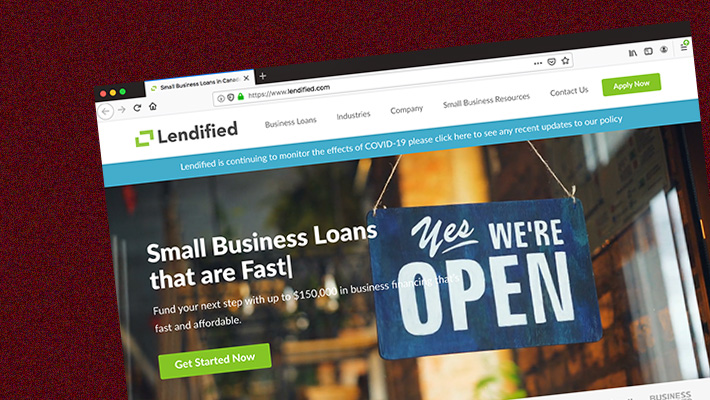 As well-known (1, 2) small business lenders in the United States continue to negotiate COVID-19 era workouts with their creditors, another in Canada appears to be falling off the cliff.
On Thursday, Lendified’s President & Director Kevin Clark tendered his resignation effective July 3rd. He follows other board members Edward Kelterborn and Benjy Katchen whose resignations went into effect on June 25th. Company CFO Norman Tan previously resigned on June 9th and no replacement has been named.
COVID-19’s arrival came at a difficult time for Lendified. Before COVID, the company had never turned a profit or reported positive cashflow in its entire history.
“Lendified is in default in respect of credit facilities with its secured lenders. Forbearance and standstill agreements are being discussed with these senior lenders, with none indicating to date that any enforcement action is expected although each is in a position to do so,” the company said. “However, no formal agreements in this regard have been concluded as of the date hereof.”
The company expressed that it would not be able to continue operations if it was not able to finalize a forbearance on its defaults AND simultaneously obtain an immediate infusion of capital to fund its operations.
Lendified’s board of directors is presently considering selling its assets or its entire business in order to raise revenue.
A wholly owned subsidiary of Lendified, Judi.ai, an automated loan underwriting platform, is poised to cease operations as a result of a cashflow shortfall. “[Judi.ai] requires cash infusions in the amount of approximately $100,000 per month in order to maintain operations,” Lendified reported. “Its cash reserves at this time are approximately $80,000. At this time, the Company is not in a position to continue to fund the Business and there can be no assurances that it will be able to do so in the future.”
The company went public on the Toronto Stock Exchange on May 26th via a reverse merger and has since experienced a 95% drop in its share price. The company’s market cap on Monday hovered around $700,000 USD.
If You Do MCA, You’re Not a Lender (Part Two)
June 16, 2020 A three-year-old AltFinanceDaily blog post turned out to be a bit prophetic.
Titled If You Don’t Make Loans, You’re Not a Lender (And definitely not a ‘direct lender’) and posted on January 19, 2017, I hypothesized that the misuse of financial language on the phone or in an e-mail, particularly if one conflated merchant cash advances with lending, could one day result in a subpoena for a deposition to explain it.
In the People of the State of New York, by Office of the New York State Attorney General v. Richmond Capital Group LLC et al, that very scenario played out. Several people were subpoenaed last year and were required to give testimony to lawyers for the New York State Attorney General to explain why internal company communications allegedly referred to MCAs as loans or why a purported MCA company website made use of lending terminology.
The answers, which are public record, were not great. At least two individuals answered that line of questioning by pleading the fifth to potentially avoid self-incrimination.
While there are a lot of colorful details to consider in this case, the AG’s lawsuit dives into the various ways in which the defendants allegedly conflated financial products, including that a defendant company allegedly advertised itself as a “lender” when it actually was not.
While the allegations in the AG’s complaint are probably somewhat unique, there are claims and arguments within them that may be worth further legal review and analysis. Contact an industry-knowledgeable attorney if you have questions.
The Commercial Finance Coalition Applauds Actions by the Federal Trade Commission and New York State to Thwart Bad Actors in Business Lending
June 11, 2020 The Federal Trade Commission (FTC) and the office of New York State Attorney General Letitia James have filed formal actions against two small business financing companies for allegedly using egregious and deceptive tactics to seize assets from small businesses, non-profits, religious organizations, and medical offices.
“The Commercial Finance Coalition whole-heartedly applauds the efforts of the FTC and Attorney General James. As a coalition of responsible financial services companies committed to funding small businesses, the CFC believes there should be zero tolerance for bad actors and deceptive practices in our industry,” said Executive Director Dan Gans.
Gans added, “Hopefully this will serve as a warning to all companies in the business finance space to serve merchants through best practices centered on respect and integrity in compliance with state and federal law.”
The CFC is a not-for-profit alliance of innovative financial technology companies that are working together to deploy capital to help small and mid sized businesses grow.
Press Release
Contact
Dan Gans
626-755-6545
Release Date
June 11, 2020
Sorry, You’re Not Eligible For PPP Money
April 8, 2020The rush to submit your PPP application may be for naught if you own an ineligible business. The SBA prohibits loan guarantees to “businesses primarily engaged in lending, investments, or to an otherwise eligible business engaged in financing or factoring.” If there’s any confusion as to what that includes, the SBA lists 7 specific ineligible business types under this definition in the statutory code. They include:
- Banks
- Life Insurance Companies (but not independent agents);
- Finance Companies
- Factoring Companies
- Investment Companies
- Bail Bond Companies
- Other businesses whose stock in trade is money
The PPP’s interim final rule refers to this statute as a rule for ineligibility as it applies to the PPP.
The statute does list a handful of businesses engaged in lending that may traditionally qualify for an exception. They are as follows:
- A pawn shop that provides financing is eligible if more than 50% of its revenue for the previous year was from the sale of merchandise rather than from interest on loans.
- A business that provides financing in the regular course of its business (such as a business that finances credit sales) is eligible, provided less than 50% of its revenue is from financing its sales.
- A mortgage servicing company that disburses loans and sells them within 14 calendar days of loan closing is eligible. Mortgage companies primarily engaged in the business of servicing loans are eligible. Mortgage companies that make loans and hold them in their portfolio are not eligible.
- A check cashing business is eligible if it receives more than 50% of its revenue from the service of cashing checks.
- A business engaged in providing the services of a financial advisor on a fee basis is eligible provided they do not use loan proceeds to invest in their own
AltFinanceDaily is not a law firm. Consult a CPA or an attorney to provide better guidance on your company’s eligibility.
PPP Lender Requirements
April 3, 2020Update: The PPP Lender Application is HERE
The elusive application to apply for PPP lender-approved status is expected to become available sometime on Friday. In the meantime, the SBA has published the requirements that a financing provider will have to meet to be eligible for approval. Federally insured depository institutions are already approved so these bullet points apply mainly to non-bank financing providers and online lenders.
- Must already originate, maintain, and service business loans or other commercial financial receivables and participation interests
- Have already been in compliance with the Bank Secrecy Act since at least February 25, 2019
- Have already originated, maintained, and serviced more than $50 million worth of business loans or other commercial financial receivables during a consecutive 12 month period in the past 36 months, or is a service provider to any insured depository institution that has a contract to support such institution’s lending activities in accordance with 12 U.S.C. Section 1867(c) and is in good standing with the appropriate Federal banking agency.
Loan underwriting requirements
- Confirm receipt of borrower certifications contained in Paycheck Protection Program Application form issued by the Administration;
- Confirm receipt of information demonstrating that a borrower had employees for whom the borrower paid salaries and payroll taxes on or around February 15, 2020;
- Confirm the dollar amount of average monthly payroll costs for the preceding calendar year by reviewing the payroll documentation submitted with the borrower’s application; and
- Follow applicable Bank Secrecy Act requirements
Notes from the SBA:
Entities that are not presently subject to the requirements of the Bank Secrecy Act, should, prior to engaging in PPP lending activities, including making PPP loans to either new or existing customers who are eligible borrowers under the PPP, establish an anti-money laundering (AML) compliance program equivalent to that of a comparable federally regulated institution. Depending upon the comparable federally regulated institution, such a program may include a customer identification program (CIP), which includes identifying and verifying their PPP borrowers’ identities (including e.g., date of birth, address, and taxpayer identification number), and, if that PPP borrower is a company, following any applicable beneficial ownership information collection requirements. Alternatively, if available, entities may rely on the CIP of a federally insured depository institution or federally insured credit union with an established CIP as part of its AML program. In either instance, entities should also understand the nature and purpose of their PPP customer relationships to develop customer risk profiles. Such entities will also generally have to identify and report certain suspicious activity to the U.S. Department of the Treasury’s Financial Crimes Enforcement Network (FinCEN). If such entities have questions with regard to meeting these requirements, they should contact the FinCEN Regulatory Support Section at FRC@fincen.gov. In addition, FinCEN has created a COVID-19-specific contact channel, via a specific drop-down category, for entities to communicate to FinCEN COVID-19-related concerns while adhering to their BSA obligations. Entities that wish to communicate such COVID-19-related concerns to FinCEN should go to www.FinCEN.gov, click on “Need Assistance,” and select “COVID19” in the subject drop-down list.
Each lender’s underwriting obligation under the PPP is limited to the items above and reviewing the “Paycheck Protection Application Form.” Borrowers must submit such documentation as is necessary to establish eligibility such as payroll processor records, payroll tax filings, or Form 1099-MISC, or income and expenses from a sole proprietorship. For borrowers that do not have any such documentation, the borrower must provide other supporting documentation, such as bank records, sufficient to demonstrate the qualifying payroll amount.
The lender does not need to conduct any verification if the borrower submits documentation supporting its request for loan forgiveness and attests that it has accurately verified the payments for eligible costs. The Administrator will hold harmless any lender that relies on such borrower documents and attestation from a borrower. The Administrator, in consultation with the Secretary, has determined that lender reliance on a borrower’s required documents and attestation is necessary and appropriate in light of section 1106(h) of the Act, which prohibits the Administrator from taking an enforcement action or imposing penalties if the lender has received a borrower attestation.
Lenders will need to complete this form with each loan.
Borrowers must complete this form.
Views from the Small Business Finance Industry, March 27
March 27, 2020 As the coronavirus pandemic continues to disrupt the economy and affect small businesses as well as funders, AltFinanceDaily will keep up with how various figures from the alternative finance sector are managing under the stresses of covid-19. Ranging from funders, to brokers, to those figures on the periphery of the industry, this series aims to highlight a variety of voices and we encourage you to reach out to AltFinanceDaily to discuss how your business is doing.
—
One such voice this week was Shawn Smith, CEO of Dedicated Commercial Recovery. Specializing in debt recovery and legal enforcement, Smith told AltFinanceDaily that his business has already seen a jump in demand, but that he reckons, for now, most demand will be for modifications on existing deals. According to Smith, many of his clients have explained to him that merchants have been requesting changes to the terms of the financing, either by tweaking the rates or length of repayment.
“Just in two weeks we can see an uptick, but by and large, it hasn’t majorly spiked. I think it’s spiking with the funders or the creditors right now. And we’ll be next on that … a major thing I’m hearing is a dramatic increase in inbound calls to our clients for modifications.”
In Smith’s view, this back and forth between merchants and funders is a better scenario than the alternative, making clear that honest communication is necessary in a crisis like this.
“Hopefully everybody’s working together through this, which does seem to be the case right now. I honestly think we’re past the point of some people calling this a hoax, or it’s not to be taken seriously. And I’m seeing a lot of rallying around the idea of ‘we’re in this together even though we can’t stand next to each other.’ A kind of American spirit of we’re going to beat this, we’re going to get through it.”
—
For Idea Financial, the idea of working together has manifested, just as it has for many companies across the world, digitally. CEO Justin Leto and President Larry Bassuk explained to AltFinanceDaily that since their entire company is working remotely, the communication app Slack has stepped in for continual conversation between employees and Zoom is being used to check in with the team multiple times throughout the day.
“In many ways, our teams interact more now than they did when they were in the office together. We hold competitions, share personal stories, and really support one another. At Idea, the sentiment that we feel is that everyone appreciated each other more now than before, and we all look forward to seeing each other again in person soon.”
—
On Thursday, industry leaders took part in a webinar hosted by LendIt Co-Founder and Chairman Peter Renton. Various subjects relating to Covid-19 were up for discussion by Lendio’s Brock Blake, Kabbage’s Kathryn Petralia, and Luz Urrutia of Opportunity Fund, with the $2 trillion government bill being foremost among them.
Blake, who had been in touch with Senators Romney and Rubio, explained that most small businesses will be eligible for a loan out of the $350 billion fund that would be allotted to the SBA under the $2 trillion bill, saying that “a tsunami of loan applications is coming because almost all small business owners in America will qualify for this product.” The Lendio CEO also noted that business can expect to pay an interest rate of 3.75% on these loans, only a portion of each individual loan may be forgivable, and the max amount loaned out will be two and a half times the business’s monthly payroll, rent, and utilities combined.
Beyond the specifics of the 7(a) loan program, Blake expressed concern over the SBA’s bandwidth, saying that he was unsure whether or not the organization and the banks that it will partner with to deliver these loans will have the capacity to process them, a point echoed by Urrutia. “We’re talking about businesses that are going to need a ton of support,” the Opportunity Fund CEO said. “With these programs, the money doesn’t really get down to the bottom of the pyramid.”
Collectively, the group hoped that the SBA would open up their channels and allow non-bank lenders to use some of the $350 billion to fund small businesses, citing that neither government agencies nor banks have the technology nor processes to hastily deal with the amount of applications that will come. In other words, the SBA is working with “dinosaur technology,” as Blake called it.
One point of concern that continually arose during the conversation was the situation lenders will find themselves in as the pandemic continues. With Blake saying that an estimated 50% of non-bank lenders on his platform have hit the pause button on new loans, each of the other participants expressed worry about lenders being wiped off the map during and in the aftermath of this crisis.
As well as this, Petralia explained that funders can expect to encounter increased rates of fraud during this time: “In times like this, the bad guys come out in force … criminals are very creative and smart, so I promise you they’ll come up with new ways to fraud the system.” Discussing how they are dealing with this, the group mentioned that they were incorporating additional revenue and cash balance checks, as well as social media checks to see whether the business announced that it had closed due to the coronavirus.
Altogether, the conversation was one of uncertainty, but also one of hope to keep the wheels of the industry turning as more and more small business owners look for financing to keep their payroll flowing. As Renton said closing the session, “This is our time to shine, this is fintech’s time to show what it’s been working on for the last decade.”
$2 Trillion Senate Relief Bill to Pass Vote, Includes Small Business Funds
March 26, 2020 Senate leaders Mitch McConnell and Chuck Schumer have come to an agreement over a stimulus package that would inject $2 trillion into the US economy. With senators debating the bill at the time of writing, it is expected to pass. Said to be the largest and most robust rescue package in American history, the bill would see $300 billion go to the SBA for its 7A loan program.
“At last we have a deal,” McConnell said after negotiations wrapped up at 1:30am on Wednesday morning. McConnell later described the bill as “a war-time level of investment into our nation.”
According to Stephen Denis, Executive Director of the SBFA, who was closely engaged with the language being placed into the bill, certain small businesses who receive SBA loans may have their loan converted to a grant, depending upon how they aim to spend the financing. As well as this, Denis made clear that small businesses will be able to use these funds to pay any charges linked to an online small business loan or MCA.
“There’s different things that you can use the SBA money for,” Denis explained in a call. “Payroll support, obviously, including paid sick leave, medical, or family leave; costs related to health care; employees salaries; mortgage payments; rent payments; utilities. And then this is another thing that we got inserted into the bill, we wanted to make sure that businesses had the flexibility to use this funding to pay existing debt obligations that were incurred before the covered period. What this means is that if a business had taken out an MCA or a loan, that they could use this money to pay off the obligations.”
As well as allotting funds for the SBA, the bill provides for cash payments of up to $1,200 to be made available directly to individuals, $2,400 for married couples, and an additional $500 per child, which will be reduced if the individual makes more than $75,000 annually or if the couple makes over $150,000. $350 billion will also be made available to help small businesses mitigate layoffs and support payroll.
The most recent example of something akin to this bill is the Troubled Asset Relief Program (TARP) that was established to help financial institutions in the aftermath of the ’08 financial crisis. And with there being some surprise in retrospect to how TARP’s funds were ultimately used, there is concern about supervision of these funds.
When asked on Monday who would provide oversight for the program to fund businesses, President Trump replied with, “I’ll be the oversight.” However, since then White House officials have agreed in closed-door negotiations that an independent inspector general as well as an oversight committee will be instated to supervise the loans.
Despite stalling in the Senate several times throughout Wednesday, Denis is confident that the bill will be voted through the Senate, and following this, through the House.
“Never make a guarantee in Washington. That’s something I’ve learned in my career. But I think this is something that both sides, both Democrats and Republicans, recognize needs to get done right now. And I can’t imagine anymore political games after the agreement this morning.”
As well as this, Denis was eager to highlight that many funders and broker shops fall under the classification of a small business, and would be eligible for some of the funds promised by this $2 trillion bill; and that if you are wondering how you might access some of the relief package upon its passing through government, to reach out to him.