
Why OnDeck is Underperforming its Peers
May 29, 2017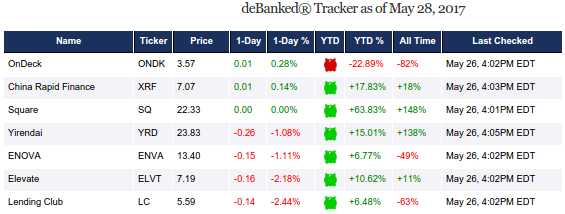 Small business lending company OnDeck was down nearly 23% on the year when the market closed on Friday. One of their closest rivals, Square, a company that makes business loans in addition to offering payment processing services, was up almost 64% this year so far. The disparity can be partially attributed to the market’s changing perception of OnDeck, originally viewed as a disruptive technology company, to what they’re seen as now, a niche commercial lender. Their tech multiple is gone, putting their market capitalization near book value.
Square is faring differently since they have virtually no borrower acquisition costs (whereas OnDeck has high acquisition costs) and a strong revenue stream outside of loans. Square’s strategy is to turn its existing payment processing customers into borrowers.
Meanwhile, Lending Club, an online lender that makes both consumer loans and business loans, is up 6.48% on the year. Despite being down 63% from their IPO price, Lending Club is different in that they generate fee income off of originated loans rather than book loans on balance sheet like OnDeck.
What ties them all together is that OnDeck, Square and Lending Club all rely on chartered banks to make the loans they advertise, a model that is coming under scrutiny by states such as New York. OnDeck and Square both depend on Celtic Bank, a Utah-chartered industrial bank.
Among its peers, OnDeck arguably has the riskiest makeup. They’re concentrated in only one type of lending, they have high acquisition costs, and they retain direct exposure to the loans they generate. Combine that with a lack of profits, lack of growth, and future regulatory challenges ahead, and it’s easy to understand why they’re so significantly underperforming the pack.
OnDeck On the Path to Profitability?
May 8, 2017 In their earnings announcement this morning, OnDeck predicted that GAAP profitability would be achieved in the second half of 2017. For now, the GAAP net loss in Q1 was only $11.1 million, down from $36.5 million in Q4. The company originated $573 million worth of loans for the quarter.
OnDeck has been under pressure from at least one major shareholder to make changes. “We’re talking about a stock that is down 75 percent to 80 percent from its IPO price. You’re not going to find a lot of happy campers in that situation. Shareholders are going to ask tough questions,” Mario Cibelli, Marathon Partners managing member, told AltFinanceDaily last month.
OnDeck has been underperforming just about all of its peers year-to-date according to the AltFinanceDaily Tracker. The company’s stock price has been flat on the year, whereas Square, which does payments in addition to business loans, is up 45%.
The Marketplace, once a defining part of the tech-based lender’s strategy, is being almost completely phased out. “Loans sold or designated as held for sale through OnDeck Marketplace represented 9.0% of term loan originations in the first quarter of 2017 compared to 25.9% of term loan originations in the comparable prior year period,” their report said. OnDeck plans to reduce the amount of loans sold through their marketplace to less than 5% for the remainder of 2017.
“The Provision Rate in the first quarter of 2017 was 8.7% compared to 5.8% in the prior year period.”
“The 15+ Day Delinquency Ratio increased to 7.8% in the first quarter of 2017 from 5.7% in the prior year period and from 6.6% in the fourth quarter of 2016 due primarily to the continued seasoning of the portfolio.”
“The Cost of Funds Rate during the first quarter of 2017 increased to 5.9% from 5.5% in the prior year period primarily due to the increase in short-term rates.”
“The Net Charge-off rate increased to 14.9% in the first quarter of 2017 from 11.2% in the prior year period and increased sequentially from 14.2%.”
“Combined with the company’s prior workforce reduction, total headcount at the end of the second quarter of 2017 is expected to be approximately 27% lower than December 31, 2016 levels, due to both involuntary terminations and actual and scheduled attrition.”
MCA Company Wins Case After Judge Actually Reads the Contract
May 5, 2017 An explosive New York Supreme Court decision in December against a merchant cash advance company just lost some of its bite, thanks to a decision handed down by the Honorable Catherine M. Bartlett in Orange County.
By all accounts, plaintiff Merchant Funding Services, LLC (“MFS”) had reason to be worried when Long Island attorney Amos Weinberg appeared on behalf of defendants Micromanos Corporation and Atsumassa Tochisako. MFS and Weinberg squared off last year in an almost identical case when Weinberg represented a company named Volunteer Pharmacy, Inc. There, a Westchester County judge decided the agreement in question to be criminally usurious on its face, leaving no question of fact for a trier of fact to resolve. According to court records, Weinberg has been relying on that decision to bolster his legal arguments against other MCA agreements ever since.
But up in Orange County, less than an hour northwest of Westchester, the court there sided in favor of MFS on Thursday, even after being briefed on the Volunteer Pharmacy decision.
Defendants, citing Merchant Funding Services, LLC v. Volunteer Pharmacy Inc., 44 NYS3d 876 (Sup. Ct. Westchester. 2016), assert that a plenary action is not required in the circumstances of this case because the Secured Merchant Agreement is, on its face and as a matter of law, a criminally usurious loan. However, Defendants’ position is grounded on a dubious misreading of the Agreement.
Micromanos, like Volunteer Pharmacy, was seeking to vacate the confession of judgment entered against them by way of a motion rather than by filing an entirely new lawsuit.
Here, the judge not only rejected that the confession of judgment be vacated but she also admonished Micromanos for misleading the court over the actual wording of the contract in order to serve their argument.
The agreement on its face provided for MFS’s purchase of 15% of Micromanos’ future receipts until such time as the sum of $224,250 has been paid. Paragraph 1.8 of the Agreement recited the parties’ understanding – directly contrary to Defendants’ claims herein – that (1) MFS’ purchase price was being tendered in exchange for the specified amount of Micromanos’ future receipts, (2) that such purchase price “is not intended to be, nor shall it be construed as a loan from MFS to Merchant”, and (3) that payment by Micromanos to MFS “shall be conditioned upon Merchant’s sale of products and services and the payment therefore by Merchant’s customers…”
These provisions not withstanding, Defendants contend that the Addendum altered the essential nature of the Agreement by requiring a Daily Payment of $2,995.00 on pain of default, thereby eliminating any element of risk or contingency in the amount or timing of payment to MFS, and converting the Agreement into a criminally usurious loan bearing interest at the rate of 167% per annum. Not so. The Addendum expressly provided that the $2,995.00 Daily Payment was only “a good-faith approximation of the Specified Percentage” of 15% of Micromanos’ receipts, and that Micromanos was entitled to request a month-end reconciliation to ensure that the cumulative monthly payment did not exceed 15% of Micromanos’ receipts. Defendants’ contention that MFS was entitled under the Addendum to the $2,995.00 Daily Payment without being obliged to offer Micromanos a month-end reconciliation is founded on an incomplete and palpably misleading quotation of paragraph “d” of the Addendum.
According to Defendants, paragraph “d” states:
“The Merchant specifically acknowledges that ***the potential reconciliation*** [is] being provided to the Merchant as a courtesy, and MFS is under no obligation to provide same”.
As noted above, paragraph “d” actually states:
“The Merchant specifically acknowledges that: (I) the Daily Payment and the potential reconciliation discussed above are being provided to the Merchant as a courtesy, and that MFS is under no obligation to provide same, and (ii) if the Merchant fails to furnish the requested documentation within five (5) business days following the end of a calendar month, then MFS shall not effectuate the reconciliation discussed above.”
The Defendants’ omission fundamentally alters the meaning of paragraph “d”. Contrary to Defendants’ assertion, the gist of paragraph “d” is that the institution of the fixed Daily Payment plus month-end reconciliation mechanism as a substitute for Micromanos’ daily payment of 15% of its actual receipts was a non-obligatory courtesy. Paragraph “d” plainly does not enable MFS to require a $2,995.00 Daily Payment while concomitantly refusing Micromanos’ request for a reconciliation.
Defendants further contention that the Agreement as a matter of law eliminated all risk of hazard of nonpayment by placing Micromanos in default upon any material adverse change in its financial condition is not borne out by the language of the Agreement. Under Paragraphs 2.1 and 3.1 of the Agreement, Micromanos’ failure to report a material adverse change in its financial condition, not the adverse change itself, was defined as an event of default.
Therefore, the Secured Merchant Agreement is not on its face and as a matter of law a criminally usurious loan. Consequently, Defendants have failed to establish an exception to the general requirement that relief from a judgment entered against them upon the filing of an affidavit of confession of judgment must be sought by way of a separate plenary action.
It is therefore ORDERED, that Defendants’ motion is denied.
Alarmingly, court documents show that Micromanos attorney Amos Weinberg is relying on the same “incomplete and palpably misleading quotation” in other cases involving other merchant cash advance contracts to serve his arguments. Fortunately, in this case, the Honorable Catherine M. Bartlett compared his quotation of the contract to the actual language of the contract and saw they didn’t match up. While a decision from the Supreme Court in Orange County doesn’t mean that the matter is settled for good in New York State, it does potentially put the decision that arose from Volunteer Pharmacy on very shaky ground.
Merchant Funding Services, LLC v. Micromanos Corporation d/b/a Micromanos and Astsumassa Tochisako can be found in the New York Supreme Court under index number: EF000598-2017
Rough Year? Market Tells Different Story for Alternative Lenders So Far
April 25, 2017 A decent day for OnDeck’s stock on Tuesday was enough to place the company’s share price in positive territory year-to-date, where just about every other public online lender finds themselves as well. According to the new AltFinanceDaily Tracker, Square is up more than 33% on the year and Yirendai up 19%. Even Lending Club, whose stock is still miles below their IPO price is still up more than 12% in 2017.
Meanwhile, Elevate just only went public earlier this month, singlehandedly putting an end to the drought of fintech IPOs. They’re already up 33% from their $6.50 IPO price.
On the publicly traded fund side, Ranger Direct Lending’s YTD struggles stem mainly from their exposure to Argon Credit who is going through bankruptcy. Ranger invested in the Princeton Alternative Income fund who had invested in Argon.
While the AltFinanceDaily Tracker shows Canadian-listed IOU Financial as significantly underperforming their lending peers, very little volume of the stock trades on a daily basis. A major shareholder of the company however, FinTech Ventures LLLP, shed more than half their holdings of the company last week. As that amounted to nearly 10% of all of IOU’s outstanding shares, the company had to file a document announcing the move.
As an aside, the S&P 500 was up 6.69% YTD by market close on Tuesday and Bitcoin, which doesn’t get as much attention anymore, is up nearly 22% over the same time period.
—
The AltFinanceDaily Tracker is still in beta and for now is automatically updated once per day after markets close in the US.
SmartBiz Loans Expands Its Footprint With a NorCal Bank
April 25, 2017Technology-based lending platform SmartBiz Loans, which is dedicated to facilitating SBA loans, has expanded its bank roster. SmartBiz announced today a new partnership with Sacramento-based Five Star Bank, bringing the tally of the number of banks on the startup’s platform to five and thrusting marketplace lending into the spotlight once again.
Five Star already delivers SBA loans to customers but through the SmartBiz platform will slash both the time and costs in the underwriting process while reaching new small business customers in the process.
Evan Singer, CEO of SmartBiz Loans, told AltFinanceDaily that the mindset of the executive team at the Silicon Valley startup has always been to bring banks back into the fold and to incentivize them to fill a void in the market left by the financial crisis by originating smaller loans, in particular SBA loans.
“What we’ve seen in the market is that good businesses cannot get access to low-priced capital if they want to borrow $250,000. So sure, if they want to borrow $5 million they can get access. That’s why we came up with the idea to bring the banks back through fintech,” he said.
Five Star Bank, a privately held bank with $850 million in total assets, is pleased to be among those ranks. James Beckwith, president and CEO of Five Star Bank, was introduced to the SmartBiz technology about a year ago after which time the bank execs began the due diligence process.
“I was intrigued,” Beckwith told AltFinanceDaily. “We felt the need to somehow play in the space. But we also knew it wasn’t practical for us to develop our own platform. So this was really right in our sweet spot of how we like to partner with people.”
As a result of the partnership Five Star Bank, which makes loans from its own balance sheet, is reaching small business clients the bank did not have access to before.
“Our market presence didn’t allow us to touch a lot of these businesses before, whether from Los Angeles, or Arizona, or San Jose. It’s really people we were unable to touch now being touched through the SmartBiz partnership,” said Beckwith, adding that the small businesses span industry verticals.
“At this point we’re looking at deals in the Western United States and we hope to expand that. The small businesses are really all types – construction companies, PR firms, consulting firms, — there’s no concentration in terms of industry type,” he noted.
The bank’s target customer is seeking a loan for $350,000 or less and the average loan size is $250,000 to $270,000. Terms of an SBA loan on this platform are comprised of a rate of Prime plus 2.75 over a 10-year period.
“The term is much longer and the rate is much lower than traditional loans. Small businesses can save thousands of dollars per month by getting an SBA loan through the SmartBiz and Five Star partnership,” said Singer. In fact, Five Star bank spends about one-tenth of the time on a file or customer originating from SmartBiz than it would on a customer coming from the traditional retail side of their business.
Industry Shakeout
Much of the fallout in the marketplace lending market segment has been tied to the stigma of subprime lending. Beckwith is quick to point out, however, that the underwriting standards for the loans on this platform, which are agreed upon by both Five Star and SmartBiz, are high.
“If you look at some of the average FICO scores we are doing, they are actually good deals. They’re SBA, they’re not subprime deals. I would not characterize them as subprime deals at all,” Beckwith said.
Meanwhile the marketplace lending segment has undoubtedly become more crowded in recent years, attracting the likes of lenders and non-lenders alike, evidenced by the participation of Amazon and Square Capital in this space, for instance.
According to Singer some industry shakeout can be expected in the near term. He expects over the next couple of years that those marketplace lenders and other alternative lenders unable to meet customer demands will either experience a wave of consolidation or they simply won’t be around any longer.
“We are already starting to see a number of our loan proceeds being used to refinance expensive shorter-term debt where they save thousands per month. Businesses are getting smarter with available options and folks that are able to best meet and deliver with small businesses on their minds first are going to come out on top,” said Singer.
SBA 7(a) Cap
As a technology platform dedicated to SBA loans, the issue of the program’s annual allotted cap is something that gets revisited on an ongoing basis. Nonetheless even when the SBA program has come close to suspension, Congress has stepped in to keep it afloat.
“The great thing about SBA is that it has support from both sides of the aisle in D.C. We’ll see what happens this year,” said Singer.
James agrees. “Every year that this becomes an issue the cap has been increased. I feel comfortable that what has happened in the past will happen again in the future because these programs are very viable. The small business space has very strong economic development activity.”
If they’re right this bodes well not only for the Smart Biz and Five Star partnership but also the new banks that the tech-based lender has in its pipeline.
“We are adding banks into the marketplace. And we’re selective about who we add,” Singer said.
Re-Banked
April 23, 2017
Just a few years ago, the financial services community was fixing for a battle of David and Goliath proportions—with scrappy, upstart online lenders threatening to rise up and vanquish the fearful and mighty brick and mortar banks. Instead, the unexpected happened: a number of well-respected online lenders and banks set aside their battle arms and began looking for ways to collaborate with their rivals—offloading loans, making referral agreements and establishing more formal partnerships, for example.
“In the real world, sometimes David wins. Sometimes Goliath wins. Just as plausibly, sometimes both sides carve up a market and they often have different offerings that target unique customers,” says Brayden McCarthy, vice president of strategy at Fundera, a New York-based marketplace for small business lending that works with a variety of lenders, including traditional banks.

Certainly, the change didn’t happen overnight. But over time, both online lenders and banks have been forced to tailor their expectations more closely to market realities. Despite their fast growth trajectory, several online lenders have come to realize that they lack several things many banks have, namely a strong, time-tested brand, a solid customer base and ample capital. Banks, meanwhile, have realized that their slow start out of the gate with respect to technology is a severe competitive disadvantage, and that they need more nimble, savvy partners to stay in the game.
Given these shifts, more and more online lenders and banks are taking the approach that if you can’t beat ‘em, join ‘em. Although some industry leaders are actively pursuing strategies that put them in direct competition with banks, partnerships of varying degrees between traditional banks and alternative players are increasingly common. As a result, the lines separating the two are getting increasingly blurry.
“Market forces are acting as a shotgun at the wedding. Whether the two sides are entirely comfortable with the marriage is irrelevant, they need one another,” says Patricia Hewitt, chief executive of PG Research & Advisory Services LLC in Savannah, Georgia. “They’re stronger together than they are alone.”
The evolution of Square is a prime example. The San Francisco-based company really packed a punch in the merchant services world with its mobile card reader designed for small businesses. From there, the payments company sought additional ways to diversify, eventually turning to merchant cash advance as a way to help small business customers obtain funds quickly. Then, in March of last year, Square moved into online lending, teaming up with Celtic Bank of Utah to offer small business loans online. The partnership got off to a running start. In its most recent earnings report, Square said it facilitated 40,000 business loans totaling $248 million in the fourth quarter of 2016—up 68 percent year over year—while maintaining loan default rates at roughly 4 percent.
Even SoFi, the San Francisco-based online lender that has been pointedly outspoken in its anti-bank rhetoric, now has bank-like aspirations. In February, the lender acquired mobile banking startup Zenbanx, giving it the ability to offer checking accounts and credit cards in 2017. Also in February, SoFi teamed up with Promontory Interfinancial Network to enable community banks to purchase super-prime student loans originated by the online lender. Large banks have been buying SoFi loans for several years.
COLLABORATION IS THE WAVE OF THE FUTURE
Many see collaboration between banks and online lenders as a logical step in the industry’s evolution. Online disrupters have forever changed the face of lending—in the same way that online brokerage shaped the financial advisor industry, according to Bill Ullman, chief commercial officer of Orchard Platform.
“There’s a tendency to want to view things as either black or white, online lenders vs. banks. The reality is that the entire financial services industry is undergoing a transformation with technology as the core driver,” he says. “I am of the view that both traditional financial services companies and fintech players can survive and thrive,” Ullman says.
For its part, Orchard recently inked a deal with Sandler O’Neill that provides access to the Orchard platform for the investment bank and brokerage firm’s bank and specialty finance clients. The deal is expected to help small banks better evaluate their options with respect to online lending opportunities.
Partnerships between online lenders and banks take many forms. Some of them are behind the scenes, where marketplaces sell loans to banks or banks informally refer customers. Others are more public. For example, in September 2015, Prosper and Radius Bank of Boston teamed up to offer personal loans to certain customers through the bank’s website using the Prosper platform. Customers can borrow from $2,000 to $35,000 in this manner.
Then in December 2015, JPMorgan Chase and OnDeck joined forces in order to dramatically speed up the process of providing loans to some of the banking giant’s small business customers. In April 2016, Regions Bank and Avant announced a partnership to better serve customers who don’t meet Regions’ credit criteria.
Avant’s customers typically have a credit score between 600 and 700, while Regions sets the bar higher. “The benefit for banks is that they do not need to worry about a platform taking away customers that meet their own credit criteria,” according to Carolyn Blackman Gasbarra, head of public relation at Avant.
She notes that Avant expects to replicate this model with more banks in 2017. “Lately many platforms and banks have come to realize their counterparts are more friend than foe,” she says.
Given the changing tides, industry watchers expect to see more relationships develop between online lenders and banks over time. These could include referral agreements, technology licensing arrangements, formalized revenue-sharing partnerships and perhaps even outright acquisitions.
PARTNERSHIP ADVANTAGES
Certainly, working together can be mutually beneficial for both online lenders and banks. For new online lenders and other fintech players, partnering with an established bank allows them to bypass significant regulatory and compliance hurdles because the necessary requirements are already in place.
“Why jump through all the hoops when you can just have a buddy system with an existing lender?” says Kerri Moriarty, head of company development at Cinch Financial, a Boston-based company dedicated to helping people make smarter investment decisions.
Fintechs that license their technology to banks still have to meet the high standards of third-party vendors determined by bank regulators, notes Stan Orszula, co-head of the fintech team at the Chicago law firm Barack Ferrazzano Kirschbaum & Nagelberg LLP.
“But it’s still less onerous than being a direct lender,” says Orszula, who works closely with banks and fintech providers on legal, regulatory and corporate issues. “They are learning that they need banks. They really do.”
Even seasoned online lenders that have a regulatory framework in place can benefit from bank relationships by using banks’ established brands as leverage. “Everyone knows Chase, Bank of America and American Express,” says McCarthy of Fundera. “They have a solid name and a solid in-built customer base to be able to offer product to them,” he says.
Teaming up with a bank gives added credibility to an online lender, at a time when the public’s confidence has faltered due to highly publicized troubles at certain firms. “Partnering has a very important signaling effect that these online players are here to stay,” McCarthy says.
Banks, meanwhile, need the nimbleness and innovation that online lenders provide. “Banks realize they have to catch up with the fintech disrupters,” says Mark E. Curry, president and chief executive of SOL Partners, which provides strategic management and information technology consulting services to financial services companies.
DIFFERENT TYPES OF PARTNERSHIP OPPORTUNITIES ABOUND

When it comes to partnerships between banks and online players, there are numerous options. In the small business lending space, for example, McCarthy of Fundera says he expects banks to continue buying loans from online lenders, as they have been for many years. He also expects more banks will route declined applicants to online lenders or online loan brokers. “This is a partnership that will allow them to make up some incremental revenue by referring business,” he says.
In addition, McCarthy says he expects banks to make products available through online marketplaces and use an online lender’s technology for online loan applications. He also expects banks will use online lenders’ technology for underwriting and servicing loans.
Years ago, before John Donovan joined Bizfi, he recalls talking to a salesman for a large national bank. The bank didn’t offer a lending product that he could give to small businesses and the salesman was losing customers as a result. “That’s where we see a lot of those opportunities,” says Donovan, chief executive of the online marketplace for small business loans.
For instance in March 2016, Bizfi partnered with Western Independent Bankers, a trade association, for over about 600 community and regional banks, to link small business clients to financing options through Bizfi. Many banks don’t offer small business loans below $150,000, whereas the average loan Bizfi does is $40,000, Donovan says, adding that the company would like to develop additional relationships similar to its agreement with Western Independent Bankers.
In the future, he predicts fintechs will continue to be more receptive to the idea of working with banks and vice versa, as the industry digests the impact of deals that are still in their early days.
FINDING STRATEGIC GROWTH OPPORTUNITIES
As banks and online lenders become increasingly accustomed to working together, there may be more opportunities for strategic acquisitions. For instance, Sandeep Kumar, managing director of Synechron, a global consulting and technology firm, expects to see banks—especially mid-tier players that don’t have the resources to innovate like big banks buying lending-related start-ups. He says banks will likely be most interested in companies that can help them with AI and other techniques to pinpoint where they should spend more efforts on cross-selling and customer profiling, for example. “There are many start-ups in this area that have very compelling technology,” he says.
On the other hand, Chris Skinner, an independent commentator at The Finanser Ltd., a research and consulting firm in London, points out that the two cultures don’t always mesh. “Quite a few startups have young, entrepreneurial founders that would loath the idea being acquired by a bank. So it really depends on the circumstances,” he says.
Valuation differences between large banks and leading online lenders may also be a sticking point for some deals, Ullman of Orchard points out. Banks’ concern over their valuation “will place a certain amount of restraint and discipline on the tech M&A activities they pursue,” he says.
ANTICIPATING TROUBLE IN PARADISE
While increased collaboration between online lenders and banks sounds good on the surface, John Zepecki, group head of product management for lending at D+H in San Francisco, urges both sides to proceed with caution. “You have to find an arrangement where you don’t have conflict,” he says. “If your innovation partner also is a competitor, it’s a challenge. If you have an inherent conflict, it doesn’t get better over time.”
That’s one reason why companies like Chicago-based Akouba have come on the scene. In Akouba’s case, its goal is to provide banks with the technology such that they don’t have to partner with an online lender that has the potential to compete for business. “We don’t compete with the bank in any way whatsoever,” says Chris Rentner, the company’s founder and chief executive.
Akouba’s business lending platform—which the American Bankers Association endorsed in February—provides banks with leading edge technology that integrates the bank’s own unique credit policies into a convenient, online process—from application to documentation— all the way to closing and funding. The bank uses its own credit policies, originates its own loans and owns the entire brand and customer relationship.
Rentner says he started the business with the idea in mind that the online lending model wouldn’t be sustainable long-term and that working alongside banks—as opposed to competing head to head— was the direction to go. “The idea that they could somehow get all of the consumers out of the banking world and onto their platforms was never going to happen. That’s why we exist today,” he says.
Catching Up With Marketplace Lending – A Timeline
April 20, 20172/17
- Prospa, an online small business lender based in Australia, was valued at $235M (AUD) in a $25M capital raise
- Square announced funding $248 million worth of business loans in Q4 2016
2/21 A Massachusetts state court vacated a merchant cash advance COJ
2/24 SoFi raised $500M in a financing round led by Silver Lake Partners that reportedly gave SoFi a $4.3B valuation
2/27 Prosper Marketplace closed a loan purchase agreement with a consortium of lenders for up to $5 billion of loans that has a provision that also enables the lenders to buy up to 35% of the company
2/28 BlueVine secured a warehouse line of up to $75M from Fortress
3/1 Lendio launched a new franchise program, allowing local offices around the country to become Lendio franchisees
3/3 Citing Madden v Midland, Colorado regulator brought a federal lawsuit against Marlette Funding for violating the state’s usury cap
3/5 Two trade associations, the Innovative Lending Platform Association (ILPA) and the Coalition for Responsible Business Finance (CRBF), joined forces. The merged company will continue to be known as ILPA
3/6 Upstart raised $32.5M
3/7
- It’s reported that former CAN Capital CFO Aman Verjee is now the COO of 500 Startups
- Kabbage priced a $525M securitization. It was oversubscribed
3/9 Citing Madden v Midland, Colorado regulator brought a federal lawsuit against Avant for violating the state’s usury cap
3/13
- Melvin Chasen, the founder of Rewards Network (originally Transmedia Network, Inc.) passed away. He was 88.
- The New York State Assembly rejected the Governor’s proposal to grant the Department of Financial Services (DFS) regulatory authority over any online lender doing business in the state
3/15
- The New York State Senate also rejected the proposal to further regulate lending
- The OCC published a manual on how it will evaluate charter applications from fintech companies
- The New York DFS published a statement rejecting the OCC’s plans
- The WSJ reported that Marlette Funding was cutting nearly 1/5th of its workforce
3/16 WebBank announced that it had a net income of $29.2M for 2016 and that it had a market valuation of $319.4M
3/20 Prosper Marketplace announced that it had originated $2.2B in loans in 2016, down from $3.7B in 2015, and had a net loss of $119M.
3/21 It’s reported that Kabbage will set up its European headquarters in Ireland
3/22 OnDeck expanded its credit facility with Deutsche Bank by $52M to a total of up to $214M
3/27 IOU Financial wins Gold Stevie Award for Best Use of Technology in Customer Service
3/30 In Advance Capital announced that they had secured access to an additional $50M
4/5
- Budget passes in New York. Proposed lending legislation was not included in it.
- Kabbage surpasses $3 billion funded to small businesses
See previous timelines:
12/16/16 – 2/16/17
9/27/16 – 12/16/16
In Advance Capital Secures $50 Million In Additional Financing
March 29, 2017New York, NY — On March 27th, Times Square-based In Advance Capital secured a $50 million credit line to continue the rapid growth of its merchant cash advance business. The eighteen-month-old company, led by founders Shalom Auerbach and Thomas Corliss, attributes its portfolio transparency, discipline, and strong relationships with investors as the key contributing factors in securing the additional capital.
“In an industry that is increasingly difficult to access capital, we are very pleased to have earned the confidence of sophisticated investors who have provided capital that aligns their objectives with ours, which is to provide fast and flexible working capital to small business owners experiencing the challenges and opportunities of high growth,” says Shalom Auerbach, IAC’s CEO. In Advance Capital has focused on creating a more streamlined process to facilitate its own growth, including a quicker underwriting process, while seeing 220% more applications within the last two months.
“In Advance is a testament that you can build and grow a company in a competitive industry if you concentrate on hiring top talent, servicing, and listening to your customers,” Corliss says.
“It’s all hands-on deck at In Advance which also makes our work environment a special place to work.”
In Advance is also please to announce its recent Executive Management addition to staff, Keith Nason as Chief Operating Officer. Keith Nason brings over 10 years of expertise to driving operational leverage, streamlining process and data science analytics.
About In Advance Capital
Founded in 2015, the company provides working capital to small business owners. To learn more, visit http://www.inadvancecap.com or call 646-412-3303.