
Merchant Cash Advance Industry is Waiting for its Big Moment
August 25, 2011Originally Posted 7/28/2011
According to an article in ISO&AGENT Magazine, the Merchant Cash Advance (MCA) industry has had significant success but “the companies that fund them acknowledge the cash-advance market is still waiting for its big moment.” This echoes our earlier opinion that a lack of collective marketing is keeping this financial tool from reaching its true potential.
How is it that in an ultra tight credit market that small businesses have not heard of MCA? With lax credit score standards, fast turnaround, minimal documentation, and a flexible method of repayment, it’s absurd that the industry has not reached so many that are looking to borrow. ISO & AGENT points to a negative image crisis and fingers the costs involved as a possible culprit.
The costs are a non-crisis. MCAs would be less expensive if they required collateral, perfect credit scores, fixed terms, ten years in business, and a 3 month underwriting process. If a small business meets those requirements and does not have a time sensitive opportunity they are looking to capitalize on, they should be going to their local bank. But most small business owners either do not meet that criteria or need the funds for a project they have going on today. Hence the product has to be more expensive for it to make sense for the firms providing the funds.
ISO&AGENT claims the industry has been compared to payday loans, an untrue characterization. In fact, that comparison has so rarely been made, that we can pinpoint the exact place they got that from. Inc.com published a very unflattering article on April 1, 2008 titled ‘Thanks, But No Thanks‘, in which they explain MCAs as “the business equivalent of a payday loan.” That was three and half a years ago! The article was not only biased and unfair, but was also written at a time when everything related to Wall Street, banks, or lending was being demonized as the nation sat on the verge of the Great Recession and economic collapse.
Still one can’t help but notice that buried deep within their criticism, is the answer to why MCAs are a tad bit more expensive:
The fact that collateral isn’t necessary is another important part of the MCA providers’ pitch. Entrepreneurs sometimes risk losing their homes if they can’t repay a bank loan, but they have no legal obligation to repay merchant cash advances if their companies fail, as long as they strictly follow the terms of the contract. They can’t encourage customers to pay in cash, for example, and they cannot switch credit card processors (typically, the MCA provider gets paid directly by the processor, rather than by the merchant). “If Diane’s Bistro goes out of business because Lauren’s Bar & Grill opens up across the street, we have absolutely no recourse to Diane, none whatsoever — as long as she follows the clearly defined covenants in our contracts,” says Glenn Goldman, AdvanceMe’s CEO.
And if you had any more reason to suspect MCAs are not as bad they tried to make it out to be, Inc.com published that article on April Fools Day. Case closed.
But there is indeed an image crisis and it’s that many businesses haven’t been exposed to the concept of MCA and thus cannot consider the pros and cons at all.
For instance: Most people can make the case for or against consumer payday loans. They’ve already got loads of information from the media, newspapers, banks, and lawmakers on which to base their argument. It’s become a well known household accepted form of financing. Whether or not payday loans can help the consumer is a separate debate.
That’s the difference. MCA is rarely spoken about by newspapers, banks, or lawmakers. Its presence in the media is limited and as a result we’re referring to stories published over three years ago. We have many friends employed as small business loan officers across the country and the only reason they’re aware of how MCAs work is because we told them. It’s embarrassing. And for an industry that funded over $500 Million last year alone, it really makes no sense.  We blamed antiquated marketing techniques: cold calling, junk mail, useless internet marketing, and spamming. The industry has gotten lazy and has a propensity to market their financing to small businesses that have already secured a MCA. This comes with bold promises of lower rates and other gimmicks. This inner competitiveness leads to both smaller margins and lower conversion rates. It does nothing to grow the industry as a whole.
That’s complemented by carpet bombing the public with an approach their customers learned to ignore a long time ago. Cold calls and junk mail. Really? Yes, really. There will always be a sliver of effectiveness from these methods and the firms that employ them will defend their success to the death. These methods may score some deals and perhaps even work well enough to grow a MCA firm, but it will not lead to the industry’s ‘big moment.’ Same goes for internet spam, poorly constructed articles that serve no purpose other than to boost some company’s SEO, and useless blogs kept by both respectable firms and no-name websites set up to harvest leads. Sure that’s the way of things on the internet these days but there isn’t anything beyond that. There are no mainstream media articles about MCA, forums for business owners where it is actively discussed, nor any public endorsements by anyone of high political or business stature.
Sounds like we have an image crisis on our hands. The Merchant Cash Advance Resource (the site you’re on right now) has been in existence for 1 year. In that time, we’ve made significant additions to the information that can be accessed here. We constantly receive emails from business owners and MCA brokers alike with the hope that we can provide them with an unbiased answer. And guess what? We do just that. By having no commercial affiliation, we give the best advice we can. The e-mail volume has gotten so heavy that our volunteer editors have trouble answering them all. But we try anyway.
And along the way we’ve managed to get some formal offers to convert this resource into a commercial site to generate sales leads. A six figure buyout offer here and there coupled with some lengthy, legalese filled non-disclosure agreements. We say ‘no’ every time. The Merchant Cash Advance Resource is designed to provide information, opinions, critiques, data, guides, and an independent ‘thumbs up’ to an industry that’s destined to do great things for small business.
Why do we spend the time, money, and effort to provide this service? We’re looking at the big picture of MCA. Big picture… Big moment…
And we’re on our way.
AltFinanceDaily
../../
How Not to Grow Your Merchant Cash Advance Business
August 23, 2011
Advertising and marketing are tricky in any industry. The Merchant Cash Advance space has certainly experienced its fair share of trial and error over the past several years. What works for one company, doesn’t for another.
Many argue that there are no virtually no barriers to entry and this causes problematic issues in competition. Some representatives don’t know what they’re selling, how to sell it, or what can and can’t be said when they’re selling it. There are so many fly by night resellers, that states are running out of LLCs to issue. “Merchant funding capital advance now approved accredited finance business source solutions, LLC” is the going fast! Better Organize it now.
For ones that make it, they have the good leads.
Blake: These are the new leads. These are the Glengarry leads. And to you they’re gold, and you don’t get them. Why? Because to give them to you would be throwing them away. They’re for closers.
But there is good way to not grow your Merchant Cash Advance business and that is to be so desperate, that you buy actual piles of garbage. These leads are obtained through sources that advertise in this manner:
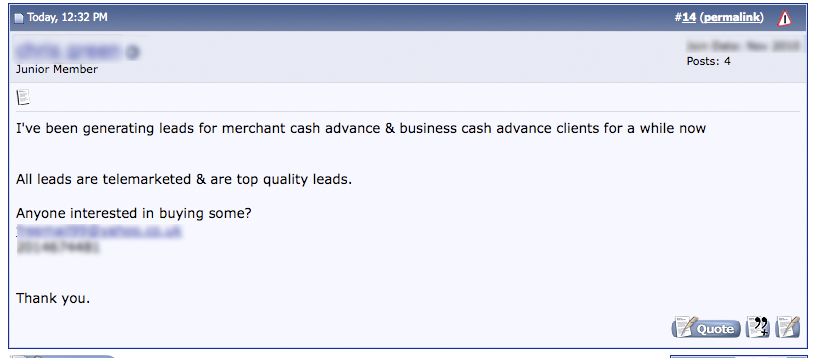
You can find stuff like these in forums, along with a shady hotmail address, no website and a promise of ‘top quality.’ If your business model is to buy leads, then make sure to have your Ch. 11 papers handy before you purchase these TOP QUALITY LEADS!!!
Also watch out for ‘try before you buy’ schemes: Get 5 trial leads for $50. if you like them, you can purchase a minimum of 100 at a time for a cost of $20 per lead. There are no refunds when you buy them. The 5 trial leads are real. The $2,000 bulk purchase is a flaming pile of crap.
Shelley Levene: The leads are weak.
Hope that helps. I would love to share more insight right now but a payday loan company with a predictive dialer is calling my phone and I’m eager to talk to someone in India who can provide a vague description of the product and have my information sold to 5 companies who swear I had completed a contact form online for car insurance because that’s what their lead sheet says.
-The Merchant Cash Advance Resource
Evidence Merchant Cash Advance is Going Mainstream
August 23, 2011
Need evidence that the Merchant Cash Advance industry has gone mainstream? One of our site’s editors shared this story:
I’ve been working in the Merchant Cash Advance business since 2004. It’s been quite a journey and we’ve really made a difference to small businesses facing capital shortfalls. The growth has been phenomenal and there have been dramatic shifts both in underwriting standards and the characteristics of our clientele.
While I could sit here and write a book about my experience, it’s the phone call I received last week from an old buddy of mine, Bob, that’s worth sharing. Bob is a Venture Capitalist(VC) out in California. He’s a self proclaimed expert of the hospitality industry and has heard a thousand young entrepreneurs pitch him a thousand different ways.
He’s always kept a distance from the Merchant Cash Advance industry and yet is always eager to hear about our tales of success, the achievements of our clients, and our ability to evolve to meet their needs. Last week Bob learned something and gave me a call.
He was sitting in a boardroom in Denver, Colorado. A group of entrepreneurs that made it big with a hotel in Florida, wanted to double their luck and open another hotel there and several in Wisconsin. These were well capitalized individuals and were pitching them for a cool $2 Million.
Bob’s firm seeks equity, so when the hotel group flatly stated that they did not intend to give up any shares, some were ready to declare the meeting over.
The powerpoint presentation flashed to the next slide and the entrepreneurs’ financial proposal was outlined in detail: “In return for $2 Million, you will be purchasing $2,400,000 of our future credit card sales. We will allow you to withhold 15% of each card transaction up until the purchased amount is paid in full.” The withholding percentage would also apply to the location that’s already established.
None of the deciding members of the VC firm like loans too much. There’s something about one payment per month that seems to not work anymore. Too many young businesses see monthly payments as an opportunity to leverage heavily. Having to make one monthly payment to the VCs enables the business to spend money on 20 other projects, all of which carry their own singular monthly payments. Then at month end, the cash gets spread too thin, and suddenly not all of these monthly payments can be met. Sure there are restrictions and terms that are supposed to prevent the business from doing this while the loan is outstanding, but there’s not much anyone can do about it if these terms get violated anyway. By the time the lenders find out, the return on investment is nullified by the cost of fixing it and that’s just if the problem can still be remedied at all. Sometimes all the money is just gone and the lenders have no idea until the day the monthly payment is due.
A purchase of the hotel’s future credit card sales would not classify this proposal as a loan, nor would it rely on a hope that the hotel’s books were properly managed and a payment made on time. While the VCs considered the unique level of security in getting repaid, Bob had a Eureka moment and took a timeout from the meeting to call me.
“It’s the pay as you go aspect of it that I like. The pace at which we get paid purely depends on the sales volume of the business. Sales up, we get paid more. Sales Down, we get paid less. Good for them, Good for us. If our credit card processing partner is withholding 15 percent of the sales before they’re deposited into our client’s bank, the hotel guys won’t face liquidity issues to meet our payments because we’re already getting paid. They can spend what’s deposited and we don’t have to get nervous on the 29th of the month.” and on and on Bob went, to which I replied, “Yes buddy, some of us have figured this out years ago.”
While $400,000 was a little bit below their desired return on investment, the VC firm put the entrepreneurial hopefuls up in a hotel for a weekend while they convened. There was an intense debate on the subject of equity vs. the purchase of future sales. One triumphal argument was that since hotels conduct transactions on a daily business, they would be collecting back on their investment every business day. That would allow the VC firm to reinvest those funds immediately.
Without completely spilling the beans on a negotiation that included non-disclosure agreements, a compromise was reached. The entrepreneurs left with a deal where they retained 100% of their equity and a structure where payments are made only at the pace that they are able to generate sales. It may have cost them more than what bank loans were going for in 2005, but like Bob and the other VCs made bluntly clear to them “What’s a bank loan? I don’t know any banks that are actually in the business of lending anymore.”
Bob could tell you that he’s been in the Venture Capital business since 1994 and it has been quite a journey. VCs have really made a difference to entrepreneurs with capital shortfalls. The growth was phenomenal until things started to change. The sale of future credit card sales from business to investor is a true mutually benefitting transaction.This structure is not only gaining popularity, but also solidifying a permanent footing in the financial transaction world altogether.
Don’t be surprised if John Doe business owner shows up at a local Bank of America branch in 2014 asking for a loan and this happens: “A loan, What’s that?” replies the financial officer. “Based on your merchant processing history, we’d like to purchase $30,000 of your future credit card sales.”….
-The Merchant Cash Advance Resource
../../merchantcashadvanceresource.htm

Who is Really Getting a Merchant Cash Advance?
August 23, 2011
You’ve seen ads like it before: “Get up to $250,000 for your small business today!”
For the local corner deli, that kind of cash may seem too good to pass up. There’s just one catch, many Merchant Cash Advance(MCA) providers cap funding approvals at somewhere in the range of 125% of a business’s monthly credit card processing volume. That means a deli processing $10,000 would be eligible for up to $12,500. ‘Mom and pop’ shops are often left wondering if anyone could ever really get $250,000 or if that figure is just a deceptive marketing gimmick.
 />
/>
The Merchant Cash Advance Resource would like business owners to know that $250,000 is not only possible, but deals of this size and larger are made often. The typical recipients are retail chains and restaurant franchises, but any business generating enough volume in credit/debit card sales is eligible. If there was any doubt about the popularity or legitimacy of the MCA financial product, take a look at some franchise names that have used it:
- Burger King
- Domino’s Pizza
- Hooters
- Subway
- Dunkin Donuts
- Taco Bell
- Denny’s
- Wendy’s
- Meineke Car Care
- Maaco
- Aamco Transmissions
- Curves Fitness
This data was confirmed by researching UCC filings on AdvanceMe, Strategic Funding Source, Merchant Cash and Capital, First Funds, and Business Financial Services.
Every funding provider is not created equal. Some of the oldest players such as AdvanceMe, Merchant Cash and Capital, and Strategic Funding Source are capitalized well enough to do deals up to $1,000,000. Other firms specifically seek out larger businesses such as Bankcard Funding in Long Island, New York. According to a representative there, their average funded deal is $100,000. Others have a comfort range of $5,000 to $75,000 but will bring in outside investors if they need to go beyond that.
Merchant Cash Advance is not just for smaller businesses, nor is it a last resort source of capital. It is an established alternative to bank lending that offers incredibly flexible repayment terms. Despite the benefits, a MCA still has a reputation for being expensive. While we don’t dispute that, we do recognize the need for it. Unlike SBA loans which can carry default guarantees up to 90%, MCA’s are completely backed by private investors. There are no billions of dollars to fall back on, government backed guarantees, or bailouts when things turn ugly.
Over the past few years, some MCA firms simply weren’t able to generate enough profit and closed as a result. In the case of Global Swift Funding(GSF), a MCA provider that dissolved back in 2009, the return on investment simply did not prepare them for the loss they would realize from a very important client.
http://www2.ocregister.com/articles/gantes-money-million-2399154-bankruptcy-restaurants
John Gantes, formerly one of the richest Men in Orange County, California owned 110 restaurants throughout the western part of the U.S. As the economy turned sour, he reportedly started loading up on Merchant Cash Advance funding for each location. In the end GSF cried foul, but they could not sustain operations further.

There is risk on both sides of the equation. A MCA is not for businesses on the fritz, but rather is a tool to acquire inventory, new locations, upgrade equipment, get through a slow season, and grow. While much hype surrounds the minimal paperwork requirements for MCA, businesses seeking in excess of $100,000 should expect a more intensive underwriting process.
“Have detailed financial statements handy and expect some scrutiny of the Balance Sheet,” was advice offered by one underwriter. “We’re going to want to make sure you are using these funds for the right reasons.”
And yet the MCA industry stands by their mantra of making capital accessible to all. With funding amounts reportedly as low as $1,000, and more than 21,000 individual advances made in 2010 alone, there is really no better time for a small business owner to apply.
The funds are there but it’s important to set your own expectations of how much you can access. The corner deli should be able to put $12,500 to good use. Our experience shows that positive sales activity will probably make the funding provider more comfortable to extend a larger amount to you down the road. I think we’d all like to get $250,000 today but in the absence of government backed guarantees, a tumultuous economy, and jittery investors, you’ll need to get your foot in the door first and work your way up.
-The Merchant Cash Advance Resource
http://www.merchantcashadvanceresource.com
Images Copyright (c) of 123RF Stock Photos