
Closing Loans and MCAs — From the Bedroom to the Office
December 8, 2017 The merchant cash advance industry has gone mainstream so quickly that it has become more difficult to identify potential customers.
Market saturation and industry consolidation have caused the cost of sales leads to increase sharply. Yet a New York business loan broker is finding success by applying lead generation and online marketing strategies to merchant cash advance, or MCA, while expanding the number of services he offers prospects. Funding is just the foot in the door.
Philip Smith, founder and CEO of PJP Marketing Inc., told AltFinanceDaily the MCA industry’s acceptance has made it more difficult for sales lead generators to produce profits. But expanding the number of services that independent sales organizations (ISOs) offer can offset the contraction. Smith’s life as a stay-at-home-dad, was recently featured in Innovate Long Island, a regional newspaper.
An ISO can’t just be a broker anymore. It needs to change, identify new revenue streams to excel. In doing so, a lead generator transforms itself into a business consultant that prospective customers turn to for additional services they often didn’t even know existed, Smith said.
For example, business loans and MCA is Smith’s largest business generator. But his most popular add-on services with such sales leads are credit repair and credit monitoring.
“The market is relatively easy,” Smith said. “The hard part is monetizing. The ISOs are going out of business because they refuse to monetize the other, non-cash advance leads.”
Smith, armed with a degree in business/e-business from the University of Phoenix, is also an advocate for entrepreneurs who want to work from home. It’s a viable model for lead generators because low overhead costs provide entrepreneurs an opportunity to capitalize on aggressive business strategies.
As such, Smith markets his pajama-centric business model with IWorkInMyJams.com. But he acknowledges that working from home presents its own challenges. Entrepreneurs need to be extra focused and tough to distract. No watching Dr. Phil during work hours.
Since they don’t work with more experienced managers, work-from-home entrepreneurs also need to seek their own sources of business advice and strategies. They deal with the reality that some lenders may deem them too small to do business. “Not everyone will work with you,” he said.
Working from home also requires a entrepreneur to set office hour limits and parameters to prevent burnout, Smith said.
“Do you know when to turn it off?” he asked. “That’s my problem. I’m up until 1 o’clock in the morning because I can.”
Smith now brokers sales leads in several verticals such as credit repair, tax relief, mortgage and solar energy. He claims revenue of $1.6 million last year and plans to reach $2 million this year.
When he was just 23, Smith launched his first company, We Link You Internet Services, a business that evolved into a web hosting concern.
He later worked for New York-based Canrock Ventures to launch a search-engine optimization platform called SEOPledge that was acquired in 2013. The following year, he founded what is now called PJP Marketing to broker leads amid the rapidly rising MCA space using the digital marketing skills he’d learned from the previous positions.
In October, AltFinanceDaily reported that several factors have contributed to several changes in the MCA industry, including consolidation, making it more difficult for alternative-funding business lead generators.
ISOs and brokers have gotten pickier about the types of leads they’ll accept as MCA evolves from a niche business to one that’s more commonplace. Also, a stricter application of the Telephone Consumer Protection Act (TCPA) has chilled soliciting and hamstrung the ability to connect with business owners who are prospective clients.
Last year’s LendingClub Corp. scandal ousted several senior managers, including the company’s then-CEO. Last summer, Bizfi laid off workers and sold the servicing rights to its $250 million loan portfolio to rival Credibly.
The result has been a consolidation of the alternative funding business.
“There are still roughly 75,000 business owners every week who meet the criteria for an [MCA],” California-based Lenders Marketing partner Justin Benton told AltFinanceDaily. “Now instead of there being 5,000 options in the space, there are 2,000, so those 2,000 are gobbling it all up.”
 David Ross, a 12-year veteran of the MCA industry and owner of Pro Leads NYC, said MCAs higher profile has been a game changer for lead generators.
“MCA is beyond saturation,” he said. “All of the merchants know about it and understand it. Now, [funders] want exclusive leads.”
Working from home is a possible option for ISOs that are wizards at online marketing. But it’s less attractive for the conventional lead generator who relies on backing from a marketing team, Ross said.
“Realistically, if you’re a broker and want to make money you have to be on someone’s floor,” he said. “You need marketing.”
Last year, a Bryant Park Capital report estimated the MCA market to be worth about $12.8 billion. It’s projected to top $15 billion this year. Smith expects the continued strong demand for MCAs regardless of all the industry consolidation and costlier lead generation.
“I think they will always be fine because they can live through the storm,” he said. “It’s now a mainstream service so more people know about it.”
Smith told Donna Drake during an appearance on the Live It Up television program that going it alone as entrepreneur takes a “do-not-quit attitude” that has served him well so far.
“Any business is pretty much a numbers game,” he said. “I live and breathe it every single day.”
Google Restricts Ads for Merchant Cash Advances
October 8, 2017Google’s quest to stamp out payday loan advertisements from its paid search results has caused collateral damage to merchant cash advances. That’s because the two-word term cash advance, often synonymous with payday loan, appears to now have a blanket restriction that blocks ads whenever that term is included in search, regardless of the words that come before it or after it.
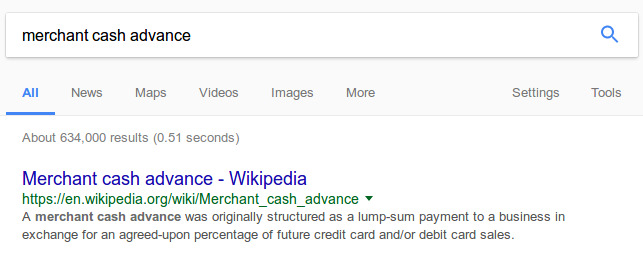
Merchant cash advances, however, are commercial factoring transactions with no relation to payday or consumer finance.
A user on the AltFinanceDaily forum first alerted me on October 5th and AltFinanceDaily conducted tests from internet connections in two states to see if we could replicate the results. Below is a sample of our results:
| Keyword | Google Adwords Status |
| cash advance | BLOCKED |
| merchant cash advance | BLOCKED |
| business cash advance | BLOCKED |
| business loan | ACCEPTED |
| loans | ACCEPTED |
| get a business loan | ACCEPTED |
| loan for my business | ACCEPTED |
| cash advance for my business | BLOCKED |
| business loan companies | ACCEPTED |
| merchant cash advance companies | BLOCKED |
| factoring or business loans or credit cards | ACCEPTED |
| factoring or business loans or merchant cash advances | BLOCKED |
| loan from ondeck | ACCEPTED |
| cash advance from ondeck | BLOCKED |
| consolidate loans | ACCEPTED |
| consolidate cash advances | BLOCKED |
No such block exists on rival search engine Bing.
Though Google has not said this, the mass removal of payday lending ads, once a massive source of revenue for them, is likely the result of government pressure. Over the last two years, federal regulators have begun targeting lead generation sites that direct users to lenders in a misleading manner.
Unless Google fixes the glitch that caused merchant cash advances to get wrapped up with consumer cash advances, the organic search results will experience a huge boost in value. Last month we reported that companies like OnDeck, Fundera, and Nerdwallet were winning the search engine optimization battle for several keywords including merchant cash advance. Absent any ads, those companies and several others will now benefit from a stream of free traffic and applicants for which their cost of acquisition will be zero dollars.
Perhaps little has been mentioned about this ban within the industry because the end result is FREE leads for those that rank well organically. Long live SEO!
The Google Battle for Lending and SMB Finance Keywords
September 14, 2017The online lending battle is at least in part being fought online. Below is a chart of organic page 1 rankings in Google for some of the industry’s biggest players, banks, and the SBA. (Hat tip to Fundera and NerdWallet):
| Keywords | OnDeck | Kabbage | Fundera | Lending Club | NerdWallet | National Funding | Traditional Banks | SBA.gov |
| business loan | 1 | 9 | 3 | 5 | 4,7 | 6 | ||
| merchant cash advance | 2 | 3 | 4 | 8 | ||||
| working capital | 9 | 4 | ||||||
| commercial loan | 3 | 2,7 | ||||||
| small business loans | 2 | 3 | 5 | 7 | 1 | |||
| business line of credit | 3 | 2 | 11 | 1,4 | 6,7,8,9,10 | 5 | ||
| fast business loan | 1 | 4 | 2 | 5,6 | ||||
| business loan with bad credit | 7 | 1 | 2 | 3 |
The Top 10 Google Search Results for Merchant Cash Advance in February 2012 compared to now:
| February 2012 | September 2017 |
| MerchantCashinAdvance.com | Wikipedia |
| Yellowstone Capital | OnDeck |
| Entrust Cash Advance | Fundera |
| Merchants Capital Access | NerdWallet |
| Merchant Resources International | Businessloans.com |
| American Finance Solutions | Bond Street |
| Nations Advance | Capify |
| Bankcard Funding | National Funding |
| Rapid Capital Funding | CNN |
| Paramount Merchant Funding | CAN Capital |
The top result in 2012 is a great example of how much easier it was to game Google’s system back then. After achieving rank #1 for MCA and 300 other related keywords, MerchantCashInAdvance.com, which was just a lead generation site, sold for $75,000 in December 2011. The site was later clobbered by Google Penguin for black hat SEO and banished from visibility.
A major shift has obviously taken place over the last 5 and a half years. Is the search results game rigged to advance Google’s own interests? Three years ago I put forth my theory on that.
One thing that’s different between then and now is that Google now has 4 paid links above the organic search results as opposed to 3 and the paid links blend in more with the organic results. With the organic results pushed further down the page, they’re not as visible as they were five years ago.
Read my previous analyses on the industry’s search war over the years:
December 2015 Google Serves Low Blow to Merchant Cash Advance Seekers
March 2015 Google Culls Online Lenders – Pay or Else?
October 2014 Merchant Cash Advance SEO War Still Raging
August 2014 Six Signs Alternative Lending is Rigged: Do Lending Club and OnDeck have a helping hand?
October 2013 Google Penguin 2.1 takes swing at the MCA industry
August 2013 Your merchant cash advance press release may be hurting you
December 2012 Is Google your only web strategy?
July 2012 The other 93% [of leads]
April 2012 The SEO war continues
February 2012 The SEO War for Merchant Cash Advance: The first story on this topic
Blazing Trails in Unexplored Financial Markets
April 4, 2017 Once upon a time people with health insurance who were treated for medical emergencies, illnesses or chronic health conditions –an illness or accident requiring hospitalization, an appendectomy, or a hip replacement, say – could rest easy. Insurance underwriters like United Health, Wellpoint or Humana would surely handle most, if not all, of a patient’s medical expenses.
Today? Not so much. As healthcare becomes ever more pricey, employers are increasingly offering health insurance plans that are less generous and require consumers to pay higher deductibles. Individuals as well are finding that the same goes for them: The only way to afford health insurance is to purchase a plan with a high deductible.
“We’re at a tipping point where the cost of healthcare is outpacing GDP,” says Adam Tibbs, chief executive and co-founder of Parasail Health, a start-up alternative lender in the San Francisco Bay area. “As a result,” he adds, “the only way health insurance can work is either to raise (the cost of) premiums or opt for higher deductibles.”
Statistics confirm Tibbs’s assertion. As of last autumn, according to a September, 2016, survey by Kaiser Family Foundation, the average deductible for workers’ health insurance policies jumped to $1,478, up by more than 12% from $1,318 in 2015. The survey found, moreover, that – for the first time — slightly more than half of all covered workers have deductibles of at least $1,000. At smaller companies, the average deductible is now more than $2,000.
Parasail, a Sausalito-based alternative lender which opened its doors last September, is angling to fill that void. Funded with seed capital raised from four venture capital firms — Healthy Ventures, Montage Ventures, Peter Thiel, and Tiller Partners, reports online data-publisher Crunchbase – Parasail acts as a go-between, connecting the medical practitioners to third-party lenders.
In partnering with doctors, hospitals, and medical clinics, Parasail employs a business model that resembles an auto dealership. After the customers picks out a four-door sedan or a sport utility vehicle, he or she drives it home thanks to a five-year, monthly-payment plan from, say, Capital One.
Similarly, after agreeing to a costly medical procedure, the patient can strike an arrangement with a medical provider’s billing department for on-the-spot financing. Once the deductible is covered, the patient is cleared to glide into the operating room.
Despite being open for less than a year, Tibbs says, Parasail has enlisted as partners some 2,500 medical practitioners with unpaid patient debt of roughly $4 billion. The typical loan averages $6,000. “Our goal,” remarks Parasails marketing vice-president, Dave Matli, “is to create a normal retail experience” so that financing medical debts is as seamless as swiping a credit card.
Meanwhile, industry experts say that Parasail represents a new breed in the financial technology sector. As online alternative lending and the broader fintech industry grow more established, institutional investors and financiers are increasingly wagering bets on companies that promise more than disruptive technologies or cheaper loans.
Increasingly, they are hunting for companies like Parasail that are introducing new products or blazing trails in unexplored markets. “The area that I find most interesting,” says Phin Upham, a venture capitalist and board member at Parasail, is investing in companies that “are developing products that didn’t exist before, serving people who haven’t been served, and playing a unique role incentivizing long-term behaviors.” (Upham, who is a principal at Peter Thiel’s VC firm, emphasizes that he is speaking only for himself.)
 Parasail’s fundraising and launch has taken place against a dramatic drop in both global and U.S. fintech financing, according to KPMG’s annual report on the industry, “The Pulse of Fintech.” The accounting firm reports that total funding for fintech companies and deal activity plummeted by more than 50% in the U.S. in 2016 to $12.8 billion from $27 billion the prior year. KPMG attributed much of the drop to “political and regulatory uncertainty, a decline in megadeals, and investor caution.”
The year “2016 brought reality back to the market” after the banner, record-shattering year of 2015, the report noted.
Venture capital financing in the U.S., however, did not slip as dramatically as overall funding, sliding some 30% to $4.6 billion from $6 billion in 2015. (Almost overlooked in the report was that corporate investment capital was “the most active in the past seven years,” KPMG’s report notes, representing 18 percent of venture fintech financing.)
Steve Krawciw, a New York-based fintech startup executive asserts that “the business has matured and, yes, there have been defaults, but the business model for fintech has stabilized.” The author of “Real-Time Risk: What Investors Should Know About FinTech, High-Frequency Trading, and Flash Crashes,” Krawciw expects more funding to stream into the industry as new players such as banks, insurance companies, hedge funds and private equity get involved. They’ll “go in a number of different directions,” he reckons, “especially direct lending by hedge funds and private equity firms.”
No figures have yet been released by KPMG for the first quarter of 2017, just ended in March, but fintech industry participants are mightily impressed at news of the $500 million financing for Social Finance Inc. (SoFi). Best known for its refinancing of student loans, the San Francisco firm reported on February 24 that it raised a half-billion dollars in a financing round led by private equity firm Silver Lake Partners. Other investors include SoftBank Group and GPI Capital, bringing SoFi’s total investment to $1.9 billion, the company said in a press release.
 SoFi, which plans to use the funds to expand online lending into international markets and devise new financial products, is ambitiously transforming itself into an online financial emporium. Along with a suite of online wares that mimic traditional banking and financial products – savings accounts, life insurance policies and mutual funds – SoFi has also invented new online offerings.
For example, SoFi formed a partnership with secondary mortgage lender Fannie Mae and, together, the companies are enabling borrowers to refinance both mortgage and student debt. The SoFi financing, says Krawciw, “is not a seminal deal, it’s a sign of what’s coming.”
SoFi may also be providing a road map for fintech companies like Parasail. After building a customer base with health-care loans at 5.88% annual percent rate — compared with credit cards charging interest rates about four times as much – Parasail could be poised to sell additional products to its built-in audience.
Just as SoFi got big on refinancing student loans, Parasail could use healthcare lending as a springboard for future financial endeavors. Its revenues have been growing by 50% month-over-month.
By the first quarter of next year, Tibbs says, the firm will be breaking even.” And at that point, he adds, it expects to roll out a menu of new products too.
Stop Being A Sub-Broker
December 10, 2015 In an industry with increasing competitive forces putting downward pressures on offer pricing, while simultaneously driving up demand for particular marketing channels (like SEO and quality data) which increases marketing costs, we are seeing massive downward pressures on profits. With this phenomenon occurring, you would have to wonder why in the world would anyone continually operate as a sub-broker today (willingly)? Are there any particular benefits to this, or is it just flat out non-sense? I wanted to explore this topic head on as we wrap up The Year Of The Broker.
THE VAST MAJORITY OF THE TIME, IT MAKES LITERALLY NO SENSE
There are times when I believe being a sub-broker makes some level of sense, but in my opinion those times (looking at our industry specifically) are very rare and most of the time being a sub-broker makes literally no sense based on the setup. The usual setup for a sub-broker is the same as a broker, which means you are going to be required to go out and spend money on marketing or other forms of lead generation to attract applicants.
Once you get those applications, you would forward them to the brokerage house so they can “close” the deal. A lot of sub-brokers believe this is some sort of grandiose deal, allowing them to as they say “free up time” to do other things. But this line of thinking makes literally no sense, because you have already done 98% of the work, which in our industry is just the consistent generation of high quality leads. Once you have done that and are doing that consistently, emailing the package over to a funder and chasing paperwork is the easiest part.
Why would you take only 25% – 50% of the commission structured on a deal, as well as most likely lose your ongoing renewal compensation, when you can instead take 100% of the commission, control your renewal portfolio and make renewal compensation going forward, which is the lifeblood of our industry?
LIES, LIES AND MORE LIES
Sub-brokers need to stop falling for the lies of larger brokerage houses which include the following:
“We are closers, you aren’t a closer, so let us handle it!”
This is rubbish. In our industry we don’t close, we are match-makers. The merchant comes to us looking for working capital, we pre-qualify their current standing and recommend a potential solution. If the merchant disagrees with the potential solution and we have nothing else that would work, the discussion ends. If the merchant agrees to the estimates and the product overview, we collect an application package to submit it to the funder that we believe can do an appropriately-priced deal. As long as we can get approval inline with expectations, everything moves forward on its own accord.
“We have access to special underwriting, platforms and pricing that you don’t have access to!”
More rubbish. When lenders get an A-paper deal, they give you A-paper quotes. When they get a B/C-paper deal, you get B/C-paper quotes. Look to establish a good relationship with a funder/lender. Let them know upfront that you are a small office so a smaller amount of volume will be coming through you. As long as you don’t have a high default rate, you will have access to the same systems, underwriters, base pricing, and innovative products of the funder/lender that the larger brokerage House has.
“We have access to special industry knowledge that you don’t have access to!”
More rubbish. With sources like AltFinanceDaily and other popular forums, the industry has been exposed. Everything you need to know, learn and be trained on has been covered. Also the assortment of direct funder and lender blogs/websites, media publications, and all of the like covering the industry, there’s no special industry knowledge that you can’t go out and attain on your own.
YOU MIGHT NOT EVEN GET PAID
Being a sub-broker might put you in a position of not even getting paid on new deal revenue as promised, as the large (or more experienced) brokerage is fully aware of your inability to truly challenge them legally or professionally.
- Sue If You Want, It Won’t Make A Difference: You can sue the broker for the $5,000 or so that they didn’t pay you on a couple new deals in Small Claims Court. But even though you can obtain a judgment, collecting on that judgment will be nearly impossible.
- Complain Online If You Want, It Won’t Make A Difference: You can also choose to damage their reputation online through posting various negative reviews, but do you think they will care? Go on the RipOffReport all you want, the largest merchant processing ISOs are all over those reports and that doesn’t do anything to stop their growth. The organizations getting these negative reviews will just say, “we serve thousands of clients and when you are as large as us, you are bound to have unhappy customers.” And that’s exactly what the brokerage house will say to their prospective merchants who bring up these negative review listings that you made.
BUT DOES BEING A SUB-BROKER “SOMETIMES” MAKE SENSE?
On very rare occasions do I believe being a sub-broker makes sense, and it includes if there’s some sort of initial training period and if the larger brokerage has significant marketing competitive advantages.
Training
So if you have zero experience, can’t spell Merchant Cash Advance, and believe you could benefit from a 6 month period with an established broker to show you the ropes, then being a sub-broker for a short period of time could make sense. However, I still believe that with the industry being exposed the way it is, you can train yourself and have to deal with insane non-compete agreements.
Marketing Competitive Advantages
So as a small shop, your marketing budget might be limited to $1k a month, whereas the larger brokerage is spending $20k a month and in a perfect world, might give you a deal where you can work with them without being required to generate your own leads.
They’ll claim to supply everything in terms of your dialer and warm leads, with funder networks already established. So all you have to do is come in, sit down, pick up the telephone, and sell all day to the warm leads coming in from their $20k in marketing. You don’t have to do any cold-calling. So you might be getting 50 leads a week that you convert to 12 applications, which you then convert to 4 new deals. If the average funding is $30k, then that’s $120k in funding with let’s say an average 6% commission that you would split 50/50 (3%/3%), giving you $3,600 per week which is $14,400 per month.
But we don’t live in a perfect world, now do we? Do you honestly believe the structure will be established as promoted? Such as more and more of the 50 leads you receive per week turn into mainly start-ups that don’t qualify for anything. Or, most weeks you don’t receive any warm leads at all, and are required to call UCCs, aged leads, or random listings out of the Yellow Pages, which are all horrible marketing mediums.
EITHER YOU GET IN ALL OF THE WAY, OR MAYBE YOU SHOULD GET OUT
If you are going to be in this industry, then properly set up your office, marketing plan, business plan, funder network and work your own deals. Get 100% of commission structured on new deals and control your renewal portfolio (the lifeblood of our business). If you are going to operate as a sub-broker, for the most part you are going to get a raw deal as we don’t live in a perfect world. We live in a world full of inefficiencies, “rah-rah” sales motivational speeches, and promises that don’t get kept.
The Telephone Is The Broker’s Best Friend
November 9, 2015 As we enter the second week of November 2015, we are indeed continuing the Year of The Broker, which I believe will not end on Thursday, December 31st at 11:59 p.m., but instead will continue into the year of 2016. As a result, I plan on remaining right here with AltFinanceDaily to continue the Year of The Broker discussion throughout the entire year of 2016. The mass entrants of new brokers into our space will surely not slow down any time soon, even though only a small percentage of new brokers will actually have some sort of career longevity. For these mass new entrants, they will surely have available a number of different Marketing mediums, but only one (in my opinion) might serve to be the most efficient considering time, costs, access and productivity.
#1.) Indirect Marketing Mediums
– Strategic Partnerships: Will be difficult to establish for new entrants due to established players already having agreements and integrations in place with a lot of the main players. Strategic Partnerships include organizations such as Banks, Credit Unions, Associations, Merchant Processors, etc.
– Mom and Pop Network: Will be difficult to establish for new entrants as there’s only so many sub-agents that could exist at any given time, and they usually (by this point) have already built up close relationships with their Funder Networks and larger Brokerage Houses.
– Indirect Ads and SEO: Will be difficult to establish for new entrants due to the high marketing costs and lower percentage of quality leads that are generated. The fact is that this medium attracts a ton of companies that won’t even qualify for our product, such as a lot of start-ups. Plus established players have pretty much already sealed quality positions and placements with high marketing budgets.
#2.) Direct
– The Mail: Won’t work for most new entrants due to the high cost of postage and packaging. In combination with the low response and conversion rates, for many this medium might not be profitable.
– Email: Only works after speaking with a client and serves as a good form of follow-up, but not good for initial contact as the emails will usually be filtered off as “spam” and one should be very mindful of national and state spam laws in relation to using this medium.
– Fax: Only works after speaking with a client and serves as a good form of follow-up, but not good for initial contact because the medium for initial contact is illegal.
– In-Person: Works decent, however with high gas costs, traffic jams, and other inefficiencies, this should not be used for initial contact, but can be used in conjunction with the Telephone.
……And speaking of the Telephone…….
The Telephone is going to be the most efficient medium used by new entrants and smaller broker shops today due to the following:
- Ease of Access: All one needs is a web based Predictive Dialer from the likes of a CallFire, YTel or Five9.
- Cost and Structure Efficiency: You can pay by the hour usage or pay a flat monthly fee for an unlimited monthly call volume. By the dialer being web-based, there are no IT specifications that you have to control on a daily basis.
- It’s Still Legal For B2B: It’s illegal for B2C in terms of the initial contact, but as of right now, it’s still legal for initial contact on the B2B side.
- Mass Productivity: It’s a great medium where one can work a 10 hour day from 9:00 a.m. to 7:00 p.m. EST, covering the East, Central, Mountain and West coast time zones. Over the course of these 10 hours, one can complete about 40 – 80 meetings with decision makers, as well as leave about 200 – 250 messages for said decision makers with employees or via voicemail.
Telephone Conversion Analytics
Over my time of directly selling both the merchant cash advance and alternative business loan products, I’ve found the following conversion analytics to be in place for new deals, and the following can assist you with your ROI planning:
- For every 15 decision makers that you speak to on a cold call, you should get 1 interested lead, or let’s say a conversion of 6.7% to leads. For a clear definition of a lead, refer to a prior AltFinanceDaily article of mine here. Calling SIC generic listings can be considered a “cold call”.
- For every 15 decision makers that you speak to on a warm call, you should get 5 interested leads, or let’s say a conversion of 33% to leads. Calling UCCs can be considered a “warm call”.
- For every 15 leads, you should get 3 completed application packages, or let’s say a conversion of 20%. A complete package includes the application and 3 – 6 months of bank statements.
- With an efficiently constructed Funder Network based on Paper Grades of 1-2 Funders for A+, A, B/C, and C/D, you should be getting approved files of about 40%, with a closing ratio of 30%.
Final Word
What will happen if B2B Telemarketing becomes illegal for initial contact just as B2C Telemarketing currently is? Would that likely be the final death blow to new brokers and smaller broker shops in terms of their ability to market efficiently and profitably?
I’m not sure, but as of right now, it’s the most efficient form of Marketing medium for new broker entrants and small broker offices. If it were to ever be taken away (become illegal), I think it might be much harder (if not impossible) for smaller broker shops to survive.
Brokers: It’s Okay To Be A Piker
November 5, 2015The Financial Services Industry is famous for coming up with different connotations that are outside of the comprehension level of the general public. Such connotation listings include terms such as: Derivatives, EPS, Diluted EPS, SPO, EBITA, Par Value, among others.
But there’s one word that I wanted to discuss in particular that comes off as a form of “slang” within the Industry, and that’s the word Piker. To be called a piker by someone in our industry, is to be called a person that thinks small, reaches for small goals and doesn’t dream big.
 MASS NEW BROKER ENTRANTS HAVE BIG DREAMS
The Merchant Cash Advance Industry is in a major bubble right now, with a large quantity of new broker entrants into the market all with big dreams inspired by the myriad of industry recruiting ads, highlighting that with little-to-no experience, you can jump in and make $20k a month. The “rah rah” sales motivational speeches soon follow with examples on how one guy is making $25k per month, how another guy just sold his MCA firm and cashed out for $5 million, how another guy made $1 million last year alone, and how YOU can do all of this too if you just come on in and start dialing!
So the big dreamers begin to dream……
- “This year I’m what Dave Ramsey calls a Whopper Flopper. I hate working in this crappy Burger King drive-thru, it’s time to start making my dreams come true.”
- “Next year, I will be making $20,000 a month and driving around in a Mercedes-Benz S-Class.”
The guy joins the new rolls of rookie/new broker entrants on web based predictive dialers calling merchants about a “UCC” they filed 3- 12 months ago. He will start out with about 150 merchants to call on Monday about this UCC filing, and by the time he calls those merchants on Monday, they would have already been called by 15 – 30 other companies over the previous two weeks alone.
In other words, they will all slam the telephone down in his face after he literally mentions the fact that he’s calling from any “capital or funding” company, without him even being able to get a word in.
 DREAM KILLED (REALITY SETS IN)
The reality is that success in our industry is mainly due to leveraged resources, rather than actual superior “selling” capabilities. What happens is that 20% of the brokers in the market remain profitable and sustain a good career/operations going forward, where as 80% of brokers don’t last more than 3 – 6 months, mainly because the 20% has access to resources that the other 80% don’t have access to, that provides them a significant market competitive advantage. These resources include:
- Having Strategic Partnerships with Banks, Credit Unions, Processors and Other Associations
- Having Access To Financing (Debt and Equity) Allowing For A Much Higher Marketing Budget
- Having Access To Better Base Pricing
- Having Access To Better Quality Data
- Having Access To Better SEO Positioning
- Having Access To Better Marketing Channels
Mr. New Broker, you were hired to be a part of what I call The Mom and Pop Network, which is just a group of random brokers who will resell for free (you pay for all of your expenses). So they might maintain a Mom and Pop Network of 2,000 brokers that bring in on average of 10 applications a year (20,000 apps) with 35% getting approved (7,000) and 30% closing (2,100) with an average funding per client of $30,000. This is $63 million in annual funding volume for the firm from this source alone.
A DIFFERENT APPROACH: THE PIKER APPROACH
So Mr. New Broker, how about instead of following the “rah rah” sales crowd, how about you join me over here on the Piker side and we set some goals on being solidly in the middle class instead?
- Going based on individual income, you are considered middle class in the US for the most part if from staying in an low/average cost of living area, you make over $40k a year (lower middle class), $50k – $60k a year (the middle of the middle class) or $70k – $85k (higher middle class).
- $50k – $60k a year in a low cost of living area will still allow you to live in a great quality Suburb, if you strategically manage your expenses with efficient budgeting and tax reduction strategies.
- You also want to be putting away let’s say $7,500 a year into your retirement/investment accounts. If you do this for 40 years from 25 – 65, with just a conservative 5% per year return, you will have over $1 million at age 65. At 65 you could put that $1 million principal into a long term CD paying let’s say 3% per year, opt to receive the interest every month, and get $30,000 a year. Then when you add in your Social Security payments of let’s say $20,000 a year, this now gives you $50,000 a year in spending power without even touching the $1 million principal.
IMPLEMENTING THE PIKER APPROACH
The first thing you want to do is make sure you stay in a low cost of living area, so if you are in a high cost of living area like NYC or LA, I would move immediately. Secondly, you would setup your virtual office (in the cloud) to include your telephone line, fax line, website, etc. Thirdly, you want to focus on doing market research on various market niche challenges where you can come in and creatively solve outstanding problems, for example, you might do some of the following:
- Find new solutions for niche industries that don’t qualify for most MCAs, but would like an MCA.
- Find new solutions for start-up companies seeking working capital.
- Analyze big data sources to find merchants in particular situations that you could address.
Map out a complete strategic business plan with sales forecast estimates, ROI estimates, and partner with companies that have the infrastructure to help deliver the solutions you laid out. Keep your credit clean and use No Interest Credit Card Promo Deals to creatively finance your marketing efforts.
FINAL WORD – AM I DREAMING TOO SMALL?
Am I dreaming too small? Shouldn’t I be up all night focused on how to be the next CAN Capital?
My issue with the “rah rah” sales speech is that they preach from the TOP of the ladder in terms of the extravagant income estimates ( $250k – $1 million per year), without providing any information to New Brokers on actual strategies, competencies, networks, and resources needed to ACTUALLY amass such levels of annual income. It doesn’t make any sense.
So my advice for all New Brokers is to be a PIKER, which is to establish yourself solidly in the middle class first, then once that’s done, you can look at ways to expand on your competencies, resources and networks to grow into the six figure income range.
Leads vs. Data: Do You Know What You’re Buying?
October 11, 2015 One important aspect of being a broker is your ability to generate qualified leads. At the core of a broker’s business, he/she is really just a lead generator for their network of funders, functioning as a way to improve their funder’s profitability through the acquisition of new clientele.
While I once questioned if brokers truly knew what they were selling when it came to the merchant cash advance product, my next question is in relation to the purchase of what vendors refer to as “Leads.” I want to know, do you (as a broker) know what you’re buying?
While it’s apparent that you can produce qualified leads internally, can you truly produce the same externally? With the various companies that pop up (seemingly overnight) without domain names, without professionally designed websites or with just the use of a Gmail/Yahoo Email Address, can you truly trust the claims that most of them make in terms of their ability to sell you qualified leads? Maybe so, maybe not, but I believe if we begin with the proper connotation of a “lead” vs. a “data record”, then it might help to truly determine what you’re purchasing from these external sources.
WHAT IS DATA?
Data is business intelligence, which is either generic or specialized information on a business or a group of businesses that are within a sales professional’s generic target market. It would be up to the sales professional to take this data, turn it into a sales pipeline (leads), convert a percentage of those pipeline listings into application submissions, and a portion of those applications into funded deals. Data can come in the form of generic listings such as those from the Yellow Pages or specialized listings such as those from court houses, financing requests and UCC records.
So for example, a UCC record is a data record, not a lead. You would buy let’s say 2,000 UCC records and after running through them via a predictive dialer internally, you might filter off 130 interested prospects which creates your sales pipeline, which is what you would now call “leads.” Then through following up on those 130 interested prospects, you might convert let’s say 20 – 30 of them into application submissions and fund 6 – 9 of them.
WHAT IS A LEAD?
A lead is an actual interested prospect in the services/products that you specifically have to offer. This means they have seen your specific ad or marketing piece, and have specifically expressed interest in what you have to offer. These can only be generated in-house through:
- Running through Data Records as explained above.
- Using other forms of direct marketing such as mailers, email marketing and through directly contracted referral sources who resell your product/company.
- Using indirect marketing options such as banner ads, radio ads, TV ads, print ads, billboard ads, SEO related concepts, and Pay-Per-Click, where the prospect will see or hear the ad and respond to you directly through filling out a form, giving you a call, shooting you an email, etc.
I firmly do not believe you can purchase Leads externally, I believe they can only be generated in-house using direct or in-direct marketing procedures listed above.
 HOW TO ADDRESS LEAD GENERATION COMPANIES?
So when a company comes to you selling “leads,” you should ask them are they selling “leads” or are they selling “data” records? Because they can only be selling YOU leads if they have specifically marketed your specific company and products to said generic target market, and generated interested parties to your specific company and products.
So what about companies that generate what they deem to be “leads” for the “service” that you offer in a generic fashion? For example, people that sell insurance would see people selling insurance Leads, people that sell equipment leasing will see people selling equipment leasing leads, and of course people that sell merchant cash advance will see people selling merchant cash advance leads.
I am still of the belief that these are not leads, but data records, it’s just a different type of data record similar to that of a UCC. A UCC is a more specialized type of data record that tells you more in-depth information on the current situation of the prospect in particular, such as the fact that they took out a cash advance on XYZ date with XYZ funder. This is more specialization than let’s just say a basic Yellow Pages listing, which just has the company’s name, address and telephone number. But both the UCC record and the Yellow Pages listing are still data records.
The “product specific leads” that are sold are usually just a listing of individuals who filled out various online forms requesting some type of particular product, service or financing vehicle. In my opinion, these are not leads, but still data records that will list only the generic information on the company and the date/time they requested more information “generically” on the product or service in particular.
You (as the broker) still have to call these leads and sell them on your company, your product, your pricing, your platform, etc. This means similar to UCC records, if you get 2,000 of these records, you might only convert 130 to interested prospects, which would now be the official “leads.” Then of course from there through following up on those 130 interested prospects, you might convert let’s say 20 – 30 of them into application submissions and fund 6 – 9 of them.
 HOPEFULLY NO ONE IS OFFENDED
This article might offend some individuals who are in the “Lead Generation” business, but I explicitly want to state that my intention is not to cause distress. I firmly believe that the vast majority of the time, when one is purchasing “leads” from an external source, they are indeed only purchasing data records. As a result, such disclosure should be made and such pricing structures modified.
The purpose of this article is so that brokers can know what they are purchasing ahead of time, to make sure that the price they’re paying fits their ROI analysis.
The last thing any vendor would want (in my opinion) is to have a bunch of angry online reviews from brokers who paid $3.00 a piece for your 2,000 “leads,” that only converted to 130 truly interested parties, and then only produced 20 – 30 completed application submissions.