
Online Lenders Square Off, Offer The Kabbage In Brooklyn Food Court
April 10, 2019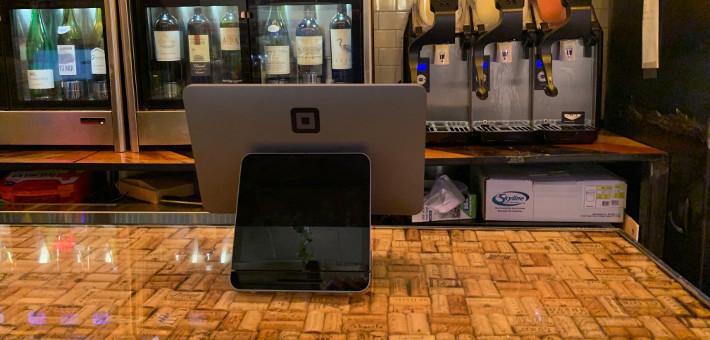
In a fast gentrifying section of Downtown Brooklyn, online lenders are waging a silent turf war. Each day, hungry consumers flock to DeKalb Market, a subterranean hipster food court where lunch and a drink can cost $17. The maze-like space with retro neon signs and rustic wood countertops offers a dizzying array of cuisines, and with it, the opportunity to indulge in one’s own individual preferences. But if you’re looking for the vendor’s payment machines, you’ll notice an eerie sameness amidst a cacophony of color.

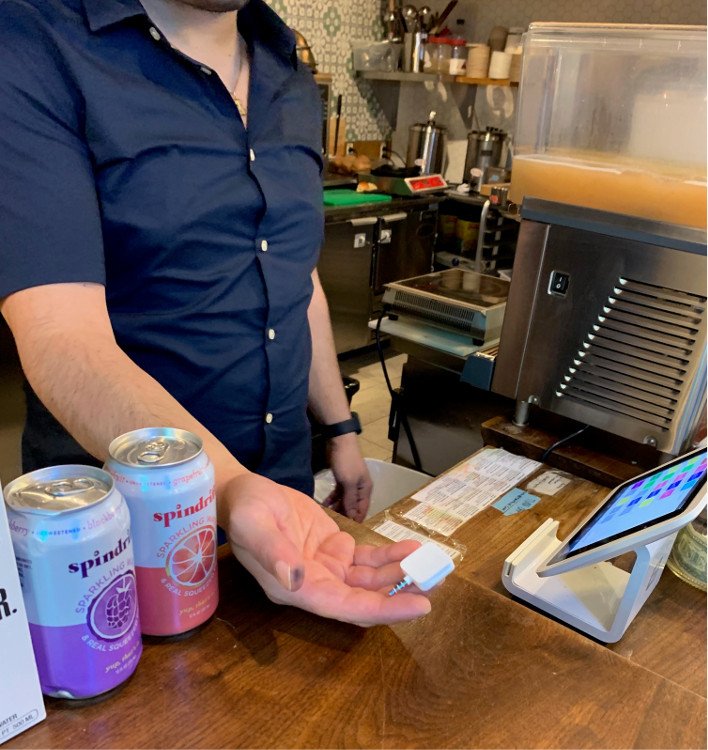
Square processed $85 billion in payments in 2018 and here in DeKalb Market, 75% of the vendors AltFinanceDaily surveyed relied on Square’s Point-Of-Sale technology. The publicly traded company generated $2.5 billion in payment transaction fees last year alone, but it’s the add-on products like Instant Deposit, Cash Card, Caviar, and Square Capital that are propelling the growth. 244,000 businesses received a loan from Square in 2018 for a total of $1.6 billion. Borrowing is as simple as clicking a few buttons on the POS dashboard, making Square the presumptive lender of choice for businesses in the food court.
But the rankings on a national level say that Square trails behind Kabbage, an online lender with no reliance on a POS system. Kabbage’s growth trajectory has been epic, once a lending service for eBay merchants, the company is now one of the largest online small business lending companies in the United States.
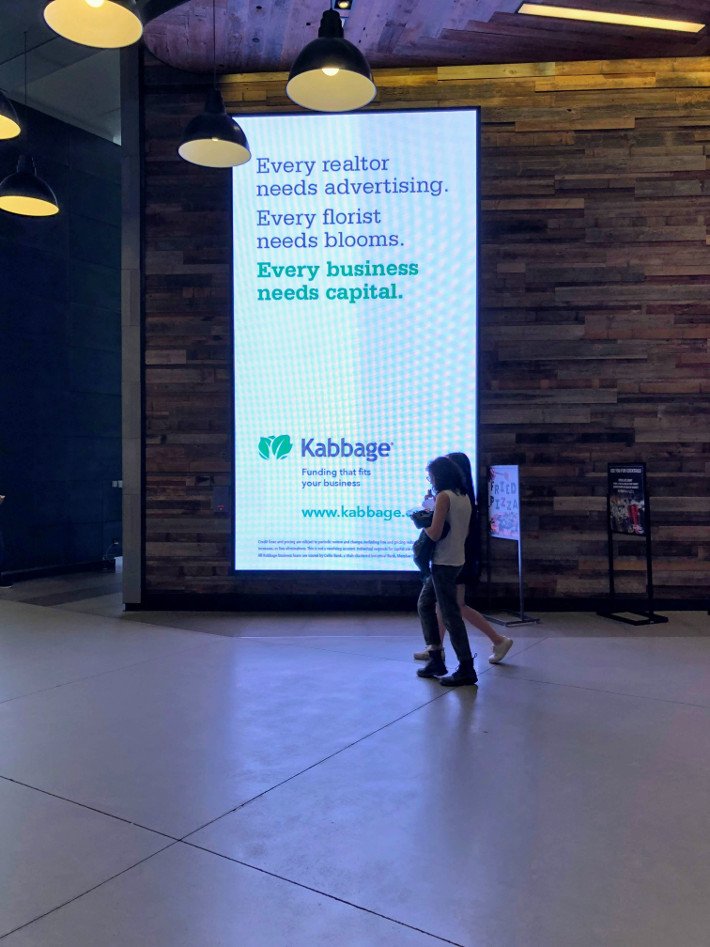
Undeterred by the sea of Square dashboards, billboard advertisements for Kabbage once blanketed the periphery. The ads, which few consumers seemed to gaze at, were clearly meant for the business owners in between the food court and the mall above it. There was also a competitive feel to it, as if Kabbage was subconsciously communicating to Square that they were not alone.
Nowhere to be found was OnDeck, an online lender headquartered a short distance away in Manhattan that does more in loan volume each year than Square and Kabbage. But just because they can’t be seen doesn’t mean they’re not there. Blending into the crowd of consumers, AltFinanceDaily spots business loan brokers, ones reputed to refer business to alternative capital sources and online lenders, OnDeck among them. 29% of OnDeck’s business in 2018 was attributed to Funding Advisors, an army of independent sales professionals across the country.
But they’re here for lunch just like everybody else, or are they? Their in-person presence may complicate their rivals’ efforts. Can a face and a handshake trump familiar software and the Internet? OnDeck’s $2.5 billion in 2018 loan volume suggests that their diverse sales strategy, including the use of Funding Advisors, has an impact.
Some vendors in DeKalb Market fail and go out of business. Others, like Cuzin’s Duzin, a homemade donut vendor made semi-famous by its feature on a Vice Media TV Show, The Hustle, recently completed renovations and further expanded its business into the nearby Barclay’s Center. Public records show the company just received financing from an equipment leasing company based in Washington State, a possible missed opportunity for the online lenders canvassing the space. Not for long, perhaps, as OnDeck announced it would be entering the equipment finance market this year.
As for Square, the love for the POS product presents a perceived edge. A general manager of Two Tablespoons, another food vendor, told AltFinanceDaily that he thinks the Square system they rely upon is very easy to use. He said it also creates promotions that allow businesses like them to track customer spending and text a customer (with their permission) if they’ve earned, say, $5 off at a store.
But converting these vendors into borrowers is not guaranteed. Kabbage’s ads could not be found on a recent trip to the food court. And one shop selling burgers there told AltFinanceDaily that they were aware of the loan product through Square because they use the POS for payments, but that they had no interest in using it to borrow money.
“It’s like a credit card,” she said. “What you take out, you owe. And we choose not to owe.”
Kabbage Could Be Neck and Neck with OnDeck for Originations This Year
April 8, 2019Kabbage funded $600 million in the first quarter of the year, putting it on pace to potentially overtake OnDeck in originations for 2019. OnDeck reported $658 million in originations just a quarter earlier to finish 2018.
The two companies have been among the top three funders by origination volume on AltFinanceDaily’s leaderboard since 2014. OnDeck has consistently been on top with Kabbage and Square solidly in the #2 and #3 slots.
In 2018, OnDeck funded $2.48 billion, while Kabbage CEO Robert Frohwein told AltFinanceDaily that the company originated “north of $2 billion.”
Both companies are expanding.
“We solidified our position as the leading online lender to small businesses in the US, launched ODX, our platform-as-a-service business, and announced plans to scale our international operations and enter the equipment finance market,” said OnDeck CEO Noah Breslow in a 2018 Q4 report statement.
Meanwhile, Kabbage announced in January of this year that it will be powering a program that offers financing to U.S. customers of the Chinese e-commerce giant Alibaba.
“Financing at the point of sale requires a fully automated solution that can handle the immense volume of daily transactions that occur on Alibaba.com,” said Kabbage CEO Rob Frohwein. “We are incredibly impressed with the service and value that Alibaba.com delivers to American businesses and want to do all we can to support their important mission.”
| Company Name | 2018 Originations | 2017 | 2016 | 2015 | 2014 |
| OnDeck | $2,484,000,000 | $2,114,663,000 | $2,400,000,000 | $1,900,000,000 | $1,200,000,000 |
| Kabbage | $2,000,000,000 | $1,500,000,000 | $1,220,000,000 | $900,000,000 | $350,000,000 |
| Square Capital | $1,600,000,000 | $1,177,000,000 | $798,000,000 | $400,000,000 | $100,000,000 |
AltFinanceDaily’s leaderboard omits companies that have not disclosed their small business origination volumes.
Kabbage’s $700 million securitization that was announced today will be used to pay down a previous securitization.
Kabbage Finances US Small Business Customers of Alibaba
January 14, 2019 Kabbage announced today that it has partnered with Chinese e-commerce giant, Alibaba, to provide financing to small businesses that purchase materials on the platform. The financing program, offered by Alibaba and powered by Kabbage, is called Pay Later.
“Financing at the point of sale requires a fully automated solution that can handle the immense volume of daily transactions that occur on Alibaba.com,” said Kabbage CEO Rob Frohwein. “We are incredibly impressed with the service and value that Alibaba.com delivers to American businesses and want to do all we can to support their important mission.”
According to the Kabbage announcement, Kabbage had a beta launch of Pay Later in June 2018 and it has so far delivered millions of dollars in financing to American small business. The business to business (B2B) financing product provides lines of credit up to $150,000, and according to Kabbage, each purchase financed via Pay Later creates a six-month term loan for the merchant with rates as low as 1.25% per month. Kabbage also said that there are no fees to maintain the line of credit, no order transaction fees and no early repayment fees.
This partnership is not the first of its kind. In February 2015, Lending Club announced a similar arrangement with Alibaba that offered funding to U.S. small business owners for point-of-sale transactions on the platform. Lending Club offered loans up to $300,000 and had an exclusive relationship with Alibaba for point-of-sale business financing. Kabbage told AltFinanceDaily that their arrangement with Alibaba is not exclusive. Lending Club did not respond in time to explain their current relationship with Alibaba.
Kabbage Reveals Plans for a ‘Reverse Play’
May 22, 2018 When it comes to lending, the business models of Square and PayPal may be too good to ignore.
According to Reuters, Kabbage plans to launch its own payment processing service by year-end. “The monoline businesses have a hard time succeeding long term,” Kabbage co-founder Kathryn Petralia is quoted as saying.
While Square and PayPal started off in payments and added lending, Kabbage sees the value proposition of the reverse play, to start off in lending and add payments.
But another Square and PayPal rival may not. Back in October, AltFinanceDaily questioned OnDeck CEO Noah Breslow during an interview about this very thing. At the time, Breslow responded that they were not going to sell merchant processing. “Never say never,” he said, “but not in the near future.”
Square and PayPal’s lending businesses differ from other online lenders in that they can solicit their existing payments customer base at virtually no cost. OnDeck, meanwhile, spent $53 million last year alone on sales and marketing to acquire loan customers.
Square’s acquisition of payments customers is not cheap, however. The company spent $253 million in sales and marketing last year. The advantage is in not needing to shell out additional cost to convert them into loan customers.
OnDeck still held the lead over both Kabbage and Square last year in loan originations at $2.1B vs $1.5B and $1.17B respectively. PayPal was not ranked.
Kabbage Acquires Orchard
April 26, 2018
Following speculation, Kabbage officially announced today that it has entered into a “definitive agreement” to acquire Orchard, a financial technology and analytics company that provides data to lenders and investors.
“I’m most excited about the people [at Orchard] because, while they’ve built this amazing technology, it takes a long time to get the right people in place,” said Kabbage co-founder Kathryn Petralia. “And they’ve built a great culture and great company of talented individuals who I think really understand the industry…and can help us get to where we’re trying to go.”
Kabbage and Orchard have enjoyed a working relationship for some time already, Petralia told AltFinanceDaily. (Kabbage has been a client of Orchard).
More than 20 employees from New York-based Orchard will move to Kabbage’s New York office, including two of its founders, Matt Burton and David Snitkof. The company was founded in 2013 by Burton and Snitkof, along with Angela Ceresnie and Phil Rosen.
Burton previously worked at Google and Snitkof previously worked at Citigroup and American Express.
“Like most businesses, we often listened to interesting offers, but never found the best fit. Until Kabbage,” Snitkof said of its decision to be acquired by Kabbage. “Everything from their mission, technology focus and culture is aligned with Orchard. [And] there are really interesting innovations we can do together by combining our data science platforms.”

Orchard has a proprietary technology platform that simplifies mass-data analysis and Kabbage has a forecasting and predictive analytics engine that strengthens its automated underwriting platform. Together, they hope to create an even stronger platform that helps small businesses access capital quickly and efficiently.
“Integrating our two data science platforms will take time, but we’re excited for what’s to come,” said Snitkof.
Almost ten years old, this is Kabbage’s first acquisition. Asked if the company is “on a buying spree,” Petralia said no, but also acknowledged that they are now in a position to make acquisitions, like Orchard, that can help them build their business faster, as long the acquisition makes sense.
Founded in 2009, Kabbage is headquartered in Atlanta and has provided over $4 billion to more than 130,000 businesses.
Boiler Rooms Are Not Brands, Kabbage CEO Says
April 21, 2018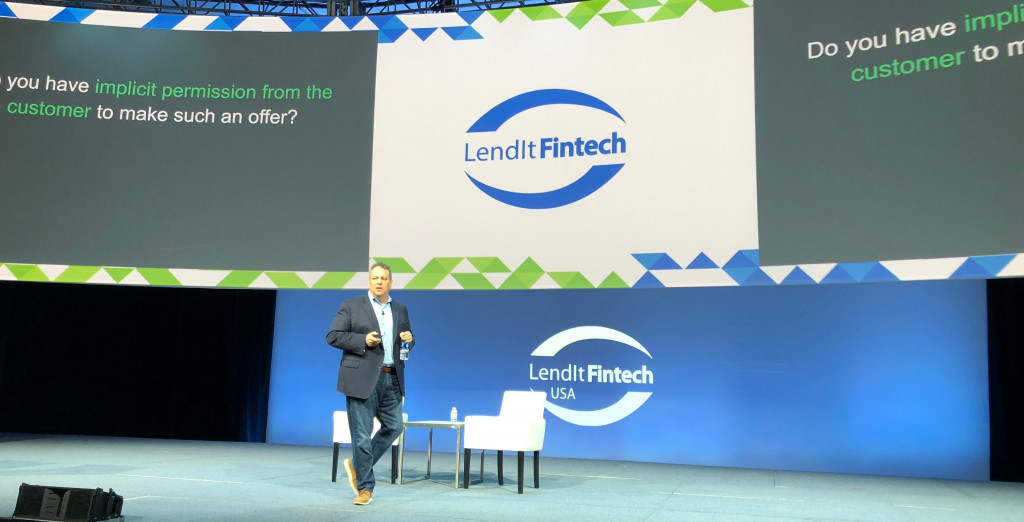
Kabbage CEO Rob Frohwein has a knack for speaking his mind at lending conferences and LendIt two weeks ago was no different. Below are some of the most notable quotes from his April 10th presentation.
On building a brand
Unfortunately, in the online lending space, most companies basically think that boiler rooms = brand. Boiler rooms don’t equal brand. They have these huge call shops and that’s what they’re focused on. That doesn’t create brand. It just doesn’t. You have to spend money in order to build a brand over time. You have to have a brand obviously from a user experience and a customer service experience that people love. That’s how you build a brand.
We’ve invested over $125 million into building our brand specifically. We don’t use brokers and brokers are those 3rd parties that go out and find loans for you, but they don’t represent your company in the process.
How 2018 differs from 2015
About 6 months ago, I was asked to speak on a panel and it wasn’t this conference. And so, I got on the phone with the conference organizer and he said to me “Hey, we’d like to do a panel on fintech and bank partnerships.” Total yawn. 2015 called. They want their panel topic back. I mean, after all, there are probably more panels on fintech and bank partnerships than there are actual conversations going on between fintechs and banks. 2018 is all about relationships.
If the only thing you’re doing is lending money online, it’s going to go the way of the dinosaur. It’s very important. It doesn’t mean that the companies are gonna blow up. It doesn’t mean that there’s going to be any challenges, you know, trying to grow that business, but they’re not going to be the kind of exciting companies that we saw just a few years ago.
The only way to build substantial enterprise value is to be in a position to expand your brand’s offerings.
On whether or not your relationship with the customer can naturally extend to other products
I’ve heard lots of people say I had 2 million customers so I can sell them an auto loan. Actually, you can’t. That’s not the way it works. That’s not the way you build the company. You can certainly try, but the question becomes do you have implicit permission from the customer to make this kind of an offer?
How close is the next product you’re launching from both the function and a brand perspective to your last product? Right? Is it close? Smith & Wesson came out with a lot of bicycles. I am not sure what amendment covers bicycles, but they did not do great with the Smith & Wesson bicycles as far as I know.
The challenge is that most online lending companies don’t really have much of an idea about what their customers want or need because they only have basic credit info at the time of qualification and they also are just getting repayment information. That does not equal understanding the customer.
On engaging with your customers
If you’re not interacting with them very often, then they’re not thinking about you very often.
Kabbage customers take 20 loans over 4 to 5 years, 4-5 loans a year every year. We have that many positive interactions. Our competitors average 2.2.
Finally, I really think of this as the potato chip dream. And I think about Amazon a lot when I talk about the potato chip dream. What that dream is the day that Kabbage is able to sell bags of potato chips to our customers and our customers are like “of course, I’m gonna buy potato chips from Kabbage, why would I buy them from anybody else?” That will mean that Kabbage is worth hundreds of billions and our customers are incredibly happy in the process because it necessarily means that we will provide them with every product and service between where we are today and potato chips tomorrow. And that’s really the key for what we’re trying to accomplish, is allow us to expand our offerings in a natural evolutionary way and take care of our customers. And I really do think that all of us here should think about that as well especially if you’re running an online lending company. Focus back on the customer. Build those relationships. Figure out how to take it to the next level.
Kabbage to Acquire Orchard Platform Markets
April 14, 2018Update 4/26/18: The acquisition is now confirmed
Kabbage is set to acquire Orchard Platform Markets, a provider of lending data and investment advisory services, according to a Bloomberg report yesterday. However, neither company has confirmed this and both companies were unreachable today.
Orchard was founded in 2013 by David Snitkof, Angela Ceresnie, Jonathan Kelfer, Matt Burton and Phil Rosen. Burton and Kelfer both worked previously at Google and Snitkof and Ceresnie worked at Citigroup and American Express. The company has raised nearly $60 million in three rounds, according to Crunchbase, and investors include Spark Capital, Thrive Capital, as well as Vikram Pandit, former CEO of Citigroup and John Mack, former CEO of Morgan Stanley. Indeed, no shabby group.
As this acquisition has not yet been confirmed, the amount Kabbage might be paying for the company is also unknown. According to Orchard’s website, it employs 31 people (including executives) in an office in Manhattan’s Flatiron district, known as a hub for tech startups. The Bloomberg story indicates that co-founders Burton and Snitkof will join Kabbage at its New York office. Founders Ceresnie and Rosen no longer work for Orchard. With headquarters in Atlanta, Kabbage is one of the largest small business lenders in the country and recently launched a new feature of its loan product at LendIt.
Despite the big name investors Orchard had when it started, some suspect the company may have lost momentum. AltFinanceDaily called a number of leaders in the alternative lending space and none were willing to comment until the acquisition was made certain.
Kabbage, LendingPoint to Offer Real Time Funding Via Push Payments
April 9, 2018Kabbage and LendingPoint each separately announced today that they will soon be able to get funds into their customers’ business accounts instantly and 24/7 via their pre-existing bank debit card. Hopes for this are not brand new. Last October, OnDeck announced a partnership with Ingo and Visa that would provide this convenience to borrowers, although this has not yet come to fruition, according to an OnDeck spokesperson. This is also not Kabbage’s first foray into real-time loan funding.
“We launched [a real-time loan product] through the debit network three years ago and we were really excited about the results,” said Kabbage co-founder Kathryn Petralia . “Our customers really liked it, [but] our challenge was that we couldn’t get broad enough coverage. Only a small percentage of our customers were able to use it…so we’re excited about our partnership with Ingo because it gives us the ability to broaden this to about 90 percent of our customers.”
Kabbage has entered into a relationship with Ingo and has plans to make this service available to customers this summer. One might wonder why, on a weekend, a merchant needs money and can’t wait until Monday?
 “Our customers are always looking to expedite the process,” Petralia said, “not because they’re desperate for cash, but because they really are desperate for time, and they don’t want to spend a bunch of time reconciling their bank accounts [and] making sure the funds have arrived. This is a much cleaner way for them to get access to capital.”
Meanwhile, as part of an announcement by LendingPoint today, the company said that later this year it will be able to “instantly disburse loans to approved borrower accounts through their debit cards, 24/7/365.” This will be facilitated through the TabaPay platform, which also enables LendingPoint borrowers to use their debit card to make loan payments.