
KAPITUS

This is a search result page


All Registered Sales-based Financing Providers in Virginia (List)

March 11, 2023
Article by:

Is the revenue-based financing provider you do business with registered to operate in Virginia? On July 1, 2022, Virginia’s commercial financing disclosure law went into effect and with that the necessity to register one’s business. As of March 8, 2023, this is the official list of registered sales-based financing providers:

  • Advance Servicing Inc.
  • Accredited Business Solutions LLC dba The Accredited Group
  • Advance Funds Network LLC dba Advance Funds Network
  • AdvancePoint Capital LLC dba advancepoint
  • Ally Merchant Services LLC
  • Alpine Funding Partners, LLC
  • Business Capital LLC
  • Byzfunder NY LLC dba Tandem dba Nano-FI
  • Bridge Capital Services, LLC
  • CFG Merchant Solutions, LLC
  • Clarify Capital II LLC dba Clarify Capital
  • Cloudfund VA LLC dba Cloudfund LLC
  • Capflow Funding Group Managers LLC
  • Clear Finance Technology (U.S.) Corp. dba Clearco
  • Coast Premier LLC dba Coast Funding
  • Commercial Servicing Company, LLC
  • Corporate Lodging Consultants, Inc.
  • Crown Funding Source LLC dba Crown Funding Source
  • Diesel Funding LLC
  • Direct Capital Source Inc.
  • Dealstruck Capital LLC
  • EBF Holdings, LLC
  • Essential Funding Group Inc
  • Errant Ventures LLC
  • FC Capital Holdings, LLC FundCanna
  • Fidelity Funding Group LLC
  • Front Capital LLC
  • Finova Capital, LLC
  • Fintegra, LLC
  • First Data Merchant Services LLC
  • FleetCor Technologies Operating Company, LLC
  • Flexibility Capital Inc.
  • Fora Financial East LLC
  • Forward Financing LLC
  • Fox Capital Group Inc.
  • Fundamental Capital LLC
  • Funding Metrics, LLC dba Quick Fix Capital
  • Good Funding, LLC
  • Granite Merchant Funding, LLC
  • Invision Funding LLC
  • Itria Ventures LLC
  • Jaydee Ventures, LLC dba 1 West Capital dba 1 West Commercial
  • Kapitus LLC
  • Knight Capital Funding III, LLC
  • Lexington Capital Holdings Ltd
  • LG Funding LLC
  • Legend Advance Funding II, LLC dba Legend Funding
  • Liberis US Inc.
  • Libertas Funding, LLC
  • Liquidibee 1 LLC dba Liquidibee LLC dba Altfunding.com
  • Loanability, Inc.
  • Millstone Funding Inc.
  • National Funding, Inc.
  • Nav Technologies, Inc.
  • Pearl Alpha Funding, LLC
  • Pearl Beta Funding, LLC
  • Pearl Delta Funding, LLC
  • Proto Financial Corp.
  • PWCC Marketplace, LLC
  • Parafin, Inc.
  • PayPal, Inc.
  • Payability Commercial Factors, LLC
  • Pinnacle Business Funding LLC dba Custom Capital USA dba EnN OD Capital
  • Platform Funding LLC
  • Prosperum Capital Partners LLC dba Arsenal Funding
  • QFS Capital LLC
  • RFG USA Inc.
  • Rival Funding, LLC
  • Riverpoint Financial Group Inc.
  • Rocket Capital NY LLC
  • ROKFI LLC
  • Ruby Capital Group LLC
  • Rapid Financial Services, LLC
  • Reliant Services Group, LLC
  • Retail Capital LLC dba Credibly
  • Revenued LLC
  • Rewards Network Establishment Services Inc.
  • Secure Capital Solutions Inc.
  • Sky Bridge Business Funding, LLC
  • SMB Compass LLC dba SMB Compass
  • Santa Barbara Tax Products Group, LLC
  • SellersFunding Corp.
  • Sharpe Capital, LLC
  • Shine Capital Group LLC
  • Shopify Capital Inc.
  • Shore Funding Solutions Inc.
  • Streamline Funding, LLC
  • Stripe Brokering, Inc.
  • The LCF Group, Inc.
  • United Capital Source Inc.
  • Upfront Rent Holdings LLC
  • Upper Line Capital LLC
  • Vader Servicing, LLC
  • Velocity Capital Group LLC
  • Vivian Capital Group LLC
  • Vox Funding, LLC
  • ZING Funding I, LLC

Register for The 4th Annual Alternative Finance Bar Association Conference

May 12, 2022
Article by:

AFBAThe fourth annual Alternative Finance Bar Association conference is BACK IN PERSON. This is the go-to event for and with the industry’s leading attorneys.

Mark your calendars for June 15th and June 16th in New York City and register by emailing Lindsey Rohan at lindsey@lrohanlaw.com. Registration is subject to approval and space availability.


Two-day program includes the following panels:

The State of the Industry: Industry experts discuss pending legislation, case law and market hurdles. They have both a regulatory panel ready to discuss what’s new in Virginia, Utah, NY and California as well as a Courtroom panel ready to discuss the winning and losing case law that has come out in the past year.

Bankruptcy: The aftermath of Chicago v. Fulton, In re Shoot the Moon and other pivotal bankruptcy cases that shape industry practices.

Ethics: Challenges faced by internal counsel and ways to navigate those pressures.

Collections: Trends in the post-COJ, post-COVID era.

Employment/Labor Law: The rise of labor use outside the U.S. What challenges arise from having call centers outside the U.S. Tax implications, oversight and practical benefits/detriments. Post-COVID remote work implications. What you need to be aware of to avoid creating liabilities.

The Art of Arbitration: The importance of a carefully drafted Arbitration Clause and the pro/cons of this venue.

Thinking Ahead: What technologies and market conditions will shape the future of the industry. Broad discussion of Blockchain technology, CRM systems, cannabis and what we can imagine will shape the future of Alternative finance.

WEDNESDAY KEYNOTE: David Picon, Esq. – It is with great pride that David Picon of Proskauer Rose will be the Keynote speaker. For years the AFBA has admired his work from afar. Attendees now have an opportunity to learn directly from David what makes for an unstoppable litigator.

THURSDAY SPECIAL EVENT: AFBA Game Show Mash-Up with the Industry’s Legendary Attorneys. Special Guests you will not want to miss!

Speakers:

  • Andrew Smith, Covington & Burlington LLP
  • Brian Simon, Hollis Public Affairs
  • Jamie Polon, Mavrides Moyal Packman & Sadkin, LLP
  • Patrick Siegfried, Rapid Finance
  • Natalie Pappas, Rapid Finance
  • Keith Ellis, Expansion Capital Group
  • Kate Fisher, Hudson Cook LLP
  • Cathy Brennan, Hudson Cook LLP
  • Blake Sims, Hudson Cook LLP
  • Steve Denis, Small Business Finance Association
  • Christopher R. Murray, Murray Legal PLLC
  • Mark Stout, Padfield & Stout
  • Shanna Kaminski, Kaminski Law Group
  • Michael W. Davis, DTO Law
  • John Viskocil, Fora Financial
  • Gabriel Mendelberg, Mendelberg P.C.
  • Anthony F. Giuliano, Giuliano Law P.C.
  • Jeffrey S. Cianciulli, Weir Greenblatt Pierce LLP
  • David Picon, Proskauer Rose
  • Jonathan Nelson, Dedicated Financial GBC
  • Lindsey Rohan, BasePoint Capital LLC
  • Christina Grigorian, Katten; Zach Miller, Burr & Foreman
  • Renata Buhkman, Delta Bridge Funding
  • Vanessa Petty, Settle
  • Alexis Shapiro, Forward Financing
  • Jan Owens, Manatt Phelps
  • Scott Pearson, Manatt Phelps
  • Jesse Michael Carlson, Kapitus
  • Robert Zadek, Buchalter

When:

Day 1 – June 15
9:00am – 4:30pm: Offices of Proskauer Rose (includes light breakfast and lunch)
5:30pm – 7:30pm: Cocktails at Dear Irving

Day 2 – June 16
9:30am – 6:00pm: 15 W. 38th Street, 2nd Fl, Sinatra Room (includes light breakfast and lunch)
4:00pm: Wine & Cheese

Register soon, SPACE IS LIMITED!


AltFinanceDaily is a sponsor of the event. Industry attorneys are highly encouraged to attend.

Immigrating From Cuba With “Nothing in my pockets,” to a CEO Funding $12 Million a Month

December 15, 2020
Article by:

Frank Ebanks“Work hard, don’t ask questions, and good things will happen to you,” Frank Ebanks described his keys to success in the MCA world. “Being Positive, working hard, and keeping my eyes open: If I hadn’t been looking for opportunities at 2 am in the morning on Craigslist, I would have never known about this industry, but it’s huge, it’s such a big industry.”

Ebanks started what would become Spartan Capital shortly after seeing an ad calling for startup investors in an industry Ebanks had never heard of, called Merchant Cash Advance.

It was around 2016. Ebanks was up late in the NYU university library, putting himself through an MBA while working as a reactor operator at the Indian Point nuclear power plant in Westchester.

Despite the job security Ebanks enjoyed, he said he wasn’t happy with his career, wasn’t getting the satisfaction he wanted. He had already made it a long way— starting before the millennium as a Cuban immigrant, immigrating to the Dominican Republic in 1998 and then Florida in 2002 with empty pockets. Shortly after arriving, Ebanks enlisted.

“I spent some time in the army; I wanted to put in some time,” Ebanks said. “I said: ‘I’m a new immigrant, what’s the best thing that I could do to reward these opportunities?’ To serve in the army, give the country a couple years, and payback in advance for this opportunity that I knew I was going to have.”

Ebanks said he learned early on to take every opportunity seriously. He served for two years and then became an engineer and contractor for the army, working on the Patriot Missile defense system. He went through college at NJIT, graduating in 2009, and following in his father’s footsteps to become an electrical engineer.

After working with South Jerseys PSE&G, Ebanks took the opportunity to work full time shifts at the the nuclear power plant, and by 2016 he was pursuing an MBA and looking for ways to grow what he called “my empire.” Used to investing in small businesses already, discovering MCA fit right within his world.

“$10,000 LATER, WE HAD A COMPANY”

“I’ve always been active, throughout my professional career I had businesses in real estate, I owned several businesses such as laundromats, a lot of retail cell phone stores and things like that,” Ebanks said. “So at one or two am in the morning, I’m working on how to build my empire. I was on Craigslist looking for opportunities, seeing what’s out there, and somebody wanted an investment, to partner up and start a company in a new industry.”

He took a meeting and learned a ton. Although he did not end up going into business with that person, he was hooked on the concept.

“I looked at that ad, and $10,000 later, we had a company,” Ebanks said.

Spartan CapitalHe learned what he needed and ended up opening his own MCA business shortly after in New Jersey, finding he loved setting up syndicated MCA deals.

“I did some research, opened an office in New Jersey, secured a manager to run the operation, and we started brokering deals and learning about syndication.”

He worked with SFS Capital, now called Kapitus. He fell in love with the immediate gratification feedback of making deals, seeing returns on account receivables, and watching renewals come in. The business grew, but things were not always a straight climb to success.

“There was a point where things were not going well and I had to start a new company, find new parters and investors with a funding direct-only focus, and moved into my basement- my wife was unhappy with that. I started hiring people, processors, underwriters, and ISO managers in my basement,” Ebanks said. “At one point, she said, ‘Okay, this is enough. Ten strangers are coming into my house every day, you’ve got to get an office,’ so we secured an office in New York. And that’s when things took off in 2017.”

At that point, Ebanks had shifted his business model from securing deals to funding them all his own, using capital he raised. Ebanks said that being a broker partnered with Kapitus was great, but he wanted to grow and run his business entirely. The best way to do that was through ISO management, Ebanks said. Ebanks let the direct sales team phase out and he hired ISO managers, learning the ISO business as he went.

“DON’T SETTLE, LOOK FOR GROWTH, AND INVEST YOUR MONEY”

“So fast forward now: We have over five ISO managers, and we’re funding about $12 million a month,” Ebanks said. “It’s been a phenomenal journey and the most rewarding thing I’ve ever done in my life; I’m not shy to share how exciting every day is to me, and how other than my family and my kids and God, this is the most important thing my life.”

For brokers looking to get started in the industry, Ebanks has this advice to share: Don’t settle.

“Don’t settle, look for growth, and invest your money,” Ebanks said. “I always invested everything I could, 95%, every penny on the business. It matters especially at the beginning, the more you invest, don’t let it sit.”

That investment should go toward your business, your staff, and hiring. Ebanks said the more you invest, the bigger the bag, the more your firm would grow, and your employees will grow with you. Helping employees will mean they will eventually leave, but in Ebanks’ experience treating employees right creates partners.

“Some of them now are partners, and the employee-employer relationship is always more partnership,” Ebanks said. “Some of them own their own companies now, and we help each other out. If they have a big deal, they say: ‘Frank do you want to take $50,000 out of this deal?’ I say yea I trust you. I’ve known you for years.”

Now that he’s on track to grow with recurring customers, seeing some merchants come back to renew twenty times since 2016, Ebanks sees a possible bright future for Spartan Capital: becoming a chartered online bank.

“It is an alternative lending space but to offer the best products to people,” Ebanks said. “I think at the end of the day, and we need all the resources we can get, the next chapter is to apply and secure an online bank charter, it’s the future of the fintech industry.

“Why do people like doing business with us versus a bank? Some of them can do business with banks, but they choose to use us because they have direct access to us after 6 pm, they could call us Saturday, they can call us on a Sunday,” Ebanks said. “A great relationship that they can never get from a bank. I want to bring what we do in MCA to the banking industry to serve people that want banking products, but I want to give them that MCA experience.”

Fintech Vets Make Move to Yardline Capital

December 11, 2020
Article by:

yardline capitalAfter Yardline Capital burst into the growth capital space for e-commerce sellers, two fintech vets have recently announced a move to the company.

Seth Broman, formerly Senior Vice President of Business Development at Kapitus, announced he had become Chief Revenue Officer of Yardline Capital.

Dennis Chin, formerly in capital markets for OnDeck, announced on LinkedIn that he had become Head of Strategic Initiatives for Yardline Capital.

On LinkedIn, Broman wrote, “Over the last 14 years, I have seen SMB lending and alternative financing grow and adapt time and time again. Innovation and technology have transformed the industry and continue to do so daily. I have seen firsthand billions and billions of dollars propel SMBs and along with the growth of those companies, the industry itself continues to evolve. With that, I’m very excited to share with my friends, family, colleagues and network that I have joined Tomo Matsuo and Ari Horowitz to build Yardline – providing value-added capital solutions for ecommerce sellers to work smarter & grow faster.”

1 Week Until AltFinanceDaily CONNECT MIAMI

December 19, 2019
Article by:

ALTFINANCEDAILY CONNECT MIAMI IS BACK

View The Agenda Here

Get inspired by Brian Holloway’s Total Market Domination, find out how much your company is worth, and learn how to make the dough from the pros in 2020.

Brokers Pay a Reduced Price

Still need a ticket? Register here!


Meet The Sponsors – Form Relationships

Get deals done, sign up a new vendor, network and more at AltFinanceDaily CONNECT MIAMI on January 16, 2020

JAN 16, 2020

Questions? Email: Events@debanked.com

917-722-0808

THANKS TO OUR AMAZING SPONSORS

TITLE SPONSOR

SPONSORS
REGISTER ONLINE AT WWW.ALTFINANCEDAILYMIAMI.COM

The FTC Wants To Police Small Business Finance

October 22, 2019
Article by:

This story appeared in AltFinanceDaily’s Sept/Oct 2019 magazine issue. To receive copies in print, SUBSCRIBE FREE

FTC PoliceOn May 23, the Federal Trade Commission launched an investigation into unfair or deceptive practices in the small business financing industry, including by merchant cash advance providers.

The agency is looking into, among other things, whether both financial technology companies and merchant cash advance firms are making misrepresentations in their marketing and advertising to small businesses, whether they employ brokers and lead-generators who make false and misleading claims, and whether they engage in legal chicanery and misconduct in structuring contracts and debt-servicing.

Evan Zullow, senior attorney at the FTC’s consumer protection division, told AltFinanceDaily that the FTC is, moreover, investigating whether fintechs and MCAs employ “problematic,” “egregious” and “abusive” tactics in collecting debts. He cited such bullying actions as “making false threats of the consequences of not paying a debt,” as well as pressuring debtors with warnings that they could face jail time, that authorities would be notified of their “criminal” behavior, contacting third-parties like employers, colleagues, or family members, and even issuing physical threats.

“Broadly,” Zullow said in a telephone interview, “our work and authority reaches the full life cycle of the financing arrangement.” He added: “We’re looking closely at the conduct (of firms) in this industry and, if there’s unlawful conduct, we’ll take law enforcement action.”

“IF THERE’S UNLAWFUL CONDUCT, WE’LL TAKE LAW ENFORCEMENT ACTION”

Zullow declined to identify any targets of the FTC inquiry. “I can’t comment on nonpublic investigative work,” he said.

cojsThe FTC investigation is one of several regulatory, legislative and law enforcement actions facing the merchant cash advance industry, which was triggered by a Bloomberg exposé last winter alleging sharp practices by some MCA firms.
The Bloomberg series told of high-cost financings, of MCA firms’ draining debtors’ bank accounts, and of controversial collections practices in which debtors signed contracts that included “confessions of judgment.”

The FTC long ago outlawed the use of COJs in consumer loan contracts and several states have banned their use in commercial transactions. In September, Governor Andrew Cuomo signed legislation prohibiting the use of COJs in New York State courts for out-of-state residents. And there is a bipartisan bill pending in the U.S. Senate authored by Florida Republican Marco Rubio and Ohio Democrat Sherrod Brown to outlaw COJs nationwide.

Mark Dabertin, a senior attorney at Pepper Hamilton, described the FTC’s investigation of small business financing as a “significant development.” But he also said that the agency’s “expansive reading of the FTC Act arguably presents the bigger news.” Writing in a legal memorandum to clients, Dabertin added: “It opens the door to introducing federal consumer protection laws into all manner of business-to-business conduct.”

“IT OPENS THE DOOR TO INTRODUCING FEDERAL CONSUMER PROTECTION LAWS INTO ALL MANNER OF BUSINESS-TO-BUSINESS CONDUCT”

FTC attorney Zullow told AltFinanceDaily, “We don’t think it’s new or that we’re in uncharted waters.”

The FTC inquiry into alternative small business financing is not the only investigation into the MCA industry. Citing unnamed sources, The Washington Post reported in June that the Manhattan district attorney is pursuing a criminal investigation of “a group of cash advance executives” and that the New York State attorney general’s office is conducting a separate civil probe.

ftc COMMISSIONER rohit chopra
FTC Commissioner Rohit Chopra

The FTC’s investigation follows hard on the heels of a May 8 forum on small business financing. Labeled “Strictly Business,” the proceedings commenced with a brief address by FTC Commissioner Rohit Chopra, who paid homage to the vital role that small business plays in the U.S. economy. “Hard work and the creativity of entrepreneurs and new small businesses helped us grow,” he said.

But he expressed concern that entrepreneurship and small business formation in the U.S. was in decline. According to census data analyzed by the Kaufmann Foundation and the Brookings Institution, the commissioner noted, the number of new companies as a share of U.S. businesses has declined by 44 percent from 1978 to 2012.

“It’s getting harder and harder for entrepreneurs to launch new businesses,” Chopra declared. “Since the 1980s, new business formation began its long steady decline. A decade ago births of new firms started to be eclipsed by deaths of firms.”

Chopra singled out one-sided, unjust contracts as a particularly concerning phenomenon. “One of the most powerful weapons wielded by firms over new businesses is the take-it-or-leave-it contract,” he said, adding: “Contracts are ways that we put promises on paper. When it comes to commerce, arm’s length dealing codified through contracts is a prerequisite for prosperity. “But when a market structure requires small businesses to be dependent on a small set of dominant firms — or firms that don’t engage in scrupulous business practices — these incumbents can impose contract terms that cement dominance, extract rents, and make it harder for new businesses to emerge and thrive.”

Watch a recording of the FTC panels below

As the panel discussions unfolded, representatives of the financial technology industry (Kabbage, Square Capital and the Electronic Transactions Association) as well as executives in the merchant cash advance industry (Kapitus, Everest Business Financing, and United Capital Source) sought to emphasize the beneficial role that alternative commercial financiers were playing in fostering the growth of small businesses by filling a void left by banks.

The fintechs went first. In general, they stressed the speed and convenience of their loans and lines of credit, and the pioneering innovations in technology that allowed them to do deeper dives into companies seeking credit, and to tailor their products to the borrower’s needs. Panelists cited the “SMART Box” devised by Kabbage and OnDeck as examples of transparency. (Accompanying those companies’ loan offers, the SMART Box is modeled on the uniform terms contained in credit card offerings, which are mandated by the Truth in Lending Act. TILA does not pertain to commercial debt transactions.)

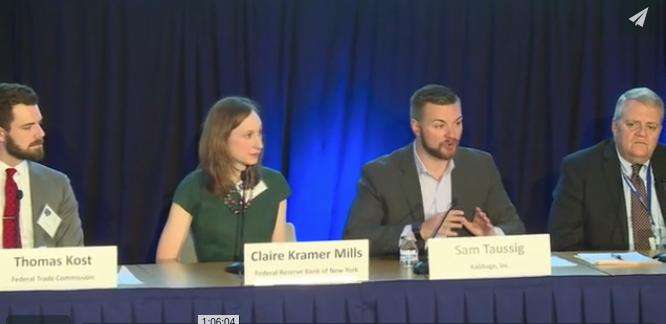
FTC paneSam Taussig, head of global policy at Kabbage, explained that his company typically provides loans to borrowers with five to seven employees — “truly Main Street American small businesses” — that are seeking out “project-based financing” or “working capital.”

“The average small business according to our research only has about 27 days of cash flow on hand,” Taussig told the fintech panel, FTC moderators and audience members. “So if you as a small business owner need to seize an opportunity to expand your revenue or (have) a one-off event — such as the freezer in your ice cream store breaks — it’s very difficult to access that capital quickly to get back to business or grow your business.”

Taussig contrasted the purpose of a commercial loan with consumer loans taken out to consolidate existing debt or purchase a consumer product that’s “a depreciating asset.” Fintechs, which typically supply lightning-quick loans to entrepreneurs to purchase equipment, meet payrolls, or build inventory, should be judged by a different standard.

A florist needs to purchase roses and carnations for Mother’s Day, an ice-cream store must replenish inventory over the summer, an Irish pub has to stock up on beer and add bartenders at St. Patrick’s Day.

The session was a snapshot of not just the fintech industry but of the state of small business. Lewis Goodwin, the head of banking services at Square Capital, noted that small businesses account for 48% of the U.S. workforce. Yet, he said, Square’s surveys show that 70% of them “are not able to get what they want” when they seek financing.

Square, he said, has made 700,000 loans for $4.5 billion in just the past few years, the platform’s average loan is between $6,000 and $7,000, and it never charges borrowers more than 15% of a business’s daily receipts. The No. 1 alternative for small businesses in need of capital is “friends and family,” Goodwin said, “and that’s a tough bank to go back to.”

florist owner waving goodbyePanelist Gwendy Brown, vice-president of research and policy at the Opportunity Fund, a non-profit microfinance organization, provided the fintechs with their most rocky moment when she declared that small businesses turning up at her fund were typically paying an annual percentage rate of 94 percent for fintech loans. And while most small business owners were knowledgeable about their businesses — the florists “know flowers in and out,” for example — they are often bewildered by the “landscape” of financial product offerings.

“Sophistication as a business owner,” Brown said, “does not necessarily equate into sophistication in being able to assess finance options.”

Panelist Claire Kramer Mills, vice-president of the Federal Reserve Bank of New York, reported that the country’s banks have made a dramatic exit from small business lending over the past ten years. A graphic would show that bank loans of more than $1 million have risen dramatically over the past decade but, she said, “When you look at the small loans, they’ve remained relatively flat and are not back to pre-crisis levels.”

Mills also said that 50% of small businesses in the Federal Reserve’s surveys “tell us that they have a funding shortfall of some sort or another. It’s more stark when you look at women-owned business, black or African-American owned businesses, and Latino-owned businesses.”

On the merchant cash advance panel there was less opportunity to dazzle the regulators and audience members with accounts of state-of-the-art technology and the ability to aggregate mountains of data to make online loans in as few as seven minutes, as Kabbage’s Taussig noted the fintech is wont to do.

merchant cash advance panel ftcInstead, industry panelists endeavored to explain to an audience — which included skeptical regulators, journalists, lawyers and critics — the precarious, high-risk nature of an MCA or factoring product, how it differs from a loan, and the upside to a merchant opting for a cash advance. (To their credit, one attendee told AltFinanceDaily, the audience also included members of the MCA industry interested in compliance with federal law.)

A merchant cash advance is “a purchase of future receipts,” Kate Fisher, an attorney at Hudson Cook in Baltimore, explained. “The business promises to deliver a percentage of its revenue only to the extent as that revenue is created. If sales go down,” she explained, “then the business has a contractual right to pay less. If sales go up, the business may have to pay more.”

As for the major difference between a loan and a merchant cash advance: the borrower promises to repay the lender for the loan, Fisher noted, but for a cash advance “there’s no absolute obligation to repay.”

Scott Crockett, chief executive at Everest Business Funding, related two anecdotes, both involving cash advances to seasonal businesses. In the first instance, a summer resort in Georgia relied on Everest’s cash advances to tide it over during the off-season.

When the resort owner didn’t call back after two seasonal advances, Crockett said, Everest wanted to know the reason. The answer? The resort had been sold to Marriott Corporation. Thanking Everest, Crockett said, the former resort-owners reported that without the MCA, he would likely have sold off a share of his business to a private equity fund or an investor.

By providing a cash advance Everest acted “more like a temporary equity partner,” Crockett remarked.

In the second instance, a restaurant in the Florida Keys that relied on a cash advance from Everest to get through the slow summer season was destroyed by Hurricane Irma. “Thank God no one was hurt,” Crockett said, “but the business owner didn’t owe us anything. We had purchased future revenues that never materialized.”

The outsized risk borne by the MCA industry is not confined entirely to the firm making the advance, asserted Jared Weitz, chief executive at United Capital Service, a consultancy and broker based in Great Neck, N.Y. It also extends to the broker. Weitz reported that a big difference between the MCA industry and other funding sources, such as a bank loan backed by the Small Business Administration, is that ”you are responsible to give that commission back if that merchant does not perform or goes into an actual default up to 90 days in.

“I think that’s important,” Weitz added, “because on (both) the broker side and on the funding side, we really are taking a ride with the merchant to make sure that the business succeeds.”

NO APRFTC’s panel moderators prodded the MCA firms to describe a typical factor rate. Jesse Carlson, senior vice-president and general counsel at Kapitus, asserted that the factor rate can vary, but did not provide a rate.

“Our average financing is approximately $50,000, it’s approximately 11-12 months,” he said. “On a $50,000 funding we would be purchasing $65,000 of future revenue of that business.”

The FTC moderator asked how that financing arrangement compared with a “typical” annual percentage rate for a small business financing loan and whether businesses “understand the difference.”

Carlson replied: “There is no interest rate and there is no APR. There is no set repayment period, so there is no term.” He added: “We provide (the) total cost in a very clear disclosure on the first page of all of our contracts.”

Ami Kassar, founder and chief executive of Multifunding, a loan broker that does 70% of its work with the Small Business Administration, emerged as the panelist most critical of the MCA industry. If a small business owner takes an advance of $50,000, Kassar said, the advance is “often quoted as a factor rate of 20%. The merchant thinks about that as a 20% rate. But on a six-month payback, it’s closer to 60-65%.”

He asserted that small businesses would do better to borrow the same amount of money using an SBA loan, pay 8 1/4 percent and take 10 years to pay back. It would take more effort and the wait might be longer, but “the impact on their cash flow is dramatic” — $600 per month versus $600 a day, he said — “compared to some of these other solutions.”

Kassar warned about “enticing” offers from MCA firms on the Internet, particularly for a business owner in a bind. “If you jump on that train and take a short-term amortization, oftentimes the cash flow pressure that creates forces you into a cycle of short-term renewals. As your situation gets tougher and tougher, you get into situations of stacking and stacking.”

On a final panel on, among other matters, whether there is uniformity in the commercial funding business, panelists described a massive muddle of financial products.

“THEY’RE TELLING US THAT IT’S VERY DIFFICULT TO FIND EVEN SOME BASIC INFORMATION”

Barbara Lipman: project manager in the division of community affairs with the Federal Reserve Board of Governors, said that the central bank rounded up small businesses to do some mystery shopping. The cohort — small businesses that employ fewer than 20 employees and had less than $2 million in revenues — pretended to shop for credit online.

As they sought out information about costs and terms and what the application process was like, she said, “They’re telling us that it’s very difficult to find even some basic information. Some of the lenders are very explicit about costs and fees. Others however require a visitor to go to the website to enter business and personal information before finding even the basics about the products.” That experience, Lipman said, was “problematic.”

She also said that, once they were identified as prospective borrowers on the Internet, the Fed’s shoppers were barraged with a ceaseless spate of online credit offers.

John Arensmeyer, chief executive at Small Business Majority, an advocacy organization, called for greater consistency and transparency in the marketplace. “We hear all the time, ‘Gee, why do we need to worry about this? These are business people,’” he said. “The reality is that unless a business is large enough to have a controller or head of accounting, they are no more sophisticated than the average consumer.

“Even about the question of whether a merchant cash advance is a loan or not,” Arensmeyer added. “To the average small business owner everything is a loan. These legal distinctions are meaningless. It’s pretty much the Wild West.”

ftc office washington dcIn the aftermath of the forum, the question now is: What is the FTC likely to do?

Zullow, the FTC attorney, referred AltFinanceDaily to several recent cases — including actions against Avant and SoFi — in which the agency sanctioned online lenders that engaged in unfair or deceptive practices, or misrepresented their products to consumers.

These included a $3.85 million settlement in April, 2019, with Avant, an online lending company. The FTC had charged that the fintech had made “unauthorized charges on consumers’ accounts” and “unlawfully required consumers to consent to automatic payments from their bank accounts,” the agency said in a statement.

In the settlement with SoFi, the FTC alleged that the online lender, “made prominent false statements about loan refinancing savings in television, print, and internet advertisements.” Under the final order, “SoFi is prohibited from misrepresenting to consumers how much money consumers will save,” according to an FTC press release.

But these are traditional actions against consumer lenders. A more relevant FTC action, says Pepper Hamilton attorney Dabertin, was the FTC’s “Operation Main Street,” a major enforcement action taken in July, 2018 when the agency joined forces with a dozen law enforcement partners to bring civil and criminal charges against 24 alleged scam artists charged with bilking U.S. small businesses for more than $290 million.

In the multi-pronged campaign, which Zullow also cited, the FTC collaborated with two U.S. attorneys’ offices, the attorneys general of eight states, the U.S. Postal Inspection Service, and the Better Business Bureau. According to the FTC, the strike force took action against six types of fraudulent schemes, including:

  • Unordered merchandise scams in which the defendants charged consumers for toner, light bulbs, cleaner and other office supplies that they never ordered;
  • Imposter scams in which the defendants use deceptive tactics, such as claiming an affiliation with a government or private entity, to trick consumers into paying for corporate materials, filings, registrations, or fees;
  • Scams involving unsolicited faxes or robocalls offering business loans and vacation packages.

“THIS IS A WAKE-UP CALL”

If there remains any question about whether the FTC believes itself constrained from acting on behalf of small businesses as well as consumers, consider the closing remarks at the May forum made by Andrew Smith, director of the agency’s bureau of consumer protection.

“(O)ur organic statute, the FTC Act, allows us to address unfair and deceptive practices even with respect to businesses,” Smith declared, “And I want to make clear that we believe strongly in the importance of small businesses to the economy, the importance of loans and financing to the economy.

Smith asserted that the agency could be casting a wide net. “The FTC Act gives us broad authority to stop deceptive and unfair practices by nonbank lenders, marketers, brokers, ISOs, servicers, lead generators and collectors.”

As fintechs and MCAs, in particular, await forthcoming actions by the commission, their membership should take pains to comport themselves ethically and responsibly, counsels Hudson Cook attorney Fisher. “I don’t think businesses should be nervous,” she says, “but they should be motivated to improve compliance with the law.”

She recommends that companies make certain that they have a robust vendor-management policy in place, and that they review contracts with ISOs. Companies should also ensure that they have the ability to audit ISOs and monitor any complaints. “Take them seriously and respond,” Fisher says.

Companies would also do well to review advertising on their websites to ascertain that claims are not deceptive, and see to it that customer service and collections are “done in a way that is fair and not deceptive,” she says, adding of the FTC investigation: “This is a wake-up call.”

A Side-By-Side Look At Small Business Funding Securitization Pools

September 6, 2019
Article by:

Several small business funding companies have closed majored securitization deals since 2018 with Kroll Bond Rating Agency rating the transactions. For the most recent transaction with National Funding, Kroll compared each securitized pool side-by-side in a chart. An abbreviated version of it is below:

NFAS 2019-1 (National Funding) RFS 2018-1 (Rapid Finance) CRDBL 2018-1 (Credibly) SFS 2018-1 (Kapitus)
Weighted Avg Original Expected Time (months) 9.9 11.7 11.5 7.8
Weighted Avg RTR Ratio 1.36x 1.27x 1.32 1.35
Weighted Avg Credit Score 664 665 679 649
Weight Avg Time in Biz (years) 9.6 14.6 12.3 12.5
Percentage of MCA 0.0% 14.1% 45.8% 60%
Percentage of Loan 100% 85.9% 54.2% 40%

Snapshot On Australia: Growth In The Making

August 30, 2019
Article by:

Downtown Sydney skyline

This story appeared in AltFinanceDaily’s Jul/Aug 2019 magazine issue. To receive copies in print, SUBSCRIBE FREE

The Australian alternative lending market continues to gain momentum, bolstered in part by increased awareness, heightened competition and growing dissatisfaction with the status quo.

Indeed, there’s been significant growth in the few years since AltFinanceDaily first wrote about the nascent alternative lending business down under. Notably, Australia’s alternative funding volume surpassed $1.14 billion in 2017, up 88 percent from $609.59 million in 2016, according to the latest data available from KPMG research. It’s the largest country in terms of total alternative finance market volume in the Asia Pacific region, excluding China, according to KPMG.

To be sure, the Australian market is still relatively small—at least compared with the U.S. Digging deeper, the largest share of market volume in 2017—the latest data available—came from balance sheet business lending, accounting for more than $574 million, according to KPMG. P2P marketplace consumer lending had the second largest market volume at $256 million. Invoice trading was the next largest segment of the Australian alternative finance market, accounting for $142.65 million, according to the KPMG report.

Its small size notwithstanding, what makes the Australian market particularly interesting is the potential promise it holds for the companies already established there and the opportunities it may offer to new entrants that find ways to successfully compete in the market.

Certainly alternative lending opportunities in Australia are growing, as awareness increases and the desire by consumers and businesses for favorable rates and faster service intensifies. The Australian alternative lending market is similar to Canada in that a small number of large banks dominate the market both in terms of consumer lending and small business lending. But, like in Canada, alternative lenders are gaining ground amid a changing customer mindset that values speed, favorable rates and a digital experience.

Reserve Bank of Australia

Equifax estimates that alternative finance volume in Australia is now growing at about 10 percent to 15 percent per year; that compares to a decline of approximately 20 percent for some major traditional lenders in terms of credit growth, says Moses Samaha, executive general manager for Equifax in Sydney. This presents an opportunity for alternative lenders to serve parts of the market the banks don’t want and those that are more attuned to a digital experience.

“IT DOESN’T FEEL LIKE THEY ARE AS ACTIVE AS THEY WERE ANNOUNCED TO BE”

Even so, challenges persist. For instance, digital disruptors are still working on gaining brand awareness, and the market is only so big to be able to accommodate a certain number of alternative players. Time will time whether there will be consolidation among alternative lenders and more bank partnerships, which haven’t been so successful to date. “It doesn’t feel like they are as active as they were announced to be,” Samaha says.

At present, the Australian market consists of a few dozen alternative lenders pitted against four major banks. RateSetter, SocietyOne and Wisr are among the largest alternative players in the consumer lending space. On the small business side, Capify, GetCapital, Moula, OnDeck, Prospa and Spotcap are some of the leading companies. PayPal Working Capital also has a growing presence in the Australian small business lending market.

New lenders continue to eye the Australian market for entry, but it’s not an easy market to crack, according to industry participants. The market consists of mostly home-grown players and that’s not expected to change drastically. (Capify, OnDeck and Berlin-based Spotcap are notable exceptions. Another U.S. major player, Kabbage, previously provided its technology to Australia’s Kikka Capital, but that agreement is no longer in force.)

Australia Lending

There can be a steep learning curve when it comes to outsiders doing business in Australia. What’s more, there’s no longer the first-to-market advantage that existed a decade or so ago. It’s also a relatively limited market in terms of size, which can be off-putting. Australia has a population of around 25 million, making it less populated than the state of California, with an estimated 39.9 million residents.

Still, for alternative players that are able to successfully navigate the challenges the Australian market presents, there’s ample opportunity to grab market share away from traditional players—similar to the pattern that’s emerged elsewhere around the globe.

Take consumer lending, for example. The unsecured consumer lending market in Australia sits at about $70 billion, with the large banks occupying maybe a 90 percent share of that, says Mathew Lu, chief operating officer of Wisr (previously known as DirectMoney Limited). Compared with other markets such as U.K. and the U.S., who went through a similar journey around a decade ago, “Australia is probably three or four years into that same journey of growth. It’s shifting and changing,” he says.

“A PERFECT STORM”

Alternative lenders have made strides in undercutting the large banks by offering generally lower rates and typically faster loan times. Unfavorable press related to bank lending practices has also benefited alternative lenders. Lu refers to these conditions as “a perfect storm” for growth.

Wisr, for instance, saw loan origination volume spike 409 percent in fiscal year 2018. The company secured $75 million in loan funding agreements last year and boasts more than 80,000 customers, according to a company presentation.

Marketplace lender, SocietyOne, which in March reached $600 million in loan originations, is another example of an alternative lender that has benefited from the momentum. The company— celebrating its 7th anniversary this summer—is hoping to reach $1 billion in loans by 2020, according to its website.

RateSetter—another major player in this space—has also experienced significant growth since launching in Australia in 2014, and is now funding over $20 million in loans each month, according to its website. In April, the company soared past $500 million in loans funded and in May it saw a record number of new investors register. The company has more than 15,000 registered investors by its own account.

deBanked AustraliaOne question for the future is whether the consumer alternative lending space in Australia will ultimately be too crowded amid a spate of new entrants. Wisr’s Lu says “there’s a big question mark” regarding how many alternative lenders the market can sustain. “Will there be a level of consolidation or amalgamation? These are questions ahead of us,” he says.

For its part, alternative lending to small businesses is also a growing force within Australia. As a testament to the development of this market, in June 2018, a group of Australia’s leading online small business lenders released a Code of Lending Practice, a voluntary code designed to promote fair terms and customer protections. Currently, the Code only covers unsecured loans to small businesses. Signatories include Capify, GetCapital, Moula, OnDeck, Prospa and Spotcap.

Capify—an early entrant to Australia—has been pursuing businesses there since 2008. The company, which integrated its U.S. business in 2017 to Strategic Funding Source (now called Kapitus) is now operating only in Australia and the U.K. In Australia, it has executed more than 7,500 business financing transactions for Australian businesses and has more than 50 staff members in its Australian offices.

The company recently closed a deal with Goldman Sachs for a $95 million line of credit for growth in Australia and the U.K., which includes building out its broker program to increase distribution and technology investment.

David Goldin, the company’s chief executive, says Capify is hoping to grow its Australian business between 25 percent and 30 percent in 2019. The company is looking at M&A activity as well as organic growth.

“YOU CAN’T GO OUT 24 MONTHS ON A 1.25 FACTOR RATE – THAT’S CRAZY”

Since Capify has been in the market, he has seen a number of new entrants—some more successful than others. One concern Goldin has is the lack of experience by some of these competitors. Many aren’t pricing the risk properly and not underwriting prudently to be able to weather a downturn, he says. They are so new, he questions whether they have the expertise to be able to survive a downturn given what he characterizes as pricing and underwriting missteps.

“You can’t go out 24 months on a 1.25 factor rate – that’s crazy,” he says, referring to some contracts he’s seen. “I’ve seen this movie in the U.S. before and it doesn’t end well.”

Australian Piggy BankMeanwhile, competition has driven down prices and made moving quickly on potential leads more of a necessity. When leads come in today, if you’re not on the phone in 30 minutes, you could lose it to a competitor, he says.

While the small business market is an enticing one for alternative lenders, raising awareness of their offerings continues to be a challenge.

“The small business market is fragmented and raising awareness is expensive,” says Beau Bertoli, co-founder and co-chief executive of Prospa, another prominent small business lender in Australia. “There hasn’t been much innovation in small business banking, but many Australians still don’t think of switching from banks and traditional lenders,” he says.

“THE SMALL BUSINESS MARKET IS FRAGMENTED AND RAISING AWARENESS IS EXPENSIVE”

That said, more small businesses are turning to alternative lenders and these companies say they expect growth to increase over time. Recent research commissioned by OnDeck found that 22 percent of small and medium-sized businesses would consider an online lender, up from 11 percent in the past. This could be buoyed further by the introduction of Open Banking in Australia, which was set to be introduced in Australia in 2019, but this was pushed back to early 2020.

“We look forward to the introduction of Open Banking in Australia as it should allow lenders to use incremental data points to improve risk modeling, and increase competition in the SME lending space, ultimately providing SMEs with improved access to cashflow solutions to grow and run their businesses,” says Cameron Poolman, chief executive of OnDeck in Australia.

Bertoli of Prospa, which recently listed on the Australian Stock Exchange, says the Australian alternative lending market will also benefit from strong support from industry and government to increase competition and improve consumer and small business outcomes. The government recently established a $2 billion Australian Business Securitisation Fund, which is a huge win for small business, he says, that will ultimately make the finance available to small business owners more affordable by lowering the wholesale cost of funds for alternative lenders. “We expect this will boost credibility and consideration of alternative lenders among small business owners,” he says.

Declining property values is another factor helping alternative lending. “In November 2018 we saw the largest annual fall in property prices in Australia since the global financial crisis in 2009,” says Simon Keast, managing director of Spotcap Australia and New Zealand.

Australian Dollar“As property prices decline, business owners find it more difficult to use their home as loan security and as such, turn to alternative lenders such as Spotcap that can provide them with unsecured loans for their business,” he says. What’s more, the SME Growth Index in March showed for the first time that business owners are almost as likely to turn to an alternative lender as they are to their main bank to fund growth, says.



Overall, the market opportunity for alternative lending to small businesses is compelling, says Bertoli of Prospa. “We estimate the potential market for small business lending in Australia is more than $20 billion per annum and we’ve penetrated only about 2 percent of the market so far. There are 2.3 million small businesses in Australia, and they’re crying out for capital,” he says.

Keast of Spotcap says he expects to see more banks and non-financial enterprises looking to leverage the technology fintech lenders have built to provide swift and digital lending products to small businesses. He offers the example of a partnership Spotcap, a German-based company, has with an Austrian Bank to provide same-day finance to SMEs in Austria as an example of the types of partnerships the company could also seek in Australia. “We have already partnered with an Austrian Bank that is leveraging our lending platform to provide same-day finance to SMEs in Austria, and there is plenty of interest for similar partnerships on the ground here,” he says.

OnDeck, meanwhile, expects to see a shake-out within the alternative finance sector, which will result in a smaller number of bigger players, with the ability to scale and serve multiple customers with a variety of products, according to Poolman, the company’s chief executive.

For his part, Goldin of Capify is bullish on the Australian small business market, but he cautions others that it’s not a gold rush type of place where everyone who comes in can make money.

“The state of California has more opportunity than the entire continent of Australia,” he says.

ROK Financial

AMA Recovery

Thorocorp

Smart Step Funding / Principis Capital

Fenix Capital Funding

B2B Finance Expo

Amerifi Capital

Cobalt Funding Solutions

Big Think Capital

ByzFunder

In Advance Capital

Essential Funding

Better Accounting Solutions

SmartMCA

Merit Business Funding & MeridianBank

Fundo

BizFund

Torro

Splash Advance

Legend Funding

Easify

Meridian Leads

Wynwood Capital Group

Cashable

1 Stop Cap

Synergy Direct Solution

South End Capital