Alternative Lending Advances: Go Ahead and Eat My Lunch
June 28, 2014Yesterday it was reported that the well-known peer-to-peer loan platform LendingClub had dubbed Morgan Stanley and Goldman Sachs to work on their IPO later this year. Going public would advance the legitimacy of the wider alternative lending industry and solidify its place in the mainstream.
The Wall Street Journal states, “As the most visible company in the growing space, Lending Club’s IPO will likely be watched carefully by a number of other firms such as OnDeck Capital Inc.”
Many folks have asked me if I syndicate and technically I do, just not in merchant cash advances. For one, that opportunity is largely reserved to brokers and institutional investors, neither of which currently describes me.
Instead I dabble in LendingClub-issued personal loans and I adhere to one major ground rule, I don’t lend to business owners.
While that rule might seem to stand in stark contrast to what I preach (support for alternative business lending), there is a reason I won’t do it on LendingClub’s platform:
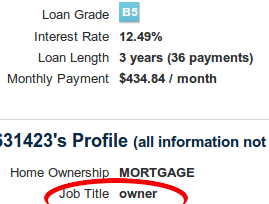 1. The rates LendingClub charges to business owners are too low (about 6-26% APR)
2. The terms are too long relative to the risk (3 or 5 year terms)
Earlier this year the Federal Reserve conducted a study that found “[p2p] loans for small business purposes were more than two-and-a-half times more likely to perform poorly.” They also acknowledged that “lending to small businesses is generally considered to be riskier and more costly because small firms have higher failure rates and are more vulnerable to downturns in the economy.”
Therein lies my dilemma, the risk that loans to business owners at those rates will result in a net loss. As a lender, I happen to be in the unique position of trying not to lose money. I know such thinking is greedy, antiquated, and close-minded but I welcome those with opposing philosophies to eat my lunch.
In a recent Bloomberg article, writer Pat Clark put the high interest business lending community on notice by touting Opportunity Fund’s 15% APR EasyPay business loans. Of course by booking an average of only 5 loans a month, their model is not built to scale. Compare that to for-profit alternative lender CAN Capital, whom has funded more than 55,000 small businesses since inception.
Opportunity Fund’s VP of Small Business Lending Marco Lucioni is quoted in the article as follows, “If you have taken out a merchant cash advance, I guarantee you that our refinance program will save you money and could even cut your payments in half.”
Their revolutionary system works for one reason, they are not a for-profit business. Opportunity Fund is a California-based charity. Less than two years ago Lucioni admitted to another Bloomberg writer, “EasyPay is a real loan, with a fixed simple interest rate that works out to be about 12 percent on an annual basis. At that rate, the nonprofit is not covering its costs.” He continued, “Opportunity Fund subsidizes the loans to keep them cheap.”
I have a difficult time with tidbits like “not covering costs” and “nonprofit organization”. As an individual lender on a platform like LendingClub I am forced to make a significantly less informed decision than the one Opportunity Fund is afforded. LendingClub only tells me simple things like credit history of the business owner, how much debt they have, and how much their monthly salary is. In short, I am not privy to the 2,000 data points that OnDeck Capital has at their disposal, a lender that charges significantly more than the California-based nonprofit.
If Opportunity Fund is substantially more informed and admittedly losing money at an annualized rate of 12%, why should I as an individual retail investor expect better results at the same or lower rate?
And just how short is Opportunity Fund coming up on covering their costs? Is it a lot or a little? It might not be outlandish to suppose that the break-even point lies in the 20% or 30% interest range… or even higher.
Above all, Opportunity Fund’s EasyPay loan program began in 2010, meaning there is no data on their performance in a recessionary economy.
This supports the case that in purely prosperous times, the odds of turning a profit on a 3-year loan to a small business owner at 12% or less is at best unfavorable. And when realizing that terms of 3 years and longer increasingly expose lenders to an economic downturn and higher loss ratios, I can only reach one conclusion; I cannot lend to small business owners at low rates over long terms and expect my investment to be safe.
To put this into additional perspective, prior to 2009, merchant cash advance companies believed they hedged the risk of economic uncertainty by limiting the amount of time their capital was outstanding to 6-9 months. They were wrong. The impact of a major recession was swift and devastating. The loss rate climbed so fast that many merchant cash advance companies declared bankruptcy.
For a time, the lesson learned was that 6-9 months of exposure was too long, not that it was too short. Indeed, 2010 and 2011 birthed an entirely new breed of merchant cash advance products, programs where capital exposure was limited to only 2-4 months. These products still exist today and are widely considered to be the profit center in the alternative business lending industry.
With the Great Recession far behind us, many new entrants to business lending have written off the long term risks. Suspiciously, default risk today has shifted from balance sheet lenders to peers, the crowd, and charitable donors.
LendingClub for example has no exposure to defaults as they are nothing more than a platform for investors and individuals like myself to lend to consumers.
Opportunity Fund is a subsidized nonprofit.
As you continue down the list of alternative business lenders, you’ll notice the trend is the same. Lower rates with longer terms offered by companies bereft of default risk. Curious, isn’t it?
Small business owners, journalists, and loan brokers tasked with securing the best terms for their clients are cheering this trend on. Who can blame them? It’s easy to get caught up in the excitement of technology-driven innovation and lower rates in a new world devoid of traditional banks. It’s absolutely a good thing for business owners. But today’s platform lenders dangle interest earning opportunities that beat savings account rates a hundred times over and sing a song that longer terms are in investors’ own interest. Are you willing to bear the risk they urge you to take?

I participate in LendingClub’s platform loans. To date, I’ve contributed to more than 800 of them. But I refuse to believe that a long term business loan at 6% is somehow a good investment when a competitor is:
1. charging double while still losing money in a stable economy
2. has access to more underwriting data than me
3. a nonprofit
If OnDeck Capital has spent years of mathematical research to get short term business loan rates down to 54% APR on average, why should the average John Doe retail investor reasonably expect to do well on vastly longer term loans with substantially reduced rates?
As the alternative lending industry advances, they don’t want peers, the crowd, and donors to ask themselves that question.
It’s a “pay no mind to the man behind the curtain” scenario. That guy’s just somebody that had to bear the liability of his own underwriting decisions. They fixed that issue by making it your problem. Fund faster, earn less, ignore history, and extend terms over longer periods of time. What could possibly happen?
Eight years ago I got my start in the merchant cash advance industry as none other than an underwriter. I know a bad deal when I see one. They’re not as obvious to everyone else.
I’ve said it a million times and I’ll say it again, business lending is fraught with risk. Eat my lunch and you won’t live past dinner.

Merchant Cash Advance Syndication: Crowdfunding?
March 28, 2014 You might not have known this, but one of the most lucrative opportunities in merchant cash advance is the ability to participate in deals. It’s a phenomenon Paul A. Rianda, Esq addressed in DailyFunder’s March/April issue with his piece, So You Want to Participate?
Syndication is industry jargon of course. You probably know the concept by its sexier pop culture name, crowdfunding. For all the shadowy rumors and misinformation that circulates out there about merchant cash advance companies, they’re similar to the trendy financial tech companies that have become darlings of the mainstream media.
Did you know that many merchant cash advances are crowdfunded? To date, no online marketplace has been able to gain traction in the public domain aside from perhaps FundersCloud, so crowdfunding in this industry happens almost entirely behind the scenes. There is so much crowdfunding taking place that it’s becoming something of a novelty for one party to bear 100% of the risk in a merchant cash advance transaction. Big broker shops chip in their own funds as do underwriters, account reps, specialty finance firms, hedge funds, lenders, and even friends and family members of the aforementioned.
Merchant cash advance companies find themselves playing the role of servicer quite often, which is coincidentally the model that Lending Club is built on. A $25,000 advance to an auto repair shop could be collectively funded by 10 parties, but serviced by only 1. Each participant is referred to as a syndicate. This is not quite the same system as peer-to-peer lending because syndicates are not random strangers. Syndication is typically only open to businesses, and most often ones that are familiar with the transaction such as the company brokering the deal itself.
In the immediate aftermath of the ’08-’09 financial crisis, some merchant cash advance companies became very mistrusting of brokers and deal pipelines were going nowhere. Underwriters had a list of solid rebuttals for deals they weren’t comfortable with. “If you want us to approve this deal so bad, why don’t you fund it yourself!,” underwriters would say. Such language was intended to put a broker’s objections over a declined deal to bed. But with all the money being spent to originate these deals, it wasn’t long until brokers stumbled upon a solution to put anxious merchant cash advance companies at ease. “Fund it myself? I’d love to, but I just can’t put up ALL of the cash.”
And so some brokers started off by reinvesting their commissions into the deals they made happen. That earned them a nice return, which in turn got reinvested into additional deals. Fast forward a few years later and deals are being parceled out by the truckload to brokers, underwriters, investors, lenders, and friends. There’s a lot of money to be made in commissions but anybody who’s anybody in this business has a syndication portfolio. The appetite for it is heavy. Wealthy individuals and investors spend their days cold calling merchant cash advance companies, brokers, and even me, trying to get their money into these deals. They know the ROI is high and they want in.
 That’s the interesting twist about crowdfunding in the merchant cash advance industry. You can’t get in on it unless you know somebody. There are no online exchanges for anonymous investors to sign up and pay in. It requires back door meetings, contracts, and typically advice from sound legal counsel. A certain level of business acumen and financial prowess are needed to be considered. These transactions are fraught with risk.
In Lending Club’s peer-to-peer model, investors can participate in a “note” with an investment as small as $25. This is a world apart from merchant cash advance where it is commonplace to contribute a minimum of $500 per deal but can range up to well over $100,000.
Lending Club defines diversification as the possession of more than 100 notes. At $25 a pop, an investor would only need to spend $2,500. With merchant cash advance, 100 deals could be $50,000 or $10,000,000. By that measure, syndication is crowdfunding at the grownup’s table, a table that doesn’t care about sexy labels to appease silicon valley, only yield.
Strange merchant cash advance jargon keeps the industry shrouded in mystery. Did you know that split-funding and split-processing are terms often used interchangeably? Or that they have a different meaning than splitting? Or that the split refers to something else entirely?
Do you know what a holdback is or a withhold? How about a stack, a 2nd, a grasshopper, an ISO, an ACH deal, a junk, a reup, a batch, a residual, a purchase price, a factor rate, or a UCC lead?
Paul Rianda did a great job detailing the risks of syndication, but there is one thing he left unsaid, and that’s if you’re going to participate in merchant cash advances, you better be able to keep up with the conversation.
At face value, syndication is nothing more than crowdfunding. But if your reup blows up because some random UCC hunting ISO stacked an ACH on top of your split while junking him hard and upping the factor with a shorter turn, you just might curse the hopper that ignored your holdback and did a 2nd. And on that note, perhaps it’s better that the industry refrain from adopting mainstream terminology. We wouldn’t want everybody to think this business is easy. Because it’s not.
One factor to consider is the actual product being crowdfunded. In equity crowfunding, participants pool funds together to buy shares of a business. In crowdlending, participants pool funds together to make a loan. But in merchant cash advance syndication, participants pool capital to purchase future revenues of a business. An assessment is made to predict the pace of future income and a discounted price is paid to the business owner upfront. That purchase price is commonly known as the advance amount.
Syndication has more in common with equity crowdfunding than crowdlending. If you buy future revenues and the business fails, then your purchase becomes worthless. There is typically no recourse against the business owner personally unless they purposely interfere with the revenue stream and breach the agreement. Sound a bit complicated? It is, but crowdfunding in this space is prevalent nonetheless. To get in on it, you need to know someone, and to do it intelligently, you better know what the risks are.
If you want to sit at the grownup’s table and syndicate, consult with an attorney first. There’s a reason this industry hasn’t adopted sexy labels. It isn’t like anything else.
Hello Square Capital
March 1, 2014We’ve seen copies of this notice posted on a few websites now:
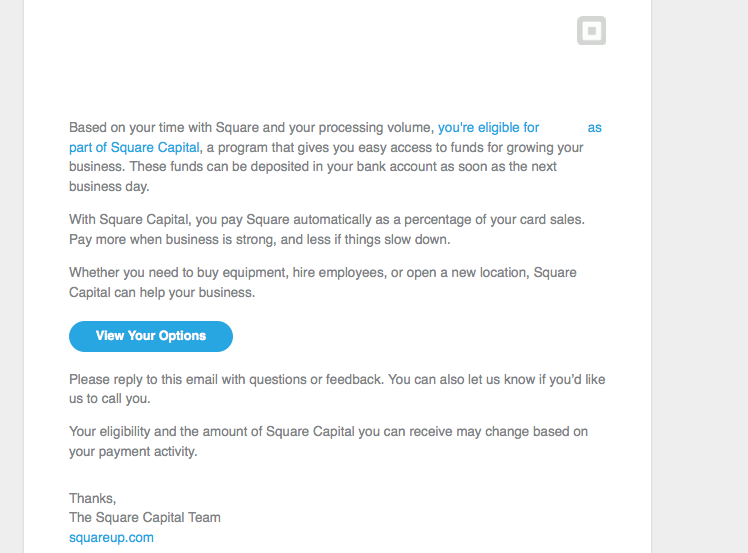
Square, the well-known micro-merchant processor with celebrity CEO Jack Dorsey is debuting a merchant cash advance program. Truthfully, I’m not surprised in the slightest. Come on in Square, the water’s fine!
What is still interesting to this day is the realization that so many small business owners have never even heard of the concept. You can check out comments by people on the mr. money mustache forum regarding Square Capital here.
Sell my future credit card sales? What the HECK?!
It’s a 16 year old industry now my friends. One of these days it’d be nice if people just knew this product existed. That seems to be the hardest part…
How to Value a Merchant Cash Advance Company (or Alternative Lender)
February 9, 2014If you’re at all interested in the future of the merchant cash advance industry, you need to read Wall Street Evaluates Merchant Cash Advance in the first issue of DailyFunder. It offers a fresh perspective through the eyes of financiers outside the industry looking in.
Names include:
- Jason Gurandiano, Managing Director in Deutsche Bank’s Financial Technology Group
- David Cox, Managing Director at Evercore Partners
- Thomas McGovern, Vice President at Cypress Associates
- Steven Mandis, adjunct professor at Columbia Business School.
The article is relatively broad but it communicates some very important points:
1. Some players in the space exist as lifestyle businesses. They’re not scalable, their success is largely attributed to what the owner does for it, and company’s long term vision is to basically make sure the owner takes home a nice paycheck.
2. Some of the big players in the space are on similar growth trajectories. Nothing differentiates each of them from the pack, and none of them really have an advantage over the other.
 3. EBITDA is a bad valuation measure and growth is a good one.
On point #1, a lifestyle business is no good to a professional investor in this space. Aside from the success usually being owner-dependent, one question an investor is certain to ask a prospect is, “If I gave you $100 million today, what would you do with it?” There are many wrong answers to that question. If you said solicit more ISOs, buy more leads, or hire more sales people, they’re going to wonder why you haven’t done those things already.
On the same token, those answers would communicate that you’re going to do the exact same thing you’re already doing. It’s a mistake to think that scaling in such a manner will keep the original margins intact. It also does nothing to protect the company against change or enable it to grow exponentially.
On point #2, it’s great to be big, established, and growing at a moderate pace, but what good is that to an investor looking to double, triple, or quadruple their money? And who’s to say that a moderate growth strategy will continue as it has in the past?
Many many many (did I say many yet?) people have come into this space with visions of grandeur, to be bigger than CAN Capital in less than 24 months. What do their plans usually consist of? Pay higher than average commissions and fund deals they shouldn’t be funding. To date, none of those companies are bigger than CAN Capital and some of them are out of business. A growth plan can’t consist of funding deals you don’t want to and paying commissions you can’t afford. That’s called a suicide mission and it’s very effective.
Some big funding companies may appear sustainable on the outside but they’re woefully fragile on the inside. Jason Gurandiano said it best with this quote, “The general knock on merchant cash advance has been that they are an ISO-centric model.” I’m not discounting the value of ISOs in this business. To some extent they rule the roost, and that’s the problem in the eyes of investors. Many merchant cash advance companies rely on a handful of symbiotic relationships. The ISO relies on the funding company for commissions and the funding company relies on the ISO for deals. But what happens if:
- The ISO is enticed with higher commissions or better service with somebody else
- The ISO’s deal flow slumps
- The ISO goes out of business
- The ISO uses unscrupulous sales practices when selling the funding company’s product
- The ISO uses their relationship as leverage on the funding company to make bad decisions
- The funding company needs to reduce commissions but the ISO can’t sustain it
An ISO-dependent merchant cash advance company doesn’t have much control over growth. Believe me, I’ve been on those phone calls where the ISO is asked to send more business. But what happens if they have no more to send? Or what if they would just rather do most of their business elsewhere?
Again, there is absolutely nothing wrong with a purely ISO-centric model in general, but it is much less attractive to investors looking to do a deal in this industry and that’s the theme of this post.
 Point #3 is unique because it addresses the how to value a company once you’ve found one worth investing in. Earnings Before Interest Taxes Depreciation and Amortization (EBITDA) is not a viable valuation formula here as it doesn’t make sense to measure the worth of a company dependent on expensive debt by stripping away the cost of that debt.
According to Aswath Damodaran, debt to a financial service company should be treated like a raw material. In his 2009 paper, Valuing Financial Services Firms, he states, “debt is to a bank what steel is to a manufacturing company, something to be molded into other products which can then be sold at a higher price and yield a profit.” It is a perfect analogy for a merchant cash advance company.
Damodaran’s analysis covers a range of situations but I find an Asset Based Valuation intriguing. It states, “How would you value the loan portfolio of a bank? One approach would be to estimate the price at which the loan portfolio can be sold to another financial service firm,” There isn’t a lot of precedent for that in this industry unfortunately. Damodaran continues though with, “but the better approach is to value it based upon the expected cash flows.” For certain, one would have to take into account the renewal rate, renewal commissions, the average recovery timeframe, and the default rate.
If you bought $100 million in RTR today, how much would you get back 1 year from now or 2 years from now? This number is going to differ from company to company.
An Asset Based Valuation might be in order for a funding company that is winding down and shedding its existing portfolio, but it’s not appropriate for one with growth. One should assume that they’re buying a growing business when investing in a merchant cash advance company, not a packaged portfolio.
One question an investor might ask is, “what am I buying?” The average merchant cash advance company can be perceived as nothing more than a vehicle to maximize the spread between revenue and borrowing costs. They’re not really businesses in the traditional sense, more like arbitrageurs. They buy leads and/or they pay commissions, there are some fixed costs, but there’s not a whole lot more to it. There are virtually no barriers to entry and anybody can replicate the model. So you invest in the people who are doing it currently and their system (assuming it’s working so far). The value of that might only be equivalent to 1x – 4x annual profit. Why pay more when competition can drag margins down, regulations could disrupt the space in the future, or the investor could just as easily start their own company with the funds they have instead?
With that said, the average merchant cash advance company is more attractive to a lender than an equity investor. Additionally, they can also offer a nice monetary return by allowing people to participate in the funding of individual deals. Both are indeed what many investors choose to do, either lend money to these companies or syndicate. Why buy the cow when you can get the milk for free?
Merchant Cash Advance companies that make the headlines with big equity investments are not average. They create value, rather than just engage in arbitrage. They’re building something, changing something, disrupting something. They don’t profit off spreads in the market, they create the market and dominate it. Today this typically happens through technology, and not just any technology, but technology that leads to substantial future earnings. There’s a difference between spending a million dollars on a platform to make things more efficient and spending a million dollars on a platform that causes earnings to increase by 1,000%. Too many companies view technological investments in the former sense, a cost that eats into the spread instead of one that can blow the roof off of it.
Investors are looking for companies that plan to soar from Point A to Z, not ones that are moseying along from A to B.
RapidAdvance was said to have gotten an Enterprise Valuation in excess of $100 million when being acquired by Rockbridge Growth Equity. For the most part that number reflects Total Debt + Total Equity – Cash. When you buy a company, you’re buying their debts as well. 90% of their enterprise value could potentially have been the value of their outstanding debts. Of course I doubt it was, but it should put their eye opening valuation into perspective.
Contrast the RapidAdvance deal with the most recent valuation of Lending Club at $2.3 billion. Lending Club earns substantially lower returns per deal but they have an engine for growth that is virtually unmatched. In the month of August 2012, they booked $70 million in loans. In January of 2014, they booked $258 million. That’s 3.7x the monthly volume they were doing less than 18 months ago. That’s what an investor calls an opportunity.
How do you value a merchant cash advance company? There’s no easy way to do it and it largely depends on whether or not they’re an arbitrage shop chugging along or one creating substantial value.
There’s plenty of free milk out there. Why would someone pay top dollar for your cow?
– Merchant Processing Resource
Merchant Cash Advance Term Used Before Congress
December 18, 2013 I’d like to think that the term, merchant cash advance, is mainstream enough that a congressman would know what it was. I have no idea if that’s the case though. What I do know is that Renaud Laplanche, the CEO of Lending Club gave testimony before the Committee on Small Business of the United States House of Representatives on December 5, 2013.
Watch:
In it, he argued that small businesses have insufficient access to capital and that the situation is getting worse. We knew that already. However, he went on to explain that alternative sources such as merchant cash advance companies are the fastest growing segment of the SMB loan market, but issued caution that some of them are not as transparent about their costs as they could be.
The big takeaway here is that he didn’t say they are charging too much, but rather that some business owners may not understand the true cost. I often defend the high costs charged in the merchant cash advance industry, but I’ll acknowledge that historically there have been a few companies that have been weak in the disclosure department. That said, the industry as a whole has matured a lot and there is a lot less confusion about how these financial products work.
Typically in the context Laplanche used, transparency is code for “please put a big box on your contract that states the specific Annual Percentage Rate” of the deal. That’s good advice for a lender and in many cases the law, but for transactions that explicitly are not loans, filling in a number to make people feel good would be a mistake and probably jeopardize the sale transaction itself. If I went to Best Buy and paid $2,000 in advance for a $3,000 Sony big screen TV that would be shipped to me in 3 months when it comes out, should I have to disclose to Best Buy that the 50% discount for pre-ordering 3 months in advance is equivalent to them paying 200% APR?
This is what happened: I advanced them $2,000 in return for a $3,000 piece of merchandise at a later date.
I got a discount on my purchase and they got cash upfront to use as they see fit. Follow me?
Now instead of buying a TV, I give Best Buy $2,000 today and in return am buying $3,000 worth of future proceeds they make from selling TVs. That’s buying future proceeds at a discounted price and paying for them today. As people buy TVs from the store, I’ll get a small % of each sale until I get the $3,000 I purchased. If a TV buying frenzy occurs, it could take me 6 months to get the $3,000 that I bought. But if the Sony models are defective and hardly anyone is buying TVs, it could take me 18 months until i get the $3,000 back.
In the first situation, if the TV never ships I get my $2,000 back. In the second situation if the TV sales never happen, I don’t get the 3 grand or the 2 grand. I’ll just have to live with whatever I got back up until the point the TV sales stopped, even if that number is a big fat ZERO.
Best Buy is worse off in the first situation, but critics pounce on the 2nd situation. APR, it’s not fair! Transparency, high rate, etc.
Imagine if every retailer that ever had a 30% off sale or half price sale one day woke up and realized the sale they had was too expensive and not transparent enough for them to understand what they were doing. If only consumers had given the cashiers a receipt of their own that explained that they would actually only be getting half the money because of their 50% off sale, then perhaps the store owners would have reconsidered the whole thing. 50% off over the course of 1 day?! My God, that’s practically like paying 18,250% interest!!!
To argue that a business owner might not understand what it means to sell something for a discount is like saying that a food critic has no idea what a mouth is used for.
I will acknowledge that issues could potentially occur if an unscrupulous company marketed their purchase of future sales as if it were a loan. That could lead to confusion as to what the withholding % represents and why it was not reported to credit bureaus. I’m all in favor of increasing the transparency of purchases as purchases and loans as loans, but let’s not go calling purchases, loans. Americans should understand what it means to buy something or sell something. Macy’s knows what they’re doing when they have a Black Friday Sale. They do a lot of business at less than retail price. They are happy with the result or disappointed with it. They’re business people engaged in business. End of the story.
In recent years, the term, merchant cash advance, has become synonymous with short term business financing, whether by way of selling future revenues or lending. When testimony was entered that many merchant cash advance providers charge annual percentage rates in excess of 40%, I do hope that Laplanche was speaking only about transactions that are actually loans. As for any fees outside of the core transaction, those should be clear as day for both purchases and loans. I think many companies are doing a good job with disclosure on that end already.
Part 2
The other case that Laplanche made was brilliant. Underwriting businesses is more expensive than it is to underwrite consumers. Consumer loan? Easy, check the FICO score and call it a day. That methodology doesn’t even come close to working with businesses. He stated:
These figures show that absolute loan performance is not the main issue of declining SMB loan issuances; we believe a larger part of the issue lies in high underwriting costs. SMBs are a heterogeneous group and therefore the underwriting and processing of these loans is not as cost efficient as underwriting consumers, a more homogenous population. Business loan underwriting requires an understanding of the business plan and financials and interviews with management that result in higher underwriting costs, which make smaller loans (under $1M and especially under $250k) less attractive to lenders.
Read the full transcript:
LendingClub CEO Renaud Laplanche Testimony For House Committee On Small Business
Merchant Cash Advance just echoed through the halls of Capitol Hill. And so it’s become just a little bit more mainstream, perhaps too maninstream.
Thoughts?
Merchant Cash Advance Hits Shark Tank
October 26, 2013 If you missed Friday night’s episode of Shark Tank, you absolutely must catch a rerun of it. Jason Reddish and Val Pinkhasov came on the show to pitch their merchant cash advance company, Total Merchant Resources. It was one of the best few minutes in merchant cash advance history for several reasons:
- Mark Cuban, the 213th richest man in the U.S. feared the growing popularity of expensive short term financing would invite tough government regulation.
- Kevin O’Leary understood that there were no barriers to entry and thus anyone with money can get into the industry.
- Robert Herjavec thought the capital was too expensive for small businesses.
- Kevin O’Leary said that non-bank alternative lenders like Total Merchant Resources were necessary to keep businesses afloat.
- Jason Reddish went at the Sharks like a Shark himself.
TMR walked away with a rather small 400k valuation through the deal they made with Kevin O’Leary that gave them 200k for 50% equity. It was O’Leary’s claim that his connections and capital would blow the lid off their business that was too good to pass up.
O’Leary had a compelling argument for why his terms were non-negotiable. Anyone can be in this business. The valuation itself was moot because two guys with a relatively small operation just became partners with a famous venture capitalist worth $300 million. Had I been in their circumstances, I would’ve taken the deal as well.
O’Leary’s name in the space makes TMR relevant and a company to watch out for, but they are by no means guaranteed success. They are up against much deeper pockets. Dan Gilbert, the 126th richest man in the U.S. owns RapidAdvance (through Rockbridge Growth Equity), a firm that got an enterprise valuation of over $100 million. Google and Peter Thiel have their hand in On Deck Capital. Google also has a stake in Lending Club, a peer-to-peer lender worth $1.55 billion that threatens to disrupt the alternative business loan market with their new loan product come early 2014. Capital Access Network funds nearly three quarters of a billion dollars a year. Every day another power player swoops in and raises the stakes, putting O’Leary in a position he’s probably not used to being in himself, in the shark tank.
At the end of the day, there are a lot of profitable ISOs and small funders. Pinkhasov and Reddish did what no one else to date has done, gone on TV and pitched Mark Cuban on merchant cash advance. And for that, they will go down in history. We’ll follow their story as it develops and I invite them to e-mail me if they’d like to comment.
You can follow the thread about their appearance on the show and find the link to the video on DailyFunder.
Is PayPal’s Working Capital Program a Mistake?
October 5, 2013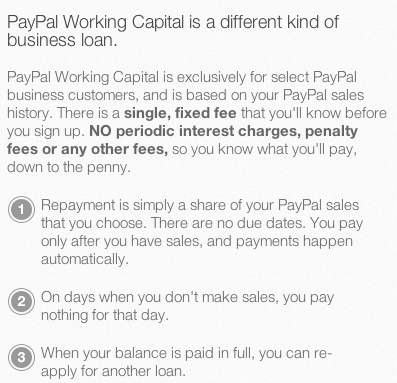 A few weeks ago, PayPal announced the launch of their Working Capital program as a way to help small businesses in need. They classify it as a loan but the explanation for how it works is textbook merchant cash advance. A percentage of each PayPal sale is withheld and applied as a reduction to the merchant’s balance. PayPal joining the booming merchant cash advance/alternative lending market is really no surprise. After all, RapidAdvance just got acquired by the same group that owns Quicken Loans. We’re in a new era of alternative finance.
PayPal is respected as a payments company but are they ready for the high risk world of merchant cash advance financing? Critics are not so sure. Industry insiders have watched dozens of funding providers jump into the market with aggressive rates, attempt to undercut the competition, and acquire a lot of marketshare. The results are usually disastrous.
For years, journalists believed that the high cost of capital provided by non-bank lenders was fueled by the desire for immense profit. They didn’t understand the risks involved or realize that some funding providers weren’t even turning a profit at all. Last year, Opportunity Fund, a non-profit small business lender revealed that to make loans at 12% APR would fail to even cover costs. The for-profit sector of the industry charges factor rates (different than Annual Percentage Rates) between 1.14 and 1.50, not including fees. I explained this variance once before in The Fork in the Merchant Cash Advance Road.
So did PayPal learn anything from an industry that has been in existence for 15 years? It doesn’t look like it:

Doing some simple math (Total to be repaid / Loan Amount), the factor rates range from 1.04 to 1.12, figures that will probably only make sense if their average client has greater than 720 FICO, many years in business, and is virtually perfect on paper and in reality. Perhaps PayPal knows that and will decline 95% of applications or perhaps they believe their clients will buck the trend. I mean, is it possible that a corporate monster like PayPal could make a boneheaded mistake?

A 1.04 deal? Seriously? This has disaster written all over it. There are some people that believe that the losing proposition is intentional…
You can follow the discussion about this on DailyFunder.
When Merchant Cash Advance isn’t the Right Fit
August 12, 2013 “I know you do a million in gross sales monthly but since you process only $5,000 in credit cards, we can only approve you for $7,000.”
Before ACH repayment became mainstream, the MCA industry was incredibly restrained in its ability to help businesses. A merchant seeking a half million dollars with the cash flow and size to back that request up was being told that the absolute best they could get would be maybe $10,000, and that’s with a 100% holdback in place instead of the industry standard max of 30-35%. It was an awkward sale for both parties.
To pitch a business owner generating $12 million a year in sales a paltry $10,000 is like telling your boss that the only thing you did at work this month is forward a single e-mail. To the business owner, they’re probably left wondering if lending really has dried up that much or perhaps they’re wondering if they’re just talking to the wrong people. Some of these mismatched situations actually turn into closed deals. I can personally remember one where a semi-serious request for $2 million became a $6,000 signed contract. I think they waited only 24 hours before applying for a renewal. The majority of these sales calls go nowhere though because what’s being offered is not a fit for what is needed.
It’s okay to have mismatches in life. As a salesman, your product is not the right solution for EVERY problem, no matter what your rebuttal script says. If a man is wheeled into an emergency room with 7 deep stab wounds, Johnson & Johnson is going to have to pass up the opportunity to offer him Band-Aids as the answer. A million Band-Aids might work, but they’re not the right solution.
In 2013, I am hearing a wider call to diversify product offerings to stay competitive. Yes, offering a fixed daily repayment loan based off of gross sales is a nice way to compliment the purchase of future credit card sales, but that’s not really diversity anymore, that’s a necessity to stay alive. By really diversifying, I’m talking about financial products beyond daily repayment loans and advances. Almost everyone agrees that being able to service more deals is a good thing but when it comes right down to it, they may see it as a distraction from their main focus.
We’ve all seen a friend or two bite off more than they can chew by trying to broker an SBA loan or commercial real estate deal. There’s no shortage of financial companies sitting on the periphery of the MCA industry waving a flag that says “if a deal isn’t compatible for you, then send it our way.” They don’t really speak the MCA language though and they expect you to do a lot of the closing and negotiating on your own. Some of these deals take months to process and if the lender believes the deal is only a one-time thing, they might not even pay you for it. Ugh! Looking at it from this perspective, perhaps it’s better to just stick with MCA and let every other type of deal fall by the wayside, that is until you look at your marketing expenses again and wonder…
An inbound lead is one that you’ve already paid for, so if they’re not a candidate for a daily repayment loan or advance, then what is the most efficient way to monetize and service them? Who can you really depend on to make servicing it a reality and how long will it take? How easy will it be? I searched beyond the industry for answers but began to find them inward. It seems New York City based Strategic Funding Source has recognized the need for product diversification and is eager to assist account reps in servicing more clients and closing more deals. Your marketing dollars are already spent, so now it’s time to monetize what they’re bringing in. There is a universe beyond daily repayment deals and if you hope to stay ahead of the curve, I recommend you become intimately familiar with programs like invoice factoring and accounts receivable factoring. You can and should be doing deals of this nature every month, not once in a blue moon.
While I like to consider myself knowledgeable on a wide range of financial topics, Lenny Leff, who heads Strategic Plus, a new division of Strategic Funding Source, has offered to write his own regular column on Merchant Processing Resource.
I spoke to David Sederholt, Strategic Funding Source’s COO, about this first in regards to Lenny’s role at the company:
“Through this new division of Strategic Funding Source, led by Lenny, we can say ‘yes’ to more businesses seeking capital to grow and are not limited to cash advance and loan products. We take a human approach to financing and know that the needs of small business owners are as diverse as the businesses themselves. With more product offerings, we are able to continue to be true partners to the small businesses we finance.”
– David Sederholt, Strategic Funding Source COO
Lenny’s posts will provide guidance and information about opportunities outside of MCA. After a few in-person meetings, I think he is uniquely positioned to discuss this topic, especially considering his prior experience in the MCA industry. I asked if Lenny would introduce himself in this post and he added the following:
“I am happy to be joining Strategic and look forward to sharing my 15+ years experience in factoring and asset based lending. The blog will give business owners and ISOs the opportunity to learn more about the different solutions and alternatives available when they go to someone offering a one-stop shop; Purchase Order Financing, Invoice Factoring, Equipment Leasing, Healthcare Lending to Business Loans and MCA. Our goal is to expand the knowledge within our community and help our partners find customized financing for their clients. We are thrilled and excited to share our insights with Sean and the Merchant Processing Resource site.”
– Lenny Leff, Strategic Plus
When the deal doesn’t fit, will you try to sell it anyway? Will you throw it out? Or will you try to monetize the lead you’ve already paid for? I don’t like the first two options… and I’m sure many of you don’t either.
Learn more about Strategic Plus at http://www.sfscapital.com/news/view/3596
Contributors
David Sederholt
Lenny Leff
Discuss factoring on DailyFunder
http://dailyfunder.com/showthread.php/353-PO-Financing-Factoring/page2