Reactions to the Treasury RFI: Business Lenders and Merchant Cash Advance Companies Share Their Thoughts
August 13, 2015 The Treasury Department could get an earful from the alternative funding industry during a 45-day public comment period on online marketplace lending that began July 17.
Treasury emphasizes that it isn’t a regulator and its Request for Information, or RFI, isn’t a regulatory action. The department just wants to hear success stories and opinions on potential public policy issues, a Treasury spokesman said.
“There isn’t a lot of data available on this industry,” the spokesman noted. “The RFI allows us to gather information from the public.”
One portion of the public – alternative funding executives – may have a lot to say on the subject. At least some of the industry’s top players favor regulation or legislation that could clean up the industry and clarify conflicting directives.
“Personally, I’d be glad to see it on the federal level,” Stephen Sheinbaum, president and CEO of Merchant Cash and Capital, said of regulation. “We won’t have to deal with 50 individual states, which is more unruly.”
Others would prefer to see the industry regulate itself instead of having federal agencies issue dictates or having Congress pass laws.
“I would like to put in my two cents,” said Asaf Mengelgrein, owner and president of Fusion Capital, indicating he intended to respond to the RFI. “I see a need for better practices, but regulation should come internally.”
Whoever makes the rules, restrictions seem inevitable because of alternative funding’s prodigious growth, executives agreed. “Regulatory attention is a sign of an emerging industry,” said Marc Glazer, president and CEO of Business Financial Services.
Regulation should curb the practice of stacking loans or advances, which can burden merchants with more financial obligations than they can meet, Sheinbaum said. Stacking has proliferated even though ethical members of the industry avoid it, he said.
At the same time, disclosure statements should become more transparent so that merchants can easily identify how much they’re paying in fees and expenses, Sheinbaum maintained. Merchants should also be able to see how much they’re paying the different entities involved in the deal, he said.
“I’m not suggesting someone should make more or less, but transparency is a healthy thing and this industry could use a little more of it,” Sheinbaum said.
 The alternative-funding industry could follow the example of the mortgage business, where more-standardized forms help consumers compare competing offers, Sheinbaum said. “That’s not the case in this industry, so that might help,” he maintained.
The industry should not emulate the credit card processing business, which uses complicated and dissimilar contracts to keep customers uniformed, Sheinbaum said. “It’s not so easy for a merchant to understand the effective cost of a transaction – and that’s by design,” he said.
Reviewing those issues could confuse among regulators who don’t understand the industry, Mengelgrein warned. Someone “on the outside looking in” might consider the industry’s fees and factor rates outrageously high, but that’s because they fail to understand the financial risk involved with lending to small businesses, he said.
Before imposing rules, regulators should also bear in mind that many small businesses could not survive without alternative funding, Mengelgrein continued. In recent years banks have failed to step up and help merchants in need of cash, and the alternative lending community has filled the gap.
Sheinbaum agreed. “I hope the regulators and legislators will make an earnest effort to understand all the good that folks in the alternative finance space provide for people,” he maintained. “It’s a critical role we play in keeping small businesses going, and small business is important to this country.”
The Small Business Finance Association could play a critical role in helping government understand the industry, Sheinbaum suggested. He noted that the trade group changed its name from the North American Merchant Advance Association because the industry is adding loans to its initial offering of merchant cash advances.
Whatever shape regulation takes, the industry should keep up with the new rules, Glazer cautioned. “As this industry evolves, we will work closely with our partners and our customers to ensure that everyone is informed about any new regulations and the potential impact that they may have on our business,” he said.
Meanwhile, Treasury’s efforts to comprehend the business are continuing. Its RFI contains 14 detailed questions that respondents could address.
The department held a forum on Aug. 5 called “Expanding Access to Credit through Online Marketplace Lenders.” The event included two panel discussions and roundtable discussions with Treasury staff.
Attendees numbered about 80 and included consumer advocates, representatives of nonprofit public policy organizations and members of the financial services industry, the department said.
Strategic Funding Source Increases Borrowing Capacity to $90 Million with New Revolving Credit Facility Led by CapitalSource
July 15, 2015 Strategic Funding Source, Inc., a leading provider of direct financing to small and midsize businesses, today announced that it has closed on a $90 million revolving credit facility. Led by CapitalSource, a division of Pacific Western Bank, the loan agreement includes continued participation from East West Bank and the addition of BankUnited to the lending group.
“Gaining access to the capital needed to grow continues to be an issue for many of America’s hard working small business owners and our industry plays a crucial role in addressing that need,” said Andrew Reiser, Chairman and Chief Executive Officer, Strategic Funding Source. “With the support of our outstanding bank partners we have now more than doubled our borrowing capacity. Coupled with the $110 million line of equity financing we secured from Pine Brook in August 2014, we are poised to significantly expand our footprint in the robust and evolving small business lending space.”
Strategic Funding Source provides loans and cash advances to small businesses by combining advanced technology and insight based on years of experience as small business owners and financial industry experts. The company works directly with small business owners to identify their capital requirements and creates flexible, tailored financing options that suit their individual business models.
About Strategic Funding Source, Inc.
Strategic Funding Source finances the future of small businesses utilizing advanced technology and human insight. Established in 2006, the Company is headquartered in New York City and maintains regional offices in Virginia, Washington state, and Florida. Strategic Funding Source has served thousands of small business clients across the U.S. and Australia. Visit www.sfscapital.com to learn more about the Company, its financing products and partnership opportunities.
Merchant Cash Advance: Do You Know What You’re Selling?
June 22, 2015 Continuing on with the Year of The Broker discussion, I want to now shift focus to the continued wave of new broker entrants that are not receiving sufficient training. I don’t believe that it’s so much the fault of the brokers, as it’s the fault of the companies they are reselling for. Those companies usually fail to provide a structured training regime. Training provided to new broker entrants is typically centered around the memorization of sales scripts, the practice of outdated rebuttals, and the repetition of lines that can end up sounding very canned and robotic.
If I had to recommend new age sales training, I’d have to go with my favorite, which is Diagnostic Selling, promoted by the likes of Jeff Thull from Prime Resource Group (www.primeresource.com). Thull explains that as the sales consultant, you should be a valued source of business advantage for your client, rather than just a person that goes through a series of sales material regurgitation. You should have access to products, services, platforms, big data, knowledge, key players, new solutions, forecasts, trends, etc., that the merchant does not have access to, which allows them to see you as a “valued extension” of their organization. This leads to not just new client acquisition, but the real key to making money in our space, and that’s client longevity.
In order to truly achieve this level of sales consultancy, it’s important that you truly understand the products being sold because, firstly, you want to be able to distinguish between the products you are selling so that you can provide a valued consultation. You might find yourself selling one product when you should be referring another. Secondly, understanding these products is important from a regulatory standpoint as the legal connotations of the products must be disclosed properly or mistakes in disclosure, marketing, or funding agreements could become costly.
If you are an independent broker in the alternative commercial lending space, you are usually going to be selling one or multiple of the following products:
- The Merchant Cash Advance
- The Alternative Business Loan
- Equipment Leasing
- Accounts Receivable Factoring
- Accounts Receivable Financing
- Purchase Order Financing
To begin, let’s discuss the Merchant Cash Advance…
Product Value Points
Don’t Let The Critics Win
Critics of the product focus mainly on its high cost and it can be very expensive, but when used properly the product is a great leveraging tool.
Critics fail to shed light on the value of the product in terms of the merchant’s usage. Going back to that Growth Investment example, if the product had not been available, then what were the other sources available for the merchant to take advantage of the growth opportunity? In actuality, there were no other credible sources. Had the Merchant Cash Advance not been available, that investment would not have been made, and a ton of national, state and local economic activity would not have taken place, such as:
- The Equipment Manufacturer’s sale of the equipment
- The Merchant’s generation of $300,000 in revenue based on having the equipment
- The Purchaser’s revenue from borrowing costs incurred from the client using the advance
- My individual commission
- Then all of the federal, state and local taxes that would have been paid as a result
All of that economic activity vanishes if said transaction does not take place. Despite the high cost of the product, the fact is that this transaction would have been a win across the board for all parties involved including the Manufacturer, the Client, the Purchaser, Myself, as well as the Federal/State/Local Government. The true value of business capital, no matter if it’s conventional or alternative, is that the capital should produce enough new revenues so that it truly pays for itself.
The Co-brokering Phenomenon: In Business Loans & Merchant Cash Advance
May 25, 2015 Meet the broker’s broker, the middleman serving the middleman. Some call this co-brokering since both parties will typically share in the commission.
Wait, what?
The broker’s broker might have relationships that the little broker does not. They could have leverage over their funding partners because of the amount of volume they can produce or the amount of professionalism they bring to the table. And they likely have a canny ability to close deals that otherwise would get tossed by the wayside.
Disintermediation is the war cry of today’s famous tech-based lenders but in the Year of the Broker, reintermediation has been the unforeseen byproduct. Big lenders such as OnDeck are shedding third party funding advisors but those advisors aren’t magically going away.
A number of them are still getting their deals funded at OnDeck, just indirectly. They have to go through a broker whom OnDeck has not cut off, a handful of salespeople have told me. Many brokers acknowledge that OnDeck’s rates and terms are not easily attainable elsewhere so they’d rather share a commission with an OnDeck approved broker than risk a dead deal with no commission.
And CAN Capital is known to offer comparable pricing to OnDeck but it’s been reported that new brokers must go through a rigorous audit before CAN will accept their business. It’s not something everybody wants to go through.
With the two largest funders in the industry imposing real barriers to doing business with them, sanctioned brokers play toll booth operator for the swarm of shops that can’t get their deals submitted without them.
Perhaps as a direct result of that, there is now an entire niche of brokers whose only business is brokering deals for other brokers. They have little to no interaction with merchants. They have no marketing budget. They might not even have a website. And they play an almost mystical role of gatekeeper and power broker.
Onesy-twosy woes
A strong focus within the industry has been growth. There’s a lot of time, resources, and salesmanship that goes into courting the lucrative partnerships. Large funders, especially those with VC backing, are typically not interested in mom and pop broker shops. “If they’re only going to send one or two deals per month, we don’t want them,” I’ve heard time and time again.
Even five to ten deals a month can draw yawns. It’s nothing particularly against the mom and pop brokers, but experience has apparently shown them that the same amount of resources are spent on the onesy-twosy brokers as the ones doing a hundred deals a month. The cost benefit analysis has to make sense, they say.
That’s left hundreds or perhaps even thousands of mom and pop brokers to fend for themselves. What outsiders might not seem to realize is that the commission on a $50,000 loan or advance can be $5,000. That’s potentially enough for a stay-at-home parent to pay for the rent, groceries, and all the other bills. A onesy-twosy broker might be completely insignificant to a funder doing a billion dollars worth of deals a year, but to a mom and pop broker, it only takes one deal to pay their bills and only a handful to make them rich, especially if they live in middle America where the cost of living is cheaper.
In From Lowes to Loans, superstar broker William Ramos said he made $66,000 on just one deal alone. While his shop produces more than a million dollars in deal flow a month, it’s easy to see what’s drawing the hoards of newbies in. A $66,000 commission might be the only commission someone needs for an entire year.
There is no licensing required so becoming a broker is as easy as imagining that you are one. And as the space invites the less knowledgeable, a more sinister element has found opportunity as well.
Shady
 “There is no president/ruler of the MCA world that can help you with your commission debacles,” wrote PSC’s Amanda Kingsley on an industry forum. That was part of her reply to a thread titled, co-brokering scumbags. The thread might be new, but the circumstances aren’t. A broker sent their deal to another broker who got the deal closed with a funder. The original broker supposedly got screwed out of the commission.
It’s a case of stolen deals. “You just have to find the right people to work with. There are a lot of shady characters in this industry,” wrote another user.
1st Capital Loans Managing Member John Tucker, who recently authored, Broker Business Planning, wrote in reply to the thread, “Get everything in writing and research your lender/partner heavily before contracting with them. Talk to other brokers and ask them about their experience with said lender/partner in terms of paying on new deals, renewals and residuals. Get a ‘feel’ for them.”
Several faulted the aggrieved party for not taking the time to hammer out a contract that would allow them to rectify the situation easily through a lawsuit. But even with a contract, pursuing the offender legally could cost more than the commission lost. A stolen deal might cost a broker a few hundred or a few thousand dollars, figures worthy of small claims court.
“Under no circumstances would I ever co-broker a deal,” wrote Tucker. “There’s just no reason to unless you are a newbie and getting trained by said broker.”
But another user wrote, “Sometimes you don’t even know you are co-brokering until after the fact.”
Unscrupulous brokers will be purposely deceitful but for others walking the thin line between broker and funder, it’s difficult to judge what constitutes direct. There are brokers that wholeheartedly believe that if any portion of their own funds are invested in a deal, then they too are a direct funder. That means a broker that syndicates with a variety of funders could be so inclined to identify themselves as a direct funder by extension.
Kingsley wrote, “You have to understand what a ‘broker’ is in this space and understand that it is A LOT different than brokering in another industry.”
She also pointed out that it’s not always the little guy that’s susceptible to becoming a victim, as could be the case if an early deal default leads to a commission chargeback. When that happens, the funder will take back the full commission on the deal from the broker of record. It’s the responsibility of that broker to claw back whatever split of the commission they shared with the sub-broker.
“The broker you sub-brokered for, can vanish,” Kingsley wrote.
Ban the bad guys?
Several industry veterans have suggested creating an ISO/funder blacklist for those that steal commissions or deals. The challenge is that a stolen deal is not always a black and white situation. Often times there are expiration dates built into contracts that allow funders to claim deals if they have not been closed by the submitting broker within a specified period of time. Other times it’s a case of miscommunication, or the victim conveniently left out key details that would certainly add a degree of color to the situation.
Calling out an offender online can quickly devolve into a he said/she said schoolyard brawl. Unfortunately, this might be the only remedy a victim has, especially if they have limited financial resources to pursue legally, or the only evidence of their deal is a handshake or an email.
The bad guys, if they’re engaged in trickery on a large scale, tend to get identified rather quickly. There’s always a few that come in, burn a lot of bridges, and then find themselves completely ostracized from the industry. When the damage is done, they might never be heard from again or they might try to repeat the process by using a different name. Blacklisting a broker or funder wouldn’t be foolproof, especially if the company owner legally changes their name, which has actually happened before.
Trust
Through it all, Tucker offered this advice, “In a nutshell, the only true thing protecting your compensation is a very good relationship with an honest, credible and ethical lender.”
And if you have to go through a broker, make sure you choose the right one. Don’t blindly send your deal to somebody you met on a message board. An unscrupulous player will tell you exactly what you want to hear. Ask around for references. If nobody’s ever heard of them, chances are you’re talking to the wrong shop.
Even the author of that thread conceded that co-brokering offers benefits. “I’m all for co-brokering deals, especially if someone has a solution that may suit the client better than a traditional MCA or when an MCA wont work,” he wrote.
So there just may be a place for the broker’s broker, whether as a gatekeeper, power broker, or toll booth operator. And like it or not, reintermediation has ironically become a byproduct of disintermediation. There are sadly no algorithms that exist to vet how a broker might treat another broker. Co-brokering is a trade that relies on the most basic of basics, trust.
Nothing’s more valuable.
CAN Capital Hits $5 Billion Milestone
May 7, 2015NEW YORK, NY, May 7, 2015 – CAN Capital, Inc., market share leader in the alternative small business finance space today announced that it has provided small businesses with access to more than $5.0 billion of working capital, more than any other company in the space. During its 17 years in business, CAN Capital has leveraged its proprietary data-driven models, technology and customer-focused delivery to cement its position as the largest and most experienced alternative finance company serving small businesses.
To date, CAN Capital has facilitated over 156,000 small business fundings in more than 540 unique industries. CAN Capital’s customer base continues to expand and its digital business grew 600 percent in 2014.
“Reaching this milestone underscores how CAN Capital’s innovative technologies have helped small business owners access much needed capital to grow their businesses,” says Daniel DeMeo, Chief Executive Officer, CAN Capital. “Small business owners have an appetite for investing in inventory, marketing and technology. We facilitate fast approvals and fundings so business owners can spend time focusing on these goals and running their businesses – instead of searching for capital.”
In April 2015, CAN Capital broke records by securing a $650MM credit facility from a dozen leading lenders including two of the three largest US banks – Wells Fargo and JP Morgan Chase – as well as two large international banks – UBS and Barclays. This transaction marks the largest of its kind to ever occur in the alternative finance industry. “Our performance and reputation as the vanguards in the alternative finance space position us for more success, more growth and a greater ability to serve even more small business owners,” says DeMeo.
“Small businesses are an incredibly important part of the American economy. We’re proud we’ve been able to support them over the past 17 years, and look forward to continuing to do so with new products that will help drive future growth for us and our customers.”
Hear the stories behind some of our successful small business customers here: YouTube.com/cancapital1.
About CAN Capital
CAN Capital, Inc., established in 1998, is the pioneer and market share leader in alternative small business finance, having provided access to over $5.0 billion in capital for tens of thousands of small businesses in a wide range of locations and different business types. As a technology-powered financial services provider, CAN Capital uses innovative and proprietary risk models combined with daily performance data to evaluate business performance and facilitate access to capital for entrepreneurs in a fast and efficient way.
CAN Capital makes capital available to businesses through its subsidiaries: Merchant Cash Advances by CAN Capital Merchant Services, Inc., and business loans through CAN Capital Asset Servicing, Inc. (CCAS). All business loans obtained through CCAS are made by WebBank, a Utah-chartered Industrial Bank, member FDIC.
For more information, please visit: www.cancapital.com. Follow CAN Capital on Twitter and Facebook.
Merchant Cash Advance Was at Transact ’15
April 4, 2015The payments crowd was no doubt in the house at Transact ’15, but if you were wondering if there was anything else going on, check it out:
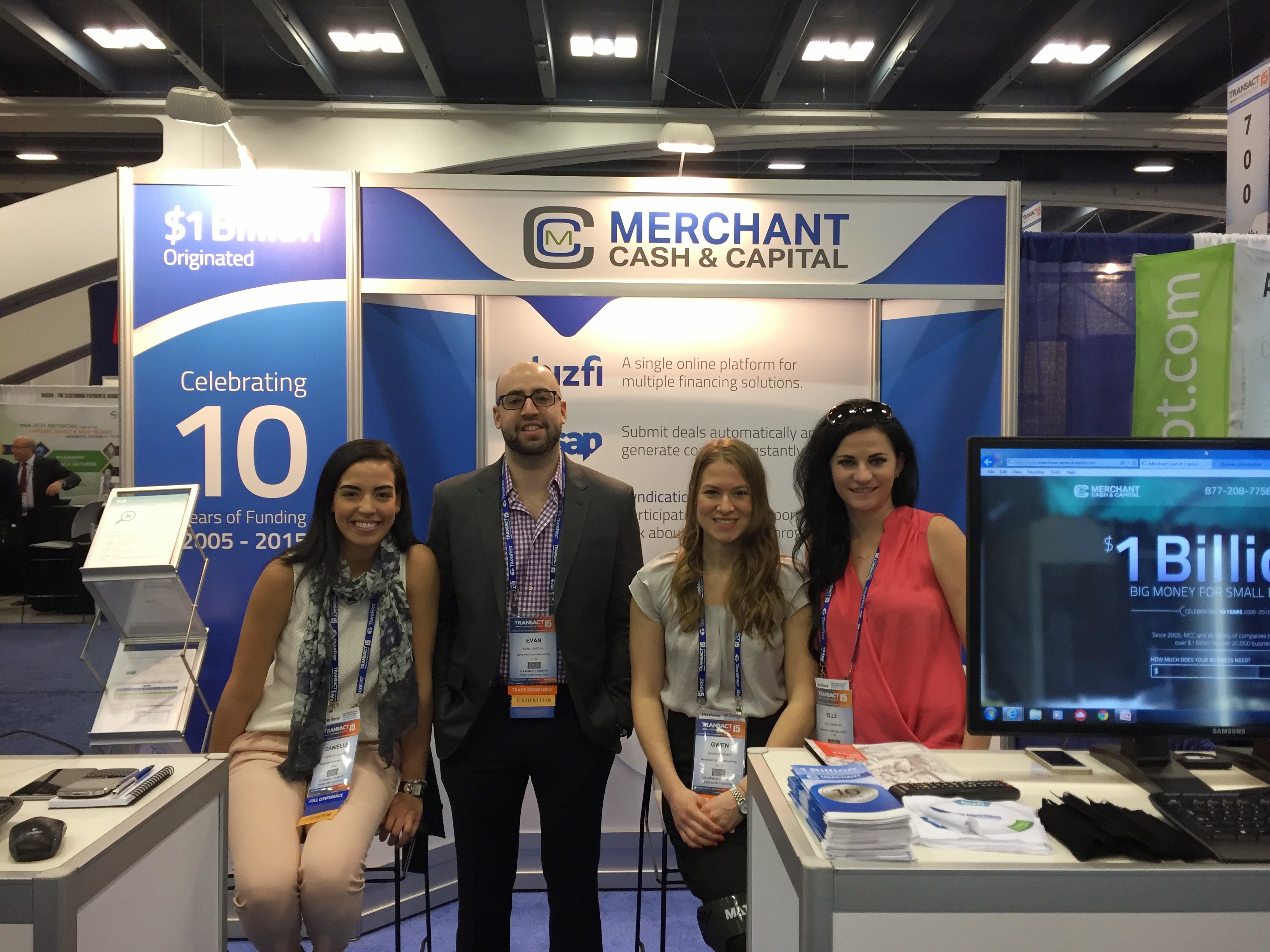

#TRANSACT15 – enjoying the show and having fun meeting new sales channels! #smallbusiness pic.twitter.com/1PxTVsUrbC
— RetailCapital (@Retail_Capital) April 1, 2015
Check out @CANCapital at @ElecTranAssoc on the exhibit floor. #TRANSACT15 pic.twitter.com/AVO3mJAyJh
— CAN Capital (@CANCapital) April 1, 2015

VPs Steven, Josh, Alan and Hellen will be at Booth 1600 this week to talk about #financing @ElecTranAssoc #TRANSACT15 pic.twitter.com/2cIy5Lfvp2
— Strategic Funding (@SFSCapital) March 31, 2015
Our dedicated Broker Services Manager is at #TRANSACT15 and ready to meet you! Stop by Booth 303 before the day ends! http://t.co/6Bl08VENoi
— National Funding (@NatFunding) April 2, 2015

Read: Is the MCA Industry Reverting Back to 2005?
A Peek Inside Yellowstone Capital
April 1, 2015When the banks say ‘no,’ alternative financing companies are saying ‘yes,’ sometimes. While costs may run high, there is still a limit on risk that a lender like OnDeck Capital and their competitors can accept.
In January of 2011, Kabbage stated their approval rate on volume-eligible applicants was only 55%. In February of this year, they said it’s about 80%. And a year ago, CAN Capital CEO Dan DeMeo told Forbes their approval rate was almost 70%. Similarly, a Biz2Credit report estimated the approval rate for alternative lenders in 2014 to be around 64% on average.
This indicates that approximately 20% – 35% of small businesses are being declined yet again. These are America’s exiles and they don’t fit into the neat little underwriting boxes that alternative lenders have crafted. Being declined by an alternative lender does not necessarily mean the business isn’t healthy or viable, but rather it could be because they exhibit some characteristic that today’s risk algorithms disqualify. Volatile sales activity, short time in business, poor credit, and atypical SIC codes are just a few of the reasons that a business could be rejected by a lender like OnDeck.
Consequently, an entire Plan C market has sprung up to service the small businesses that have been cast aside by the algorithms. And it’s huge. At the center of it all is Yellowstone Capital, a New York City-based merchant cash advance provider that has carved out its own niche. Founded in 2009, Yellowstone was one of a handful of pioneers that introduced ACH payments to an industry that relied entirely on split-processing.
 Yellowstone does not publish their annual funding volume, but according to insiders not authorized to speak on the record, the numbers dwarf many industry behemoths including Square Capital, a company that funded more than $100 million in the last twelve months. And there’s some interesting changes happening there behind the scenes.
Last year, Yellowstone gave up an equity stake to a New York-based hedge fund in exchange for capital. Just recently however, Yellowstone CEO Isaac Stern led a management buyout to reportedly better position themselves for growth.
As part of the arrangement led by Stern and backed by a private family office, the hedge fund has been bought out and Stern is the only remaining company co-founder to retain an equity stake.
Additionally, private equity turnaround expert Jeff Reece has come on as President. Reece is a former Director of Cogent Partners, a boutique, private equity-focused investment bank and advisory firm.
Josh Karp is remaining the company’s Chief Operating Officer.
Jake Weiser is staying on as General Counsel.
 Above all, the changes are more than just a few new faces in management. Yellowstone has already rented an additional floor at 160 Pearl Street, bringing the total floors they occupy there now to three.
Notably, the company has endured some negative press in the past of which they are well aware, but they have no shortage of supporters. I contacted two ISOs that claim to have worked with them and asked for their opinion on the Yellowstone experience.
Len Gelman of Allied Capital Corp couldn’t say enough good things about his account manager there, “He fights for every deal I submit, no matter how small or how difficult it may be to get done,” said Gelman. “He always takes my calls and responds to my emails and texts no matter how late it may be.”
And Arty Bujan of Cardinal Equity said, “Working with Yellowstone opened a door of business for me that really wouldn’t have existed without their unique approach to funding what some may call less desirable merchants.”
With a new management team and strong capital backing, Stern and Reece appear to be laying the groundwork to scale.
According to company insiders, Yellowstone is also working to expand their box beyond just high risk businesses and plan to service the middle market risk class. That would in effect also make them a Plan B option.
Their new underwriting depth could spare business owners from that second ‘no.’
Merchant Cash and Capital Hits a Billion Dollars
March 18, 2015I was there. In August 2006, a little startup in College Point, Queens hired its third and fourth employees. One of them was me. The company’s CEO Steve Sheinbaum hired us to be underwriters of a financial product that at that point didn’t really have a name. It would later become referred to as a merchant cash advance.
The company grew fast, almost too fast. By December of 2006, half of the company was working out of temporary offices in the Empire State Building. And when that no longer made sense, we leased a floor at 450 Park Avenue South in mid-2007 where Merchant Cash and Capital still has its headquarters today.
Fast forward to 2008, I was the most senior risk manager of the firm. As the Director of Underwriting, my direct reports were two underwriting managers. Below them were three or four team leaders. And below them were entry-level underwriters and their administrative assistants. I oversaw what was arguably the most important department leading up to the financial crisis. I really believe the hard work of all the underwriters and the seriousness of which they took their job is a huge contributing factor to why MCC survived when many of their competitors did not.
It is great to see them hit the milestone of $1 billion in funding. Congratulations.