A Peek Inside Yellowstone Capital
April 1, 2015When the banks say ‘no,’ alternative financing companies are saying ‘yes,’ sometimes. While costs may run high, there is still a limit on risk that a lender like OnDeck Capital and their competitors can accept.
In January of 2011, Kabbage stated their approval rate on volume-eligible applicants was only 55%. In February of this year, they said it’s about 80%. And a year ago, CAN Capital CEO Dan DeMeo told Forbes their approval rate was almost 70%. Similarly, a Biz2Credit report estimated the approval rate for alternative lenders in 2014 to be around 64% on average.
This indicates that approximately 20% – 35% of small businesses are being declined yet again. These are America’s exiles and they don’t fit into the neat little underwriting boxes that alternative lenders have crafted. Being declined by an alternative lender does not necessarily mean the business isn’t healthy or viable, but rather it could be because they exhibit some characteristic that today’s risk algorithms disqualify. Volatile sales activity, short time in business, poor credit, and atypical SIC codes are just a few of the reasons that a business could be rejected by a lender like OnDeck.
Consequently, an entire Plan C market has sprung up to service the small businesses that have been cast aside by the algorithms. And it’s huge. At the center of it all is Yellowstone Capital, a New York City-based merchant cash advance provider that has carved out its own niche. Founded in 2009, Yellowstone was one of a handful of pioneers that introduced ACH payments to an industry that relied entirely on split-processing.
 Yellowstone does not publish their annual funding volume, but according to insiders not authorized to speak on the record, the numbers dwarf many industry behemoths including Square Capital, a company that funded more than $100 million in the last twelve months. And there’s some interesting changes happening there behind the scenes.
Last year, Yellowstone gave up an equity stake to a New York-based hedge fund in exchange for capital. Just recently however, Yellowstone CEO Isaac Stern led a management buyout to reportedly better position themselves for growth.
As part of the arrangement led by Stern and backed by a private family office, the hedge fund has been bought out and Stern is the only remaining company co-founder to retain an equity stake.
Additionally, private equity turnaround expert Jeff Reece has come on as President. Reece is a former Director of Cogent Partners, a boutique, private equity-focused investment bank and advisory firm.
Josh Karp is remaining the company’s Chief Operating Officer.
Jake Weiser is staying on as General Counsel.
 Above all, the changes are more than just a few new faces in management. Yellowstone has already rented an additional floor at 160 Pearl Street, bringing the total floors they occupy there now to three.
Notably, the company has endured some negative press in the past of which they are well aware, but they have no shortage of supporters. I contacted two ISOs that claim to have worked with them and asked for their opinion on the Yellowstone experience.
Len Gelman of Allied Capital Corp couldn’t say enough good things about his account manager there, “He fights for every deal I submit, no matter how small or how difficult it may be to get done,” said Gelman. “He always takes my calls and responds to my emails and texts no matter how late it may be.”
And Arty Bujan of Cardinal Equity said, “Working with Yellowstone opened a door of business for me that really wouldn’t have existed without their unique approach to funding what some may call less desirable merchants.”
With a new management team and strong capital backing, Stern and Reece appear to be laying the groundwork to scale.
According to company insiders, Yellowstone is also working to expand their box beyond just high risk businesses and plan to service the middle market risk class. That would in effect also make them a Plan B option.
Their new underwriting depth could spare business owners from that second ‘no.’
Merchant Cash Advance Risks and Myths
October 24, 2014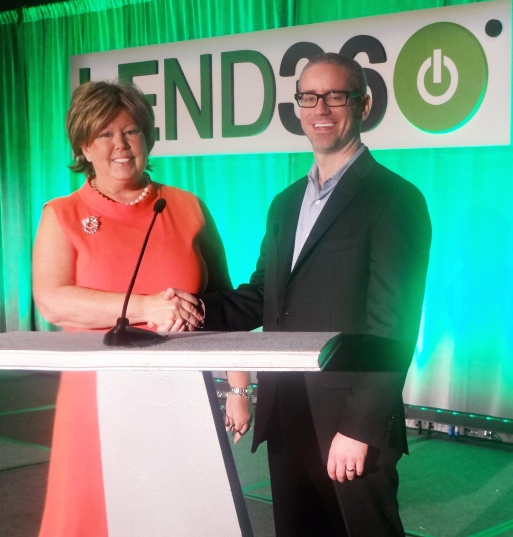 The Lend360 Conference in New Orleans last week had a different vibe from the five other conferences I’ve attended this year. For one, I was a partner in it through DailyFunder. And further, there was a huge focus on best practices, ethics, and regulations. Expert speakers and panelists aired it out to dispel myths and disclose risks.
Most telling about the future was a response from Victory Park Capital’s Brendan Carroll about whether or not he feared looming regulations could hurt the merchant cash advance and alternative business lending industry. As someone who has invested heavily in Kabbage and more recently in Square Capital, he expressed concern about regulations in general but clearly was not convinced they were on the immediate horizon for the industry.
Lisa McGreevy, president of the Online Lenders Alliance moderated the two-man panel which also consisted of John Hecht of Jefferies and she did a great job of digging out the true thoughts from one of the room’s most powerful investors. It’s unlikely a company like Victory Park Capital would invest hundreds of millions of dollars in an industry they believed faced imminent regulatory upheaval.
Merchant Cash Advance regulation is not on any regulator’s immediate agenda but they are doing their homework. At Lend360, it was revealed that several members of the North American Merchant Advance Association met with the Federal Reserve in Washington D.C. months ago for a Q&A. There’s communication occurring now on some levels. Even I’ve been contacted by the Federal Reserve to comment as a part of a broad research assessment.
Eventually I believe the CFPB will try to play a role in the industry through Section 1071 of the Dodd-Frank Act. We’re a long way from there though and it doesn’t mean they’ll be successful. Even internal operatives have expressed doubt on business-to-business jurisdiction.
In the meantime, it’s not all blue seas and sunny skies. Robert Cook, an attorney at Hudson Cook, LLP explained at the conference that the industry is already in many ways supervised by the FTC. And with the FTC, it’s not a question of how high the costs are, it’s about how transparent those costs are. If they’re high, fine, but do the customers understand them and are they marketed accordingly?
Terms like guaranteed, 99% approval rate, and lowest rates can be deemed deceptive if not true.
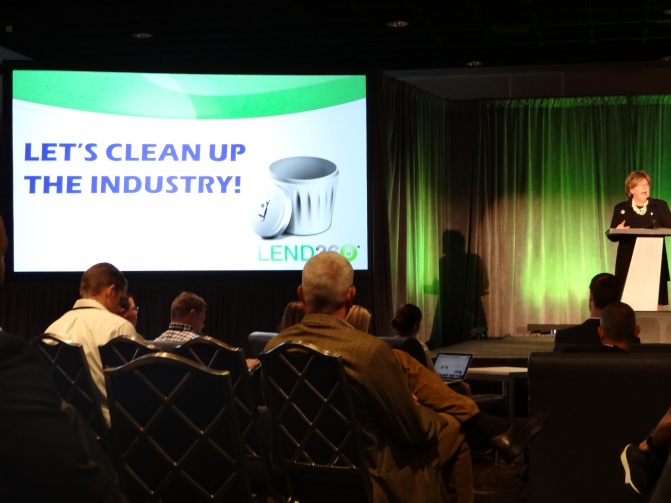 Transparency, ethics, customer experience, that’s what people in the business need to be focused on right now. Stacking, while a polarizing topic, seems to be a matter of contract law. Everybody’s caught up in the stacking debate believing it’s the lightning rod that will attract regulation. If left unchecked, it might draw interest, but it’s the fundamentals that get overlooked that could draw the ire of an agency like the FTC.
If your marketing says “rates from 1.10 and up”, while actually contracting 99% of your customers with 1.49s, that’s something you’ll probably want to address now. Think about the net cost your customer is likely to be charged. If a 1.10 is a buy rate and there’s a 10 point upsell, a 10% closing fee, and 10% origination fee that makes the end cost closer to a 1.40, you probably don’t want to market the cost as 1.10.
Right now it all basically comes down to doing good business in a transparent manner. Costs may be high but explain those costs, make sure the customers understand them. Don’t be deceptive. There will always be critics of high costs, but rational people are being exposed to the sober reality that you can lose money even at a 50% interest rate.
As a word of advice for new ISOs and brokers, stay away from funding companies that don’t even have a paid email account. If a funder is too financially strapped to afford a web domain, they probably are going to cut corners in other places too. The story about working off a gmail or hotmail account in the interim while they try to get their website set up is indicative that they’re getting ahead of themselves. There are way too many solid funding companies to choose from for you to entertain doing business with hotFunding4ISOsNow@hotmail.com. Even middlemen are accountable in the grand scheme of best practices and the customer experience.
Fund intelligently…
– AltFinanceDaily
Also read:
4/11/14 Regulatory Paranoia and the Industry Civil War
8/13/14 Should Licensing and Accreditation come to Merchant Cash Advance?
Did Google Penguin Hurt Your MCA Website?
October 22, 2014 Google struck again late on Friday the 17th with a refresh of the Penguin Algorithm. As posted on Search Engine Roundtable, the algorithm is still rolling out and will continue to do so over the next few weeks.
Those familiar with Penguin know that it targets backlinks, specifically: paid links, spam links, bad links, the whole gamut. Hit the trigger and your site can virtually disappear from search.
I monitor several keywords in our niche and I haven’t noticed much of a change between what I see now and what I saw prior to the 17th. Truthfully, some of the companies I see popping up now in the first 2 pages are exactly the type of companies I’d expect to see on a list offline. That’s a good indicator that something is going right.
The exact search results are different for everyone but amongst the top 20 results for the search term merchant cash advance, I get:
- OnDeck
- Kabbage
- AmeriMerchant
- Business Financial Services
- Capital for Merchants
- CAN Capital
- Merchant Cash and Capital
- Retail Capital
Years ago through spam manipulation, the first few results were dominated by random lead generation sites like fastcashfunding4unow.com. I see very few sites like that these days ranking well.
If you were wondering where your organic site traffic went in the last week, there’s a good chance you got Penguined. Good luck getting out of that!
Industry Takes ALS Ice Bucket Challenge
August 24, 2014Have you been nominated to take the ALS ice bucket challenge yet?
Kabbage below:
Their video made the local Atlanta news.
OnDeck in Times Square NYC:
Noah Breslow, their CEO also did it:
Funding Circle:
PayPal
Coincidentally, in the industry’s 2012 fantasy football competition for charity, league winner Sure Payment Solutions chose to donate all funds raises ($7,100) to the ALS Association.
Whether you get nominated or not, you can donate at http://www.alsa.org/.
Feel free to tweet @financeguy74 if you or your company accepted the challenge. 🙂
The Missing Puzzle Pieces
July 24, 2014 About 1% of my LendingClub consumer loan portfolio bounces their very first payment. It’s discouraging stuff, especially considering these loans range between 3 and 5 years. Granted, most manage to get caught back up at least for a little while.
LendingClub, like the rest of the alternative lending industry relies on ACH debits to retrieve those monthly payments. I’ve published my feelings before on single monthly debit payment systems (they’re like roulette). Out of 30 days of the month, you’re betting on the balance being available on just 1 particular day. When I noticed that 1% of my borrowers were failing right out of the gate, it validated two practices that originated in the merchant cash advance industry, daily payments and the analysis of historical cash flow.
For all the underwriting data points that LendingClub offers its investors, I don’t get to see average daily bank balance, overdraft activity, NSF data, or anything at all related to the borrower’s bank account. Ironically, many merchant cash advance companies consider that data to be the single most important piece of assessing a deal.
The problem my 1%-ers have is not a credit problem or a stable income problem, it’s a cash flow problem. You can have 750 credit and be broke. You can have a good job with a hefty salary and be broke. You and I knew this already, which is why it’s odd that LendingClub and other p2p lenders like them still rely mainly on employment data and FICO score.
What I want to know is if the borrower is broke…
That’s something that LendingClub can’t tell me and doesn’t know. Hence a good looking borrower like the one mentioned below, missed the first payment. That led to a negotiation for a reduced monthly payment. They then failed to pay even the reduced amount.
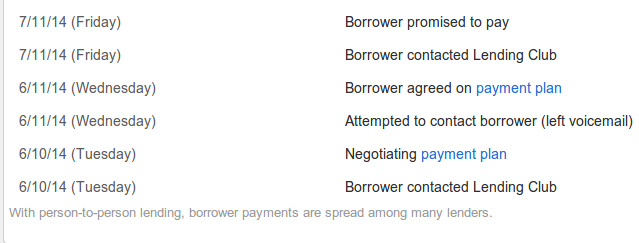
This was a very low risk B1 note. The borrower is a nurse that has worked at their current job for 5 years. They had over 700 credit and very little revolving debt, only $5,500 (compared to some on the platform that have more than 50k!). It was a 3 year loan and it has blown up in my face.
The borrower is broke and nobody knew it.
 The Missing Puzzle Pieces
This borrower may very well have done better with a change in how the deal was both underwritten and structured. With daily payments:
- The borrower will know exactly how much cash they can really spend on any given day. They don’t have to worry about trying to set aside for that one big day.
And
By examining their last 3 months bank transactions:
- Their payment plan will be based on more relevant data. There are 3rd party tools like yodlee that consumers could connect their bank accounts to, so at the very least LendingClub could see what’s really going on. Why business lenders consider this essential while consumer lenders completely ignore this, I don’t understand. Business lender Kabbage for example requires applicants to connect their bank accounts in the application process before they even type in their business address. It is the single most important part of their underwriting.
Picking loans on LendingClub is like trying to complete a puzzle without half the pieces. If you guessed the puzzle on the right was an ocean scene with dolphins playing because of the pretty blue border pieces, you were wrong. It’s actually a picture of a guy on a boat holding a bank statement that shows a negative $3,000 balance and 10 NSFs.
Oops…
Does Culture Make a Difference?
June 30, 2014I came across this video that describes the work culture of Kabbage, an Atlanta-based business lender. It’s strikingly different from the way many of the MCA and business lending companies in New York operate.
Though New York is well-known for its medieval dungeon-like office environments, especially for smaller companies just getting started, do it too long and you start to believe that offices are like that everywhere.


What do you think? Is the Kabbage work environment more conducive to productivity and growth?