
Ten Days
September 28, 2012 It’s been ten days since Kabbage announced they had raised $30 million to fuel the growth of their Merchant Cash Advance (MCA) operations at home and abroad. MCA is changing faster than we can report it:
Former Yahoo CEO joins Kabbage. Hello Silicon Valley takeover! Quotes from the story:
Kabbage is providing an old service, merchant cash advances, with a new twist
Did they just call merchant cash advances old?
Kabbage is rapidly reshaping the small business financing space in the same way that PayPal reshaped the payments space over the last decade
Start believing this…
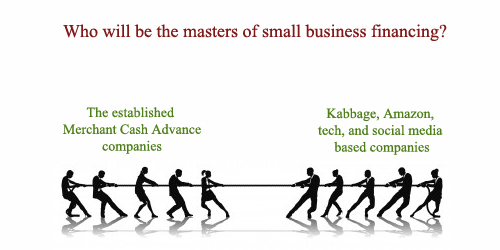
Amazon enters the MCA industry with a new division called Amazon Lending. Quotes:
Amazon is lending up to $800,000 to some merchants, Wingo said, adding that this is a pretty aggressive entrance into merchant financing.
Merchant financing…quite possibly the term that will replace “merchant cash advance” in the next couple years. Notice AMEX’s advance program is called the same thing. Trend anyone?
Amazon is competing against a start-up called Kabbage, which extends cash advances ranging from $500 to $50,000
They apparently don’t feel anyone else is a threat in the online space.
“We’re flattered that Amazon is building a business modeled on ours,” said Kabbage co-founder Marc Gorlin. “It’s validating that big companies are getting into the small business financing space.”
Dear Kabbage, you did not invent this model.
The kicker to Amazon’s new program? They charge up to 13% interest annually, on pace with what a little company in California named Opportunity Fund claimed was flat out unprofitable. Does that make them yet another new company walking around with a giant Kick-Me sign on their back? Some industry insiders would argue that offering these low rate programs are like swallowing dynamite.
We did a little bit of digging on this new program to see exactly what Amazon was up to. One of their prospective merchants posted this excerpt of the fine print:
Subject to applicable law, you will be in default under this Loan Agreement if any of the following events occur: ……..
(iii) your gross merchandise sales on Amazon.com as reported in your Seller Account (“GMS”) in any month is less than 50% of your lowest GMS on Amazon.com in any of the prior 12 months,(iv) the collective value of your units stored in Amazon fulfillment centers in the US, based on your list price of those units on Amazon.com, (“FBA Inventory Value”) in any month is less than 50% of your lowest FBA Inventory Value in any of the prior 12 months,
Except as otherwise required by applicable law, if you are in default, subject to any right you may have under applicable law to receive notice of and to cure such default, you agree that we may in our sole discretion exercise any remedy available to us at law or equity or take any or all of the following actions: (I) declare the unpaid balance of your Loan to be immediately due and payable, (II) enforce our rights as a secured party by directing Amazon Services LLC to reserve, hold, and pay to us an amount up to the unpaid balance of your Loan from your Seller Account disbursements until the unpaid balance of your debt under this Loan Agreement is paid in full, (III) enforce our rights as a secured party, by taking possession of your units stored in Amazon fulfillment centers and disposing of them in accordance with the Uniform Commercial Code,……………..
If this Loan Agreement is referred to an attorney (who is not our salaried employee) to collect the amount you owe or otherwise enforce the terms of this Loan Agreement, you agree to pay our reasonable attorneys’ fees, court costs and other costs of collection to the fullest extent not prohibited by applicable law.
6. Financing Statements. You authorize us to file and, as we may deem necessary or desirable, to sign your name on any documents and take any other actions that we deem necessary or desirable to ensure that our security interest in any item of inventory or your Seller Account is properly attached and perfected.
There’s some language in there that would make a lot of MCA companies jealous, particularly the section that states a 50% drop in sales is an automatic default!
Thoughts? Share them on DailyFunder.
– Merchant Processing Resource
../../
The End of an Era
September 19, 2012It’s the end of an era. Sound ominous for a blog that reports on the Merchant Cash Advance (MCA) industry? It shouldn’t. In the last 10 years, MCA firms played in the minor leagues. No one was really paying attention to them and truthfully, a lot of critics didn’t think this business model would still be around. But today it still stands, funders are still funding, and this blog is practically struggling to keep up with the incredible amount of action that is taking place. Coincidentally, 2012 marks the end of the Mayan Calendar. Yes, it’s the end of an era.
MCA Goes From 0 to 60
There were a few big firms in the Mid-2000s (RapidAdvance, Merchant Cash and Capital, Strategic Funding Source, AdvanceMe, etc.) and they’ve all experienced modest success. It was “modest” in the sense that it is nothing compared to today’s standards. The level of play is changing. Wining and dining an Independent Sales Office (ISO) that could bring in $300,000 a month in deal flow used to be all the rage. 300k for one company was 300k less for a competitor. An extra point of commission here or a freebie approval there was enough to make you the big dog in town, at least for awhile. Despite all the supposed innovation and growth, the talent pool remained the same. Lead generators became agents, agents became ISOs, ISOs became syndication partners, syndication partners became funders, and funders became technology companies that were basically clearing houses for groups of funders. If the industry was Sally, Joe, and Tom in 2005, it was still Sally, Joe, and Tom in early 2011, just with new company names or titles. Then everything changed…
Money poured in:
Merchant Cash and Capital Announces $25 Million in new financing 10/4/11
Snap Advances raises $3 Million from TAB bank 11/21/11
Capital Access Network raises $30 Million 2/7/12
RapidAdvance Receives new financing facility through Wells Fargo 4/2/12
1st Merchant Funding | $5 Million re-discount line of credit from TAB bank 6/12
Strategic Funding Source secures $27 million 6/27/12
On Deck Capital raises $100 Million 8/23/12
Kabbage raises $30 Million 9/17/12
Industry insiders loosely redefined what a Merchant Cash Advance was:
Merchant Cash Advance Redefined Merchant Processing Resource 3/25/12
Big companies entered the market:
American Express Announces Their Own Merchant Cash Advance Program 9/22/11
PayPal Pilots Merchant Cash Advance Program in the U.K. 7/13/12
Some funders became licensed lenders in major states such as California:
A New Chapter Opens for Merchant Cash Advance The Green Sheet 6/25/12
Search the California licensed lender registry
New products formed:
FundersCloud creates platform to raise capital and find syndicate partners faster 8/29/12
A charity announces a new way to make subsidized business loans using the split-funding method 9/6/12
These barely scratch the surface of industry events. What used to be a competition to score the local neighborhood ISO has morphed into a race to be the first to partner up with Facebook, twitter, Groupon, and Square. Anyone not moving full speed ahead to integrate technology and social media will be gone in the next 24 months.
May 18, 2012 was the first time we noticed and commented on what was happening. In How The Facebook IPO Affects the Merchant Cash Advance Industry, venture capitalists and Silicon Valley had finally found MCA and there’s no hiding from them. Now it seems all of our far-fetched predictions are not only coming true, they’re happening moments after we predict them. In our last article we instructed everyone to keep their eyes on Kabbage. Six days later they announced they had raised $30 million in new financing and would be expanding overseas. For a company that makes wild claims about the correlation of facebook fans with account performance, all while humorously being named after a boring vegetable, they sure seem perfectly able to threaten the status quo. Nobody dared touch Ebay or Amazon businesses until they came around.
Price
On the cost basis front, the middle ground is eroding even further. We first discussed this phenomenon on April 25, 2011 in The Fork in the Merchant Cash Advance Road. In it, we explained that the combination of competition and defaults were placing downward pressure and upward pressure on price at the same time. Today, there is surging demand for “starter deals” at 1.49 factors that are payable over 3 months at the same time that more and more new lenders are offering 1 year loans at 10%. The low rate, 12-18 month term deals are nothing new. A few funders tried them in the past and most suffered irrecoverable consequences. This is history that the new players didn’t witness.
Some outsiders view the MCA industry as a bunch of Wall Street guys that got fat, happy, and disincentivized to lower costs. On the contrary, one only needs to take a single look at this chart to realize that undercutting the entire market isn’t so genius after all. How can a funder survive with extremely low margins when 15% – 71% of their target market is likely to experience problems repaying their loans? These aren’t our stats, these are FICO’s:

Veteran industry insiders know this and acknowledge that the coming tide of low rate financing is a bubble that has burst before. On the DailyFunder, a few folks have offered this insight:
The mca/unsecured loan biz is very risky. It’s all fun and games till deals start going south. My guess is they either adjust rates to match defaults or go out of business. I know first hand that this is not a get rich quick business. It may look like it is from the outside but once you are inside you see the world differently pretty quickly.
[these new low rate deals are] just like On Deck did. When they first came out, they offered 12 month 1.09’s. Then it dropped to 6 month 1.12’s, then 1.18’s. Now you see 1.25’s to 1.35’s offered by them
Governance
On the other side of the cost war is potential federal regulation. At least one D.C. consulting firm is prodding the leaders of the MCA industry to take a proactive approach on self-governance. According to Magnolia Strategic Partners, MCA is on the radar of regulators and members of congress, especially in light of the Dodd-Frank Wall Street Reform and Consumer Protection Act. The new MCA playing field has invited media attention, and not all of it is positive.
The North American Merchant Advance Association is the only organization for industry cooperation but their ability to dictate policies and standards is weak. They receive very little press and their website has been down for weeks. Many argue that they have been effective in minimizing defaults by sharing data on fraudsters. While this does stand to serve the community, it is but a footnote in their orignal intended purpose.
New Barriers to Entry
For the first time ever, potential resellers are facing barriers to entry. Becoming an ISO has long been as simple as owning a phone and purchasing a list of businesses that have used MCA financing before. Today, it’s not that easy. These lists have been sold literally hundreds of times over and called tens of thousands of times over. Pay-Per-Click marketing is dominated by the million and billion dollar firms with money to burn. If John Doe ISO wants to advertise on Google, he better be prepared to compete with the likes of American Express and Wells Fargo. Good luck! Putting skin in the game has also become more of a prerequisite for ISOs to succeed. Funders want to know if a sales agent would put his or her own money into a deal… and then actually commit them to doing just that. The odds are becoming stacked against the undercapitalized and it isn’t likely to change.
In 2009, the most prevalent pitch used by sales agents was to inform prospects that they themselves were “a direct lender” and that anyone else the prospect might be talking to was a broker. “Cut out the middleman and go direct with us,” they’d convincingly argue. This line became less effective when prospects heard this from all five agents they spoke to. Name dropping strategic partnerships will be the new way to build credibility. “We’re partnered with Facebook, twitter, Groupon, and Square,” a sales agent will soon be saying. “Can our competitors make the same claims? Go with us.”
 See You On the Other Side
2013 will kick off a single elimination tournament. Funders that didn’t realize 2012 was the end of an era will begin to fade. 2014 will eliminate the weaker firms that remain and by 2015, Merchant Cash Advance will no longer be a term that anyone uses. Big banks and billion dollar technology companies will go on to rebrand all that which the funding warriors of the last decade have worked so hard to establish. MCA will simply assimilate into other financial products. The metaphorical Sally, Joe, and Tom will probably still be in the business, but be working for companies like Capital One, Wells Fargo, and American Express. And as for us…well… we’re going to need something else to talk about. But we’ll keep you posted until that day. 🙂
– Merchant Processing Resource
../../
The Funders of Summer
August 2, 2012What’s new? Who funded? What happened? Merchant Processing Resource will try to give you a glimpse into the Merchant Cash Advance (MCA) universe:
We all know salespeople love to fund, but underwriters?!! This banner hangs on the wall of the underwriting department at mid-sized MCA firm, Rapid Capital Funding:

Holy Moses Batman! $10 Million in a month?! Yellowstone Capital is reporting a new personal monthly funding record of $10,245,000.

There has been an influx of really creative instructional/promotional videos about MCA lately. Cartoons are really “in” right now:
PayPal white labeled a Merchant Cash Advance program in the U.K.
Will the mega banks be next?
It feels like 2006 all over again says First Annapolis Consulting in a recent article:
This seems to be the same bullish sentiment that surrounded the industry in 2006, when there was a constant influx of new MCA providers into the industry and what appeared to be unlimited financial sources. What might be different now is the experience accumulated in the industry during the recession. In the last few years, and as a result of the mounting losses that the industry suffered during the economic crisis, MCA players have implemented more conservative risk management practices and procedures.
Underwriters industrywide are also reporting that stacking, splitting, double funding, and fake statements are on the rise. It certainly brings back some nostalgia for veterans and not the good kind. A screenshot of a current ad on craigslist that is directed at bad apple merchants:

A new chapter opened for Merchant Cash Advance (This is soooo last month but a great read if you missed it).
http://greensheet.com/emagazine.php?issue_number=120602&story_id=3088
Is the loan shortage a banking problem or a merchant problem? Ami Kassar makes the case in his New York Times column.
“Where are the leads? I need the leads. Can you tell me where the leads are?” We literally get asked daily where to get leads from. We recommend:
http://SmallBusinessLoanRates.com
http://meridianleads.com
By the way… for every company that says cold calling doesn’t work, there’s a company getting rich doing just that. Same goes for SEO, mailers, e-mail blasts, PPC, and so. Marketing is an art form. Just because it doesn’t work for you, doesn’t mean it doesn’t work period. Keep doing what you’re doing. Too many ISOs/agents/marketing directors abandon campaigns after 30-60 days. Practice makes perfect!
Have you abandoned social media? We ask this question: What looks worse to a prospect?
Not having a business twitter account or having one but failing to tweet at all in the last 8 months?
Not having a business blog or having one but failing to add any new blog posts in over a year?
We didn’t spend much time researching hard data but we would surmise that freshness is a psychological component to a prospect’s shopping experience. If a business blogged regularly on their site up until May, 2011 and then stopped, might a merchant think the entire business itself is abandoned or gone? Is a facebook fan page with 1 post from 8 months ago a positive or negative selling point? WE SAY: If you build it, maintain it. Nothing brings down your presence on the Internet like abandonment. We understand that smaller companies might not have the manpower, time, or creative energy to write informative articles or engage people through social networking, especially when it’s hard to measure the results and value it creates. Consider the value you might actually be losing by projecting to the world that you have given up. It’s like operating a store with a sign out front that says “THIS BUILDING HAS BEEN CONDEMNED” even though you are actually open for business. If WE stopped posting articles for a year, would you still come back several times a month?

Here are two examples of MCA firms that keep it FRESH!:
http://unitedcapitalsource.com/blog/
http://takechargecapital.com/category/blog/
Don’t you just love MCA? We do! Visit our site again soon.
– Merchant Processing Resource
../../
A Merchant Cash Advance Fad or Future?
May 11, 2012We were recently asked the following questions:
What do you think has caused this explosion of bank-only and loan products in the MCA space? Will they last?
 It’s said that 50% of all marriages end in divorce. So after years of a happy marriage and several offspring (starter advance, premium advance, and lockbox), the Merchant Cash Advance industry is seemingly ready to part ways from merchant processing. Back in the Mid 2000’s, the two did everything together. But now it seems every time a funder receives an application, there’s a note attached to it from the reseller that says “this needs to be ACH.” What began as a temporary work around for POS equipment that couldn’t be converted, has turned into a full blown fixed debit ACH love affair. Will this product boom last? How did this even happen?
Here are several of our theories, some of which may even contradict each other:
1. The Merchant Cash Advance industry has grown uninhibited for so long, that some companies do not see any harm in collecting fixed payments. A projected 6 month advance could take 18 months to complete due to a slowdown in merchant account sales, a risk that some funders are no longer willing to take.
2. At least one state (::cough:: California ::cough::)has been nagging Merchant Cash Advance providers to obtain a lending license even if they’re truly purchasing future revenues. If you have a lending license, you might as well actually lend money. Hence, more fixed term and fixed payment deals are being done.
3. Sales agents are constantly talking about upfront commissions and closing fees. It seems like none of them are earning merchant account residuals anymore or don’t see the long term value in them. Should we be surprised if an agent pushes to get an account funded on ACH instead of waiting 6 weeks to convert a Micros POS?
4. Payment technology has evolved too much. There are tons of ways to circumvent a funder’s split. Anyone can whip out their smart phone and swipe a card through an attachable device. There’s also the ability to get terminals and POS technology for free from virtually ever merchant services provider in the country. Instead of worrying about whether or not the merchant is going to secretly use Square or PayPal to bypass the split, it’s beginning to make more sense to pull funds from the bank account instead. At least if they end up using Square, PayPal or 10 other processors, those sales will end up in the bank account anyway.
5. “I have to change my processor? Ugh!” How many times have sales agents heard that? It only takes 1 sales agent in a 5 way deal competition to ruin it for everyone else by offering a fixed debit repayment program. No one wants to be caught without the ability to present the same alternative.
6. There are so many businesses that don’t accept credit cards, accept them with such low frequency, or in such a small proportion to their cash sales. It may seem like everyone is doing fixed debit ACH deals now, but in reality a lot of these businesses would never have qualified for a Merchant Cash Advance previously. The merchant pool has grown to include anyone that owns a small business instead of anyone that owns a small business that does at least $5,000 a month in credit cards and batches out 15x times consistently.
We think #6 is the biggest part of it, but certainly this shift in the parameters of eligibility and the widespread ability to ACH is cannibalizing the sector that would normally qualify for split-funding. The rate at which the industry is doing ACH deals may slow down but it’s very unlikely it will ever go away. Is this is all a fad? We think not…
– AltFinanceDaily
../../
Cool Stuff | ISO Extinction | Ignorant Media
April 27, 2012What’s new in the Merchant Cash Advance arena?
Cool Stuff
FundersCloud is making waves in the industry with their Peer2Peer/Crowdfunding platform. We’ve finally gotten a chance to speak to their team, do a walkthrough, and aim to release an independent review of their cloud next week. However, for the moment we would like to take this time to gloat that another one of our predictions is being proven right.
On December 1, 2010, we explained that the Direct Funder model was quickly becoming a thing of the past. (The Direct Funder Model is Sooo 2009). How many of your friends and colleagues have at some point considered leaving their current job to go and start a funding company? Tired and worn down agents are all prone at some point to say “screw this! I want to be the funder so the agents can send the deals to ME instead!” Now it makes increasingly less sense to start a funding company. Why would you do that when you can just syndicate on your own deals or on the deals of other funders? You can earn the same return they enjoy but without having to pay the nasty overhead. In some aspects, being the funder has disadvantages, unless they’re making a hefty amount on management fees.
 ISOs Facing Extinction
According to an article in ISO&Agent Magazine, it’s not practical to compete on just price anymore:
The internal threat lies in continuing to base the ISO business model solely on selling card services at the lowest price and failing to offer the latest payment technology, Helgeson cautioned the packed session room.
“They should be talking innovation,” Helgeson said of ISOs. “If they’re only talking rates, they’re already out of business”
Basically, if two merchant account representatives walk into the corner deli and one offers to lower the processing rates by 15 basis points and the other offers a state of the art POS cloud that can accept payments through the merchant’s smartphone, home computer, and in-store touch screen device, what’s going to happen? So many merchants have been tricked into higher rates under the guise that their rates would be lower that they’re beginning to tune out the low rate pitch already anyway. They want the technology now.
Could the same issue begin to plague the Merchant Cash Advance industry? In the last two years, new funders have popped up with the strategy to acquire marketshare by undercutting the competition. That works until the next guy undercuts the first guy, and the next guy undercuts the second guy. Pretty soon, we’ll have funders purposely operating in the red just to have a share of the market. Some are bleeding red ink already but not because they want to be. 🙁
They key is to give merchants added value with the financing program. This doesn’t mean trying to sell them insurance and warranties and trying to pass this off as some kind of value. Those are junk costs and extra fees for the funder, not value for the merchant. Anything you can contribute that would drive more customers to their business or make their business operate more efficiently is value.
Ways Merchant Cash Advance Companies Can Provide Additional Value to Their Clients:
- Provide them with POS software
- Provide them with SEO services to increase their exposure to customers in search engines
- Create a custom tailored marketing campaign for them to reach more customers
- Create and execute an e-mail marketing campaign for them that would be sent to either previous customers, potential customers, new customers, etc.
- Rent a few billboards and allow merchants to opt-in to have their business advertised on these billboards
- Copy Groupon
- Etc., etc., etc.
If you can’t come up with anymore ideas here on your own, you’ll probably be out of business by 2015. If the items you add to this list include ways to make yourself more money and not the merchant, you’ll probably be out of business by 2015.
Ignorant Media
In our own opinion, the petition set up to automatically e-mail the Huffington Post in response to their article about businesses having no choice but to pawn jewelry was a success. The Huffington Post may feel differently because they didn’t respond to us at all.
It figures that websites that receive millions of views daily really don’t bother to care about actual facts or information. They’re entertainment sites and for-hire PR mechanisms. Every time we see a friend’s company mentioned in the news, we shoot them an e-mail or call them up to offer them congratulations on getting noticed. They always respond with some version of, “Don’t congratulate me. I had to pay $30,000 to some PR company to try and buy placement.” Oh well… At least there’s the Merchant Processing Resource to fulfill all your Merchant Cash Advance information needs. 🙂
– AltFinanceDaily
../../
The point of sale isn’t what it used to be
December 16, 2011 “I’m sorry sir but our credit card machine just went down. Can you wait 11 minutes while I activate a card reader on my iPhone so I can take your payment?”
11 minutes. That’s how long it took Sean, the founder of the Merchant Processing Resource to set up a merchant account with Square. The point of sale is changing quickly. Dial-up terminals are becoming more and more like their carbon copy imprint predecessors and there’s no way to stop the changing tide. According to Square, 1 out of every 8 merchants in the U.S. uses Square to process credit cards.
The revolution in payments seems to have gone over the heads of Merchant Cash Advance (MCA) providers, a financial industry that purchases future card revenues of small businesses. If the big MCA players have plans in the works to overcome the obstacle of capturing revenues, they certainly haven’t made them public.
We first sounded the warning bell to the industry back in May, 2011, in an article that characterized the modern merchant as having four methods of accepting electronic payments: Desktop POS software, a terminal, PayPal, and mobile payment software. This payment makeup directly leads to rising costs of the MCA product. The ultimate result of our warning was…nothing. MCA providers have for the most part shrugged off the changes in the point of sale, rather than stay ahead of the curve. It’s a shame.
The Electronic Transactions Association (ETA) recently created a certification, a nationally recognized level of excellence for the payment industry employed to become true professionals. A Certified Payment Professional (CPP) will be best equipped to work with business owners and they are required to be knowledgeable on the subject of MCA, as indicated in the CPP handbook. The reverse is unfortunately not required of those employed in the MCA industry, where underwriters mostly hail from the worlds of lending or leasing. Bankcard is certainly not their strong point.
There is a big void of bankcard knowledge in the risk assessment of MCAs. Underwriters are accustomed to reviewing “batch data,” the amount settled out by a merchant, normally once at the end of the day. But press an underwriter for an explanation of where the batch came from, if the technology was PCI compliant, or what would happen to their interchange rates if they delayed settlement for a few days, and you’ll likely catch them scratching their head.
I once personally experienced this firsthand when a relatively new MCA firm sent a 3rd party site inspector to visit a clothing store prior to approval. The inspector’s report and photographs indicated that there was no physical credit card terminal on site but that a USB swiping unit was attached to a desktop computer at the register to accept card payments. The MCA provider declined the deal based on the report since the lack of a credit card machine flew in the face of the processing statements they received. I appealed the case to the CEO, who responded by e-mail with, “The merchant is showing $7,000 a month in credit card sales but when we visited the store, there’s apparently no credit card machine there. The statements we have must be fabricated.” Flabbergasted, I pointed out that the merchant uses desktop POS software and a swiping unit and that it had been verified in the inspector’s report. The last e-mail I received from the CEO was, “I don’t know what you mean by their computer accepting credit cards. Is this PayPal? We don’t do PayPal. We only fund merchants who process on site and they don’t seem to process on site. The deal remains declined.”
Just because I haven’t cited the name of the company, doesn’t mean this exchange wasn’t real. It was and It’s even more embarrassing because their goal was to be in the top three largest funders of MCA in the country. They’re still in business but they’ve suffered some major setbacks.
USB card readers have been in use for a long time and we recently had the pleasure of hearing from Richard Freedkin, the Co-founder of USBSwiper.com. We asked if the mobile pos software revolution was impacting the desktop industry. He shared this, “I don’t think that the USB card readers are being threatened per se… however; I believe that the Mobile Payments industry will make a dent. There will always be people using computers for their POS especially at more fixed locations and Internet access is much cheaper than mobile phone data plans that are required for processing to work.”
And while he’s probably right that the desktop POS experience isn’t going away, they’re not standing on the sidelines either. “We are also about 6 weeks from releasing our new beta version of our software for iPad, iPhone, iPod Touch and Android systems. We will also have a swiper for that platform as well. So we will offer the best of both worlds.”
Great firms innovate so we’re waiting…waiting…waiting for the MCA players to follow suit. If 1 out of 8 merchants are using Square, then the MCA industry is ignoring at least 1 out of every 8 merchants or failing to capture total card revenues from their merchants that use it.
Besides, technology companies like Roam Data are claiming that their mobile payments device has 3x the capabilities of Square. With Text2Pay, you can just SMS text someone funds or better yet, FaceCash allows consumers to make payments using their phone and their FACE!
Capturing payments directly from a merchant account is what made the MCA industry so popular but it could also be their downfall. If a merchant can activate a new account in 11 minutes, then surely there must be an increased focus on the overall banking and financial picture of a small business before purchasing future revenues. That might be where underwriters with lending backgrounds excel but if they don’t know bankcard, then they don’t know squat.
The point of sale isn’t what it used to be…
– The Merchant Cash Advance Resource
Kabbage: The Merchant Cash Advance of the Online Business World
August 23, 2011
Show me the Kabbage! Kabbage offers working capital to Ebay sellers that have difficulty qualifying for a bank loan.  They describe their financial product as an advance and funds are collected back automatically via the seller’s PayPal account. Sound strikingly similiar to something else?
Kathryn Petralia, the COO of Kabbage provided details in an interview with practicalcommerce.com. Funding ranges from $2,000 to $15,000 and approval is based on the following factors:
- Minimum 1 year in business
- Historical Ebay sales volume
- Historical PayPal account activity
- Credit score (although they are flexible)
- Business type
- Chargeback history
Petralia describes the cost as fee based, not rate based. “So it’s a maximum six month period that an advance can be held by a merchant and all of the merchants have to enroll in auto-payback system via PayPal. We automatically take a percentage of the initial advance amount every month. So the idea is in no more than six months, this sum of money will be paid off. A business will not be approved for an amount they cannot payback in that timeframe.”
Take away the fixed timeframe and we have all the signature features of a Merchant Cash Advance (MCA). The term loan, is even for the most part absent from Kabbage’s website. It’s difficult to overlook another feature of Kabbage, the ability to obtain funds in 10 minutes.
It’s easy to see if you qualify for an advance with Kabbage. Do you have about 5 seconds to spend with us? Simply enter your eBay marketplace ID and we will start the process. If you have sufficient activity and a great history of selling on eBay, we will then ask you to complete our application. You can go from eBay ID to cash (in your PayPal account) in as few as 10 minutes!
10 minutes? Traditional MCA funders don’t move THAT fast, nor should they. There’s a few things that alternative funding sources have learned since the financial crisis, and that’s not to go overboard. Funding in 10 minutes is great for the business owner, but doesn’t give the funding company any time to actually underwrite the deal. There’s a few questions we would like Kabbage to answer or consider.
- Do you ask where your applicants store their inventory?
- Is drop shipping an acceptable business model?
- Do you ask applicants if they’re current on their business property or home? If they’re renting a location, this isn’t going to show up on their credit report. If they’re on the verge of eviction, how would you know?
- Do you require contact information for any of their suppliers?
- Do you perform a criminal background check on your applicants?
- If the business conducts sales on a separate website in addition to their Ebay store, what’s to prevent them from discontinuing their Ebay operation while a balance is outstanding?
- What is the recourse in the case of default? What collateral is there?
- What if a business stops using the designated PayPal account and starts using another one. Are there any worthwhile deterrents?
- What if Ebay changes how they conduct business in a way that prevents or decreases the sales capability of their sellers? Are you prepared to adapt?
Though Kabbage is not exactly a Merchant Cash Advance, it’s close enough that we should welcome them to the community. A few tips for these folks though. The more automated the approval process, the higher the default rate. Does a business really need funding in 10 minutes or less? Also, the less grounded a business is, such as a long term lease in a brick and mortar location vs. an Ebay store, the less likely they will survive in the long run.
Good luck!
– The Merchant Cash Advance Resource