
Shopify Launches Merchant Cash Advance Program
April 27, 2016
Shopify (NYSE:SHOP), the online storefront software company that went public a year ago, announced today that it has formally launched a merchant cash advance product.
“For many merchants, securing capital is a frustrating and time-consuming process,” said Saad Atieque, Product Manager at Shopify. “With Shopify Capital, we’re giving entrepreneurs a simple, fast, and convenient way to secure financing to invest in their business. Similar to our payments and shipping solutions, Shopify Capital represents one more way Shopify can help entrepreneurs strengthen their business operations.”
The company’s release referred to it specifically as a merchant cash advance. “During the pilot program, merchants used Shopify Capital merchant cash advances to buy equipment and inventory, launch new products, hire more employees, and add new channels and products.”
Although Shopify is headquartered in Canada, the program will initially only be available to small businesses in the US.
The company closed yesterday at $31.47, nearly twice its $17 initial public offering.
Small Business Lending and Merchant Cash Advance Industry Confidence On The Rise
April 25, 2016A fresh survey of industry captains revealed that their confidence is actually increasing.
Late last year, AltFinanceDaily and Bryant Park Capital teamed up to produce the first ever comprehensive industry report on merchant cash advance and small business lending. More recently, eligible participants took a narrower survey to gauge their confidence in Q1 2016 and that was compared to results measured in Q4 2015.
The results were striking. Despite the apparent end of a euphoric love affair between investors and marketplace lenders earlier this month at LendIt, those on the small business side are still feeling very optimistic.
Confidence among industry captains increased from 84.4% in Q4 2015 to 91.7% in Q1 2016.

Confidence among industry captains in their ability to access capital needed to grow their business increased from 85.8% to 91.7%.

The 2015 comprehensive report is available for $495. Please contact sean@debanked.com for more information.
Splits Glitz or Fritz? – Transact 16 highlighted strange chapter in merchant cash advance history
April 21, 2016
It’s Opposite Day in the alternative business funding industry. Lenders are splitting card payments and merchant cash advance companies are doing ACH debits.
Jacqueline Reses was not an odd choice for Transact 16’s Wednesday morning keynote. Square, the company she works for, has continued to be a hot topic in the payments world for years. But what was striking is that Reses heads the lending division, the group that allows merchants to pay back loans through their future card sales. If that sounds very merchant-cash-advance-like, it’s because that’s exactly the product they used to offer before changing the legal structure behind them.
Split-payments, not ACH payments, have literally propelled Square and PayPal to the top of the charts of the alternative business funding industry. One individual on the exhibit hall floor posited that Square’s ability to originate loans through their payments ecosystem was the company’s real value; Payments itself was secondary. It’s a testament to the opportunities that split-payments affords to (as I argued 3 years ago on the ETA’s blog) a company well positioned to benefit from it.
Meanwhile, the companies at Transact that one would have historically described as merchant cash advance companies have mostly transitioned away from split-payments to ACH. Essentially, Square and PayPal embraced splits as an incredible strength while yesterday’s merchant cash advance companies viewed splits as a handcuff that limited scalability. The payment companies became merchant cash advance companies and the merchant cash advance companies became something else entirely, a diverse breed of loan and future receivable originators operating under a label people are now calling “marketplace lenders.” But even Square and PayPal, arguably the two companies at Transact doing the most split-payment transactions, claim to make loans, not advances.
Merchant Cash Advance as anyone knew it previously is dead
Ten years. That’s the average age of the small business funding companies that exhibited at Transact this week. They are but the last remaining players that probably considered the debit card interchange cap imposed by the Durbin Amendment of Dodd-Frank as being among the most significant legislation that affected their businesses.
A senior representative for one credit card processor told me at the conference that their biggest gripe with new merchant cash advance ISOs today is that they know almost absolutely nothing about merchant accounts. It’s not that they know less, they know nothing, he said.
One company was notably absent from the floor this year, OnDeck. They’ve since embraced the marketplace lending community as their home, just as many others have.
Nine years ago, I overheard a very influential person say that the first company to be able to split payments across the Global, First Data and Paymentech platforms would be crowned the “winner” of the merchant cash advance industry and by extension the wider nonbank small business financing space.
If one were to define the winner as the first company from that era to go public, well then those 3 platforms played no role. OnDeck was the first and they relied on ACH payments the entire way. They also refer to themselves these days as a nonbank commercial lender. If that doesn’t sound very payments-like, it’s because it’s not.
What cause is being Advanced?
At least four coalitions are currently advocating on the marketplace lending industry’s behalf, the Coalition for Responsible Business Finance, the Marketplace Lending Association, the Small Business Finance Association, and the Commercial Finance Coalition. The Transact conference is put on by the Electronic Transactions Association whose tagline is “Advancing Payments Technology.” In an age where new merchant cash advance ISOs know nothing about payments, it’s no wonder there’s a growing disconnect.
Could Transact now be one of the best kept secrets?
A few people from companies exhibiting say that they believed they stood a better chance to land referral relationships from payment companies by being there and that there was still a lot of value in landing those deals. Partnerships like these may be why the average exhibitor has been in business for 10 years while today’s new companies relying solely on pay-per-click, cold calling, or handshakes are falling on hard times.
Some payment processors acknowledged that merchant cash advance companies were still a good source to acquire merchant accounts, though the process by which that happens is not the same as it used to be. A lot of it is referral based now, according to one senior respresentative for a card processor. The funding company funds a deal via ACH and then refers them to the payment guy to try and convert that as an add-on. The residual earnings may not be as good as they used to be but that’s because they don’t have to do any work in this circumstance. In a sense, funders are still leading with cash but instead of the boarding process being mandatory, it’s an entirely separate sale that sometimes works and sometimes doesn’t. In that way, small business funding companies can be a good lead source for payments companies.
When I asked the senior representative if they really had success closing merchant accounts just off of a referral from a funding company, he looked at me incredulously, and said, “you used to do this, of course we do. that’s how this whole industry started.”
“What industry?” I asked.
What industry indeed…
SCORCHED EARTH – Controversial Bill Could Eliminate Marketplace Lending, Merchant Cash Advance and Nonbank Business Loans in Illinois (and starve small businesses in the process)
April 9, 2016
The State of Illinois wants to make it a Class A misdemeanor for providing small businesses with quick, easy working capital.
The world’s strangest bill, dubbed the Small Business Lending Act, could send marketplace lenders, nonbanks, and merchant cash advance companies to prison for up to 1 year if applicants don’t submit at the very least, their most recent six months bank statements, the previous year’s tax return, a current P&L, a current balance sheet, and an accounts receivable aging.
Loans in which the monthly payments exceed at least 50% of the business’s monthly net income would be illegal, which implies that any business that is either breaking even or running at a loss would be banned from obtaining a loan from alternative sources.
This is not an April Fools’ prank. Not even preemption granted under the National Bank Act or Federal Deposit Insurance Act is safe.
Introduced into the State Senate under the pretense that it would squash predatory lenders, the bill’s licensing and compliance proposal would also effectively outlaw marketplace lending and securitizations by making the sale of loans illegal unless it’s to a bank or another state-licensed party. Even merchant cash advances are referenced specifically but almost as an afterthought and defined in such a way that even traditional factoring companies may be in jeopardy.
No licensee or other person shall pledge, assign, hypothecate, or sell a small business loan entered into under this Act by a borrower except to another licensee under this Act, a licensee under the Sales Finance Agency Act, a bank, savings bank, community development financial institution, savings and loan association, or credit union created under the laws of this State or the United States, or to other persons or entities authorized by the Secretary in writing. Sales of such small business loans by licensees under this Act or other persons shall be made by agreement in writing and shall authorize the Secretary to examine the loan documents so hypothecated, pledged, or sold.
 At a time when most fintech lenders are advocating for smart regulation, the State of Illinois apparently wants to end all nonbank commercial finance under $250,000 completely, with the exception of one organization (which we’ll get to shortly).
There are some exemptions granted under this proposal of course. Loans over $250,000 aren’t subject to it, nor are any loans made by Illinois-based banks or credit unions, that is unless they are acting as the agent for another party like say perhaps a marketplace lender.
Hidden inside is also an exemption for nonprofit lenders, a loophole left open for Accion Chicago, the nonprofit masterminds behind the bill who seem to want the entire state’s lending market all for themselves.
Illinois State Senator Jacqueline Collins Introduced This Bill

Senator Collins introduced the legislation as an amendment to Senate Bill 2865 on April 6th. A former journalist, she’s now the chairwoman of the Illinois Senate Financial Institutions Committee. Among her self-professed accolades is that she “has played a key role in addressing predatory lending and high foreclosure rates in Chicago through legislation that protects homebuyers and homeowners with subprime mortgages.” She lists the Mortgage Rescue Fraud Act, the landmark Sudan Divestment Act and the Payday Loan Reform Act among her major legislative accomplishments.
It’s no surprise then that sections of the bill are borrowed straight out of the Payday Loan Reform Act. Collins isn’t acting on her own however…
Chicago City Treasurer Kurt Summers
In January, Senator Collins joined Chicago City Treasurer Kurt Summers in a call for “new legislation to protect small business owners from misleading and dishonest predatory lenders.” In a closed-door hearing, the committee supposedly heard from business owners, advocates and elected officials on predatory lending.
“Chicago’s small business community deserves protection from the unchecked greed of predatory lenders,” Treasurer Summers said. “While access to capital is the number one concern of small business owners across the state, bank and commercial loans continue to decline, steering them to underhanded lenders. As we continue to urge banking partners to increase their local investment, this new, common-sense legislation would ensure transparency in lending that so often puts our entrepreneurs at risk.”
Of note is his use of the phrase “banking partners” since this bill has bankers all over it, as we’ll get into shortly. Summers represents the Chicago Mayor’s office and the Mayor’s office says they’ve launched this campaign thanks to partners like Accion Chicago.
Hon. Kurt Summers, Treasurer, City of Chicago from City Club of Chicago on Vimeo.
Accion Chicago and the Mayor’s Office
Last year, Mayor Rahm Emanuel announced a joint campaign with Accion Chicago to help small businesses avoid predatory lending.
Accion Chicago, ironically makes business loans themselves, having originated 535 loans totaling $4.8 million in 2014 with a maximum loan size of $100,000.
Who is Accion Chicago really?
The Small Business Lending Act virtually ensures that small business loans under $250,000 only be facilitated by banks and nonprofits. Isn’t it convenient then that Accion Chicago is not only a nonprofit, but also funded and staffed by banks?
According to their 2014 annual report, Citibank and JPMorgan Chase were two of their three largest supporters (the third was the US Treasury!). Below are some of the figures:
$100,000+
- Citibank
- JPMorgan Chase
$50,000 – $99,999
- Bank of America
$20,000 – $49,999
- Fifth Third Bank
- PNC Bank
- U.S. Bank
$5,000 – $19,999
- American Chartered Bank
- Alliant Credit Union
- BMO Harris Bank
- First Bank of Highland Park
- First Eagle Bank
- First Midwest Bank
- Ridgestone Bank
- State Bank of India
- The PrivateBank
- Wells Fargo Bank
About a dozen more banks gave less than $5,000.
 JPMorgan Chase has also been a partner of the annual Taste of Accion fundraising event, and was the lead sponsor in 2014, a spot that costs $30,000. Benefactor sponsorships which cost $20,000 each were comprised of American Chartered Bank, Capital One, Northern Trust Company, and Wintrust Bank. And the lesser sponsorships? Again, mostly banks.
You know who hasn’t donated to Accion Chicago? Marketplace lenders and merchant cash advance companies.
Accion Chicago raised only $1.4 million in 2014 from public support, the bulk of which came from banks or related traditional financial institutions. So is it just a coincidence that this predatory lending bill they’re supporting grants exemptions to all the banks from compliance?
Accion Chicago’s 2014 Board of Directors includes executives from:
- American Chartered Bank (chairman)
- First Eagle Bank
- JPMorgan Chase
- Ridgestone Bank
- MB Financial Bank
- Talmer Bank & trust
- Citibank
- First Midwest Bank
The 2014 committees were made up almost entirely of bank executives from:
- First Eagle Bank
- The PrivateBank
- Ridgestone Bank
- U.S. Bank
- JPMorgan Chase
- Forest Park National Bank & Trust Co.
- MB Financial Bank
- FirstMerit Bank
- Wintrust Bank
- Standard Bank & Trust Co.
- First Midwest Bank
- Wells Fargo Bank
- Seaway Bank & Trust Co.
- Metropolitan Capital Bank
- Evergreen Bank Group
- First Financial Bank
- PNC Bank
Thanks to the impartial work of these good citizens, they have discovered that small businesses should only be working with banks or nonprofits funded and staffed by banks and have craftily devised a bill to legislate all the alternatives out of existence.
If this was really about predatory lending, then they screwed up big time
All coincidences aside, some of the bill’s rules have nothing to do with protecting borrowers, like the required $500,000 surety bond to become licensed for example. Compare that to California’s $25,000 licensed lender surety bond. And the restriction on being able to sell or securitize a loan, how does that help small businesses?
These requirements and others suggest that it’s about preventing all alternatives from existing in the marketplace, rather than predatory alternatives. The losers would undoubtedly be small businesses and the Illinois job market. Senator Collins and Treasurer Summers, both of whom have a strong track record of empowering their constituents financially, may have underestimated or overlooked the likely negative consequences of this bill.
The nonbanks
Several nonbank trade groups are reportedly in the process of formulating a response.
The Commercial Finance Coalition for example, a nonprofit coalition of financial technology companies, told AltFinanceDaily that they are concerned about the impact this will have on the Illinois job market and will indeed have representatives on the ground in Illinois.
They also wanted to make known that they welcome support from marketplace lenders, nonbanks and merchant cash advance companies in these efforts and that interested parties should email Mary Donahue at mdonohue@commercialfinancecoalition.com
To contact Senator Jacqueline Collins who introduced the bill, call her at 217-782-1607.
CAN Capital Crosses $6 Billion in Small Business Funding
April 7, 2016
CAN Capital has surpassed the milestone of providing more than $6 billion in working capital to over 70,000 small businesses over 18 years.
Since they have a strong track record of repeat business, the company has actually made over 170,000 individual fundings across restaurants, medical offices, beauty salons and more. Last year, the company introduced two new special small business loans – TrakLoan, which adjusts daily payments with daily card sales and a monthly installment loan product offering a customer longer terms with higher transaction sizes.
The New York-based company was founded in 1998 and uses propriety data-driven models to underwrite loans and advances. CAN Capital is one of the early companies in the space that has seen much overhaul over the past few years with a slew of new companies offering a variety of working capital products distributed through a number of channels. “There has been an evolution both in product and distribution over the years,” said Daniel DeMeo, CEO of CAN Capital. “From a single type of loan and monolithic distribution, we have come to work with big changes in underwriting and decision making,” he said.
It helps to have a favorable economic environment for small businesses to thrive in. The Federal Reserve, in its part has kept borrowing rates unchanged in a decade with only a marginal hike. Small business borrowing also peaked in February touching 17 percent after hitting a two-year low the previous month.
Why Square Ditched Their Merchant Cash Advance Program
March 27, 2016 Square did $400 million in merchant cash advances last year. Now they are no longer even offering them. To fill the void, they’ve partnered up with Celtic Bank to issue a unique kind of merchant loan, one in which borrowers have a fixed term to repay but make their payments daily by diverting a percentage of every transaction they process to Square.
But why make this change? After all, Square reported that its merchant cash advances typically tended to cycle through to completion in approximately nine months despite there being no fixed term. Their loans will have terms of 18 months, almost ensuring that money will turn over slower, not faster.
Todd Baker, the managing principal of Broadmoor Consulting LLC, says it’s a P/E play. That’s because as part of the change, Square will not be keeping the bulk of the loans on their balance sheet. Instead, they’ll be bundled together and sold to institutional investors. That positions them to be an originator or marketplace dependent on fee income instead of a lender. “Banks and lenders trade at 12x-15x p/e while tech trades at infinity,” Baker said.
Square likely encountered trouble trying to bundle up merchant cash advances because their legal standing across states is not as defined. Celtic Bank-issued-loans however are considered to be rather protected under federal preemption laws established under the Federal Deposit Insurance Act.
But that’s not the whole story either
Online lenders were widely criticized in the wake of the San Bernardino attacks after it was learned the terrorists obtained a loan from Prosper. “The issue may end up being whether marketplace lenders are too easy of a source of cash to finance terrorist attacks,” said Guggenheim Partners analyst Jaret Seiberg in a research letter back in December.
Square’s merchant cash advance program had very little underwriting. The focus was almost entirely on a merchant’s historical sales activity. No credit check was required, nor did applicants have to supply a photo ID or financial statements. This one-click process may have played a major role in originating $400 million in merchant cash advances in 2015, but it probably raised red flags with regulators.
Notably, the new Square Capital application page makes light of this issue. “To help the government fight the funding of terrorism and money laundering activities, Federal law requires all financial institutions to obtain verify and record information that identifies each person who opens an account,” it says. “What this means for you: When you open an account, we will ask for your name, address, date of birth, and other information that will allow us to identify you. We may also ask to see your driver’s license and other identifying documents.”
There’s easy and then there’s too easy. For Square, $400 million a year in merchant cash advances may have been proof of concept for demand but also proof that it was time to slow it down just one notch and make sure they aren’t being reckless.
Few would be impressed by one-click no-underwriting funding if it meant money flowed into the coffers of terrorists even once. Similarly, institutional investors would not be too happy if it was deemed that all of the California merchant cash advances in a bundle they bought were subject to a class action lawsuit. Square can now focus on what they are known for, technology, and perhaps improve their market cap.
By moving away from merchant cash advances, Square has killed at least three birds with one stone. Long live the bank charter model.
Square Swaps Out Merchant Cash Advances for Business Loans
March 25, 2016 Square’s merchant cash advance program is already among the biggest in the world, but they’ve got even bigger plans, or maybe just different ones.
The company announced on Thursday that they will now be offering true business loans as well through a partnership with Celtic Bank, an industrial bank chartered by the State of Utah. The WSJ reports that loan payments will also be made via a split of future credit card sale activity but with the caveat of there ultimately being a fixed term. This is coincidentally how PayPal’s loan product works.
The WSJ makes it seem as if both products will run alongside each other, but a Square merchant revealed to AltFinanceDaily that all of the language on Square Capital’s application portal has changed from advances to loans. Even the promotional materials have changed to reflect that it may take more than just an automated review of historical credit card sales activity to get approved and funded. Also, all Square loans are subject to credit approval, whereas no credit check was required for merchant cash advances. Applicants may be required to produce a photo ID and other documents for further verification. North Dakota businesses are prohibited from borrowing altogether.
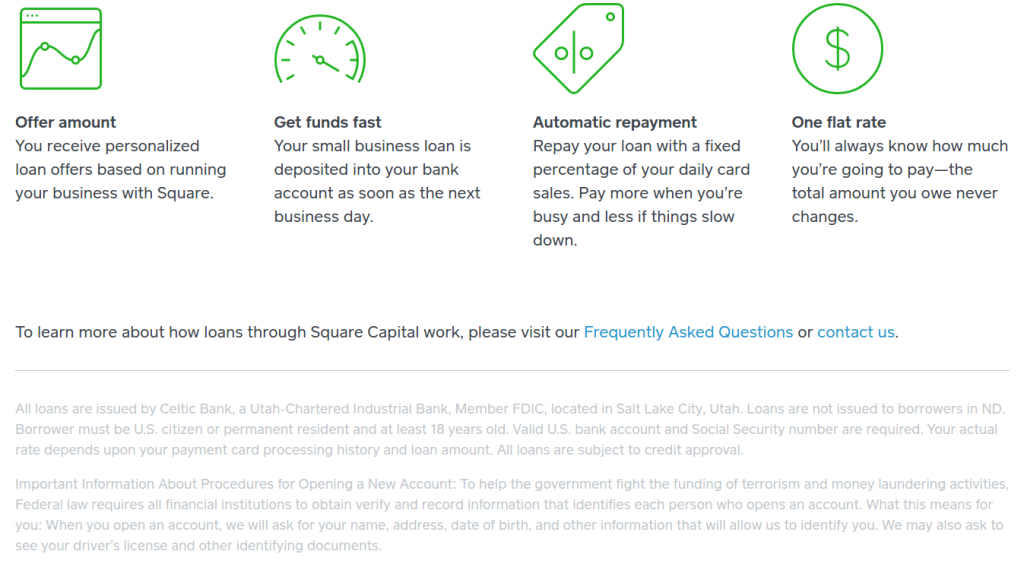
Square’s loans require that merchants process at least $10,000 or more a year. Borrowers must pay at least 1/18th of their initial loan balance every 60 days. PayPal by comparison requires that their borrowers pay down 10% of their loan amount every 90 days.
A Square merchant was not able to locate any mention of the merchant cash advance program. It’s all loans now.
Did Square really just add business loans to their arsenal or have they traded MCAs for the bank charter lending model?
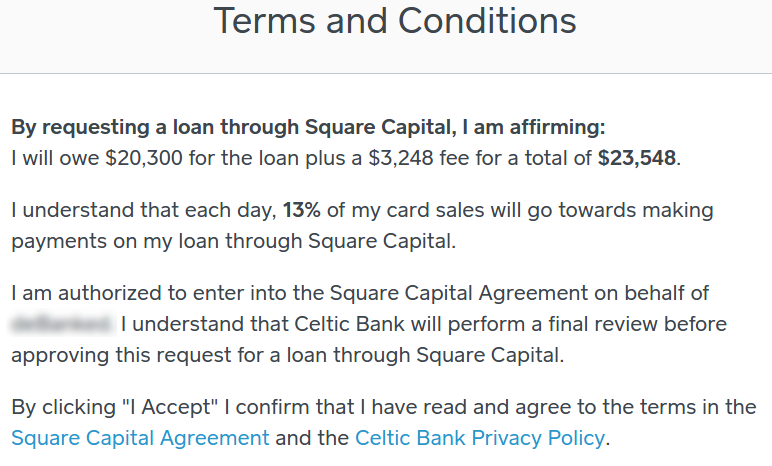
Update: 3/25 2:54 PM Square confirmed that they have indeed replaced their merchant cash advance program with the loan program.
Our Square Capital program is transitioning from merchant cash advances to flexible loans. https://t.co/oUyRtNgVSS pic.twitter.com/ELXC7ayJyU
— Square (@Square) March 25, 2016
Square Buys Analytics Startup for Its Merchant Cash Advance Team
March 14, 2016Square has acquired analytics startup Framed Data to better target customers for Square Capital.
The startup mined data using machine learning to predict user behavior and purchasing decisions. Founded by data scientists in 2013, Framed Data will help Square use analytics to provide more capital to more merchants.
Square Capital is a big business for the company. It funded over $400 million in 70,000 merchant cash advances last year. The company’s first earnings report last week showed that it is beginning to bring bigger merchants into its customer base. The majority of Square’s point of sale customers are micromerchants, a fragmented market of low volume businesses.
It’s a crucial time for the company to prove to investors that it can grow beyond point of sale solutions for payments and Square Capital will play a major role in that.