
SecurCapital Acquires Breakout Capital Finance’s Lending Business
July 17, 2019Supply chain and logistics company acquires the lending business of leading fintech small business lender and injects new equity capital
MCLEAN, VA — SecurCapital Corp, an expanding supply chain and financial services provider headquartered in California, today announced the acquisition of the lending business of Breakout Capital Finance, a leading fintech company and nationwide small business lender. SecurCapital is also providing additional equity capital to drive growth in Breakout Capital Finance’s two primary lending products: its highly regarded and innovative term loan product and its FactorAdvantage ® lending solution for small businesses that utilize factoring to finance their business. The acquired lending business assets will be operated by a subsidiary of SecurCapital that will conduct business as Breakout Capital.
Steve Russell, CEO of SecurCapital commented, “We’re delighted to have found a highly respected team and innovative business model in the small business finance space. I share the founder’s vision of the massive potential of the FactorAdvantage lending solution and believe we now have the platform and capital to rapidly grow this industry-changing product. We couldn’t have found a better business to complement SecurCapital’s strategic vision for empowering small businesses.” SecurCapital, through a series of strategic acquisitions, provides supply chain and financial services to small businesses primarily in the logistics industry, including veteran-and minority owned businesses.
Breakout Capital Finance’s Founder, Carl Fairbank added, “After four years as Founder and CEO of Breakout Capital Finance, this transaction begins the next chapter of Breakout Capital’s lending business. SecurCapital is also committed to the proliferation of best practices to drive change in the broader market. I believe Breakout Capital, in partnership with SecurCapital, is now well positioned for substantial growth, especially with its commitment to FactorAdvantage.” Mr. Fairbank will provide strategic guidance during the transition, but has stepped down as CEO of the lending business to focus on driving innovation in advanced technology, including artificial intelligence, machine learning, and blockchain.
Tim Buzby has been appointed as the new CEO of Breakout Capital. He spent 17 years at Farmer Mac, in executive positions culminating as CEO. Notably, he oversaw a 58% increase in company earnings and an almost 4x increase in stock price and strategically matured the company into an agricultural lending industry leader.
Breakout Capital has also hired McLean Wilson, former CEO of Charleston Capital, an asset manager in the SME space, and former CEO of inFactor, a factoring company, as Chief Credit Officer. Mr. Russell added, “With the appointment of Tim as CEO and the addition of McLean to the management team, we expect Breakout Capital not only to carry forward its role in the industry as product innovator and transparent lender but also to deliver financing solutions to a much broader range of small businesses.” Breakout Capital is committed to maintain the high ethical standards, best practices, APR-based disclosure, and competitive pricing for which it has always been known.
About Breakout Capital
Breakout Capital, headquartered in McLean, Virginia, has been and will continue to be a leading fintech company, offering innovative small business lending solutions across the country. As part of SecurCapital, Breakout Capital will remain committed to transparent and responsible lending solutions through product innovation, small business borrowing education, and advocacy against predatory lending practices and will continue to empower small business through right-sized lending, suitability testing, improving terms and supporting the long-term financing objectives of small businesses. Breakout Capital has been widely regarded as the “white-hat” lender in the alternative finance space and intends to retain that reputation as part of SecurCapital.
FOR ADDITIONAL INFORMATION:
Breakout Capital www.breakoutfinance.com
CONTACT:
Public Relations and Media Contact:
Phone: 703.852.6142
Email: info@breakoutfinance.com

About SecurCapital
SecurCapital is headquartered in greater Los Angeles, California with locations in San Diego, Atlanta, Baltimore and Washington, DC. SecurCapital provides supply chain financial services and proven advisory services to logistics businesses from a seasoned team of logistics and financing professionals. SecurCapital offers mid-tier and startup companies access to working capital, M&A consulting, technology enablement and mission critical services for all their supply chain needs. SecurCapital offers forwarders, truckers, custom brokers, 3PL, wholesalers, 4PL, suppliers, veteran owned small businesses (VOSB), minority owned enterprises and government contractors’ on-line access to a broad range of services.
Forward-Looking Statements Disclaimer: This press release contains forward-looking statements within the meaning of Section 27A of the Securities Act of 1933, as amended, and Section 21E of the Securities Exchange Act of 1934, as amended. In some cases, you can identify forward-looking statements by the following words: “anticipate,” “believe,” “continue,” “could,” “estimate,” “expect,” “intend,” “may,” “ongoing,” “plan,” “potential,” “predict,” “project,” “should,” “will,” “would,” or the negative of these terms or other comparable terminology, although not all forward-looking statements contain these words. Forward-looking statements are not a guarantee of future performance or results and will not necessarily be accurate indications of the times at, or by, which such performance or results will be achieved. Forward-looking statements are based on information available at the time the statements are made and involve known and unknown risks, uncertainty and other factors that may cause our results, levels of activity, performance or achievements to be materially different from the information expressed or implied by the forward-looking statements in this press release.
FOR ADDITIONAL INFORMATION:
SecurCapital Corp www.securcapital.com
CONTACT:
Public Relations and Media Contact:
Phone: 619-384-3359
Email: info@securcapital.com

Breakout Capital is BACK
July 17, 2019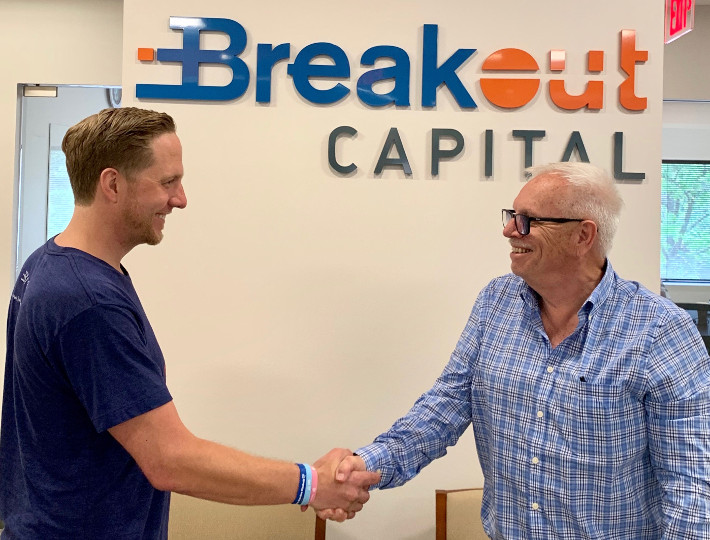
SecurCapital Corp has acquired the lending business of Breakout Capital Finance.
Breakout was founded in 2015 by Carl Fairbank, a former investment banker, and quickly made a splash in the burgeoning small business lending industry. The company has raised significant capital and is a principal member of Innovative Lending Platform Association (ILPA), a trade group that among other things, created SMART Box, a uniform loan disclosure meant to enhance transparency across the industry.
Earlier this year, however, the company suspended originations.
But that’s poised to change. The deal with SecurCapital, a supply chain and financial service provider headquartered in California, means that Breakout is on track to resume originations as early as next week, according to the company. And there’s other changes afoot.
Tim Buzby, who previously served as the company’s CFO is now the President & CEO. Buzby is well primed for the job. He’s a former CEO of Farmer Mac, a company he spent 17 years with.
Carl Fairbank, who previously served as CEO of the lending business, will provide strategic guidance during the transition, the company reports. He will no longer have a day-to-day role.
“After four years as Founder and CEO of Breakout Capital Finance, this transaction begins the next chapter of Breakout Capital’s lending business,” Fairbank is quoted as saying in a company announcement. “SecurCapital is also committed to the proliferation of best practices to drive change in the broader market. I believe Breakout Capital, in partnership with SecurCapital, is now well positioned for substantial growth, especially with its commitment to FactorAdvantage.”
Fairbank is reportedly shifting his focus toward driving innovation in artificial intelligence, machine learning, and blockchain.
Breakout Capital has also hired McLean Wilson, former CEO of Charleston Capital (fka Drift Capital Partners), an asset manager in the SME space, and former CEO of inFactor, a factoring company, as Chief Credit Officer.
In an interview with Breakout’s new CEO Tim Buzby and VP Jay Bhatt (who has been with the company since the very beginning), they said that the company’s risk criteria and credit box will remain the same as it was previously, with potential to even expand it down the road. The company pressing the originations pause button from approximately February to July, therefore, shouldn’t be interpreted as a weakness of the company’s business model. Rather the acquisition and changes should suggest the opposite.
Steve Russell, CEO of SecurCapital, commented, “We’re delighted to have found a highly respected team and innovative business model in the small business finance space. I share the founder’s vision of the massive potential of the FactorAdvantage lending solution and believe we now have the platform and capital to rapidly grow this industry-changing product. We couldn’t have found a better business to complement SecurCapital’s strategic vision for empowering small businesses.”
Two SecurCapital executives have also been placed on Breakout’s board of directors.
Buzby confirmed that operations will resume as normal. The business address and business name will remain the same with one notable difference; That being that the name has been shortened from Breakout Capital Finance to Breakout Capital. It’s also now being operated by a subsidiary of SecurCapital.
Prospa, An Online Business Lender, Goes Public In Australia
June 10, 2019 Another online small business lender has gone public. This time it’s Australia-based Prospa, a company founded in Sydney in 2012. Prospa offers daily and weekly payment business loans with terms from 3-24 months and competes with companies like OnDeck and Capify.
Earlier this year Prospa surpassed $1 billion in loans funded to 19,000 small businesses. In a 2015 interview with AltFinanceDaily, cofounder Beau Bertoli said, “The market in Australia has been very ripe for alternative finance. We see an opportunity for the alternative finance segment to be more dominant in Australia than it is in America.”
Prospa was slated to go public on the Australian Securities Exchange last June but it was cancelled in dramatic fashion 15 minutes before being listed as rumors swirled that the Australian Securities and Investments Commission (ASIC) had questions about their business practices. By September, Prospa agreed to revise its loan disclosures to be more fair. Those revisions were published by ASIC.
Prospa’s IPO raised AUS $110 million and was valued at AUS $610 million. The share price jumped nearly 20% in early trading on Tuesday.
BFS Capital Joins ILPA
May 23, 2019
The Innovation Lending Platform Association (ILPA), a group of online small business financing and service companies, announced today the addition of BFS Capital. ILPA is known for creating the Straightforward Metrics Around Rate and Total Cost (SMART) Box.
“We believe that transparency matters,” Ruddock told AltFinanceDaily.
“BFS Capital is committed to being both a responsible and an innovative lender,” Ruddock said. “Our membership in the ILPA allows us to work with industry leaders who are dedicated to advancing standards and best practices in the critical small business lending marketplace… [and] we believe that clarity and transparency is critical in helping [small businesses] make educated and informed financial decisions.”
As a new member of ILPA, BFS will join current members including OnDeck, Kabbage, BlueVine and 6th Avenue Capital.
“We applaud Mulligan Funding and BFS Capital for committing to adopt fair and transparent disclosure best practices to ensure small businesses are well informed when seeking funding,” said ILPA CEO Scott Stewart. (ILPA announced that Mulligan Funding has joined the association as well).
BFS is also a member of the Small Business Finance Association (SBFA) and Ruddock told AltFinanceDaily that BFS will remain a member of that trade association as well.
Separately, BFS announced today that it has named Fred Kauber as the company’s new Chief Technology Officer and Chief Product Officer. Kauber was previously with fintech marketplace platform CAIS Group and he served in senior roles at First Data, Dun & Bradstreet and IBM.
“I’m confident that Fred is the right person to advance both our vision and our capabilities [at BFS,]” Ruddock said.
Canada’s Alternative Financing Market Is Taking Off
May 20, 2019

Canadians have been slow out of the gate when it comes to mass adoption of alternative financing, but times are changing, presenting opportunities and challenges for those who focus on this growing market.
Historically, the Canadian credit market has traditionally been dominated by a few main banks; consumers or businesses that weren’t approved for funding through them didn’t have a multitude of options. The door, however, is starting to unlock, as awareness increases about financing alternatives and speed and convenience become more important, especially to younger Canadians.
Indeed, the Canada alternative finance market experienced considerable growth in 2017—the latest period for which data is available. Market volume reached $867.6 million, up 159 percent from $334.5 million in 2016, according to a report by the Cambridge Centre for Alternative Finance and the Ivey Business School at Western University. Balance sheet business lending makes up the largest proportion of Canadian alternative finance, accounting for 57 percent of the market; overall, this model grew 378 percent to $494 million in 2017, according to the report.
Industry participants say the growth trajectory in Canada is continuing. It’s being driven by a number of factors, including tightening credit standards by banks, growing market demand for quick and easy funding and broader awareness of alternative financing products.
 To meet this growing demand, new alternative financing companies are coming to the market all the time, says Vlad Sherbatov, president and co-founder of Smarter Loans, which works with about three dozen of Canada’s top financing companies. He predicts that over time more players will enter the market—from within Canada and also from the U.S.—and that product types will continue to grow as demand and understanding of the benefits of alternative finance become more well-known. Notably, 42 percent of firms that reported volumes in Canada were primarily headquartered in the U.S., according to the Cambridge report.
To be sure, the Canadian market is much smaller than the U.S. and alternative finance isn’t ever expected to overtake it in size or scope. That’s because while the country is huge from a geographic standpoint, it’s not as densely populated as the U.S., and businesses are clustered primarily in a few key regions.
To put things in perspective, Canada has an estimated population of around 37 million compared with the U.S.’s roughly 327 million. On the business front, Canada is similar to California in terms of the size and scope of its small business market, estimates Paul Pitcher, managing partner at SharpShooter, a Toronto-based funder, who also operates First Down Funding in Annapolis, Md.
Nonetheless, alternative lenders and funders in Canada are becoming more of a force to be reckoned with by a number of measures. Indeed, a majority of Canadians now look to online lenders as a viable alternative to traditional financial institutions, according to the 2018 State of Alternative Lending in Canada, a study conducted by online comparison service Smarter Loans.
Of the 1,160 Canadians surveyed about the loan products they have recently received, only 29 percent sought funding from a traditional financial institution, such as a bank, the study found. At the same time, interest in alternative loans has been on an upward trajectory since 2013. Twenty-four percent of respondents indicated they sought their first loan with an alternative lender in 2018. Overall, nearly 54 percent of respondents submitted their first application with a non-traditional lender within the past three years, according to the report.
Like in the U.S., there’s a mix of alternative financing companies in Canada. A number of companies offer factoring and invoicing and payday loans. But there’s a growing number focused on consumer and business lending as well as merchant cash advance.

Some major players in the Canadian alternative lending or funding landscape include Fairstone Financial (formerly CitiFinancial Canada), an established non-bank lender that recently began offering online personal loans in select provinces; Lendified, an online small business lender; Thinking Capital, an online small business lender and funder; easyfinancial, the business arm of alternative financial company goeasy Ltd. that focuses on lending to non-prime consumers; OnDeck, which offers small business financing loans and lines of credit; and Progressa, which provides consolidation loans to consumers.
By comparison, the merchant cash advance space has fewer players; it is primarily dominated by Thinking Capital and less than a dozen smaller companies, although momentum in the space is increasing, industry participants say.
“The U.S. got there 10 years ago, we’re still catching up,” says Avi Bernstein, chief executive and co-founder of 2M7 Financial Solutions, a Toronto-based merchant cash advance company.
OPPORTUNITIES ABOUND
In terms of opportunities, Canada has a population that is very used to dealing with major banks and who are actively looking for alternative solutions that are faster and more convenient, says Sherbatov of Smarter Loans. This is especially true for the younger population, which is more tech-savvy and prefers to deal with finances on the go, he says.
Because the alternative financing landscape is not as developed in Canada, new and innovative products can really make a significant impact and capture market share. “We think this is one of the key reasons why there’s been such an influx of international companies, from the U.S. and U.K. for example, that are looking to enter the Canadian market,” he says.
Just recently, for example, Funding Circle announced it would establish operations in Canada during the second half of 2019. “Canada’s stable, growing economy coupled with good access to credit data and progressive regulatory environment made it the obvious choice,” said Tom Eilon, managing director of Funding Circle Canada, in a March press release announcing the expansion. “The most important factor [in coming to Canada] though was the clear need for additional funding options among Canadian SMEs,” he said.
OnDeck, meanwhile, recently solidified its existing business in Canada through the purchase of Evolocity Financial Group, a Montreal-based small business funder. The combined firm represents a significantly expanded Canadian footprint for both companies. OnDeck began doing business in Canada in 2014 and has originated more than CAD$200 million in online small business loans there since entering the market. For its part, Evolocity has provided over CAD$240 million of financing to Canadian small businesses since 2010.
“There is an enormous need among underserved Canadian small businesses to access capital quickly and easily online, supported by trusted and knowledgeable customer service experts,” Noah Breslow, OnDeck’s chairman and chief executive, said in a December 2018 press release announcing the firms’ nuptials.
There are also a number of home grown Canadian companies that are benefiting from the growth in the alternative financing market.
2M7 Financial Solutions, which focuses on merchant cash advances, is one of these companies. It was founded in 2008 to meet the growing credit needs within the small and medium-sized business market at a time when businesses were having trouble in this regard.
But only in the past few years has MCA in Canada really started picking up to the point where Bernstein, the chief executive, says the company now receives applications from about 200 to 300 companies a month, which represents more than 50 percent growth from last year.
“We’re seeing more quality businesses, more quality merchants applying and the average funding size has gone up as well,” he says.
NAVIGATING THROUGH CHALLENGES
Despite heightened growth possibilities, there are also significant headwinds facing companies that are seeking to crack the Canadian alternative financing market. For various reasons, some companies have even chosen to pull back or out of Canada and focus their efforts elsewhere. Avant, for example, which offers personal loans in the U.S., is no longer accepting new loan applications in Canada at this time, according to its website. Capify also recently exited the Canadian business it entered in 2007, even as it continues to bulk up in the U.K. and Australia.
One of the challenges alternative lenders face in Canada is distrust of change. Since Canadians are so used to dealing with only a few major financial institutions to handle all their finances, they are skeptical to change this behavior, especially when the customer experience shifts from physical branches to online apps and mobile devices, says Sherbatov of Smarter Loans. He notes that adoption of fintech products in Canada has lagged in recent years, partially because there has been a lack of awareness and trust in new financial products available.
One way Smarter Loans has been working to strengthen this trust is by launching a “Smarter Loans Quality Badge,” which acts as a certification for alternative financing companies on its platform. It is issued to select companies that meet specified quality standards, including transparency in fees, responsible lending practices, customer support and more, he says.
 The Canadian Lenders Association, whose members include lenders and merchant cash advance companies, has also been working to promote the growing industry and foster safe and ethical lending practices. For example, it recently began rolling out the SMART Box pricing disclosure model and comparison tool that was introduced to small businesses in the U.S. in 2016.
Another challenge that impacts alternative lenders in the consumer space is having restricted access to alternative data sources. Because of especially strict consumer privacy laws, access is “substantially more limited” than it is in any other geography,” says Jason Mullins, president and chief executive of goeasy, a lending company based in Mississauga, Ontario, that provides consumer leasing, unsecured and secured personal loans and merchant point-of-sale financing.
From a lending perspective, goeasy focuses on the non-prime consumer—generally those with credit scores of under 700. Mullins says the market consists of roughly 7 million Canadians, about a quarter of the population of Canadians with credit scores. The non-prime consumer market is huge and has tremendous potential, he says, but it’s not for the faint of heart.
Another issue facing alternative lenders is the relative difficulty of raising loan capital from institutional lenders, says Ali Pourdad, co-founder and chief executive of Progressa, which recently reached the $100 million milestone in funded loans for underserved Canadian consumers. “The onus is on the alternative lenders to ensure they have good lending practices and are underwriting responsibly,” he says.
What’s more, household debt to income ratios in Canada are getting progressively worse, with Canadians taking on too much debt relative to what they can afford, Pourdad says. As the situation has been deteriorating over time, there is inherently more risk to originators as well as the capital that backs them. “Originators, now more than ever, have to be cautious about their lending practices and ensure their underwriting is sound and that they are being responsible,” he says.
On the small business side of alternative lending, getting the message out to would-be customers can be a challenge in Canada. In U.S. there are thousands of ISOs reaching out to businesses, whereas in Canada, most funders have a direct sales force, with a much smaller portion of their revenue coming from referral partners, says Adam Benaroch, president of CanaCap, a small business funder based in Montreal.
He predicts this will change over time as the business matures and more funders enter the space, giving ISOs the ability to offer a broader array of financing products at competitive rates. “I think we’re going to see pricing go down and more opportunities develop, and as this happens, the business is going to grow, which is exactly what has happened in the U.S,” he says.
Generally speaking, Canadian businesses are still somewhat skeptical of merchant cash advance and require considerable hand-holding to become comfortable with the idea.
“You can’t wait for them to come to you, you have to go to them and explain what the products are,” says Pitcher of SharpShooter, the MCA funding company.
While Pitcher predicts more companies will continue to enter the Canadian alternative financing market, he doesn’t think it will be completely overrun by new entrants—the market simply isn’t big enough, he says. “It’s not for everyone,” he says.
New Jersey Bill Seeks to Eliminate Quick Easy Access to Small Business Loans
March 21, 2019 The speed at which a small business owner can access capital to grow and create jobs in New Jersey is too dangerous and must be stopped. This is the takeaway from a bill (S3617) proposed by New Jersey State Senator Nellie Pou that calls for a minimum 3-day waiting period between when contract terms are disclosed to an applicant and when they can actually go through with getting a business loan or merchant cash advance. If the transaction does not fund within 10 days of the terms being disclosed, it implies that the waiting process must start over if the applicant wishes to still go forward.
The motivation behind the bill is to presumably force small business owners to think about the terms for awhile. It would apply where the payment frequency is greater than bi-weekly or the maturity is less than two years. There’s other little caveats too. If it passed, funding small businesses same-day or next-day would effectively become illegal.
In addition, the bill calls for detailed contract disclosures, proof that the funds will be used to economically benefit the small business applicant, lenders to set up their own complaint departments, licensing, bonding requirements for brokers & lenders, a minimum net worth for a broker of $100,000, background checks, written examinations, and ethics classes as part of continuing required education.
Pou’s bill, which at this point has not had the opportunity to get traction yet, is separate from another bill, S2262, which in addition to disclosures, calls for merchant cash advances to be defined as loans in the state. S2262 passed the Senate in February and is now under consideration in the Assembly.
Get The Affidavit or Waive It? Examining Confessions of Judgment
February 1, 2019 Caton Hanson, the chief legal officer and co-founder of the online credit-reporting and business-to-business matchmaker Nav, says that his Salt Lake City-based company would not associate with a small-business financier that included “confessions of judgment” in its credit contracts.
“If we understood that any of our merchant cash advance partners were using confessions of judgment as a means to enforce contracts,” Hanson told AltFinanceDaily, “we would view that as abusive and distance ourselves from those partners. As a venture-backed company,” Hanson adds, “we have some significant investors, including Goldman Sachs, and I’m sure they would support us.”
Steve Denis, executive director of the Small Business Finance Association, which represents companies in the merchant cash advance (MCA) industry, says that, as an organization, “We’ve taken a strong stance against confessions of judgment.”
He reports that his Washington, D.C.-based trade group is prepared to work with legislators and policy-makers of any political party, regulators, business groups and the news media “to ban that type of practice.
“We’re fighting against the image that we’re payday lenders for business,” Denis says of the merchant cash advance industry. “We’re trying to figure out internally what we can do to stop that from happening and we have been speaking to members of Congress and their staff.”
“Confessions of judgment,” says Cornelius Hurley, a law professor at Boston University and executive director of the Online Lending Policy Institute, “are to the merchant cash advance industry what mandatory arbitration is to banks. Neither enforcement device reflects well on the firms that use them.”
These are just some of the reactions from members of the alternative lending and financial technology community to a blistering series of articles published by Bloomberg News on the use—and alleged misuse—of confessions of judgment (COJs) by merchant cash advance companies. The series charges the MCA industry with gulling unwary small businesses by not only charging high interest rates for quick cash but of using confession-laden contracts to seize their assets without due process.
The Bloomberg articles also reported that it doesn’t matter in which state the small business debtors reside. By bringing legal action in New York State courts, MCA companies have been able to use enforcement powers granted by the confessions to collect an estimated $1.5 billion from some 25,000 businesses since 2012.
“I don’t think anyone can read that series of articles and honestly say what went on were good practices and in the best interest of small business,” says SBFA’s Denis, noting that none of the companies cited in the Bloomberg series belonged to his trade group. “It’s shocking to see some companies in our space doing things we’d classify as predatory,” he adds. “As an industry we’re becoming more sophisticated, but there are still some bad actors out there.”
 A confession of judgment is a hand-me-down to U.S. jurisprudence from old English law. The term’s quaint, almost religious phrasing evokes images of drafty buildings, bleak London fog, and dowdy barristers in powdered wigs and solemn black gowns. (And perhaps debtor prisons as well.)
Yet while the legal provision’s wings have been clipped—the Federal Trade Commission banned the use of confessions of judgment in consumer credit transactions in 1985 and many states prohibit their use outright or in such cases as residential real estate contracts—COJs remain alive and well in many U.S. jurisdictions for commercial credit transactions.
Even so, most states where COJs are in use, such as California and Pennsylvania, have adopted safeguards. Here’s how the San Francisco law firm Stimmel, Stimmel and Smith describes a COJ.
“A confession of judgment is a private admission by the defendant to liability for a debt without having a trial. It is essentially a contract—or a clause with such a provision—in which the defendant agrees to let the plaintiff enter a judgment against him or her. The courts have held that such a process constitutes the defendant’s waiving vital constitutional rights, such as the right to due process, thus (the courts) have imposed strict requirements in order to have the confession of judgment enforceable.”
In California, those “strict requirements” include not only that a written statement be “signed and verified by the defendant under oath,” but that it must be accompanied by an independent attorney’s “declaration.” If no independent attorney signs the declaration or—worse still—the plaintiff’s attorney signs the document, the confession is invalid.
But if the confession is “properly executed,” the plaintiff is entitled to use the full panoply of tools for collection of the judgment, including “writs of execution” and “attachment of wages and assets.”
 In Pennsylvania, confessions of judgment are nearly as commonplace as Philadelphia Eagles’ and Pittsburgh Steelers’ fans, particularly in commercial real estate transactions. Says attorney Michael G. Louis, a partner at Philadelphia-area law firm Macelree Harvey, “They may go back to old English law, but if you get a business loan or commercial lease in Pennsylvania, a confession of judgment will be in there. It’s illegal in Pennsylvania for a consumer loan or residential real estate. But unless it’s a national tenant with a ton of bargaining power—a big anchor store and the owner of the shopping center really wants them—95% of commercial leasing contracts have them.
“And any commercial bank in Pennsylvania worth its salt includes them in their commercial loan documents,” Louis adds.
Pennsylvania’s laws governing COJs contain a number of additional safeguards. For example, the confession of judgment is part of the note, guaranty or lease agreement—not a separate document—but must be written in capital letters and highlighted. One of the defenses that used to be raised against COJs, Louis says, was that a contractual document was written in fine print “but we haven’t seen fine print for years.”
Other reforms in Pennsylvania have come about, moreover, as a result of a 1994 case known as “Jordan v. Fox Rothschild.” Says Louis: “It used to be lot worse. You used to be able to file a confession of judgment and levy on a defendant’s bank account before he knew what happened. It was brutal. But after the Fox Rothschild case, they changed the law to prevent taking away a defendant’s right of notice and the opportunity to be heard.”
Because of that case, which takes its name from the Fox Rothschild law firm and involved a dispute between a Philadelphia landlord renting commercial space to Jordan, a tenant, the law governing COJs in Pennsylvania requires, among other things, a 30-day notice before a creditor or landlord can execute on the confession. During that period the defendant has the opportunity to stay the execution or re-open the case for trial.
 Defenses against the execution of a COJ can entail arguments that creditors failed to comply with the proper language or procedures in drafting the document. But the most successful argument, Louis says, is a “factual defense.” Louis cites the case of a retail clothing store renting space in a shopping center that has a leaky roof. In the 30-day notice period after the landlord invoked the confession of judgment, the tenant was able to demonstrate to the court that he had asked the landlord “ten times” to fix the roof before spending the rent money on roof repairs. In such a case, the courts will grant the defendant a new trial but, Louis says, the parties typically reach a settlement. “Banks generally will waive a jury trial,” he notes, “because they don’t want to take a chance of getting hammered by a jury.”
A number of states, including Florida and Massachusetts ban the use of confessions of judgment. That’s one big reason that Miami attorney Roger Slade, a partner at Haber Law, advises clients that “there’s no place like home.” In other words: commercial contracts should specify that any legal disputes will be adjudicated in Florida. “It’s like having home field advantage in the NFL playoffs,” Slade remarked to AltFinanceDaily. “You don’t want to play on someone else’s turf.”
He has also been warning Floridians for several years against the way that COJs were treated by New York courts. Writing in the blog, “The Florida Litigator,” Slade—a native New Yorker who is certified to practice law there as well as in Florida counseled in 2012: “If you live in New York, a creditor can have your client sign a confession of judgment and, in the event of a default on a loan, can march directly to the courthouse and have a final judgment entered by the clerk. That’s right—no complaint, no summons, no time to answer, no two-page motion to dismiss. The creditor gets to go right for the jugular.”
In addition, because of the “full faith and credit clause of the U.S. Constitution,” Slade notes in an interview, a contract that’s enforced by the New York courts must be honored in Florida. “Courts in Florida have no choice,” Slade says. “It’s a brutal system and it’s unfortunate.”
In December, two U.S. senators from opposing parties—Ohio Democrat Sherrod Brown and Florida Republican Marco Rubio—introduced bipartisan legislation to amend both the Federal Trade Commission Act and Truth in Lending Act to do away with COJs. Their legislative proposal reads:
“(N)o creditor may directly or indirectly take or receive from a borrower an obligation that constitutes or contains a congnovit or confession of judgment (for purposes other than executory process in the State of Louisiana), warrant of attorney, or other waiver of the right to notice and the opportunity to be heard in the event of suit or process theron.”
But with a dysfunctional and divided federal government, warring power factions in Washington, and an influential financial industry, there’s no telling how the legislation will fare. Meantime, the New York State attorney general’s office announced in December that it will investigate the use of COJs following the Bloomberg series. And New York Governor Andrew Cuomo has declared support for legislation that will, among other things, prohibit the use of confessions in judgment for small business credit contracts under $250,000 and restrict judgments by New York courts to in-state parties.
But if New York State or Congressional legislation are adopted it can have “unintended consequences” to merchant cash advance firms in the Empire State—and to their small business customers as well—asserts the general counsel for one MCA firm. “Losing the confession of judgment will be removing what little safety net there is in a risky industry,” the attorney says, noting that the industry has roughly a 15% default rate.
“It is not as powerful a tool as the Bloomberg news stories would have you believe,” this attorney, who spoke on the condition of anonymity, told AltFinanceDaily. “The suggestion seems to be that the MCAs can use the confession of judgment to get back the total amount of money due—and then some—while leaving a trail of dead bodies behind. But that’s not the case.
“What is much more likely to be the case,” he adds, “is that MCA companies try to get the defaulting merchant back on track. And—probably more than we should and only after we’ve tried to reach out to them and failed—do we then reluctantly use the COJ as a last resort. At which point we hope we can recover some part of our exposure. The numbers vary, but the losses are always in the thousands of dollars. These are not micro-transactions.
“What’s going to happen,” he concludes, “is that It will not make sense for us to work with those merchants most in need of working capital. The unfortunate reality is that businesses who don’t have collateral and can’t get a Small Business Administration product will be left out in the cold.”
All of which prompts BU professor Hurley to argue that the “Swiss cheese” system of financial regulation among the 50 states continues to be a root cause of regulatory confusion. Echoing Miami attorney Slade’s concern about New York courts’ dictating to Florida citizens, Hurley likens the situation governing COJs with the disorderly array of state laws governing usury regulations.
In the 1978 “Marquette” decision, the U.S. Supreme Court ruled that a Nebraska bank, First of Omaha, could issue credit cards in Minnesota and charge interest rates that exceeded the usury rate ceiling in the Gopher State. Since then, usury rates enacted by state legislatures have become virtually unenforceable.
“The problem we’re seeing with confessions of judgment is a subset of the usury situation,” Hurley says. “One state’s disharmony becomes a cancer on the whole system. It’s a throwback to Colonial times with 50 states each having their own jurisdictions—and it doesn’t work.”
 Hurley’s Online Lending Policy Institute has joined with the Electronic Transactions Association and recruited a phalanx of “academics, non-banks, law firms and other trade associations as members or affiliates” to form the Fintech Harmonization Task Force. It is monitoring the efforts by the 50 states to align their regulatory oversight of the booming financial technology industry which was recently recommended by a U.S. Treasury report.
Tom Ajamie, who practices law in New York and Houston and has won multimillion-dollar, blockbuster judgments against “dozens of financial institutions” including Wall Street investment firms, also argues for greater regulatory oversight. He urges greater funding and expansion of the powers of the Consumer Financial Protection Bureau to rein in “the anticipatory use” of confessions of judgment in commercial transactions.
However, notes Catherine Brennan, a partner at Hudson Cook in Baltimore, the job of protecting small businesses is outside the agency’s mandate. “The CFPB doesn’t have authority over commercial products as a general rule,” she explained in an interview. “Consumers are viewed as a vulnerable population in need of protections since the 1960’s.” As a society “we want protection for households because the consequences are high. A family could become homeless if they lose a house. Or (they) could lose employment if they lose a car and can’t drive. And there is also unequal bargaining power between lenders and consumers.
“Large institutions have lawyers to draft contracts and consumers have to agree on a take it or leave it basis. So there’s not a lot of negotiation and government has decided that consumers need protections, including a (Federal Trade Commission) ban on confessions of judgment.”
But Christopher Odinet, a law professor at the University of Oklahoma and a member of Hurley’s harmonization task force, sees the efforts of the federal government and the states to grapple with confessions of judgment as further recognition that small businesses have more in common with consumers than with big business. The COJ controversy follows on the recent passage of a commercial truth-in-lending bill by the State of California which, for the first time, stipulated that consumer-style disclosures should be included in business loans and financings under $500,000 made by non-bank financial organizations.
He cites the close-to-home example of an accomplished professional who got in over his head in financial dealings. “I recently observed a situation where a family member who is a very successful and affluent medical professional was relying on his own untrained business skills,” Odinet says. “He was about to enter into a sophisticated and complex business partnership relying on his intuition and general sense of confidence in the other party.”
Odinet says that he recommended that his relative hire a lawyer. Which, Odinet says, he did.
Former Merchant Cash Advance CFO Charged With Fraud by New York Attorney General
January 4, 2019 A former merchant cash advance CFO and executive for a fund that provides capital to merchant cash advance companies, has been charged with fraud by the New York Attorney General. The allegations against Stephen Brown stem from his role as CFO of Cardis Enterprises International, a company that claimed to possess patented and proprietary technology to make low-value credit card transactions less expensive for merchants. Brown is the former CFO for Capital Stack, LLC/eProdigy Financial in New York. In reality, Cardis was a massive fraud and a ponzi scheme, the Attorney General alleges. The company raised tens of millions of dollars from duped investors.
Brown is one of twelve defendants, but is described as the most senior financial executive of the firm whose principal role was to draft and send investor update letters, which contained a host of false statements and omissions.
Among the allegations against Brown is that he lied to investors about being close to finalizing deals with Sony, Warner, and Universal. “At the time of Defendant Brown’s representation, only one introductory meeting between Cardis and each music company had taken place, and the parties had not even executed non-disclosure agreements,” the complaint says. Several other business deals Brown announced were either imaginary, had never made it past a simple introduction, or had already been outright rejected by the prospective partner.
Despite being the CFO, Brown did not even maintain a basic income statement, a formal share registry, or comprehensive records of its debts and obligations. When the scheme was suspected by investors, Brown doubled down on the lies, the complaint says.
On September 24, 2015, a Cardis investor emailed Defendant Brown asking for the “latest on Cardis” and whether it was “a complete loss,” while mentioning a recent investor lawsuit. Defendant Brown, copying Defendant Rosenblatt, responded that the lawsuit claiming fraud was “frivolous,” while claiming that Cardis’ relationship with Roc Nation was “developing” and ongoing. In fact, the lawsuit had merit, and Cardis’ relationship with Roc Nation was long over.
On February 28, 2018, a Cardis investor recorded a telephone conversation with Defendant Brown. The investor asked “what happened to the cash” investors put into Cardis. Defendant Brown responded by detailing the Company’s large budget and staff, while failing to disclose the substantial misuse of investor funds. The investor also questioned Defendant Brown about various investor lawsuits against Cardis and its principals. The investor asked: “After reading those lawsuits, why should we think that the company has any future?” In response, Defendant Brown told the investor “the lawsuits were not the most credible lawsuits,” attributing them to “angry investors.” Defendant Brown later told the investor “none of those lawsuits have any merit to them.” In fact, there was substantial merit to the investor lawsuits.
These misrepresentations and omissions were material to investors because they bore directly on Cardis’ viability.
The New York Post ran a story that labeled Cardis a Bernie Madoff-style scheme that falsely claimed ties to Jay-Z’s entertainment company.
The defendants stand accused of Material Misrepresentations, Repeated and Persistent Fraud and Illegality, Actual Fraud, Equitable Fraud, and Constructive Fraud. The Attorney General is pursuing restitution for victims, a ban from the securities industry in the State of New York, and to liquidate the company.
The docket # is 452353/2018 in the New York Supreme Court. The allegations have not yet been proven. According to LinkedIn, Brown currently lists himself as the President of GMA USA, LLC, President of CoreFund Capital LLC, and the CFO of Nanovibronix. He also lists being the CFO of eProdigy Financial for almost 3 years until early 2017.